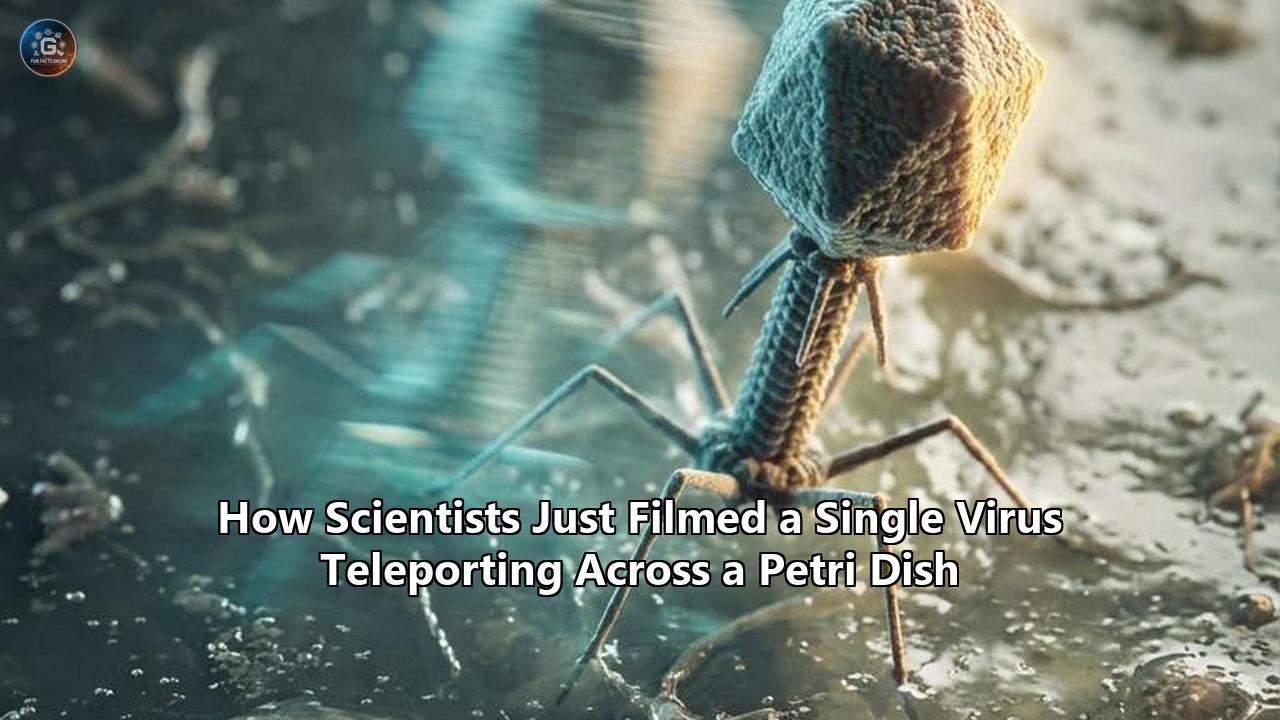
Just weeks ago, researchers gathered in a microscopy lab to watch raw footage that looked like a glitch in the physical world. Displayed on a high-definition monitor, a single viral particle darted across a biological landscape with such disjointed, blistering speed that it appeared to be teleporting. Instead of tracing a predictable, linear path toward a human host cell, the pathogen snapped out of existence in one microscopic coordinate and reappeared in another, violently bounding through the fluid of a petri dish before finally locking onto a cellular receptor.
This was not a computer simulation. It was the first three-dimensional, real-time recording of a single virus prowling the extracellular matrix and hijacking a human cell. Captured using a novel dual-microscope system, the footage shatters decades of static, textbook assumptions about the precise physical mechanics of infection. For years, scientists have understood the biological chemistry of a virus entering a cell, but observing the actual, mechanical journey has remained one of virology’s greatest technical hurdles.
By visualizing this microscopic "car chase," researchers have unlocked a completely new understanding of the transient, rapid-fire contacts a pathogen makes before it commits to an invasion. The implications stretch far beyond academic curiosity. Exposing exactly what happens in the milliseconds before a virus breaches a cell wall provides pharmaceutical developers with a mechanical blueprint for creating physical viral traps, engineering hyper-targeted vaccines, and intercepting the next pandemic before it takes root in the human body.
The Physics of the Microscopic 'Teleportation'
To understand what the researchers captured, it is necessary to strip away the science-fiction connotations of teleportation and look at the sheer physics of the extracellular environment. At the nanometer scale, fluids do not behave the way they do at the human scale. A petri dish filled with a liquid medium is a chaotic, violently active environment driven by thermal energy.
When observing the footage, the virus appears to teleport because it is being subjected to Brownian motion—the erratic, unpredictable bombardment by surrounding fluid molecules. Because a single virion is many thousands of times smaller than a grain of sand, it possesses virtually no mass to resist these microscopic collisions. The resulting movement is known in physics as a "random walk." Heat energy manifests as small, violent kinetic shifts in all three dimensions, propelling the virus in a jagged, stuttering trajectory.
Kevin Welsher, an associate professor of chemistry at Duke University who has spearheaded advanced viral tracking techniques, describes this motion as a series of highly transient interactions. The virus does not simply drift gracefully toward its target. It slams into the cell surface, bounces off, skips across the membrane, and makes dozens of micro-second contacts before finding the exact biological lock to fit its chemical key.
This hyper-kinetic activity is precisely why observing how viruses move has been functionally impossible until now. A virus travels exponentially faster in the open fluid outside a cell than it does once it breaches the cellular interior. Capturing that initial approach requires an imaging system capable of processing profound shifts in speed, scale, and depth simultaneously.
The Technological Chasm: The Skyscraper Problem
Historically, virologists have been forced to choose between seeing the virus clearly or seeing the environment clearly. They could not do both.
Electron microscopy, for example, offers stunning, near-atomic resolution. However, it requires freezing the biological sample in liquid nitrogen. As researchers at Penn State recently noted, studying a frozen virus is like studying a fish in an icy pond in the dead of winter; you can count its scales in perfect detail, but you learn absolutely nothing about how it swims.
Conversely, standard optical microscopes can observe live cells, but viruses fall below the diffraction limit of visible light. They are simply too small. Even with the advent of fluorescent tagging, where a virus is illuminated with specialized glowing dyes, traditional 3D microscopy relies on taking rapid, flat, 2D slices of a sample and digitally stacking them into a volume. By the time the camera physically adjusts its lens to capture the next optical slice, the fast-moving virus has already bounded out of the frame.
Courtney Johnson, a chemist involved in these cutting-edge tracking projects, perfectly summarized the spatial dilemma. Attempting to film a virus against the backdrop of a human intestinal cell is like trying to take a photograph of a single person standing on the sidewalk in front of a towering skyscraper. If you zoom in tight enough to see the person's facial features, you lose the building entirely. If you pull back to capture the entire skyscraper, the person vanishes into a single, unidentifiable pixel.
3D-TrIm: Two Microscopes in One
The solution that finally caught the teleporting virus is a custom-engineered system known as 3D Tracking and Imaging Microscopy (3D-TrIm). Rather than forcing a single lens to do two opposing jobs, 3D-TrIm essentially combines two distinct microscopes into one synchronized machine.
The first microscope acts like a military radar lock. Utilizing specialized fluorescent labels that illuminate the viral particle, this tracking module locks onto the fast-moving target and plots its exact three-dimensional coordinates 1,000 times per second. It adjusts its focus dynamically, moving with the erratic, random walk of the pathogen. It functions similarly to a news helicopter locked onto a high-speed vehicle pursuit, remaining fixed on the subject regardless of where it darts.
Simultaneously, the second microscope takes care of the skyscraper. While the first module follows the virus, the second continuously scans the surrounding cellular environment, capturing real-time 3D topographical images of the cell membranes, the microscopic ridges, and the tissue walls.
When the data streams from these two microscopes are merged, the result is a seamless, real-time video of the virus—rendered as a fast-moving, squiggly purple trajectory—navigating the vast cellular landscape. For the first time, scientists are watching the actual physical journey of a pathogen in its native, liquid state.
The Anatomy of the Final Hijacking
The footage does more than just prove the efficacy of 3D-TrIm; it provides a mechanical timeline of an infection event. Once the virus completes its chaotic, teleportation-like journey across the fluid and makes contact with the cell, its behavior changes drastically.
Recent high-resolution studies, such as the cryo-electron microscopy work led by Susan Hafenstein at Penn State, have shed light on the exact physical mechanics of this binding process. When studying pathogens like the canine parvovirus and its interaction with the transferrin receptor (TfR)—a cellular gateway that manages iron uptake—researchers discovered that the interaction is highly dynamic.
The virus does not just click into place like a puzzle piece. It engages in what researchers describe as a "rock-and-roll" motion. Because the initial binding is often imperfect, the virus sways and rolls along the receptor, physically shifting its weight and adjusting its surface proteins to search for the optimal point of contact. This microscopic rocking is a critical vulnerability. If the virus cannot secure the proper angle, it fails to hijack the host's biological machinery.
This deep, structural analysis of the binding process explains how slight genetic mutations allow a virus to jump species. By understanding the mechanical physics of the receptor interaction, virologists mapped out how just two surface mutations allowed a virus to evolve and jump from cats to raccoons, and eventually to dogs, triggering widespread outbreaks.
Fluid Dynamics and the Behavior of Antibodies
The ability to film these interactions in real-time fluid environments is heavily altering pharmaceutical testing. Traditional static imaging requires up to 24 hours of meticulous sample preparation and data compilation just to see one frozen moment of a virus interacting with an antibody.
Using near-atomic detail liquid droplet imaging, scientists can now record 20-second live movies of human viruses floating in their natural state. In recent tests utilizing the adeno-associated virus (AAV)—a biological nanoparticle frequently engineered as a delivery vehicle for gene therapies and vaccines—researchers observed subtle, constant changes in the particle's physical surface. The virus actively alters its physical properties as it explores different chemical gradients in its environment.
This exact methodology is now being applied to antibodies generated by COVID-19 patients. By introducing SARS-CoV-2 particles into liquid droplets containing human serum, researchers can watch in real-time as antibodies physically swarm, block, and neutralize the virus. This direct observation acts as a rapid-assessment tool. Instead of waiting weeks for clinical trial data to show whether a new vaccine candidate is effective against an emerging variant, scientists can literally watch the battle unfold on a monitor.
Airborne Spread: The Macro Version of Viral Teleportation
The insights gained from tracking single viral particles in petri dishes directly translate to our understanding of human-to-human transmission. The erratic, fluid-driven mechanics of how viruses move at the microscopic level dictate how they behave when expelled from a human lung.
During the height of the coronavirus pandemic, public health officials relied heavily on the six-foot rule, assuming that heavy respiratory droplets would predictably fall to the ground. However, infrared camera analyses of exhaled human breath revealed a chaotic, airborne reality that mirrored the random walk seen in petri dishes.
Fitted with specific filters to detect the infrared signature of heated carbon dioxide, military-grade cameras captured how a breath plume acts as a turbulent transport mechanism for viral particles. Because viruses are incredibly light, they do not simply drop out of the air. They ride the thermal currents of exhalation, lingering in poorly ventilated indoor spaces for minutes to hours. The microscopic Brownian motion that makes a virus appear to teleport in fluid also allows it to remain suspended in airborne aerosols, dispersing far beyond initial safety estimates.
Visualizing these airflow mechanics proved that standard surgical and cloth masks act less as absolute barriers and more as physical disruptors. A properly fitted mask does not catch every single virus; rather, it breaks the velocity of the heated exhalation plume. By stripping the kinetic energy from the breath, the mask severely limits the distance the virus can travel, drastically reducing the concentration of the pathogen in the shared air supply.
The 2026 Pathogen Landscape: AI and Organ-on-a-Chip
The integration of 3D tracking microscopes with artificial intelligence is setting a new standard for biological defense in 2026. Global alliances, such as the Indo-EU COMBAT project focused on the escalating threat of Dengue, are utilizing these imaging pipelines to process massive datasets.
Dengue cases have exploded globally due to rising temperatures expanding the habitat of Aedes mosquitoes. To combat this, researchers are employing single-cell sequencing and advanced protein biomarker analysis, scanning thousands of biological signals to understand why the Dengue virus turns deadly in specific patients.
Crucially, this research is moving away from the traditional, flat petri dish. Virologists are increasingly utilizing organ-on-a-chip models—miniature, bioengineered devices that recreate the exact 3D microarchitecture, blood flow, and mechanical stress of living human organs.
When a virus is introduced into an organ-on-a-chip, it does not just float in stagnant liquid. It must navigate flowing synthetic blood, bypass engineered mucus layers, and negotiate complex cellular junctions. Tracking the pathogen through these highly realistic synthetic environments provides a precise read on how viruses move inside a human patient.
Artificial intelligence algorithms are fed the tracking data from these experiments. By analyzing thousands of hours of a virus’s random walk, the AI learns to predict the pathogen’s behavior. It calculates the exact kinetic energy required for the virus to breach a synthetic lung membrane or identifies the specific surface proteins a Dengue variant utilizes to evade an immune response. This computational biology is rapidly accelerating the design of single-dose recombinant vaccines, such as those currently undergoing Phase III trials across India.
The Economics of Pandemic Interception
The push to visualize and track viruses in real-time is not an isolated academic pursuit; it is a massively funded pillar of global economic security. The 2014 Ebola outbreak and the COVID-19 pandemic exposed a glaring vulnerability in the global supply chain: the sheer amount of time it takes to identify a pathogen, study its mechanics, synthesize a vaccine, and physically distribute it.
Agencies like the US military’s research arm, DARPA, have recognized that traditional timelines are economically and socially devastating. Through initiatives like the P3 Program, the goal has been set to halt any new pandemic threat within 60 days of the first reported case. Achieving this requires the ability to instantly decode the physical and genetic properties of a virus.
This demand for speed has given rise to the concept of biological teleporters, formally known as Digital-to-Biological Converters (DBCs). Developed by entities like Synthetic Genomics Inc., a DBC is a highly advanced, automated laboratory device that functions somewhat like a biological 3D printer.
If a novel virus breaks out in a remote village in Southeast Asia, researchers do not need to physically ship a vial of the live pathogen across the globe. Instead, they can sequence the virus’s DNA on-site and transmit the digital code via the internet to a DBC located in a pharmaceutical hub in San Diego or Geneva. The machine receives the digital sequence and automatically manufactures the physical DNA, RNA, and viral proteins from scratch, entirely without human intervention.
When combined with 3D-TrIm tracking technology, the response time is compressed dramatically. The DBC prints the virus, the 3D tracking microscope immediately films how it moves and binds to human cells, and the AI suggests a chemical countermeasure. What used to take months of painstaking laboratory prep can now be executed in days.
Designing Mechanical Defenses
Understanding the physical movement of viruses opens a completely new avenue of therapeutic design: mechanical defense. Historically, antiviral drugs and vaccines have focused entirely on chemical and biological neutralization. They train the immune system to recognize the virus or use chemicals to inhibit viral replication.
However, if scientists can clearly map the exact trajectory and kinetic energy of a viral particle, they can design physical traps. The human body already employs mechanical defenses—the mucosal layers in the respiratory and intestinal tracts are designed to slow down and trap foreign particles.
By analyzing the high-speed footage of a virus fighting through a cell’s exterior defenses, researchers are exploring how to artificially enhance these barriers. This includes engineering therapeutics that temporarily increase the viscosity of mucus in the respiratory tract during an outbreak, physically halting the virus’s random walk before it can ever reach a cell wall.
Other experimental models involve "dummy receptors." If a virus like canine parvovirus relies on a highly specific "rock-and-roll" motion to bind with an iron-uptake receptor, scientists can flood the extracellular matrix with synthetic, decoy receptors. The virus expends its kinetic energy binding to the decoy, locking itself into a harmless synthetic structure, and is naturally flushed from the body.
The Single-Virus Tracking (SVT) Timeline
The ability to film a single virus darting across a cellular landscape represents the culmination of a decades-long technological evolution. Single-Virus Tracking (SVT) began in the late 1990s as a highly limited procedure. Early techniques relied on basic organic dyes to label viruses via antigen-antibody interactions. These early experiments were largely restricted to fixed, dead cells, completely stripping the dynamic biological context from the observation.
As the field progressed, researchers began utilizing environment-sensitive fluorophores. Dyes like CypHer5, a pH-sensitive cyanine chemical, allowed virologists to track the chemical state of a virus. CypHer5 exhibits low fluorescence in basic environments but glows intensely in acidic conditions. By double-labeling a virus with standard dyes and pH-sensitive dyes, researchers could track the pathogen as it moved from the neutral plasma membrane into the highly acidic interior of a cellular endosome.
The introduction of Total Internal Reflection Fluorescence (TIRF) microscopy pushed SVT into the realm of the living cell. TIRF allowed researchers to illuminate only the very edge of the cell membrane, effectively cutting out the background light pollution of the rest of the cell. This provided the first clear looks at the actual fusion events between viral and cellular membranes, such as the clathrin-mediated endocytosis of the vesicular stomatitis virus.
However, all of these techniques were fundamentally limited by the fixed field of view. The camera remained stationary while the virus moved. The true leap represented by today’s dual-microscope systems is the transition from passive observation to active, automated tracking.
What Happens Next
The footage of the single virus teleporting across the petri dish is a profound victory for microscopy, but it is ultimately an intermediate step. The current systems, while extraordinary in their speed and resolution, are still observing pathogens in controlled, exterior environments.
The next major frontier in virology is in-vivo real-time tracking. Researchers are actively working toward the day when they can track a single viral particle not just in a petri dish or an organ-on-a-chip, but inside a living host organism. This involves overcoming immense optical challenges, as the density of living tissue scatters light and obscures the fluorescent tags used to track the virus.
Advances in quantum dot labeling—utilizing highly stable, nanoscale semiconductor particles that emit bright, sustained light without degrading—are paving the way for these deeper observations. Quantum dots have already been used to track the Porcine Epidemic Diarrhea Virus as it moves along cellular microtubules. If these highly stable tags can be paired with non-invasive, deep-tissue imaging technology, scientists will be able to watch a viral infection spread through a living body, cell by cell, in real time.
The days of viewing viruses as invisible, abstract threats are rapidly closing. By forcing pathogens out of the shadows and into the focal point of high-speed tracking microscopes, the scientific community is stripping the virus of its primary advantage: stealth. We are no longer guessing where the pathogen will strike, nor are we relying on frozen snapshots of the aftermath. We are watching the invasion live, analyzing the mechanics of the breach, and engineering the precise tools necessary to ensure the next virus hits a microscopic wall.
Reference:
- https://www.sciencealert.com/scientists-record-a-virus-prowling-cells-in-search-of-a-way-inside
- https://www.eurekalert.org/news-releases/923913
- https://www.psu.edu/news/research/story/virus-may-jump-species-through-rock-and-roll-motion-receptors
- https://www.youtube.com/watch?v=xEp-Sdgl9AU
- https://indianexpress.com/article/health-wellness/dengue-spreading-fast-science-study-vaccines-10661357/
- https://www.311institute.com/scientists-have-built-the-worlds-first-biological-teleporter/
- https://pmc.ncbi.nlm.nih.gov/articles/PMC7075663/