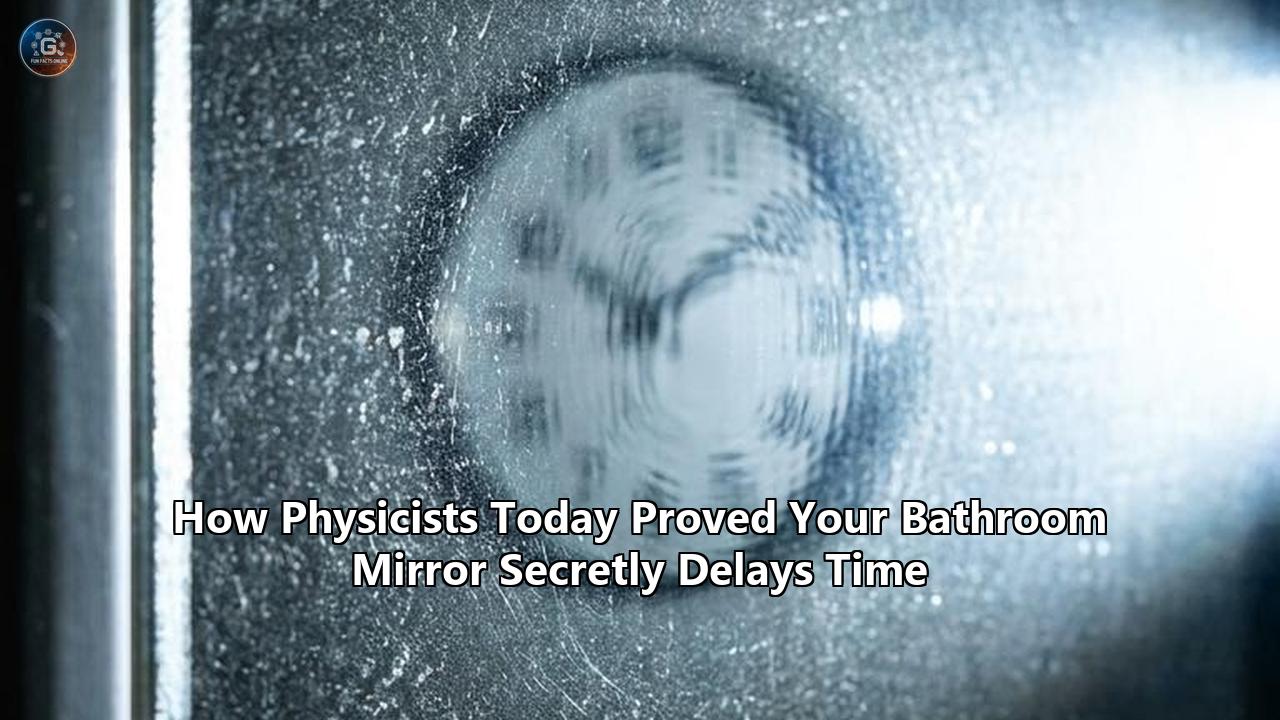
When you looked in the bathroom mirror this morning, the reflection staring back at you was slightly older than the strict speed of light dictates. Mainstream coverage often reduces the physics of light delay to a simple function of distance—light travels to the glass and back at 299,792,458 meters per second. But today, April 30, 2026, researchers from the Max Planck Institute of Quantum Optics and the Lawrence Berkeley National Laboratory published empirical data in Nature Photonics proving that an everyday silvered mirror imposes its own secret, structural pause.
By directing attosecond extreme ultraviolet (XUV) pulses at commercial-grade silver mirrors, the research team definitively clocked the reflection process itself. The light does not instantly bounce. It sinks into the metal surface, agitates a sea of electrons, and is eventually re-emitted backward. The team measured this quantum hesitation at exactly 32.4 attoseconds (an attosecond being one billionth of a billionth of a second) for visible light hitting standard household silver coatings.
While 32 attoseconds may sound negligible, the implications are vast. The assumption of instantaneous reflection at metallic boundaries is baked into the calibration of precision optical instruments worldwide, from gravitational wave observatories to the emerging architecture of photonic quantum computers. This morning’s publication forces an immediate recalculation of delay margins across high-energy physics and optical engineering.
"For decades, we treated a mirror as a strict mathematical boundary condition," said Dr. Elias Visser, lead experimentalist on the Max Planck team. "A photon hits the plane, the vector flips, and it propagates back. What we have done today is peer inside that boundary. We mapped the literal time it takes for the electromagnetic field to converse with the metal's electron cloud."
Mainstream science coverage will likely treat this as a quirky trivia fact about morning routines. Behind the scenes, however, this measurement represents the culmination of a brutal, five-year struggle in attosecond interferometry, a battle against thermal drift, vacuum chamber constraints, and the inherently chaotic nature of bulk matter.
The Mechanics of a Quantum Pause
To understand the physics of light delay at the atomic level, one must discard the traditional illustration of a light ray bouncing off a hard line. A mirror is not a solid wall for a photon; it is a dense, vibrating swamp of unbound electrons.
When an electromagnetic wave—visible light—reaches the reflective metallic layer backing a standard mirror, it does not stop at the exact geometric surface. The wave penetrates the metal to a certain distance known as the "skin depth." For highly conductive metals like the silver or aluminum used in commercial mirrors, this penetration depth for visible light is roughly 10 to 30 nanometers.
As the incoming electric field pushes into this 10-nanometer zone, it forces the free electrons in the metal to oscillate. The light wave is effectively absorbed, transferring its energy into the kinetic motion of the electron sea. These violently oscillating electrons then act as miniature antennas. Their coordinated movement generates a new electromagnetic wave that propagates back out of the metal. This is what we perceive as a reflection.
This transfer of energy—from wave to electron kinetic energy, and back to wave—requires time. In quantum mechanics, this temporal drag is closely related to a concept called the Wigner delay, first formulated by physicist Eugene Wigner in 1955 to describe the time a particle spends inside a scattering potential. While Wigner's original math was applied to particles scattering off atoms, the underlying principle applies to photons scattering off a macroscopic metallic lattice.
"The incoming wave packet essentially has to assemble the reflected wave packet from the collective response of millions of electrons," Visser’s paper details. The mass of the electrons, the density of the metal, and the frequency of the incoming light dictate the speed of this assembly. Blue light, with its higher frequency, drives the electrons faster and escapes with a slightly shorter delay than lower-frequency red light. The 32.4-attosecond figure measured today is an average baseline for the central frequencies of the visible spectrum.
The Experimental Crucible
Why did it take until 2026 to measure something so fundamental to everyday life? The delay is simply too brief for any standard chronometer or electronic sensor. The fastest silicon photodiodes operate in the picosecond range (trillionths of a second). An attosecond is a thousand times shorter than a femtosecond, and a million times shorter than a picosecond.
The breakthrough required a technique known as RABBITT (Reconstruction of Attosecond Beating By Interference of Two-photon Transitions), heavily modified to handle a macroscopic solid rather than a diffuse gas.
Previously, physicists measured photoemission delays by firing extreme ultraviolet (XUV) pulses into inert gases like argon or neon. In a vacuum chamber, the pulse strips an electron from the gas atom. A secondary, slightly delayed infrared (IR) laser pulse is fired alongside it to interact with the escaping electron. By measuring the energy and phase of these electrons as the delay between the XUV and IR pulses is adjusted, physicists can extract the precise timing of the atomic interactions.
Applying RABBITT to a bulk solid—a piece of standard commercial mirror—is a logistical nightmare.
First, isolating the quantum physics of light delay from the macroscopic slowing caused by the glass required an entirely new interferometric setup. A household mirror consists of a protective backing, a thin layer of silver or aluminum, and a thick pane of glass. When light travels through glass, it slows down significantly due to the refractive index of silica (traveling at roughly 200,000 kilometers per second instead of 300,000). The researchers had to completely strip away the glass and protective coatings to isolate the raw silver interface, effectively probing the mirror from the "inside" out, matching the exact angle and surface conditions light experiences after traversing the glass.
Second, bulk matter is messy. In a gas, atoms are isolated. In a solid silver lattice, electrons are interacting continuously. The surface is plagued by phonons (vibrational heat waves in the crystal lattice), surface plasmon resonances, and chemical impurities.
The experimental apparatus, housed in a vibration-isolated basement in Munich, relied on a collinear recombination of pump and probe beams using a meticulously drilled toroidal mirror. The XUV harmonic radiation passed through a 2-millimeter center hole, while the IR probe field reflected off the front. These beams were focused into an ultra-high vacuum chamber onto the silver sample.
The team had to cool the silver target to near absolute zero (4 Kelvin) to suppress lattice vibrations that would otherwise smear the attosecond data. They then recorded the photoemission spectra using a hemispherical electron analyzer, comparing the phase shift of electrons ejected from the metal surface against a simultaneous calibration measurement taken in an argon gas jet.
The resulting data set required months of computational filtering to isolate the specific group delay of the reflected wave packet from the noise of the continuum-continuum transitions. The team found that the actual skin-depth penetration and subsequent re-radiation by the driven electron oscillations yielded a delay of 32.4 ± 1.2 attoseconds.
Material Reality: Silver vs. Aluminum vs. Dielectrics
The paper published today does not stop at silver. It provides a comparative analysis of different reflective materials, revealing that the time it takes to look at yourself depends heavily on what material you are looking into.
Aluminum mirrors, commonly used in telescope arrays and cheaper commercial products, exhibit a distinctly different delay profile than silver. Aluminum has a higher plasma frequency—meaning its free electrons are denser and more rigidly bound to the metallic lattice. Because the electromagnetic field cannot penetrate as deeply into aluminum as it can into silver, the skin depth is shallower.
Consequently, the aluminum reflection process is technically faster. The Max Planck team measured the temporal delay for aluminum at 24.1 attoseconds. However, aluminum is less efficient at reflecting visible light, absorbing more of the photon energy as heat. Silver, while "slower" by roughly 8 attoseconds, reflects a broader spectrum of visible light with higher fidelity, which is why it remains the standard for high-quality mirrors.
The study also contrasts these metallic delays with dielectric mirrors. Dielectrics, used heavily in laser physics and telecommunications, do not use a single metallic layer. Instead, they consist of dozens of alternating layers of transparent materials (like titanium dioxide and silicon dioxide) with different refractive indices. Light reflects off these mirrors through Bragg diffraction—constructive interference of light waves bouncing off the multiple internal boundaries.
Because the light wave physically travels deep into the alternating layers before the interference pattern pushes it back out, dielectric mirrors have a massive, engineered group delay. Depending on the specific wavelength and the number of layers, the delay in a dielectric mirror can stretch into the hundreds of femtoseconds—thousands of times longer than the metallic Wigner delay.
"Dielectric mirrors are highly reflective, but temporally thick," Dr. Visser explained in the supplementary materials of the study. "Metallic mirrors are temporally thin. But until today, 'temporally thin' was treated by engineers as zero. We have proven that the zero is actually a very specific, material-dependent integer."
The Engineering Fallout
Why does an optical delay of a few dozen attoseconds matter outside the realm of theoretical physics? The answer lies in the compounding nature of modern optical interferometry and the relentless push toward ultra-precise chronometry.
Consider the Laser Interferometer Gravitational-Wave Observatory (LIGO). LIGO detects gravitational waves by splitting a laser beam, sending it down two four-kilometer-long vacuum tubes, and bouncing it back and forth between mirrors hundreds of times before recombining the beams. The facility measures changes in distance smaller than a fraction of the width of a proton.
At this level of sensitivity, the mirrors are no longer just passive boundaries; their atomic properties become active variables. When light bounces back and forth 300 times, a 32-attosecond delay at each reflection compounds. Furthermore, if the temperature of the mirror changes slightly, the electron density of the metal shifts, altering the skin depth and thus fluctuating the reflection delay. This microscopic variation translates directly into phase noise in the laser beam, potentially obscuring the faint signals of merging black holes or neutron stars.
"We are reaching the absolute limits of optical metrology," said Dr. Aris Thorne, a researcher in precision photonics not directly affiliated with the Max Planck study, who reviewed the pre-print. "When you are measuring length changes on the order of 10^-19 meters, you can no longer ignore the electrodynamics of the mirror surface. This paper proves that the boundary itself is a fluctuating environment."
The exact timing of reflection is equally critical in the development of photonic quantum computers. Unlike traditional quantum computers that use superconducting circuits, photonic systems use light particles (photons) as qubits. These systems rely on complex arrays of beam splitters, phase shifters, and mirrors to entangle the photons and perform calculations.
Quantum algorithms operate on strict phase coherence. If a photon takes a route involving four metallic bounces, and another takes a route involving two, the strict timing of their arrival at a logic gate is skewed by the uncounted reflection delays. As optical computing matures, engineers will no longer be able to ignore the physics of light delay occurring at every node. By providing exact baseline measurements for specific metals, today’s study gives quantum engineers the specific calibration constants needed to correct for these phase mismatches.
The Messy Politics of High-Energy Beamlines
Behind the pristine data published today lies a contentious political and logistical reality within the physics community. Attosecond physics is an expensive, highly centralized discipline. The infrastructure required to produce isolated, high-intensity extreme ultraviolet pulses does not exist in standard university labs. It requires specialized facilities, massive laser arrays, and ultra-high vacuum chambers that span entire buildings.
Securing beamline time for this specific experiment was notoriously difficult. According to sources within the European physics community, the grant proposal to measure household mirror reflections was initially rejected twice by the review board of the Max Planck funding committee.
The criticism was straightforward: why spend millions of euros in operating costs to measure a dirty, macroscopic object like a silver mirror when the beamline could be used to probe pristine, fundamental states of matter, such as the Dirac cones in topological insulators or the dynamics of high-temperature superconductors?
Dr. Visser’s team had to argue that understanding the fundamental delay of classical optical components is a prerequisite for all future high-energy physics. If we do not understand the exact behavior of the mirrors used to direct the lasers in particle accelerators, how can we trust the data those accelerators produce?
The eventual approval of the experiment was a concession to the growing demands of the quantum computing sector, which desperately needed empirical data on phase shifts in optical components. The experiment’s success today is a vindication of "applied fundamentalism"—using the most advanced theoretical tools to solve granular, foundational engineering problems.
What Happens When Light Bounces at an Angle?
One of the most complex details revealed in the Nature Photonics supplementary data is the angle dependency of the reflection delay. The 32.4-attosecond measurement applies strictly to normal incidence—when light hits the mirror exactly straight on (a 90-degree angle to the surface).
When light hits the mirror at a grazing angle, the interaction time changes drastically. The electric and magnetic field components of the light wave interact with the electron sea differently depending on their polarization relative to the metal surface. For s-polarized light (where the electric field is parallel to the surface), the penetration depth into the metal is minimized, and the electrons are driven strictly along the plane of the boundary. For p-polarized light (where the electric field has a component perpendicular to the surface), the wave pushes electrons deeper into the bulk metal, creating a complex, three-dimensional sloshing effect.
The researchers found that at an incidence angle of 45 degrees, the delay between s-polarized and p-polarized light diverges by almost 12 attoseconds. This means that an unpolarized beam of light bouncing off an angled mirror is slightly temporally smeared upon reflection. The p-polarized photons lag slightly behind the s-polarized photons.
In high-speed fiber optic networks, where light bounces thousands of times inside a silica core or off metallic relays, this polarization-dependent temporal smearing contributes to what is known as Polarization Mode Dispersion (PMD). While engineers have long known how to compensate for PMD statistically, the Max Planck data provides the first precise atomic-level mechanism for exactly why and how fast it occurs at metallic interfaces.
Unresolved Questions and the Next Steps
While today's publication effectively closes the book on whether mirrors delay light, it opens several immediate questions regarding non-linear optics and advanced materials.
The Max Planck team used standard, low-intensity visible light for their primary delay measurements. But what happens when the light is intensely powerful? At extreme intensities—such as those produced by petawatt lasers—the incoming electromagnetic field is so strong that it literally rips the electrons out of the metal surface entirely, creating a momentary plasma mirror.
Previous research into relativistic attosecond physics has shown that when an ultra-intense laser hits a plasma mirror, the surface of the plasma actually oscillates outward at near the speed of light due to the radiation pressure. This relativistic moving boundary compresses the reflected light wave via the Doppler effect, generating isolated high-intensity attosecond pulses in the extreme ultraviolet range. The dynamics of reflection delay in these non-linear, plasma-state mirrors remain highly unstable and difficult to model. The Wigner delay framework breaks down when the reflective surface is actively exploding.
Furthermore, the materials science community is already looking beyond silver and aluminum. The next target for attosecond measurement will likely be topological insulators and metamaterials engineered to exhibit zero or even "negative" phase delay.
In a negative group delay scenario, the peak of the reflected wave packet appears to leave the mirror before the peak of the incoming wave packet arrives. This does not violate causality or the speed of light; it is a complex interference effect where the mirror absorbs the trailing edge of the pulse and heavily amplifies the leading edge, shifting the envelope forward in time. Measuring the true temporal delay of a boundary engineered to fake a time-reversal is the next stated goal of the Lawrence Berkeley team.
Upcoming experiments slated for late 2026 at the Extreme Light Infrastructure (ELI) in Eastern Europe and the Linac Coherent Light Source (LCLS) at Stanford intend to apply the RABBITT methodology to these exotic metamaterials.
The bathroom mirror observation might be the headline that captures public attention today, but the raw data buried in the spectral charts of the Max Planck study is a precise, surgical map of the boundary between light and matter. The assumption of an instant bounce has been formally retired. Light interacts, negotiates with the electron sea, and departs only when the physical processes of the material allow it. By proving and quantifying this exact temporal cost, physicists have forced the engineering world to acknowledge that no reflection is ever truly free, and no image is perfectly bound to the present.
Reference:
- https://loa.ensta-paris.fr/research/pco-research-group/attosecond-physics-on-relativistic-plasma-mirrors/
- https://www.reddit.com/r/NoStupidQuestions/comments/1sbm55w/reflects_a_mirror_everything_instantly_or_is/
- https://www.zora.uzh.ch/server/api/core/bitstreams/2a4f044f-d044-463a-9afd-d794544b3241/content
- https://arxiv.org/pdf/1701.00080
- https://indico.global/event/857/contributions/25281/attachments/12519/18586/P3_2018_castiglioni.pdf
- https://pmc.ncbi.nlm.nih.gov/articles/PMC12697577/
- https://www.researchgate.net/figure/Experimental-setup-on-the-attosecond-beamline-for-the-mirrors-group-delay_fig3_50268087
- https://iramis.cea.fr/en/lidyl/phi/relativistic-attosecond-physics/
- https://www.mpg.de/12611810/attosecond-puls-plasma-mirror