Inside a hermetically sealed, trailer-sized research house parked beside Hampton Hall of Civil Engineering at Purdue University, an analytical instrument known as a nanocluster condensation nucleus counter began to scream in data points.
Minutes earlier, researchers had simulated an ordinary household chore: spraying a citrus-scented multi-surface cleaner across a laminate countertop and wiping it down.
To human senses, the room smelled clean—crisp, lemony, and sanitized. But to the mass spectrometers and particle sizers lining the walls, the room had undergone a violent chemical transformation. The concentration of airborne nanoparticles—submicroscopic clusters of matter measuring less than 100 nanometers across—skyrocketed from a quiet baseline to tens of millions of particles per cubic centimeter.
The data, presented by Dr. Brandon Boor and his research team at the American Chemical Society Fall Meeting in Chicago, revealed an unsettling reality: routine domestic cleaning with scented products creates a surge of secondary organic aerosols so intense that the resulting lung dose can rival or exceed the inhalation exposure of standing next to a congested multi-lane highway choked with diesel exhaust.
“Importantly, cleaning removes viruses and bacteria from surfaces, but it can also generate invisible air pollution,” Dr. Boor, an associate professor of civil engineering at Purdue who directs the Boor Lab for indoor atmospheric chemistry, stated during the presentation. “We showed that indoor ozone reactions with fragrances from cleaning produce nanoparticles that carry a respiratory dose comparable to, or greater than, what you would experience from standing outside along a busy road. The particles are different in terms of their composition, but the total dose can be higher. You’re not seeing smoke, dust, or haze in the air. Instead, you think the air smells great, so it must be clean.”
The findings pierce a widespread sensory illusion: the belief that a fragrant home is a healthy home. Instead, an extensive body of chemical and aerosol forensics confirms that the unseen dangers of scented cleaning sprays stem from a spontaneous, high-speed atmospheric reactor operating directly inside the living room.
Inside the Purdue Tiny House: Tracking the Chemical Ignition
To capture the invisible particle burst in real time, the Purdue research team utilized a zero-energy test house—a specialized, fully instrumented residential laboratory equipped with a functioning kitchen, wood flooring, a bathroom, and controlled ventilation systems.
Researchers introduced common household cleaning agents, ranging from synthetic commercial formulations to premium botanical disinfectants advertised as green, plant-derived, and essential-oil-based. They then monitored the air using high-resolution proton-transfer-reaction time-of-flight mass spectrometry (PTR-TOF-MS) and ultrafine particle spectrometers capable of tracking aerosol nucleation down to the 1-nanometer scale.
The sequence of events unfolded with rapid speed:
- The Volatile Pulse: The moment a trigger spray atomizes cleaning fluid, the liquid breaks into airborne droplets while a large portion coats the surface. Highly volatile organic compounds (VOCs)—specifically monoterpenes and terpenoids used to impart pine, citrus, and floral scents—evaporate immediately into the surrounding air.
- Atmospheric Saturation: Indoor terpene concentrations surged from standard background levels to between 10 and 1,000 parts per billion (ppb). In open nature, a dense coniferous forest or citrus grove rarely exceeds 1 to 10 ppb of ambient terpenes. Inside the closed kitchen, the concentration was hundreds of times higher than natural outdoor levels.
- The Ozone Collision: As these evaporated terpenes mixed with ambient background ozone ($O_3$) present in the indoor air (typically infiltrating from outside at concentrations between 20 and 40 ppb), chemical bonds began snapping.
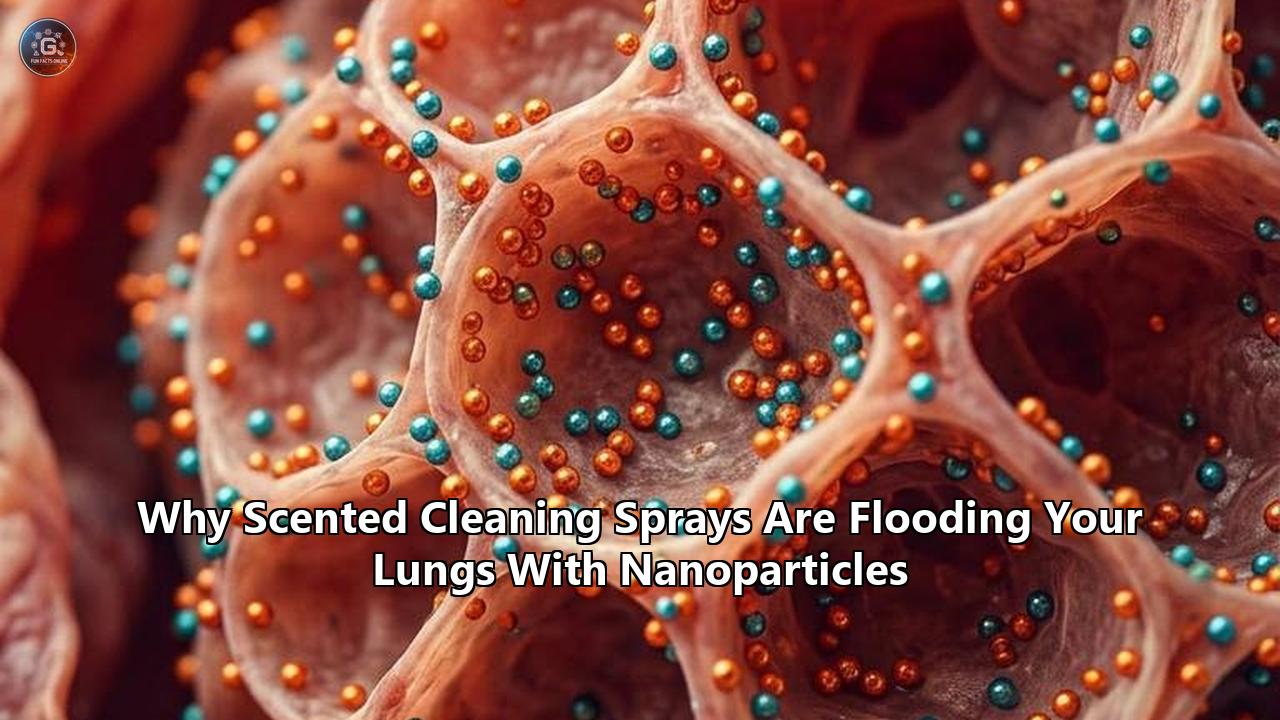
- Nucleation and Runaway Growth: The chemical reaction generated low-volatility oxidized fragments that rapidly clustered together, nucleating into 1-to-3-nanometer particles. Nucleation rates reached roughly $10^5$ particles per cubic centimeter per second ($10^5 \text{ cm}^{-3}\text{s}^{-1}$), driving total particle counts to between $10^5$ and $10^8$ particles per cubic centimeter. These nascent clusters grew at rates up to 300 nanometers per hour through continuous condensation, rapidly reaching sizes between 10 and 30 nanometers.
[ Trigger Spray: Limonene / Pinene / Terpenes ]
                     │
                     ▼ (Instant Evaporation into Gas Phase)
        Indoor Terpene Spike (10 – 1,000 ppb)
                     │
                     ▼ + [ Indoor Background Ozone (O₃: 20 – 40 ppb) ]
           (Rapid Gas-Phase Ozonolysis)
                     │
                     ▼
     Highly Oxygenated Organic Molecules (HOMs)
     & Criegee Intermediates (Low Volatility)
                     │
                     ▼ (Homogeneous Nucleation: 10⁵ cm⁻³ s⁻¹)
       Nanocluster Aerosols (1 – 3 nm)
                     │
                     ▼ (Condensational Growth: up to 300 nm/h)
      Secondary Organic Aerosol Soup (10 – 30 nm)
                     │
                     ▼ (Inhalation)
 Deep Alveolar Penetration & Bloodstream Translocation
“By the time you finish cleaning up an indoor space, you’ve already formed a lot of nanoparticles and inhaled them,” Boor observed.
The speed of the transformation caught researchers off guard. The entire nucleation event occurs within a window of two to ten minutes. A homeowner or custodian does not need to wait hours for secondary chemistry to take place; the particle factory operates at full throttle while the cleaning cloth is still wet in their hand.
The Molecular Forensics: How Fragrance Becomes Smog
To understand why this reaction occurs so rapidly, one must look at the organic chemistry of fragrance. The distinctive, sharp scent of pine stems primarily from alpha-pinene and beta-pinene. The bright, zesty aroma of lemon, orange, and grapefruit comes from d-limonene. Thyme-scented disinfectants rely on thymol, while lavender scents are driven by linalool and linalyl acetate.
All these compounds belong to a class of hydrocarbons known as terpenes and terpenoids. In biological terms, plants synthesize them as defensive shields against herbivores, pathogen inhibitors, or attractants for pollinators. In chemical terms, they are characterized by unsaturated carbon-carbon double bonds ($C=C$).
               CH3
                |
             //   \
            /      \
           |   (Limonene)
            \      / \
             \\   /   C = CH2
                |     |
               CH2   CH3
When ozone ($O_3$) encounters an unsaturated terpene like d-limonene in the gas phase, it attacks the carbon-carbon double bond in a reaction known as ozonolysis. The ozone molecule cleaves the double bond, creating an unstable primary ozonide that rapidly decomposes into energy-rich carbonyl compounds and zwitterionic fragments known as Criegee intermediates.
These high-energy intermediates react along multiple pathways:
- They strip hydrogen atoms from surrounding molecules, spawning hydroxyl radicals ($\cdot OH$), the most aggressive oxidants in environmental chemistry.
- They form highly oxygenated multifunctional organic molecules (HOMs)—dense, sticky carbon chains loaded with hydroperoxide ($-OOH$), carbonyl ($=O$), and carboxyl ($-COOH$) functional groups.
- They generate secondary hazardous byproducts, most notably gaseous formaldehyde ($HCHO$), acetaldehyde, and formic acid.
Because these newly formed HOMs possess exceptionally low saturation vapor pressures, they can no longer remain in the gas phase. They must condense. If preexisting dust or seed particles are present, they condense onto those surfaces. If the air is relatively clean of dust, the molecules collide directly with one another, sticking together to form brand-new solid and semi-solid liquid droplets out of thin air—a process known as homogeneous nucleation.
The result is secondary organic aerosol (SOA)—the exact same chemical substance that makes up regional photochemical smog over industrial river valleys and sun-drenched highway basins.
“The chemistry taking place over a clean kitchen island is fundamentally the same mechanism that generates blue haze over the Great Smoky Mountains or urban smog across the Los Angeles basin,” says Dr. Delphine Farmer, an atmospheric chemist at Colorado State University and a principal investigator on the landmark HOMEChem (House Observations of Microbial and Environmental Chemistry) project. “The crucial difference is volume and proximity. Outdoors, that chemistry is diluted across millions of cubic meters of boundary layer air. Indoors, it is confined within a space of fifty or one hundred cubic meters, directly inside human breathing zones.”
Anatomy of an Inhalation Event: The Sub-30-Nanometer Breach
The physical dimensions of these particles dictate where they land inside the human respiratory system.
Airborne particulate matter is categorized by aerodynamic diameter:
- $PM_{10}$ (particles $\le 10 \text{ }\mu\text{m}$): Coarse dust, pollen, mold spores. Trapped efficiently in the nasal passages, pharynx, and upper trachea by mucus and cilia.
- $PM_{2.5}$ (particles $\le 2.5 \text{ }\mu\text{m}$): Fine combustion soot, industrial emissions. Penetrates into the bronchioles.
- Ultrafine Particles & Nanoparticles (particles $\le 0.1 \text{ }\mu\text{m}$ or $\le 100 \text{ nm}$): The specific domain generated by indoor terpene-ozone reactions, where the vast majority of particles measure between 1 and 30 nanometers.
========================================================================================
PARTICLE SIZE COMPARISON & HUMAN RESPIRATORY PENETRATION
========================================================================================
Particle Class       Diameter Range       Typical Sources              Deposition Site
────────────────────────────────────────────────────────────────────────────────────────
PM10 (Coarse)        2.5 µm – 10 µm       Dust, Pollen, Spores         Nose, Pharynx, Trachea
PM2.5 (Fine)         0.1 µm – 2.5 µm      Smoke, Engine Soot           Bronchi, Bronchioles
Nanoparticles (UFP)  1 nm – 100 nm        Scented Sprays + Ozone,      Alveoli (Air Sacs),
                                          Nucleated Aerosols           Crosses into Capillaries
========================================================================================
Because 1-to-30-nanometer particles are smaller than the wavelength of visible light, they do not scatter light effectively. A room filled with tens of millions of them per cubic centimeter appears crystal clear.
Furthermore, standard consumer-grade air quality monitors rely on low-cost optical laser particle counters that cannot detect anything smaller than 300 nanometers ($0.3\text{ }\mu\text{m}$). A homeowner checking their smart indoor air monitor during a cleaning session will see a reading of "Good" or "0 $\mu\text{g/m}^3$," completely blind to the trillions of nanoclusters surrounding them.
When inhaled, these nanoparticles behave according to the physics of Brownian diffusion rather than inertial impaction. Because they possess almost no physical mass, they do not slam into the mucosal walls of the throat or trachea. Instead, they ride the inhaled air current straight down through the twenty-three branching generations of the bronchial tree, reaching the pulmonary alveoli—the fragile, single-cell-thick air sacs where gas exchange occurs.
                          [ Inhaled Airway ]
                                 │
                 ┌───────────────┴───────────────┐
                 ▼                               ▼
      [ Coarse PM10 / PM2.5 ]         [ 1–30 nm Nanoparticles ]
      Blocked by mucus & cilia        Bypasses upper respiratory filtration
      Trapped in upper airways        Rides Brownian diffusion into deep lung
                 │                               │
                 ▼                               ▼
       Expelled via coughing           Lands directly in Alveoli (Air Sacs)
                                                 │
                                 ┌───────────────┴───────────────┐
                                 ▼                               ▼
                       [ Cellular Inflammation ]     [ Endothelial Translocation ]
                       ROS generation, Surfactant    Penetrates alveolar wall
                       breakdown, Macrophage decay   Enters capillary bloodstream
Once inside the alveoli, the particle deposition fraction peaks sharply. Nanoparticles make direct contact with the pulmonary surfactant layer and the alveolar epithelial cells (type I and type II pneumocytes).
The biological consequences are immediate:
- Epithelial Disruption: The reactive chemical functional groups on the surface of secondary organic aerosols—such as peroxides, organic hydroperoxides, and epoxides—act as direct chemical irritants, inducing cellular oxidative stress and lipid peroxidation.
- Macrophage Exhaustion: Alveolar macrophages (the scavenger immune cells tasked with engulfing foreign debris) are biologically unequipped to clear millions of sub-30-nanometer particles efficiently. The sheer particle number overwhelms macrophage clearance pathways, triggering a release of inflammatory cytokines, including Interleukin-6 ($IL\text{-}6$), Interleukin-8 ($IL\text{-}8$), and Tumor Necrosis Factor-alpha ($TNF\text{-}\alpha$).
- Systemic Translocation: Because the alveolar-capillary barrier is ultra-thin (often less than 0.5 micrometers), nanoparticles can cross directly through cellular membranes via non-endocytic pathways, entering the pulmonary capillaries. From the bloodstream, these particles and their oxidative payloads circulate through the vascular endothelium, promoting systemic arterial inflammation and autonomic nervous system dysfunction.
This deep alveolar breach highlights the true biological dangers of scented cleaning sprays: the human respiratory tract is being exposed not just to a benign smell, but to an aggressive, chemically reactive particulate dose delivered directly to the vascular interface.
The Botanical Fallacy: The Green Cleaning Paradox
One of the most revealing discoveries to emerge from the Purdue experiments centers on the performance of "green," "natural," and "botanical" cleaning sprays.
Over the past decade, consumer demand has shifted away from industrial petroleum-based detergents and chlorine bleach toward plant-derived alternatives. Supermarket shelves are packed with sprays highlighting natural essential oils: cold-pressed orange peel, distilled pine needles, crushed thyme extract, and pure French lavender. Marketing campaigns frequently equate "botanical" with non-toxic, clean, and lung-safe.
The atmospheric instruments in the Purdue test home told an entirely different story.
When researchers compared conventional synthetic fragranced cleaners with botanical, essential-oil-based disinfectant sprays, the botanical products consistently triggered faster nucleation events and produced equal or higher concentrations of ultrafine nanoparticles.
========================================================================================
TERPENE CONTENT & REACTIVITY: SYNTHETIC VS. BOTANICAL CLEANERS
========================================================================================
Product Formulation       Dominant VOC Additives       Reaction Rate with Ozone (k_O3)
────────────────────────────────────────────────────────────────────────────────────────
Conventional Scented      Synthetic Fragrance Oils,    Moderate to Fast;
                          Low-Conc. Limonene/Linalool  Generates 10^5 to 10^6 particles/cm³
────────────────────────────────────────────────────────────────────────────────────────
"Green" Botanical Spray   Pure Citrus Terpenes,        Extremely Fast;
                          Thymol, Pine/Lavender Oils   Generates 10^6 to 10^8 particles/cm³
========================================================================================
The underlying chemistry explains why:
- Terpene Purity: Synthetic cleaning formulations often utilize engineered synthetic aroma chemicals designed to resist oxidation or provide long-lasting scent at low concentrations. Botanical cleaners, by contrast, frequently rely on concentrated, raw plant essential oils.
- High Monoterpene Mass: A single bottle of natural citrus-based surface degreaser can contain liquid formulations that are up to 5% to 10% pure d-limonene by weight. When aerosolized, it discharges a massive volume of unshielded, highly reactive monoterpenes into the room.
- Multi-Bond Monoterpenes: Essential oils like orange oil, pine oil, and tea tree oil contain complex mixtures of cyclic monoterpenes and sesquiterpenes (such as limonene, terpinolene, and alpha-pinene). Many of these molecules possess multiple double bonds ($C=C$), multiplying their reaction rates with ozone. Terpinolene, for example, reacts with ozone at a rate thousands of times faster than many simple synthetic volatile compounds.
                    [ The Consumer Trap ]
    ┌──────────────────────────────────────────────────┐
    │  "100% Plant-Derived" / "Natural Essential Oils" │
    └─────────────────────────┬────────────────────────┘
                              │
                              ▼ (Contains Unshielded, Concentrated Monoterpenes)
           [ Trigger Spray Discharge Indoors ]
                              │
                              ▼
        Airborne Terpenes Reach Hundreds of ppb
                              │
                              ▼ (Collides with Infiltrated Ozone)
    Hyper-Accelerated Homogeneous Particle Nucleation
                              │
                              ▼
    Higher Nanoparticle Dose Than Many Synthetic Formulas
The data demonstrates that plants do not design essential oils for human inhalation via high-pressure trigger sprays in enclosed rooms. In nature, monoterpenes are emitted into open atmospheric currents to repel pests or signal other plants. When bottled in high concentrations, pressurized, and atomized in an 8-foot-ceiling kitchen, those same natural defense compounds become the primary chemical fuel for indoor secondary organic aerosol synthesis.
The marketing claims surrounding plant-based sprays have obscured the physical reality: indoor ozone does not differentiate between a limonene molecule synthesized in a petrochemical laboratory and one cold-pressed from an organic orange peel. Both molecules possess identical carbon-carbon double bonds, both undergo rapid ozonolysis, and both generate the exact same lung-saturating nanoparticles.
Compounding Hazards: Far-UV, Ionizers, and Disinfection Stacking
The Purdue investigations also uncovered a dangerous interaction in modern hygiene practices: the simultaneous use of advanced disinfection technology and scented chemical cleaners.
In the wake of heightened infection-control awareness in schools, offices, clinics, and residential spaces, building operators have increasingly deployed germicidal ultraviolet technologies—specifically far-UV (222 nm) and conventional UV-C (254 nm) lamps—alongside aggressive chemical wiping schedules.
Dr. Boor, working alongside environmental engineering professor Dr. Ernest Blatchley, tested what occurs when these technologies operate in the same airspace.
               [ Scented Cleaning Sprays ]
                           │
                           ▼ (Emits Terpenes: Limonene, Pinene)
    =================================================
    INDOOR AMBIENT AIRSPACE (Cross-Reaction Zone)
    =================================================
                           ▲
                           │ (Emits Ozone Byproduct: 20 – 40+ ppb)
             [ Germicidal Far-UV / Ionizers ]
                           │
                           ▼
     [ RUNAWAY INDOOR PHOTOCHEMICAL SMOG FORMATION ]
        * Nucleation Rate Multiplied
        * Continuous SOA Replenishment
        * Sustained High-Density Nanoparticle Cloud
The mechanics of this indoor photochemical cross-reaction are stark:
- UV-Induced Ozone Generation: Far-UV light operating at 222 nanometers efficiently inactivates surface and airborne pathogens. However, photons at this wavelength interact with ambient diatomic oxygen ($O_2$) molecules in the air, photolyzing oxygen and generating significant amounts of ozone ($O_3$) as a direct operational byproduct.
- The Ozone Accelerator: In the Purdue tiny house, running germicidal far-UV lamps drove steady-state indoor ozone levels to between 20 and 40 ppb in a fully enclosed room.
- The Secondary Aerosol Engine: When a scented cleaner was introduced into a room where far-UV lamps were active, the enriched ozone environment accelerated the terpene ozonolysis cascade. The nanoparticle nucleation rate exploded, sustaining high particle concentrations far longer than under standard ventilation conditions.
A similar hazard occurs with consumer "air purifying" ionizers, plasma generators, and electrostatic cleaners that emit low levels of ozone as an operational byproduct. When consumers deploy an ozone-emitting electronic air cleaner to "freshen" a room that has just been cleaned with scented sprays, they create an indoor smog chamber.
The chemical stacking effect does not stop with ultraviolet light. When scented products are used sequentially with chlorine bleach (sodium hypochlorite), the chemistry grows even more complex. Bleach emissions release gaseous hypochlorous acid ($HOCl$), chlorine ($Cl_2$), and nitryl chloride ($ClNO_2$) into the indoor airspace. These reactive chlorine species undergo photolysis under indoor indoor lighting, generating highly reactive chlorine radicals ($\cdot Cl$).
Chlorine radicals attack terpenes at diffusion-limited rates—orders of magnitude faster than ozone or hydroxyl radicals—initiating rapid secondary organic chlorination reactions that yield chlorinated organic aerosols whose toxicological properties remain largely unmapped.
The 20-Pack-Year Reality: From Laboratory Physics to Chronic Disease
The physics and chemistry observed in test chambers align with long-standing epidemiological data on respiratory health. For decades, clinicians observed that professional cleaners, custodial staff, and individuals with intense domestic cleaning routines suffered from disproportionately high rates of adult-onset asthma, chronic bronchitis, and accelerated lung function decline. For years, these clinical outcomes were attributed vaguely to "chemical fumes" or harsh bleach vapors. The discovery of high-speed nanoparticle formation provides the missing mechanistic link.
========================================================================================
EPIDEMIOLOGICAL EVIDENCE: CLEANING EXPOSURE & RESPIRATORY DAMAGE
========================================================================================
Study / Cohort        Sample Size / Duration     Key Clinical Finding
────────────────────────────────────────────────────────────────────────────────────────
European Community    6,230 participants;        Forced Expiratory Volume (FEV1)
Respiratory Health    20-year follow-up period   declined 3.9 ml/yr faster in domestic
Survey (ECRHS)                                   cleaners; 4.3 ml/yr faster in occupational
(Univ. of Bergen)                                cleaners. Equivalent to a 20-pack-year
                                                 tobacco smoking history.
────────────────────────────────────────────────────────────────────────────────────────
French Constances     13,000+ adults;            Regular use of spray cleaning agents
Cohort Investigation  Cross-sectional analysis   linked to a 38% increase in current
                                                 asthma symptoms and airway reactivity.
========================================================================================
The landmark European Community Respiratory Health Survey (ECRHS), conducted by a team of international researchers led by the University of Bergen in Norway, tracked 6,230 women and men across 22 health centers over a two-decade span. The study analyzed lung function via spirometry—specifically evaluating Forced Expiratory Volume in one second ($FEV_1$) and Forced Vital Capacity ($FVC$).
The results, published in the American Journal of Respiratory and Critical Care Medicine, revealed:
- Women cleaning at home or working as occupational cleaners experienced an accelerated decline in lung capacity ($FEV_1$ and $FVC$) that matched the lung function deterioration observed in chronic smokers with a 20-pack-year history (equivalent to smoking one pack of 20 cigarettes per day for 20 years).
- The accelerated decline was most pronounced in individuals who used cleaning products delivered via aerosol cans and trigger spray bottles, as opposed to liquids applied directly via buckets and cloths.
- Rates of occupational asthma were markedly elevated among workers regularly exposed to cleaning chemicals, with chronic airway obstruction developing over years of routine exposure.
When an individual inhales trillions of 1-to-30-nanometer particles week after week, the chronic physical deposition of reactive organic aerosols inside the pulmonary acinus maintains a perpetual state of low-grade microvascular and alveolar inflammation. Over time, this chronic inflammatory cascade triggers structural remodeling of the small airways: collagen deposition, loss of alveolar elasticity, thickening of the basement membrane, and permanent loss of ventilatory capacity.
The unrecognized dangers of scented cleaning sprays are not confined to immediate sensory irritation, sneezing, or mild headaches. Rather, they represent a cumulative, chronic toxicological burden that slowly degrades respiratory architecture under the guise of household sanitation.
The Regulatory Loophole: The Protected Void of "Fragrance"
If fragranced cleaning sprays discharge billions of reactive nanoparticles into breathing zones, why are there no health warnings on the product labels?
The answer lies in a fragmented regulatory framework designed in the mid-20th century that never accounted for secondary indoor atmospheric chemistry.
                     [ THE REGULATORY VOID ]
  ┌──────────────────────────────────────────────────────────┐
  │ Clean Air Act (EPA):                                     │
  │ • Regulates outdoor ambient air (NAAQS)                  │
  │ • ZERO authority over private residential indoor air     │
  └────────────────────────────┬─────────────────────────────┘
                               │
                               ▼
  ┌──────────────────────────────────────────────────────────┐
  │ Consumer Product Safety Act (CPSC):                      │
  │ • Requires testing for acute poisoning / chemical burns  │
  │ • No testing required for secondary gas-to-particle SOAs │
  └────────────────────────────┬─────────────────────────────┘
                               │
                               ▼
  ┌──────────────────────────────────────────────────────────┐
  │ Fragrance Secrecy Loophole:                              │
  │ • Hundreds of individual chemical compounds (terpenes,   │
  │   phthalates, fixatives) legally grouped under one word: │
  │   "FRAGRANCE" or "PARFUM"                                │
  └──────────────────────────────────────────────────────────┘
The institutional blind spots are structural:
- The EPA's Jurisdictional Boundary: Under the Clean Air Act, the U.S. Environmental Protection Agency possesses clear legal authority to regulate outdoor ambient air pollution, setting National Ambient Air Quality Standards (NAAQS) for ground-level ozone, $PM_{2.5}$, nitrogen dioxide, and lead. The EPA, however, does not hold regulatory authority over the indoor air quality of private homes, residential apartments, or commercial office environments.
- The CPSC and the Acute Toxicity Standard: Household cleaning products fall primarily under the jurisdiction of the Consumer Product Safety Commission (CPSC) via the Federal Hazardous Substances Act (FHSA). This framework evaluates acute, primary hazards: Will the liquid burn human skin on contact? Will it cause blindness if splashed into an eye? Will it cause acute poison toxicity if swallowed by a child? The FHSA contains no statutory mandate requiring manufacturers to evaluate the secondary, gas-to-particle atmospheric reactions that occur when a non-toxic liquid evaporates and mixes with indoor ambient oxidants.
- The "Fragrance" Trade Secret Exemption: Under federal labeling laws, fragrance formulations are classified as proprietary trade secrets. A manufacturer can blend fifty distinct volatile chemical compounds—including d-limonene, alpha-pinene, linalool, benzyl acetate, and diethyl phthalate—into a single product and legally disclose them on the ingredient panel under the single, generic word: "Fragrance" or "Parfum".
Even in occupational domains governed by the Occupational Safety and Health Administration (OSHA), Permissible Exposure Limits (PELs) for VOCs are calibrated to prevent acute, gross industrial poisoning in healthy adult workers. These limits are expressed in parts per million (ppm).
OSHA maintains no exposure standards for nanocluster aerosol particle number counts ($10^5\text{ to }10^8\text{ particles/cm}^3$) or secondary organic aerosol mass generated by cleaning workers performing daily duties in closed rooms.
The consumer and the worker operate within a regulatory vacuum: the chemicals responsible for generating trillions of respiratory nanoparticles are legally hidden behind trade secret labels, while the physical environment where people spend 90% of their lives—the indoors—remains entirely unmonitored by clean air standards.
Evidence-Based Remediation: How to Clear the Indoor Airspace
Navigating the hidden dangers of scented cleaning sprays requires moving past aesthetic marketing claims and implementing basic chemical and aerodynamic controls inside the home.
Indoor air quality researchers, aerosol scientists, and occupational health specialists recommend four primary interventions:
1. The Fragrance-Free Baseline
The most effective way to prevent nanoparticle formation is to remove the chemical precursor from the equation.
- True Fragrance-Free vs. Unscented: Consumers must distinguish between "unscented" and "fragrance-free." Products labeled "unscented" often contain synthetic masking fragrances—neutralizing chemicals that block human olfactory receptors from smelling harsh detergent bases while still emitting reactive VOCs. True "fragrance-free" products contain no added fragrance chemicals or essential oils.
- Rejecting the Sensory Association: As Dr. Boor noted following the Purdue findings: "Clean air should not smell like highly concentrated citrus fruit. It should not really smell of anything".
========================================================================================
PRACTICAL COMPARISON: CLEANING PRODUCT SAFETY PROFILES
========================================================================================
Product Class             Precursor Load (Terpenes)    Nanoparticle Synthesis Risk
────────────────────────────────────────────────────────────────────────────────────────
Scented Conventional      High (Synthetic Terpenes)    Extreme (10^5 – 10^7 particles/cm³)
"Natural" Botanical       Very High (Pure Oils)        Extreme (10^6 – 10^8 particles/cm³)
True Fragrance-Free       Near Zero                    Negligible / Baseline
Microfiber + Pure Water   Zero                         None (No Gas-Phase VOCs)
========================================================================================
2. Physical Mechanics: Eliminate the Aerosol Trigger
The application method directly dictates how much volatile chemistry enters the breathing zone:
- Eliminate Aerosol Cans and Trigger Sprays: High-pressure triggers and aerosol propellants shear bulk liquids into fine mists, maximizing the surface area of the droplets and accelerating the flash evaporation of VOCs into the gas phase.
- Transition to Direct Surface Application: Applying cleaning liquid directly onto a microfiber cloth from a pour bottle—or using simple microfiber cloths dampened with warm water—cuts gas-phase VOC emissions by up to 80% to 90%, physically capturing dirt and microbial matter without saturating the surrounding air with evaporated precursors.
[ AEROSOL TRIGGER SPRAY ]
High surface area atomization ──► Instant gas-phase volatilization ──► Runaway SOA Nucleation

[ DIRECT POUR-TO-CLOTH ]
Low surface area contact     ──► Minimal gas-phase escape       ──► Near-zero Nucleation
3. Aerodynamic Control and Ventilation Rates
When cleaning surfaces, ventilation must be actively managed to flush precursors before nucleation peaks:
- Mechanical Exhaust Deployment: Running localized kitchen and bathroom exhaust fans vented directly outdoors during and for thirty minutes after cleaning creates negative pressure, drawing volatile vapors out before they can react with incoming ozone.
- Cross-Ventilation Dynamics: Opening windows on opposite sides of a living space increases the Air Changes per Hour (ACH). High ACH rates dilute both the terpene concentration and background ozone, drastically reducing the probability of low-volatility molecules colliding to nucleate new particles.
4. Air Cleaning Strategy: HEPA vs. Activated Carbon
Understanding air filtration limits prevents a false sense of security:
- The HEPA Limitation: High-Efficiency Particulate Air (HEPA) filters capture ultrafine particles via diffusion, but they cannot capture gas-phase VOCs. A HEPA purifier running during a cleaning session will capture some formed secondary aerosols, but the gaseous terpenes will pass straight through the filter matrix, continuously reacting with ozone in the room.
- The Carbon Requirement: To remove the chemical fuel, filtration systems must incorporate dense, thick beds of activated carbon or specialized alumina impregnated with potassium permanganate to chemically adsorb and neutralize the volatile gas-phase monoterpenes before ozonolysis can take place.
What Comes Next for Indoor Air Science
The Purdue tiny house experiments mark a critical shift in how science understands the air inside built environments. For decades, indoor air research focused almost exclusively on primary emissions: lead in dust, asbestos fibers, carbon monoxide from faulty furnaces, and radon gas seeping from sub-slab geology.
Today, atmospheric chemistry has moved indoors. The living room is increasingly recognized as a dynamic, unmanaged photochemical reactor where consumer products, background oxidants, engineered light sources, and human occupants interact in real time.
Several key milestones and scientific questions lie ahead:
- In Vivo Nanoparticle Mapping: Toxicologists are currently working to determine the precise chemical composition of secondary organic aerosols generated during domestic cleaning. Because these particles carry peroxides, aldehydes, and organic radicals directly into the vascular system, research must establish their precise biological half-life and cellular clearance mechanics in human lung tissue.
- Building Ventilation Codes: ASHRAE (the American Society of Heating, Refrigerating and Air-Conditioning Engineers) and international building code bodies are facing growing pressure to incorporate indoor chemical reactivity metrics into minimum ventilation rate standards (such as ASHRAE Standard 62.1 and 62.2), moving beyond simple carbon dioxide ($CO_2$) dilution models.
- Legislative Transparency Mandates: Policy advocates in the European Union and several U.S. states are advancing legislation that would strip the "Fragrance" trade secret exemption from consumer household cleaning products, requiring manufacturers to disclose all individual terpene concentrations on product packaging.
Until regulatory standards and product formulations catch up to the science of indoor atmospheric nucleation, the responsibility falls squarely on the individual holding the bottle.
The next time a cleaning spray fills a room with the crisp, invigorating scent of a mountain pine forest or a sunny citrus orchard, remember what the instruments see. The scent is not evidence of clean air; it is the exhaust plume of a high-speed chemical reaction filling your lungs with trillions of invisible particles. True clean air carries no fragrance at all.
Reference:
- https://pubs.acs.org/doi/10.1021/acs.est.0c00740
- https://gizmodo.com/if-you-hate-scented-cleaning-products-prepare-to-feel-hugely-vindicated-2000804250
- https://www.labcompare.com/617-News/627655-Scented-Cleaning-Products-Create-Invisible-Air-Pollution/
- https://www.acs.org/pressroom/presspacs/2026/august/scented-cleaning-products-create-invisible-air-pollution.html
- https://acs.digitellinc.com/live/37/session/591663
- https://phys.org/visualstories/2026-08-scented-cleaners-nanoparticles-deep-lungs.amp
- https://www.facebook.com/surgicallycleanair/videos/your-hairspray-might-be-giving-you-the-perfect-hold-but-what-is-it-leaving-behin/1826791878747946/
- https://www.facebook.com/westnewsmagazine/posts/products-we-commonly-spray-inside-our-homes-including-household-cleaners-and-dis/977260924401926/
- https://airqualitynews.com/health/scented-cleaners-linked-to-rapid-formation-of-airborne-nanoparticles/
- https://www.facebook.com/groups/1503505426577849/posts/3736208063307563/
- https://repository.library.noaa.gov/view/noaa/24994/noaa_24994_DS1.pdf
- https://www.mindbodygreen.com/articles/how-fresh-scented-cleaning-products-may-cause-air-pollution-in-yourhome
- https://respiratory-therapy.com/public-health/healthcare-policy/environmental-news/scented-cleaning-products-linked-to-indoor-air-pollution/
- https://facss.mit.edu/pdf/Spring2022/Spring2022_Vance.pdf