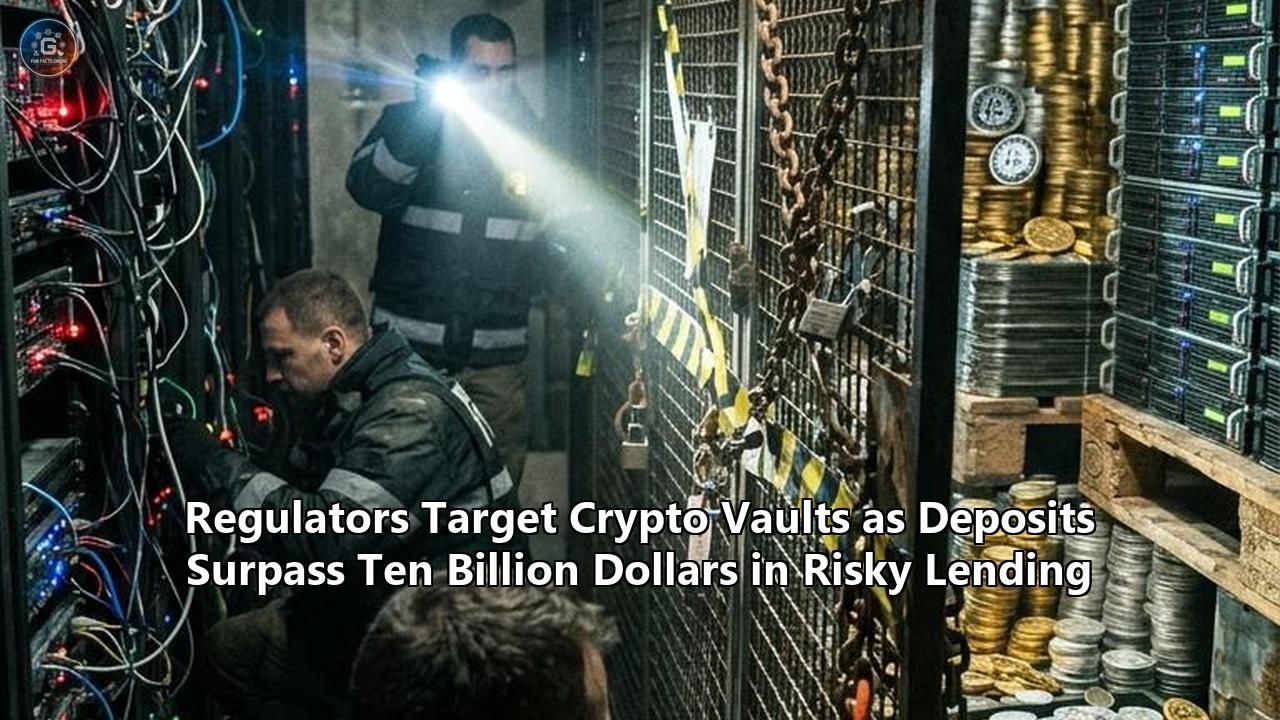
Financial regulators in Washington and Brussels have launched coordinated inquiries into curated crypto lending vaults after total deposits committed to the automated credit vehicles surged past $10 billion, climbing from $4 billion in early 2025.
The regulatory escalation, reported by the Financial Times on October 19, 2026, zeroes in on decentralized finance (DeFi) platforms where algorithmic smart contracts pair with professional human risk managers—known in the sector as "curators"—to route investor capital across complex borrowing markets. The sudden influx of institutional and corporate treasury cash into these products has alarmed supervisory bodies, including the U.S. Securities and Exchange Commission (SEC) and the European Securities and Markets Authority (ESMA). Officials are examining whether these curated vaults function as unregistered collective investment schemes, shadow hedge funds, or unlicensed asset management vehicles masquerading as software.
The scrutiny arrives at a critical juncture. Corporate treasuries, digital asset funds, and fintech firms holding massive stablecoin reserves have flooded onchain lending vaults to capture annualized yields ranging from 3.5% on conservative dollar pools to more than 20% on leveraged credit strategies. Unlike early decentralized lending protocols that relied on pooled, monolithic liquidity, modern vaults package isolated credit markets into single-click deposit vehicles.
This structure shifts the operational risk from protocol code to discretionary curator decisions. Depositors are exposed to automatic liquidation spirals, collateral illiquidity, and oracle vulnerabilities without the baseline disclosure mandates and consumer protections enforceable in traditional capital markets.
"One of the biggest paradoxes is everything is public because everything is encoded in the smart contract, but none of the investors read or understand the ratios, the liquidity rates—they just have a look at the interest rates," said Léopold Wenger, digital assets director at research firm Kaiko.
The regulatory clampdown serves as a case study in the structural evolution of decentralized finance. It highlights what occurs when decentralized protocols strip away intermediaries only to quietly reinvent them through specialized gatekeepers, and it reveals how supervisory bodies adapt when discretionary investment management disguises itself within immutable code.
THE ONCHAIN VAULT CAPITAL PIPELINE
┌─────────────────────────┐
│ Depositors (Fintechs,   │
│ Treasuries, Funds)      │
└────────────┬────────────┘
             │ Deposited Assets (USDC, USDT, WBTC)
             ▼
┌─────────────────────────┐
│ Curated Lending Vault   │ <---- [Curator: Risk Rules, Caps, Allocations]
│ (ERC-4626 Standard)     │       (Subject to SEC / ESMA Inquiries)
└──────┬───────────┬──────┘
       │           │
       │ Market A  │ Market B (High Yield / Higher Risk)
       ▼           ▼
┌──────────────┐ ┌──────────────┐
│ Isolated     │ │ Isolated     │
│ Market:      │ │ Market:      │
│ Low LLTV     │ │ High LLTV    │
│ Liquid Asset │ │ Exotic Coll. │
└──────────────┘ └──────────────┘
Anatomy of the $10 Billion Milestone
The explosive migration of capital into curated vaults stems from a structural redesign in how decentralized credit platforms manage market exposure. Between 2020 and 2023, decentralized credit operated primarily through shared-reserve lending pools such as Compound and Aave v2. In those designs, every depositor entered a singular liquidity pool that supported a wide array of collateral assets. If a single exotic token suffered an economic exploit or oracle failure, the resulting bad debt compromised the entire pool, threatening every depositor.
To dismantle this systemic fragility, developers introduced modular lending protocols, led by Morpho Blue and Euler v2. These architectures split the lending market into isolated pairs: a single loan token (such as USDC) paired with a single collateral asset (such as staked Ethereum or a tokenized Treasury bill), operating under immutable parameters including a hard-coded liquidation loan-to-value (LLTV) ratio and a dedicated oracle feed.
While isolated markets solved the pooled-contagion problem, they introduced an operational challenge: liquidity fragmentation. Passive capital providers lacked the time and technical sophistication to evaluate hundreds of distinct, isolated lending pairs, verify smart contract code, and monitor real-time borrower solvency.
The industry solved this liquidity bottleneck by deploying curated vaults, standardized largely on the Ethereum token standard ERC-4626.
Under this setup, a depositor deposits stablecoins into a vault. The vault smart contract holds these assets and issues vault share tokens back to the depositor. The critical lever sits with the "curator"—often a specialized risk firm, financial consultancy, or algorithmic trading shop—who retains the discretionary cryptographic keys to allocate the vault's pooled capital among approved isolated lending markets.
Curators such as Steakhouse Financial, Block Analitica, B.Protocol, and MEV Capital establish risk caps, approve collateral types, set minimum interest rate spreads, and rebalance balances across markets. In exchange for this risk management service, curators deduct an automated performance or management fee from the yield earned by depositors.
The convenience of this abstraction catalyzed the surge from $4 billion to more than $10 billion in total value locked within eighteen months. Fintech firms holding dollar-backed payment rails, corporate treasuries managing balance-sheet crypto assets, and institutional hedge funds seeking non-directional returns found an automated mechanism that promised the yields of private credit without balance sheet lockups or lengthy legal negotiations.
TRANSITION: SHARED POOLS TO CURATED VAULTS

Shared Pool Architecture (Legacy DeFi)
[Depositors] ──▶ [Single Unified Liquidity Pool] ──▶ Multiple Collateral Types
* Risk Profile: Systemic Contagion. If Asset X fails, whole pool suffers bad debt.

Curated Vault Architecture (Modern DeFi)
[Depositors] ──▶ [ERC-4626 Vault] ──▶ Curator Allocates ──▶ Market 1 (Collateral A)
                                                          ──▶ Market 2 (Collateral B)
                                                          ──▶ Market 3 (Collateral C)
* Risk Profile: Isolated Bad Debt, but Concentrated Curator Discretion Risk.
Deconstructing Crypto Lending Risks in Curated Onchain Vaults
The primary catalyst for regulatory intervention is the widening disconnect between marketing narratives of passive, risk-managed yield and the actual crypto lending risks embedded in multi-layered smart contract systems. When deposits crossed the eight-figure threshold, supervisors in the United States and Europe recognized that the structural architecture of curated vaults concentrates credit, market, and technical exposures in ways that mimic pre-2008 structured finance vehicles.
Liquidity Transformation and the Withdrawal Run Dynamic
The foremost vulnerability within crypto lending vaults stems from maturity and liquidity transformation. Depositors interact with vaults under an assumption of instantaneous liquidity: they expect to deposit USDC today and withdraw it tomorrow on demand. However, the vault deploys that capital into isolated markets where borrowers post collateral and borrow the stablecoins to execute leverage strategies.
If a curated vault deploys 92% of its stablecoins into borrower markets, only 8% remains liquid in the contract buffer. Should an exogenous market shock occur—such as a sharp decline in the price of underlying collateral tokens—depositors frequently rush to withdraw capital simultaneously.
Once withdrawals exhaust the 8% buffer, the vault’s utilization hits 100%. At this saturation point, smart contracts freeze withdrawals for subsequent depositors until borrowers voluntarily repay loans or liquidators seize and sell collateral on open markets.
This dynamic replicates a traditional bank run. Depositors who submit withdrawal transactions early exit at par, while later depositors find their capital locked inside distressed debt pools.
Unlike commercial banking systems, curated onchain vaults have no access to central bank discount windows, no deposit insurance from bodies like the FDIC, and no capital reserve requirements to cushion redemption shocks.
Collateral Quality and Liquidation Cascades
The hunt for outsized yields has led many curators to allocate deposits into markets backed by exotic collateral. While early lending markets accepted only high-volume, deeply liquid assets such as wrapped Bitcoin (WBTC) and liquid ether (WETH), contemporary vaults frequently accept liquid restaking tokens (LRTs), yield-stripping principal tokens (such as Pendle PTs), and synthetic stablecoins.
When an exotic collateral asset depegs or suffers a sharp price decline, the automated liquidation system must trigger. Liquidators repay the borrowed stablecoins in exchange for seizing the collateral asset at a discount, which they then liquidate on decentralized exchanges.
If the secondary market depth for that collateral is thinner than the total debt outstanding, liquidators cannot execute these trades profitably. The liquidation engine stalls, and the market accrues bad debt.
LIQUIDATION FAILURE WATERFALL

Collateral Price Drops Below Liquidation Threshold
                 │
                 ▼
Automated Liquidation Engine Triggers
                 │
                 ▼
Liquidator Evaluates DEX Secondary Liquidity
                 │
       ┌─────────┴─────────┐
       ▼                   ▼
Adequate Liquidity   Thin Liquidity / Severe Slippage
[Debt Cleared]       [Liquidators Abandon Auction]
                           │
                           ▼
                     Bad Debt Accrues
                           │
                           ▼
                     Vault Incurs Principal Loss
                     (Socialized across depositors)
In an isolated market, this bad debt does not bleed into unrelated tokens. However, inside a curated vault that allocated 15% of its capital to that market, the loss socializes across all vault share tokens. A depositor who believed they were providing safe, general-purpose liquidity discovers their principal has absorbed the default of an unhedged speculative trader.
Oracle Latency and Flash Loan Manipulation
Every curated lending market relies on an external price oracle—such as Chainlink, Pyth, or automated market maker (AMM) time-weighted average price (TWAP) feeds—to report the exact valuation of pledged collateral. This pricing mechanism introduces an attack vector that traditional credit markets never face.
If a market relies on an onchain oracle with a delayed update window, a bad actor can exploit this latency. Through flash loans—uncollateralized blockchain loans borrowed and returned within a single execution block—an attacker can manipulate the thin trading volume of an exotic collateral asset on a decentralized exchange, temporarily inflating its oracle-reported price.
The attacker then deposits the artificially inflated asset into an isolated market, borrows the vault’s pristine stablecoins up to the maximum loan-to-value cap, and walks away. When the oracle corrects on the next block, the market is left with worthless collateral and a severe stablecoin deficit. The curator's risk parameters, established through periodic offchain modeling, prove entirely useless against millisecond-level smart contract exploits.
Looped Leverage and Re-Hypothecation
Curated vaults frequently serve as the foundational liquidity engine for leveraged looping. Borrowers deposit yield-bearing assets, borrow stablecoins from a curated vault, purchase more yield-bearing assets, and redeposit them into the same or neighboring protocols. This cycle amplifies nominal yield while compounding debt leverage fivefold or tenfold.
This interconnected gearing creates a synthetic web of re-hypothecation across DeFi. While the vault operates as a senior credit provider on paper, its actual solvency becomes inextricably tethered to the health of the entire leveraged loop. A micro-shock at any link in the chain—such as an unannounced smart contract pause, a governance token exploit, or a sudden change in staking redemption queues—unravels the structure, triggering mass un-looping and destabilizing the vaults that financed the leverage in the first place.
The Curator Dilemma: Software Developers or Shadow Asset Managers?
The central driver of current regulatory intervention is not the underlying software code, but the human discretion exerted over capital distribution.
In pure decentralized finance, smart contracts are designed to operate autonomously without human intervention. Early lending platforms relied on token-holder governance votes to approve broad protocol parameters. Curated vaults fundamentally deviate from this ethos by introducing an active portfolio manager into the smart contract execution loop.
GOVERNANCE EVOLUTION IN DEFI LENDING

1. Autonomous Code (2020)
[Depositor] ──▶ [Immutable Smart Contract] ──▶ Autonomous Liquidity Pool
Parameters: Hardcoded at deployment, immutable.

2. DAO Governance (2021-2023)
[Depositor] ──▶ [Smart Contract] ──▶ Token Holder Snapshot / Onchain Vote
Parameters: Slow, politicized, public governance proposals.

3. Discretionary Curator (2024-Present)
[Depositor] ──▶ [ERC-4626 Vault] ──▶ [Professional Risk Curator]
                                      - Sets Caps
                                      - Selects Borrowers/Markets
                                      - Collects Management Fees
                                      - Allocates Capital at Discretion
Curators operate with varying degrees of cryptographic control. In typical implementations, the curator possesses administrative keys allowing them to:
- Add or remove isolated markets from the vault's approved lending registry.
- Set supply caps that dictate the maximum dollar balance allocated to any single market.
- Reallocate idle capital dynamically between markets based on interest rate fluctuations.
- Adjust fee parameters, extracting up to 10% to 20% of net interest revenue as management compensation.
While depositors maintain theoretical custody of their funds—retaining the cryptographic right to burn their vault shares and withdraw remaining underlying assets—their economic returns and exposure profiles are dictated by the curator's daily portfolio rebalancing.
This operational reality shatters the legal argument that curated vaults are merely passive software tools. When an entity selects assets, sets risk bounds, actively routes capital, and collects performance compensation, that entity engages in activities traditionally defined as investment management.
"Fintech groups with large stablecoin balances, digital asset treasury companies and hedge funds" constitute the primary liquidity base for these vaults, confirmed Adrian Cachinero Vasiljevic, co-founder of risk management firm Steakhouse Financial.
Yet, these institutional and corporate depositors are interacting with curators who routinely operate without investment adviser registrations, public prospectus filings, or standard capital adequacy audits. The curator functions as an asset manager, but without the legal duties, reporting requirements, and compliance structures mandated for traditional fiduciaries.
Regulatory Crosshairs: The Transatlantic Clampdown
Regulators across multiple jurisdictions have moved from passive observation of decentralized lending to active structural enforcement. By focusing on curated vaults exceeding $10 billion, securities watchdogs and banking regulators are pursuing an intentional strategy: targeting the human choke points managing onchain credit allocation rather than fruitlessly attempting to ban permissionless software protocols.
REGULATORY JURISDICTIONAL MATRIX

┌─────────────────┬───────────────────────────┬──────────────────────────────────────────┐
│ Regulatory Body │ Primary Legal Tool        │ Focus of Current Vault Inquiries        │
├─────────────────┼───────────────────────────┼──────────────────────────────────────────┤
│ U.S. SEC        │ Reves Test / Howey Test   │ Are vault shares notes or investment     │
│                 │ '40 Acts ('33, '34, '40)  │ contracts? Are curators unreg. advisers? │
├─────────────────┼───────────────────────────┼──────────────────────────────────────────┤
│ ESMA (EU)       │ AIFMD / MiCA              │ Do vaults qualify as Alternative         │
│                 │ Directive 2011/61/EU      │ Investment Funds? Curator compliance.    │
├─────────────────┼───────────────────────────┼──────────────────────────────────────────┤
│ U.K. FCA        │ FSMA / Regulated Activity │ Treatment as Unregulated Collective      │
│                 │ Order (RAO)               │ Investment Schemes (UCIS). Custody scope.│
└─────────────────┴───────────────────────────┴──────────────────────────────────────────┘
The United States: Howey, Reves, and the Investment Advisers Act
In the United States, the SEC’s inquiry focuses on whether the issuance of vault shares and the operations of curators violate federal securities laws. SEC Commissioner Hester Peirce detailed this legal tension in a public statement titled "Headstands and Summervaults: A Statement on Crypto Vaults and Lending Strategies," noting that these products cross multiple statutory regimes:
"The Commission, the Crypto Task Force, and staff across the Divisions have done tremendous work... to provide clarity to crypto markets as to when a certain asset or activity is subject to the federal securities laws and, if so, how those laws apply. You may not fall within our regulatory scope, but, if you do, we welcome the opportunity to talk with you about how to serve your customers in compliance with the federal securities laws... Vaults may implicate several regulatory frameworks: the investment contract analysis (Howey), the Reves note test for lending arrangements, investment company status under the Investment Company Act, and investment adviser status under the Investment Advisers Act."
The SEC’s legal framework targets three vulnerabilities:
The Reves "Family Resemblance" Test
Under Reves v. Ernst & Young (1990), an instrument promising a fixed or variable interest return in exchange for an advance of capital is presumed to be a security (specifically, a note) unless it bears a strong "family resemblance" to categories of non-security debt instruments. Curated vaults solicit deposits from the public, promote variable investment returns, and deploy funds into commercial lending operations. Under the four Reves prongs—the motivations of buyer and seller, the plan of distribution, the reasonable expectations of the investing public, and the presence of an alternative regulatory scheme—curated vaults resemble notes issued for investment capital without an alternative safety net.
The Howey Investment Contract Analysis
Under SEC v. W.J. Howey Co. (1946), an investment contract exists when there is an investment of money in a common enterprise with an expectation of profits derived solely from the efforts of others. While DeFi advocates claim vault depositors rely on software code rather than a common promoter, the presence of a discretionary curator dismantles this defense. Depositors pool funds in a smart contract and rely on the curator’s skill, risk modeling, and manual asset reallocation to safeguard capital and generate returns.
The Investment Advisers Act of 1940
If the assets managed inside a vault are deemed securities, or if curators provide continuous advice regarding the purchase or sale of securities for compensation, curators meet the statutory definition of an investment adviser. Section 203 of the Advisers Act requires registration with the SEC, mandatory disclosure filings (Form ADV), written compliance policies, and adherence to strict federal fiduciary standards—obligations that decentralized risk curators have disregarded.
The European Union: MiCA Gaps and the AIFMD Perimeter
In the European Union, the regulatory approach is unfolding through the coordinated interaction of the Markets in Crypto-Assets Regulation (MiCA) and the Alternative Investment Fund Managers Directive (AIFMD).
While MiCA established an extensive licensing framework for crypto-asset service providers (CASPs) and stablecoin issuers across the European single market, Title I of MiCA explicitly exempted fully decentralized financial services provided without an intermediary.
Curated vaults, however, operate directly in the ambiguous gray zone between pure DeFi and traditional asset management.
ESMA and national regulators, such as France's Autorité des Marchés Financiers (AMF) and Germany's BaFin, are examining whether curated vaults meet the definition of an Alternative Investment Fund (AIF) under Directive 2011/61/EU. Under European law, an AIF is any collective investment undertaking that raises capital from a number of investors to invest it in accordance with a defined investment policy for the benefit of those investors, without requiring an operational commercial purpose.
If a curated vault publishes a mandate—for example, targeting 8% net yields by allocating stablecoins across tokenized real-world assets and decentralized money markets—European regulators view this as a defined investment policy.
If European regulators classify these vaults as AIFs, curators based within the EU, or marketing to EU citizens, must obtain full AIFM authorization, maintain capital reserves, appoint independent depositaries to oversee custodial assets, and adhere to strict leverage reporting limits. For decentralized protocols designed around pseudonymous developer teams and permissionless access, compliance with the AIFMD framework would mandate a complete corporate restructuring.
Enter S&P Global: The Institutional Standardization of Onchain Credit
As regulatory agencies mobilized formal inquiries, traditional capital market infrastructure moved rapidly to fill the analytical void. In early October 2026, S&P Global Ratings launched the Vault Risk Assessment (VRA) framework, introducing letter-grade evaluations for onchain lending vaults.
The introduction of Wall Street debt grading to smart contract vaults represents a pivotal step in the maturity of the asset class. The framework acknowledges that digital asset lending has grown beyond an experimental playground for crypto native retail traders into an asset class requiring standard institutional underwriting.
S&P GLOBAL VAULT RISK ASSESSMENT (VRA) FRAMEWORK

┌─────────────────────────────────────────────────────────────┐
│                 VAULT RISK ASSESSMENT (VRA)                 │
│              Scale: AAA(v) to B(v) / CCC(v)                 │
└──────────────────────────────┬──────────────────────────────┘
                               │
       ┌───────────────────────┼───────────────────────┐
       ▼                       ▼                       ▼
┌──────────────┐        ┌──────────────┐        ┌──────────────┐
│  TECHNICAL   │        │  CURATION &  │        │ LIQUIDATION  │
│  SECURITY    │        │  OPERATIONAL │        │  & LIQUIDITY │
│  (Code audits,│       │  (Key mgmt,  │        │  (Depth, slippage,│
│   oracles,    │       │   track record,│      │   LLTV margin,│
│   dependencies)│      │   timelocks) │        │   volatility)│
└──────────────┘        └──────────────┘        └──────────────┘
The S&P methodology departs sharply from traditional sovereign or corporate credit ratings, which evaluate the willingness and balance-sheet capacity of a legal entity to repay its bond obligations. Because a smart contract cannot be sued in bankruptcy court and possesses no corporate board, S&P’s Vault Risk Assessment evaluates a tripartite framework:
- Smart Contract and Architecture Resilience: Assessing protocol code immutability, formal verification status, historical audit track records, and external oracle dependencies.
- Curator Operational and Governance Profiling: Reviewing the track record, governance structures, conflict-of-interest policies, and emergency intervention powers of the vault curator. S&P evaluates whether curators employ multi-signature cryptographic security, timelock delays on strategy shifts, and transparent risk models.
- Liquidation and Collateral Stress Testing: Simulating market drawdowns across pledged collateral to test whether the market’s programmed liquidation loan-to-value (LLTV) ratios provide sufficient margin to absorb high slippage during liquidity crunches.
The ratings agency uses an evaluation scale designated with a small "v" suffix—such as AAA(v) down to B(v)—to mark the relative risk of capital impairment.
The market's reliance on external rating agencies illustrates an ongoing institutional reality: as non-bank balance sheets deploy capital into decentralized markets, institutional treasury managers cannot rely exclusively on internal developers to read raw bytecode. They require standardized, third-party benchmarks that translate complex execution mechanisms into recognized institutional metrics.
Yet, the S&P framework carries its own contradictions. Traditional rating methodologies depend heavily on historical default data accumulated over decades of business cycles. Decentralized vaults operate in hyper-volatile environments characterized by structural regime shifts, rapid fork modifications, and unprecedented economic exploits. If rating agencies assign high investment-grade marks to vaults that subsequently collapse due to unanticipated economic contagion or oracle manipulations, it could replicate the structural misjudgments of the 2008 subprime crisis, when AAA ratings masked fragile structured credit products.
Technical Case Study: The Morpho and Euler Vault Mechanics
To understand the regulatory and systemic friction, one must examine the software architecture powering the current vault surge. Morpho’s MetaMorpho standard and Euler’s Vault Kit (eVaults) serve as primary case examples of modern curated lending infrastructure.
METAMORPHO SMART CONTRACT EXECUTION TOPOLOGY

+-------------------------------------------------------------+
|                     MetaMorpho Contract                     |
|                                                             |
|  - Tracks Depositor Shares (ERC-4626)                       |
|  - Enforces Curator Timelocks (e.g., 24-hr delay on changes)|
|  - Fee Recipient Address                                    |
+------------------------------+------------------------------+
                               │
               Discretionary Rebalancing Vector
                               │
        +----------------------+----------------------+
        │                                             │
        ▼                                             ▼
+───────────────────────────+   +───────────────────────────+
|   Morpho Blue Market A    |   |   Morpho Blue Market B    |
|   (Conservative)          |   |   (Aggressive Loop)       |
+───────────────────────────+   +───────────────────────────+
| Collateral: cbBTC         |   | Collateral: sUSDe         |
| Loan Token: USDC          |   | Loan Token: USDC          |
| LLTV: 77.0%               |   | LLTV: 91.5%               |
| Oracle: Chainlink Primary |   | Oracle: Custom RedStone   |
| Hard Supply Cap: $200M    |   | Hard Supply Cap: $50M     |
+───────────────────────────+   +───────────────────────────+
The Allocation Algorithm and Supply Caps
A MetaMorpho vault functions as an ERC-4626 standard contract that collects a single loan asset, such as USDC, and supplies it to multiple underlying Morpho Blue markets.
Each underlying Morpho Blue market is identified by an immutable configuration hash comprising five precise variables:
- Loan Token Address
- Collateral Token Address
- Oracle Contract Address
- Interest Rate Model (IRM) Contract Address
- Liquidation Loan-to-Value (LLTV) threshold
The vault curator cannot change these underlying parameters; they are fixed when the market is launched on the blockchain. However, the curator retains discretionary authority over three variables within the vault:
- The Market Registry: Which market IDs are permitted to receive capital from the vault.
- Supply Caps: The maximum quantity of loan tokens allowed to reside in each market.
- The Allocation Priority Queue: The algorithmic order in which funds are distributed to capture yield or withdrawn to honor redemptions.
When a borrower interacts with Market B, they post collateral—such as Ethena’s sUSDe—and borrow USDC allocated to that market by the MetaMorpho vault. If Market B offers an interest rate of 12% while Market A (backed by tokenized treasuries) offers 4.5%, the curator faces a recurring economic incentive: shifting supply caps to push larger shares of depositor funds into Market B to increase the vault's blended APY and generate higher performance fees.
Mathematical Exposure and Timelock Defense
To mitigate curator abuse or sudden strategy changes, modern vault protocols integrate algorithmic delay mechanisms.
When a curator decides to add a new, riskier market to the vault or increase a market's supply cap, the update must pass through an onchain timelock—often set between 24 and 72 hours.
The mathematical formulation for vault share valuation is determined continuously onchain via the asset-to-share exchange rate:
$$\text{Share Price} = \frac{\text{Total Assets in Vault} + \sum \text{Accrued Debt Across Active Markets}}{\text{Total Outstanding Vault Shares}}$$
If a borrower defaults in Market B and liquidations fail to cover the debt, the accrued bad debt reduces the numerator ($\text{Total Assets}$) without changing the denominator ($\text{Total Outstanding Shares}$). Instantly, the unit value of each share token declines across every depositor in the vault.
If a sophisticated depositor notices bad debt accruing before the broader market catches on, they can front-run the final accounting update, burn their shares at the previous par value, and leave remaining, less-sophisticated depositors to absorb the full loss.
This dynamic illustrates how crypto lending risks are frequently shifted from active market participants to passive depositors who lack the technical infrastructure to run autonomous onchain monitoring nodes.
Lessons and Principles from the Vault Boom
The rapid ascent of curated vaults to $10 billion and the resulting regulatory actions reveal fundamental economic dynamics governing decentralized financial protocols. Analyzing this transition exposes broader truths regarding software automation, capital efficiency, and systemic risk.
+-----------------------------------------------------------------------------------+
|                     CORE PRINCIPLES EXTRACTED FROM THE CASE                       |
+-----------------------------------------------------------------------------------+
| 1. THE CONSERVATION OF INTERMEDIATION                                             |
|    Eliminating traditional institutions does not remove the need for judgement;   |
|    it simply shifts fiduciary responsibility onto pseudonymous protocol actors.    |
+-----------------------------------------------------------------------------------+
| 2. THE LIQUIDITY CONVERGENCE ILLUSION                                             |
|    Packaging illiquid, exotic debt into instantly redeemable ERC-4626 shares       |
|    creates run risks that software design cannot eliminate.                      |
+-----------------------------------------------------------------------------------+
| 3. TRANSPARENCY DOES NOT EQUAL PROTECTION                                        |
|    Publishing open-source code does not empower depositors if real-time risk     |
|    analysis requires specialized technical and financial infrastructure.          |
+-----------------------------------------------------------------------------------+
| 4. REGULATORY ARBITRAGE CARRIES EXPONENTIAL EXPIRY                               |
|    When an unregulated product achieves scale ($10B+), regulatory authorities    |
|    will re-interpret legacy laws to close the gap, regardless of code structure.  |
+-----------------------------------------------------------------------------------+
1. The Conservation of Intermediation
Decentralized finance originated on the premise of disintermediation: removing bankers, brokers, and clearinghouses to let buyers and sellers transact directly via code. The evolution of lending vaults demonstrates what can be termed the Conservation of Intermediation.
Complex credit markets cannot allocate capital efficiently without human judgment, risk profiling, and continuous credit underwriting.
When protocols eliminated centralized lenders like Celsius and Voyager following their 2022 insolvencies, the market did not move to pure, unmanaged peer-to-peer credit.
Instead, the market reconstructed intermediaries in a modular form. The curator is an asset manager; the isolated market protocol is a clearinghouse; the oracle provider is a credit evaluation bureau.
Intermediation was never eliminated; it was merely broken into discrete, composable smart contract layers.
2. The Illusion of Instantaneous Liquidity
A foundational economic lesson of this case study is that packaging long-duration, leveraged credit into instantly redeemable smart contract shares creates an inherent liquidity mismatch.
A vault cannot sustainably offer instant withdrawals while simultaneously financing high-yielding private loans, tokenized receivables, and leveraged collateral loops.
The industry’s attempt to manufacture liquidity via automated market utilization curves functions smoothly only during periods of capital expansion.
During market distress, the structural reality reasserts itself: loans take time to liquidate or repay. By offering instantaneous redemptions on paper, vaults incentivize depositors to run on the pool at the first whisper of trouble, recreating the classic Diamond-Dybvig bank run model inside decentralized code.
3. Transparency Is Not a Substitute for Disclosure
The defense long mounted by decentralized protocol advocates—that open-source code and public blockchain ledgers eliminate the need for regulatory disclosure—fails in real-world application.
As Léopold Wenger observed, the presence of public parameters on a block explorer does not mean capital providers can comprehend the dynamic credit risk they are underwriting.
An institutional corporate treasurer or retail participant reviewing a vault dashboard sees an annualized percentage yield (such as 7.4%) and an aggregate deposit balance.
Deciphering the actual risk requires parsing smart contract assembly code, evaluating liquidation margins across thousands of dynamic loans, and continuously modeling oracle dependencies.
Public data is not the same as meaningful investor protection. True protection requires understandable disclosures, stress-tested collateral assumptions, clear declarations of curator fees, and honest explanations of loss-waterfall mechanics.
4. Regulatory Realism: Function Dictates Law
For years, digital asset projects operated under the assumption that if an action was executed by an autonomous smart contract on a decentralized network, it fell entirely outside the scope of traditional securities, banking, and fund management laws.
The regulatory actions targeting the $10 billion vault milestone dismantle this assumption.
Regulators apply the economic reality doctrine: the legal system evaluates the substantive economic function of a financial product, not the technology through which it is delivered.
If a curator markets a vault, exercises ongoing discretion over capital, deducts fees, and exposes depositors to collective default risk, regulators will classify that curator as a fund manager and the vault as a collective investment scheme.
Software scripts do not provide legal immunity for traditional financial activities.
The Cross-Asset Spillover: Traditional Finance Meets Onchain Credit
The regulatory focus on curated vaults is further intensified by the accelerating convergence of decentralized credit and traditional real-world assets (RWA). The current $10 billion vault ecosystem no longer operates as an isolated sandbox dealing exclusively in native crypto tokens like ETH and BTC.
A significant portion of vault collateral consists of tokenized Treasury bills, private credit receivables, and yield-bearing stablecoins issued by regulated financial entities.
REAL-WORLD ASSET (RWA) INTEGRATION IN CURATED VAULTS

[Corporate / Traditional Treasury]
               │  Purchases Tokenized U.S. T-Bills / Notes
               ▼
[Tokenized Asset Issuer (e.g., Ondo, BlackRock BUIDL)]
               │  Wraps Real-World Collateral into Onchain Tokens
               ▼
[Morpho / Euler Isolated Lending Market]
               │  Pledges Tokenized Treasuries as Collateral
               │  Borrows Liquid Stablecoins (USDC / USDT)
               ▼
[Curated Lending Vault (ERC-4626)]
               │  Supplies Stablecoins from Depositors
               ▼
[Depositors: Fintechs, Yield Funds, Web3 Treasuries]
This structural crossover introduces unprecedented systemic contagion pathways between traditional banking systems and onchain smart contracts:
Legal Disconnects in Collateral Seizure
When a traditional loan defaults, the creditor exercises legal rights under commercial law frameworks—such as Article 9 of the Uniform Commercial Code (UCC) in the United States—to repossess pledged collateral. In a curated onchain vault accepting tokenized real-world assets, liquidation is executed algorithmically via smart contracts.
However, a smart contract cannot physically seize a company’s real estate assets, inventory, or physical bank accounts if the underlying tokenized asset defaults offchain.
If the offchain issuer pauses token transfers or faces regulatory asset-freeze orders, the onchain vault's automated liquidation engine fails completely. The smart contract holds an untransferable digital token, while the stablecoin debt remains unpaid, saddling vault depositors with unrecoverable bad debt.
Custodial Ambiguity and Cross-Jurisdictional Exposure
Institutional capital flowing into curated vaults often routes through centralized custodian wrappers and institutional access layers.
Firms such as Coinbase, Robinhood, and traditional fintech operators have begun exploring or deploying integrations with isolated lending vault protocols like Morpho to offer automated yield products to their institutional client tiers.
This multi-jurisdictional financial architecture creates significant regulatory friction:
- Who is legally responsible if an onchain curator makes an allocation error that wipes out client balances?
- Does the retail fintech providing the frontend application bear statutory broker-dealer or custodial liability?
- Can a European depositor seek recovery through EU courts under MiCA if the vault curator is a decentralized autonomous organization (DAO) distributed across Switzerland, the Cayman Islands, and Singapore?
These jurisdictional conflicts have elevated vault oversight from a technical crypto debate into an urgent priority for cross-border financial stability bodies, including the Financial Stability Board (FSB) and the Basel Committee on Banking Supervision.
Comparative Analysis: 2022 Centralized Lenders vs. 2026 Onchain Vaults
To evaluate whether the current regulatory response is justified, one must compare the risk profile of modern curated vaults against the centralized crypto lending intermediaries that collapsed in 2022, wiping out tens of billions of dollars in client savings.
STRUCTURAL COMPARISON: 2022 CEFI COLLAPSE VS. 2026 DEFI VAULTS

┌──────────────────────┬───────────────────────────────┬───────────────────────────────┐
│ Feature              │ 2022 Centralized Lenders      │ 2026 Curated Onchain Vaults   │
│                      │ (Celsius, Voyager, Genesis)   │ (MetaMorpho, Euler eVaults)   │
├──────────────────────┼───────────────────────────────┼───────────────────────────────┤
│ Asset Custody        │ Custodial; platform held      │ Non-custodial; assets reside  │
│                      │ private keys and ownership    │ in verified smart contracts   │
├──────────────────────┼───────────────────────────────┼───────────────────────────────┤
│ Transaction          │ Total opacity; balance sheets │ Real-time visibility into all │
│ Transparency         │ were internal corporate books │ loans, collateral, and caps   │
├──────────────────────┼───────────────────────────────┼───────────────────────────────┤
│ Risk Intermediary    │ Corporate executives / credit │ Independent Curators / Risk   │
│                      │ risk committees behind doors  │ firms via onchain multisig    │
├──────────────────────┼───────────────────────────────┼───────────────────────────────┤
│ Margin Calls &       │ Manual, discretionary, often  │ Automated, algorithmic via    │
│ Liquidations         │ delayed for favored clients   │ smart contracts and oracles   │
├──────────────────────┼───────────────────────────────┼───────────────────────────────┤
│ Re-hypothecation     │ Uncapped, unmonitored offchain│ Traceable onchain looping,    │
│ Risk                 │ re-lending to third parties   │ subject to programmed caps    │
├──────────────────────┼───────────────────────────────┼───────────────────────────────┤
│ Failure Mode         │ Chapter 11 bankruptcy filing, │ Onchain bad debt, share price │
│                      │ multi-year asset freezes      │ impairment, instant haircut   │
└──────────────────────┴───────────────────────────────┴───────────────────────────────┘
The contrast illustrates why curated vaults have attracted capital despite the memory of the 2022 crashes.
In 2022, entities like Celsius operated as opaque, unregulated shadow banks. They took retail customer deposits, secretly transferred them to hedge funds like Three Arrows Capital on an uncollateralized basis, and lied about their solvency until withdrawals were unilaterally halted.
Curated onchain vaults present a fundamentally different structural paradigm. Assets remain secured within audited, non-custodial smart contract code. Every collateral balance, every borrowing address, every loan-to-value ratio, and every accrued interest payment is recorded live on a public blockchain ledger. Depositors retain programmatic custody of their deposit shares, avoiding the scenario where a centralized CEO can abscond with funds or assign balance-sheet assets to favored insiders.
Yet, this technical transparency does not eliminate risk; it transforms it.
While credit transparency is near absolute, execution risk remains elevated. If code contains an undetected exploit, or if an oracle feed is compromised, the automated execution that protects depositors from human corruption becomes the very mechanism that algorithmically liquidates their assets without recourse.
The regulatory tension centers on this distinction: watchdogs understand that vaults do not present the traditional fraud vectors of 2022 CeFi, but they recognize that vaults introduce acute systemic risks—algorithmic runs, rapid liquidation cascades, and shadow asset management—that existing securities frameworks were enacted to prevent.
Strategic Implications: What Happens Next in the Vault Sector
As regulatory scrutiny intensifies across North America and Europe, the curated vault ecosystem faces a structural shakeout. Crossing the $10 billion threshold has moved decentralized lending into the crosshairs of global supervisory bodies, setting off legal and technical realignments.
THE COMING VAULT BIFURCATION

                     Curated Lending Protocols
                                 │
                 ┌───────────────┴───────────────┐
                 ▼                               ▼
    Compliant Institutional Path        Permissionless Shadow Path
    ────────────────────────────        ──────────────────────────
    - Full KYC/AML on Depositors        - Fully Pseudonymous Wallets
    - Licensed, Registered Curators     - Decentralized AI / Algorithmic Curators
    - Whitelisted ERC-4626 Vaults       - Unregulated Exotic Collateral
    - Mandatory Legal Disclosures       - Outside Western Regulatory Perimeters
    - Lower, Regulated Yields (3-6%)    - Higher, Uncapped Yields (10-25%)
1. The Institutional Cleaving: Permissioned vs. Shadow Vaults
The market will bifurcate into two distinct operational models:
- Compliant Institutional Vaults: Major crypto infrastructure providers and licensed asset managers will launch regulated, know-your-customer (KYC) permissioned vaults. Depositors will be restricted to accredited institutions and verified corporate entities. Curators operating these vaults will register under the Investment Advisers Act in the U.S. or under the AIFMD framework in Europe, providing audited disclosures, compliance attestations, and traditional fiduciary backing. Yields in this tier will align closely with risk-free benchmark rates plus a modest credit spread (3.5% to 6.5%).
- Permissionless Onchain Vaults: Native DeFi users, offshore trading desks, and pseudonymous developers will continue to operate entirely onchain, non-KYC vaults deploying capital into exotic, speculative lending markets. However, these products will face complete exclusion from Western banking on-ramps, aggressive frontend domain blockades by regulators, and targeted enforcement actions against identified curators.
2. Algorithmic and AI Curators Replacing Named Risk Firms
To evade the regulatory definition of an investment adviser, protocol developers are already developing automated, algorithmic curators.
Instead of relying on named risk consulting firms like Steakhouse Financial or Block Analitica—who possess recognizable corporate entities that can be served with subpoenas—next-generation vaults will execute capital allocation via immutable, decentralized algorithmic agents.
These algorithmic curators will adjust supply caps and rebalance markets based purely on deterministic onchain parameters: historical DEX volatility, automated liquidity depth calculations, and machine-readable credit inputs.
This technical pivot will challenge regulatory enforcement regimes: if an algorithm without human intervention allocates deposits into a failing market, who does the SEC name in an administrative cease-and-desist order?
3. S&P Ratings as the Gatekeeper for Corporate Treasuries
The rollout of S&P Global’s Vault Risk Assessment framework will establish an institutional credit divide. Corporate treasuries, public companies, and regulated fintech platforms will face internal risk mandates barring them from depositing capital into any onchain vault lacking an investment-grade mark, such as A(v) or higher.
This gatekeeping role will grant significant market power to traditional credit rating agencies over decentralized protocol parameters. Protocol teams will design lending markets not to maximize capital efficiency or crypto-native utility, but specifically to conform to S&P's risk models, cementing Wall Street’s analytical standards at the core of onchain software architecture.
TIMELINE OF KEY DEVELOPMENTS & UPCOMING MILESTONES

Q1 2025: Lending vault deposits stand at ~$4B. Capital flows accelerate into modular lending.
Q3 2026: SEC Commissioner Hester Peirce issues statement on crypto vaults and securities laws.
Oct 2026: S&P Global launches Vault Risk Assessment (VRA) framework for crypto lending.
Oct 2026: Total deposits surpass $10B; Financial Times reveals coordinated SEC and ESMA inquiries.
Mid-2027: Expected European Commission definitive guidelines on DeFi under MiCA review.
Late 2027: First formal SEC enforcement actions against unregistered onchain vault curators anticipated.
Navigating the Next Phase of Onchain Credit
The regulatory confrontation over the $10 billion vault milestone marks the end of decentralized finance's era of structural plausible deniability. For years, the sector operated under the assumption that wrapping financial activities in smart contract code transformed the nature of credit, risk, and investment management. The emergence of curated lending vaults exposed the limits of that narrative.
By reintroducing active human management through curators, the industry resolved DeFi’s user experience and capital fragmentation challenges, unlocking billions in corporate and institutional capital.
In doing so, it revived the legal questions that have governed capital markets for nearly a century: when one entity manages another’s capital for profit, what duties are owed, what disclosures are mandatory, and who bears the loss when credit collapses?
The lessons from the $10 billion vault surge will dictate the trajectory of decentralized credit for the remainder of the decade. The industry will not be permitted to build a $100 billion shadow banking system on the premise that code is law when human discretion continues to direct the flow of capital.
Whether through court battles over the Howey and Reves doctrines in the United States, AIFMD fund classifications in the European Union, or the widespread adoption of S&P credit assessments, curated vaults are being forced out of the regulatory gray zone.
The platforms and curators that survive this transition will not be those that construct the cleverest legal evasions, but those that establish transparent, verifiable risk architectures capable of satisfying both mathematical proofs on the blockchain and regulatory standards in the courts.
Reference:
- https://cryptovank.com/defi/crypto-lending-vaults-10b-regulators/
- https://tradersunion.com/news/cryptocurrency-news/show/3867973-crypto-vaults-defi-lending-risk/
- https://www.ft.com/content/997a975e-dd70-4935-b2b8-2ba5bafa62d5?syn-25a6b1a6=1
- https://cryptorank.io/news/feed/cb4c7-de-fi-lending-surges-150-to-10-b-as-sec-and-european-regulators-examine-crypto-vault-risks
- https://www.kucoin.com/news/flash/jinse-reports-crypto-lending-vaults-surpass-10-billion-in-deposits
- https://docs.morpho.org/learn/concepts/vault-v2/
- https://morpho.org/blog/vaults-the-future-of-noncustodial-finance
- https://www.onebullex.com/news/articles/s-p-global-ratings-debuts-letter-grade-risk-scores-for-defi-lending-vaults-at-10b-record-2
- https://app.morpho.org/vaults
- https://www.llamarisk.com/research/morpho-vaults-risk-disclaimer
- https://ipor.io/blog/institutional-vaults
- https://247wallst.com/investing/cryptocurrency/2026/10/19/crypto-lending-vaults-now-hold-over-10-billion-is-the-yield-worth-the-risk/
- https://www.fintechanddigitalassets.com/2026/08/crypto-vaults-us-regulatory-considerations/
- https://www.sec.gov/newsroom/speeches-statements/peirce-statement-crypto-vaults-lending-strategies-072226
- https://newscord.org/article/sandp-global-ratings-launches-vault-risk-assessment-for-10-billion-defi-lending--Story_20261005_SPGlobalbringsriskasccbc99a8
- https://www.binance.com/en/square/post/379007457651318
- https://cryptoslate.com/sp-brings-ratings-style-scrutiny-to-10-billion-crypto-vault-market-as-6-million-base-incident-exposes-risks/
- https://www.morganlewis.com/pubs/2026/09/sec-commissioner-peirce-highlights-securities-law-considerations-for-crypto-vaults-and-onchain-lending