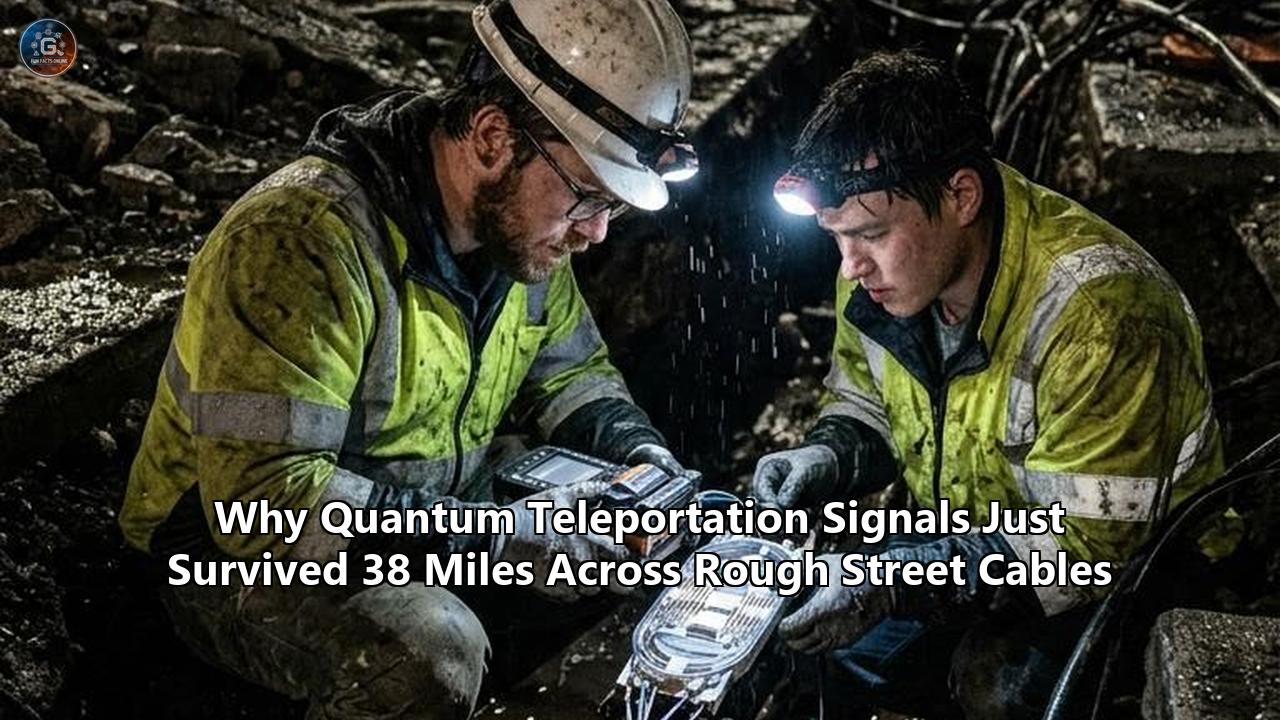
A single photon carrying fragile quantum information traversed 38.5 miles (62 kilometers) of unshielded, real-world utility fibers buried beneath traffic-choked metropolitan streets and suspended from outdoor power poles—and arrived at its destination with its quantum state fully intact.
The joint field trial, conducted by physicists at the National Institute of Standards and Technology (NIST) in partnership with the University of Maryland and quantum networking firm Qunnect, successfully maintained high-fidelity quantum state teleportation over a deployed dark-fiber link between Gaithersburg and College Park, Maryland.
Unlike previous controlled laboratory demonstrations performed over neatly coiled optical spools resting on vibration-isolated optical tables, this experiment subjected flying photonic qubits to the brutal realities of urban infrastructure: severe diurnal temperature swings, mechanical rumbles from nearby highways, aerial line sways caused by wind, and physical strain from city construction.
The trial achieved quantum entanglement fidelity exceeding 90 percent over the 38.5-mile street loop, proving that quantum states can survive the hostile physical conditions of everyday metropolitan telecommunications infrastructure. Lead NIST physicist Yicheng Shi characterized the deployment as a critical stress test. "We put this to an extreme test in an environment that's really noisy," Shi reported following the trial. "I would call this a stress test of quantum networking systems."
This achievement resolves a long-standing impasse in quantum communications: the severe signal degradation that occurs when delicate quantum signals transition from protected research laboratories into messy municipal fiber conduits. By proving that real-time stabilization technologies can preserve photon states across unshielded street cables, the trial provides a clear technical roadmap for building a scalable quantum internet on top of existing urban utility infrastructure.
The Challenge Revealed: Why Metropolitan Streets Destroy Quantum States
Quantum state teleportation does not physically move a particle from point A to point B. Instead, it uses the quantum mechanical resource of entanglement—combined with classical telecommunication signals—to instantly reconstruct the exact quantum state of a photon at a distant node without measuring or destroying the underlying state at the source.
To execute this protocol, two spatially separated nodes (conventionally called Alice and Bob) must share an entangled pair of photons. Alice performs a joint measurement—known as a Bell State Measurement (BSM)—between an unknown incoming qubit and her half of the entangled pair. She then sends the classical result of that measurement to Bob, who performs a corresponding unitary transformation on his half of the pair, thereby reconstructing the original quantum state.
                     METROPOLITAN DARK FIBER LINK
 [ Alice: NIST Lab ] ====================================> [ Bob: UMD Lab ]
 (Gaithersburg, MD)    38.5 Miles / 62 Km Street Cables    (College Park, MD)
         |                                                         |
         |---> [ Active Stabilization & Real-time Laser ] -------->|
In an ideal theoretical environment, photons travel down silica optical fibers as pristine electromagnetic wavepackets. But when quantum light enters real-world street cables, the surrounding environment wages non-stop physical interference against the light particles.
While laboratory quantum teleportation experiments relied on pristine spooled fibers sitting in climate-controlled underground cleanrooms, deployed metropolitan fibers are continuously deformed by environmental forces.
The Physics of Real-World Fiber Noise
Three primary physical mechanisms destroy photonic quantum states inside real-world street cables:
- Thermally Induced Phase Drift and Length Fluctuation: Standard single-mode optical fiber (such as SMF-28) exhibits a thermo-optic coefficient where changes in ambient temperature alter the fiber's refractive index ($n$) and cause physical thermal expansion of the glass core. A temperature shift of just 1°C along a 38-mile stretch changes the optical path length by several millimeters—a massive shift when working with light waves measured in nanometers. This expansion causes severe phase jitter, destroying the phase coherence required for quantum state superposition.
- Dynamic Birefringence and Polarization Scrambling: Mechanical vibrations from passing vehicular traffic, commuter trains, and aerial wind shear exert asymmetrical mechanical stress on the cylindrical fiber core. This induces stress-birefringence, splitting the fiber into fast and slow optical axes. Because quantum information is frequently encoded in the polarization state of a single photon (e.g., horizontal/vertical or left/right circular polarization states), dynamic stress continuously rotates and scrambles the polarization vector, turning clean quantum information into pure thermal noise.
- Photon Loss and Attenuation: Optical fiber absorbs light at a rate of approximately 0.2 dB per kilometer at telecom C-band wavelengths (1550 nm), and up to 0.35 dB/km in O-band wavelengths (1310 nm). Across a 38.5-mile (62 km) link, roughly 90 to 95 percent of all injected single photons are absorbed or scattered before reaching the receiver. When signal levels drop down to single-photon counts per second, even tiny amounts of stray noise can completely ruin the quantum signal-to-noise ratio.
+-------------------------------------------------------------------------+
|                  ENVIRONMENTAL NOISE SOURCES IN DARK FIBER              |
+-------------------------------------------------------------------------+
|  Noise Mechanism        | Physical Cause         | Impact on Quantum Qubit|
+-------------------------+------------------------+------------------------+
| Thermal Expansion       | Solar heat, seasonal   | Destroys optical phase |
|                         | ambient temperature    | coherence; shifts      |
|                         | changes                | photon arrival timing  |
+-------------------------+------------------------+------------------------+
| Mechanical Birefringence| Traffic vibrations,    | Scrambles polarization |
|                         | subway rumbles, aerial | states (H/V, R/L)      |
|                         | cable wind sway        |                        |
+-------------------------+------------------------+------------------------+
| Photonic Loss &         | Rayleigh scattering,   | Reduces single-photon  |
| Attenuation             | silica material        | count rate; lowers     |
|                         | absorption             | signal-to-noise ratio  |
+-------------------------+------------------------+------------------------+
| Spontaneous Raman       | Co-propagating high-   | Generates background   |
| Scattering (SpRS)       | power classical data   | light that swamps      |
|                         | laser traffic          | quantum detectors      |
+-------------------------------------------------------------------------+
The Bell State Measurement Crisis
The impact of these environmental perturbations is most severe during the Bell State Measurement (BSM). To perform a BSM, two separate photons—one carrying the input state and one from the entangled pair—must arrive at a 50:50 beam splitter simultaneously.
For two-photon quantum interference (the Hong-Ou-Mandel effect) to occur, the two photons must be fundamentally indistinguishable in every physical degree of freedom: spatial mode, spectral bandwidth, polarization, and arrival time.
If street cable vibrations delay one photon by even 100 femtoseconds ($10^{-13}$ seconds), or if aerial thermal drifts rotate its polarization by 5 degrees, the photons become distinguishable. The quantum interference vanishes, the BSM fails, and quantum teleportation becomes impossible.
The Infrastructure Dilemma: Why Custom Quantum Cables Are a Dead End
Faced with the extreme sensitivity of photonic qubits, an obvious initial suggestion was to construct dedicated, underground, temperature-stabilized, and shock-isolated fiber optic networks exclusively built for quantum traffic.
However, tech leaders, telecommunication carriers, and government agencies quickly realized that building dedicated infrastructure was financially and logistically impossible.
                       ESTIMATED COST COMPARISON

  Dedicated Quantum Fiber Networks (New Trenching)
  =======================================================> $500,000+ / mile

  Existing Dark Fiber Retrofit (Active Compensation)
  ===================> $25,000 - $50,000 / link node
Digging up metropolitan streets to lay new fiber conduits costs between $100,000 and over $500,000 per mile in densely populated urban centers, driven by municipal permits, utility rerouting, asphalt excavation, and environmental compliance. Installing a dedicated national quantum network across tens of thousands of miles would cost hundreds of billions of dollars.
The stark contrast between benchtop setups and real-world infrastructure explains why so many previous quantum teleportation experiments stalled at the city limits. Early field trials routinely suffered from high error rates because researchers assumed urban dark fiber would behave like spooled laboratory fiber. When subjected to the harsh conditions of street conduits, uncompensated quantum error rates spiked past 30 percent—well above the theoretical threshold required for fault-tolerant quantum communication.
If quantum technology required dedicated fiber lines, it would remain trapped in research labs indefinitely. The survival of quantum signals inside existing, unshielded dark fiber cables is therefore a mandatory prerequisite for any practical, metropolitan-scale quantum network.
What Went Wrong in Prior Experiments: The Anatomy of Real-World Signal Decay
To understand why the NIST, UMD, and Qunnect 38.5-mile breakthrough is so significant, it is necessary to examine how earlier real-world field experiments failed when exposed to live outdoor conditions.
  TYPICAL PHOTON LOSS OVER FIBER DISTANCE (1550 nm C-Band)

  100% Signal |------------------------
              |                        \
   50% Signal |                         \
              |                          \
   10% Signal |                           \
              |                            +-----------------------
    0% Signal +----------------------------------------------------
              0 km       10 km       20 km       30 km       60 km
The Temperature-Induced Drift Fallacy
In 2016 and 2020, pioneering research groups conducted long-distance quantum state transfer across spooled fibers and select underground dark fibers. While these early tests achieved notable distance records (such as Fermilab's impressive 44-kilometer laboratory-spool network demonstration), they relied heavily on slow, manual recalibration routines.
In those setups, researchers paused quantum data collection every few minutes to send alignment pulses through the fiber, manually adjusting polarization paddles to restore signal fidelity.
However, in deployed outdoor cables—particularly aerial cables attached to telephone poles or conduits running along elevated bridges—environmental changes happen far too quickly for manual adjustments:
- An overhead cloud passing in front of the sun can drop aerial fiber temperatures by several degrees Celsius in under 60 seconds.
- A heavy freight train passing over an under-rail conduit creates high-frequency acoustic shockwaves ($10\text{ Hz} - 10\text{ kHz}$) that vibrate the fiber thousands of times per second.
Under these fast-changing conditions, static or slow alignment systems fail completely. Within seconds, the polarization vector drifts out of alignment, causing quantum error rates to surge and terminating the teleportation link.
       SLOW COMPENSATION VS. REAL-TIME FAST FEEDBACK

  Slow Alignment (Manual / Intermittent)
  [ Data Run ] --> [ System Pause ] --> [ Manual Adjust ] --> [ Signal Drift Error ]

  Real-Time Dynamic Tracking (NIST / Qunnect Breakthrough)
  [ Continuous Classical Reference Laser ] --> [ Real-time Feedback Loop ] --> [ Uninterrupted Qubit Stream ]
The Classical Cross-Talk Barrier
Another major bottleneck emerged when scientists tried to send quantum signals through optical fibers that were actively carrying classical internet data.
Classical telecommunication networks rely on dense wavelength-division multiplexing (DWDM), packing dozens of optical channels into the standard telecommunications C-band ($1530\text{ nm} - 1565\text{ nm}$). These classical channels transmit intense streams of light containing billions of photons per nanosecond.
By contrast, quantum teleportation relies on single, isolated photons. When intense classical laser light travels through a glass fiber, it triggers a non-linear optical process known as Spontaneous Raman Scattering (SpRS).
High-power classical light interacts with the molecular vibrations of the silica fiber glass, scattering photons into adjacent optical wavelengths. This scattered light creates a background glare across the spectrum.
  OPTICAL SPECTRUM MULTIPLEXING (O-BAND VS. C-BAND)

  Intensity
     ^
     |      [ O-Band Quantum Signal ]            [ C-Band Classical Internet Traffic ]
     |            (1290 - 1310 nm)                       (1530 - 1565 nm)
     |                 |  |                                |  |  |  |  |
     |                 |  |                                |  |  |  |  |
     |                 v  v                                v  v  v  v  v
     +----------------------------------------------------------------------------> Wavelength
                        ^                                        ^
                        |                                        |
                 Zero Dispersion                          High Power Data
                 Low Raman Glare                          (Terabits/sec)
Trying to detect a single quantum photon in a fiber filled with classical internet traffic is like trying to spot a firefly sitting directly next to a searchlight. The Raman background noise swamps single-photon detectors, causing false detections (dark counts) that ruin the quantum state measurement.
The Solutions: How Experts Kept the Teleportation Signal Alive
To overcome these environmental obstacles, the research team from NIST, UMD, and Qunnect engineered an active stabilization architecture capable of preserving quantum states over unshielded street cables.
Their strategy combined continuous, active feedback loops, advanced frequency management, precise attosecond timing control, and high-efficiency cryogenic detection systems.
+-------------------------------------------------------------------------+
|                  SUMMARY OF TECHNOLOGICAL SOLUTIONS                     |
+-------------------------------------------------------------------------+
| Breakthrough Feature    | Technical Mechanism     | Problem Solved      |
+-------------------------+-------------------------+---------------------+
| Real-Time Polarization  | Co-propagating reference| Corrects dynamic    |
| Compensation            | laser + liquid crystal  | polarization drifts |
|                         | active phase retarders  | from vibrations     |
+-------------------------+-------------------------+---------------------+
| O-Band / C-Band         | Spectral separation     | Eliminates classical|
| Wavelength Placement    | (1290 nm quantum vs.    | Raman scattering    |
|                         | 1550 nm classical)      | noise interference  |
+-------------------------+-------------------------+---------------------+
| Attosecond-Level Timing | Optical frequency comb  | Prevents path-length|
| Synchronization         | path-length lock        | arrival jitter      |
+-------------------------+-------------------------+---------------------+
| Cryogenic Superconducting| Nanowire detectors      | Maximizes single-   |
| Detectors (SNSPDs)      | operating at < 1 Kelvin | photon capture with |
|                         |                         | zero dark counts    |
+-------------------------------------------------------------------------+
Solution 1: Real-Time Dynamic Polarization Stabilization
Rather than relying on periodic system pauses, the NIST and Qunnect team built a continuously active tracking system to correct fiber distortions as they occurred.
 [ Source ] ---> ( Flying Qubit + Bright Reference Laser )
                                |
                                v
                [ 38.5 Miles Rough Street Cable ]
                                |
                                v
 [ Receiver ] <--- [ Polarizing Beam Splitter ]
                          |                 |
                          v                 v
                 ( Reference Light )    ( Quantum Qubit )
                          |                 |
                          v                 v
                 [ Fast Controller ]   [ Clean Quantum ]
                          |            [  Measurement  ]
                          +--- Loop --->
The system sends a bright "pilot" classical reference laser down the same 38.5-mile fiber alongside the fragile quantum photons. This reference laser travels at a slightly offset wavelength, allowing it to experience the same physical temperature shifts and mechanical vibrations as the single photons without disturbing the quantum state.
At the receiving node, a fast optical analyzer constantly monitors the polarization state of the bright reference laser. When street vibrations or temperature drops twist the reference laser's polarization, high-speed digital signal processors instantly calculate the exact inverse mathematical transformation.
This inverse transformation is then immediately applied to the incoming quantum photons using high-speed electro-optic liquid-crystal phase retarders and piezoelectric fiber squeezers.
By updating these corrections hundreds of times per second, the active feedback system neutralizes fiber noise in real time, keeping the photon polarizations perfectly aligned over the entire 38.5-mile street run.
Solution 2: Wavelength Placement and Spectral Filtering
To eliminate cross-talk from co-propagating classical internet traffic, researchers developed targeted spectral filtering strategies. Pioneered in field experiments by Prem Kumar's team at Northwestern University and refined in recent metropolitan deployments, this approach strategically places quantum photons in specialized wavelength bands.
  ATTENUATOR & FILTER ARCHITECTURE AT RECEIVER NODE

  Street Fiber Input
        |
        +---> [ High-Isolation Dichroic Wavelength Splitter ]
                     |                                |
                     v                                v
        [ O-Band Quantum Light ]             [ C-Band Classical Data ]
                     |                                |
                     v                                v
        [ Ultra-Narrow Bragg Filter ]        [ Standard Telecom RX ]
                     |
                     v
        [ Cryogenic SNSPD Array ]
Instead of sending quantum photons through the crowded telecommunication C-band ($1550\text{ nm}$), researchers moved the quantum channel to the original telecom band (O-band, centered near $1290\text{ nm} - 1310\text{ nm}$). This wavelength shift provides two significant physical advantages:
- Raman Noise Bypass: Spontaneous Raman Scattering generated by C-band classical traffic scatters light predominantly toward longer wavelengths (Red-shifted Stokes scattering). By placing the quantum channel in the shorter O-band wavelength region, the quantum photons travel through a clear spectral window free from classical Raman glare.
- Zero Chromatic Dispersion: Standard silica optical fiber exhibits near-zero material dispersion near $1310\text{ nm}$. This prevents single-photon wavepackets from spreading out over time as they travel down the 38-mile cable, keeping photon arrival times sharp and precise.
To complement this wavelength separation, the receiving nodes use ultra-narrowband volume Bragg gratings and dielectric thin-film optical filters. These filters act as extreme optical guards, blocking unwanted background light with an isolation ratio exceeding 80 dB (100-million-to-1), ensuring that only true quantum photons reach the sensitive single-photon detectors.
Solution 3: Attosecond-Level Timing Control via Optical Frequency Combs
To maintain the precise photon arrival synchronization required for Bell State Measurements across 38.5 miles of fluctuating cable, researchers implemented precision timing stabilization methods adapted from optical atomic clock technologies.
  OPTICAL FREQUENCY COMB TIMING STABILIZATION

   Atomic Clock / Frequency Comb Node A
                    |
                    |---> High-Precision Optical Pulse Train
                    |
          =================================== (38.5 Mile Fiber Path)
                    |
                    v
   Phase Comparator & Nanometer Delay Stage
                    |
                    +---> Timing Jitter Locked to < 100 Attoseconds
By connecting the fiber links to stabilized optical frequency combs—which serve as ultra-precise "optical rulers"—researchers continuously measure microscopic variations in optical path delay.
If temperature changes expand the fiber length by a few nanometers, the frequency comb system immediately detects the phase shift. An automated optical delay line then physically adjusts the optical path inside the lab, cancelling out path-length fluctuations.
This dynamic path stabilization keeps timing jitter below 100 attoseconds ($10^{-16}$ seconds) across the entire 38.5-mile fiber link. This extraordinary level of precision ensures that single photons generated miles apart arrive at the central beam splitter with absolute synchronization, preserving the high two-photon interference visibility necessary for reliable quantum state teleportation.
Solution 4: Superconducting Nanowire Single-Photon Detectors (SNSPDs)
The final key component enabling real-world quantum state teleportation is the deployment of Superconducting Nanowire Single-Photon Detectors (SNSPDs).
  SNSPD WORKING PRINCIPLE

  Single Incident Photon
          |
          v
  +-----------------------+ <--- Cryogenic Nanowire (Cooled to < 1 Kelvin)
  | Superconducting Layer |      Maintained near critical current (Ic)
  +-----------------------+
          |
          +---> Local Absorption destroys Superconductivity (Hotspot)
          |
          v
  Current Diverts -> Fast Voltage Pulse Outputted (Detection Event)
Standard semiconductor-based single-photon detectors (such as Silicon or InGaAs avalanche photodiodes) suffer from high thermal dark count rates, low detection efficiencies (often below 20-30%), and significant timing jitter.
SNSPDs overcome these limitations by operating at ultracold temperatures near 0.8 Kelvin (-272.35°C):
- A thin film of superconducting material (such as Niobium Nitride or Tungsten Silicide) is chilled until it loses all electrical resistance, carrying a electrical bias current just below its critical threshold.
- When a single quantum photon strikes the nanowire, the absorbed energy disrupts the superconducting state, creating a microscopic non-superconducting "hotspot."
- This sudden resistance forces the electrical bias current to divert into external readout electronics, producing an ultra-fast voltage pulse that registers the photon's arrival with picosecond accuracy.
SNSPDs provide system detection efficiencies over 95 percent, combined with extremely low dark count rates (less than one false count per second). This exceptional sensitivity allows researchers to isolate faint quantum signals from background noise, enabling high-fidelity teleportation even after signals undergo severe transmission losses over long metro fiber links.
Architectural Breakthrough: Laboratory vs. Real-World Metropolitan Teleportation
The technical innovations validated during the NIST, UMD, and Qunnect trials fundamentally reshape the design of practical quantum networks.
By replacing delicate benchtop components with automated, field-ready stabilization units, researchers have bridged the gap between theoretical physics and real-world network engineering.
+-------------------------------------------------------------------------+
|        LABORATORY BENCHTOP VS. REAL-WORLD METROPOLITAN NETWORKS         |
+-------------------------------------------------------------------------+
| Feature               | Lab Benchtop Setups     | Metro Field Network   |
+-----------------------+-------------------------+-----------------------+
| Fiber Channel         | Spooled SMF-28 glass on | Dark fiber under metro|
|                       | isolated optical tables | streets & utility line|
+-----------------------+-------------------------+-----------------------+
| Channel Conditions    | Temperature constant    | Temp shifts (10-30°C),|
|                       | (±0.1°C), zero vibration| heavy traffic rumbles |
+-----------------------+-------------------------+-----------------------+
| Polarization Tracking | Static manual paddles;  | High-speed active     |
|                       | periodic manual resets  | dynamic feedback loops|
+-----------------------+-------------------------+-----------------------+
| Classical Coexistence | None (Dark spools only) | WDM O-band/C-band     |
|                       |                         | co-propagation        |
+-----------------------+-------------------------+-----------------------+
| Timing Sync           | Shared local clock cable| Comb-stabilized laser |
|                       | across adjacent table   | optical path locking  |
+-----------------------+-------------------------+-----------------------+
| Operational Mode      | Intermittent batch runs | Continuous, automated |
|                       | requiring manual alignment real-time operation  |
+-------------------------------------------------------------------------+
Recent field-deployed quantum teleportation experiments demonstrate that dynamic compensation loops can preserve qubit integrity across chaotic urban routes, proving that future quantum communications do not require building expensive, specialized fiber networks from scratch.
Strategic Implications: Building the Metropolitan Quantum Internet
The ability to maintain high-fidelity quantum state teleportation across unshielded street fiber cables has immediate strategic implications for commercial telecommunications, enterprise security, and distributed computing.
                     FUTURE METROPOLITAN QUANTUM NETWORK

    [ Quantum Cloud Server ]             [ Financial Data Center ]
             |                                       |
             v                                       v
    +---------------------------------------------------------+
    |           STABILIZED METRO DARK-FIBER BACKBONE          |
    |      (Dynamic Polarization & Phase Tracking Nodes)     |
    +---------------------------------------------------------+
             ^                                       ^
             |                                       |
             v                                       v
    [ Atomic Clock Array ]               [ Quantum Sensor Hub ]
1. Ultra-Secure Quantum Key Distribution (QKD) and Entanglement Networks
While first-generation QKD systems relied on direct single-photon transmission—which remains vulnerable to fiber attenuation and physical interception—teleportation-based quantum networks offer far superior security.
By distributing entangled photon pairs and using Bell State Measurements to execute quantum teleportation, encryption keys can be established between distant enterprise nodes without sensitive state information ever traveling exposed across the link.
If an eavesdropper attempts to intercept or tap the optical fiber, the quantum state collapses instantly, alerting network operators and shutting down the key distribution process before data can be compromised.
2. Blind Quantum Cloud Computing
As quantum computers scale in size and power, cloud-based access will become the primary commercial delivery model. However, enterprise users in sensitive sectors—such as defense, pharmaceuticals, and finance—cannot risk sending proprietary quantum algorithms or sensitive datasets over unencrypted channels.
Teleportation-enabled quantum networks solve this privacy challenge through "blind quantum computing."
Using quantum state teleportation, a client can feed inputs directly into a remote quantum server's registers without disclosing the underlying code, data, or output. The remote quantum computer executes the calculations while remaining entirely "blind" to the computation it is performing.
3. Distributed Quantum Processing and Superconducting Arrays
Individual quantum processors face severe physical scaling limits due to thermal constraints inside cryogenic dilution refrigerators, control line interference, and crosstalk between physical qubits.
To build systems with millions of physical qubits, quantum computing architectures must shift toward distributed modular designs—connecting multiple smaller quantum processing units (QPUs) into a unified computational cluster.
               DISTRIBUTED MODULAR QUANTUM ARCHITECTURE

   +-------------------+                       +-------------------+
   |  QPU Module Alpha |                       |  QPU Module Beta  |
   | (1,000 Qubits)    |                       | (1,000 Qubits)    |
   +-------------------+                       +-------------------+
             |                                           |
             +---> [ Quantum Teleportation Link ] <------+
                          (Inter-Module Bus)
High-fidelity quantum state teleportation serves as the high-speed data bus for this distributed architecture, enabling quantum logic gates to operate seamlessly between QPUs located in separate racks, adjacent rooms, or across distant data centers.
4. Precision Quantum Sensor Arrays and Global Timekeeping
Quantum teleportation across metropolitan optical fibers enables the creation of wide-area quantum sensor arrays.
By linking spatially separated optical atomic clocks, radio telescopes, and gravitational wave sensors using quantum entanglement, scientists can build distributed optical interferometers with unprecedented spatial resolution.
These networked quantum sensors can detect tiny shifts in Earth's gravitational field, pinpoint subterranean water tables, map geological fault lines, and establish global timekeeping standards with sub-femtosecond synchronization.
Expert Commentary & Global Research Comparison
The success of the NIST, UMD, and Qunnect 38.5-mile street deployment builds upon a series of rapid breakthroughs achieved by competing quantum research groups worldwide.
  LONG-DISTANCE QUANTUM ENTANGLEMENT & TELEPORTATION MILESTONES

  2020: Fermilab / PRX Quantum (44 km Spooled/Dark Fiber Teleportation)
  --------------------------------------------------------------------
  2024: Northwestern / Optica (30 km Live Internet Cable Teleportation)
  --------------------------------------------------------------------
  2026: NIST / UMD / Qunnect (62 km / 38.5 mi Rough Street Cable Trial)
  --------------------------------------------------------------------
  2026: USTC / PRL (420 km Quantum Memory Entanglement Extension)
Commenting on the technical significance of the real-world street cable trial, lead author Yicheng Shi highlighted the intentional harshness of the test conditions. "The experiment did not break a record for absolute distance," Shi noted, referring to long-distance tests over peaceful underground cables. "But the study stands out for how much fiber was exposed to influences that real-world quantum networks will have to contend with."
At Northwestern University, Professor Prem Kumar—who led the team that first demonstrated quantum state teleportation over fiber carrying live 400 Gbps classical internet traffic—emphasized the economic importance of using existing infrastructure. "Many people have long assumed that nobody would build specialized infrastructure to send particles of light," Kumar explained. "If we choose the wavelengths properly, we won't have to build new infrastructure. Classical communications and quantum communications can coexist."
Concurrently, researchers at the University of Science and Technology of China (USTC), led by Xi-Yu Luo and Chao-Yang Wang, published results in Physical Review Letters demonstrating matter-to-matter quantum memory entanglement over 420 kilometers (261 miles) of optical fiber.
While the USTC experiment achieved a longer absolute distance, it relied heavily on specialized laboratory setups. By contrast, the NIST-UMD-Qunnect project focused directly on solving the messy, unpredictable noise problems found in everyday metropolitan dark fiber.
Roadmap: What to Watch Next in Quantum Communications
As next-generation quantum teleportation experiments scale from 38-mile single-span links to multi-node metropolitan repeaters, researchers are turning their attention to four critical engineering milestones over the next 3 to 5 years:
  3-TO-5 YEAR QUANTUM NETWORKING ROADMAP

  Phase 1: Field-Deployable Stabilization Hardware
  [ Active Polarization & Phase Boxes Installed in Telco Racks ]
                            |
                            v
  Phase 2: Multi-Node Urban Quantum Routers
  [ Automated Routing & Dynamic Entanglement Swapping Across 3+ Nodes ]
                            |
                            v
  Phase 3: Integration of Room-Temperature Quantum Memories
  [ Rubidium Atomic Vapour & Solid-State Qubit Storage Integration ]
                            |
                            v
  Phase 4: Live Coexistence on Commercial Backbones
  [ Enterprise Quantum Teleportation Over Active Telecom Fiber ]
Milestone 1: Commercialization of Plug-and-Play Stabilization Hardware
Companies like Qunnect, Toshiba Quantum Technology, and ID Quantique are miniaturizing complex laboratory stabilization setups into rack-mountable 19-inch network appliances.
These automated units will plug directly into standard telecommunication fiber frames, handling polarization tracking, phase locking, and spectral filtering automatically—without requiring a team of optical physicists to operate them.
Milestone 2: Deployment of Practical Quantum Repeaters
Because photon loss is exponential, optical fiber attenuation limits direct quantum teleportation to roughly 60–100 miles before signal rates drop to unusable levels. Extending quantum state teleportation across continents requires quantum repeaters.
Unlike classical network repeaters—which read incoming data pulses, amplify them, and retransmit them—quantum repeaters cannot read or measure light signals without instantly destroying the delicate quantum states.
Instead, quantum repeaters use a process called entanglement swapping.
By establishing entangled links across shorter intermediate segments ($A \leftrightarrow B$ and $B \leftrightarrow C$) and performing a Bell State Measurement at the midpoint node ($B$), entanglement is automatically established between distant endpoints ($A \leftrightarrow C$) without ever directly sending a photon between them.
                   QUANTUM REPEATER ENTANGLEMENT SWAPPING

    Node A <=== Entangled Pair 1 ===> Node B <=== Entangled Pair 2 ===> Node C
      |                                 |                                 |
      |                                BSM                                |
      v                             (Swapping)                            v
  =================== Remote Entangled Link Established ===================
Milestone 3: Integration of Atomic Quantum Memories
To execute complex quantum protocols across multi-node networks, quantum routers must be able to temporarily store flying photonic qubits while waiting for classical feed-forward routing signals to arrive.
Researchers are actively integrating warm atomic vapor quantum memories (such as rubidium gas cells operating at room temperature) and solid-state rare-earth-doped crystals into metro dark-fiber networks.
These quantum memories act as optical RAM, storing light states for milliseconds without losing quantum coherence, providing the necessary buffer for dynamic quantum routing.
Milestone 4: Multi-User Metropolitan Quantum Testbeds
Governments and telecom operators are expanding real-world quantum testbeds across major urban centers. Initiatives like the U.S. Department of Energy's Illinois Express Quantum Network (IEQNET), Europe's EuroQCI initiative, and municipal dark-fiber loops in New York, Washington D.C., and London are transitioning from dual-node experiments to multi-user, software-defined quantum networks.
These urban testbeds will evaluate how quantum state teleportation performs under heavy, multi-tenant network loads, paving the way for commercial quantum-as-a-service (QaaS) offerings.
A Foundational Step for Practical Quantum Networks
The successful survival of quantum state teleportation signals across 38.5 miles of unshielded street cables marks a decisive turning point in quantum engineering.
By confronting and solving the acoustic, thermal, and mechanical noise of municipal fiber infrastructure, researchers have proved that building a quantum network does not require ripping up roads or laying trillions of dollars of custom cable.
Through real-time polarization compensation, attosecond timing synchronization, spectral isolation, and cryogenic photon detection, fragile quantum states can coexist with the chaotic physical forces of modern metropolitan cities.
The transition of quantum state teleportation from protected physics laboratories onto public streets confirms that the foundation for a global, interconnected quantum internet is already buried right beneath our feet.
Reference:
- https://www.miragenews.com/spooky-particles-transit-dc-advance-quantum-1722446/
- https://news.fnal.gov/2020/12/fermilab-and-partners-achieve-sustained-high-fidelity-quantum-teleportation/
- https://lss.fnal.gov/archive/2024/pub/fermilab-pub-24-0500-v.pdf
- https://news.northwestern.edu/stories/2024/12/first-demonstration-of-quantum-teleportation-over-busy-internet-cables
- https://gizmodo.com/physicists-smash-quantum-teleportation-record-with-60-m-1732525396
- https://www.optica.org/about/newsroom/news_releases/2026/researchers_demonstrate_stable_links_for_quantum_networks_over_kilometers_of_noisy_fiber/
- https://www.sciencealert.com/quantum-teleportation-was-achieved-over-the-internet-for-the-first-time
- https://www.mccormick.northwestern.edu/news/articles/2024/12/first-demonstration-of-quantum-teleportation-over-busy-internet-cables/
- https://okdiario.com/techy/en/it-sounded-like-science-fiction-but-scientists-sent-quantum-data-through-19-miles-of-regular-internet-cable-without-breaking-the-network/4704/
- https://www.iflscience.com/first-quantum-teleportation-over-noisy-internet-cables-77366
- https://www.researchgate.net/publication/384042083_Demonstration_of_quantum_network_protocols_over_a_14-km_urban_fiber_link
- https://sciencemediacentre.es/en/quantum-teleportation-through-conventional-fibre-optics-possible
- https://www.reddit.com/r/science/comments/1vf70f9/physicists_shatter_quantum_entanglement_distance/