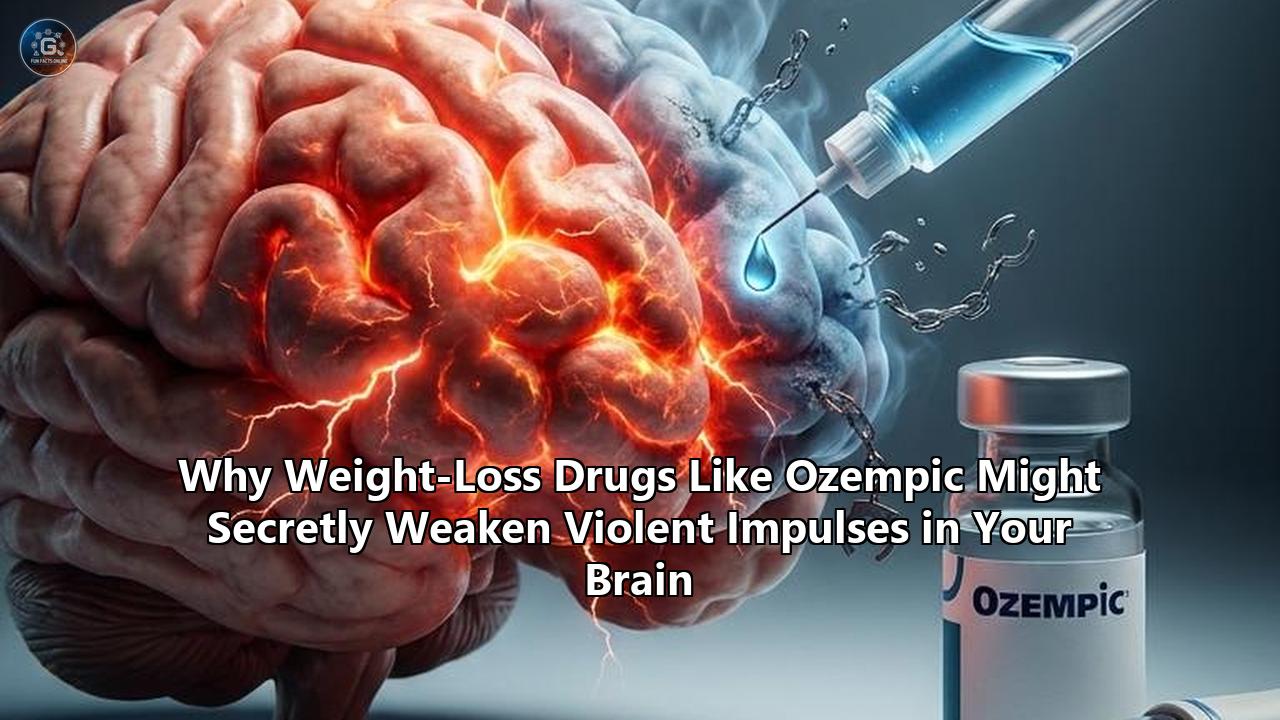
On June 17, 2026, a study quietly slipped into the pages of the academic journal Criminology that would instantly destabilize our understanding of human violence, self-control, and the pharmaceutical blockbusters currently reshaping global society.
The paper, authored by researchers at Rutgers University, did not set out to solve the crisis of urban crime or dissect the minds of serial offenders. Instead, it investigated a curious, quiet side effect occurring inside the brains of millions of people currently injecting glucagon-like peptide-1 (GLP-1) receptor agonists—medications sold under household names like Ozempic, Wegovy, and Mounjaro.
What they discovered was startling. For individuals actively taking these medications, the standard, decades-old psychological link between highly impulsive personality traits and physical violence was blunted by a staggering 62%. Furthermore, the historically ironclad relationship between heavy alcohol consumption and violent behavior—the catalyst for an estimated 40% of all violent crimes globally—was weakened by 52%.
"Our findings are consistent with these medications working like cognitive behavioral therapy, weakening the path from impulse to action rather than eliminating impulsivity itself," said Christopher Thomas, an assistant professor of criminal justice at Rutgers University-Camden and co-author of the study.
For years, the public narrative surrounding semaglutide and its chemical cousins has focused on waistlines, diabetes management, and the financial fortunes of Danish pharma giant Novo Nordisk. But behind the scenes, a growing coalition of neuroscientists, criminologists, and psychiatrists have been following a far more profound trail of evidence. They are realizing that these weekly injections do not just slow down the stomach; they actively rewrite the electrical and chemical signaling of the human brain.
In doing so, these metabolic drugs are quietly revealing that some of our most deeply entrenched behavioral flaws—including the sudden, explosive urges that lead to physical violence—may not be failures of moral character, but rather highly treatable anomalies of neural circuitry.
The Rutgers Breakthrough: Following the Empirical Trail
To understand how a metabolic drug became a subject of interest for violence researchers, one has to look at the work of Daniel C. Semenza, an associate professor and director of research at the New Jersey Gun Violence Research Center at the Rutgers School of Public Health.
For years, Semenza’s work focused on classic criminological risk factors: poverty, neighborhood instability, trauma, gun availability, and domestic dysfunction. But as GLP-1 prescriptions exploded by more than 300% in the early 2020s, Semenza began noticing a bizarre pattern of anecdotal reports bubbling up in medical forums and social media. People taking the drugs were not just losing interest in food; they were suddenly quitting drinking, gambling, nail-biting, and compulsive shopping.
"As criminologists and violence researchers, that caught our attention," Semenza said in an interview following the study's release. "Impulsivity and alcohol use are among the most established behavioral risk factors for violence. We wanted to explore whether GLP-1 use might be associated with changes in the relationship between those risk factors and violent behavior."
                       ┌─────────────────────────┐
                       │  High Impulsive Traits  │
                       └────────────┬────────────┘
                                    │
                        Historically strong link
                        (Assaults, fighting, etc.)
                                    │
                                    ▼
                       ┌─────────────────────────┐
                       │    Physical Violence    │
                       └────────────▲────────────┘
                                    │
                    [ GLP-1 Agonists (e.g. Ozempic) ]
                    - Substantially weakens this link (by 62%)
                    - Acts as a circuit breaker between impulse and action
Semenza and Thomas designed a study utilizing data from a nationally representative survey of 7,521 U.S. adults, carefully isolating a subset of 821 individuals who had used a GLP-1 medication. They split this cohort into current users and former users. To measure violent behavior, the researchers employed a validated, self-reported offending scale that assessed actual physical behaviors over the preceding year, including street fighting, physical assaults, and armed robberies.
In the control group of former users—and the broader population of non-users—the data behaved exactly as criminologists have predicted for a century. People who scored high on standardized scales of impulsivity and those who drank heavily were vastly more likely to engage in violent crime.
But among the current GLP-1 users, that statistical correlation collapsed.
"Among former users, people with higher levels of impulsivity and alcohol use reported much higher levels of violent behavior, which is consistent with decades of prior research," Semenza explained. "Among current users, those relationships were much less pronounced. We were quite surprised with how robust the impulsivity finding was in particular."
The study did not suggest that Ozempic turned highly impulsive, aggressive people into perfectly placid saints. Instead, it revealed something far more biochemically precise: it acted as a circuit breaker. The raw materials of violence—the sudden flash of anger, the impulsive urge to strike out, the chemically induced lack of judgment—were still present. But the physical translation of those impulses into actual bodily harm simply failed to fire.
The bridge between the thought and the fist had been dismantled.
The Synaptic Brake: Mapping Ozempic Effects on Brain Circuits
To understand why this happens, we must descend from the macro-level statistics of sociology into the deep, wet architecture of the mammalian brain.
For the first two decades of its development, glucagon-like peptide-1 was viewed primarily as a gut hormone. Secreted by the L-cells of the small intestine in response to nutrients, natural GLP-1 travels through the bloodstream to the pancreas, where it triggers insulin secretion and suppresses glucagon, keeping blood sugar stable. It also binds to local receptors on the vagus nerve, sending a slow, mechanical signal to the brainstem: we are full, stop eating.
But natural GLP-1 is a highly fragile molecule. Within minutes of entering the bloodstream, it is chewed to pieces by an enzyme called dipeptidyl peptidase-4 (DPP-4).
The pharmaceutical breakthrough of semaglutide (Ozempic) was to modify this peptide chain, shielding it from DPP-4 and allowing it to persist in the human body for days instead of minutes. This prolonged lifespan allowed the drug to do something natural GLP-1 rarely could: saturate the central nervous system at sustained, therapeutic doses.
As scientists work to map the precise Ozempic effects on brain structures, they are realizing that the human brain is absolutely carpeted with GLP-1 receptors. Crucially, these receptors are not just confined to the hypothalamus—the primitive, deep-brain region that regulates basic metabolic functions like hunger, thirst, and body temperature. They are densely packed within the mesocorticolimbic system, the ancient neural superhighway that governs reward, motivation, salience, and behavioral reinforcement.
                     ┌─────────────────────────────┐
                     │      PREFRONTAL CORTEX      │
                     │  (Executive control/Brakes) │
                     └──────────────┬──────────────┘
                                    │
                      GLP-1 strengthens top-down control
                                    │
                                    ▼
       ┌────────────────────────────────────────────────────────┐
       │               MESOLIMBIC REWARD SYSTEM                 │
       │                                                        │
       │  ┌────────────────────────┐    ┌────────────────────┐  │
       │  │ VENTRAL TEGMENTAL AREA │───►│ NUCLEUS ACCUMBENS  │  │
       │  │         (VTA)          │    │       (NAc)        │  │
       │  └───────────┬────────────┘    └────────────────────┘  │
       │              │                                         │
       │     GLP-1 dampens cue-driven                           │
       │     dopamine surges here                               │
       └──────────────┼─────────────────────────────────────────┘
                      ▼
       ┌────────────────────────────┐
       │   Reduced Aggressive/      │
       │   Compulsive Output        │
       └────────────────────────────┘
When we look at how the mesolimbic pathway operates, we find the roots of both addiction and impulsive aggression. The system relies on a delicate balance between three key players:
- The Ventral Tegmental Area (VTA): The cradle of dopamine-producing neurons, which fire in response to survival cues (food, sex, safety) and artificial stimulants.
- The Nucleus Accumbens (NAc): The brain’s motivation engine. When dopamine surges from the VTA into the NAc, it generates a state of intense "wanting"—a powerful, visceral drive to consume, act, or react.
- The Prefrontal Cortex (PFC): The rational executive sitting at the front of the skull. The PFC is responsible for top-down control, weighing the future consequences of an action and applying the cognitive "brakes" to the impulses screaming out from the mesolimbic system.
Under normal circumstances, a highly impulsive individual has a prefrontal cortex that is chronically outmatched by their mesolimbic drive. When they encounter a provocative cue—such as an insulting comment, a physical threat, or a high-stress confrontation—their VTA releases a sudden, massive spike of dopamine into the nucleus accumbens. This generates an immediate, high-salience compulsion to react aggressively. Because their cognitive brakes are weak, the path from the VTA surge to a physical assault is nearly instantaneous.
This shift in understanding the Ozempic effects on brain pathways from metabolic to cognitive has revealed that synthetic GLP-1 acts as a powerful volume knob for this entire system.
When semaglutide binds to GLP-1 receptors in the VTA, it alters the local synaptic architecture. Specifically, it increases the presynaptic release of glutamate, which in turn modulates the excitability of dopaminergic projection neurons. Rather than shutting down dopamine entirely—which would cause severe motor deficits and profound clinical depression—the drug selectively dampens the peaks. It flattens the sudden, cue-triggered dopamine surges that drive compulsive behavior.
At the same time, functional MRI (fMRI) studies in humans have shown that GLP-1 receptor activation increases cerebral blood flow and neural activity within the anterior cingulate cortex and the ventromedial prefrontal cortex.
In other words, while the drug is down-regulating the raw emotional and physical cravings generated in the midbrain, it is simultaneously strengthening the neurological "brakes" in the forebrain. The consequence is a profound expansion of the split-second gap between stimulus and response.
Quiet in the Skull: Dismantling the "Rage Noise"
For patients who have taken Ozempic or Wegovy, the most commonly reported psychological effect is the sudden, eerie disappearance of "food noise."
For an individual with obesity or binge-eating disorder, food noise is not a simple, passing hunger. It is an intrusive, relentless, background hum of cognitive processing. The brain is constantly calculating: When is the next meal? How much sugar is in the pantry? Can I eat just one more slice? This mental chatter occupies immense cognitive bandwidth, draining executive function and making long-term self-control an exhausting, continuous uphill battle.
But as clinical researchers began studying this phenomenon, they realized that "food noise" is not a unique, isolated system. It is merely the metabolic expression of a universal human neurological state: compulsive salience.
For a person struggling with alcohol use disorder, the noise is the constant calculation of where the nearest bar is, or whether they can sneak a drink before a meeting. For a person with pathological gambling, the noise is the obsessive urge to check odds or pull a lever.
And for a person with an intermittent explosive disorder or high trait impulsivity, the noise is "rage noise."
Rage noise is the constant, low-level hyper-vigilance that interprets neutral social cues as active threats. It is the obsessive replaying of past grievances, the immediate flare of white-hot anger when cut off in traffic, and the internal voice that demands physical dominance or retaliation during a minor domestic dispute.
"What we are seeing is that the Ozempic effects on brain systems that govern executive function are proving to be remarkably generalized," says Dr. Sarah Lindstrom, a neuropsychiatrist who has studied off-label behavioral changes in GLP-1 patients. "We have had patients tell us, almost with a sense of disbelief, that for the first time in their adult lives, they didn’t want to scream back when someone yelled at them. They felt the anger, but it didn't possess them. It was just an emotion they could look at and put away."
This clinical observation aligns perfectly with the neurological findings of Karolina Skibicka, a neuroscientist whose lab has spent years mapping how GLP-1 receptor signaling in specific brain sub-regions controls food, drug, and social reward behaviors.
In animal models, Skibicka’s work demonstrated that micro-infusing GLP-1 agonists directly into the lateral septum—a brain region heavily implicated in both satiety and social aggression—dramatically reduced the animals’ motivation to work for highly rewarding stimuli without causing general lethargy or motor impairment.
The drug, in essence, targets the brain's "salience detector." It tells the amygdala and the nucleus accumbens that the environmental cue triggering your rage, your hunger, or your craving is simply not that important. It lowers the emotional volume of the world, allowing the rational prefrontal cortex to finally do its job.
The Alcohol Multiplier: Neutralizing the Catalyst of Violence
While the 62% reduction in impulsivity-driven violence was the most robust statistical signal in the Rutgers study, the 52% reduction in the link between alcohol and violent behavior represents the most immediate, real-world public health opportunity.
The relationship between alcohol and violence is one of the most thoroughly documented facts in all of criminology. Ethanol is a blunt-force trauma to the brain’s executive architecture. It is an agonist for GABA-A receptors, which slows down neural transmission, and an antagonist for NMDA glutamate receptors. In lay terms, alcohol systematically deactivates the prefrontal cortex—the very brakes we rely on to stop us from doing something catastrophic.
When you mix high baseline impulsivity with heavy alcohol consumption, you create a chemical pressure cooker. The VTA-NAc dopamine pathway is highly sensitized, driving aggressive, reward-seeking behavior, while the cognitive brakes are entirely offline. Under this state of disinhibition, minor slights translate into physical assaults, domestic arguments escalate into homicides, and casual altercations become deadly encounters.
GLP-1 receptor agonists appear to dismantle this deadly synergy through a double-pronged attack.
First, they dramatically reduce the actual physical desire to consume alcohol. In January 2025, a massive, landmark study published by scientists at Washington University School of Medicine in St. Louis and the Veterans Affairs (VA) St. Louis Health Care System analyzed clinical data from over two million veterans. Led by Dr. Ziyad Al-Aly, the study mapped 175 distinct health outcomes over a multi-year period, comparing veterans on GLP-1 medications to those on other, more traditional diabetes drugs.
The results were stunning. Veterans on GLP-1 drugs showed a massive, highly statistically significant reduction in the development of new addictions and relapses, particularly involving alcohol, cannabis, stimulants, and opioids.
| Substance | Risk Reduction on GLP-1 (VA St. Louis Study) |
|---|---|
| Alcohol Use Disorder / Relapse | ~50% Reduction |
| Opioid Use / Relapse | ~40% Reduction |
| Stimulant Abuse / Relapse | ~35% Reduction |
| Cannabis Dependence | ~30% Reduction |
This reduction in drinking occurs because the GLP-1 receptor agonists block the primary mechanism of alcohol reward. When a person on Ozempic drinks, they do not get the same sharp, pleasurable, dopamine-driven buzz that usually reinforces the behavior. The alcohol feels flat, unappealing, and chemically inert.
But the Rutgers study suggests an even more fascinating, secondary layer of protection: even when a GLP-1 user does choose to drink, and even when they become intoxicated, the alcohol is significantly less likely to provoke them into a state of physical violence.
"This suggests that GLP-1s are not just working by keeping people sober," says Daniel Semenza. "There is a direct behavioral stabilization occurring. Even under the influence of alcohol, the neurological pathway that translates a drunken impulse into a physical strike is somehow buffered."
By dampening the baseline reactivity of the mesolimbic dopamine system, the drug ensures that even when alcohol turns off the prefrontal cortex's top-down control, the underlying midbrain is not generating the massive, volatile spikes of explosive energy that typically drive aggressive outbursts. The biological engine of rage is running on low fuel.
The Darker Ledger: Anhedonia, Suicidality, and Emotional Blunting
To present GLP-1 receptor agonists as an unmitigated miracle for human behavior, however, would be a grave scientific error. The human brain is a highly tuned, homeostatic ecosystem. You cannot systematically down-regulate the dopamine-driven reward pathways of the midbrain without paying a biological tax.
In March 2026, the U.S. Food and Drug Administration (FDA) issued a formal, highly publicized warning to Novo Nordisk regarding failures to adequately monitor and report serious psychiatric side effects associated with its GLP-1 medications, including severe depressive episodes and suicidal ideation.
This was not a minor regulatory skirmish; it was a reflection of a growing, dark clinical signal. For a subset of patients, the silencing of "noise" does not stop at food, alcohol, or rage. It sweeps across the entire spectrum of human desire, leading to a state of profound clinical anhedonia—the total inability to feel pleasure, motivation, or joy.
"Dopamine is not the 'pleasure' chemical; it is the chemical of anticipation, motivation, and drive," explains Dr. Lindstrom. "When you blunt that system too heavily, you don't just stop wanting to overeat or fight. You can stop wanting to play with your children, listen to music, pursue your career, or wake up in the morning."
For these patients, the world does not become peaceful; it becomes entirely gray. The prefrontal cortex is no longer acting as a healthy, executive brake; instead, the entire motivational engine of the brain has been starved of its primary fuel.
               [ STANDARD THERAPEUTIC DOSE ]
               - Selective dampening of dopamine peaks
               - Healthy "cognitive brakes" (PFC active)
               - Reductions in cravings, rage, and compulsions
                               │
                               ▼
               [ OVER-DAMPENED DOPAMINE STATE ]
               - Global suppression of reward signaling
               - Clinical Anhedonia (Total loss of pleasure)
               - Depressive symptoms / Suicidal ideation
This psychiatric double-edged sword represents the central conflict of neuropsychology. The very same biological mechanism that makes Ozempic a potentially revolutionary tool for reducing violent crime—the suppression of intense, cue-driven, impulsive motivation—is also what makes it a potential hazard to mental health.
Furthermore, researchers must grapple with the complex relationship between weight loss, body image, and mental health. While many patients experience a profound psychological boost from shedding significant weight, others experience severe identity crises, rapid changes in interpersonal relationships, or the unmasking of deep-seated trauma that was previously self-medicated with food.
When you strip away a person’s primary coping mechanism—whether that mechanism is food, alcohol, or aggressive dominance—without providing alternative psychological support, the brain can lapse into states of severe, volatile despair. The chemical stabilizer can, in fragile systems, become an emotional wrecking ball.
Pharmacological Pacification: The Brave New World of Public Safety
The findings of the Rutgers study push us past the boundaries of medicine and land us squarely in a complex, ethically fraught landscape of criminology, law, and social philosophy.
For centuries, the criminal justice system has operated on the fundamental assumption of free will and moral agency. We punish offenders because we believe they made a conscious, rational choice to violate the social contract. When we attempt rehabilitation, we rely on cognitive, social, and spiritual interventions: counseling, vocational training, anger management classes, and restorative justice.
But if a simple, weekly subcutaneous injection can reduce a person’s biological translation of an impulsive urge into physical violence by more than 60%, the lines between "moral character" and "chemical state" become paper-thin.
This realization raises profound, deeply uncomfortable questions about the future of public safety and criminal justice:
1. The Rise of "Pharmacological Parole"
Could we see a future where courts offer violent offenders a choice: five years in a maximum-security penitentiary, or a mandatory, court-monitored weekly prescription of a GLP-1 receptor agonist?
While this sounds like the premise of a dystopian science fiction novel, the legal precedents for pharmacological intervention in criminal behavior already exist. In several U.S. states and European countries, convicted sex offenders are offered or mandated "chemical castration" (anti-androgen drugs like medroxyprogesterone acetate) as a condition of parole. If a drug like Wegovy can demonstrate a consistent, massive reduction in physical violence and domestic assault, the pressure from budget-strapped state prison systems to implement "pharmacological pacification" will be immense.
2. The Medicalization of Social Failures
By focusing on the chemical pathways inside an individual's brain, do we risk ignoring the systemic, societal drivers of violence?
If we treat street violence or domestic abuse primarily as a neurotransmitter imbalance to be corrected with a syringe, we can easily justify ignoring poverty, underfunded schools, racial inequality, housing instability, and the systemic trauma of marginalized communities. It is far cheaper for a state to subsidize generic semaglutide than it is to rebuild a broken economic infrastructure.
3. The Bio-Politics of Consent
How do we define true consent in a prison environment? If a parole board makes release contingent on taking a drug that permanently alters your brain chemistry, dampens your ability to feel pleasure, and carries a risk of severe depression, is that choice truly voluntary?
We find ourselves staring directly at the biopolitical warnings of philosopher Michel Foucault, who argued that modern states would increasingly seek to control populations not through physical chains, but through the highly precise, clinical management of the biological body itself.
What to Watch: The Upcoming Scientific Milestones
We are currently standing at the very beginning of this pharmacological revolution. The Rutgers study, as its authors are quick to point out, is an observational, cross-sectional piece of research. It established a powerful, undeniable correlation, but it cannot definitively prove a direct, molecular cause-and-effect relationship.
"We view this study as a first step, not a final answer," Daniel Semenza cautions. "Future longitudinal and experimental studies are absolutely critical to determine whether GLP-1 medications directly reduce violence risk, and to map out the exact human behavioral pathways involved."
To track how this startling science develops, there are several key milestones, ongoing trials, and clinical indicators to watch over the next 24 to 36 months:
- Longitudinal Cohort Studies: Researchers are currently designing studies that track individuals with high-trait impulsivity or prior violent offenses from the day they begin GLP-1 therapy, measuring objective behavioral changes over years rather than relying on retrospective surveys.
- Double-Blind Randomized Controlled Trials (RCTs) for Impulsivity: We must watch for the results of upcoming psychiatric clinical trials that test semaglutide and newer dual-agonist drugs (like tirzepatide) directly on populations diagnosed with severe impulse-control disorders, such as Intermittent Explosive Disorder (IED), ADHD, and Borderline Personality Disorder (BPD).
- Real-World Crime Database Integration: Researchers in countries with comprehensive, centralized national healthcare and criminal registries—such as Sweden, Denmark, and Norway—are currently working on matching national GLP-1 prescription databases directly with violent crime arrest records. These studies will provide massive, population-scale data that can either confirm or refute the Rutgers findings with absolute mathematical certainty.
- Neuroimaging (PET/fMRI) Studies: Watch for upcoming studies using Positron Emission Tomography (PET) to map exactly how GLP-1 medications alter dopamine D2/D3 receptor availability and active synaptic plasticity in the human striatum and prefrontal cortex during exposure to high-stress, anger-inducing stimuli.
- The Policy Battle Over Off-Label Use: As the evidence for neuropsychiatric benefits grows, expect intense policy debates within the FDA and the American Medical Association (AMA) regarding the approval of GLP-1 drugs for primary psychiatric indications. This will trigger massive fights over insurance coverage, as insurers who currently refuse to pay for weight-loss drugs may be forced to cover them if they are classified as vital treatments for severe addiction or public safety risks.
The ongoing debate surrounding the Ozempic effects on brain chemistry and behavior is forcing a profound, historic reckoning. It is proving that the biological boundaries we have erected to separate the metabolic body from the psychological mind are entirely artificial.
The very same hormone that tells a human being they have had enough to eat is also telling them, in the quietest depths of their synaptic architecture, that they have no need to strike out, to consume, or to destroy. As these molecules continue to saturate our global population, we are not just witnessing a historic shift in human physical health—we may be witnessing the chemical pacification of the human animal itself.
Reference:
- https://www.sciencedaily.com/releases/2026/06/260617032152.htm
- https://www.rutgers.edu/news/researchers-link-use-glp-1-medications-lower-risk-violence
- https://medicine.washu.edu/news/study-identifies-benefits-risks-linked-to-popular-weight-loss-drugs/
- https://neurosciencenews.com/glp-1-medications-reduce-impulsivity-violence-30905/
- https://english.elpais.com/science-tech/2026-06-17/could-ozempic-reduce-violent-crime-it-weakens-the-leap-from-impulse-to-action.html
- https://www.iflscience.com/glp-1-medications-such-as-ozempic-and-wegovy-may-have-a-secret-effect-on-violent-behavior-83857
- https://www.cbsnews.com/philadelphia/news/glp1-drugs-violent-behavior-link-rutgers-university-study/
- https://gizmodo.com/scientists-find-intriguing-link-between-ozempic-and-violent-behavior-2000772629
- https://bioengineer.org/new-study-finds-glp-1-medications-may-reduce-risk-of-violent-behavior/
- https://pmc.ncbi.nlm.nih.gov/articles/PMC12372146/
- https://www.vice.com/en/article/ozempic-style-drugs-may-weaken-the-link-between-impulsivity-and-violence-new-study-finds/
- https://allianceclinicalnetwork.com/advancing-glp-1s-through-neuropsychiatry-focused-clinical-research/
- https://topics.consensus.app/news/observational-study-finds-reduced-impulsivity-violence-link-among-adults-using-glp-1-medications-evidence-review
- https://www.healthline.com/health-news/glp-1s-reduce-impulsivity-violent-behavior
- https://www.e-jmd.org/journal/view.php?number=355
- https://www.mdpi.com/1422-0067/27/4/1886
- https://pmc.ncbi.nlm.nih.gov/articles/PMC12652136/
- https://www.mdpi.com/2076-3271/13/3/136
- https://pmc.ncbi.nlm.nih.gov/articles/PMC3796262/
- https://www.tandfonline.com/doi/full/10.2147/DDDT.S559919
- https://www.sochob.cl/web1/wp-content/uploads/2026/03/GLP%E2%80%901-at-the-Metabolic%E2%80%93Cognitive-Interface-Reward-Affect-and-Memory.pdf
- https://www.neurology.org/doi/10.1212/WNL.0000000000209781
- https://blueskymd.com/glp-1-and-dopamine-why-weight-loss-medications-affect-your-mood-and-cravings/
- https://diabetesjournals.org/diabetes/article/69/Supplement_1/145-OR/55644/145-OR-GLP-1-Analogue-Effects-on-Neural-Responses
- https://www.frontiersin.org/journals/neuroscience/articles/10.3389/fnins.2013.00181/full
- https://psychiatryonline.org/doi/10.1176/appi.neuropsych.20230226
- https://www.news-medical.net/news/20260617/Weight-loss-medications-lessen-the-risk-of-violent-criminal-behavior.aspx
- https://ground.news/article/new-study-finds-glp-1-medications-may-reduce-risk-of-violent-behavior
- https://www.rutgers.edu/news/researchers-link-use-glp-1-medications-lower-risk-violence