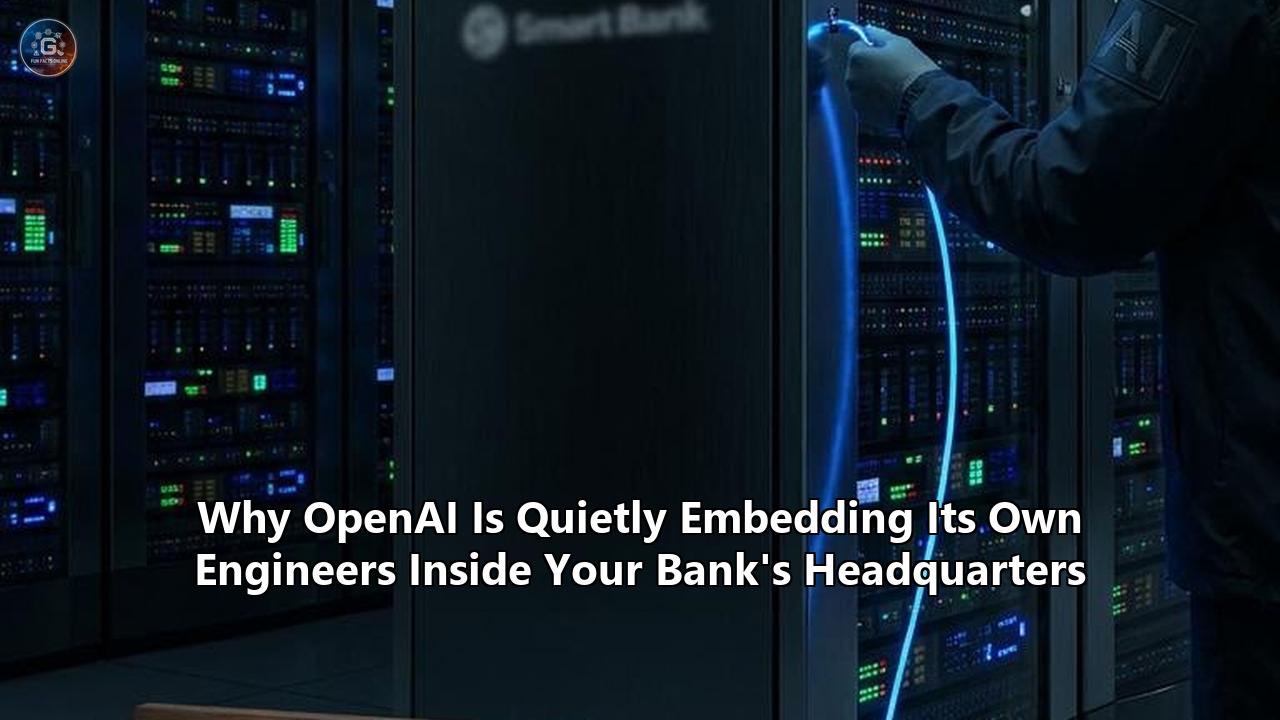
The badge readers at the secure entryways of major financial institutions have begun admitting a new class of contract worker. They do not wear the typical tailored suits of investment bankers or the branded polo shirts of traditional IT consultants. Instead, these are systems architects and model tuners from OpenAI.
In a series of quiet maneuvers that have escalated rapidly, the artificial intelligence giant has transitioned from selling software subscriptions to physically embedding its own technical teams directly inside the highly secured headquarters of regional and global banks.
This is not a standard software rollout. It is a physical infiltration. On April 27, 2026, Pennsylvania-headquartered Customers Bank, a high-performing regional lender with nearly $26 billion in assets, announced a multiyear strategic collaboration that places OpenAI's technical teams directly on-site. Two weeks later, on May 11, 2026, OpenAI formalized this hands-on business model by launching a massive standalone subsidiary: The OpenAI Deployment Company (DeployCo). Backed by an initial $4 billion in capital from a syndicate led by TPG—along with private equity powerhouses Advent International, Bain Capital, and Brookfield—DeployCo is designed to embed "Forward Deployed Engineers" (FDEs) inside client organizations to integrate frontier AI models directly with proprietary enterprise data.
Among the founding partners and equity stakeholders of this $10 billion venture are global banking institutions like Goldman Sachs and Spain’s BBVA. By acquiring the applied AI consulting and engineering firm Tomoro and absorbing its 150 specialized FDEs from day one, OpenAI has effectively built a private consulting army designed to operate behind bank firewalls.
This represents a structural shift in how the world’s most sensitive businesses adopt artificial intelligence. By analyzing this physical migration from the cloud to the corporate campus, we can map who is affected, what changes at the operational level, and the short- and long-term consequences of this quiet integration.
The Limits of SaaS and the Birth of Onsite Integration
For the past several years, the standard playbook for corporate AI adoption was straightforward: purchase enterprise licenses of a large language model (LLM), set up a secure API gateway, and encourage employees to automate their daily tasks. This approach underpinned the first wave of OpenAI enterprise partnerships, allowing firms to run secure, sandboxed versions of ChatGPT. BBVA, for instance, began its relationship with OpenAI in May 2024 by distributing several thousand ChatGPT Enterprise accounts, eventually expanding the deployment to all 120,000 global employees by late 2025.
However, banks quickly hit a hard wall. While generic cloud access is useful for drafting emails, summarizing lengthy research papers, or writing basic code, it is fundamentally incapable of running the core engines of commercial finance.
A bank's true value lies in its proprietary workflows:
- The complex, multi-variable process of underwriting a commercial real estate loan.
- The intricate validation of collateral across dozens of legacy databases.
- The processing of high-volume payments through proprietary networks.
These systems do not reside on the modern public cloud; they are buried deep within highly secure, on-premise environments, often running on legacy COBOL mainframes or siloed databases that have been patched together over decades of bank mergers. For an AI model to automate these processes, it cannot merely receive queries over an API. It must be woven directly into the internal plumbing of the bank.
[Legacy Banking Mainframes] <---> [Onsite OpenAI FDEs] <---> [Custom Fin-Tuned Models]
            |                                                           |
   (Siloed Customer Data)                                      (Enterprise Workflows)
"The challenge now is helping companies integrate these systems into the infrastructure and workflows that power their businesses," explained Denise Dresser, Chief Revenue Officer at OpenAI, upon the launch of DeployCo. "DeployCo is designed to help organizations bridge that gap and turn AI capability into real operational impact."
The physical presence of OpenAI engineers inside bank offices is a direct response to this integration bottleneck. Under the Customers Bank agreement, OpenAI technical teams are working on-site to build custom AI capabilities directly on the bank's own processes, data, and institutional knowledge. They are bypassing the standard software-vendor relationship to co-create a bespoke operational architecture. This hands-on, highly customized approach is the new standard for high-value OpenAI enterprise partnerships in regulated environments.
The Strategic Playbook: Project Mercury and the Palantir Model
To understand why OpenAI is deploying its engineers to bank headquarters, one must look at a secretive precursor initiative and a highly successful enterprise software model.
Project Mercury: Training the Core Models
In October 2025, reports emerged regarding a highly confidential program inside OpenAI code-named Project Mercury. The company hired more than 100 former investment bankers from top-tier institutions, including JPMorgan Chase, Morgan Stanley, and Goldman Sachs. Paid $150 per hour, these financial professionals were tasked with writing highly specific prompts and building complex financial models for a range of transaction types, such as leveraged buyouts, corporate restructurings, and initial public offerings.
The goal of Project Mercury was to train OpenAI’s next-generation models on the precise, unspoken methodologies of high finance. By teaching the models how to construct complex Excel formulas, organize pitch books, and interpret intricate corporate balance sheets, OpenAI built the specialized intelligence required for the financial sector.
However, possessing specialized intelligence is only half the battle; the model must still be deployed where the work actually happens.
The Palantir Model of Forward Deployed Engineers
To execute this deployment, OpenAI adopted a methodology popularized by US software giant Palantir: the Forward Deployed Engineer (FDE). An FDE is not a remote support agent or a traditional software salesperson. They are highly skilled systems engineers who physically sit alongside a client's business leaders, risk officers, and frontline operators.
Sitting on-site allows FDEs to:
- Absorb Domain Context: Learn the precise regulatory constraints, internal vocabulary, and operational quirks of the specific bank.
- Identify High-Value Workflows: Spot manual bottlenecks that are invisible to outside software developers.
- Build and Test in Real-Time: Write code, connect databases, and iterate on custom AI agents directly within the bank’s secure testing environment.
- Establish Feedback Loops: Act as a direct channel to OpenAI’s research and core engineering teams in San Francisco, ensuring that the primary models are continuously optimized for real-world financial applications.
By launching DeployCo and acquiring Tomoro, OpenAI successfully institutionalized this model. The $4 billion in private equity funding provides what industry insiders describe as "patient capital, locked up for five years," allowing OpenAI to guarantee its PE backers a 17.5% annual return floor while deploying hundreds of FDEs to build deep, hard-to-replace integrations within the world’s largest enterprises.
Who Is Affected: A Multi-Tiered Impact Analysis
The decision to place OpenAI engineers directly inside bank headquarters triggers a cascade of consequences across the financial services ecosystem. This physical integration alters the competitive landscape for banks, transforms the daily lives of employees, and threatens the traditional technology consulting industry.
| Stakeholder Group | Primary Impact of Embedded OpenAI Engineers |
|---|---|
| Regional Banks | Gain a digital equalizer to compete with Tier-1 giants without building massive in-house AI teams. |
| Global Investment Banks | Protect their market share by taking equity stakes in DeployCo, securing priority access to custom models. |
| Junior Finance Professionals | Face the rapid automation of entry-level tasks, shifting their roles from data entry to strategic advisory. |
| Legacy Tech Consultants | Risk disintermediation as OpenAI bypasses traditional system integrators to own the client relationship directly. |
1. Regional Lenders on the Offense
Historically, midsize and regional banks have struggled to compete with the technology budgets of Wall Street giants. JPMorgan Chase, for example, routinely spends upwards of $15 billion annually on technology, with billions earmarked specifically for AI development. A regional bank with $20 billion to $50 billion in assets simply cannot match that scale of software engineering talent.
Onsite OpenAI enterprise partnerships level the playing field. By embedding OpenAI’s elite engineers directly into their operations, regional lenders can skip the painful process of building their own machine learning infrastructure from scratch.
Sam Sidhu, President and CEO of Customers Bancorp, made this strategy clear when announcing the bank's partnership:
"This strategic collaboration with OpenAI gives us the frontier models, engineering expertise, and ability to co-create a roadmap toward becoming an AI-native bank. This strategic engagement positions us to be the leader in AI adoption among regional banks."
For regional lenders, the physical presence of OpenAI engineers is an existential lifeline, allowing them to achieve operational efficiencies that were previously the exclusive domain of trillion-dollar institutions.
2. Global Giants and the Venture Lock-In
For Tier-1 institutions like Goldman Sachs and BBVA, the strategy is less about playing catch-up and more about capturing the economics of the AI transformation. By joining DeployCo as founding partners and equity stakeholders, these institutions have secured direct, prioritized access to the absolute frontier of OpenAI’s technology.
This equity-investment model creates a powerful mutual dependency. The banks provide OpenAI’s engineers with access to their massive, complex operational environments, allowing the startup to refine its models on real-world transaction data.
In exchange, the banks gain a significant stake in a venture valued at $10 billion, ensuring that their internal systems are built on custom architectures that competitors cannot easily copy.
3. The Extinction Event for Entry-Level Grunt Work
Perhaps no group is more directly affected by this development than junior investment bankers, credit analysts, and loan officers. For generations, entering Wall Street meant enduring a grueling rite of passage: working 80 to 100 hours a week, manually formatting PowerPoint decks, copying and pasting data from PDFs into financial models, and cross-referencing legal clauses.
Traditional Junior Banker Workflow:
[Ingest 500-page PDF] ──(12 hours manual review)──> [Construct Excel Model] ──(4 hours formatting)──> [Generate Pitch Deck]

AI-Native Integrated Workflow:
[Ingest 500-page PDF] ──(3 seconds AI processing)──> [Custom Model Generated Output] ──(15 mins analyst verification)──> [Automated Client Presentation]
With OpenAI's FDEs sitting inside banks, this manual labor is being systematically coded out of existence. The tools co-developed on-site are designed to automate document ingestion, construct complex cash-flow models, and draft credit memos in minutes.
The industry debate is no longer about whether these tasks can be automated, but rather how the career ladder will function once they are.
"Without doing this work, you will not learn," some industry veterans argue, pointing out that manually building financial models is how young bankers learn to spot anomalies.
The counter-argument, championed by modern managers, is that automation will free junior staff to focus on strategic analysis, valuation theory, and client relations much earlier in their careers. Regardless of how this cultural debate plays out, the practical reality is clear: banks will require far fewer entry-level analysts to handle the same volume of transactions.
4. The System Integrator Dilemma
For decades, legacy consulting firms like Accenture, Deloitte, PwC, and EY made billions of dollars acting as the default system integrators for corporate America. If a bank wanted to deploy a new technology, they hired a small army of consultants to handle the implementation, data migration, and training.
By launching DeployCo and deploying its own engineers on-site, OpenAI is systematically cutting out these traditional intermediaries. The acquisition of Tomoro is a direct shot across the bow of the IT consulting industry. OpenAI is telling enterprises that if they want to build production-ready AI systems, they should work directly with the model creators, rather than relying on third-party integrators who are still learning how frontier models operate.
To avoid being entirely disintermediated, major consulting firms are shifting their strategies. Bain & Company, Capgemini, and McKinsey & Company have signed on as investors and consulting partners in DeployCo. They realize that if they cannot beat OpenAI’s in-house deployment capabilities, they must participate in the ecosystem, co-deploying their own change-management specialists alongside OpenAI’s technical engineers.
Under the Hood: Re-Engineering the Core Systems of Commercial Finance
When OpenAI’s engineers set up their desks inside a bank's headquarters, they do not spend their time building chatbot interfaces. Instead, they focus on three core operational domains that define commercial banking performance: lending, deposits, and payments.
                        [Embedded OpenAI Engineers]
                                     │
         ┌───────────────────────────┼───────────────────────────┐
         ▼                           ▼                           ▼
    [Lending]                    [Deposits]                  [Payments]
  • Document Collection        • Digital Onboarding        • Transaction Velocity
  • Credit Memoranda           • KYC/AML Checks            • Fraud Detection (cubiX)
  • Collateral Monitoring      • Account Setup             • Liquidity Optimization
1. Automating the Lending Lifecycle
Commercial lending is notoriously slow and paper-heavy. Underwriting a single commercial loan typically takes between 30 and 45 days, requiring a small army of analysts to collect financial disclosures, verify collateral, write detailed credit memoranda, and draft complex legal agreements.
At Customers Bank, OpenAI engineers have target-focused workflows designed to compress this timeline:
- Document Collection: Custom AI agents automatically scan incoming documents, flag missing disclosures, and extract structured data from unstructured corporate tax returns.
- Credit Memoranda: Instead of a junior analyst spending days drafting a 50-page credit memo, an embedded model analyzes the borrower’s historical financial performance, compares it against the bank’s internal underwriting guidelines, and generates a comprehensive draft in seconds.
- Post-Closing Portfolio & Collateral Monitoring: AI agents continuously monitor loan portfolios, scanning local real estate registries and corporate filings to identify early-warning signs of collateral depreciation or deteriorating borrower creditworthiness.
The operational goal is highly ambitious: reducing the commercial loan closing timeline from several weeks to just seven days. Such a compression of the lending lifecycle represents a massive competitive advantage, allowing the bank to capture high-quality business borrowers who are tired of waiting on slower competitors.
2. Payments and Deposits at Machine Speed
Beyond lending, embedded engineers are targeting deposit onboarding and payment infrastructure. In commercial banking, setting up corporate accounts involves complex Know-Your-Customer (KYC) and Anti-Money Laundering (AML) checks, which routinely drag out onboarding timelines. By connecting custom AI agents directly to the bank’s compliance databases, the onboarding process is streamlined into an automated, highly secure workflow.
On the payments side, the focus is on maximizing transaction velocity and security. At Customers Bank, OpenAI is working to integrate custom capabilities directly into cubiX, the bank’s proprietary payments platform that processes roughly $2 trillion in transactions annually. By leveraging the low-latency reasoning capabilities of custom-tuned models, the platform can analyze payment anomalies, optimize routing, and detect sophisticated fraud patterns in real-time, matching transaction speeds that were previously impossible with legacy rules-based engines.
3. The Friction of Data Sovereignty and Regional Governance
To execute these deep integrations, OpenAI has had to address one of the most significant barriers to financial AI adoption: strict regulatory requirements around data security and customer privacy. Banks are legally prohibited from sending non-public personal information (NPI) to third-party cloud servers where it might be stored, analyzed, or used for model training.
To solve this, OpenAI expanded its data residency options in late 2025, allowing enterprise customers in major markets—including the United States, United Kingdom, European Union, Singapore, Australia, and the UAE—to store their customer content completely at rest within their preferred region.
Furthermore, the integrations built by DeployCo are deployed within the bank’s existing secure, enterprise-grade infrastructure. The model requests and responses are handled in-region, with strict data governance, access controls, and risk management built into the system design from the outset. By physically placing their engineers inside the bank, OpenAI ensures that the custom-built models operate strictly within the bank's own secure perimeter, completely isolated from public training sets.
Short-Term Consequences: Efficiency Breakthroughs vs. Regulatory Alarm Bells
As these onsite deployments move from pilot programs to full production, they are generating immediate, highly visible consequences. These short-term impacts are characterized by dramatic improvements in bank operating efficiency, alongside mounting friction with financial regulators who are deeply wary of the speed at which AI is being integrated into core systems.
1. The Race to Lower Efficiency Ratios
In banking, the efficiency ratio—defined as non-interest expenses divided by total revenue—is a critical metric of financial health. A lower ratio indicates a highly streamlined, highly profitable operation.
By systematically automating manual back-office tasks, banks using embedded OpenAI engineers expect to achieve dramatic, unprecedented improvements in this metric. Customers Bank, which historically operated with a highly respectable efficiency ratio of approximately 49%, has announced that its on-site collaboration with OpenAI is targeted at driving that ratio down to the low 40s, with higher returns expected to begin flowing directly to shareholders by 2027.
Customers Bank Target Efficiency Ratio Overhaul:
[Pre-AI Deployment] ── 49% Efficiency Ratio
[Target by 2027]     ── Low 40s (Targeting unprecedented cost savings)
For public regional banks, achieving an efficiency ratio in the low 40s would make them highly attractive to investors, potentially driving up stock valuations and triggering a wave of copycat partnerships across the midsize banking sector.
2. Compliance Friction and the "AI-Cloned" Executive
The sheer speed of these deployments is causing considerable anxiety among risk officers and external regulators. A stark preview of this tension occurred during Customers Bank's Q1 2026 earnings call.
About one-third of the way through the call, CEO Sam Sidhu revealed to Wall Street analysts that the prepared remarks they had just listened to were delivered not by him, but by his AI clone. While Sidhu demonstrated this as a live proof-of-concept of the bank's commitment to AI-native operations, it highlighted the blurred lines between human oversight and automated systems in highly regulated public companies.
This event sparked immediate debate among corporate governance and regulatory compliance experts. If a bank’s chief executive can clone their voice for an earnings call, where do the boundaries of executive responsibility lie?
Regulatory bodies like the Office of the Comptroller of the Currency (OCC), the Federal Reserve, and the FDIC are watching these developments with growing concern. While they support technological innovation, they are highly sensitive to "black box" risk—the danger that automated underwriting or risk-monitoring systems could make flawed decisions that the bank's human operators cannot explain or correct. Placing outside OpenAI developers directly inside bank networks raises immediate questions about data governance, system auditing, and clear lines of liability.
Long-Term Consequences: The Monopolization of Financial Intelligence
While the short-term impacts focus on efficiency gains and compliance friction, the long-term consequences of this embedded-engineering strategy point toward a fundamental reorganization of the financial sector. Over the next five to ten years, this model will likely lead to an unassailable data moat for OpenAI and a dramatic shift in how financial products are built and distributed.
1. The Ultimate AI Training Playground
The most significant aspect of the DeployCo model is not the service fees OpenAI charges, but the intellectual property feedback loop.
As Piper Sandler analyst Manuel Navas noted in a research report following the Customers Bank announcement:
"What differentiates this arrangement is that OpenAI's personnel will be embedded in operations to improve its AI tools... Customers will be the first to implement improved AI tools that it is already fully committed to using, while OpenAI has the opportunity to improve its large language model in a live operating environment."
In essence, banks are paying OpenAI to let its engineers sit inside their offices, observe their proprietary workflows, and learn from their highly secured data.
                       [OpenAI Deployment Company]
                                    │
                       (Forward Deployed Engineers)
                                    │
                                    ▼
                     [Onsite Bank Operating Environment]
                       • Proprietary Workflows
                       • Complex Transactions
                       • Compliance Constraints
                                    │
                        (Anonymized Pattern Insights)
                                    │
                                    ▼
                      [OpenAI Core Model Research]
                                    │
                       (Optimized Financial Models)
                                    │
                                    ▼
                    [Commercialization to Entire Market]
While OpenAI is legally restricted from using direct customer data to train its public models, the learnings, design patterns, and agentic architectures developed on-site are fully retained by OpenAI. Once OpenAI’s engineers have successfully automated commercial lending at Customers Bank, they can package those refined patterns, white-label the underlying financial reasoning capabilities, and market them directly to hundreds of other banks worldwide.
This creates a massive, self-reinforcing intelligence monopoly. The more banks that embed OpenAI engineers, the smarter OpenAI’s models become at handling complex financial transactions. Consequently, competitors who attempt to build their own custom models will find themselves hopelessly behind, unable to match the specialized reasoning capabilities that OpenAI has honed across dozens of live banking environments.
2. The Existential Threat of Technological Lock-In
For banks, the long-term risk of this strategy is the threat of absolute technological lock-in.
Unlike traditional software integrations, which can be swapped out or migrated to alternative vendors, the custom-built, agentic workflows being designed by DeployCo are woven directly into the bank's operational DNA. Once an institution’s lending, deposit, and payment pipelines are orchestrated by custom-tuned OpenAI models, migrating to a competitor like Anthropic, Google, or an open-source alternative becomes practically impossible. The cost, complexity, and operational risk of ripping out an AI operating model that touches every department would be too high.
This leaves banks highly vulnerable to future pricing decisions, licensing changes, or operational shifts dictated by OpenAI. Over time, the balance of power in the financial sector could shift dramatically.
Instead of tech companies serving as vendors to the banks, banks could find themselves functioning as highly regulated front-offices, while the core intellectual property, risk-pricing engines, and operational workflows are entirely owned and operated by a handful of AI labs in Silicon Valley.
What to Watch Next: The Milestones on the Horizon
As OpenAI’s engineers continue to integrate into bank headquarters through early 2026, several key milestones will signal whether this embedded deployment model will become the permanent blueprint for enterprise AI adoption:
- The Results of the 7-Day Loan Close: By late 2026, we will see the first audited operational results from Customers Bank. If they successfully compress commercial lending to seven days while maintaining or improving underwriting quality, it will likely trigger a massive wave of regional bank migrations toward onsite OpenAI enterprise partnerships.
- Regulatory Interventions on Onsite Training: Watch for the first formal guidelines or enforcement actions from the OCC, the Federal Reserve, or the European Central Bank regarding the physical presence of AI engineers on bank trading floors and within core data systems. If regulators restrict the feedback loop between on-site FDEs and core model training, it could disrupt DeployCo’s long-term business model.
- Anthropic’s Counter-Offensive: Rival AI lab Anthropic has reportedly been in separate talks with private equity giants like Blackstone and Hellman & Friedman to establish its own multi-billion-dollar deployment joint ventures. Watch to see if Anthropic launches a direct competitor to DeployCo, initiating an on-site talent war for forward-deployed AI engineers inside the world's major financial capitals.
- The Scale of the "Mercury" Models: Monitor whether OpenAI formally launches a specialized, finance-native model family based on the work trained during Project Mercury. If such a model is commercialized, it will mark the first time a foundation model has been structurally designed from the ground up to replace specialized, high-end white-collar tasks.
The era of theoretical AI is officially over. By deploying its own engineers to sit directly inside bank offices, OpenAI is actively re-engineering the actual machinery of the global financial system. Whether this results in an unprecedented era of hyper-efficient, democratized finance, or a highly centralized system dominated by a single technology giant, is the defining question for the future of Wall Street.
Reference:
- https://letsdatascience.com/news/customers-bank-engages-openai-to-reengineer-commercial-banki-8d906617
- https://www.customersbank.com/investor-relations/press-releases/press-release/Customers-Bank-Announces-Strategic-Collaboration-with-OpenAI-to-Redefine-the-Commercial-Banking-Operating-Model-1778/
- https://www.adventinternational.com/news/openai-launches-the-openai-deployment-company-to-help-businesses-build-around-intelligence/
- https://thenextweb.com/news/tomoro-openai-deployment-company-consulting
- https://pe-insights.com/openais-deployco-wins-4bn-from-leading-pe-firms-ft-says/
- https://openai.com/index/openai-launches-the-deployment-company/
- https://www.fintechfutures.com/ai-in-fintech/may-2026-top-five-ai-stories-of-the-month
- https://openai.com/index/expanding-data-residency-access-to-business-customers-worldwide/
- https://openai.com/index/bbva-collaboration-expansion/
- https://letsdatascience.com/news/customers-bank-signs-openai-partnership-to-automate-finance-7d55bf55
- https://www.youtube.com/watch?v=NLKCIUEDNTI
- https://jakobnielsenphd.substack.com/p/fdd-workflow-redesign
- https://www.americanbanker.com/news/openai-will-embed-staff-at-customers-bank-under-multiyear-deal
- https://www.americanbanker.com/payments/news/bbva-and-goldman-sachs-invest-in-openais-new-venture
- https://www.constellationr.com/insights/news/openai-launches-openai-deployment-company-acquires-tomoro
- https://ibsintelligence.com/ibsi-news/bbva-joins-openais-new-deployco-venture/
- https://www.efinancialcareers.com/news/an-md-who-left-banking-for-coinbase-is-now-joining-open-ai
- https://qz.com/customers-bank-openai-commercial-lending-automation-042726
- https://www.investing.com/news/company-news/customers-bank-partners-with-openai-for-ai-deployment-93CH-4638928