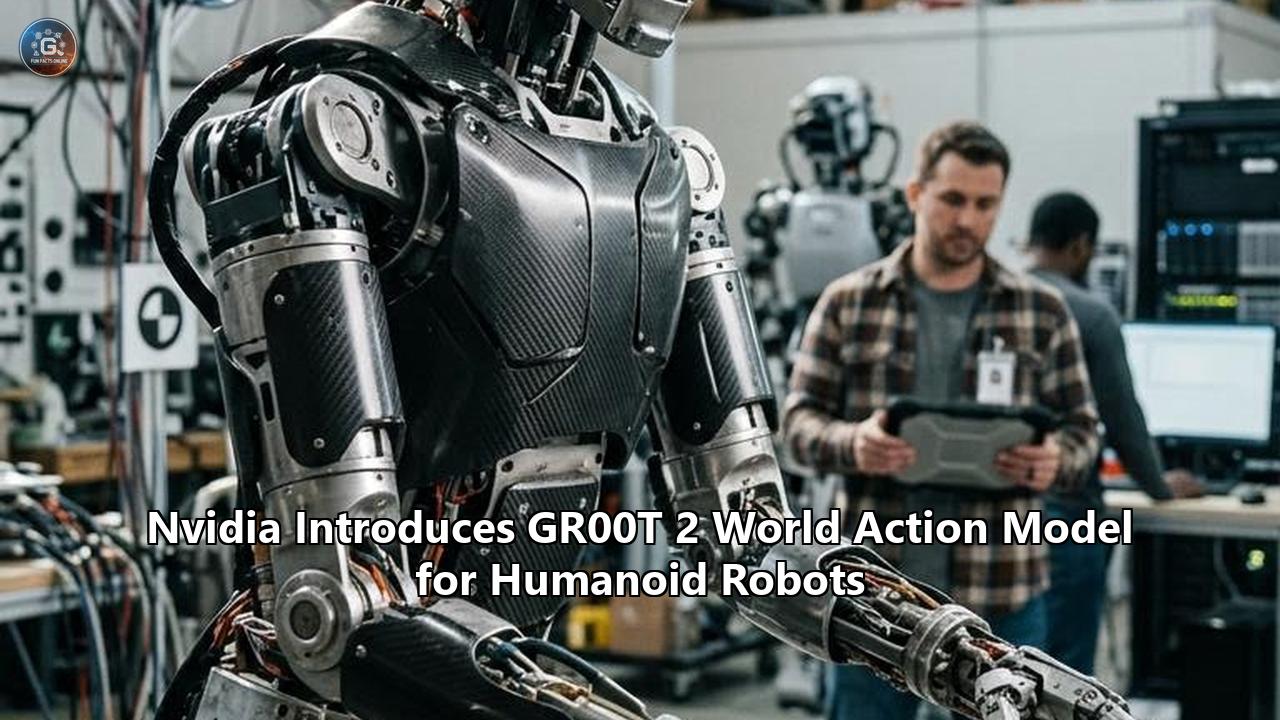
AUSTIN, Texas — On the opening afternoon of the Conference on Robot Learning (CoRL) in Austin, Nvidia unveiled GR00T 2, an open frontier "world action model" designed to serve as a universal intelligence foundation for humanoid robots and dexterous manipulators. Built on top of the company’s Cosmos visual world foundation models, the system represents a departure from traditional vision-language-action (VLA) architectures by simultaneously predicting what an embodied machine will see next alongside the precise physical motor trajectories required to alter its environment.
Alongside the model, Nvidia released version 3.0 of its Isaac Lab robot learning framework, open-sourced a massive 100,000-hour slice of its proprietary first-person human video dataset, and unveiled open hardware designs for sensorized data collection devices. The suite is aimed directly at solving the deepest structural bottleneck in modern physical artificial intelligence: the scarcity of real-world robotic interaction data and the historical inability of policies trained on one machine morphology to transfer seamlessly to another.
During his keynote presentation, Jim Fan, director of robotics and distinguished scientist at Nvidia who co-leads the Generalist Embodied Agent Research (GEAR) lab alongside Yuke Zhu, demonstrated the system executing complex, multi-step dexterous tasks entirely at normal speed and without human teleoperation. In video captures of physical hardware running autonomously, bimanual robots operating under GR00T 2 were shown striking matches to light alcohol burners, navigating delicate laboratory pipettes, aligning and installing server memory modules, and peeling and applying thin adhesive shipping labels with scissors.
"Not a single pixel is real," Fan told the audience as he displayed a clip of the model generating future video frames in lockstep with motor commands. "We are watching the robot dreaming".
According to technical benchmarks released by Nvidia, GR00T 2 achieved an out-of-the-box average success rate of 40% across 50 intricate manipulation tasks that had never been demonstrated on the target robot body. When researchers provided just one single teleoperated demonstration per task, the average success rate climbed to 71%. With five demonstrations—amounting to less than three minutes of physical machine data per task—followed by a 30-minute Low-Rank Adaptation (LoRA) fine-tuning session on a single desktop GeForce RTX 5090 GPU, the model reached a 95% average success rate.
The announcement has triggered immediate engagement across the robotics ecosystem. Industrial conglomerates including Foxconn and Siemens, alongside specialized automation startups such as MicroAGI and Nexuni, have confirmed active testing of the platform across factory automation, electronic assembly, and deformable material handling.
Yet behind the headline metrics, the release surfaces significant technical nuances. While the training data, simulation pipelines, and peripheral software were made available immediately on Hugging Face and GitHub, the model weights themselves remain closed until December. Concurrently, the technical documentation reveals that the impressive 95% few-shot adaptation figures stem from a benchmark suite specifically preselected for learnability, while high-level symbolic planning latencies continue to introduce prolonged pauses during physical execution.
From VLA to WAM: The Mechanics of a World Action Model
To understand the engineering pivot embedded in GR00T 2, one must trace the structural limitations of the Vision-Language-Action models that have dominated robotic learning since 2023. Systems such as Google DeepMind’s RT-2, Physical Intelligence’s $\pi_0$, and the earlier iterations of the Nvidia GR00T model treated robotics as an autoregressive translation task. Cameras captured RGB images, visual encoders flattened those images into tokens, transformer backbones digested the visual tokens alongside natural language instructions, and the model projected continuous motor actions directly out of its final layers.
Traditional VLA Architecture:
[RGB Cameras] + [Text Instruction] ---> [Visual/Language Transformer] ---> [Direct Motor Commands]
                                                                        (Blind to future physics)

GR00T 2 World Action Model (WAM):
[Recent Video]                                             +---> [Synthesized Future Video Frames]
[Robot State]  ---> [Cosmos Diffusion Transformer] --------|     (Internal forward dynamics)
[Text Prompt]                                              +---> [Chunked Motor Trajectories]
                                                                 (Actions matched to visual plan)
While effective for broad semantic comprehension, pure VLA architectures suffer from severe physical myopia. Because the model operates without an explicit representation of forward dynamics—how the geometry, lighting, friction, and occlusions of the surrounding world will transform over the next two seconds—it frequently commits to kinematically unviable paths. When a mechanical finger slips against a slick surface or an object shifts unexpectedly, a standard VLA has no native concept of what the scene ought to look like at the next time step, resulting in cascading execution failures.
A World Action Model (WAM) reconfigures this relationship by unifying world modeling and policy generation inside a single computational graph. Rather than predicting an action in isolation, GR00T 2 processes recent multi-view video frames, current joint configurations, and language prompts to simultaneously denoise two coupled outputs across a shared diffusion transformer: a synthetic chunk of future video frames and the exact joint velocities required to manifest that visual future.
This co-generation binds motor execution to visual expectation. The model is forced to learn an intuitive physics engine within its latent weights. If GR00T 2 intends to pull open a cabinet drawer, it must synthesize the visual representation of the drawer sliding forward while calculating the torque profiles of the arm. If the physical drawer sticks due to friction, the discrepancy between the synthesized visual prediction and the incoming camera feed generates an immediate, high-fidelity error signal that can be routed back into the policy loop.
In the system's baseline configuration, the core model utilizes a 2-billion-parameter diffusion backbone initialized from Nvidia’s Cosmos-Predict2.5-2B architecture. The network takes three visual inputs—typically an egocentric head camera and two wrist-mounted sensors—along with proprioceptive joint encoders. Through cross-attention mechanisms, spatial-temporal tokens interact with language embeddings before diffusing a trajectory of action chunks, which are decoded by small, robot-specific actuator heads designed to interface with different joint configurations and degrees of freedom.
In blinded, head-to-head empirical evaluations conducted on identical physical setups inside Nvidia's testing facility, the research team reported that GR00T 2 outperformed Physical Intelligence’s $\pi_{0.5}$ policy by 236 Elo points (representing an expected 80% head-to-head win rate) and surpassed its own predecessor, GR00T N1.7, by 95 Elo points.
Onboard Edge Compute: Inside GR00T 2 Turbo and Jetson AGX Thor
A foundational dilemma in applying 2-billion-parameter diffusion models to dynamic humanoids is latency. Generating high-resolution video frames via iterative reverse diffusion is computationally punishing. If a humanoid balancing on two legs must wait several seconds for a remote server to complete a diffusion pass, it will collapse long before the motor packet traverses the wireless network.
To bring WAM execution out of the data center and into autonomous untethered bodies, Nvidia engineered a specialized distillation known as GR00T 2 Turbo.
                                 +---------------------------------------------+
                                 |         Nvidia Jetson AGX Thor              |
                                 |  - 2B-Parameter GR00T 2 Turbo               |
[Multi-View RGB Cameras] ------->|  - High-Compression Video VAE               |
[Proprioceptive Encoders] ------>|  - Latent Spatial Grid (4x Reduction)       |
                                 |  - Single Inference Pass: 124 ms            |
                                 +---------------------------------------------+
                                                       |
                                                       | Action Chunk (Motor Plan)
                                                       v
                                 +---------------------------------------------+
                                 |            Jetson Orin NX                   |
                                 |  - SONIC Whole-Body Controller (WBC)        |
                                 |  - High-Frequency Stability Loop: 50 Hz     |
                                 +---------------------------------------------+
                                                       |
                                                       v
                                            [Actuators & Joint Motors]
GR00T 2 Turbo retains the full 2-billion-parameter scale of the parent transformer to preserve its broad semantic reasoning and spatial generalization. However, it radically alters its visual latent representation. By encoding input video streams through an aggressively quantized Variational Autoencoder (VAE), the Turbo variant predicts an internal spatial latent grid four times smaller than the base model. This mathematical compression slashes the token count per diffusion step, allowing the model to execute a complete predictive action chunk in precisely 124 milliseconds when deployed directly onto an onboard Nvidia Jetson AGX Thor robotics computer.
The physical deployment architecture splits computation across a hierarchical "System 1" and "System 2" topology:
- System 1 (Onboard Fast-Reactive Loop): Mounted in the torso of a Unitree G1 humanoid, the Jetson AGX Thor module runs GR00T 2 Turbo at approximately 8 Hz, streaming forward-looking action chunks that define end-effector targets, wrist orientations, and waist trajectories.
- Kinematic Translation Loop: These 8 Hz action chunks feed into a secondary, lightweight onboard processor—such as an Nvidia Jetson Orin NX—running the SONIC (Synchronized Optimal Neural Inverse Control) whole-body controller at 50 Hz. The SONIC layer translates end-effector vectors into torque commands across the G1’s 23 active joints, calculating center-of-mass balancing, ground reaction forces, and postural stabilization in real time.
- System 2 (Offboard Strategic Planner): High-level task monitoring, natural language comprehension, and long-range visual goal evaluation are handled by an offboard multi-modal reasoning model, which communicates intermittently with the robot over a dedicated local network.
This separation of concerns was on physical display at CoRL through demonstrations on Marvin Pro, a custom dual-arm manipulation platform engineered for Nvidia by Tianji Intelligence. Equipped with twin 21-degree-of-freedom dexterous hands driven by low-clearance, fully backdrivable linkage mechanisms, the Marvin Pro executed bilateral manipulation routines—such as steadying a container with one hand while using a knife to slice fruit with the other—without requiring tethered compute racks or external motion-capture rigs.
The Data Engine: 400,000 Hours and the X-Adapt Engine
Humanoid robotics has long run into what researchers call the "teleoperation wall". While internet-scale text corpora allowed Large Language Models to swallow trillions of tokens at low marginal cost, physical robots cannot learn from raw text. Historically, teaching a machine to manipulate an object required an engineer to wear an exoskeleton or manipulate a pair of master arms, manually guiding the physical robot through hundreds of repetitions to compile a dataset. Because every distinct robotic chassis possesses unique kinematic limits, link lengths, and camera angles, teleoperation data collected on a dual-arm Franka setup was largely useless when transferred to an Apptronik Apollo or a Unitree G1.
Nvidia’s strategy with GR00T 2 bypasses this bottleneck by turning to human video, transforming human task execution into usable robot intelligence.
                     +-------------------------------------------------------------+
                     |                 Pretraining Data Pipeline                   |
                     |  - 402,730 Hours: Egocentric First-Person Human Video       |
                     |  -  10,184 Hours: Handheld UMI Gripper Demonstrations       |
                     |  -  23,500 Hours: Multi-Embodiment Robot Teleoperation      |
                     +-------------------------------------------------------------+
                                                       |
                                                       v
                                      +-------------------------------+
                                      |     X-Adapt Engine Core       |
                                      |  - Kinematic Decoupling       |
                                      |  - Morphological Invariance   |
                                      |  - Retargeting Output Heads   |
                                      +-------------------------------+
                                                       |
                        +------------------------------+------------------------------+
                        |                                                             |
                        v                                                             v
       +----------------------------------+                         +----------------------------------+
       |   Zero-Shot Cross-Embodiment     |                         |     Few-Shot Rapid Adaptation    |
       |  - 40% Success on Unseen Tasks   |                         |  - 1 Demo:  71% Success          |
       |  - 65% Success on Lab Wet-Prep   |                         |  - 5 Demos: 95% Success          |
       +----------------------------------+                         |  - 30-min LoRA on single RTX 5090|
                                                                    +----------------------------------+
The pretraining mixture compiled for GR00T 2 encompasses 436,414 total hours of motion data:
- 402,730 hours of first-person, egocentric human video capturing unscripted manual work, assembly, tool handling, and domestic chores.
- 10,184 hours of handheld Universal Manipulation Interface (UMI) gripper demonstrations spanning 2,897 distinct manipulation tasks.
- 23,500 hours of direct robot teleoperation data compiled across multiple physical embodiments, including YAM modular arms, Franka Emika Panda arms, high-degree-of-freedom Sharpa tactile hands, Wuji dexterous hands, and the bipedal Unitree G1 humanoid.
Human video represents roughly 92% of the total pretraining mixture. To demonstrate the utility of this massive visual corpus, Nvidia released an initial open-source slice called Human-1M-100K on Hugging Face under a permissive Creative Commons Attribution 4.0 (CC BY 4.0) license, providing researchers worldwide with 100,000 hours of curated, annotated egocentric activity.
The mathematical bridge enabling this data to train a robot is a methodology Nvidia calls X-Adapt (Cross-Embodiment Adaptation).
X-Adapt addresses the fundamental morphology mismatch problem: humans have compliant, five-fingered biological hands, soft tissue, and intuitive biological joints; robots have rigid links, gear backlash, current limits, and diverse actuator counts. Instead of attempting to enforce an exact, brittle joint-to-joint mapping between a human hand and a mechanical gripper, X-Adapt forces the internal layers of the diffusion transformer to focus on object-centric affordances and spatial-temporal trajectories.
The model learns what needs to happen to the object in three-dimensional space—how the filter paper folds, where the seam of the box separates, how much tilt is required to pour liquid from a beaker—rather than memorizing the precise muscle activations of the demonstrator. The final execution details are left to modular, robot-specific decoding heads that map the high-level physical intention down into the joint limits of the target hardware.
The empirical yield of this approach is evident in cross-morphology transfers. In one benchmark test highlighted in the technical paper, researchers recorded a human wearing a lightweight camera harness lining a laboratory glass funnel with circular filter paper and dampening it with a wash bottle. The target robot—a dual-arm torso fitted with 22-DoF Sharpa five-finger hands—had never received a single teleoperated demonstration of that task. Driven purely by the representations acquired through human video via X-Adapt, the robot successfully completed the sequence in 65% of physical trials.
In another trial, assembly procedures for a complex toy dump truck were collected solely using a handheld plastic UMI gripper mounted to a human hand. The skill was transferred across embodiments to a table-mounted YAM robotic arm, which completed the assembly autonomously with a 60% baseline success rate without a single minute of machine-level teleoperation.
When the model is granted even minimal exposure to the target machine’s physical dynamics, performance curves climb rapidly. Across a rigorous 50-task manipulation battery executed on the dual-arm Sharpa platform, zero-shot performance hovered at 40%. Introducing one demonstration per task lifted aggregate task completion to 71%. Providing five short teleoperated episodes—amounting to less than 180 seconds of physical data per task—elevated the system to a 95% average success rate, with the policy successfully resolving 37 out of the 50 tasks in 100% of recorded evaluation trials.
Because the underlying representations of the physical world are already deeply baked into the Cosmos diffusion backbone, adjusting the model to a new task does not require training millions of parameters from scratch. Adaptation is performed via low-rank parameter updates across the attention blocks, allowing engineers to fine-tune the Nvidia GR00T model on specialized industrial datasets in roughly 30 minutes using standard consumer hardware.
Isaac Lab 3.0 and the Newton Physics Engine
While human video provides the foundational intuition for how objects move and interact, real-world deployment requires robots to survive contact-rich dynamics. Grasping a smooth plastic block is a static kinematic problem; routing a floppy, flexible braided Ethernet cable through a crowded server chassis or sliding a fragile fabric shirt across a laundry table involves infinite degrees of deformation, continuous micro-slips, and complex surface friction.
For years, the standard simulation engine powering Nvidia's robotics stack was PhysX. While fast and capable of simulating hundreds of rigid boxes tumbling onto a conveyor belt simultaneously, PhysX struggled with accuracy when forced to calculate deformable objects, thin shells, and the high-dimensional micro-contacts characteristic of multi-jointed, tendon-driven robotic hands.
+-----------------------------------------------------------------------------------+
|                                  Isaac Lab 3.0                                    |
|   Universal Task API | Autonomous Agent Scene Builders | Post-Training RL Suite   |
+-----------------------------------------------------------------------------------+
                                          |
                +-------------------------+-------------------------+
                |                                                   |
                v                                                   v
+-------------------------------+                   +-------------------------------+
|     Nvidia PhysX Backend      |                   |     Newton Physics Solver     |
|  - Traditional Rigid Body     |                   |  - GPU-Native via Warp        |
|  - Large-Scale Logistics      |                   |  - Deformables (Cables, Cloth)|
|  - Coarse Geometric Collision |                   |  - Multi-Joint Dexterous Hands|
|                               |                   |  - 2.5x Training Throughput   |
+-------------------------------+                   +-------------------------------+
To resolve this limitation, Nvidia rolled out Isaac Lab 3.0 alongside GR00T 2, integrating its GPU-accelerated Newton physics engine.
Developed natively on Nvidia’s Warp programming framework, Newton replaces generalized rigid-body approximations with high-performance continuum mechanics, finite-element formulations, and unified constraint solvers running directly on GPU tensor cores. Within Isaac Lab 3.0, developers can hot-swap between PhysX and Newton through a single task API, deploying Newton specifically when modeling cables, fluid-like particles, woven cloth, and human-like robotic palms with 20 or more articulable joints.
On standardized vision-based dexterous manipulation benchmarks, Nvidia reported that Isaac Lab 3.0 utilizing the Newton engine reached up to 2.5 times the training throughput of Isaac Lab 2.3 running PhysX.
This speedup fundamentally shifts the economics of reinforcement learning. On the newly introduced AlphaNIST multi-task benchmark, researchers demonstrated that training a single, generalized policy capable of mastering 20 distinct dexterous manipulation operations reached a 98% training success rate. In contrast, older frameworks training separate policies for each individual task topped out at an 81% success rate—while the unified Newton policy consumed 39 times less total GPU compute time.
Policy Training Efficiency on AlphaNIST Benchmark:
-------------------------------------------------------------------------------------
Architecture / Setup                  Task Success Rate      Relative GPU Compute Time
-------------------------------------------------------------------------------------
Per-Task Isolated Policies (PhysX)          81.4%                     39.0x
Unified Multi-Task Policy (Newton)          98.2%                      1.0x (Baseline)
-------------------------------------------------------------------------------------
To evaluate these simulation policies against rigorous industrial criteria, Nvidia and its academic collaborators simultaneously unveiled two standardized benchmarks built inside Isaac Lab-Arena 0.4:
- DexBench: A multi-domain evaluation framework featuring 15 distinct high-precision tasks situated across four photorealistic simulation environments: electronics retail, logistics parcel handling, manufacturing assembly, and commercial hospitality. The benchmark tests whether a model can withstand severe randomizations in object scale, surface reflectivity, physical friction coefficients, and spatial orientations.
- VABAR (Variational Automation Benchmark for Agentic Robotics): Developed in direct partnership with UC Berkeley’s AUTOLAB, VABAR establishes a six-task industrial baseline focused on unstructured variations. Rather than testing whether an arm can insert a bolt into a perfectly centered hole, VABAR introduces unpredictable part tolerances, mechanical jamming, and camera lens distortions.
"To me, agentic robotics is the most exciting technological development since the internet in 1995," said Ken Goldberg, the UC Berkeley professor of robotics who spearheaded the development of the VABAR benchmark suite. Goldberg emphasized that benchmark standardization represents the line between academic curiosities and production-grade factory automation, forcing foundation models to demonstrate resilience against the chaotic imperfections of real physical environments.
Industrial Shop Floors and Server Racks: Early Deployments
Nvidia is not positioning GR00T 2 as a speculative laboratory exercise. A central narrative throughout the CoRL launch was the immediate migration of the model onto live commercial shop floors and enterprise testing cells.
The flagship industrial partnership involves electronics manufacturing titan Foxconn. In its automated server production plants, Foxconn is piloting GR00T 2 policies to handle some of the most delicate manual procedures involved in data center hardware assembly.
A central bottleneck in deploying artificial intelligence infrastructure has been the manual labor required to assemble, test, and repair high-density compute nodes. In one physical deployment presented by Nvidia, a bimanual manipulator operated by GR00T 2 was tasked with extracting, aligning, and securely reseating high-bandwidth memory and computing modules within a dense Nvidia GB300 server rack.
The operation requires millimeter-level alignment tolerances, dynamic compensation for internal mechanical flex, and controlled force profiles to avoid cracking delicate printed circuit boards. Across repeated real-world validation runs, Nvidia and Foxconn reported an 85% first-pass success rate on autonomous memory module reseating—a task that previously defied traditional pre-programmed automation due to minor variations in rack tolerances and cable harness routing.
+-----------------------------------------------------------------------------------+
|                        Enterprise Validation Ecosystem                            |
+-----------------------------------------------------------------------------------+
| Foxconn        | Autonomous server assembly; GB300 memory module reseating        |
| Siemens        | Multi-cell industrial automation, precision part mating          |
| MicroAGI       | Reinforcement-learned Ethernet cable routing using YAM arms      |
| Nexuni         | Unstructured textile handling and autonomous laundry folding     |
+-----------------------------------------------------------------------------------+
In industrial control, German conglomerate Siemens has begun evaluating the model across mixed-part kitting lines and precision gear mating. Because GR00T 2 combines visual language comprehension with fine spatial control, operators on a Siemens manufacturing line can prompt an agentic robot in natural language to locate, inspect, and mate non-standardized automotive fittings without reprogramming kinematic waypoint trees.
In the telecom and enterprise IT sector, robotics startup MicroAGI demonstrated a complete automated system using GR00T 2 to resolve one of the most notoriously frustrating physical tasks in modern data centers: dynamic Ethernet and fiber-optic cable swapping.
Routing a flexible patch cord requires a robot to grip a flexible connector, orient the plastic retention clip, align it with an RJ-45 jack, push until a physical click occurs, and depress the microscopic retention tab to unplug it. MicroAGI achieved this by deploying GR00T 2 as a foundational initialization policy, subsequently post-training it within Isaac Lab 3.0 utilizing the Newton physics engine to master the compliant physics of cable bending. Deployed physically on a modular YAM arm, the policy autonomous navigated crowded patch panels, clearing cables out of its line of sight and successfully swapping network ports.
Concurrently, robotics startup Nexuni is utilizing the platform to tackle unstructured deformables in commercial hospitality, testing GR00T 2 on the automated handling, sorting, and folding of industrial laundry. Unlike rigid metal gears, textiles collapse into infinite unpredictable configurations upon touch. By utilizing the world model’s forward prediction dynamics, the Nexuni manipulators evaluate how a towel or sheet will drape across a surface as it is lifted, dynamically adjusting grasp points mid-motion to achieve clean folds.
Technical Scrutiny: Benchmark Selection, Latency Penalties, and the Tactile Void
Despite the technical velocity visible in the CoRL demonstrations, a rigorous reading of Nvidia's documentation reveals substantial engineering qualifications. A critical gap remains between curated conference showcases and the brutal, 99.999% reliability thresholds demanded by modern high-throughput manufacturing.
The first major qualification surrounds the headline-grabbing 95% few-shot adaptation metric. In its marketing summary, Nvidia emphasizes that providing five demonstrations allows a robot to master tasks with near-perfect reliability. However, deep inside the technical whitepaper, researchers openly acknowledge a critical caveat: the 50 tasks utilized for the evaluation battery were preselected from an initial task candidate pool based on whether the model was capable of achieving at least an 80% success rate within five episodes.
In statistical terms, the benchmark is partly pre-filtered for learnability. If an engineer presents the model with a novel, highly non-linear manipulation task that falls outside this learnable distribution—such as threading an un-tensioned sewing needle or working with turbulent liquids—there is no guarantee that five demonstrations will yield anything resembling a 95% success rate.
A second friction point lies in the latency penalty of agentic supervisory loops. To achieve sustained autonomous behavior over multi-minute sequences, GR00T 2 relies on an external multi-modal reasoning agent—dubbed ASPIRE (Agentic Sequencing, Planning, and Integrated Recovery Engine)—which monitors progress, breaks complex prompts down into sub-goals, and commands recovery routines when a component is dropped.
Physical Execution Timeline (Standard Sorting Task):
+-----------------------------------+--------------------+-----------------------------------+
|      GR00T 2 Motion Execution     |   Agent Reasoning  |      GR00T 2 Motion Execution     |
|         (Active Manipulation)     |   (Robot Idle)     |         (Active Manipulation)     |
|               62%                 |        38%         |               62%                 |
+-----------------------------------+--------------------+-----------------------------------+
                                    |<- Median: 7.2 sec->|
                                       Waiting for LLM
While ASPIRE enabled spectacular recovery demonstrations—such as a dual-arm robot dumping out parts of a toy car, realizing a wheel was upside down, flipping it over, and assembling the chassis across 100 consecutive trials with 98% final completion—it introduced massive throughput drag. In recorded trash-sorting trials, the robot spent a median of 38% of the total episode duration standing completely motionless.
The machine was not physically constrained; it was waiting an average of 7.2 seconds per decision step for the offboard vision-language reasoning model to parse the scene, verify object state transitions, and generate the next prompt for the diffusion backbone. On an automotive or consumer electronics assembly line, where factory managers track cycle times in fractions of a second, an automated worker that idles for more than a third of its shift is commercially non-viable.
Perhaps the most significant physical limitation is the absence of tactile and force feedback. GR00T 2 is, at its architectural foundation, almost entirely vision-centric. It predicts visual futures and maps visual tokens to joint velocities. But manipulation is inherently an act of force exchange.
The model cannot directly ingest high-frequency, continuous arrays from tactile sensor skins, such as GelSight optical tactile pads or piezoresistive fingertip arrays. In physical testing, the research team noted that the system frequently struggled to identify subtle mechanical errors that do not manifest visually—such as a cross-threaded bolt that looks aligned from above but has physically bound in its threads, or a screw that is turned halfway down but meets excessive resistance. Until world action models learn to co-predict tactile and haptic futures alongside visual video frames, humanoid hands will continue to operate with a form of sensory numbness.
Finally, the robotics community has raised questions regarding Nvidia’s definition of "open". While the company published the research paper, open-sourced the 100,000-hour Human-1M dataset, and released peripheral code repositories, the actual GR00T 2 model weights, fine-tuning recipes, and inference checkpoints will not be released until an unspecified date in December.
For academic labs and independent startups attempting to replicate the reported benchmark metrics immediately, the system remains an observational showcase rather than an immediately inspectable tool.
The Platform Battle for the Physical AI Operating System
The arrival of GR00T 2 signals that the primary competitive frontier in artificial intelligence is rapidly shifting from digital screens to physical actuators. The timing of the announcement was marked by a direct collision of industry heavyweights: on the exact day Nvidia presented GR00T 2 at CoRL, Anthropic unexpectedly rolled out its flagship model Fable 5.2, which registered an unprecedented 64.9% success rate on the RoboDojo dual-arm simulation benchmark, shattering prior records held by general-purpose frontier models.
This simultaneous push underscores a profound transformation in how the technology sector views robotics. For decades, robotics was viewed as a mechanical engineering discipline defined by bespoke kinematics, specialized hydraulics, and rigid, hand-coded control theory. Today, robotics is being rewritten as a compute-scaling problem governed by foundation models, massive synthetic simulation runs, and cross-embodiment data ingestion.
+-----------------------------------------------------------------------------------+
|                        Competing Humanoid AI Paradigms                            |
+-----------------------------------------------------------------------------------+
| Paradigm:           | Vertically Integrated Closed | Open Platform Ecosystem      |
| Exemplars:          | Tesla (Optimus), Figure AI   | Nvidia (GR00T 2 + Cosmos)    |
| Hardware Strategy:  | Proprietary custom actuators | Multi-chassis, open reference|
| Compute Revenue:    | Internal cost center         | Massive GPU/Jetson ecosystem |
| Operating System:   | Walled garden / In-house     | "Android of Physical AI"     |
+-----------------------------------------------------------------------------------+
In this emerging landscape, two diametrically opposed industrial paradigms are locking horns:
- The Vertically Integrated Closed Stack: Exemplified by Tesla with Optimus and Figure AI, this approach argues that general-purpose robotics demands complete, proprietary ownership of the entire chain. Tesla designs its own structural castings, custom electric actuators, battery packs, and inference silicon, training its neural network policies exclusively on data captured by its own fleet of homogeneous humanoid chassis. This approach optimizes for mechanical synergy and tight hardware-software co-design, but it requires astronomical capital reserves and locks the company into its own proprietary ecosystem.
- The Open Platform Play: Nvidia is executing an aggressive platform strategy aimed at becoming the universal infrastructure provider for everyone else. Nvidia does not sell a proprietary consumer humanoid robot. Instead, it sells the tools required to build every humanoid robot: DGX compute clusters to train models, Isaac Sim and Isaac Lab to run physics simulations, the Cosmos foundation models to provide visual imagination, the Nvidia GR00T model to serve as the pre-trained physical intelligence, and Jetson Thor modules to execute inference at the edge.
By positioning the updated Nvidia GR00T model as a multi-embodiment backbone capable of running on hardware from Unitree, Tianji Intelligence, Franka, or custom industrial arms, Nvidia is constructing the "Android of Robotics". The company understands that hardware commoditization is inevitable; dozens of mechanical engineering firms in Shenzhen, Europe, and the United States will drive down the cost of harmonic drives, frameless motors, and carbon-fiber limbs over the next decade. By establishing its software, simulation pipelines, and compute architectures as the default standard upon which all those disparate mechanical bodies operate, Nvidia secures high-margin platform hegemony across the physical automation century.
What Remains to Be Proven
The introduction of GR00T 2 and Isaac Lab 3.0 provides the clearest view yet of how artificial intelligence plans to escape the digital boundary and begin manipulating real-world objects at scale. The transition from reactive Vision-Language-Action mappings to predictive, imagination-driven World Action Models marks a decisive conceptual evolution. By forcing a neural network to forecast the visual consequences of its own physical actions before committing torque to an actuator, Nvidia has equipped machines with an internal representation of real-world physics.
Yet as researchers pack up their hardware at CoRL in Austin and prepare for the broader release of model code, critical milestones must be tracked to determine whether this system can truly bridge the gap between impressive research demonstrations and reliable commercial operation:
- The December Weights Release: The initial litmus test will arrive when Nvidia officially releases the 2-billion-parameter checkpoints and the X-Adapt adaptation code to the public. Third-party academic labs and enterprise engineers will quickly discover whether the reported 40% zero-shot and 95% few-shot adaptation rates hold up on uncurated, highly irregular manipulation tasks outside Nvidia’s optimized test stations.
- Tackling System 2 Latency: Until the high-level symbolic planning loop is integrated directly into the fast-reactive inference pipeline, agentic robots will remain hobbled by sluggish decision cycles. Compressing the multi-second reasoning pauses of models like ASPIRE down into sub-500-millisecond reflexes is essential if humanoids are to match the pacing of human industrial workers.
- The Integration of Multi-Modal Tactile Sensing: The most glaring omission in current WAM architectures is physical touch. Tracking whether Nvidia updates the Cosmos diffusion transformer to co-predict dynamic torque limits, strain-gauge arrays, and optical tactile slip vectors alongside RGB video will dictate whether the model can ever master blind assembly, complex threading, and fine-tolerance mechanical servicing.
- Real-to-Sim-to-Real Tightening: With the deployment of the Newton physics engine inside Isaac Lab 3.0, the robotics sector will be closely monitoring how cleanly policies trained on simulated deformables—like wires, cables, and garments—survive when dropped onto physical factory floors. If synthetic simulation data can completely replace physical teleoperation for delicate dexterous tasks, the cost curve of robot learning will drop precipitously.
As competing frameworks measure their progress against the Nvidia GR00T model throughout the coming year, the focus of the robotics industry has permanently altered. The central engineering challenge is no longer merely getting a metal frame to balance on two feet or swing a mechanical arm. The challenge is building machines that can gaze upon the physical clutter of an unfamiliar world, dream of what that world looks like when the job is done, and instantly coordinate their fingers to make it so.
Reference:
- https://mlq.ai/news/nvidia-launches-gr00t-2-a-robot-model-that-learns-new-skills-from-human-video-and-isaac-lab-3-at-corl/
- https://www.humanoidsdaily.com/news/nvidia-gr00t-2-world-action-model-corl-2026
- https://www.therobotreport.com/nvidia-launches-gr00t-2-isaac-lab-3-0-corl/
- https://cryptobriefing.com/nvidia-gr00t-jim-fan-corl-keynote-teaser/
- https://robohorizon.uk/en-gb/magazine/2026/11/nvidias-gr00t-2-robot-is-now-disturbingly-good-with-fire/
- https://finance.biggo.com/news/8ddafed0-623d-4366-95f8-df981ca4611b
- https://www.morningstar.com/news/pr-newswire/20261110cn93769/tianji-intelligence-debuts-21-dof-dexterous-hand-at-corl-2026-as-nvidia-demos-gr00t-2-on-custom-marvin-pro
- https://research.nvidia.com/labs/gear/gr00t-2/
- https://cellcog.ai/blog/nvidia-groot-2-isaac-lab-3-corl/
- https://the-decoder.com/nvidias-model-gr00t-2-watches-humans-on-video-then-imagines-itself-as-the-robot/
- https://www.unite.ai/nvidia-introduces-gr00t-2-for-robots-learning-from-human-video/
- https://www.humanoidsdaily.com/news/nvidia-gr00t-2-world-action-model-corl-2026
- https://robocloud-dashboard.vercel.app/learn/blog/gr00t-2-corl-2026-world-action-model-what-is-released
- https://research.nvidia.com/labs/gear/gr00t-2/assets/gr00t2_whitepaper.pdf
- https://thedefiant.io/frontier/ai/nvidia-unveils-gr00t-2-with-onboard-humanoid-control
- https://humanoid.guide/nvidia-gr00t-2-transfers-human-task-skills-to-humanoid-robots/
- https://robohorizon.cn/zh/magazine/2026/11/nvidia-gr00t-2-robot-fire-dexterity/
- https://www.therobotreport.com/nvidia-launches-gr00t-2-isaac-lab-3-0-corl/
- https://mlq.ai/news/nvidia-launches-gr00t-2-a-robot-model-that-learns-new-skills-from-human-video-and-isaac-lab-3-at-corl/
- https://aiweekly.co/alerts/nvidia-debuts-gr00t-2-robotics-model-71-on-50-tasks
- https://robohorizon.de/de/magazine/2026/11/nvidias-gr00t-2-roboter-beherrscht-feuer/
- https://www.techrepublic.com/article/news-nvidia-gr00t-2-robot-training-human-demonstrations/
- https://blog.buildfastwithai.com/nvidia-cosmos-3-isaac-groot-physical-ai-2026