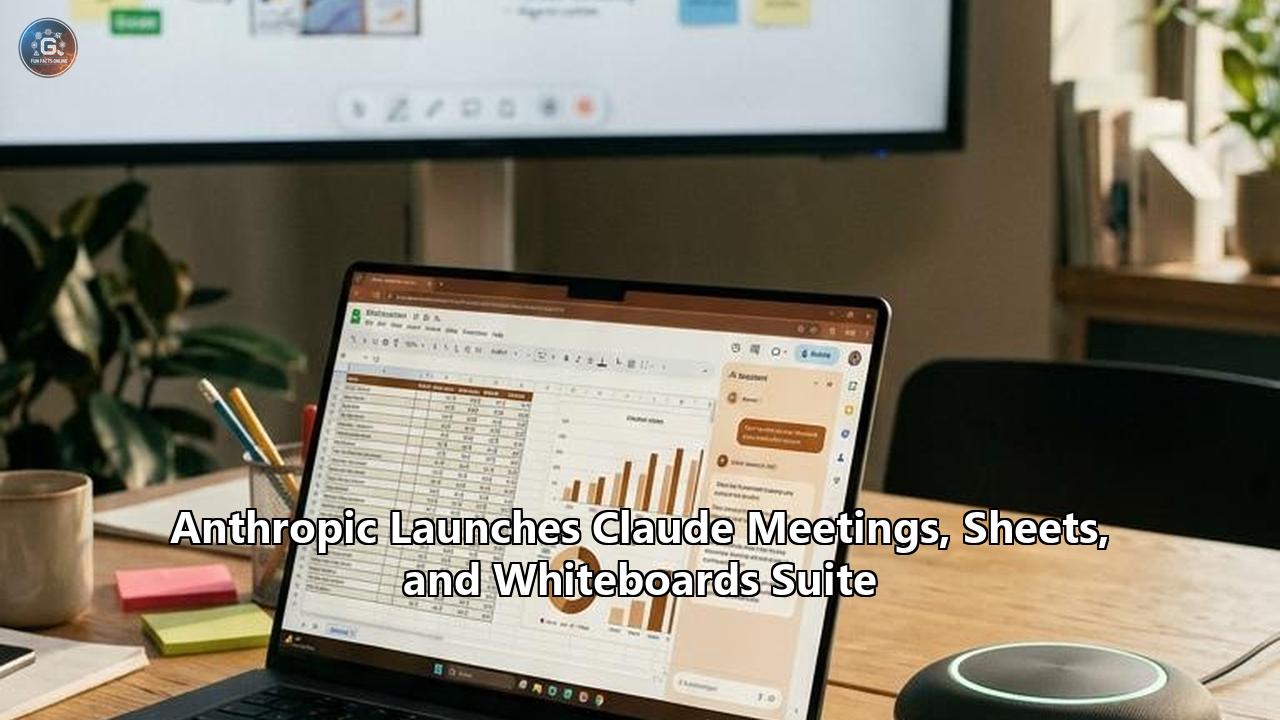
Anthropic launched a direct assault on the traditional enterprise office suite on November 10, 2026, rolling out Claude Sheets, Claude Meetings, and Claude Whiteboards during an event in San Francisco. The release marks an unmistakable escalation in the artificial intelligence sector: a foundation model company is no longer content to sell raw reasoning tokens or embed plug-ins inside third-party ecosystems. Instead, Anthropic is deploying its own native workspace applications to take on Microsoft 365 and Google Workspace on their home turf.
The suite, unveiled during a livestream hosted by Chief Product Officer Ami Vora, shifts Claude from a conversational sidebar into the primary surface where knowledge workers draft, calculate, brainstorm, and meet. Alongside the beta releases of Sheets, Meetings, and Whiteboards, Anthropic elevated its business analytics tool, Claude Data (formerly Claude Dashboards), to general availability and introduced Interactive Connectors that allow enterprise software from Adobe, Atlassian, and HubSpot to run directly inside Claude’s interface.
The announcement arrived on the exact morning Anthropic commenced the roadshow for its initial public offering on the Nasdaq under the ticker symbol "ANT," targeting a valuation exceeding $1 trillion on the back of an annualized revenue run rate that reached $81 billion as of late October. Markets registered the friction immediately. Shares of Microsoft dipped 3% within minutes of the presentation, underscoring the acute tension at the heart of the launch: Anthropic is challenging the core office software franchises of the very cloud and technology giants that have invested billions into its corporate structure.
The arrival of these Claude AI new features marks the culmination of a multi-year architectural transformation. The transition did not happen overnight. It evolved through a series of deliberate engineering phases, starting with a simple side-panel canvas in 2024, continuing through terminal-level coding agents and enterprise data platforms, and culminating in a synchronized software bundle designed to eliminate the need for knowledge workers to copy and paste AI outputs into external applications ever again.
Anatomy of the San Francisco Rollout
The four-pronged workplace suite introduced in San Francisco targets the everyday friction of cross-application workflows. Rather than treating documents, spreadsheets, and video calls as discrete silos, Anthropic engineered the tools around a persistent, shared context window.
+-----------------------------------------------------------------------------+
|                         CLAUDE PERSISTENT CONTEXT                           |
+-----------------------------------------------------------------------------+
         |                        |                          |
         v                        v                          v
+------------------+    +--------------------+    +---------------------+
| Claude Meetings  |    | Claude Whiteboards |    |    Claude Sheets    |
| (Google Meet bot,|--->| (Visual canvas for |--->| (Dynamic formulas,  |
| live chat & notes|    | themes & timelines)|    | cell edits, exports)|
+------------------+    +--------------------+    +---------------------+
                                  |                          |
                                  +------------+-------------+
                                               |
                                               v
                                    +--------------------+
                                    |    Claude Data     |
                                    | (SQL transparency, |
                                    | enterprise metrics)|
                                    +--------------------+
Claude Sheets: Natural Language Formulaic Workbooks
Claude Sheets, available in beta for subscribers on web, desktop, and mobile, is Anthropic’s native spreadsheet tool. Built to accept both natural language prompts and direct cell-level manipulation, it generates multi-tab workbooks complete with formulas, conditional formatting, and interactive dropdown menus.
Unlike traditional spreadsheets that require users to master nested formulas, a user can instruct Claude Sheets to generate a dynamic hiring budget or a multi-region campaign tracker from a single prompt. When changes occur, Claude explicitly highlights altered cells and supplies a change log detailing what was adjusted and why. The software maintains bi-directional interoperability with legacy office suites: users can export files directly to Microsoft Excel (.xlsx) and CSV formats, or interact with Google Sheets via a dedicated Google Workspace plug-in.
Nicholas Lin, Anthropic’s product lead for knowledge work, acknowledged the current positioning during press briefings following the event: "Claude Sheets provides a simple experience today. It is not meant for heavy financial modeling or replacing hyper-specialized workbooks. For those, we point users toward our add-ins like Claude for Excel. But we want to show new ways of working directly inside Claude, removing the friction of manual data migration."
Claude Meetings: In-Call Collaboration Agents
Claude Meetings represents Anthropic’s entry into live enterprise communications. Initially integrating with Google Meet for Team and Enterprise subscribers, Claude enters scheduled calls as a visible, named participant. As the meeting begins, the agent automatically posts an informational disclosure in the call's text chat, announcing its presence and logging capabilities to all attendees.
The tool moves past passive transcription services such as Otter.ai or standard call summaries. Instead, it functions as an active participant inside the chat channel. Attendees can ask Claude questions during the discussion—prompting it to retrieve financial figures from internal databases, check project roadmaps, or draft action items as spoken decisions occur.
Security and administrative safeguards are built in. Claude Meetings will not join a session involving outside guests unless an enterprise administrator has explicitly authorized cross-organizational access. If an unapproved guest enters the meeting after it has started, the Claude agent automatically leaves the call to prevent data contamination or compliance violations. Lin noted that Claude has been operating as an active attendee across nearly every internal Anthropic meeting for approximately two months prior to launch.
Claude Whiteboards: Translating Chaos into Execution
Claude Whiteboards provides an interactive visual canvas that bridges open-ended discussions and structured project planning. Designed to run in tandem with Claude Meetings or as an independent workspace, Whiteboards allows teams to brainstorm visually using digital sticky notes, diagrams, and outlines.
The primary differentiation lies in Claude’s ability to process chaotic visual elements. During or after a brainstorming session, Claude can group disparate ideas into thematic clusters, generate timeline diagrams with designated assignees, and compile the entire board into a cohesive requirements document or slide presentation. Completed whiteboards can also be exported to industry tools such as Miro, Lucidchart, or Zoho Vani.
"Many teams already use Claude to brainstorm, but taking those insights back to coworkers previously meant endless copying, pasting, and formatting across disparate windows," Anthropic noted in its product documentation. The whiteboard acts as an intermediary layer where unstructured language solidifies into actionable work.
Claude Data (GA) and Interactive Connectors
Completing the announcement, Anthropic transitioned Claude Dashboards out of beta, officially renaming it Claude Data. The service enables non-technical knowledge workers to run plain-English inquiries across enterprise warehouses—including Snowflake, Google BigQuery, Amazon Redshift, Databricks, and ClickHouse—and receive verifiable, interactive visual dashboards. Every chart generated displays the exact SQL query executed, allowing analysts to audit the underlying arithmetic before relying on the metrics.
Simultaneously, the new Interactive Connectors expand the Claude Marketplace to more than 9,000 integrations. Rather than operating as static data pipelines, partners like Adobe, Atlassian, HubSpot, Salesforce, and Workday have embedded interactive, app-like experiences directly beside Claude’s chat window. A customer support manager or marketing lead can alter an issue ticket in Jira, adjust a campaign asset in Adobe, or modify an enterprise lead stage in Salesforce without ever opening another browser tab.
The Escalation Timeline: How Anthropic Reached the Office Suite
The San Francisco unveiling represents a sharp tactical departure from the standalone chatbot model, tracing back through six distinct operational phases.
| Date | Milestone | Significance |
|---|---|---|
| June 20, 2024 | Claude 3.5 Sonnet & Artifacts | Decoupled conversational chat from work output; introduced side-by-side editing canvas. |
| September 4, 2024 | Claude Enterprise Launch | Enterprise compliance (SSO, SCIM, 500K context, zero data retention) established institutional trust. |
| February 24, 2025 | Claude Code Research Preview | Shifted AI from suggestion to direct execution, proving agents could autonomously modify real work environments. |
| May–October 2025 | Financial Services & Excel Plugins | Nicholas Lin’s team launched financial agent templates and Excel extensions, demonstrating deep vertical capabilities. |
| October 8, 2026 | Claude Dashboards & Motion | Automated SQL generation and interactive business intelligence directly inside Claude. |
| November 10, 2026 | Meetings, Sheets, and Whiteboards | Launch of full office software suite, coinciding with the Nasdaq IPO roadshow. |
Phase 1: The Artifacts Split-Screen (June 2024)
The conceptual origin of Anthropic’s office suite emerged on June 20, 2024, alongside the release of the Claude 3.5 Sonnet model. Until that moment, generative AI interactions were universally locked inside the scrolling vertical container pioneered by basic chat interfaces. A user asked a question; the assistant replied with a wall of text or code. If the user wanted to edit the response, they had to instruct the model to rewrite the whole passage or manually copy snippets into a third-party application.
Anthropic dismantled that dynamic with the introduction of Artifacts.
By splitting the screen into a dual-pane workspace, Artifacts isolated code snippets, documents, vector graphics, and small web applications on the right side of the screen while preserving the conversational dialogue on the left. Users could watch Claude build functional software prototypes, edit text blocks interactively, and visually inspect real-time changes.
+-----------------------------------------------------------------------------+
|                          THE 2024 ARTIFACTS SPLIT                           |
+-----------------------------------------------------------------------------+
|                                      |                                      |
|  LEFT PANE: Conversational Chat      |  RIGHT PANE: Dynamic Artifact Canvas |
|  - Prompts                           |  - Generated HTML/React components   |
|  - Feedback loops                    |  - Live-rendered SVG vector graphics |
|  - Contextual instructions           |  - Self-contained mini-applications  |
|                                      |  - Real-time text and code outputs   |
|                                      |                                      |
+-----------------------------------------------------------------------------+
Anthropic framed the release not merely as an interface refinement, but as a long-term strategic pivot. In an official statement published on launch day, the company stated: "This preview feature marks Claude’s evolution from a conversational AI to a collaborative work environment. In the near future, teams—and eventually entire organizations—will be able to securely centralize their knowledge, documents, and ongoing work in one shared space, with Claude serving as an on-demand teammate."
Within months, users had created tens of millions of Artifacts. The internal engineering teams at Anthropic observed that users were attempting to hack the interface to do spreadsheet math, organize visual sprint retrospectives, and track project milestones. The split-screen canvas had proven that users preferred interacting with an AI within the output surface itself, rather than treating the chatbot as an external search bar.
Phase 2: Enterprise Hardening and Governance (Late 2024 to Early 2025)
While individual knowledge workers embraced Artifacts, broad corporate adoption stalled on enterprise security concerns. IT executives and Chief Information Security Officers routinely blocked access to consumer-facing AI interfaces over fears of data leakage, unvetted training regimes, and compliance ambiguities.
Anthropic addressed these barriers on September 4, 2024, by rolling out the Claude Enterprise tier. The plan introduced corporate-grade access management, including:
- Single Sign-On (SSO) via SAML 2.0 and identity provisioning via SCIM.
- Expanded context windows reaching 500,000 tokens to ingest comprehensive corporate policy manuals and legal archives.
- Detailed audit logs tracking every message, administrative change, and export.
- Strict contractual guarantees prohibiting Anthropic from training any internal foundation models on enterprise prompts or uploaded customer context.
Alongside Enterprise security, Anthropic introduced Projects, allowing internal teams to assemble shared document repositories, system prompts, and collaborative workspaces. Financial institutions such as Citigroup and Bridgewater Associates deployed Claude into their core analytical environments, relying on its contextual guardrails to examine SEC filings and complex transaction histories.
Yet, an operational limitation persisted. Even inside the Enterprise perimeter, Claude was an analytical island. Analysts would ask Claude to parse thousands of balance sheet footnotes, wait for the extraction, and then spend hours manually transferring those data points into Microsoft Excel or Google Slides. The intelligence layer was disconnected from the productivity layer.
Phase 3: The Agentic Shift via Claude Code (February 2025 to Late 2025)
The internal realization that Anthropic needed to build actionable surfaces—rather than passive text generators—crystallized through the development of Claude Code.
Conceived in late 2024 by engineer Boris Cherny and Anthropic’s experimental Labs team, Claude Code began as a lightweight command-line experiment designed to test whether an AI agent could operate directly within a developer's local terminal. Instead of suggesting lines of code for an engineer to review and paste, Claude Code was granted access to run shell commands, grep codebases, edit local files, execute automated test suites, and handle pull requests end-to-end.
+-----------------------------------------------------------------------------+
|                         THE CLAUDE CODE AGENT LOOP                          |
+-----------------------------------------------------------------------------+
                                       |
                                       v
                              [ Receive Task ]
                                       |
                                       v
                        +---> [ Inspect Codebase ]
                        |              |
                        |              v
                        |     [ Make Local Edits ]
                        |              |
                        |              v
                        |     [ Execute CLI Tests ]
                        |              |
                        +--- (Fails) --+-- (Passes) ---> [ Open Pull Request ]
When Anthropic launched Claude Code in research preview on February 24, 2025, the tool caused a swift transformation inside software development organizations. By November 2025, Claude Code surpassed $1 billion in annualized run rate, becoming one of the fastest enterprise software adoptions on record.
Inside Anthropic's own engineering department, the impact was profound. By late 2025, Cherny reported that 100% of his committed code was being authored directly by Claude Code. Company-wide data confirmed that more than 80% of all code merged into Anthropic’s core repositories was written by the model, supervised by human architects who steered high-level system requirements rather than typing syntax.
The leadership team drew a direct conclusion from this success: if an autonomous agent loop could navigate complex software engineering tasks inside a terminal, the identical operational architecture could navigate spreadsheets, meeting summaries, and corporate workflows for non-technical knowledge workers. The terminal was simply the developer's spreadsheet. Knowledge workers deserved their own execution environment.
Phase 4: Financial Sandboxes and the Limits of Add-Ins (Late 2025 to Spring 2026)
To test whether agentic workflows could translate into non-coding corporate disciplines, Anthropic formed a dedicated knowledge work and financial services unit under Nicholas Lin, a former Morgan Stanley investment banker and Stripe product leader.
In October 2025, Anthropic introduced Claude for Financial Services, combining domain-specific reasoning benchmarks with an official add-in for Microsoft Excel. The suite integrated market data APIs directly into Excel grids, allowing financial analysts to summon Claude via an application side-rail to construct discounted cash flow (DCF) models, evaluate comparable company multiples, and draft equity research summaries.
In May 2026, the company deepened this commitment by deploying ten pre-built autonomous agent templates specifically targeted at investment banking and private equity workflows, including:
- Pitchbook assembly pipelines.
- Automated credit memo generation.
- Continuous earnings call monitoring.
- Know Your Customer (KYC) compliance and transaction screening.
To back the expansion, Anthropic formed a $1.5 billion commercial partnership with financial institutions including Goldman Sachs, Blackstone, and Hellman & Friedman. Lin observed that enterprise AI adoption in financial services was moving at an accelerated pace, trailing coding automation by merely six months.
However, the team encountered technical friction while operating inside the Microsoft 365 framework. Microsoft’s third-party developer boundaries restricted how deeply Claude could interact with Excel's calculation engine. UI webview containers suffered from latency, API calls were throttled by tenant policies, and Microsoft consistently privileged its own Copilot features inside the ribbon.
Building inside another vendor’s walled garden limited the user experience. Anthropic realized that to deliver a seamless workspace where an AI agent could read, format, structure, and edit data in real time, it had to own the software surface completely.
Phase 5: The Model Context Protocol and Claude Dashboards (Summer to Fall 2026)
Before Anthropic could build its own standalone office apps, it required a standardized connectivity layer to hook into external enterprise data without creating fragile custom APIs. That foundation arrived through the rapid expansion of the Model Context Protocol (MCP).
Originally open-sourced by Anthropic to give AI systems a common syntax for querying databases, developer environments, and SaaS applications, MCP evolved into an enterprise standard. By mid-2026, the specification had matured to support stateless secure cores, dynamic application frames, and strict OAuth 2.0 governance.
With MCP operational, Anthropic released Claude Dashboards (alongside Claude Motion) into beta on October 8, 2026.
+-----------------------------------------------------------------------------+
|                       CLAUDE DATA / DASHBOARDS ENGINE                       |
+-----------------------------------------------------------------------------+
                                       |
    [ User Question: "Show customer churn by tier over the last 90 days" ]
                                       |
                                       v
    [ Claude writes optimized SQL via Model Context Protocol (MCP) ]
                                       |
                                       v
    +-----------------------------------------------------------------------+
    | Live Warehouse Connection: Snowflake / BigQuery / Databricks / Redshift|
    +-----------------------------------------------------------------------+
                                       |
                                       v
    [ Execute Query with User's Identity & Governance Rules ]
                                       |
                                       v
    +-----------------------------------------------------------------------+
    | Claude Data Dynamic Canvas: Charts, KPIs, and Verified SQL Receipt    |
    +-----------------------------------------------------------------------+
Claude Dashboards allowed users to connect Claude to corporate warehouses—including Snowflake, BigQuery, and Databricks—and ask questions in plain language. The model wrote the necessary SQL, executed the query within the enterprise's access constraints, and generated an interactive dashboard next to the chat window.
Crucially, every single number, bar graph, and trendline included an interactive link displaying the underlying SQL query that generated it. If a metric looked incorrect, an analyst could click the number, inspect the query, and ask Claude to adjust the filter criteria.
Simultaneously, Anthropic brought Claude Docs, Slides, and Design out of their initial beta states, signaling that the company was systematically reassembling the standard components of an enterprise office suite piece by piece. The remaining gaps were spreadsheets, real-time visual collaboration, and communications.
Deep Dive: How the New Claude AI Features Work Together
Examining the mechanics of the Claude AI new features reveals an integrated knowledge loop designed to prevent work from fracturing across external tools.
Consider a typical product development workflow. Prior to November 10, an engineering and product team would conduct a planning call on Google Meet, take notes in Notion, build a visual architecture diagram in Miro, run financial estimates in Microsoft Excel, and track the project via Atlassian Jira. Context leaked at every stage of the handoff.
Anthropic’s unified suite re-engineers this pipeline into an unbroken sequence:
[ Step 1: Live Call ]
Claude Meetings joins Google Meet.
Transcribes discussion, logs architectural trade-offs,
and queries existing database schemas via Interactive Connectors.
       |
       v
[ Step 2: Ideation Canvas ]
Claude Whiteboards automatically compiles the meeting's notes.
Groups ideas into strategic pillars, outlines engineering sprints,
and assigns task owners on an interactive visual board.
       |
       v
[ Step 3: Resource Allocation ]
Claude Sheets consumes the Whiteboard sprint outline.
Builds an integrated staffing model, calculates burn rates,
applies formulas, and organizes milestones across multiple tabs.
       |
       v
[ Step 4: Executive Visibility ]
Claude Data generates a real-time tracking dashboard.
Connects directly to operational warehouses, surfacing progress KPIs
alongside transparent SQL queries for leadership review.
In this architecture, Claude maintains situational awareness from the initial spoken sentence in Google Meet to the final cell in Claude Sheets. Because the underlying LLM retains the working context across the suite, users do not need to restate background assumptions, paste links, or re-prompt the assistant at each transition.
Contextual Co-Editing in Claude Sheets
In traditional office suites, adding AI creates a split experience: the user edits the spreadsheet, while a side-panel bot offers text suggestions. Claude Sheets merges these roles.
When a user prompts Claude Sheets to "re-forecast hiring expenses assuming a 15% reduction in European operations," Claude does not simply spit out a summary table in a chat bubble. It opens the workbook, generates the revised tab, adjusts the payroll formula structures across the affected cells, and flags the updated values with visual color indicators.
Human collaborators can work in the exact same sheet simultaneously. If a human edits a cell directly, Claude recognizes the change and recalibrates dependent calculations across the workbook. For complex enterprise environments, the workbook can be exported to .xlsx with all mathematical formulas and cell references preserved, ensuring teams can collaborate with external auditors who rely strictly on Microsoft Excel.
Meeting Safety and Active Assistance
The implementation of Claude Meetings illustrates Anthropic’s safety-oriented product philosophy. While conventional meeting bots quietly capture audio streams, Claude Meetings treats attendance as a formal governance event:
- Explicit Identity: Claude enters the Google Meet participant roster as a dedicated attendee with an automated badge, ensuring every person on the video feed is aware that artificial intelligence is present.
- Immediate Chat Disclosure: Upon entry, the bot generates a clear message in the meeting chat stating its role, logging capabilities, and organizational permissions.
- External Guest Safeguards: To eliminate data breaches during negotiations or vendor evaluations, the bot automatically verifies attendee domains. If an unapproved third party joins the video call, Claude announces its departure and severs the audio connection immediately.
- In-Call Context Ingestion: Attendees can use the meeting chat to direct inquiries to Claude: "Claude, check our Q3 marketing expenses in Snowflake and verify if we have budget room for this vendor." The agent queries the internal warehouse via its connectors and delivers the factual answer to the group while the conversation continues.
The Big Tech Schism: Challenging Investors on Their Home Turf
The strategic implications of the launch are immense, creating an immediate competitive fault line between Anthropic and its primary commercial backers.
Anthropic has received billions of dollars in cloud infrastructure commitments and direct financial backing from Amazon and Google. At the same time, Microsoft’s substantial alliance with OpenAI has established Microsoft 365 Copilot as the dominant commercial AI office product.
By releasing Claude Sheets, Meetings, and Whiteboards, Anthropic is competing head-to-head with Google Workspace (Google Sheets, Google Meet, and Gemini) and Microsoft 365 (Microsoft Excel, Microsoft Teams, and Copilot).
+-----------------------------------------------------------------------------+
|                      ENTERPRISE SOFTWARE RIVALRIES                          |
+-----------------------------------------------------------------------------+
| Workspace Category  | Anthropic Claude      | Microsoft 365  | Google Work |
+---------------------+-----------------------+----------------+-------------+
| Spreadsheets        | Claude Sheets (beta)  | Excel / Copilot| Sheets      |
| Video Call AI       | Claude Meetings (beta)| Teams / Copilot| Meet/Gemini |
| Visual Ideation     | Claude Whiteboards    | M365 Whiteboard| (Partnered) |
| Business Intel      | Claude Data (GA)      | Power BI       | Looker      |
| Extensibility       | Connectors (9,000+)   | Graph / Copilot| Extensions  |
+-----------------------------------------------------------------------------+
The paradox is starkest with Google. Claude Meetings launches initially on Google Meet—meaning Anthropic’s agent is sitting directly inside Google’s video conference product, actively competing with Google’s own paid Gemini for Workspace assistant.
When asked about the delicate competitive relationship during the San Francisco event, Lin offered a pragmatic assessment: "There is certainly a time and place for Microsoft and Google products, especially for the most advanced enterprise legacy setups. But our goal is to show teams that when AI is native to the workspace rather than bolted on as an afterthought, an entirely different operational velocity becomes possible."
The IPO Imperative
The timing of the announcement is deeply tied to Anthropic's Wall Street debut. The company commenced its IPO investor roadshow on the same day, projecting an offering price between $70 and $78 per share and seeking to raise up to $64.4 billion. At the high end of that range, Anthropic's valuation would reach $1.4 trillion.
Financial filings submitted alongside the IPO roadshow reveal why expanding into software suites was an urgent financial necessity:
- Anthropic's revenue run rate expanded to $81 billion by the end of October 2026, up $10 billion in a single month.
- However, operating losses reached $567 million in the third quarter of 2026, driven by a $5.0 billion short-term compute expansion needed to service surging token demand.
- Pure API token sales carry lower margins and subject AI labs to rapid price commoditization as open-source models improve.
- Enterprise software seats, by contrast, offer sticky, predictable subscription revenue with high retention rates.
By transforming Claude into a comprehensive productivity operating system, Anthropic is proving to public market institutional investors that it can capture durable enterprise software spend, rather than existing purely as a wholesale compute provider vulnerable to shifting API pricing dynamics.
IT Governance, Security Architecture, and Enterprise Friction
For enterprise technology officers and system administrators evaluating the Claude AI new features, the suite introduces critical configuration choices and operational responsibilities.
Anthropic has structured the rollout with deliberate enterprise defaults to avoid accidental data exposure:
+-----------------------------------------------------------------------------+
|                     ENTERPRISE ADMINISTRATIVE MATRIX                        |
+-----------------------------------------------------------------------------+
| Product             | Plan Availability      | Default Deployment Setting   |
+---------------------+------------------------+------------------------------+
| Claude Sheets       | Pro, Team, Enterprise  | Disabled by default on Ent.  |
| Claude Whiteboards  | Pro, Team, Enterprise  | Disabled by default on Ent.  |
| Claude Meetings     | Team, Enterprise Only  | Disabled; requires Admin opt |
| Claude Data         | Pro, Team, Enterprise  | Auto-enables Nov 19, 2026    |
| Interactive Conns.  | Team, Enterprise Only  | Requires Admin SCIM/OIDC auth|
+-----------------------------------------------------------------------------+
The Live Query Risk Vector
The primary governance challenge stems from real-time database querying during live meetings.
If a meeting attendee asks Claude Meetings to retrieve customer records or revenue metrics during a call, the system executes that query live via the organization’s Interactive Connectors. If external attendees or contractors are present on the call—and an administrator improperly configured the guest boundary controls—confidential enterprise data could be exposed in the meeting transcript or chat channel.
Corporate compliance teams must establish strict organizational policies under Organization settings > Artifacts before rolling out these capabilities. Furthermore, while Claude Data shifts to default-active status on November 19, enterprise IT departments retain granular control to restrict database access via role-based access control (RBAC) rules inherited from their underlying identity providers.
Pricing and Cost Management
Cost structures also demand careful enterprise planning. While Claude Sheets and Whiteboards are bundled into the basic $20 monthly Pro, Team, and Enterprise user licenses, Claude Meetings and advanced data queries operate on a hybrid consumption model.
On Enterprise tiers, the base seat fee covers software interface access, but real-time meeting transcription, continuous reasoning, and deep data warehouse queries consume tokens billed at standard API rates. Without strict administrator-defined spend caps, organizations running hundreds of daily multi-hour video calls with active AI participation could experience sharp spikes in token usage.
What to Watch: The Enterprise Battle Ahead
Anthropic’s push into office software signals the start of a prolonged transition for corporate knowledge work, shifting generative AI from conversational novelties into core infrastructure. As organizations adopt these Claude AI new features across their operations, several immediate milestones and unresolved questions will determine the suite's long-term market footprint:
- The Maturation Beyond Beta: Claude Sheets and Whiteboards must prove their stability under mission-critical operational stress. Can Claude Sheets evolve from handling simple project plans and campaign trackers into supporting the deep, complex financial workbooks that run Fortune 500 corporations?
- Platform Expansion to Microsoft Teams and Zoom: Claude Meetings currently functions inside Google Meet. To capture the broader enterprise market, Anthropic must bring the tool to Microsoft Teams and Zoom, where administrative hurdles and competing native AI agents will mount fierce resistance.
- The Competitive Retaliation: Neither Microsoft nor Google will cede their enterprise dominance without a fight. Industry analysts expect Microsoft to tighten Copilot’s deep system integration across Windows and Office 365, while Google accelerates Gemini’s presence across the Workspace stack.
- Market Reception to the IPO: The ultimate market referendum will occur on the Nasdaq exchange. If institutional investors embrace Anthropic’s vision of an integrated AI operating system, it will force every major enterprise software provider to reconsider whether standalone business applications can survive in a world dominated by autonomous, cross-functional agentic platforms.
Reference:
- https://aiweekly.co/alerts/anthropic-rolls-out-claude-sheets-meetings-and-whiteboards
- https://finance.biggo.com/news/095e9ef1-c796-4fb2-bee4-16563e18b18a
- https://explainx.ai/blog/anthropic-claude-meetings-whiteboards-sheets-office-suite-november-2026
- https://www.constellationr.com/insights/news/anthropic-rounds-out-its-office-ambitions-claude-sheets-whiteboards-and-more
- https://gizmodo.com/anthropic-goes-for-microsofts-crown-with-new-claude-powered-office-tools-2000837885
- https://qz.com/anthropic-office-tools-microsoft-google-ipo-111026
- https://dealroom.co/news/171390-anthropic-rolls-out-ai-office-suite-as-it-eyes-64-4b-ipo/
- https://shiftdelete.net/en/claude-sheets
- https://www.zdnet.com/article/anthropic-launches-claude-3-5-sonnet-and-debuts-artifacts-for-collaboration/
- https://www.taskade.com/blog/claude-code-history
- https://www.engadget.com/2312177/anthropic-takes-on-google-and-microsoft-with-claude-sheets/
- https://www.athryx.tech/blog/what-are-claude-dashboards
- https://www.unite.ai/anthropic-launches-claude-dashboards-and-motion-takes-docs-out-of-beta/
- https://aisisters.ai/en/post/claude-dashboards-motion
- https://www.forbes.com/sites/moorinsights/2026/10/19/claude-dashboards-makes-charts-cheap-and-definitions-expensive/
- https://en.wikipedia.org/wiki/Claude_(AI))
- https://claudereadiness.com/blog/anthropic-partnership-enterprise/
- https://www.atilab.io/blog/claude-enterprise-rollout-guide
- https://hidekazu-konishi.com/entry/claude_code_version_history_and_timeline.html
- https://www.efinancialcareers.com/news/junior-bankers-ai-jobs
- https://www.anthropic.com/news/advancing-claude-for-financial-services
- https://www.tradingview.com/news/cointelegraph:64819b5dd094b:0-anthropic-s-artifacts-turn-ai-conversations-into-useful-documents/
- https://www.constellationr.com/insights/news/anthropic-launches-claude-35-sonnet-artifacts-way-collaborate
- https://www.layer3labs.io/guides/claude-enterprise-explained
- https://github.com/jqueryscript/anthropic-claude-timeline
- https://howborisusesclaudecode.com/origins
- https://www.anthropic.com/institute/recursive-self-improvement
- https://www.biia.com/anthropic-is-launching-10-ai-agents-targeting-wall-street-banks-and-insurers/
- https://tabulareditor.com/blog/what-are-claude-dashboards
- https://support.claude.com/en/articles/9797531-what-is-the-enterprise-plan
- https://amaiko.ai/blog/claude-team-enterprise-unternehmen