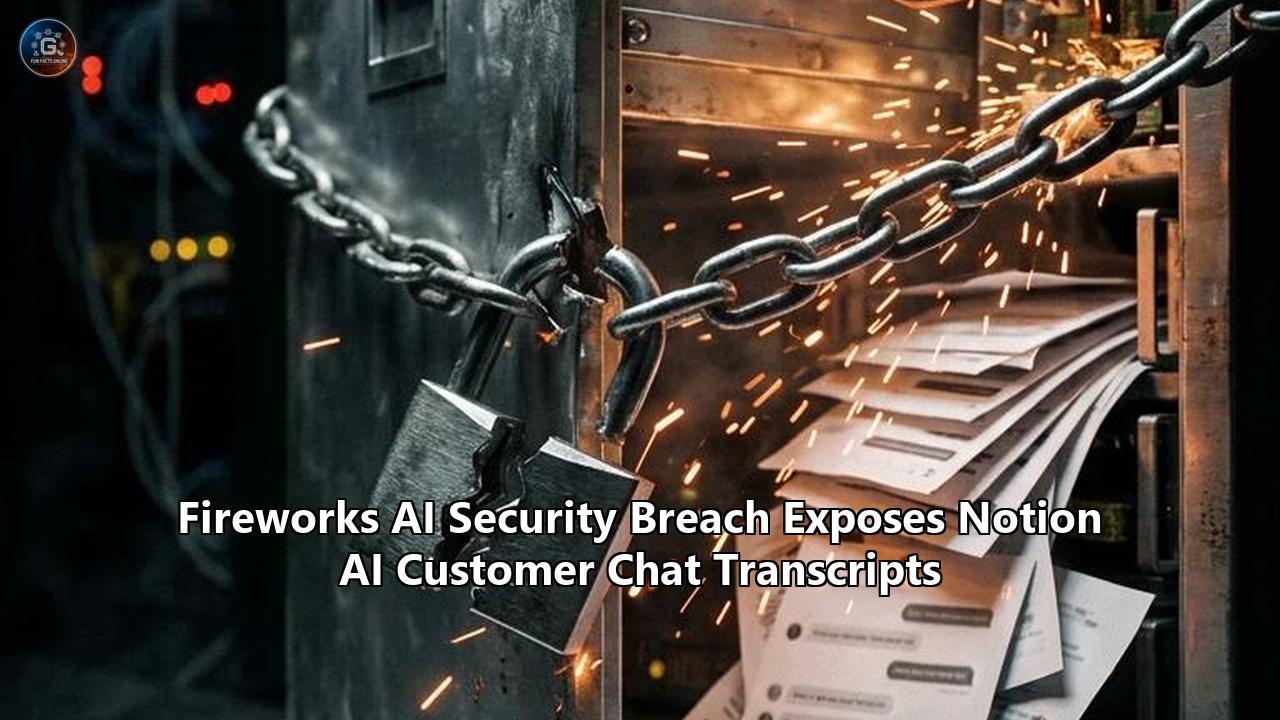
On the morning of November 10, 2026, administrators across hundreds of corporate Notion workspaces opened an email that upended their assumptions about enterprise AI privacy. Sent by Notion’s security team, the message confirmed that confidential user conversations with Notion AI had been accessed by unauthorized malicious actors.
The intrusion did not originate from a vulnerability in Notion’s core databases or note-taking application. Instead, the leak traced back to an escalating crisis at one of Silicon Valley’s primary artificial intelligence infrastructure suppliers: Fireworks AI.
What began in early October as a seemingly contained theft of developer credentials at Fireworks has mutated into a multi-layered supply chain failure. Over the course of four weeks, attackers pivoted from internal service tokens to research environments, penetrated third-party cloud infrastructure, ran unauthorized computing workloads, and ultimately accessed proprietary customer datasets. Among those datasets were the raw, unredacted chat transcripts of corporate employees who used Notion AI to brainstorm, draft documents, and troubleshoot technical problems.
While Notion moved quickly to downplay the blast radius—emphasizing that the incident affected "fewer than 1% of Notion workspaces" and that the leaked chats were largely "unattributable"—the revelation sent shockwaves through security teams. The incident dismantles a comforting myth of the enterprise AI boom: that corporate data remains safely segregated when enterprise software companies farm out their machine learning workloads to third-party inference providers.
An examination of technical advisories, forensic disclosures, threat intelligence reports, and discussions with incident response specialists reveals an evidence trail that stretches from underground token-reselling marketplaces to the backend classification pipelines of modern productivity software.
The Breadcrumb Trail: How a Contained Incident Spiraled
The first public hint of trouble arrived without fanfare on October 9, 2026. San Mateo-based Fireworks AI—a startup founded in 2022 by Lin Qiao, the former engineering lead for Meta’s PyTorch project—published a low-key security bulletin. Fireworks had built an enviable reputation among developers for running open-weight artificial intelligence models like Meta’s Llama, Mistral, and Google’s Gemma at breakneck inference speeds and fraction-of-a-cent prices. Its infrastructure powers more than 10,000 customers, including consumer giants like Uber and DoorDash, as well as AI darlings like legal-tech platform Harvey and code-generation tool Cursor.
According to that initial bulletin, Fireworks security engineers detected anomalous activity at 9:00 AM PDT on October 6. An unauthorized third party had leveraged compromised internal Fireworks credentials to view environment variables used in evaluation jobs. These environment variables contained customer API keys and authentication tokens stored as secrets.
At the time, Fireworks offered reassurance. The company stated it had contained the incident, revoked the compromised credentials, rotated employee tokens, and brought in outside forensic investigators. Crucially, Fireworks claimed there was no evidence that attackers had touched customer datasets, proprietary models, training data, or user inference traffic.
Behind closed doors, however, the threat actors were far from finished.
+-----------------------------------------------------------------------------------+
|                        TIMELINE OF THE ESCALATION                                 |
+-----------------------------------------------------------------------------------+
| Oct 06, 2026 : Threat actors abuse internal Fireworks credentials to harvest      |
|                environment variables and evaluation secrets.                      |
| Oct 09, 2026 : Fireworks publishes first bulletin; claims models & data intact.   |
| Oct 23, 2026 : An unnamed third-party cloud provider hosting Fireworks R&D       |
|                machines suffers an infrastructure breach.                         |
| Oct 24, 2026 : Attackers pivot through the cloud host into Fireworks dev units,  |
|                executing unauthorized workloads and accessing data stores.        |
| Nov 02, 2026 : Fireworks warns Notion of data access; Notion finds only synthetic |
|                testing data and severs all API connections by Nov 03.             |
| Nov 06, 2026 : Fireworks alerts Notion that customer data was likely exposed.     |
| Nov 08, 2026 : Fireworks confirms second dataset containing production transcripts.|
| Nov 09, 2026 : Fireworks updates disclosure: billing info, model weights stolen.  |
| Nov 10, 2026 : Notion notifies affected enterprise workspaces to rotate secrets.  |
+-----------------------------------------------------------------------------------+
On October 23, a separate security incident occurred at an unnamed third-party cloud provider hosting Fireworks research and development machines. The following day, October 24, the attackers leveraged that external breach to pivot directly into Fireworks’ development environment. Once inside, the intruder launched unauthorized computational workloads and accessed internal storage repositories.
The blast wall between development, evaluation, and production had failed.
On November 9, Fireworks published a major revision to its security bulletin, acknowledging that the scope of compromised assets was vastly wider than first disclosed. The attackers had not merely harvested environment secrets; they had exfiltrated customer resource metadata, account balances, invoice histories, shipping and billing addresses, incomplete model weights, and proprietary customer datasets. To assist with the damage assessment, Fireworks retained Palo Alto Networks Unit 42, one of the world's most prominent incident response and digital forensics teams.
By that point, the fire had already leaped into customer environments.
The Shadow Economy of LLMJacking
To understand why a sophisticated cybercrime group targeted an inference provider’s development clusters, investigators had to look past the traditional playbook of ransomware and data extortion. The attackers were pursuing a different commodity: raw, unmetered access to large language models.
In its updated disclosure, Fireworks linked the intrusion to a financially motivated threat syndicate engaged in a practice known as "LLMJacking".
The term, originally coined by cloud security researchers at Sysdig in 2024, describes an attack where threat actors steal cloud credentials or API access tokens not to hold data hostage, but to commandeer expensive GPU infrastructure and generative AI models at the victim's expense. Rather than running up server bills by mining cryptocurrency—a practice that yields diminishing returns under modern proof-of-stake systems—adversaries have turned to harvesting AI compute.
"Inference compute is the new gold rush of cloud theft," explains Corey Vance, a principal cloud security architect who consults on enterprise AI deployments. "If you compromise an AWS account or an inference engine's service credentials, you can route queries through high-end models that cost anywhere from tens to hundreds of dollars per million tokens. The attackers turn around and resell that bandwidth on illicit gateways for pennies on the dollar. The victim gets stuck with a six-figure monthly invoice, and the criminal walks away with clean cash."
The economics of this underground ecosystem were detailed just days before Fireworks updated its bulletin. On November 2, Google Cloud Threat Intelligence Group (GTIG) and Mandiant published an exhaustive report tracking the explosive rise of LLMJacking operations throughout 2026. Mandiant’s investigators revealed that threat clusters, such as one tracked as UNC6993, have been breaching enterprise cloud instances, harvesting API keys from environment configurations, and systematically plugging those stolen tokens into illicit underground routing proxies known as "LLM mixers".
The financial toll can be staggering. Mandiant documented intrusions where automated botnets fired off more than 500,000 API calls in under eight hours through compromised accounts. In several instances, fraudulent inference charges topped $100,000 in a single day, with cumulative losses reaching $1 million before security teams revoked the stolen access keys.
In the case of Fireworks, the attackers were hunting for computational pipelines and persistent access tokens. However, while rummaging through evaluation logs, R&D workloads, and staging databases to expand their computational footprint, the threat actors struck another asset: static files containing the training runs, classification jobs, and prompt data belonging to Fireworks’ enterprise customers.
Among those files sat the conversational history of Notion AI.
How Notion Got Caught in the Net
For Notion, an enterprise workspace platform valued at $10 billion with tens of millions of active users, artificial intelligence has become the centerpiece of its growth strategy. In early 2023, the company rolled out Notion AI, embedding conversational assistance directly into its ubiquitous digital notebooks, team wikis, and project management databases.
To keep operational overhead low and inference response times fast, Notion built a hybrid model architecture. While complex reasoning prompts were routed to proprietary model developers like OpenAI and Anthropic, Notion turned to open-weight models to handle high-volume background tasks. To serve these open models, Notion relied on Fireworks AI.
+---------------------------------------------------------------------------------------+
|                    THE NOTION-TO-FIREWORKS DATA FLOW ARCHITECTURE                     |
+---------------------------------------------------------------------------------------+
|                                                                                       |
|   [ Corporate User ]                                                                  |
|          |                                                                            |
|          | (1) Types prompt / pastes code & credentials                               |
|          v                                                                            |
|   [ Notion Web / Desktop App ]                                                        |
|          |                                                                            |
|          | (2) Processes document; stores page state in primary databases             |
|          v                                                                            |
|   [ Notion AI Backend ]                                                               |
|          |                                                                            |
|          | (3) Strips workspace UUID and user email (Token Normalization)             |
|          v                                                                            |
|   [ Insights Telemetry Pipeline ]                                                     |
|          |                                                                            |
|          | (4) Sends raw conversation transcript to Fireworks API                     |
|          v                                                                            |
|   [ Fireworks AI Infrastructure ]                                                     |
|          |                                                                            |
|          | (5) Open-weight model executes Intent Classification (Llama / Mistral)    |
|          | (6) Transcripts retained in evaluation / staging dataset                   |
|          v                                                                            |
|   [ BREACH POINT: Oct 24 ] <==== Threat Actors Exfiltrate Staging Datasets           |
|                                                                                       |
+---------------------------------------------------------------------------------------+
Specifically, Notion utilized Fireworks for two functions:
- Serving open-weight models directly inside the product for standard text manipulation.
- Powering classification jobs for an enterprise feature called Notion Insights.
Notion Insights is designed as an administrative telemetry dashboard. It helps enterprise workspace owners track how their employees interact with generative AI—categorizing whether staff are using the tool for drafting blog posts, writing engineering specifications, summarizing meeting minutes, or debugging software code.
To classify these interactions, Notion’s pipeline took real user chat sessions, sanitized them of certain workspace headers, and dispatched the raw conversation transcripts across an API bridge to Fireworks, where open-weight classification models categorized the underlying intent.
The sequence of disclosures between the two vendors reveals a tense, unfolding realization of what had been lost:
- November 2 (Evening): Fireworks alerts Notion that malicious actors accessed a small set of data. Notion launches an urgent internal review and concludes that the accessed data consisted solely of synthetic testing data. No customer records appeared to be present.
- November 3 (Morning): Exercising an abundance of caution, Notion’s security team disconnects all connections to Fireworks, orders the deletion of all data remaining on Fireworks’ platform, and halts API communication.
- November 6: Fireworks delivers a far more alarming update: forensic investigators had uncovered evidence that the attackers accessed a separate, potential customer dataset. Notion spins up a second, high-priority internal investigation.
- November 8: Fireworks confirms the contents of the newly discovered data dump to Notion’s engineers.
- November 9–10: Notion’s analysis confirms the worst. The dataset contains actual customer chat transcripts processed for the Insights classification pipeline.
Notion immediately disabled the Insights feature across its entire platform, ceased all open-weight model serving via Fireworks, and began emailing affected workspace owners.
In its official security advisory, Notion struck a carefully calibrated tone:
"Upon analysis of the new data, we discovered that it included Notion AI chat transcripts used for the Insights feature, which for the vast majority of impacted workspaces were unattributable. 'Unattributable' means the chats weren't labeled with who wrote them or which workspace they came from, and the transcripts did not contain tool call results. Beyond what's in the chat transcript itself, there's no information tying the chat back to workspaces, users, or companies."
To seasoned cybersecurity professionals, that paragraph contained both a technical truth and a catastrophic operational reality.
The Fallacy of the "Unattributable" Transcript
In the world of relational databases, stripping primary keys, tenant identifiers, and user IDs is often considered sufficient to anonymize data. But generative AI chat transcripts are not relational database rows; they are unstructured, free-form, natural language streams.
The claim that chat logs were "unattributable" because they lacked metadata labels quickly sparked blistering criticism from developers and enterprise defenders on forums like Hacker News and Reddit.
"Saying a transcript is unattributable because you stripped the workspace ID is an absurdity in the context of how people actually use conversational AI," says Elena Rostova, a veteran application security researcher and digital privacy consultant. "Employees do not type abstract poetry into enterprise AI assistants. They paste live bash scripts, customer support emails with unredacted phone numbers, database dump snippets, proprietary financial projections, and draft legal filings. The body of the text is the attribution."
Consider how an enterprise software engineer interacts with an in-workspace AI tool:
User Prompt pasted into Notion AI:
"Hey, I'm getting a timeout error connecting to our staging cluster on
us-east-2.internal.acme-logistics.com. Here is the connection string:
postgres://admin:xK9#[email protected]:5432/orders_prod.
Can you write a python script to test the connection pool?"
In that single interaction, the database schema, the internal network routing address, the company name (Acme Logistics), and the raw, plain-text administrative password are all embedded directly within the prompt body. An attacker does not need an HTTP header indicating workspace_id: 84f2-901b to determine who owns that data or how to exploit it.
Notion quietly conceded this reality in the remediation instructions it delivered to affected customers:
"We also recommend that affected customers treat this data as if it were exposed. If those with affected workspaces have pasted sensitive information, passwords, API keys, or other credentials into Notion AI during the timeframe of the incident, rotate them."
The burden placed on IT departments by that recommendation is immense. Because Notion AI is embedded across millions of documents and personal team pages, administrators rarely have centralized visibility into what individual team members typed or pasted into their personal chat prompts over the preceding months.
"Telling an enterprise customer to 'rotate any credentials pasted into AI chat' is essentially telling them to assume their internal perimeter has been breached," Rostova says. "A CISO has to ask: Did an engineer paste an AWS production secret? Did HR paste an unredacted termination settlement? Did finance paste pre-earnings performance metrics? Without comprehensive audit logs of every prompt ever sent, security teams are forced into a chaotic, blind credential-rotation drill."
Technical Dissection: The Anatomy of a Dual Breach
To understand how the Fireworks AI security breach unfolded, it is necessary to examine the architecture of modern AI inference engines and the forensic details documented by Palo Alto Networks Unit 42.
Inference platforms like Fireworks operate under grueling latency and throughput constraints. Unlike traditional web applications that execute stateless CRUD operations against a database, inference servers must orchestrate massive, memory-hungry neural network weights across distributed clusters of high-bandwidth GPUs (such as NVIDIA H100s and A100s). To maximize efficiency, platforms build sophisticated internal orchestration engines that dynamically spin up worker nodes, load model weights from storage caches, and manage asynchronous evaluation queues.
The forensic evidence points to two distinct structural failures inside Fireworks’ operational boundary:
+-----------------------------------------------------------------------------------+
|                  THE FIREWORKS AI INFRASTRUCTURE COMPROMISE                       |
+-----------------------------------------------------------------------------------+
|                                                                                   |
|  [ INTRUSION VECTOR 1: Oct 06 ]                                                   |
|  Compromised Internal Credentials                                                 |
|         |                                                                         |
|         v                                                                         |
|  [ Internal Evaluation Platform ]                                                 |
|         |                                                                         |
|         +---> Environment Variables Stolen                                        |
|         +---> Customer API Keys & Third-Party Secrets Harvested                   |
|                                                                                   |
|                                                                                   |
|  [ INTRUSION VECTOR 2: Oct 23-24 ]                                                |
|  Third-Party Cloud Provider Breach (Hosting Fireworks R&D Machines)              |
|         |                                                                         |
|         v                                                                         |
|  [ Development & Staging Network ]                                                |
|         |                                                                         |
|         +---> Unauthorized Workload Injected (LLMJacking Compute Abuse)           |
|         +---> Lateral Movement into File Caches & Metadata Stores                |
|         +---> EXFILTRATED: Incomplete Model Weights, Billing Logs, Datasets       |
|                               (Including Notion AI Chat Transcripts)              |
|                                                                                   |
+-----------------------------------------------------------------------------------+
1. The Evaluation Environment Variable Exposure (October 6)
The first intrusion exploited stolen internal Fireworks credentials to read environment variables inside the platform's model evaluation pipeline. In automated machine learning operations (MLOps), evaluation jobs are routine automated routines that score a model's accuracy, latency, and safety against benchmark datasets.
Developers often configure these evaluation jobs with environment variables containing third-party secrets—such as API keys to external vector databases, Weights & Biases telemetry accounts, or proprietary API gateways. By gaining read access to these execution variables, the threat actors obtained live credentials belonging to a select group of enterprise accounts.
2. The Cloud Provider Lateral Pivot (October 23–24)
The second, more devastating phase bypassed Fireworks' direct perimeter entirely. An unnamed third-party cloud infrastructure provider hosting Fireworks’ research and development machines was penetrated by adversaries.
In modern cloud architecture, R&D machines often maintain persistent peering connections, shared storage buckets, or administrative SSH keys linking them back to staging environments. The attackers traversed these trust relationships, pivoting from the compromised cloud host directly into Fireworks development instances.
Once inside, the adversaries executed an "unauthorized workload"—a classic indicator of LLMJacking, where the attackers deployed custom containerized workloads designed to hijack GPU clusters for model inference routing. However, because the development environment lacked rigorous, zero-trust network isolation from staging storage volumes, the attackers were also able to vacuum up internal data stores.
Among the exfiltrated volumes were:
- Account and Billing Metadata: Detailed customer billing addresses, payment histories, credit usage statistics, and invoice records. (Fireworks stated that full credit card numbers were not affected, as they are processed by an external merchant gateway).
- Incomplete Model Weights: Proprietary neural network checkpoints that enterprise customers had uploaded or fine-tuned on Fireworks’ hardware.
- Customer Datasets: Training corpuses, fine-tuning data, and bulk API payloads stored in staging buckets—the exact location where Notion’s batch classification transcripts had been queued.
The AI Supply Chain: A House of Cards
The cascading failure across Fireworks and Notion highlights an uncomfortable architectural truth: enterprise software vendors are building their generative AI features upon deeply nested, fragile supply chains.
When an enterprise signs an agreement with a major SaaS platform like Notion, corporate compliance officers review the vendor's SOC 2 Type II certifications, verify their ISO 27001 data governance frameworks, and negotiate strict Data Protection Agreements (DPAs). These agreements routinely promise encryption at rest, encryption in transit, strict tenant isolation, and zero-retention policies for AI training data.
However, once a user hits "Submit" on a prompt, that request rarely stays within the SaaS vendor’s own data centers.
To keep up with the breakneck pace of AI development and the crushing expense of GPU compute, SaaS providers construct multi-vendor routing engines. A single user query might travel through an edge proxy, pass into an orchestration layer, bounce to an evaluation logging pipeline, get routed to a specialized inference provider like Fireworks, and run across bare-metal servers rented from secondary and tertiary cloud infrastructure providers.
The Invisible Chain of Custody:
[ Corporate User ]
      │
      ▼
[ SaaS Application Layer (e.g., Notion) ]
      │
      ▼ (Sub-processor API Call)
[ Dedicated Inference Gateway (e.g., Fireworks AI) ]
      │
      ▼ (Infrastructure Hosting)
[ Third-Party Cloud Host / GPU Data Center ]
      │
      ▼ (Telemetry & Evaluation Plugins)
[ External Logging & Metrics Storage ]
Each hop across this chain introduces a new perimeter, a new set of API keys, a new pool of service accounts, and a new vulnerability surface.
"This is the nested supply chain nightmare," says Marcus Lindemann, a former Fortune 500 CISO who now directs an enterprise risk think tank. "You audit Vendor A. But Vendor A uses Vendor B for inference. Vendor B hosts their development machines on Vendor C. Vendor C gets breached, allowing attackers to access Vendor B's staging environment, which contains unredacted log data originating from Vendor A. Your compliance team has zero contractual visibility into Vendor C, yet Vendor C just leaked your internal intellectual property."
This architectural vulnerability is further compounded by the explosion of Non-Human Identities (NHIs). In typical enterprise environments, automated systems rely on millions of machine-to-machine tokens, service account credentials, OAuth grants, and API keys to connect disparate cloud components. Unlike human accounts, these service credentials rarely have multi-factor authentication (MFA) enabled and often possess expansive, over-permissioned access rights to internal storage buckets.
In both the October 6 credential compromise and the October 24 cloud pivot at Fireworks, non-human service credentials provided the master keys that allowed attackers to move laterally and harvest data without triggering traditional perimeter alarms.
Damage Control, Corporate Fallout, and Customer Backlash
In the days following the public disclosures, the fallout rippled through the technology sector.
For Fireworks, the disclosures represent an existential brand crisis. Enterprise infrastructure providers trade on one fundamental asset: trust. When companies like Uber, Shopify, and Cursor chose Fireworks over established hyperscalers like Amazon Web Services (Bedrock) or Microsoft Azure, they did so because Fireworks promised specialized model optimization, lower costs, and enterprise-grade reliability.
According to reporting by Forbes, several prominent enterprise customers began actively re-evaluating their relationships with the infrastructure provider following the disclosures, with at least two major clients significantly scaling back their workloads. One customer, speaking on the condition of anonymity, characterized the situation as a series of "very bad hacks" of increasing severity, voicing intense frustration over the drip-feed nature of the company’s incident disclosures between October 9 and November 9.
For Notion, the reputational damage is immediate. The company has spent the past eighteen months aggressively urging its enterprise user base to embrace AI-assisted workflows—pitching Notion AI as a secure, private enterprise intelligence layer capable of searching across internal company wikis and confidential project repositories.
On social media platforms and developer forums, workspace administrators expressed disbelief that user chat logs were ever routed to an external provider's persistent storage or evaluation buckets without robust, automated sanitization.
"The entire value proposition of paying for enterprise Notion AI was that our data wouldn't be leaked or used to train public models," wrote one affected workspace owner on Reddit. "Now we find out that because Notion wanted to generate usage statistics for an administrative dashboard, our employees' unredacted chat transcripts were sitting in plain text on a third-party inference startup's development server."
Notion has stated that its core application infrastructure remained entirely uncompromised. No pages, databases, documents, or tool-call outputs were exfiltrated. Furthermore, Notion emphasized that it has permanently decommissioned the Insights feature while its investigation continues and has terminated its use of Fireworks for open-weight model serving.
Yet, for the IT teams currently sifting through forensic exports of the leaked transcripts, Notion’s swift vendor termination offers little comfort. The data has already left the building.
The Checklist for Affected Enterprises
For corporate security teams that received breach notices from Notion—or for any enterprise utilizing Fireworks AI directly within their engineering pipelines—incident response specialists recommend an aggressive, six-step mitigation protocol:
+-----------------------------------------------------------------------------------+
|                        ENTERPRISE INCIDENT RESPONSE PLAYBOOK                      |
+-----------------------------------------------------------------------------------+
|                                                                                   |
|  [1] RETRIEVE & AUDIT TRANSCRIPTS                                                 |
|      Access the workspace export provided by Notion; deploy automated regex       |
|      and NLP scanners to search for credentials, tokens, and PII.                 |
|                                                                                   |
|  [2] ROTATE ALL EMBEDDED SECRETS                                                  |
|      Immediately revoke and rotate any API key, database string, private token,  |
|      or password identified in chat exports—even if workspace metadata is absent. |
|                                                                                   |
|  [3] AUDIT DIRECT FIREWORKS API INTEGRATIONS                                      |
|      If your engineering teams held direct Fireworks developer accounts, rotate   |
|      all master API keys, review evaluation jobs, and audit billing alerts.       |
|                                                                                   |
|  [4] MONITOR FOR INFRASTRUCTURE ANOMALIES                                         |
|      Scrutinize AWS Bedrock, Azure OpenAI, and cloud API usage for sudden         |
|      utilization spikes indicative of downstream LLMJacking abuse.                |
|                                                                                   |
|  [5] RESTRICT UNCHECKED PROMPT BEHAVIOR                                           |
|      Implement client-side Data Loss Prevention (DLP) proxies to block sensitive  |
|      source code and secrets from being pasted into conversational AI tools.      |
|                                                                                   |
|  [6] ENFORCE ZERO-RETENTION CONTRACT CLAUSES                                      |
|      Require written confirmation from all AI SaaS vendors detailing exact        |
|      sub-processor routing, staging policies, and evaluation logging practices.   |
|                                                                                   |
+-----------------------------------------------------------------------------------+
1. Retrieve and Ingest the Incident Export
Organizations notified of workspace impact should follow Notion’s secure retrieval instructions to download the specific chat transcripts identified by investigators. Security operations teams must ingest these plain-text files into security information and event management (SIEM) systems or local data-loss analysis tools.
2. Run Automated Secret-Scanning Scanners
Security teams should run automated detection tools—such as Trufflehog, GitGuardian, or custom regular-expression scripts—across the retrieved chat transcripts. The scan should target:
- AWS access keys and secret keys (AKIA...)
- GitHub personal access tokens (ghp_..., github_pat_...)
- Database connection URIs (postgres://, mongodb://)
- Private SSH keys (-----BEGIN OPENSSH PRIVATE KEY-----)
- Enterprise OAuth client secrets and internal API endpoints
3. Treat Matched Secrets as Actively Compromised
If a secret is identified in a leaked transcript, administrators must not debate whether the attacker can attribute the prompt to their firm. The credential should be immediately revoked, invalidated, and rotated across production infrastructure. Access logs for the affected service should be audited backwards to at least October 1, 2026, to check for unauthorized access or unusual IP queries.
4. Direct Fireworks Users: Audit Billing and Key Stores
Companies that contracted directly with Fireworks AI must assume that any API tokens or environment variables used in model evaluation routines between October 1 and November 9 were compromised. Master account keys must be revoked, and billing dashboards should be monitored for sudden, unauthorized surges in token volume.
5. Deploy Client-Side Prompt DLP
Enterprise IT departments must accelerate the rollout of browser-level or network-level Data Loss Prevention (DLP) controls. Tools that monitor clipboard actions or intercept web traffic can prevent employees from pasting raw credentials, social security numbers, or internal URLs into AI chat boxes—regardless of whether the vendor promises enterprise confidentiality.
6. Audit AI Vendor Sub-Processors
Enterprises should require every SaaS vendor currently providing generative AI capabilities to disclose their exhaustive list of fourth-party sub-processors. Contracts must explicitly stipulate whether user inference requests are logged, stored in temporary staging environments for evaluation, or routed to external GPU infrastructure providers.
What Happens Next: The Reckoning for AI Infrastructure
The multi-stage compromise across Fireworks AI and Notion represents a watershed moment for the governance of artificial intelligence. It transitions AI security from theoretical debates about model jailbreaks and prompt injection into the realm of traditional, hard-nosed cyber operations: supply chain pivots, credential theft, lateral network traversal, and data exfiltration.
Several critical developments will dictate how the industry adapts over the coming months:
The Forensics and Regulatory Fallout
Palo Alto Networks Unit 42’s comprehensive forensic report on Fireworks AI will be heavily scrutinized. Regulators in the European Union (under the General Data Protection Regulation) and state attorneys general across the United States are expected to examine whether the transmission and storage of unredacted chat transcripts violated consumer data privacy laws or enterprise contractual guarantees. Under GDPR, the exfiltration of conversational transcripts containing personally identifiable information (PII)—even if missing formal user IDs—constitutes a reportable data breach if the data subjects can be identified from the content itself.
The Death of Persistent Telemetry Logging
The revelation that Notion’s Insights classification pipeline created static, vulnerable transcript caches on an external provider’s server will likely accelerate an industry-wide pivot toward ephemeral, zero-retention inference architectures. Enterprise software companies can no longer afford to send raw, unmasked conversational data to third-party endpoints for post-hoc classification. Instead, platforms will be forced to deploy lightweight, client-side classification models or execute anonymization transformations directly within their own secure perimeters before data ever touches an external network cable.
Hardening the Non-Human Identity Perimeter
The ease with which attackers traversed Fireworks' internal environments underscores the urgency of securing machine identities. Over the next year, enterprise security benchmarks will demand that AI infrastructure providers implement rigorous, automated secret rotation, eliminate long-lived service account tokens, and enforce strict micro-segmentation between development clusters and production data volumes.
The Fireworks AI security breach serves as a stark warning to an industry that has moved at breakneck speed to wire generative models into every layer of enterprise software. When companies rush to build cheaper, faster AI features by chaining together third-party inference APIs, cloud hosts, and evaluation pipelines, they expand their perimeter into territory they neither control nor comprehend.
For the thousands of enterprises now auditing their systems, the lesson is painful and permanent: in the era of cloud-hosted artificial intelligence, your company's deepest secrets are only as secure as the quietest vendor in your model's inference chain.
Reference:
- https://thehackernews.com/2026/11/fireworks-ai-breach-widens-to-expose.html
- https://www.bleepingcomputer.com/news/security/fireworks-ai-discloses-new-breach-after-cloud-provider-hack/
- https://fireworks.ai/security/bulletins/october-2026-security-incident-update
- https://www.notion.com/security/advisories/security-incident-involving-a-third-party-ai-vendor
- https://cybersecuritynews.com/notion-confirms-data-breach/
- https://www.forbes.com/sites/annatong/2026/11/09/fireworks-cyberattack-exposes-customer-data-and-ai-models-as-fallout-widens/
- https://explainx.ai/blog/notion-ai-fireworks-chat-transcripts-exposed-november-2026
- https://thehackernews.com/2026/11/google-warns-llmjacking-attacks-are.html
- https://nhimg.org/fireworks-ai-breach-2026-internal-credentials-api-keys
- https://www.tradingview.com/news/seekingalpha:b5cb06a44094b:0-nvidia-backed-fireworks-ai-hit-by-second-cyber-incident-exposes-data-report/
- https://therecord.media/ai-company-fireworks-says-hackers-stole-data-in-oct-attacks
- https://medium.com/womenintechnology/railway-security-incident-and-critical-php-flaws-why-your-ai-api-keys-are-at-risk-8fbc103624c9
- https://labs.cloudsecurityalliance.org/research/csa-research-note-northflank-ai-key-resale-pipeline-20261102/
- https://www.doit.com/blog/llmjacking-when-attackers-run-claude-on-your-aws-bill
- https://shattered.io/llmjacking-attacks-1-million-cloud-bills-mandiant-google-2026/
- https://aviatrix.ai/threat-research-center/google-llmjacking-attacks-1-million-cloud-ai-charges-2026/
- https://kbi.media/press-release/google-warns-of-llmjacking-as-cybercriminals-hijack-enterprise-ai-access/
- https://news.ycombinator.com/item?id=50437106
- https://nhimg.org/nhi-breaches
- https://explainx.ai/blog/notion-ai-fireworks-chat-transcripts-exposed-november-2026
- https://explainx.ai/blog/fireworks-october-2026-security-incident-update-billing-weights-november-2026
- https://www.reddit.com/r/Notion/comments/1xsddi7/important_security_notice_about_the_fireworks_ai/