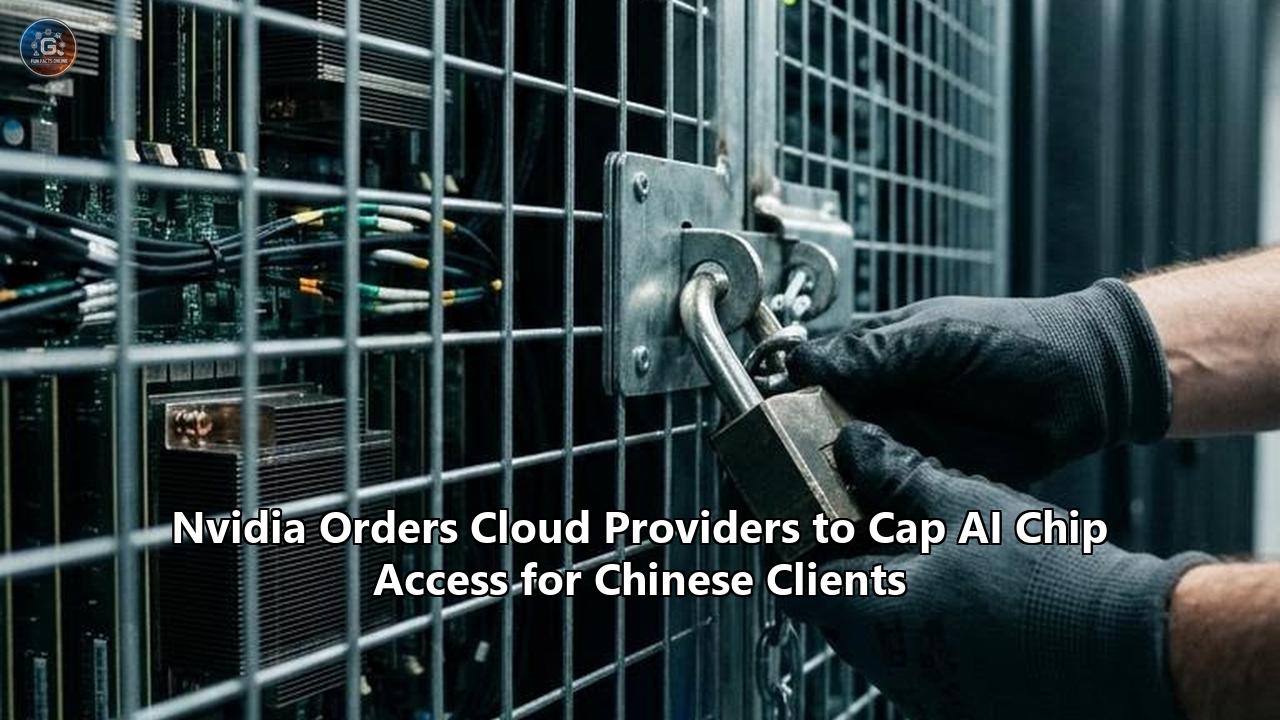
Nvidia has issued verbal directives to its global cloud computing and data center partners mandating that at least 51% of their service revenue must originate from non-Chinese clients, effectively placing a 49% cap on business derived from Chinese companies. Communicated directly through the semiconductor giant's regional sales teams rather than formal written documentation, the prospective rule applies worldwide to future leasing agreements while grandfathering existing contracts.
The intervention takes direct aim at an infrastructure loophole that has allowed Chinese artificial intelligence developers to train advanced frontier models. Under existing United States export controls administered by the Department of Commerce’s Bureau of Industry and Security (BIS), physical shipments of high-performance accelerators—including Nvidia’s Hopper architectures and its Blackwell B200 and B300 series—are strictly barred from mainland China. Yet, the statutory framework of the Export Administration Regulations (EAR) historically governed the transfer of physical commodities, software, and technical data, leaving remote "Compute-as-a-Service" largely unregulated. By leasing processing capacity in data centers located in Singapore, Malaysia, the United Arab Emirates, and Europe, Chinese labs have routinely harnessed thousands of interconnected Nvidia GPUs across the Pacific without ever taking physical delivery of a single chip.
This sudden rationing of compute access lands in an increasingly fraught geopolitical climate. In the Chinese gray market, a single server rack containing Nvidia’s export-restricted B300 chips reportedly trades for 18.5 million yuan (approximately $2.8 million)—more than four times its standard international price of roughly $600,000. Concurrently, federal prosecutors in the United States have leveled criminal charges against former executives of hardware assemblers for orchestrating the illicit diversion of billions of dollars in AI servers, while intelligence agencies scrutinize sovereign data hub transactions in Southeast Asia.
The market must now absorb a structural recalibration. Nvidia is attempting to walk an acute commercial tightrope: insulating its business from looming, draconian federal cloud regulations while trying not to trigger aggressive antitrust retaliation or immediate boycotts from Beijing. The corporate directive exposes a complex landscape of competing technical architectures, clashing regulatory models, and divergent corporate coping mechanisms that are fundamentally splitting the global artificial intelligence infrastructure.
+---------------------------------------------------------------------------------------------------+
|                        NVIDIA'S 51/49 REVENUE ALLOCATION MANDATE                                  |
+---------------------------------------------------------------------------------------------------+
|                                                                                                   |
|   GLOBAL CLOUD PARTNERS & NEOCLOUDS                                                               |
|   (CoreWeave, Lambda, Nscale, YTL Power, Megaspeed, etc.)                                         |
|                                                                                                   |
|             +---------------------------------------------------------------+                     |
|             |                100% TOTAL SERVICE REVENUE                     |                     |
|             +-------------------------------+-------------------------------+                     |
|                                             |                                                     |
|                     ------------------------+------------------------                             |
|                     |                                               |                             |
|                     v                                               v                             |
|       +---------------------------+                   +---------------------------+               |
|       |  >= 51% REVENUE FLOOR     |                   |   <= 49% REVENUE CEILING  |               |
|       |  Non-Chinese Customers    |                   |   Chinese Customers       |               |
|       +---------------------------+                   +---------------------------+               |
|       | * North American AI Labs  |                   | * Frontier Labs (01.AI,   |               |
|       | * European Enterprises    |                   |   Moonshot, DeepSeek)     |               |
|       | * Global Hyperscalers     |                   | * Tech Giants (ByteDance, |               |
|       | * Sovereign AI Initiatives|                   |   Alibaba, Tencent)       |               |
|       +---------------------------+                   +---------------------------+               |
|                     |                                               |                             |
|                     +-----------------------+-----------------------+                             |
|                                             |                                                     |
|                                             v                                                     |
|                        +-----------------------------------------+                                |
|                        |          ENFORCEMENT MECHANISM          |                                |
|                        +-----------------------------------------+                                |
|                        | * Unwritten, verbal sales channel alerts|                                |
|                        | * Prospective rules (new contracts only)|                                |
|                        | * Hardware allocation tied to compliance|                                |
|                        | * End-user KYC reporting required       |                                |
|                        +-----------------------------------------+                                |
+---------------------------------------------------------------------------------------------------+
The Enforcement Dilemma: Private Supply-Chain Rationing vs. Statutory Federal Mandate
The mechanism Nvidia has chosen to restrict remote access represents an unusual privatization of export policy, presenting stark contrasts to conventional statutory governance. Historically, national security trade controls are promulgated through public administrative rulemakings, formal entity listings, and strict, legally binding licensing requirements enforced by federal agencies like BIS or the Treasury Department’s Office of Foreign Assets Control (OFAC).
In this instance, Nvidia has bypassed the public Federal Register entirely. By deploying its regional sales directors to verbally deliver the 51% non-Chinese revenue floor, the chipmaker is leveraging its near-monopoly over premier accelerator silicon to police international business agreements. The trade-offs between this private administrative rationing and formal government rulemaking highlight fundamentally competing approaches to technological containment.
| Dimension | Nvidia Private Supply-Chain Rationing | Statutory Federal Regulation (BIS / EAR) |
|---|---|---|
| Legal Basis | Commercial sales contracts, hardware allocation leverage | Export Administration Regulations, Executive Orders |
| Delivery Mechanism | Verbal guidance from regional sales representatives | Published rules, Federal Register notices, formal licenses |
| Jurisdictional Reach | Extraterritorial control enforced via silicon supply priority | National jurisdiction, nexus to U.S.-origin technical items |
| Enforceability | High commercial penalty (loss of future GPU allocation) | Civil/criminal penalties, statutory audits, federal sanctions |
| Operational Flexibility | High; adjustable on a per-customer basis without litigation | Low; rigid legal definitions subject to APA legal challenges |
| Diplomatic Liability | Direct corporate exposure to host-country antitrust scrutiny | State-to-state diplomatic friction; intergovernmental talks |
The Advantages and Vulnerabilities of Private Rationing
Nvidia’s reliance on informal, unwritten channels is an intentional protective shield. By avoiding a paper trail of official policy memoranda, the company retains commercial and legal deniability. Under Chinese anti-foreign sanctions legislation and the Ministry of Commerce's (MOFCOM) "Unreliable Entity List" regulations, multinational firms that actively assist foreign governments in discriminating against Chinese corporate entities face severe retaliatory penalties, asset freezes, and potential bans on local market operations. A formal, public announcement barring Chinese clients from leasing servers would instantly expose Nvidia’s mainland offices to administrative sanction and supply-chain blockades.
Operationally, the verbal policy functions through implicit leverage rather than formal litigation. Nvidia holds the ultimate trump card: allocation. In a global market where cloud providers must wait anywhere from six to twelve months to secure dense clusters of GB200 NVL72 or B300 liquid-cooled racks, an operator that resists the manufacturer's customer-mix guidelines simply finds itself deprioritized on the quarterly shipping manifests. Compliance is secured not by subpoena, but by the existential threat of hardware starvation.
Yet this private rationing model contains glaring structural vulnerabilities. First, it places an enormous investigative burden on cloud providers' internal sales desks. Unlike statutory frameworks that define clear corporate ownership tests, an informal 51% revenue benchmark fails to articulate complex beneficial ownership standards. If a venture-backed foundation model startup registers a corporate vehicle in Singapore or the Cayman Islands, hires an international executive team, but retains its core research engineering cadre and state-backed seed capital in Beijing, does its lease count against the Chinese allocation? Cloud operators must make these determinations at their own peril, balancing the risk of losing Nvidia’s favor against the danger of walking away from lucrative multi-year lease commitments.
The Looming Statutory Alternative
The federal alternative—formal "Know Your Customer" (KYC) regulations for Infrastructure-as-a-Service (IaaS) providers—carries a different set of trade-offs. The U.S. Commerce Department has spent months drafting proposed regulations under Executive Order 14110, aiming to compel American cloud platforms and their foreign resellers to systematically verify the identity of foreign persons opening accounts that train large language models (LLMs).
Statutory regulations provide legal clarity and level the competitive playing field. An official BIS rule would bind all market participants simultaneously—including alternative accelerator developers like AMD and Intel—preventing cloud operators from simply switching chip architectures to avoid compliance. However, government rulemakings are notoriously slow to adapt. They face statutory notice-and-comment requirements, interagency review between Commerce, Defense, Energy, and State, and potential constitutional challenges regarding the extraterritorial regulation of computational logic.
By enacting its own corporate rationing preemptively, Nvidia is actively attempting to defuse congressional pressure. Lawmakers on the House Select Committee on the Strategic Competition Between the United States and the Chinese Communist Party have repeatedly pointed to the cloud loophole as a fatal flaw in the microelectronics containment strategy. By demonstrating that it can suppress Chinese access through its commercial channels, Nvidia seeks to head off an overbroad statutory mandate from BIS that could permanently damage its global data center revenues.
From Physical Silicon to Cloud Instances: The Evolution of Nvidia AI Chip Restrictions
To grasp why Nvidia has intervened at the cloud software layer, one must analyze the progressive tightening of hardware export rules and the subsequent relocation of Chinese compute demand. The evolution of Nvidia AI chip restrictions illustrates an ongoing technological cat-and-mouse game between national regulators and cross-border engineering teams.
+----------------------------------------------------------------------------------------------------+
|                         CHRONOLOGY: TIGHTENING THE PHYSICAL & VIRTUAL CHOKEPOINTS                  |
+----------------------------------------------------------------------------------------------------+
|                                                                                                    |
|   OCTOBER 2022: INITIAL BIS CONTROLS                                                               |
|   * Threshold: Peak processing performance (4800 bits) & interconnect bandwidth (600 GB/s)         |
|   * Target: Banned A100 & H100 direct exports to China                                             |
|   * Response: Nvidia designs down-binned A800 and H800 variants with reduced interconnect           |
|                                                                                                    |
|                                         |                                                          |
|                                         v                                                          |
|                                                                                                    |
|   OCTOBER 2023: REVISED INTERCONNECT & DENSITY METRICS                                             |
|   * Threshold: Total Processing Performance (TPP) & Performance Density formulas                    |
|   * Target: Banned A800, H800, L40S, and restricted RTX 4090 GPUs                                  |
|   * Response: Nvidia releases H20 chip; Chinese labs shift en masse to overseas cloud leasing       |
|                                                                                                    |
|                                         |                                                          |
|                                         v                                                          |
|                                                                                                    |
|   2024 - EARLY 2026: HARDWARE WHITELISTS & BLACKWELL ROLLOUT                                       |
|   * Threshold: Enhanced screening of tier-1 Asian buyers; B200/B300 excluded entirely from China   |
|   * Target: Intercept gray-market smuggling and international hardware diversion                   |
|   * Response: Smuggling premiums hit 360% ($2.8M per rack); Neocloud compute leasing accelerates   |
|                                                                                                    |
|                                         |                                                          |
|                                         v                                                          |
|                                                                                                    |
|   NOVEMBER 2026: THE 51/49 CLOUD REVENUE ALLOCATION MANDATE                                        |
|   * Threshold: Data center partners must maintain >= 51% service revenue from non-Chinese entities  |
|   * Target: Closes offshore "Compute-as-a-Service" loophole for frontier model training             |
|   * Status: Verbal, prospective enforcement across global partner data centers                      |
|                                                                                                    |
+----------------------------------------------------------------------------------------------------+
The Breakdown of Hardware-Centric Interdiction
The regulatory campaign commenced in October 2022, when the Department of Commerce instituted performance thresholds targeting interconnect bandwidth and bidirectional transmission capabilities. The initial rule aimed to deny Chinese military and civil-fusion labs the ability to aggregate thousands of processors into cohesive supercomputing fabrics. In response, Nvidia engineered the A800 and H800: modified accelerators that capped the NVLink data transfer rate at 400 GB/s—just below the 600 GB/s statutory line—while preserving dense, high-precision floating-point execution cores.
Recognizing that Chinese developers were circumventing the spirit of the restrictions by scaling out wider clusters with advanced network topologies, BIS revised its standards in October 2023. The agency introduced a "Total Processing Performance" (TPP) metric alongside a "Performance Density" formula, measuring raw computational speed relative to physical die area. This update eliminated the A800 and H800 from Chinese catalogs, swept away consumer-grade hardware such as the GeForce RTX 4090, and forced Nvidia to manufacture the heavily throttled H20 accelerator for the mainland market.
While the H20 met legal requirements, it proved commercially and technically problematic. Chinese frontier developers found its scaled-down compute capacity inefficient for the pre-training phases of large-scale models exceeding 100 billion parameters. With the rollout of the Blackwell architecture—specifically the B200 and the high-density B300 configurations—the performance gap between export-compliant chips and international enterprise hardware widened significantly.
This expanding capability gulf fundamentally transformed market incentives. Instead of spending capital on localized, throttled H20 clusters, Chinese AI developers adapted to earlier iterations of Nvidia AI chip restrictions by splitting their operational workloads. Local inference and fine-tuning were shifted to compliant hardware or domestic silicon, while large-scale pre-training runs were migrated overseas to high-throughput cloud environments.
The Shift to the Compute-as-a-Service Layer
By early 2026, the primary battleground of microelectronics containment had clearly migrated from shipping ports to virtual terminal sessions. Through international subsidiaries, holding companies, or simple offshore enterprise service accounts, Chinese research teams routinely provisioned SSH access to multi-node Blackwell clusters hosted in neutral data hubs.
This offshore compute pipeline offered clear operational advantages over physical smuggling:
- Capital Efficiency: Renting capacity requires zero black-market hardware markups. A company avoids paying the $2.8 million rack-level hardware premium and instead pays standard global hosting rates, which typically range between $3.50 and $4.50 per GPU-hour for Blackwell infrastructure.
- Maintenance and Support: Smuggled hardware within China operates completely devoid of factory warranties, certified firmware patches, or manufacturer field engineering services. In contrast, instances leased from major foreign facilities benefit from direct operational support, liquid-cooling maintenance, and low-latency network tuning.
- Cluster Scale: Smuggling operations generally move hardware piecemeal—diverting dozens or occasionally hundreds of server cards through complex logistics networks. However, training frontier generative models requires thousands of unified accelerators operating across ultra-low-latency fabrics. Such industrial scale can only be reliably provisioned inside purpose-built, megawatt-scale data center facilities.
By imposing the 51/49 revenue allocation framework, Nvidia is acknowledging that hardware-centric shipment bans have reached the limits of their strategic efficacy. Once physical silicon lands inside a foreign, non-embargoed data center, controlling which engineer's keystrokes access its virtualized memory partitions requires intervening directly within the service layer.
Cloud Architectures in the Crosshairs: Specialized Neoclouds vs. Tier-1 Hyperscalers
The imposition of a 49% revenue ceiling hits different tiers of the global cloud computing market with wildly asymmetrical force. The modern data center landscape is structurally divided between established, diversified tier-1 hyperscalers and venture-backed specialized "neoclouds." These two models face vastly different operational realities and revenue exposures under the new mandate.
+----------------------------------------------------------------------------------------------------+
|                                    NEOCLOUDS VS. HYPERSCALERS                                      |
+----------------------------------------------------------------------------------------------------+
|                                                                                                    |
|   SPECIALIZED NEOCLOUDS                                HYPERSCALERS                                |
|   (CoreWeave, Lambda, Nscale, YTL, Megaspeed)          (Microsoft Azure, AWS, Google Cloud)        |
|                                                                                                    |
|   REVENUE CONCENTRATION                                REVENUE CONCENTRATION                       |
|   +---------------------------------------+            +---------------------------------------+   |
|   | Highly concentrated: Top 5-10 clients |            | Highly diversified: Thousands of      |   |
|   | drive 60-80% of cluster utilization   |            | enterprise SaaS, IT & cloud clients   |   |
|   +---------------------------------------+            +---------------------------------------+   |
|                                                                                                    |
|   EXPOSURE TO CHINESE LABS                             EXPOSURE TO CHINESE LABS                    |
|   +---------------------------------------+            +---------------------------------------+   |
|   | Acute: Asian/regional operators rely  |            | Marginal: Global enterprise workloads |   |
|   | heavily on Chinese AI model developers|            | dwarf Chinese cloud compute leases    |   |
|   +---------------------------------------+            +---------------------------------------+   |
|                                                                                                    |
|   CAPITAL STRUCTURE                                    CAPITAL STRUCTURE                           |
|   +---------------------------------------+            +---------------------------------------+   |
|   | Leveraged debt financed against GPU   |            | Massive corporate cash reserves,      |   |
|   | collateral and compute lease cashflows|            | investment-grade corporate bonds      |   |
|   +---------------------------------------+            +---------------------------------------+   |
|                                                                                                    |
|   COMPLIANCE & IAM INFRASTRUCTURE                      COMPLIANCE & IAM INFRASTRUCTURE             |
|   +---------------------------------------+            +---------------------------------------+   |
|   | Lean sales desks, minimal KYC checks, |            | Mature international compliance,      |   |
|   | bare-metal provisioning architectures |            | strict identity verification & IAM    |   |
|   +---------------------------------------+            +---------------------------------------+   |
|                                                                                                    |
+----------------------------------------------------------------------------------------------------+
The Neocloud Exposure Crisis
Neoclouds—specialized infrastructure providers optimized entirely for dense GPU orchestration—have emerged as the primary vehicle for high-throughput AI workloads. Companies like CoreWeave, Lambda Labs, and Nscale, alongside regional infrastructure giants like Malaysia’s YTL Power and Singapore’s Megaspeed, spent the 2024–2026 cycle purchasing hundreds of thousands of advanced enterprise GPUs.
To finance these massive capital expenditures, many neoclouds tapped aggressive asset-backed debt markets, using their allocations of Nvidia accelerators as physical collateral. Servicing these multi-billion-dollar debt facilities requires non-stop, high-margin cluster utilization. Operators cannot afford to let empty server racks burn idle power.
For independent data center operators across Southeast Asia, Chinese technology conglomerates (such as ByteDance, Tencent, and Alibaba) and well-funded foundation model startups (including Moonshot AI, 01.AI, and DeepSeek) were the ideal customer base. These firms arrived with deep venture funding, an urgent need for massive compute capacity, and a willingness to sign multi-year, premium-rate contracts for unthrottled Blackwell or Hopper clusters. In key data centers across Singapore and Johor, Chinese-linked accounts quickly came to represent anywhere from 50% to over 80% of total contracted computing demand.
Nvidia’s 51% non-Chinese revenue floor threatens to upend these debt-backed business models. If an operator's customer base is 70% Chinese, it cannot simply evict half its tenants without immediately breaching the minimum debt-service coverage ratios (DSCR) demanded by its institutional lenders. Compounding this challenge, the local demand for massive LLM training clusters outside the United States remains comparatively modest.
As a data center director based in Singapore recently noted, operators across the region are discovering that finding enough non-Chinese enterprise clients with the budget to book tens of millions of dollars in sustained, ultra-dense compute leases is an uphill battle. If regional neoclouds are barred from onboarding Chinese clients up to full capacity, they face two unappealing financial alternatives: either leave high-cost server racks dark and bleed operational cash, or aggressively drop leasing prices to attract Western clients, sparking an industry-wide margin collapse.
Hyperscale Insulation and Enterprise Identity Control
Conversely, global tier-1 hyperscalers—Microsoft Azure, Amazon Web Services (AWS), and Google Cloud Platform (GCP)—operate within deeply insulated corporate environments. Their cloud operations are not single-asset GPU leasing schemes; they are massive enterprise IT fabrics generating recurring software, storage, database, and platform revenue from hundreds of thousands of multinational corporations.
For hyperscalers, compute demand from Chinese AI labs accounts for a fraction of their total annualized recurring revenue. Furthermore, these platforms already maintain advanced identity and access management (IAM), SOC 2 Type II compliance frameworks, and comprehensive enterprise auditing protocols. They can cross-reference enterprise billing addresses, track corporate entity registrations, verify corporate payment rails, and deploy automated telemetry to monitor anomalous network access patterns.
| Feature / Metric | Tier-1 Hyperscaler (e.g., Azure, AWS, GCP) | Independent Neocloud (e.g., Megaspeed, Nscale) |
|---|---|---|
| Primary Revenue Driver | Enterprise SaaS, platform services, enterprise storage | Dedicated bare-metal and virtualized GPU leasing |
| Client Base Diversification | High; tens of thousands of global commercial accounts | Low; heavy reliance on a concentrated pool of AI labs |
| Capital Financing Model | Corporate balance-sheet cash flow, corporate debt | Asset-backed credit facilities secured by GPU inventory |
| Impact of 51% Rule | Negligible; Chinese accounts are below 10% of workload mix | Critical; requires turning away the highest-bidding clients |
| End-User Audit Capability | Highly automated IAM, IP tracking, telemetry profiling | Manual identity checks, basic billing verification |
Hyperscalers are also far better equipped to absorb the compliance overhead associated with client auditing. When a tier-1 provider signs a major enterprise client, that customer must pass through rigorous billing validation and corporate verification. If an account is flagged as an unauthorized overseas proxy for an entity on the U.S. Entity List, the hyperscaler’s compliance team can cleanly isolate or terminate the virtual environment without threatening the company's baseline solvency.
Specialized neoclouds, lacking these enterprise safety nets, now face a precarious business environment: they must either absorb the operational costs of building an in-house corporate compliance infrastructure or risk losing their hardware allocations from Nvidia entirely.
Technical Workarounds: Cloud Leasing, Hardware Smuggling, and Algorithmic Adaptations
Faced with tightening constraints on both physical hardware and virtual cloud instances, Chinese AI initiatives have pursued three distinct technical and operational workarounds. A technical comparison reveals stark trade-offs in computational latency, capital efficiency, scaling limits, and legal exposure.
+----------------------------------------------------------------------------------------------------+
|                       COMPARING CHINESE COMPUTE ACQUISITION STRATEGIES                             |
+----------------------------------------------------------------------------------------------------+
|                                                                                                    |
|   VECTOR 1: OFFSHORE CLOUD LEASING (IaaS)                                                          |
|   * Scalability: Very High (16,000+ GPU unified fabrics)                                           |
|   * Interconnect: Unthrottled NVLink 5 (1.8 TB/s) & InfiniBand NDR (400 Gbps)                      |
|   * Cost Efficiency: Standard international cloud rates ($3.50-$4.50/GPU-hr)                       |
|   * Primary Vulnerability: Account termination, provider KYC compliance, IP tracking              |
|                                                                                                    |
|                                         vs.                                                        |
|                                                                                                    |
|   VECTOR 2: PHYSICAL GRAY-MARKET SMUGGLING                                                         |
|   * Scalability: Very Low (Fragmented topologies, typically <512 GPUs)                             |
|   * Interconnect: Severely degraded by lack of OEM field deployment & liquid-cooling maintenance   |
|   * Cost Efficiency: Catastrophic (360% markups; $2.8M per B300 rack)              |
|   * Primary Vulnerability: Criminal interdiction, zero factory firmware support, component failure|
|                                                                                                    |
|                                         vs.                                                        |
|                                                                                                    |
|   VECTOR 3: ALGORITHMIC COMPRESSION & ARCHITECTURAL OPTIMIZATIONS                                  |
|   * Scalability: High conceptual scale, but constrained by total parameter limits                  |
|   * Approach: DeepSeek-style MoE, Multi-Head Latent Attention (MLA), FP8/INT4 quantization         |
|   * Cost Efficiency: Maximizes output-per-FLOP; dramatically cuts memory footprint                |
|   * Primary Vulnerability: Architectural diminishing returns; cannot fully replace raw pre-training|
|                                                                                                    |
+----------------------------------------------------------------------------------------------------+
The Architectural Reality of Remote Cloud Leasing
Remote cloud provisioning was the primary path for frontier training runs because of the unique network physics of distributed transformer models. Pre-training a foundation model spanning hundreds of billions of parameters cannot be executed on isolated, discrete servers communicating over generic network fabrics.
During the backward pass of distributed model training, the cluster must continuously exchange hundreds of gigabytes of parameter gradients via parallel operations:
- AllReduce Communications: In data-parallel training runs, gradients must be summed across all participating nodes and redistributed before the subsequent forward pass can proceed.
- Pipeline and Tensor Parallelism: In modern model architectures, individual transformer layers and attention heads are split across multiple GPUs. This requires raw inter-chip data transfer speeds that exceed what standard Ethernet fabrics can deliver.
Inside modern overseas facilities, Blackwell clusters rely on fifth-generation NVLink switches providing 1.8 TB/s of bidirectional bandwidth per GPU, coupled with Quantum-2 InfiniBand networking running at 400 Gbps per port. When a Chinese research lab connects remotely via an offshore proxy server, the high network latency across the Pacific applies only to user inputs, terminal monitoring, and periodic checkpoint file downloads.
The latency-critical training computations remain entirely self-contained within the overseas data hall's switch fabric. The cluster operates at maximum efficiency because the physical distance of the remote developer does not introduce latency into the inter-GPU gradient synchronization loops.
The Limits of Gray-Market Smuggling
In contrast, physical gray-market smuggling cannot support industrial-scale model pre-training. While individual enterprise cards and fragmented server nodes continue to trickle across borders through shell entities in Southeast Asia and Central Asia, the scale of this hardware falls orders of magnitude short of what frontier labs require.
The economics are increasingly difficult to justify. Paying $2.8 million for a single B300 rack that retails globally for $600,000 represents a massive capital penalty. Furthermore, contemporary AI supercomputing architecture has moved away from standard air-cooled server chassis toward tightly integrated, liquid-cooled, multi-rack systems. Modern systems like the NVL72 are delivered as unified, liquid-plumbed units containing massive copper busbars, manifold distribution systems, and specialized blind-mate connectors.
Operating and maintaining such dense infrastructure without Nvidia's certified field technicians, proprietary diagnostic suites, and genuine replacement components is exceptionally difficult. If a liquid-cooling quick-disconnect valve fails or a critical interposer develops micro-fractures inside a Shenzhen server room, the operator cannot simply call enterprise support. The hardware quickly becomes an expensive paperweight. Smuggled hardware is suitable for boutique academic research, inference hosting, or fine-tuning runs, but it cannot reliably anchor a multi-month, multi-million-dollar pre-training run for a frontier model.
Algorithmic Adaptation: The Architectural Countermeasure
The third workaround bypasses hardware acquisition entirely, focusing instead on algorithmic efficiency. Chinese research labs have emerged as leaders in developing model architectures that drastically reduce the floating-point operations (FLOPs) and high-bandwidth memory (HBM) footprints required to achieve competitive reasoning benchmarks.
DeepSeek’s architectural breakthroughs illustrate this technical adaptation. By deploying Multi-Head Latent Attention (MLA) and aggressive Mixture-of-Experts (MoE) designs, DeepSeek models dynamically route inference and training tokens through sparsely activated parameter subsets. Rather than firing every parameter for every token:
- A model may hold hundreds of billions of total parameters in memory, but only activate a fraction (e.g., 20 to 30 billion parameters) per token forward pass.
- Multi-Head Latent Attention compresses key-value (KV) activations into low-dimensional latent vectors, significantly reducing the memory bandwidth bottlenecks that normally degrade training performance.
- Extensive adoption of FP8 mixed-precision execution pipelines minimizes the volume of gradient data that must be shuffled across network interconnects.
While these algorithmic innovations yield remarkable capabilities per FLOP, they do not eliminate the underlying need for high-end silicon. Mathematical optimizations can compress training requirements, but frontier model development ultimately faces the wall of empirical scaling laws: all else being equal, the lab that can orchestrate more raw compute over tighter network topologies will produce the more capable general-purpose foundation system.
Silicon Performance and Infrastructure Realities: Blackwell B300 vs. Huawei Ascend 910C
As Nvidia’s cloud channels narrow, Chinese technology companies are increasingly pushed toward domestic semiconductor alternatives. The central challenge of this transition lies in the performance gap separating American enterprise accelerators from Chinese silicon alternatives, such as Huawei’s Ascend series.
+----------------------------------------------------------------------------------------------------+
|                         SILICON STACK ARCHITECTURE: B300 VS. ASCEND 910C                           |
+----------------------------------------------------------------------------------------------------+
|                                                                                                    |
|   NVIDIA BLACKWELL B300                                 HUAWEI ASCEND 910C                         |
|   ---------------------                                 ------------------                         |
|                                                                                                    |
|   FABRICATION & PACKAGING                               FABRICATION & PACKAGING                    |
|   * Node: TSMC 4NP (Custom 5nm class)                   * Node: SMIC N+2 / 7nm DUV Multi-patterning|
|   * Packaging: CoWoS-L with Silicon Interposer          * Packaging: Domestic Multi-Die Packaging  |
|                                                                                                    |
|   MEMORY SUBSYSTEM                                      MEMORY SUBSYSTEM                           |
|   * Spec: 288GB HBM3e                                   * Spec: Slower, legacy HBM2e / High-Cap DDR|
|   * Bandwidth: ~8.0 TB/s                                * Bandwidth: Restricted (<2.5 TB/s)        |
|                                                                                                    |
|   INTERCONNECT & CLUSTER FABRIC                         INTERCONNECT & CLUSTER FABRIC              |
|   * Spec: NVLink 5 (1.8 TB/s per GPU)                   * Spec: Dual-ring HCCS (392 GB/s)          |
|   * Fabric: Native Quantum-2 InfiniBand NDR             * Fabric: RoCE v2 (Lossless Ethernet)       |
|                                                                                                    |
|   SOFTWARE & COMPILER STACK                             SOFTWARE & COMPILER STACK                  |
|   * Environment: CUDA, TensorRT, Megatron-LM            * Environment: CANN, MindSpore             |
|   * Integration: Decades of optimization, unified API   * Integration: Translation wrappers, bugs  |
|                                                                                                    |
+----------------------------------------------------------------------------------------------------+
The Physical Silicon and Packaging Divide
Nvidia's Blackwell B300 architecture reflects the cutting edge of modern merchant semiconductor manufacturing. Fabricated on TSMC’s specialized 4NP lithography node, the Blackwell die pushes the absolute limits of reticle sizing. It stitches together two distinct silicon dies across a 10 TB/s high-density chip-to-chip interface, effectively operating as a unified monolithic processor.
Crucially, the B300 integrates up to 288GB of High-Bandwidth Memory (HBM3e), unlocking roughly 8.0 TB/s of memory bandwidth. This extreme throughput is enabled by TSMC’s advanced Chip-on-Wafer-on-Substrate with Local Silicon Interconnect (CoWoS-L) packaging technology.
By contrast, China’s primary domestic competitor, the Huawei Ascend 910C, operates under severe industrial and physical constraints. Cut off from TSMC’s leading-edge foundries by the U.S. Foreign Direct Product Rule, Huawei relies on China’s Semiconductor Manufacturing International Corporation (SMIC). Without access to extreme ultraviolet (EUV) lithography systems—barred from export by the Dutch government and ASML—SMIC manufactures these high-performance processors using deep ultraviolet (DUV) immersion lithography paired with complex, multi-patterning techniques.
Multi-patterning DUV imposes heavy manufacturing costs:
- Defect Rates and Die Yields: Multiple exposure passes increase mask alignment errors, sharply reducing functional die yields and driving up unit costs.
- Thermal and Energy Overhead: To achieve competitive floating-point performance on a 7nm-class node, the Ascend silicon must draw significantly more electrical power, generating extreme thermal density that strains data center cooling systems.
- The High-Bandwidth Memory Choke Point: Advanced HBM3e and HBM4 technologies, manufactured by SK Hynix, Samsung, and Micron, are directly blocked by federal export controls. While Chinese memory manufacturers like CXMT are developing domestic HBM lines, production capacity remains limited, leaving Ascend processors largely dependent on older, lower-bandwidth HBM2e packaging or unconventional multi-chip configurations.
| Performance Metric | Nvidia Blackwell B300 | Huawei Ascend 910C (Estimated) |
|---|---|---|
| Manufacturing Process | TSMC 4NP (5nm Enhanced) | SMIC N+2 (7nm DUV Multi-patterning) |
| Advanced Packaging | TSMC CoWoS-L | Domestic 2.5D Advanced Packaging |
| Memory Standard | Up to 288GB HBM3e | 64GB - 128GB HBM2e |
| Memory Bandwidth | ~8.0 TB/s | ~1.8 – 2.4 TB/s |
| Interconnect Bandwidth | NVLink 5: 1.8 TB/s bidirectional | HCCS: ~392 GB/s bidirectional |
| Native Software Stack | CUDA / TensorRT / PyTorch | CANN / MindSpore |
| Cluster Scaling Efficiency | High across 10,000+ nodes via InfiniBand | Degrades significantly past 2,048–4,096 nodes |
Interconnect Topologies and the Scaling Wall
The critical operational divide between the B300 and the Ascend 910C is not necessarily raw, single-chip compute performance; it is cluster-level interconnect efficiency.
When training large language models, processors spend considerable operational time waiting for parameter updates from neighboring chips. Nvidia mitigates this bottleneck through NVLink 5, which equips each GPU with 1.8 TB/s of non-blocking, bidirectional bandwidth. Combined with dedicated NVLink network switches, an operator can build a cluster of thousands of GPUs that address shared memory with minimal latency penalties.
Huawei’s Ascend architecture relies on its proprietary Huawei Cache Coherence System (HCCS), which delivers roughly 392 GB/s of bandwidth—less than a quarter of NVLink 5’s throughput. At the multi-chassis networking layer, Ascend clusters typically deploy RDMA over Converged Ethernet (RoCE v2).
While RoCE v2 is cost-effective, running it across thousands of nodes requires complex network tuning to avoid packet drops, priority flow control deadlocks, and buffer bloat. As Ascend clusters scale beyond 2,048 to 4,096 chips, communication overhead grows rapidly, consuming an increasing share of total runtime and causing cluster scaling efficiency to degrade.
CLUSTER SCALING EFFICIENCY: EFFECTIVE COMPUTE VS. PHYSICAL NODES

Effective
Compute
   ^
   |                                                  / (Nvidia B300 / NVLink + InfiniBand)
   |                                                 /
   |                                                /
   |                                               /
   |                                              /
   |                                             /
   |                                            /
   |                                           /      . - - - (Huawei Ascend 910C / RoCE v2)
   |                                          /   . '
   |                                         /. ' (Communication overhead bottleneck)
   |                                      . '
   |                                   . '
   |                               . '
   |                           . '
   |                       . '
   |                   . '
   +-------------------------------------------------------------------->
   0                  1024                   4096                  16384+
                               Physical Accelerators
Consequently, while Huawei’s accelerators are proving viable for localized enterprise inference workloads and targeted model fine-tuning, they face distinct scaling hurdles when deployed for frontier pre-training runs. This fundamental architectural gap explains why Chinese developers have been willing to pay steep premiums for offshore Nvidia cloud instances rather than relying exclusively on domestic silicon clusters.
Geopolitical and Market Fallout: Southeast Asian Hubs Caught in the Crossfire
The global data center buildout has catalyzed hundreds of billions of dollars in international real estate and infrastructure development. The primary geographic beneficiaries of this boom—particularly data center hubs in Southeast Asia—are now caught squarely in the crossfire of Nvidia’s customer-mix mandates.
+----------------------------------------------------------------------------------------------------+
|                         SOUTHEAST ASIAN DATA HUBS: GEOPOLITICAL PRESSURES                          |
+----------------------------------------------------------------------------------------------------+
|                                                                                                    |
|                 SINGAPORE HUB                                    JOHOR (MALAYSIA) HUB              |
|                 =============                                    ====================              |
|                                                                                                    |
|   GEOGRAPHIC ADVANTAGES                                        GEOGRAPHIC ADVANTAGES               |
|   * Premier subsea fiber landing hub                           * Vast physical land availability   |
|   * High concentration of global enterprise capital            * Direct access to gigawatt power   |
|   * Mature legal and financial framework                       * Proximity to Singapore network    |
|                                                                                                    |
|                                         |                                                          |
|                                         v                                                          |
|                                                                                                    |
|   THE CHINESE DEMAND BASE                                      THE CHINESE DEMAND BASE             |
|   * Anchor tenants: ByteDance, Alibaba, Chinese AI labs        * Anchor tenants: Major Chinese tech|
|   * Regional neoclouds derived 60-80% of revenue from China    * Substantial share of newly built  |
|                                                                  capacity presold to Chinese labs  |
|                                                                                                    |
|                                         |                                                          |
|                                         v                                                          |
|                                                                                                    |
|   THE REGULATORY CROSSFIRE                                     THE REGULATORY CROSSFIRE            |
|   * Western intelligence scrutiny (Megaspeed controversy)      * Risk of unutilized data halls     |
|   * Strict power caps & green energy mandates                  * Squeeze between debt covenants    |
|   * Squeezed by Nvidia's 51% non-Chinese revenue floor         * and loss of Chinese tenant base   |
|                                                                                                    |
+----------------------------------------------------------------------------------------------------+
The Singapore and Johor Convergence
Singapore has long served as the digital crossroads of the Asia-Pacific region, hosting the highest concentration of subsea cable landings and international financial enterprise networks in Southeast Asia. However, a multi-year domestic moratorium on new data center development—spurred by land constraints and power grid limits—pushed the wave of new AI infrastructure across the Johor Strait into southern Malaysia.
The Johor corridor transformed into one of the world's fastest-growing data center clusters. Major developers and regional conglomerates, including YTL Power International, broke ground on gigawatt-scale campuses designed to house arrays of high-density, liquid-cooled computing hardware. The primary commercial anchor for this explosive growth was the massive, unmet compute demand radiating from mainland China.
Chinese tech leaders, facing hardware constraints at home, poured capital into Southeast Asian subsidiaries to lock down future hosting capacity. For Malaysian and Singaporean operators, signing these tenants was the quickest route to securing pre-lease commitments, satisfying project finance lenders, and hitting their initial revenue targets.
The Megaspeed Precedent and Regulatory Friction
This concentration of Chinese capital quickly drew Western intelligence scrutiny. The risks of this exposure surfaced publicly following investigations into Megaspeed, a Singapore-based data center operator that built high-density computing clusters powered by Nvidia enterprise hardware.
Reports that Western intelligence agencies were scrutinizing commercial and personnel links surrounding regional facilities sent shockwaves through the Southeast Asian data center market. The controversy underscored Washington’s growing concern: sovereign hubs in Southeast Asia were effectively transforming into remote computing enclaves for Chinese artificial intelligence developers, bypassing the strategic intent of U.S. export controls.
Nvidia’s 51% non-Chinese revenue floor fundamentally disrupts the financial assumptions supporting this regional buildout. Data center operators in Singapore and Malaysia who built their business plans around Chinese clients must now urgently recruit Western or non-Chinese tenants.
Yet American AI companies—such as OpenAI, Anthropic, and Microsoft—already enjoy access to massive domestic data center clusters subsidized by local capital, benefit from preferential access to domestic green energy grids, and show limited appetite for leasing remote computing capacity in Southeast Asia, where network latency back to their core research hubs is significantly higher.
As regional operators navigate these new constraints, the cumulative commercial toll of Nvidia AI chip restrictions is realigning cross-border infrastructure financing. Banks and private equity syndicates that underwrote multi-hundred-million-dollar data center facilities based on high-margin Chinese lease commitments are facing increased credit risk.
If facility operators are forced to turn away qualified Chinese clients to preserve their status on Nvidia’s hardware delivery list, debt covenants will come under pressure, project valuations will decline, and the broader expansion of Southeast Asian data center infrastructure will decelerate.
The Software Moat: CUDA Lock-In vs. Open-Source and Domestic Toolchains
Underpinning the entire hardware and cloud dispute is the software ecosystem. The primary force driving Chinese AI developers to navigate regulatory barriers and lease offshore Nvidia servers is CUDA (Compute Unified Device Architecture)—the proprietary parallel computing platform Nvidia has spent two decades embedding into global computer science curricula, research libraries, and enterprise software pipelines.
+----------------------------------------------------------------------------------------------------+
|                         SOFTWARE ECOSYSTEM: CUDA MOAT VS. CANN ALTERNATIVE                         |
+----------------------------------------------------------------------------------------------------+
|                                                                                                    |
|   NVIDIA CUDA ECOSYSTEM                                 HUAWEI CANN ARCHITECTURE                   |
|   ---------------------                                 ------------------------                   |
|                                                                                                    |
|   FOUNDATIONAL LIBRARIES                                FOUNDATIONAL LIBRARIES                     |
|   * cuBLAS, cuDNN, TensorRT, NCCL                       * Basic BLAS, AscendCL, HCCL               |
|   * Native execution, microcode optimization            * Wrapper layers, frequent patching        |
|                                                                                                    |
|   DEVELOPER ECOSYSTEM & TOOLCHAINS                      DEVELOPER ECOSYSTEM & TOOLCHAINS           |
|   * Universal framework standard (PyTorch, JAX)         * MindSpore framework, PyTorch adaptation  |
|   * Triton compiler support                             * Significant translation friction         |
|   * One-click deployment of new architectures           * Manual kernel optimization required      |
|                                                                                                    |
|   DISTRIBUTED TRAINING FRAMEWORKS                       DISTRIBUTED TRAINING FRAMEWORKS            |
|   * Megatron-LM, DeepSpeed native support               * Custom Ascend forks, porting overhead    |
|   * Automated NVLink topology optimization              * Manual collective communication tuning   |
|                                                                                                    |
+----------------------------------------------------------------------------------------------------+
The Architecture of the CUDA Moat
CUDA is not merely an API; it is an extensive, deeply integrated hardware-software ecosystem comprising specialized mathematical libraries, compiler toolchains, and collective communication primitives:
- cuDNN and cuBLAS: Highly optimized routines for deep learning primitives and dense matrix multiplications, tuned to exploit the physical layout of Nvidia tensor cores.
- NCCL (Nvidia Collective Communications Library): Software routines optimized to execute multi-GPU communication patterns across NVLink and InfiniBand fabrics with near-zero latency overhead.
- Triton and Megatron-LM: High-level development environments that allow researchers to write custom, high-performance GPU kernels without manually hand-crafting low-level C++ or assembly code.
When a research lab launches an ambitious pre-training run on an Nvidia cluster, the software pipeline operates smoothly. Pre-training scripts execute natively, memory allocation is handled efficiently by mature drivers, and distributed communication routines drop directly into optimized network paths.
The Friction of CANN and Domestic Toolchains
Migrating a frontier training pipeline to a domestic ecosystem like Huawei’s CANN (Compute Architecture for Neural Networks) introduces substantial engineering friction. While Huawei has invested significant resources into engineering software compatibility layers to run standard PyTorch code on Ascend hardware, real-world execution frequently runs into development bottlenecks:
- Operator Support and Kernel Gaps: New generative model architectures routinely introduce novel mathematical operators or specialized attention mechanisms (such as ring attention or custom mixture-of-experts gating functions). On Nvidia platforms, these operators are quickly supported by the community via optimized Triton kernels. On CANN, engineers often must manually write custom C++ operator implementations from scratch, delaying development by weeks.
- Translation and Emulation Overhead: Emulation layers and compiler wrappers that translate CUDA calls into Ascend-compatible binaries can introduce significant performance penalties. Code that runs with high efficiency on Nvidia hardware often suffers from pipeline stalls and inefficient memory utilization when translated to domestic architectures.
- Debugging and Cluster Stability: Pre-training large foundation models involves managing cluster stability over weeks or months. Hardware failures, silent data corruption, and gradient divergence are constant threats. Nvidia's mature profiling and diagnostic toolchains (such as Nsight Systems) allow engineers to quickly isolate problematic nodes. Equivalent domestic diagnostic tools are still maturing, often requiring engineering teams to spend valuable time troubleshooting infrastructure rather than refining their models.
This software friction represents a hidden tax on Chinese artificial intelligence labs. The imperative to preserve access to CUDA-native enterprise environments is what drove Chinese firms to utilize offshore cloud instances in the first place, turning Nvidia’s software moat into an effective geopolitical lever.
Economic Balancing Acts: Capital Realignment and the Future of Cross-Border Compute
Nvidia’s move to throttle cloud access for Chinese clients carries profound economic consequences that ripple far beyond the borders of mainland China. The mandate is forcing a structural re-evaluation of data center valuations, cross-border corporate investments, and semiconductor market share distributions across the technology landscape.
+----------------------------------------------------------------------------------------------------+
|                         MARKET RECONFIGURATION: CAPITAL & HARDWARE REALIGNMENT                     |
+----------------------------------------------------------------------------------------------------+
|                                                                                                    |
|   NVIDIA CORPORATE EXPOSURE                                     CHINESE DOMESTIC ACCELERATOR SHIFT |
|   * Domestic China share drops to 34% (H1 2026)         * Huawei Ascend market share surges|
|   * Revenue exposure protected via non-Chinese compute floor      to 28%, closing the gap   |
|   * Faces growing long-term threat of domestic substitution     * State mandates accelerate total  |
|                                                                   decoupling from foreign silicon  |
|                                                                                                    |
|                                         |                                                          |
|                                         v                                                          |
|                                                                                                    |
|   CROSS-BORDER CLOUD INFRASTRUCTURE REALIGNMENT                                                    |
|   * Neoclouds must aggressively pivot to Western & regional clients                         |
|   * Secondary market premiums surge for physical smuggled racks (360% markups)             |
|   * Infrastructure lenders re-underwrite debt covenants on Asian data centers                      |
|                                                                                                    |
+----------------------------------------------------------------------------------------------------+
Market Share Realignment Inside Mainland China
The progressive restrictions on Nvidia’s hardware and cloud channels are accelerating Beijing's domestic substitution campaign. Market intelligence data underscores this rapid domestic transition: in the first half of 2026, Nvidia’s share of the Chinese domestic AI accelerator market dropped to 34%, down 44% year-over-year. Concurrently, Huawei’s share surged to 28%, significantly narrowing the competitive gap.
This domestic pivot is reinforced by state intervention. Beijing has steadily escalated directives compelling state-owned enterprises, national telecommunications carriers, and municipal data center operators to deploy domestic silicon. In public tenders for large-scale intelligent computing centers, Chinese provincial governments now routinely require that 80% to 100% of procurement budgets be allocated to domestic processing architectures.
By capping Chinese access to its overseas cloud partners, Nvidia risks hastening the day when China’s frontier commercial labs permanently abandon the Western software ecosystem. When accessing foreign cloud capacity becomes sufficiently difficult, risky, and expensive, Chinese technology firms will inevitably redirect their vast capital expenditure budgets away from offshore leases and directly into domestic semiconductor development.
This domestic capital influx directly funds Huawei, SMIC, CXMT, and emerging domestic accelerator startups, funding the long-term R&D cycles needed to narrow the hardware performance gap.
The Infrastructure Financing Squeeze
For global data center operators and their financial backers, Nvidia’s 51% mandate introduces immediate operational friction. The industry's rapid expansion over the past three years relied heavily on borrowing against forward capacity commitments. In many regional markets outside the United States and Western Europe, Chinese technology firms were the only tenants with both the balance-sheet capital and the technical demand to absorb massive, multi-megawatt allocations of liquid-cooled GPU compute.
Now, data center operators face a sharp commercial trade-off:
- The Compliance Path: Comply with Nvidia’s verbal guidelines, cap Chinese clients at 49%, and scramble to sign alternative enterprise tenants in secondary markets. This path risks leaving high-cost server racks underutilized, squeezing operating margins and stressing debt covenants.
- The Non-Compliance Risk: Continue onboarding high-bidding Chinese accounts to maintain full cluster utilization, but risk being cut off from future allocations of next-generation hardware platforms.
This squeeze is realigning capital flows across the data center industry. Institutional investors are shifting their capital toward data center developments located within the United States, Japan, and Western Europe—jurisdictions where domestic enterprise demand is deep enough to sustain high GPU utilization without needing to onboard Chinese clients.
Meanwhile, high-density data center developments across Southeast Asia and the Middle East face higher risk premiums, more conservative debt financing terms, and an urgent mandate to diversify their customer bases.
The Road Ahead: KYC Mandates, Beneficial Ownership Auditing, and Infrastructure Sovereignty
The immediate catalyst of this supply-chain intervention—the unwritten, prospective 51/49 revenue rule—marks a transitional phase rather than a settled status quo. The global artificial intelligence landscape is entering an era defined by stricter identity verification, intrusive beneficial ownership auditing, and fragmented computational infrastructure. Several critical milestones will shape this transformation over the coming months:
- Formal BIS Rulemaking on Cloud Services: The U.S. Commerce Department’s Bureau of Industry and Security is expected to advance formal regulatory frameworks regarding foreign access to American Infrastructure-as-a-Service platforms. The central question is whether federal regulators will adopt a simple revenue-based ceiling similar to Nvidia's model, or implement a stringent, identity-verified licensing framework that requires real-time end-user verification for every compute cluster lease.
- The Beneficial Ownership Audit Battle: Cloud providers will face immense pressure to establish auditable standards for defining what actually constitutes a "Chinese client". As frontier research teams establish complex networks of international holding companies, foreign joint ventures, and offshore research foundations, determining beneficial ownership will require tracing investor capital, executive control, and corporate voting rights. An industry of compliance and auditing specialists will emerge to inspect data center customer rosters.
- Network-Level Behavioral Telemetry: Beyond corporate ownership checks, the focus of access verification is likely to shift toward network-layer telemetry. Even if an account uses an international corporate address, monitoring connection origins, telemetry logs, API endpoints, and model weight exfiltration destinations will provide regulators and cloud providers with data to detect and flag offshore proxy users.
- The Chinese Domestic Scaling Inflection: The ultimate benchmark of whether Western compute restrictions achieve their strategic goals will be the performance of China’s next-generation foundation models. If domestic frontier developers successfully train competitive multi-modal frontier models utilizing clusters built exclusively on SMIC-fabricated silicon, Huawei CANN toolchains, and optimized sparse architectures, it will confirm that algorithmic adaptation and state-backed manufacturing can circumvent external compute restrictions. Conversely, if the lack of high-density hardware causes Chinese models to fall behind global capabilities, the pressure on Chinese labs to exploit alternative workarounds will intensify.
The transition from physical trade interdiction to the direct rationing of remote cloud instances fundamentally reshapes the technology landscape. What began as an export restriction on advanced semiconductor silicon has expanded into an assertive effort to control access to compute power itself.
By using its supply-chain leverage to force global data center operators to police their customer rosters, Nvidia has demonstrated that advanced compute is no longer a neutral enterprise utility. It has become a closely managed, strategic resource, reshaping the economics of global cloud providers and accelerating the bifurcation of the digital world into two distinct, competing technological ecosystems.
Reference:
- https://finance.biggo.com/news/0c298b0c-28ee-4f67-9441-62502c8a6ee4
- https://www.techzine.eu/news/infrastructure/145501/nvidia-imposes-strict-requirements-on-cloud-providers/
- https://the-decoder.com/nvidia-pushes-cloud-customers-to-cut-back-on-china-business/
- https://www.investing.com/news/stock-market-news/nvidia-tells-data-center-partners-to-limit-china-sales-ft-4993618
- https://www.visiontimes.com/2026/11/03/nvidia-moves-to-restrict-chinas-access-to-ai-computing-as-us-china-tech-rivalry-intensifies.html
- https://www.tradingview.com/news/benzinga:6d0f23411094b:0-nvidia-tightens-the-screws-on-china-s-ai-access-cloud-partners-worldwide-must-restrict-chinese-customers-under-new-revenue-rule-report-updated/
- https://thenextweb.com/news/nvidia-cloud-partners-cap-china-business
- https://www.kucoin.com/news/flash/nvidia-reportedly-orders-ai-data-center-partners-to-reduce-china-exposure