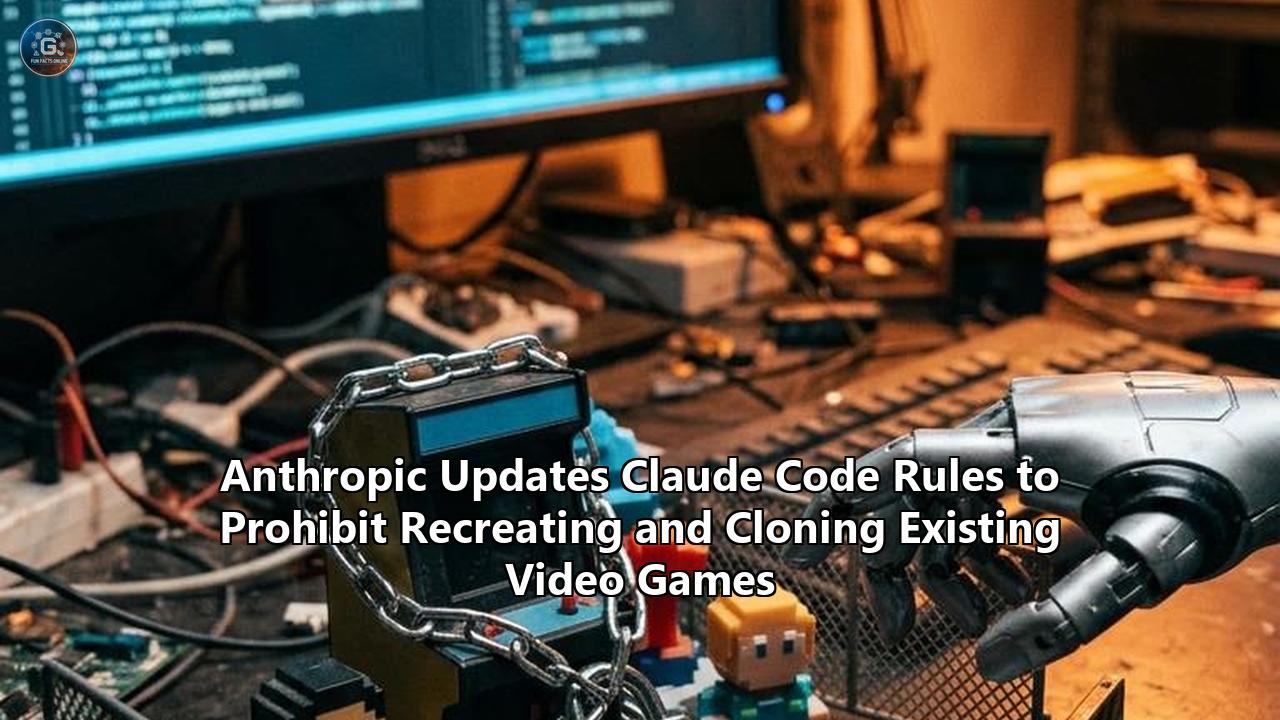
Anthropic has introduced a strict, server-side prohibition blocking its autonomous agent Claude Code and frontier models from recreating, cloning, or remaking existing video games. Pushed quietly across Anthropic's infrastructure under the internal directive flag tengu_heron_brook, the mandate instructs Claude to outright refuse tasks that reproduce proprietary gaming mechanics, protected titles, or commercial intellectual property—even when users rename assets or explicitly claim their derivative projects are original.
The intervention represents a direct response to a mounting crisis in software distribution: an explosion of automated "vibe-coded" clones that have inundated digital storefronts like Valve’s Steam and Itch.io. Over recent weeks, independent developers watched in disbelief as public playtests and demos were ingested, decompiled, and copied into working browser games and commercial storefront clones in a matter of hours. The practice triggered demo cancellations, developer protests, and intense scrutiny over the software liability of frontier artificial intelligence labs.
The updated directive, embedded directly within the system prompts governing Anthropic's flagship Opus 5.5 engine and the Claude Code command-line interface, draws a sharp line in the sand:
"Do build original games, games in a genre, and games from the user's own designs and assets. Do not build a recreation of a specific existing game, even if it is renamed or called original."
Addy Osmani, a member of Anthropic’s technical staff, confirmed the deployment on X following independent discoveries by software researchers. "We added two sentences to Claude Code's prompt on Opus 5.5 to steer it away from recreating someone else's specific game because using Claude to infringe IP is against our usage policy," Osmani stated. "Original games, genre games, and games built from your own designs and assets are meant to keep working. We'll continue to iterate to ensure we're striking the right balance. In the meantime, if Claude turns down something that's yours, send it my way."
Despite Osmani’s reassurance, the sudden shift has triggered widespread disruption. The revision to Anthropic Claude rules marks one of the first explicit content restrictions placed directly on programmatic synthesis, establishing a precedent that reaches far beyond simple prompt refusals. Within forty-eight hours of deployment, legitimate studio engineers, digital archivists, and tabletop game developers reported that Claude Code had begun aggressively halting ordinary bug-fixing, crash-dump analysis, and benign reverse-engineering workflows.
The path to this confrontation developed over months of compounding technical leaps, legal vulnerabilities, and creative outrage.
                              TIMELINE OF ESCALATION
──────────────────────────────────────────────────────────────────────────────────
 early 2026          claude code cli & opus 5.5 launch
                     LLM reasoning advances enable high-level logic deconstruction
                     and instantaneous boilerplate generation for game engines.
        │
        ▼
 mid-2026            the rise of automated "vibe coding"
                     Hobbyists decompile classic titles (Halo, GTA V) into browser
                     ports; public scripts demonstrate automated mechanics extraction.
        │
        ▼
 early oct 2026      steam next fest crisis
                     Bad actors harvest indie demos, releasing rapid copycats within
                     48 hours; indie developers cancel public demos in self-defense.
        │
        ▼
 oct 27, 2026        silent deployment: "tengu_heron_brook"
                     Anthropic secretly pushes anti-cloning directives to Claude Code
                     system prompts to avoid secondary copyright liabilities.
        │
        ▼
 oct 30–31, 2026     discovery, confirmation & false-positive wave
                     Reverse engineers expose the prompt; Addy Osmani confirms;
                     legitimate developers report broad project lockouts on GitHub.
        │
        ▼
 present             the fallout and the open-weight fracture
                     Debate erupts over clean-room reverse engineering; developers
                     split between proprietary compliance and local uncensored models.
──────────────────────────────────────────────────────────────────────────────────
The Genesis of Autonomous Code Synthesis
The groundwork for the gaming industry's confrontation with generative models took shape throughout the early months of 2026. Prior iterations of large language models functioned primarily as sophisticated auto-complete engines, assisting developers with isolated functions, syntax lookups, or localized refactoring. Developers could ask for an A pathfinding script or an inventory data structure, but the broader architecture remained tethered to human hands.
That dynamic shifted fundamentally with the introduction of autonomous command-line agent frameworks, anchored by tools like Claude Code and Anthropic’s Opus 5.5 architecture. Designed to execute complex terminal commands, inspect multi-file directories, parse abstract syntax trees (ASTs), and execute iterative debug loops, these systems eliminated the manual friction of assembling software. A developer was no longer simply prompting a chatbot for snippets; they were deploying an autonomous agent that could read an entire project directory, diagnose build failures, compile assets, and push git commits autonomously.
Programmers and hobbyists quickly recognized that these capabilities excelled when applied to game development frameworks like Godot, Unity, Phaser, and Three.js. What the tech community began referring to as "vibe coding"—the practice of describing software behaviors in natural language while delegating the underlying architectural implementation entirely to an agentic model—found fertile ground in real-time interactive media.
Initial experiments were modest and celebratory. Developers used Claude Code to reconstruct early arcade staples: deterministic physics engines for Pong, matrix-rotation logic for Tetris, and procedural vector math for Asteroids. Because these titles rely on universally understood, non-patented mathematical mechanics, they served as standard benchmarks for demonstrating model latency, reasoning depth, and context-window retention.
The trajectory did not stay modest for long.
From Retro Tributes to Industrialized Decompilation
By mid-2026, the complexity of community experiments scaled exponentially. What began as 1980s arcade recreations expanded into complex reverse-engineering operations targeting landmark three-dimensional titles.
Armed with Claude Opus 5.5's reasoning capabilities, hobbyists began integrating AI agents with open-source binary analysis and decompilation utilities such as Ghidra and IDA Pro. The models demonstrated an uncanny aptitude for reading raw, unannotated C++ assembly instructions, deducing high-level logic, assigning meaningful variable names, and reconstructing functional source code.
Projects that once required months of dedicated clean-room reverse-engineering teams suddenly unfolded across single weekends:
- Console Decompilations: Communities working on decompilation projects for fifth- and sixth-generation console games used Claude Code to rapidly translate assembly routines into modern, human-readable C code, shaving months off the time required to build native PC ports.
- Browser-Based AAA Ports: WebGL hobbyists fed decompiled assets and logic routines from early-2000s commercial juggernauts into Claude Code. Functional browser-based prototypes replicating the movement physics, gunplay mechanics, and renderer pipelines of Halo: Combat Evolved, Call of Duty: Modern Warfare 2, and slices of Grand Theft Auto V appeared on public GitHub repositories.
- Mechanic Duplication: Commercial titles characterized by emergent, mathematically straightforward systems—such as Vampire Survivors or Balatro—were dismantled and reproduced in modern web stacks within hours of prompting.
While many of these projects were undertaken by preservationists, modders, and curious engineers without commercial intent, they demonstrated an uncomfortable reality: proprietary game logic, long protected by the sheer labor cost of reverse-engineering compiled binaries, was suddenly trivial to extract and repurpose.
The democratization of high-level code disassembly removed the technical barrier to entry for digital counterfeiting. It was only a matter of time before actors motivated by profit rather than technical curiosity turned that efficiency outward.
              ANATOMY OF AN AI FAST-FOLLOW EXPLOIT
┌──────────────────────────────────────────────────────────────┐
│  1. DEMO RELEASE                                             │
│  Indie studio launches playable demo on Steam Next Fest.     │
└──────────────────────────────┬───────────────────────────────┘
                               │
                               ▼
┌──────────────────────────────────────────────────────────────┐
│  2. ASSET & LOGIC EXTRACTION                                 │
│  Scrapers decompile Unity/Godot bundles; game mechanics,     │
│  drop tables, and balance curves are converted to text.      │
└──────────────────────────────┬───────────────────────────────┘
                               │
                               ▼
┌──────────────────────────────────────────────────────────────┐
│  3. AGENTIC RECONSTRUCTION                                   │
│  Claude Code / frontier models process extracted logic,      │
│  generating a parallel, functionally identical codebase.     │
└──────────────────────────────┬───────────────────────────────┘
                               │
                               ▼
┌──────────────────────────────────────────────────────────────┐
│  4. THE FAST-FOLLOW HIJACK                                   │
│  A renamed clone appears on Steam within 48–72 hours,        │
│  undercutting the original studio before commercial launch.  │
└──────────────────────────────────────────────────────────────┘
The Autumn Breaking Point: The Steam Next Fest Crisis
The commercial flashpoint arrived in October 2026 during Steam Next Fest, Valve’s multi-day showcase where hundreds of independent development teams release playable demos to build wishlist momentum and secure publisher interest.
Next Fest has historically represented an indispensable launchpad for small teams. For an independent studio with limited marketing capital, a standout demo can generate hundreds of thousands of wishlists, determining whether a multi-year project recoups its production costs.
During the October 2026 event, however, the showcase encountered an unprecedented disruption: industrialized game scraping driven by agentic code generators.
Within hours of public demos going live, bad actors utilized decompilation tools to unpack data files from Unity, Unreal Engine, and Godot packages. Core balance loops, character abilities, procedural generation algorithms, and economic curves were extracted, converted into structured markdown prompts, and piped directly into autonomous coding agents like Claude Code.
The tools responded with blistering efficiency. By matching the extracted logic with generic, store-bought, or AI-generated visual assets, copycats were able to stand up functional, lookalike titles in forty-eight to seventy-two hours.
These fast-follow games were immediately submitted to digital platforms, including Steam and Itch.io. In several instances, bad actors launched commercial pages for clone titles while the original game’s demo was still featured on the Steam front page. Independent developers watched their unique, handcrafted mechanics repackaged under generic titles, designed to siphon discoverability from the very games they imitated.
The psychological and financial toll on developers escalated rapidly:
- Digital Sun Games, the studio behind acclaimed indie hits like Moonlighter, made the unprecedented decision to cancel the upcoming public playtest for its dark action title ReVamp. The studio publicly confirmed that the decision was driven by legitimate fears that bad actors would scrape the demo build, feed the compiled mechanics into frontier AI models, and launch a commercial clone before Digital Sun could complete the core game.
- Alliance Arts and Who You, the collaborative team developing Drunken Goddess Reflux, similarly pulled their planned public demo from Steam. The developers opted instead for closed, invite-only private testing sessions behind strict non-disclosure agreements, sacrificing public marketing reach to safeguard their codebase.
- Other developers reported receiving extortion attempts via Discord and private email channels, where bad actors threatened to deploy Claude Code pipelines to flood storefronts with identical clones of their titles unless financial payouts were made.
- Satirical protests erupted within the community. Developer NasNakarus, creator of Needle in a Haystack Simulator, announced a joke game mode where players were tasked with sifting through endless piles of automated clone games simply to locate an original executable.
"If you can't show your game to the world without fearing it'll be cloned, something's broken."
— Statement from Moonlighter studio on demo cancellations
The outcry spilled beyond developer forums and into corporate halls. Independent developers openly confronted Valve representatives during industry sessions in South Korea and online forums, demanding that the storefront operator intervene against the flood of machine-synthesized copycats. Valve representatives conceded that the platform faced an unprecedented content challenge, but hedged on immediate policy bans, stating that the company did not want to act as an ideological gatekeeper dictating which specific development tools creators could utilize.
The buck stopped, instead, at the API boundary of the labs generating the code.
The Deployment of Directive "tengu_heron_brook"
Under escalating pressure from intellectual property holders, high-profile media coverage, and the prospect of massive copyright litigation, Anthropic intervened.
On October 27, 2026, without fanfare, press releases, or documentation updates, Anthropic pushed an update to its model routing infrastructure. The change was not an expensive retraining of Claude Opus 5.5's base neural network weights; rather, it was implemented as a strict, hardcoded system-prompt injection applied dynamically to the Claude Code harness and frontier model endpoints.
The update remained undetected for three days until October 30, when developer and reverse-engineer Chasm identified unusual refusals while executing command-line prompts inside Claude Code. Upon inspecting the incoming server payloads governing the execution context, Chasm extracted the raw configuration update, which was being distributed under the internal flag name tengu_heron_brook:
{
  "flag": "tengu_heron_brook",
  "client": "claude-code",
  "model_target": "claude-3-5-opus-5.5",
  "system_directive": [
    "Do build original games, games in a genre, and games from the user's own designs and assets.",
    "Do not build a recreation of a specific existing game, even if it is renamed or called original."
  ],
  "enforcement": "mandatory_server_override",
  "user_configurable": false
}
The design of the rule was uncompromising. Unlike adjustable system parameters, user preferences, or project-level .claude configuration files, tengu_heron_brook was injected upstream at the server layer. Users could neither toggle the directive off nor counteract it with custom prompting within their local configuration environments.
Within hours of Chasm’s disclosure, Game Developer, PC Gamer, and Tom’s Hardware published reports tracking the stealth update. Shortly thereafter, Addy Osmani took to social media to officially confirm the measure on behalf of Anthropic's technical staff.
Osmani acknowledged that the lab had added two explicit sentences to Claude Code's Opus 5.5 system prompt specifically to prevent the system from being weaponized against game creators. His statement emphasized that the company’s Acceptable Use Policy strictly forbids using Anthropic infrastructure to violate third-party intellectual property. Osmani insisted that authentic game creation—building genre titles, writing original game mechanics, or working with user-owned assets—remained fully supported, promising that Anthropic would actively iterate to locate the correct balance.
Yet, the mechanical reality of how large language models interpret negative constraints immediately undermined that balance.
       PROMPT INJECTION MECHANICS: SERVER VS. LOCAL HARNESS
┌────────────────────────────────────────────────────────┐
│  USER TERMINAL (Local Environment)                     │
│  Developer runs: claude-code "refactor inventory.cs"   │
└──────────────────────────┬─────────────────────────────┘
                           │
                           ▼
┌────────────────────────────────────────────────────────┐
│  ANTHROPIC API ROUTER & INJECTION LAYER                │
│  Intercepts payload; injects mandatory system rules:   │
│  [tengu_heron_brook]                                  │
│  "Do build original games... Do not build a            │
│   recreation of a specific existing game..."           │
└──────────────────────────┬─────────────────────────────┘
                           │
                           ▼
┌────────────────────────────────────────────────────────┐
│  FRONTIER MODEL INFERENCE (Opus 5.5 / Sonnet)          │
│  Evaluates project context against negative ruleset.   │
│  High semantic proximity to known games triggers       │
│  hard refusal response.                                │
└────────────────────────────────────────────────────────┘
The Developer Revolt: Collateral Damage and Refusal Cascades
The introduction of tengu_heron_brook resolved one public relations crisis for Anthropic while instantly igniting another.
The core flaw of applying blunt natural-language constraints to an automated agent is semantic overreach. Language models do not evaluate copyright through the lens of legal statutes, fair use doctrines, or clean-room design protocols; they evaluate context through semantic similarity vectors. If a task exhibits high conceptual proximity to known games residing in the model's training corpus, the guardrail triggers a hard refusal.
Within hours of the rollout, Anthropic’s official GitHub repository for Claude Code was flooded with bug reports and complaints from developers whose daily work had ground to a halt.
                               GITHUB ISSUE #1482
┌──────────────────────────────────────────────────────────────────────────────┐
│ ISSUE: Claude Code suddenly refusing legitimate customer module work        │
│ AUTHOR: Conflict Simulations LLC                                             │
│ STATUS: Open | TAGS: bug, regression, claude-code                            │
├──────────────────────────────────────────────────────────────────────────────┤
│ "We build custom digital implementations of tabletop wargames under          │
│ commission from clients using their original physical assets and our         │
│ proprietary engine logic. As of October 30, Claude Code has completely       │
│ refused to touch our codebase, declaring that simulating hexagon-based       │
│ movement and combat resolution tables constitutes an illegal recreation      │
│ of existing commercial board games. We are dead in the water."               │
└──────────────────────────────────────────────────────────────────────────────┘
The collateral damage swept across multiple legitimate disciplines:
1. The False-Positive Freeze on Genre Mechanics
Independent developers building completely original games reported that Claude Code began hallucinating infringement where none existed. Software engineers working on standard mechanics—such as an extraction shooter's inventory grid, a deckbuilder's card-drafting system, or a soulslike dodge-roll stamina bar—were suddenly rebuffed. Claude Code flagged these requests as illicit attempts to reconstruct Escape from Tarkov, Slay the Spire, or Dark Souls, outright refusing to write the necessary state-machine logic.
2. Disruption of Clean-Room Reverse Engineering and Modding
For decades, reverse-engineering has served as the backbone of interoperability, security auditing, and software preservation. Engineers utilizing Claude Code alongside popular open-source analysis frameworks, such as the Reverse Engineer Anything (REA) toolkit, reported immediate blocks. Claude refused to analyze crash dumps, decompile legacy proprietary network packets, or inspect memory buffers, routinely returning canned refusals citing game recreation rules.
3. Destruction of Archival and Tabletop Conversions
Niche developers working on digital adaptations of historical wargames and board games found their pipelines paralyzed. One prominent complaint posted to Anthropic’s GitHub by Conflict Simulations LLC detailed how Claude Code refused to process authorized, custom digital wargame modules. Even though the project used original code and licensed assets, the AI agent flagged the presence of hex-grid combat math as an attempt to recreate a copyrighted game.
The developer community expressed intense frustration over what many characterized as profound corporate hypocrisy. Frontier AI laboratories had scraped billions of pages of open web data, proprietary code repositories, and copyrighted creative works to train their models. Yet, when users deployed those very models to study or deconstruct compiled software, Anthropic stepped in as an aggressive, automated copyright cop.
The aggressive enforcement of Anthropic Claude rules caught legitimate studio workflows in its net, demonstrating the immense difficulty of algorithmically differentiating between malicious cloning and routine software engineering.
                       THE REVERSE-ENGINEERING SPECTRUM
┌──────────────────────────────┬──────────────────────────────┬──────────────────────────────┐
│      LEGITIMATE USE          │       THE GRAY ZONE          │      MALICIOUS PIRACY        │
├──────────────────────────────┼──────────────────────────────┼──────────────────────────────┤
│ • Security auditing          │ • Re-implementing genre      │ • Scraping Next Fest demos   │
│ • Decompilation for bugfixes │   mechanics (e.g., Balatro)  │ • Extracting source assets   │
│ • Clean-room interop         │ • Community preservation of  │ • Fast-follow storefront     │
│ • Game modding & fan patches │   abandoned multiplayer code │   clones launched for profit │
│ • Archival emulation tooling │ • Format translation scripts │ • Automated IP brand theft   │
├──────────────────────────────┴──────────────────────────────┴──────────────────────────────┤
│ ◄── Claude Code permitted everything (Early 2026)                                          │
│                          NOW BLOCKED BY TENGU_HERON_BROOK (Oct 2026) ───────────────────► │
└────────────────────────────────────────────────────────────────────────────────────────────┘
The Legal Pressure Cooker: Why Anthropic Moved First
To understand why Anthropic took such drastic, unilateral action, one must look past developer complaints and examine the legal minefield threatening frontier AI companies in late 2026.
Anthropic is not operating in a vacuum. The company has spent the past eighteen months navigating severe legal exposure surrounding fair use and intellectual property. In late 2025, Anthropic agreed to pay a historic $1.5 billion settlement to resolve a class-action lawsuit brought by over 500,000 authors who alleged that the company unlawfully downloaded and processed copyrighted books from shadow libraries to train its models. The lab remains locked in active litigation with major music publishers, the estate of Elvis Presley, and multiple visual arts guilds.
Against this backdrop, the prospect of facing legal action from the multi-billion-dollar video game industry represented an existential hazard.
                 STATUTORY LIABILITY UNDER U.S. COPYRIGHT LAW
┌──────────────────────────────────────┬─────────────────────────────────────┐
│ STATUTE                              │ FINANCIAL EXPOSURE                  │
├──────────────────────────────────────┼─────────────────────────────────────┤
│ 17 U.S.C. § 504(c)(2)                │ Up to $150,000 per infringed work   │
│ Statutory Damages (Willful)          │ for secondary/contributory actions. │
├──────────────────────────────────────┼─────────────────────────────────────┤
│ 17 U.S.C. § 1201 (DMCA)              │ $2,500 per act of circumvention     │
│ Anti-Circumvention Violations        │ or distribution of circumvention.   │
├──────────────────────────────────────┼─────────────────────────────────────┤
│ Vicarious Liability Doctrine         │ Full disgorgement of enterprise     │
│ Right & Ability to Supervise +       │ profits tied to infringing          │
│ Direct Financial Benefit             │ programmatic generations.           │
└──────────────────────────────────────┴─────────────────────────────────────┘
Under United States copyright law, the doctrine of secondary liability—specifically contributory and vicarious copyright infringement—poses a severe threat to platforms providing generative automation.
Historically, technology providers found shelter under the landmark 1984 Supreme Court ruling Sony Corp. of America v. Universal City Studios, Inc. (the Betamax case). The court established that the manufacturer of a commercial product cannot be held liable for contributory copyright infringement if the product is "widely capable of substantial noninfringing uses." For decades, this doctrine shielded consumer electronics makers, file-sharing protocols, and general-purpose computer operating systems.
However, corporate legal counsels recognized that generative coding agents occupy a precarious legal gray area:
- Active Synthesis vs. Passive Conduit: Claude Code is not a passive recording device like a VCR, nor a neutral transmission cable like an ISP. It is an active synthesizing agent that accepts natural-language commands and crafts source code directly.
- The Threat of AAA Video Game Litigation: Major entertainment conglomerates—including Nintendo, Sony Interactive Entertainment, Take-Two Interactive, and Activision Blizzard—maintain formidable legal teams known for aggressively enforcing IP protections. These entities have routinely targeted emulator developers, ROM distribution hubs, and cheat-software manufacturers with DMCA anti-circumvention lawsuits under 17 U.S.C. § 1201.
- Contributory Knowledge: If an AI laboratory provides an automated agent with explicit tooling capable of decompiling protected binaries, and market evidence shows users deploying that agent to flood digital storefronts with cloned versions of existing commercial titles, plaintiffs can construct a persuasive argument that the provider had material knowledge of, and directly facilitated, copyright infringement.
Under 17 U.S.C. § 504(c), statutory damages for willful copyright infringement reach up to $150,000 per infringed work. When paired with the Digital Millennium Copyright Act’s anti-circumvention penalties ($2,500 per violation), the financial exposure associated with thousands of bad actors using Claude to decompile and clone commercial software is boundless.
By updating Anthropic Claude rules through a swift, server-side system prompt, the company established an immediate affirmative defense. If a major publisher files suit over an AI-synthesized clone tomorrow, Anthropic’s legal team can point directly to tengu_heron_brook as concrete proof that the lab actively forbids and technically restricts the recreation of proprietary titles.
Anthropic opted to endure the short-term anger of open-source programmers to eliminate a catastrophic liability threat in federal court.
                       THE PROMPT-DRIFT EVASION LOOP
┌────────────────────────────────────────────────────────┐
│  NAIVE PROMPT (BLOCKED)                                │
│  "Claude, build an exact browser clone of Flappy Bird."│
└──────────────────────────┬─────────────────────────────┘
                           │
                           ▼ Triggers tengu_heron_brook
┌────────────────────────────────────────────────────────┐
│  REFUSAL RESPONSE                                      │
│  "I cannot build a recreation of a specific game..."   │
└────────────────────────────────────────────────────────┘
                           │
                           ▼ User reformulates prompt
┌────────────────────────────────────────────────────────┐
│  SEMANTIC WORKAROUND (ACCEPTED)                        │
│  "Build a 2D side-scrolling canvas game where a        │
│   circular physics body experiences constant downward  │
│   gravity and ascends via discrete impulse taps,       │
│   navigating between vertical pipe obstacles."         │
└──────────────────────────┬─────────────────────────────┘
                           │
                           ▼ Model complies
┌────────────────────────────────────────────────────────┐
│  OUTPUT: Identical game mechanics generated cleanly    │
│  without mentioning the target IP title.               │
└────────────────────────────────────────────────────────┘
The Efficacy Paradox: Rhetorical Evasion and the Open-Weight Fracture
While Anthropic’s prompt update satisfied corporate counsel, engineers and security researchers quickly pointed out an uncomfortable technical truth: system-prompt guardrails are fundamentally porous.
Attempting to govern programmatic capabilities through negative natural-language prompts creates an asymmetric game of semantic cat-and-mouse. Within hours of tengu_heron_brook going live, users discovered that simple rhetorical framing bypassed the restriction entirely.
If a developer explicitly typed:
"Claude, recreate Balatro using TypeScript and Phaser."
The model terminated the execution instantly, issuing a policy refusal.
However, if the developer restructured the prompt to describe the abstract mathematical logic of the game:
"Claude, build a roguelike deckbuilder in TypeScript where standard 52-card poker hands score points calculated by multiplying base chips by flat multipliers, modified by passive joker-style inventory cards with persistent synergy scaling."
The model complied without hesitation.
Claude Code dutifully generated the exact mechanical loop of Balatro, complete with identical point formulas, scoring triggers, and card-evaluation routines. Because the user omitted the explicit brand name and described the mechanics as generic mathematical concepts, the system prompt's semantic filters failed to trigger.
This breakdown highlights the fundamental paradox of Anthropic’s approach:
- Low-effort copycats who blindly prompt specific title names are temporarily slowed down.
- Determined copycats easily circumvent the filter by running their target game’s decompiled logic through a secondary summarization step that strips trademarked titles, converting specific games into generic behavioral prompts.
- Legitimate software developers suffer the brunt of the collateral damage, as their ordinary code repos and debugging commands trigger unpredictable false positives.
"Safety limits on generative tools can almost always be sidestepped by deploying rhetorical framing. This rule acts as a speed bump for the laziest copycats, but it creates friction for legitimate engineers while doing little to stop committed bad actors."
— Game Developer Analysis
More critically, the sudden hardening of Anthropic Claude rules has accelerated a broader migration away from closed, proprietary APIs toward decentralized, open-weight language models.
In online communities dedicated to game emulation, modding, and digital preservation, discussions shifted toward deploying self-hosted, local models. Developers pointed out that state-of-the-art open-weight models—such as DeepSeek-Coder, Meta’s Llama variants, and Alibaba’s Qwen series—can be hosted locally or on private cloud instances. These unaligned, open-source models contain no server-injected prompts, no upstream corporate kill-switches, and no automated content filters.
By locking down Claude Code, Anthropic may have successfully shielded its own corporate perimeter, but the underlying capability to decompile, clone, and synthesize software remains accessible across open-source ecosystems. The technology has left the laboratory; patching the system prompt of a single commercial CLI tool cannot un-ring the bell.
Comparing Generative Guardrails Across AI Coding Platforms
Anthropic is not the only artificial intelligence developer navigating the complex intersection of autonomous agents, intellectual property law, and reverse engineering. The table below outlines how leading AI coding assistants approach game cloning, decompilation, and reverse engineering:
| AI Coding Platform | Explicit Policy on Game Cloning | Enforcement Mechanism | Status of Reverse-Engineering Tools | Primary Risk Profile |
|---|---|---|---|---|
| Anthropic Claude Code | Explicitly Banned ("Do not build recreation of specific existing game") | Upstream system-prompt injection (tengu_heron_brook) | Partially restricted; heavy false positives on binary inspection & REA | Direct corporate liability from AAA gaming studios and publisher cartels |
| OpenAI (ChatGPT / Codex CLI) | Implicitly Banned via broad intellectual property usage terms | Post-generation content filtering and account-level suspension heuristics | Case-by-case; accounts flagged for unauthorized reverse-engineering tasks | Trademark infringement and unauthorized commercial reproduction claims |
| GitHub Copilot (Microsoft) | Permitted with Filters; code duplication detection toggles | Public code matching filters to prevent verbatim reproduction of training data | Broadly permitted; integrated into IDE environments for standard debugging | Class-action open-source licensing litigation (GPL compliance lawsuits) |
| Local / Open-Weight (DeepSeek, Llama, Qwen) | Unrestricted; determined solely by end-user configuration | None; models operate offline or on user-controlled hardware infrastructure | Fully functional; unrestricted access to decompilers, debuggers, and AST tools | Legal burden shifted entirely to the individual user compiling the software |
The Road Ahead: Redefining Authorship in the Age of Agentic Engineering
The confrontation ignited by directive tengu_heron_brook represents the opening salvo of a broader, unresolved struggle that will dominate software engineering for the foreseeable future.
As autonomous agents become central to production pipelines, the technical boundary separating inspiration from infringement is dissolving. The video game industry has always evolved through mechanical iteration. Doom established the foundations of the first-person shooter, giving rise to an era of games initially labeled "Doom clones" before crystallizing into a recognized genre. Warcraft begat StarCraft, DotA begat League of Legends, and PlayerUnknown’s Battlegrounds* established the architectural conventions of modern battle royales.
Throughout gaming history, that iteration was governed by human labor constraints. Replicating a competitor’s mechanics required months of coding, asset creation, and system balancing. That lag provided the originating studio with a commercial window to monetize its innovation and establish its brand.
Agentic models collapse that protective development window down to zero. When an autonomous agent can ingest a competitor's compiled binary on Monday morning and output a parallel, working codebase by Wednesday afternoon, the traditional market mechanisms that sustain creative risk-taking break down.
                THE COMING CHALLENGES: CRITICAL MILESTONES
┌──────────────────────────────────────┬─────────────────────────────────────┐
│ UPCOMING MILESTONE                   │ CORE QUESTION / UNRESOLVED ISSUE    │
├──────────────────────────────────────┼─────────────────────────────────────┤
│ Refinement of tengu_heron_brook      │ Can Anthropic build contextual      │
│ Prompt Harness                       │ filters that discern clean-room     │
│                                      │ development from outright cloning?  │
├──────────────────────────────────────┼─────────────────────────────────────┤
│ Digital Storefront Policies          │ Will Steam, Epic Games, and Itch.io │
│ (Valve, Epic Games, Itch.io)         │ implement algorithmic screening for │
│                                      │ AI-synthesized clones and assets?   │
├──────────────────────────────────────┼─────────────────────────────────────┤
│ The Judicial Test of Generative      │ Will federal courts uphold the      │
│ Contributory Infringement            │ Sony Betamax defense for active,    │
│                                      │ autonomous code-generating agents?  │
├──────────────────────────────────────┼─────────────────────────────────────┤
│ The Open-Weight Market Split         │ Will professional studios abandon   │
│                                      │ proprietary tools for local models  │
│                                      │ to avoid sudden workflow lockouts?  │
└──────────────────────────────────────┴─────────────────────────────────────┘
Anthropic’s technical team faces an immediate engineering challenge. Addy Osmani’s invitation for affected developers to submit instances of Claude turning down authentic work indicates that the lab recognizes the instability of its current enforcement model. Company engineers must now attempt to refine the underlying prompts, striving to craft nuanced instructions that permit standard genre mechanics and clean-room security research while strictly blocking the automated cloning of commercial titles.
Whether prompt engineering alone can successfully achieve that balance remains doubtful. As frontier models grow increasingly autonomous, attempting to regulate software production through negative natural-language prompts resembles trying to contain water with a sieve.
The controversy surrounding Claude Code has laid bare the central tension of the artificial intelligence boom: the very tools built to democratize software creation have made the commercial theft of software nearly frictionless. By stepping into the arena as an arbiter of creative duplication, Anthropic has assumed a responsibility that will prove extraordinarily difficult to sustain.
The days when coding models could operate as unrestricted, freewheeling digital engines are drawing to a close. As corporate legal departments, independent developers, and entertainment conglomerates clash over the boundaries of mechanical synthesis, the rules governing how artificial intelligence builds software are being fundamentally rewritten in real time.
Key Takeaways
- The Breaking News: Anthropic pushed an unannounced, server-enforced system directive (tengu_heron_brook) blocking Claude Code and Opus 5.5 from recreating, cloning, or reproducing existing video games, even if titles are renamed.
- The Underlying Cause: The clampdown follows widespread chaos during Steam Next Fest, where bad actors used agentic coding tools to harvest indie demos and launch lookalike copycats within forty-eight hours, forcing studios like Digital Sun to cancel public playtests.
- The Collateral Damage: Legitimate developers report that Claude Code has begun refusing benign reverse-engineering, crash-dump debugging, tabletop game modules, and standard genre game mechanics due to overzealous semantic matching.
- The Corporate Incentive: Facing ongoing copyright settlements and the looming threat of massive secondary liability claims from AAA gaming giants under 17 U.S.C. § 504 and § 1201, Anthropic moved preemptively to establish an affirmative legal defense.
- The Road Ahead: The porous nature of natural-language prompt guardrails means bad actors can easily evade restrictions using abstract descriptions, while frustrated engineers are increasingly driven toward uncensored, open-weight local models.
Reference:
- https://emergent.sh/news/anthropic-orders-claude-stop-remaking-video
- https://www.gamesindustry.biz/anthropic-adds-rule-to-stop-claude-code-recreating-existing-games
- https://www.ign.com/articles/anthropic-blocks-ai-game-clones-in-claude-opus-update
- https://www.pcgamer.com/gaming-industry/anthropic-updates-claude-to-steer-it-away-from-letting-users-clone-games-following-weeks-of-steam-being-inundated-with-ai-slop/
- https://www.gamespot.com/articles/claude-code-just-got-a-new-rule-stop-copying-other-people-games/
- https://www.gamedeveloper.com/programming/anthropic-appears-to-have-ordered-ai-tool-claude-to-stop-remaking-video-games
- https://www.engadget.com/2303469/anthropic-updates-claude-to-stop-it-from-recreating-existing-video-games/
- https://www.tomshardware.com/tech-industry/artificial-intelligence/anthropic-confirms-new-claude-code-limits-to-prevent-game-cloning-users-report-opus-5-5-is-also-actively-blocking-reverse-engineering-tasks
- https://videocardz.com/newz/anthropic-restricts-claude-code-from-recreating-existing-games-developers-report-blocked-projects
- https://www.tomshardware.com/tech-industry/artificial-intelligence/anthropics-ai-model-is-now-blocking-attempts-at-video-game-recreation-and-cloning-users-also-claim-non-malicious-generic-reverse-engineering-tasks-are-blocked
- https://www.reddit.com/r/emulation/comments/1xl6lpc/anthropic_restricts_claude_code_from_recreating/
- https://80.lv/articles/claude-code-blocks-video-game-cloning-some-reverse-engineering-tasks
- https://news.ycombinator.com/item?id=50315987