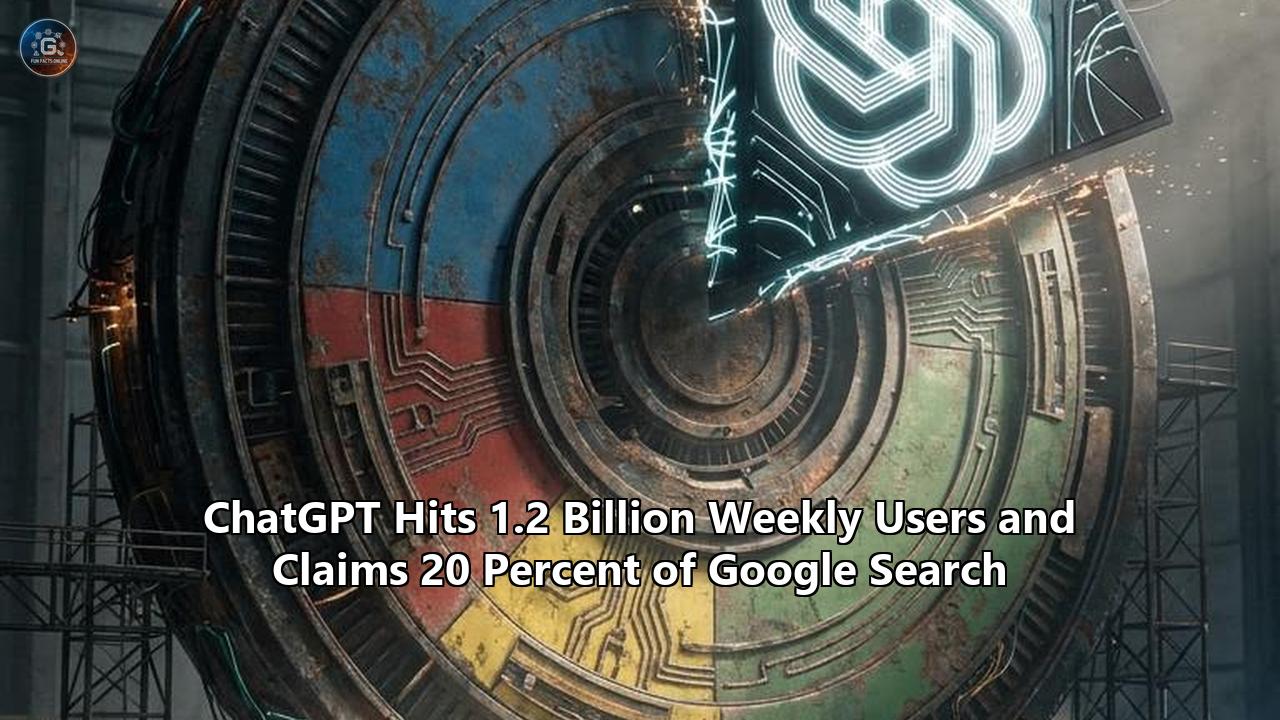
At an intimate gathering of media figures and technology executives in lower Manhattan on Monday night, Adam Fry, the consumer product lead for ChatGPT at OpenAI, delivered a pair of statistics that sent immediate tremors through Wall Street and Silicon Valley.
ChatGPT has reached 1.2 billion weekly active users, having added 200 million people to its roster in the past 60 days alone. More provocatively, Fry disclosed that the volume of search-like queries routed through ChatGPT has reached approximately 20 percent of Google’s total global search volume.
The disclosure represents the first time OpenAI has officially quantified its product directly against the benchmark of Alphabet’s core monopoly. For over two decades, Google Search operated with a domestic and global market share consistently hovering above 90 percent. Microsoft spent twenty years and tens of billions of dollars attempting to position Bing as a viable alternative, only for its chief executive, Satya Nadella, to concede during a 2023 federal antitrust trial that Bing commanded roughly 3 percent of the market.
In under two years since integrating real-time retrieval capabilities, ChatGPT has captured a query volume roughly four times that of Bing, carving out a structural beachhead in the consumer habit of information discovery.
Alphabet shares dipped 2.8 percent in after-hours trading following the circulation of Fry’s comments, reflecting an intensifying anxiety among institutional investors that the company's high-margin advertising engine is finally facing systemic query erosion. Behind OpenAI’s audacious top-line numbers, however, lies an intricate web of measurement technicalities, escalating compute deficits, changing user psychology, and an aggressive push toward commercialization ahead of an anticipated initial public offering.
An investigation into internal product telemetry, independent clickstream datasets, and search engine infrastructure reveals that while OpenAI has established a genuine alternative to the traditional web portal, the battle for the future of search is evolving into an economically volatile war of attrition.
Deconstructing the 20 Percent Claim: Query Math and Methodology
To evaluate OpenAI’s claim of capturing one-fifth of Google's volume, one must first isolate what constitutes a "search" inside a neural network.
Google processes an estimated 5 trillion searches annually, translating to roughly 14 to 16 billion queries each day. If ChatGPT’s volume sits at 20 percent of that baseline, OpenAI’s infrastructure is fielding somewhere between 2.8 and 3.2 billion search-oriented interactions every twenty-four hours.
When pressed on how OpenAI arrived at that figure, Fry offered a critical qualification: OpenAI defines a search query as any prompt that explicitly triggers real-time web retrieval.
"Every time you ask a question and go search the web, that's a search," Fry said during a fireside discussion with tech journalist Alex Kantrowitz.
Search Query Volume Comparison (Daily Estimated Queries)

Google Search:    [████████████████████████████████████████] ~15.0 Billion
ChatGPT Search:   [████████] ~3.0 Billion (20% of Google)
Microsoft Bing:   [██] ~0.75 Billion (~5% of Google)
This distinction between native language generation and retrieval-augmented generation (RAG) is central to understanding the mechanics of OpenAI's claim. When a user asks ChatGPT to debug a block of Python code, draft a resignation letter, or rewrite a memorandum, the model relies on internal parametric weights. No external network call is made. But when that same user asks for the score of an ongoing baseball game, comparative pricing on heat pumps, or an explanation of a breaking political scandal, ChatGPT’s orchestration layer sends a retrieval query across the live internet, extracts text snippets from indexed sources, and synthesizes an answer.
OpenAI did not disclose the precise source of its Google baseline data, relying instead on aggregated market intelligence estimates. Yet outside telemetry corroborates a massive structural migration.
An analysis of over 1 billion lines of desktop and mobile clickstream data conducted by search analytics platform Semrush found that user behavior across digital properties underwent a decisive bifurcation. For transactional queries—buying a specific SKU, finding local plumbing services, or navigating directly to a banking login—Google retains near-total dominance. But for open-ended informational, analytical, and comparative queries, users are increasingly bypassing search engines entirely.
"What we are seeing in the telemetry is not a uniform decline in Google usage, but a clean excision of the high-cognition query," says Dr. Aris Thorne, a computational linguistics fellow at the Center for Information Technology Policy. "Ten years ago, a user trying to evaluate the tax implications of an estate sale would execute four to seven discrete searches on Google, scan a dozen ad-heavy links, and manually cross-reference the findings. Today, that entire sequence happens in a single conversational thread on ChatGPT. OpenAI is counting that retrieval sequence as search volume, and from an intent perspective, they are entirely correct."
The Semrush clickstream dataset illustrates the shift: searches containing 11 or more words on traditional engines grew from 3.27 percent to 5.37 percent over the past year, while conversational search prompts across all web engines jumped from 5 percent to 20 percent. Users have been trained by conversational interfaces to stop typing disjointed keywords like "best commuter bike rain durable" and instead write complete paragraphs detailing their height, budget, terrain, and city climate.
Because Google's classical index was built around keyword relevance, link graphs, and page-level authority, it often falters when parsing dense, multi-variable prompts. ChatGPT’s architectural ability to ingest a paragraph of constraints and return a synthesized recommendation without requiring the user to navigate out to third-party domains represents the primary engine pulling users away from traditional search engine result pages (SERPs).
Anatomy of an Acceleration: Tracing ChatGPT User Growth
The velocity of ChatGPT user growth over the preceding twenty-four months has defied standard software adoption curves, presenting a pattern rarely witnessed even during the peak expansion phases of platforms like Instagram, WhatsApp, or TikTok.
ChatGPT Trajectory: Weekly Active Users (WAUs)

Nov 2022:  Launch
Feb 2025:  [████] 400M
Feb 2026:  [█████████] 900M
Sep 2026:  [████████████] 1.0B
Nov 2026:  [██████████████] 1.2B (+200M in 60 days)
Consider the chronological trajectory:
- Late 2022 to Early 2023: ChatGPT reaches 100 million monthly users within sixty days of launch, operating largely as an offline curiosity bound by static knowledge cutoffs.
- February 2025: Brad Lightcap, OpenAI’s Chief Operating Officer, confirms the platform has scaled to 400 million weekly active users.
- February 2026: Internal filings and public statements peg the platform at 900 million weekly users, driven by the expansion of zero-latency multimodal models and native enterprise rollouts.
- September 2026: OpenAI crosses the 1 billion weekly active threshold.
- November 2026: Adam Fry announces that the base has surged to 1.2 billion weekly active users.
Adding 200 million net active users in eight weeks represents a sustained intake rate of over 3.3 million individuals daily. Fry stressed that this surge marks an acceleration rather than the plateau many venture analysts predicted when generative text first lost its initial novelty.
Analyzing the mechanics behind this surge reveals that ChatGPT user growth was not merely driven by novelty seekers, but by the rapid normalization of voice interfaces and systemic dissatisfaction with the ad-saturated web.
During the Manhattan briefing, Fry disclosed two metrics that clarify where this usage is concentrating:
- Voice Engagement: The platform's voice architecture—spanning real-time conversational voice mode and background audio dictation—now commands 250 million weekly active users. This means more than one out of every five ChatGPT users engages with the service verbally.
- Visual Asset Generation: Users now generate roughly 1.5 billion images per week through integrated diffusion and autoregressive graphics engines.
The expansion of voice is particularly disruptive to Google’s search ecosystem. When individuals interact with an assistant via voice, the classical search advertising model collapses. A screen-based Google search allows the company to display four sponsored links, a map pack with local business bids, and sponsored shopping tiles before a user ever reaches an organic snippet.
In a voice environment, there are no screens to populate with sponsored links. The user demands a single, accurate, spoken answer.
"We are seeing voice move from an intermittent accessibility feature to a primary interface," Fry remarked during the gathering. "People are walking their dogs, driving, preparing meals, or sitting at their desks, holding continuous, twenty-minute working conversations with the system. That is not behavior that fits into a search box, yet it consumes the exact information retrieval use cases that Google historically monetized".
A demographic analysis published by the Pew Research Center mirrors this behavioral evolution. In a comprehensive study of digital habits, Pew found that 42 percent of American adults now report using generative AI tools explicitly for "information searching," making it the single most common consumer application of the technology, outpacing workplace automation (38 percent), coding, and creative entertainment.
Crucially, brand consolidation in this space is heavily lopsided. Pew's data indicates that 44 percent of adults have used ChatGPT, compared to just 24 percent who have used Google’s native Gemini assistant, despite Gemini's default distribution across the Android operating system.
The Crisis of the "Broken" Web
To understand why 1.2 billion people are using ChatGPT every week, one must investigate the parallel deterioration of the traditional search engine results page.
For years, consumer sentiment regarding Google Search has tracked downward across independent consumer satisfaction indices. The root cause lies in the perverse incentives of Search Engine Optimization (SEO) and programmatic ad monetization.
A standard search query for consumer advice—whether for the "best dishwasher" or "how to fix a frozen water line"—frequently yields a top-heavy layout:
- Two to four sponsored ads masking as organic results.
- A massive "People Also Ask" algorithmic module designed to retain users on Google properties.
- A cluster of affiliate-revenue content farms containing 2,000 words of programmatic filler designed solely to satisfy Google's crawler algorithms, buried under auto-playing video players and third-party tracking scripts.
Visual Architecture: Google SERP vs. ChatGPT Interface

TRADITIONAL SEARCH ENGINE (SERP)       CHATGPT CONVERSATIONAL INTERFACE
+---------------------------------+    +---------------------------------+
| [Sponsored Ad 1]                |    | > User Query                    |
| [Sponsored Ad 2]                |    |                                 |
| [Sponsored Shopping Carousel]   |    | [Synthesized Answer]            |
| [AI Overview / Zero-Click Box]  |    | Direct explanation tailored     |
| [People Also Ask Accordion]     |    | to user constraints. Extracted  |
| [Affiliate Blog Link]           |    | from 4 real-time sources.       |
|  - 2,000 words of filler text   |    |                                 |
|  - Pop-up newsletter mod        |    | [Sources: Wall Street Journal,  |
|  - 14 programmatic banner ads   |    |  Reuters, TechCrunch]           |
+---------------------------------+    +---------------------------------+
"Google didn’t lose 20 percent of search intent because ChatGPT was magically omniscient; Google lost it because using the open web became a hostile consumer experience," says Marcus Vance, head of search strategy at the digital consultancy Omnia Labs. "Users reached an inflection point where they simply refused to wade through an obstacle course of affiliate marketing schemes and invasive ad tech to find out how to remove a wine stain from an antique rug. ChatGPT gave them the direct answer in three seconds flat".
Internal research at major publishing houses confirms the severity of the shift. In a private memorandum circulated among executive leadership at a top-tier digital media group, analysts noted that direct organic search referrals from Google for broad informational queries dropped 24 percent year-over-year.
Simultaneously, the click-through rate on standard search results dropped to historic lows as Google attempted to stem the bleeding by deploying its own AI Overviews. But in doing so, Google created a trap for its own business model.
When Google places an AI Overview at the top of the search page to mimic ChatGPT's synthesis, it cannibalizes the very clicks that generate its core ad revenue. In its recent regulatory filings, Alphabet acknowledged facing "lower monetization" on search surfaces that heavily integrate generative answers.
Google executives maintain that their search engine remains fundamentally unmatched in breadth, timeliness, and local relevance. Alphabet CEO Sundar Pichai has repeatedly pushed back against the narrative of Google's vulnerability. During an exchange regarding the rise of standalone AI chatbots, Pichai noted: "You’ve had these chatbots scale up to hundreds of millions of users. We’ve grown in queries".
At Google’s annual developer conference, Robby Stein, vice president of product for Google Search, addressed the shifting landscape directly, arguing that search is expanding rather than shrinking.
"People are asking much longer and harder questions that no longer have a clear response anywhere on the internet," Stein said, describing new multimodal capabilities that generate interactive web canvases and micro-applications directly within Google Search. "(AI has) really almost trained people how to search differently".
Yet Stein’s assertion that AI has trained people to search differently cuts both ways. Having learned to ask longer, more complex questions, millions of users are simply choosing not to execute those searches on Google.
Under the Hood: The Cost and Architecture of 3 Billion Daily Searches
While capturing 20 percent of Google’s query volume is a triumph for OpenAI's product team, it presents a staggering architectural and computational challenge.
The classical search engine index is one of the most computationally efficient systems ever engineered by computer scientists. Google's web spiders crawl the global internet, parse HTML pages, build an inverted index, and map every token across distributed clusters of commodity servers. When a user queries Google, the search engine does not read the internet in real time. It performs an ultra-fast, highly optimized database lookup against its pre-computed index, retrieving ranked links in less than 200 milliseconds at a cost estimated at a fraction of a cent per query.
ChatGPT’s search architecture is fundamentally more complex, computationally demanding, and expensive.
Cost & Retrieval Architecture: Inverted Index vs. RAG Pipeline

GOOGLE SEARCH (Inverted Index)
User Query ---> Inverted Index Lookup ---> PageRank Scoring ---> Ad Auction ---> SERP Delivered
Cost: ~$0.0002 | Latency: ~180ms

CHATGPT SEARCH (Inference + RAG)
User Query ---> Query Classifier ---> Web Search (Bing/Proprietary Crawler)
            ---> Document Parsing ---> Dynamic Context Injection
            ---> LLM Autoregressive Generation ---> Text Streamed
Cost: ~$0.0120 to $0.0350 | Latency: 1.2s - 2.8s
When a user submits a retrieval prompt to ChatGPT, a multi-tier orchestration pipeline engages:
- Query Intent Classification: A compact, low-latency transformer model evaluates the user's prompt to determine if up-to-date factual retrieval is required. If the prompt can be satisfied through parametric knowledge, external search is skipped.
- Web Retrieval Execution: If external grounding is mandated, the orchestration layer dispatches API calls to external web indices—primarily Microsoft Bing, alongside OpenAI’s proprietary in-house crawler, OAI-SearchBot.
- Document Extraction and Reranking: The retrieval engine downloads live HTML pages, strips away boilerplate code, navigation chrome, and advertisements, and feeds the raw textual data into a dense reranker model that scores individual paragraphs for semantic relevance.
- Context Injection and Generative Synthesis: The most relevant passages are packed into the context window of the frontier model (such as GPT-4o or its successive variants). The model then reads those passages, evaluates credibility, reconciles conflicting data, and writes an original, citations-backed synthesis in real time.
The economic ramifications of this architecture are acute. Where a classical Google search costs an estimated $0.0002 to execute, an inference-heavy, retrieval-augmented response inside ChatGPT can cost anywhere from $0.012 to $0.035, depending on the number of documents retrieved and the length of the generated output.
Sustaining this rate of ChatGPT user growth while absorbing the computational overhead of billions of daily inferences presents a stark architectural challenge. At 3 billion search queries a day, OpenAI’s daily computational burn rate for search retrieval alone reaches tens of millions of dollars.
To mitigate this burden, OpenAI has quietly deployed aggressive infrastructural optimizations. Engineering sources familiar with OpenAI’s data pipeline reveal that the company has transitioned from relying exclusively on Microsoft Bing’s search API to building out a bespoke caching layer and its own web index.
By caching frequently queried real-time entities—such as stock indices, current weather forecasts, sports scores, and trending headlines—OpenAI can ground responses without executing costly fresh web retrievals for every identical question.
Furthermore, OpenAI has optimized its dynamic routing logic. Simple informational lookups are routed to smaller, highly distilled models running on custom silicon, reserving the parameter-heavy frontier models for complex multi-step research tasks.
Despite these efficiencies, the economic reality remains undeniable: serving 20 percent of the world’s search queries via autoregressive language models requires an unprecedented capital commitment to GPU and TPU compute clusters, physical data center capacity, and electrical grid infrastructure.
The Monetization Dilemma: From Subscriptions to the Ad Auction
How does OpenAI plan to pay for this mountain of compute?
Until recently, the company’s business model rested on two main pillars: consumer subscriptions (such as ChatGPT Plus and Pro tiers) and enterprise developer API access. OpenAI has amassed approximately 50 million paying consumer subscribers, generating billions in predictable annual recurring revenue.
Yet when measured against 1.2 billion weekly active users, those 50 million paying accounts reveal an uncomfortable truth: only about 4 to 5 percent of ChatGPT’s user base pays for the service. The remaining 95 percent use the platform for free, burning expensive inference cycles on informational queries that yield zero direct subscription revenue.
ChatGPT User Base Monetization Split

Paying Subscribers (Plus/Pro):     [█] ~50 Million (~4.2%)
Free Tier Users (Compute Burn):    [██████████████████████] ~1.15 Billion (~95.8%)
Faced with an approaching initial public offering that financial analysts project could value the company at over half a trillion dollars, OpenAI has taken the step that its leadership once swore to avoid: it has entered the digital advertising market.
Last month, OpenAI initiated live tests integrating sponsored products, interactive merchant widgets, and brand images directly within ChatGPT’s responses. If a user asks for recommendations on running shoes for flat feet, ChatGPT no longer returns purely organic recommendations. Integrated into the conversational output are rich, visual product cards complete with live pricing, inventory status, and affiliate or direct-sponsored checkout links.
During the Manhattan briefing, Adam Fry offered an unapologetic defense of this commercial evolution.
"Ads have not negatively impacted the product or the usage of the product," Fry asserted, dismissing concerns that commercial placement would alienate users. "Most people do not seem to mind ads in the product. We could be doing this more, actually".
Wall Street analysts monitoring ChatGPT user growth view the platform's foray into visual advertising not as an option, but as a mathematical necessity.
"A subscription-only model cannot scale to handle 20 percent of global search intent," explains Elena Rostova, managing director of internet equities at Baird Capital. "Google is one of the most profitable enterprises in the history of capitalism because its search engine is paired with an automated, ultra-liquid advertising exchange that monetizes commercial intent in milliseconds. For OpenAI to break even on free users who are asking for car insurance rates, airline tickets, and mortgage options, it has no choice but to build an ad network".
Yet the introduction of advertising into a generative AI assistant creates a structural conflict of interest that does not exist in standard keyword search.
On Google, the boundary between an organic link and a sponsored link, though increasingly blurred by UI tweaks, remains structurally distinct: the top three links are marked as "Sponsored," and the user understands that the advertiser paid for placement.
Inside an AI conversation, the distinction is fundamentally murky. If ChatGPT synthesizes a single, authoritative recommendation advising a user to book a room at a specific boutique hotel chain, and that hotel chain is paying OpenAI an ad-placement premium, the integrity of the synthetic answer is compromised.
"When an AI acts as a trusted personal advisor, the monetization of intent becomes ethically perilous," says Dr. Thorne. "If a search engine gives you five links and two are ads, you retain agency over what you click. But when a synthetic voice or an intelligent agent tells you, 'Based on your criteria, this is the best loan for your small business,' and that recommendation was influenced by an algorithmic ad auction, that isn't search advertising anymore. That is algorithmic persuasion for hire."
OpenAI insists that sponsored integrations will be clearly labeled and that the underlying model's objective reasoning will remain strictly separated from commercial bidding. But the company’s need to demonstrate a path to sustained profitability ahead of its public listing creates structural pressure to monetize every point of search share it wrests from Mountain View.
Collateral Damage: The Starvation of the Open Web
As ChatGPT and Google engage in their multi-billion-dollar war over conversational search, an existential crisis is unfolding across the broader internet ecosystem.
For thirty years, the fundamental social contract of the World Wide Web was built on a reciprocal exchange:
- Independent publishers, journalists, specialized bloggers, and subject-matter experts produced free, high-quality content and published it openly on the web.
- Search engines crawled, indexed, and organized that content.
- In exchange for access to the content, search engines directed human traffic back to the publishers' websites, where those publishers could monetize visitors through advertising, subscriptions, or e-commerce referrals.
ChatGPT’s capture of 20 percent of search volume represents an aggressive rupture of that contract.
When ChatGPT grounds an answer using real-time information from a publication, it extracts the facts, synthesis, and analysis, serves the complete conclusion directly to the user, and leaves the original source with nothing more than an inline footnote link that fewer than 1 percent of users ever click.
The Zero-Click Funnel: Traditional Search vs. AI Synthesis

TRADITIONAL SEARCH REFERRAL FLOW
User Query ---> Google SERP ---> User Clicks Publisher Link ---> Publisher Monetizes Traffic
(Click-Through Rate to Open Web: ~35-55%)

AI RETRIEVAL SYNTHESIS FLOW
User Query ---> ChatGPT Engine ---> Scrapes Publisher Context ---> Direct Answer Rendered
(Click-Through Rate to Source Citations: <1.2%)
Result: The user gets the information; the publisher gets zero traffic.
Publishers refer to this dynamic as the "zero-click economy". The downstream consequences are already visible across the media industry. Dozens of mid-tier digital publications, regional news outlets, and niche reference sites have reported traffic drops ranging from 30 to 60 percent over the past eighteen months, prompting cascading newsroom layoffs, site closures, and aggressive paywall installations.
The irony of this system is that generative search engines are actively starving the very information ecosystem upon which their reasoning depends.
If digital publishers shutter because conversational bots siphon away their traffic and ad revenues, where will ChatGPT obtain the fresh, human-verified data needed to answer queries tomorrow?
A system that trains on human knowledge while simultaneously eliminating the financial viability of producing human knowledge creates a feedback loop of digital degradation. Without continuous human reporting, investigative journalism, and technical documentation feeding the web index, retrieval-augmented models will inevitably begin ingesting low-quality, programmatic AI spam generated by secondary models, leading to systemic epistemic drift and hallucination cascades.
OpenAI has attempted to defuse this tension through strategic content licensing deals, signing multi-million-dollar agreements with organizations such as Axel Springer, News Corp, Condé Nast, and the Associated Press. But these partnerships primarily protect legacy media conglomerates, leaving the vast long-tail of independent web creators—the individuals who write open-source guides, cooking repositories, technical tutorials, and local analysis—uncompensated and vulnerable.
Multiple legal challenges, spearheaded by the Authors Guild, the New York Times, and a coalition of international press agencies, continue to work their way through federal courts, arguing that the systematic ingestion and commercial summarization of protected creative work constitutes massive copyright infringement. But the speed of judicial review moves in years, while the pace of consumer adoption moves in months.
Desktop Unification: The Convergence of Chat, Work, and Search
Beyond search metrics and user milestones, Fry revealed a major product realignment intended to cement ChatGPT’s presence on desktop workstations.
Within the coming weeks, OpenAI plans to dissolve the boundary between its separate "Chat" and "Work" modes, consolidating them into a unified desktop interface. Previously, users were forced to toggle manually between standard conversational chat and an advanced workspace designed for multi-step data manipulation, document writing, and code execution.
"That confusing toggle up top will soon go away," Fry said during the Manhattan event. "Users don’t think about their digital tasks in rigid silos. They want to start with a vague, conversational question, pull in live search data, transition directly into editing a 20-page strategic document, and run financial models against it, all within the exact same continuous canvas".
Under the unified interface:
- Dynamic Canvas Integration: Casual informational prompts automatically expand into side-by-side collaborative canvases when the model detects that the user is composing structured text, software code, or complex tables.
- Resource and Token Pooling: Beginning in December, OpenAI will revise its billing architecture for Plus, Pro, and Business subscribers, implementing a shared token resource pool that covers general chat, document work, and Codex coding environments simultaneously, eliminating arbitrary hourly query caps on specific workflows.
- Persistent Context Retrieval: The application will seamlessly cross-reference local desktop files, past conversation histories, and live web searches without requiring the user to explicitly prompt external tools.
This architectural pivot exposes OpenAI’s broader operational ambitions.
The company is not merely trying to replace the Google search bar; it is attempting to supplant the operating system’s entire application layer. If a user relies on ChatGPT as their search engine, their word processor, their research assistant, and their coding terminal, the conventional web browser becomes a legacy runtime environment.
Google’s historic moat was built on the distribution power of Google Chrome and the default placement purchased on Apple’s Safari. By positioning ChatGPT as an all-in-one execution environment that lives on the desktop, OpenAI is bypassing the browser entirely, severing Google’s primary point of leverage over the consumer.
The Next Horizon in the Information Wars
The disclosure that ChatGPT has reached 1.2 billion weekly active users and commands 20 percent of Google’s query volume marks the formal end of the foundational era of web discovery.
For twenty-five years, humanity searched the internet through an established ceremony: type words into a blank white box, hit enter, and scan a curated directory of external links. That ceremony is being systematically abandoned.
Yet the structural stability of the ecosystem OpenAI is building remains profoundly unproven.
The technical and economic contradictions are mounting on every front:
- Compute Margins vs. Ad Revenue: Can OpenAI monetize conversational search through visual ads without degrading user trust and triggering the exact user revolt that crippled traditional search engines?
- Antitrust Cross-Fire: As OpenAI expands into an ad-supported search behemoth processing billions of queries daily, will it escape the regulatory scrutiny currently threatening to break up Google’s ad tech stack?
- Publisher Sustainability: If the open web continues to dry up as zero-click AI overviews proliferate, what happens when the synthetic models run out of real-time human intelligence to summarize?
- Google's Counter-Offensive: With billions of Android devices in global circulation, custom TPU hardware stacks, and deep enterprise distribution, Google is aggressively retooling its entire interface to prevent ChatGPT from capturing the remaining 80 percent of its empire.
The evidence trail reveals that the search war is no longer a speculative technology demonstration. It is an active struggle for the commercial pipeline that guides the curiosity, commerce, and attention of the global population.
OpenAI has demonstrated that it can alter human habits at a scale unprecedented in software history. The unresolved question is whether it can build an enduring economic architecture beneath that habit before the staggering computational costs and collateral damage to the digital ecosystem catch up with it.
Reference:
- https://www.bigtechnology.com/p/openai-chatgpt-search-is-about-20
- https://emergent.sh/news/chatgpt-hits-1-2b-users-claims-20-google
- https://www.karostartup.com/article/openai-says-chatgpt-search-volume-has-hit-20-percent-of-google
- https://gizmodo.com/chatgpt-claims-to-have-achieved-20-of-googles-search-volume-2000834464
- https://9to5google.com/2026/11/03/chatgpt-has-hit-roughly-20-of-google-search-volume-openai-says/
- https://www.toledoblade.com/business/technology/2026/05/31/ai-is-changing-the-internet-forever/stories/20260531067
- https://presenc.ai/research/ai-search-engine-market-share-2026
- https://www.businessinsider.com/chatgpt-20-percent-google-search-volume-adam-fry-2026-11
- https://www.instantpress.co/ai-statistics
- https://www.demandsage.com/chatgpt-statistics/
- https://www.businessofapps.com/data/chatgpt-statistics/
- https://www.blazehive.io/statistics/chatgpt-user-statistics/
- https://explodingtopics.com/blog/chatgpt-users
- https://www.egyptindependent.com/ai-is-changing-the-internet-forever-heres-how/
- https://fatjoe.com/blog/chatgpt-stats/