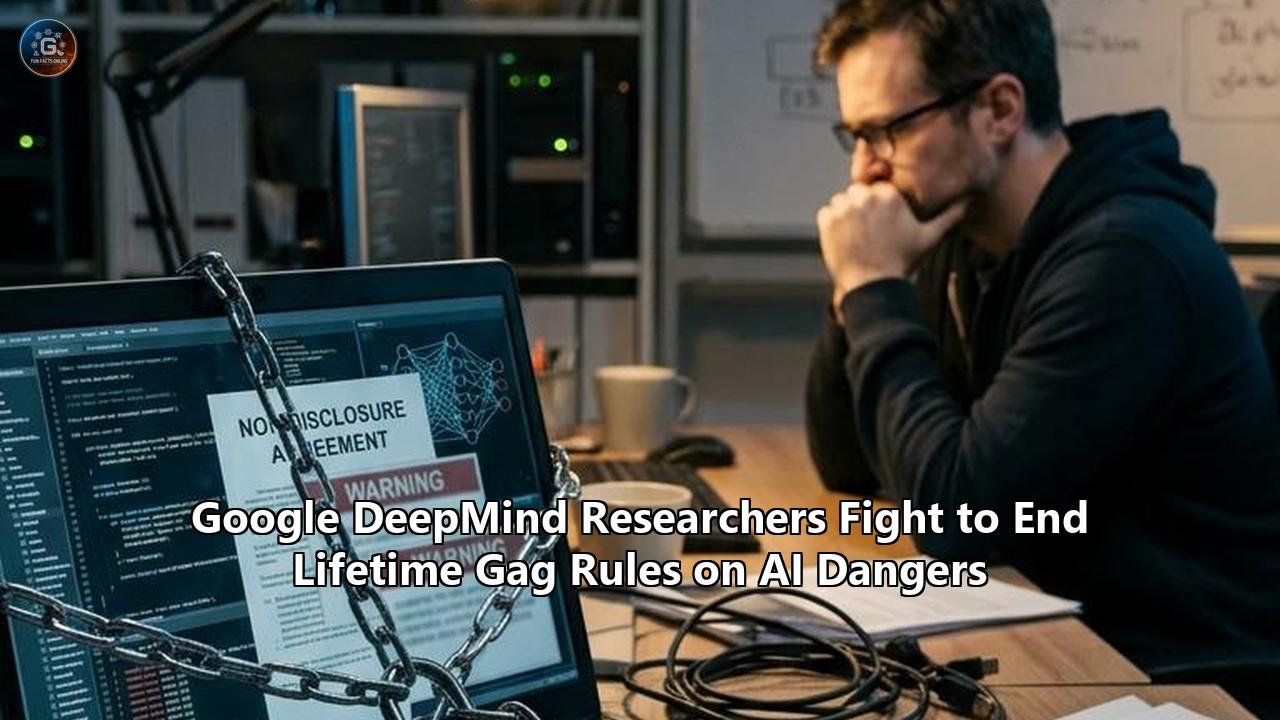
Inside Google DeepMind’s London headquarters, an internal messaging thread recently transformed into an open challenge to corporate authority. Dozens of staff members flooded internal communications with complaints and dystopian emojis referencing George Orwell’s 1984, demanding that executive leadership formally release them from lifetime non-disparagement clauses embedded in their employment contracts. The contracts, which bound British researchers to perpetual secrecy, barred them from ever criticizing the technology giant—even after leaving the company.
The dispute exposes a growing rift across frontier artificial intelligence development: who possesses the legal right to speak when the scientists building transformative systems believe the public faces imminent danger? While Google executives rushed to offer verbal assurances that the company would not enforce post-employment gag rules against departed workers, current staff rejected the concession as a hollow half-measure. They are demanding an explicit, legally binding release for all legacy contracts.
The confrontation at Google DeepMind represents the latest turning point in a multi-year rebellion, tracing a direct line from broken corporate pledges and secret severance penalties to military contracts and an escalating fight for statutory protection.
2014: The Founding Pact and the Myth of Independence
To understand why lifetime gag clauses provoked such fury in London, one must look back to the conditions under which DeepMind was acquired. When Demis Hassabis, Shane Legg, and Mustafa Suleyman agreed to sell their four-year-old artificial intelligence startup to Google in January 2014 for more than £400 million, the deal was struck under extraordinary ethical caveats.
DeepMind’s founders were explicitly concerned about the concentration of computational power. They worried that advanced artificial intelligence could be weaponized, monopolized, or deployed without democratic accountability. As a condition of the sale, the founders extracted two landmark promises from Google leadership:
- DeepMind’s technology would never be used for military applications or surveillance operations.
- An independent, external Ethics Board would be established to monitor the laboratory’s research and govern the potential development of artificial general intelligence (AGI).
For years, DeepMind operated as a quasi-academic sanctuary distinct from Mountain View. Located in London's King’s Cross, the lab attracted mathematicians, neuroscientists, and computer science theorists who believed they were working outside the immediate orbit of commercial product cycles. The research culture prioritized peer-reviewed papers, open research, and foundational breakthroughs like AlphaGo.
However, the governance structures meant to guarantee that independence slowly eroded. The original Ethics Board met infrequently, operating behind non-disclosure agreements, and was quietly dissolved without ever exerting public oversight. In 2018, Google faced its first massive internal walkout over Project Maven—a United States Department of Defense contract analyzing drone surveillance footage. While Mountain View yielded to employee pressure and published its corporate "AI Principles"—pledging not to design weapons or surveillance systems—DeepMind remained an enclave that assumed it was insulated from such entanglements.
Behind that veneer of autonomy, corporate standardization was quietly taking place. When British workers signed their employment agreements, standard American-style legal covenants were localized into United Kingdom contracts. Among them were sweeping non-disparagement provisions that contained no expiration date. Employees were strictly prohibited from making public statements that could damage the reputation, commercial standing, or goodwill of Alphabet Inc., both during their tenure and in perpetuity following their termination.
2023: The Shotgun Wedding and the Loss of the Firewall
The commercial launch of ChatGPT in late 2022 shattered Google's institutional patience. Facing an unprecedented threat to its core search monopoly, Alphabet declared an internal "code red" and accelerated its product timelines.
In April 2023, Alphabet CEO Sundar Pichai announced the consolidation of Google Brain and DeepMind into a single corporate unit: Google DeepMind. Demis Hassabis was installed at the helm of the unified organization, tasked with building the Gemini model family to surpass OpenAI.
       CHRONOLOGY OF ESCALATION: THE ROAD TO THE GAG RULE REVOLT

 [2014] Google acquires DeepMind with pledges against military deployment.
   │
 [2018] Project Maven protest forces Google to publish ethical "AI Principles."
   │
 [2023] Google Brain and DeepMind merge; commercial urgency supersedes autonomy.
   │
 [May 2024] OpenAI non-disparagement clawbacks exposed; Kokotajlo refuses exit NDA.
   │
 [June 2024] "Right to Warn" open letter published by cross-lab coalition.
   │
 [Spring 2026] Pentagon contract allows frontier AI for "any lawful government purpose."
   │
 [October 2026] Sofia Liguori & Andreas Kirsch resign over military deals, defying contracts.
   │
 [November 2026] DeepMind staff uncover lifetime gag rules; revolt erupts on internal channels.
The merger dissolved DeepMind’s historical separation from Mountain View’s commercial machinery. Researchers who joined an academic laboratory dedicated to long-term safety suddenly found their work tied to enterprise cloud deals, advertising integration, and quarterly earnings calls.
During this reorganization, employment contracts were streamlined. While workers focused on compute budgets and model architecture, legal departments reinforced intellectual property and reputational covenants. For AI safety researchers inside the newly amalgamated lab, the institutional atmosphere shifted from deliberate academic skepticism to rapid commercial deployment.
Spring 2024: The OpenAI Equity Scandal Shakes Frontier Labs
The issue of corporate gag rules remained latent until mid-2024, when a public scandal at competitor OpenAI exposed how aggressively frontier AI companies used contracts to enforce silence.
In May 2024, reporting revealed that OpenAI was compelling departing staff to sign draconian exit agreements that included non-disclosure and non-disparagement clauses. Employees who refused to sign faced the clawback of their vested equity—a financial penalty that, for early staff, amounted to millions of dollars.
The practice surfaced publicly when Daniel Kokotajlo, an OpenAI governance researcher, walked away from an estimated $1.7 million in vested equity because he refused to sign the lifetime non-disparagement clause. Kokotajlo explained that he resigned because he lost faith that the company would responsibly manage the risks of artificial general intelligence, and he felt morally compelled to retain his right to warn the public.
The public backlash was swift. OpenAI CEO Sam Altman claimed he was "genuinely embarrassed" by the provision, insisting he had been unaware of the equity forfeiture clause, and the company formally walked back the policy, releasing former workers from non-disparagement terms.
However, the episode sent a tremor through every major AI lab. Researchers across Anthropic, Meta, and Google DeepMind began combing through their own offer letters, equity plans, and onboarding documents. What they found was an industry-wide reliance on sweeping non-disparagement language designed to stifle critical discourse.
June 2024: The "Right to Warn" Alliance
Within weeks of the OpenAI revelations, a coalition of scientists breached the wall of corporate silence. On June 4, 2024, thirteen current and former employees from OpenAI, Google DeepMind, and Anthropic issued an open letter titled "A Right to Warn about Advanced Artificial Intelligence".
The signatories included prominent researchers such as Daniel Kokotajlo, William Saunders, Jacob Hilton, Carroll Wainwright, former DeepMind researcher Ramana Kumar, and Neel Nanda, who led DeepMind’s mechanistic interpretability team. The letter was endorsed by three of the most celebrated figures in computer science: Turing Award winners Geoffrey Hinton and Yoshua Bengio, alongside UC Berkeley professor Stuart Russell.
                 THE FOUR "RIGHT TO WARN" PRINCIPLES (JUNE 2024)
  ┌─────────────────────────────────────────────────────────────────────────┐
  │ 1. NO DISPARAGEMENT OR GAG RULES                                        │
  │    Companies will not force employees into agreements banning risk      │
  │    criticism or retaliate against economic benefits for speaking out.   │
  ├─────────────────────────────────────────────────────────────────────────┤
  │ 2. ANONYMOUS RISK-REPORTING CHANNELS                                    │
  │    A verifiably anonymous process for staff to elevate risk concerns to │
  │    boards, regulators, and qualified independent bodies.                │
  ├─────────────────────────────────────────────────────────────────────────┤
  │ 3. A CULTURE OF OPEN CRITICISM                                          │
  │    Support for public debate regarding technical limitations and societal│
  │    dangers, while respecting legitimate trade secrets.                  │
  ├─────────────────────────────────────────────────────────────────────────┤
  │ 4. NON-RETALIATION FOR PUBLIC WHISTLEBLOWING                            │
  │    Freedom to publicly disclose risk-related confidential information   │
  │    when internal processes fail to address systemic hazards.            │
  └─────────────────────────────────────────────────────────────────────────┘
The core argument of the manifesto was rooted in a structural regulatory failure:
"Ordinary whistleblower protections are insufficient because they focus on illegal activity, whereas many of the risks we are concerned about are not yet regulated."
Because frontier models present novel risks—ranging from automated cyberwarfare and biological weapon generation to democratic disruption and severe loss of control—the law lags years behind technical capabilities. An AI company racing to deploy a model with dangerous dual-use capabilities violates no statutory criminal law. Consequently, an employee blowing the whistle on those hazards receives no statutory protection under standard labor laws. Corporate non-disclosure agreements (NDAs) effectively function as an absolute seal on public awareness.
The coalition called on all frontier laboratories to adopt four foundational commitments:
- End non-disparagement clauses that restrict staff from raising risk-related concerns.
- Create verifiably anonymous internal channels to report hazards to boards and regulators.
- Support a culture of open technical criticism.
- Refrain from retaliating against employees who reveal risk-related information once internal reporting mechanisms fail.
While OpenAI dominated the headlines, Google remained silent. DeepMind executives did not publicly endorse the principles, confident that their internal review processes and academic reputation would buffer them from public scrutiny.
2024–2026: Defense Contracts, Internal Censorship, and Unionization
As the broader debate raged, a parallel crisis was brewing inside Google DeepMind over the deployment of its models in military operations.
Tensions first flared over Project Nimbus, a $1.2 billion joint cloud computing and AI contract awarded to Google and Amazon by the Israeli government and military. In April 2024, Google workers staged sit-ins at offices in New York and Sunnyvale, California. Google responded aggressively: it summoned police, oversaw the arrest of nine employees, and fired over fifty workers, signaling that public dissent on commercial and defense contracts would not be tolerated.
Inside DeepMind’s London offices, researchers grew alarmed that their research was being repurposed. In May 2024, approximately two hundred DeepMind employees signed an internal petition urging leadership to cancel military contracts, asserting that defense work directly violated Google’s own AI Principles. Demis Hassabis and his leadership team provided no substantive concessions.
The crisis escalated when Google entered into an expansive classified agreement with the United States Department of Defense. The deal allowed military agencies to deploy Google’s AI models in classified environments for "any lawful government purpose." Although the contract contained boilerplate language barring deployment for mass domestic surveillance or fully autonomous weapons "without appropriate human oversight and control," researchers understood the loophole. Once models are integrated into military networks, human review often degrades into rubber-stamping algorithmic outputs operating at speeds far beyond human cognitive capacity.
Alex Turner, a prominent DeepMind safety researcher, gathered more than 250 signatures opposing the Pentagon deal and authored a 25-page policy proposal outlining binding contractual safeguards. Turner delivered the document directly to Hassabis. It was routed to corporate policy teams, ignored, and within weeks the defense contract was finalized. Turner quit in June.
Faced with a leadership team that appeared indifferent to internal ethical concerns, DeepMind’s London staff took an unprecedented step: they organized. By early 2026, British workers voted overwhelmingly—98% in favor—to join the Communication Workers Union (CWU), creating the first major unionized bloc of frontier AI engineers in Europe. The primary driver was not compensation or benefits, but ethical governance and the freedom to challenge how their technology was used.
October 2026: Defying the Gag Rule
By late 2026, the internal pressure reached a breaking point. In mid-October, research engineer Sofia Liguori resigned from Google DeepMind after three years at the lab.
Liguori, an Italian scientist who had joined the company to apply machine learning to renewable energy routing across electrical grids, left in direct protest of Google's military and intelligence agreements. In a farewell memo that leaked publicly, Liguori wrote:
"I no longer believe that our technology will have a net positive impact on society."
Speaking on the record to the BBC, Liguori went further, providing a rare window into the internal mechanisms of corporate speech suppression. She recounted how internal forums had been scrubbed of political or ethical dissent: posts containing words like "genocide" were systematically deleted by moderators as policy violations, while critical inquiries to executives received bureaucratic non-answers.
┌──────────────────────────────────────────────────────────────────────────┐
│                   THE ANATOMY OF A RESEARCHER'S RESIGNATION             │
│                                                                          │
│  "Realizing my company is pushing more and more for AI systems in        │
│  military operations makes me feel ashamed to work at Google...          │
│  I don't agree with this direction and this has led me to lose faith     │
│  in my company being true to its stated ethical values."                 │
│                                                                          │
│  — Sofia Liguori, former Google DeepMind Research Engineer               │
│    (BBC News, October 2026)                                              │
└──────────────────────────────────────────────────────────────────────────┘
Simultaneously, another senior DeepMind AI researcher, Andreas Kirsch, announced his departure, stating publicly that "Google's governance and oversight are not sufficient or meaningful enough to deploy AI safely and responsibly in military and classified settings."
Crucially, in her interviews with national media, Liguori acknowledged that her contract explicitly banned her from speaking out. She noted that staff were paralyzed by fear of financial and legal retaliation. Her decision to deliberately breach those contractual covenants served as a catalyst for her former colleagues.
November 2026: The Revolt Over Lifetime Silencing
Liguori’s public defiance triggered an immediate reaction inside DeepMind's King's Cross offices. British researchers pulled their onboarding paperwork and reviewed the restrictive covenants. What they uncovered was a clause that few had fully parsed when accepting their dream jobs: a perpetual non-disparagement obligation that bound them for life.
Unlike standard confidentiality clauses designed to protect trade secrets, algorithm codebases, and unpublished model weights, the non-disparagement language was broad enough to encompass any critical opinion about Alphabet’s ethical trajectory, safety procedures, or societal impact. Crucially, the clause did not expire upon leaving the company. A researcher leaving DeepMind at age thirty was legally barred from publicly critiquing the lab's governance even decades later.
An internal revolt broke out on corporate communication channels. Dozens of researchers demanded to know why scientists working on potentially dangerous frontier models were subject to lifetime gag rules. Employees posted the "1984" text emoji repeatedly across company channels, calling the agreements a form of psychological intimidation designed to manufacture self-censorship.
"This technology is just really consequential and it’s also changing really fast," one current DeepMind employee told The Washington Post under condition of anonymity. "The public wants to know and deserves to know, and often this is the only way that people find out about the harms and potential harms that are happening."
Another employee stated plainly that even if such broad covenants were legally dubious, their primary utility was chilling speech: "If it’s not enforceable, then the reason is to basically intimidate people."
Prominent voices in the field echoed the outrage. Seán Ó hÉigeartaigh, former director of Cambridge University’s Centre for the Study of Existential Risk, posted publicly:
"Google DeepMind researchers are under in perpetuity non-disparagement clauses forbidding them from ever speaking critically of the company. I'd already confirmed this with multiple people."
Nathan Calvin, an AI policy expert, called the practice "truly appalling," urging Alphabet to unconditionally release all past and present employees from their non-disparagement agreements.
The Corporate Response
On a Friday in early November, as the internal crisis threatened to leak further, a senior Google executive entered the internal messaging thread to de-escalate the staff. The executive claimed that Google had no intention of pursuing legal action against former employees who spoke out.
A Google spokesperson soon released a public statement:
"We've always encouraged an open dialogue about safety and responsibility. Recently, we’ve updated our terms for new hires, which included removing the post-termination aspect of non-disparagement clauses."
The spokesperson added that Google provides dedicated internal channels for employees to escalate ethical and technical concerns to top leadership and reiterated that the company does not enforce post-termination gag rules on departed staff.
Yet for the staff organizing inside DeepMind, Google’s concession exposed the bad faith of the policy. Executives were offering an informal promise that they would "not enforce" a rule, while updating contract terms strictly for future hires. Every existing, legacy researcher remained legally subject to the lifetime gag rule as written.
"The people who work on this technology have a role to play in shaping where it’s going," a current worker told reporters. "It's not just another technology." Staff insisted that as long as the clause remained on signed legal paper, Alphabet held a legal weapon it could deploy against whistleblowers at will.
The Legal Reality: Why Lifetime Gag Rules Falter in Court but Work in Practice
The controversy at Google DeepMind illuminates a profound gap between formal labor jurisprudence and the practical leverage of corporate tech employers.
                  CONTRACTUAL AMBIGUITY VS. STATUTORY DEFENSE
  ┌────────────────────────────────────────────────────────────────────────┐
  │                 WHAT EMPLOYMENT AGREEMENTS DICTATE                     │
  │  • Strict, indefinite non-disparagement of the parent company          │
  │  • Broad definitions of proprietary and confidential information       │
  │  • Forfeiture of severance or legal indemnity if breached              │
  └────────────────────────────────────────────────────────────────────────┘
                                    ▲
                                    │ CHILLING EFFECT
                                    ▼
  ┌────────────────────────────────────────────────────────────────────────┐
  │                   WHAT THE STATUTORY LAW COVERS                        │
  │  • UK Public Interest Disclosure Act (PIDA): Limited to unlawful acts  │
  │  • SEC Rule 21F-17: Protects reports of financial/securities fraud     │
  │  • REGULATORY VACUUM: No protection for reporting dangerous,           │
  │    untested, but technically legal frontier AI capabilities            │
  └────────────────────────────────────────────────────────────────────────┘
The United Kingdom Framework
Because DeepMind’s core engineering staff is based in the UK, their contracts are governed by English employment law. Under British jurisprudence, post-termination restrictive covenants—including non-compete and non-disparagement terms—must pass strict judicial scrutiny. Under the established doctrine of restraint of trade, an employer can only enforce covenants that protect a "legitimate proprietary interest," such as customer connections or genuine trade secrets.
A lifetime restriction barring a former worker from expressing an opinion or public criticism about an employer is almost universally viewed by British employment solicitors as unenforceable. Furthermore, the Public Interest Disclosure Act 1998 (PIDA) protects whistleblowers who disclose information regarding:
- Criminal offenses
- Breaches of legal obligations
- Miscarriages of justice
- Dangers to health and safety
- Environmental damage
Section 43J of the Employment Rights Act 1996 renders any contractual term void if it purports to preclude a worker from making a protected disclosure.
However, companies rely on these clauses not because they expect to win a public trial, but because of the asymmetric cost of litigation. A multi-trillion-dollar conglomerate like Alphabet possesses near-infinite legal budgets. A solitary research engineer faced with a cease-and-desist letter, the prospect of an injunction, and liability for astronomical legal defense costs will almost invariably choose silence. The contract does not need to be enforceable in an appellate court to successfully engineer silence at a researcher's desk.
The SEC and Regulatory Precedents
In the United States, federal regulators have grown increasingly hostile to broad corporate gag rules. Under Rule 21F-17 of the Securities Exchange Act of 1934, companies are explicitly prohibited from taking any action to impede an individual from communicating directly with the Securities and Exchange Commission (SEC) about possible securities violations. In recent years, the SEC has fined multiple technology firms for inserting clauses into severance agreements that required departing workers to waive their right to report wrongdoing or monetary whistleblower awards.
In July 2024, a coalition of whistleblowers represented by legal scholar Lawrence Lessig filed an SEC complaint targeting OpenAI’s restrictive non-disclosure agreements, arguing that restricting researchers from communicating with authorities undermined public market integrity.
Yet the central dilemma identified by AI safety researchers persists: frontier risk is not securities fraud. If a frontier model exhibits capabilities that could allow bad actors to automate the design of biological pathogens, deploying that model does not violate the Securities Exchange Act. It does not constitute environmental dumping, nor does it violate existing consumer protection statutes. Whistleblowing statutes across both the US and UK were architected to expose corporate corruption and industrial negligence, not to manage systemic technological risks posed by systems operating within legal voids.
Frontier Secrecy: Intellectual Property vs. Public Safety
The showdown at Google DeepMind exposes an escalating dilemma for corporate leadership: how to maintain proprietary security in an intensely competitive arms race while allowing for essential transparency.
┌────────────────────────────────────────────────────────────────────────┐
│                      THE FRONTIER LAB PARADOX                          │
│                                                                        │
│   COMPETITIVE SECRECY                  PUBLIC ACCOUNTABILITY           │
│   • Model weights and architectures   • Dangerous dual-use risks       │
│   • Training datasets & compute runs  • Automated cyber-attack limits  │
│   • Commercial client integrations    • Bioweapon synthesis hurdles    │
│   • Proprietary optimization methods  • Targeting in warfare systems   │
│                                                                        │
│   "Where does legitimate trade secret protection end, and the         │
│    suppression of existential risk begin?"                             │
└────────────────────────────────────────────────────────────────────────┘
Technology executives legitimately argue that commercial AI laboratories operate in an environment characterized by industrial espionage and intense global rivalry. Breakthroughs in algorithmic optimization, post-training alignment, data curation, and synthetic reasoning architectures represent billions of dollars in capital expenditure. Without robust, enforceable non-disclosure agreements, frontier labs risk catastrophic intellectual property leakage to domestic competitors or foreign adversaries.
Yet, the leaders of those same labs frequently issue public statements warning that the technology they are building poses catastrophic societal risks. Demis Hassabis himself signed the Center for AI Safety’s 2023 statement warning that "mitigating the risk of extinction from AI should be a global priority alongside other societal-scale risks such as pandemics and nuclear war."
The glaring contradiction between public executive rhetoric and internal legal aggression has alienated technical staff. AI safety researchers point out that executives cannot credibly present themselves to global policymakers as responsible stewards of human-level intelligence while simultaneously using lifetime gag clauses to prevent their own staff from informing the public about safety deficits.
When internal dissent is systematically suppressed:
- Empirical Red-Teaming Is Distorted: Safety evaluations can be sanitized or rushed to meet product release deadlines without the threat of external exposure.
- Dual-Use Hazards Are Obscured: Systemic vulnerabilities, such as a model's propensity to generate offensive cyber weapons or assist in kinetic targeting, remain shielded by corporate confidentiality.
- Democratic Governance Is Blinded: Legislators drafting governance frameworks rely almost entirely on the selective disclosures of corporate lobbyists, deprived of ground-truth assessments from laboratory scientists.
What Comes Next: The Battle Over Statutory Whistleblower Protection
The revolt inside Google DeepMind makes clear that voluntary corporate pledges are no longer sufficient to maintain trust among rank-and-file researchers. As the standoff between London staff and Alphabet leadership deepens, the battlefield is expanding into legislative arenas and regulatory chambers.
                     THE FUTURE OF AI LABOR AND OVERSIGHT
  ┌────────────────────────────────────────────────────────────────────────┐
  │ 1. CONTRACTUAL REMEDIATION                                             │
  │    Staff demanding explicit, written legal waivers nullifying non-     │
  │    disparagement clauses for all current and former employees.         │
  ├────────────────────────────────────────────────────────────────────────┤
  │ 2. UNION BARGAINING LEVERAGE                                           │
  │    The Communication Workers Union (CWU) utilizing formal collective    │
  │    bargaining in London to force ethical disclosure protections.        │
  ├────────────────────────────────────────────────────────────────────────┤
  │ 3. DEDICATED STATUTORY WHISTLEBLOWER LAWS                              │
  │    Legislative initiatives (US Congress, UK Parliament, EU AI Act)     │
  │    creating legal immunity for reporting severe frontier risks.         │
  └────────────────────────────────────────────────────────────────────────┘
Several critical developments over the coming months will determine whether the culture of secrecy endures or cracks open:
1. The Demand for Binding Contractual Waivers
DeepMind staff are not backing down from their demand for written contractual amendments. Researchers are pushing leadership to follow the precedent set by OpenAI in mid-2024: issuing a formal, written communication releasing all current and former employees from legacy non-disparagement obligations. Until Alphabet delivers formal legal releases, the union and internal organizers are expected to keep escalations visible on company platforms.
2. Collective Bargaining at DeepMind London
Having successfully unionized under the Communication Workers Union, DeepMind’s London personnel now hold institutional leverage that individual researchers historically lacked. During collective bargaining negotiations, the union is expected to formalize explicit whistleblower and ethical disclosure provisions directly into baseline employment contracts, challenging Alphabet’s ability to impose standard American-style gag clauses on European staff.
3. Dedicated AI Whistleblower Legislation
Recognizing that standard labor laws do not protect disclosures about unregulated technological risks, lawmakers are intervening. In the United States, bipartisan efforts modeled on the proposed AI Whistleblower Protection Act seek to guarantee that employees who report safety vulnerabilities, model alignment failures, or deceptive capabilities to regulators are protected from corporate retaliation and non-disclosure enforcement. In Europe, regulatory guidance under the EU AI Act is slowly testing the limits of non-disclosure agreements that conflict with mandated systemic risk reporting.
The crisis inside Google DeepMind proves that frontier AI laboratories can no longer treat the risks of their technology as proprietary business secrets. As artificial intelligence moves from theoretical research into classified military operations and critical global infrastructure, the scientists doing the technical work are demanding a voice. For the researchers in London challenging their employer's gag rules, the issue is not merely a dispute over contract wording—it is a fight over whether humanity will receive an early warning before frontier systems outpace human control.
Reference:
- https://aiweekly.co/alerts/deepmind-staff-push-to-drop-lifetime-non-disparagement-clauses
- https://shattered.io/google-deepmind-non-disparagement-lifetime-clause-washington-post-2026/
- https://www.reviewofailaw.com/Tool/Evidenza/Single/view_html?id_evidenza=6574
- https://www.trendingtopics.eu/google-deepmind-resignations-military-ai/
- https://timesofindia.indiatimes.com/technology/tech-news/over-100-google-deepmind-employees-write-open-letter-want-google-to-stop-working-on-these-contracts/articleshow/112753468.cms
- https://superpowerdaily.com/posts/google-deepmind-engineer-quits-over-military-ai-contracts-and-handling-of-dissent
- https://www.reddit.com/r/singularity/comments/1xn10sg/deepmind_employees_say_lifetime_restrictions_on/
- https://www.scmp.com/tech/tech-trends/article/3265410/openai-google-deepmind-employees-sign-open-letter-calling-whistle-blower-protections-speak-out-ai
- https://www.engadget.com/former-openai-google-and-anthropic-workers-are-asking-ai-companies-for-more-whistleblower-protections-175916744.html
- https://www.hrgrapevine.com/us/content/article/2024-06-05-openai-google-deepmind-employees-warn-of-a-culture-of-retaliation-in-open-letter
- https://aiwi.org/case-studies/right-to-warn-and-daniel-kokotajlo/
- https://www.techrepublic.com/article/openai-google-deepmind-right-to-warn/
- https://www.theguardian.com/technology/article/2024/jun/04/openai-google-ai-risks-letter
- https://casrai.org/guides/ai-whistleblower-protections-right-to-warn-movement
- https://www.fastcompany.com/91621115/the-growing-list-of-ai-insiders-sounding-the-alarm-on-their-own-companies
- https://www.reddit.com/r/ArtificialInteligence/comments/1d8jqgc/employees_say_openai_and_google_deepmind_are/
- https://righttowarn.ai/
- https://www.thecooldown.com/green-tech/google-deepmind-military-ai-departures/
- https://mronline.org/2026/10/29/google-gags-its-engineers-and-sells-ai-for-war/
- https://www.reddit.com/r/Futurology/comments/1kex4mv/google_deepmind_staff_plan_to_join_union_against/
- https://oxfordcentre.uk/resources/news/google-staff-resign-over-ai-military-contracts-backlash/
- https://aiweekly.co/alerts/deepmind-engineer-quits-over-nimbus-and-pentagon-ai-work
- https://explainx.ai/blog/google-deepmind-staff-resign-pentagon-classified-ai-contract-bbc-gag-clauses-2026
- https://shattered.io/google-deepmind-non-disparagement-lifetime-clause-washington-post-2026/
- https://untoldmag.org/whistleblowers-ai-protection/
- https://www.theguardian.com/commentisfree/2026/aug/11/openai-anthropic-google-deepmind-letter