For over 150 years, a series of rocky, reddish-brown fragments sat quietly in the storage cabinets of the Natural History Museum in London. Collected from the Welsh Borders in the latter half of the nineteenth century, these stony specimens were classified as the remains of an ancient, extinct crustacean—a bizarre, oversized relative of the modern woodlouse. Genera of scientists examined the fossils, puzzled by their strange proportions and lack of defining anatomical structures, yet unable to reach a consensus on what the creature actually was.
That long-standing paleontological mystery has finally been solved. In a landmark study published in the journal Palaeontology, a team of British researchers used advanced 3D scanning and digital modeling to reveal that these ancient fragments do not belong to a crustacean at all. Instead, they represent the remains of the largest prehistoric giant scorpion ever discovered—a formidable predator named Praearcturus gigas that grew to the size of a medium-to-large dog.
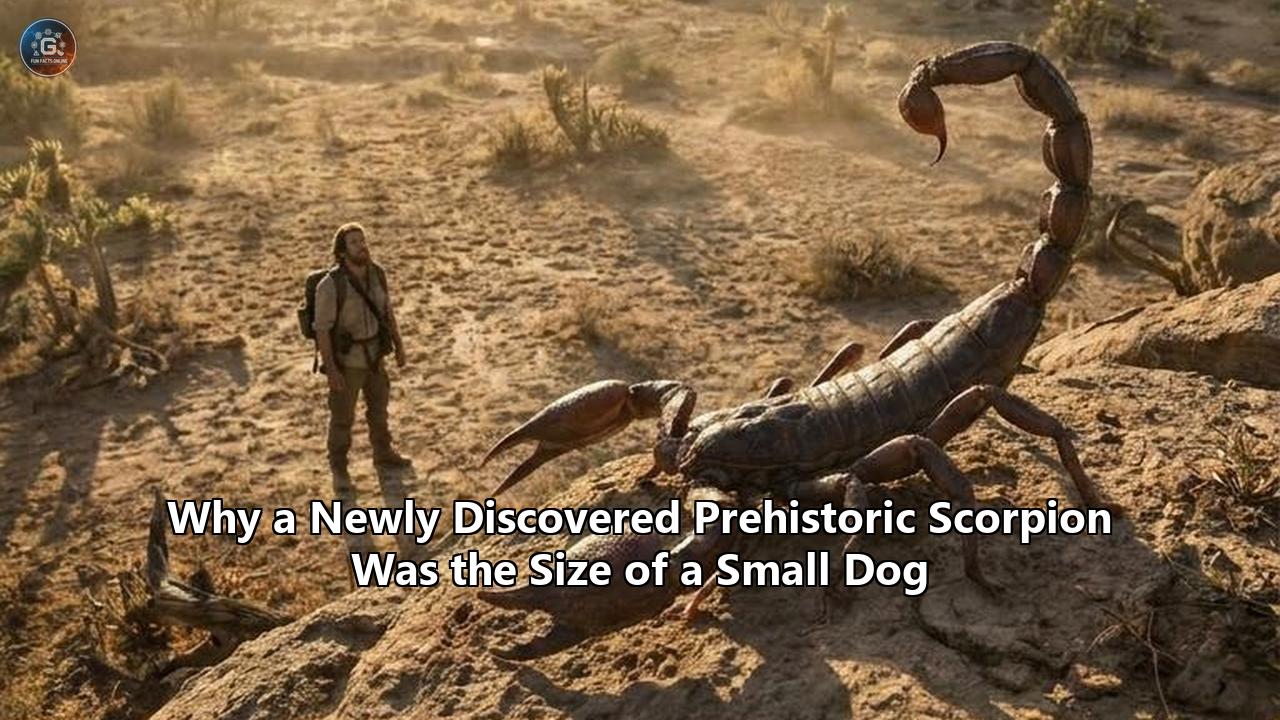
Measuring roughly a meter (3.3 feet) in length from its head to the tip of its tail, and armed with robust, heavily armored pincers exceeding 16 centimeters (6.3 inches) in length, this prehistoric giant scorpion was the undisputed apex predator of its ecosystem. The creature stalked the muddy floodplains and shallow river deltas of what is now England and Wales approximately 415 million years ago, during the Early Devonian period.
                                  PRAEARCTURUS GIGAS
                                  [~415 Million Years Ago]

   [======================== 1 Meter (3.3 Feet) Body Length ========================]

             ,.-"``"-.                                     _..----.._
            /   _  _   \                                 .'          '.
            |  (o)(o)  |                                /   _      _   \
            \    __    /                               |   (o)    (o)   |
             '-.____.-'                                 \      __      /
               /    \                                    '.________..'
              /======\                                        |  |
             /========\                                      /====\
            /==========\                                    /======\
           /============\                                  /========\
          /==============\                                /==========\
         /================\                              /============\
        /==================\                            /==============\
       (====================)                          (================)
        \==================/                            \==============/
         \================/                              \============/
          \==============/                                \==========/
           \============/                                  \========/
            \==========/                                    \======/
             \========/                                      \====/
              \======/                                        \==/
               \====/                                          ||
                \==/                                           ||
                 ||                                            ||
                 ||                                            ||
                 ||                                            ||
                 ||                                            (|)  <-- Stinger
                 (|)  <-- Stinger
This reclassification is not merely a matter of correcting an old cataloging error. By establishing that Praearcturus gigas was indeed a true scorpion, the study has completely upended existing models of how, when, and why early terrestrial animals grew to gigantic proportions.
Historically, scientists believed that giant land-dwelling arthropods could only evolve in oxygen-rich atmospheres, such as those that characterized the Carboniferous period tens of millions of years later. The confirmation of this dog-sized predator living in a low-oxygen, tree-less world suggests that ecological opportunity, rather than atmospheric chemistry, was the primary driver behind its evolutionary gigantism.
Act I: 1870 — The Rowlestone Quarry and a 150-Year Misidentification
To understand how this story developed, one must travel back to the rural landscape of Victorian England. In 1870, quarrymen working the St Maughans geological formation in Herefordshire unearthed a series of unusual, dark, reddish-brown fossil segments embedded within dense layers of Old Red Sandstone. The fossils were brought to the attention of Henry Woodward, a prominent English paleontologist and the assistant keeper of geology at the British Museum (which would later spin off its natural history collections into the Natural History Museum in London).
Woodward recognized that the fossils belonged to a massive arthropod, but the fragments were highly incomplete. Most notably, they lacked any evidence of a telson—the needle-sharp stinger at the end of a scorpion's tail—or the long, segmented tail itself. What Woodward did see were broad, overlapping, tile-like plates that protected the creature's back.
                                  THE 150-YEAR TAXONOMIC JOURNEY

      1870                      1972                       1980s                      2026
       |                         |                           |                         |
       o-------------------------o---------------------------o-------------------------o
  Discovered in             Brontoscorpio                 Arachnid                   Confirmed
  Herefordshire;              anglicus                 classification              as the largest
  misidentified as           described as               proposed but                true scorpion
  a giant isopod.            giant claw.                  disputed.                 on record.
In 1871, Woodward published a formal description of the species. He named it Praearcturus gigas. The generic name translated literally to "before Arcturus," referencing Arcturus, a group of modern, marine, woodlouse-like isopods. The specific epithet, gigas, was a nod to its gargantuan size.
For the next several generations, Praearcturus gigas remained a taxonomic anomaly. It was shuffled from one group of organisms to another as successive paleontologists tried to make sense of the strange animal. Some argued that it was a giant millipede-like myriapod. Others suggested it was a eurypterid—a group of extinct aquatic predators commonly known as "sea scorpions," which, despite their name, are only distantly related to true land scorpions.
The primary barrier to a definitive identification was the nature of the fossil record itself. Terrestrial scorpions are notoriously difficult to fossilize. Unlike marine creatures, which are easily buried in fine ocean silts upon their death, land-dwelling arachnids typically live in dry environments under rocks or decaying vegetation. When they die, their soft internal organs decay rapidly, and their delicate chitinous exoskeletons are easily scattered by wind, rain, and scavengers, leaving behind nothing but unidentifiable fragments.
Without a complete specimen showing the distinct arrangement of the limbs, mouthparts, and reproductive organs, Woodward's giant isopod interpretation remained the default classification. Praearcturus gigas was filed away in museum drawers, a forgotten giant from an era when life on land was supposedly still microscopic.
Act II: 1970 to 2010 — Taxonomic Chaos and the Ghost of Brontoscorpio
The next major turning point in the story occurred in the early 1970s, when another fragment of a giant arthropod was discovered in the Old Red Sandstone of Worcestershire, England. This fossil was far more dramatic than the plates described by Woodward: it was a single, colossal pedipalp claw.
In 1972, the renowned paleo-arachnologist Erik Kjellesvig-Waering published a paper describing this find. He named the species Brontoscorpio anglicus, which translates to "the English thunder scorpion". Based on the size of the claw, Kjellesvig-Waering estimated that the animal would have reached nearly a meter in length, making it a terrifying presence on the Devonian landscape.
                                 TAXONOMIC CONVERGENCE (JUNE 2026)

              [ Brontoscorpio anglicus ]        [ Bennettarthra annwnensis ]
               (Described from claw fragment)    (Described from body plate)
                           \                              /
                            \                            /
                             v                          v
                        ======================================
                              PRAEARCTURUS GIGAS (1870)
                        ======================================
                         (Fully reconstructed giant species)
In 1980, Kjellesvig-Waering and other researchers turned their attention back to Praearcturus gigas. They suggested that Woodward’s "giant isopod" might actually be the body of a giant scorpion, potentially related to Brontoscorpio. However, because the study was published with very limited illustrations and lacked direct, physical proof of key diagnostic features, the wider paleontological community remained highly skeptical.
To make matters more complicated, in 2010, another team of paleontologists (Fayers, Trewin, and Morrissey) described yet another giant arthropod from the same British rocks, naming it Bennettarthra annwnensis.
The result was systematic chaos. Paleontologists now had three distinct genera of giant, predatory arachnids—Praearcturus, Brontoscorpio, and Bennettarthra—all supposedly living in the exact same river systems of Devonian Britain, yet each described from different, highly fragmentary parts of the body. Were these actually three separate giants competing for the same resources, or were scientists looking at different pieces of the same evolutionary puzzle? Without a complete, well-preserved reference specimen, there was no way to resolve the debate.
Act III: 2015 — The Canadian Rosetta Stone
The breakthrough that would eventually unite these scattered puzzle pieces came not from the United Kingdom, but from the shores of Ontario, Canada.
In 2015, a team of researchers described an extraordinarily well-preserved fossil scorpion discovered in the Silurian-aged rocks of the Bruce Peninsula. The species, named Eramoscorpius brucensis, lived approximately 430 million years ago, making it slightly older than the British fossils.
                                  THE STERNUM COMPARISON

         Modern Scorpion                             Eramoscorpius & Praearcturus
         (Pentagonal Sternum)                        (Elongated Triangular Sternum)

               ______                                             /\
              /      \                                           /  \
             /        \                                         /    \
            |          |                                       /  ||  \  <-- Median Groove
            |__________|                                      /___||___\
Unlike the fragmented remains of Praearcturus, the Eramoscorpius fossils were preserved in exquisite detail. Crucially, they included the underside of the animal's cephalothorax (the fused head and thorax). This region revealed a key anatomical feature: an unusually elongated, nearly triangular sternum (the central plate between the legs) with a deep, distinct groove running down the middle.
Modern scorpions have a very small, pentagonal or keyshaped sternum. The elongated, triangular sternum found in Eramoscorpius represented a highly primitive, ancestral state.
"This parallel was not evident beforehand because Eramoscorpius was not discovered until 2015," explained Dr. Richard Howard, Curator of Fossil Arthropods at the Natural History Museum. "Finding that triangular sternum in a definitive, perfectly preserved Silurian scorpion gave us the exact anatomical key we needed to re-evaluate the mysterious British specimens."
Act IV: The 2026 Turning Point — Re-examining the Old Red Sandstone Collection
Armed with the anatomical data from Canada and utilizing cutting-edge digital imaging technologies, Dr. Richard Howard and his colleagues at the Natural History Museum and the University of Manchester decided to revisit the 150-year-old collection of Praearcturus gigas fossils.
The team used computed tomography (CT) scanning and high-resolution light photography to peer through the dense sandstone matrix without damaging the fragile specimens. They then constructed highly detailed 3D digital reconstructions of the fossilized bones.
                                 3D TOMOGRAPHIC RECONSTRUCTION

      [ Fossil Specimen ] ---> [ CT Scanner (X-Rays) ] ---> [ Slice Data Processing ]
                                                                   |
                                                                   v
      [ Expanded Anatomy ] <--- [ 3D Digital Model ] <--- [ Multi-angle Rendering ]
The results of the digital analysis were clear and decisive. Hidden within the stone, the researchers identified several unmistakable anatomical features that confirmed Praearcturus gigas was a true scorpion:
- A Scorpion Claw Structure: The 15-centimeter-long pincer of Praearcturus had a movable claw (or finger) that faced away from its fixed claw. This is a diagnostic feature of modern scorpions. In crustaceans like lobsters and crabs, the movable claw points inward, toward the fixed claw.
- The Triangular Sternum: On the underside of the fossilized head, the CT scans revealed the exact same elongated, subtriangular sternum with a median groove that was first identified in Eramoscorpius brucensis.
- Stridulation Ridges: The team identified a series of microscopic, parallel ridges on the coxae (the basal segments of the legs and claws). Modern scorpions rub these ridges against their bodies to produce a low, hissing sound (a process called stridulation) to warn off potential predators. Finding these same acoustic organs on a 415-million-year-old fossil was proof of complex behavioral adaptations.
                                 THE DUAL-FINGER CLAW (CHELA)

                              Fixed Finger
                             .-'''-.
                            /       \
                           /   _     \
                          |   ( )     |
                          |   `"`     |
                           \         /
                            \       /____
                             `'-..-'     `"-.
                              /              \
                             /   ==========   \
                            |   ============   |
                             \   ==========   /
                              `-..______..-'
                             .-'        '-.
                            /   _        _ \
                           /   ( )      ( ) \
                          |    `"`      `"`  |
                           \                /
                            '-..________..-'
                             Movable Finger (Points Away)
With the identity of Praearcturus gigas secure, the researchers took their analysis one step further. They compared the digital models of Praearcturus with the fossil fragments of Brontoscorpio anglicus and Bennettarthra annwnensis.
They discovered that the subtle differences previously used to classify these three genera as separate animals were actually the result of different parts of the body being fossilized, or differences in how the fossils had been compressed by the weight of the overlying rock over millions of years.
The researchers collapsed the taxonomy, declaring Brontoscorpio anglicus and Bennettarthra annwnensis to be junior synonyms of Praearcturus gigas. The historic "English thunder scorpion" was, in reality, the same animal as Henry Woodward's "giant isopod".
"This is the power of modern museum curation," said co-author Dr. Russell Garwood, a paleontologist at the University of Manchester. "By bringing together material from collections across the country and applying cutting-edge imaging, we've been able to turn three highly confusing, fragmented species into one beautifully understood, colossal predator."
Deep-Dive Biology: Why Was It the Size of a Dog?
The confirmation of Praearcturus gigas as a true prehistoric giant scorpion of such immense proportions raises a fundamental biological question: how did this creature grow so large?
                      ATMOSPHERIC OXYGEN VS. ECOLOGICAL OPPORTUNITY

   Carboniferous Period (~300 Ma)               Early Devonian Period (~415 Ma)
   ------------------------------               -------------------------------
   * Oxygen levels: ~35%                        * Oxygen levels: ~20% (Modern levels)
   * Powered by massive forests.                * No forests; only small plants/fungi.
   * Giant millipedes & dragonflies.            * Praearcturus gigas grows to 1 meter.
   * Driver: Atmospheric Chemistry              * Driver: Ecological Opportunity
To put its size into perspective, the largest modern scorpion in the world is the giant forest scorpion (Gigantometrus swammerdami) of India, which rarely exceeds 23 centimeters (9 inches) in length. Praearcturus gigas was more than four times that size. It was roughly comparable in length and mass to a modern Labrador retriever.
To explain this extraordinary size, scientists must look at the unique ecological conditions of the Early Devonian period.
The Low-Oxygen Paradox
For decades, the standard explanation for prehistoric gigantism in invertebrates was atmospheric oxygen levels. During the Carboniferous period, which began roughly 359 million years ago, the Earth was covered in massive, swampy rainforests. These forests pumped massive amounts of oxygen into the atmosphere, raising oxygen levels to an estimated 35%, compared to just 21% today.
Because insects and arachnids do not have lungs like mammals, they rely on a passive network of tubes called tracheae to deliver oxygen directly to their tissues. Under high atmospheric pressure and high oxygen concentrations, these passive systems can support much larger bodies. This allowed for the evolution of Arthropleura, an eight-foot-long millipede, and Meganeura, a predatory dragonfly with the wingspan of an eagle.
However, Praearcturus gigas lived 415 million years ago—at least 55 million years before the Carboniferous forests even existed.
During the Early Devonian, the Earth was a relatively barren, low-oxygen world. Trees had not yet evolved. Land vegetation consisted primarily of primitive, non-vascular plants, early mosses, and low-lying clubmosses that clung to the damp edges of rivers and lakes. The tallest structures on land were not trees, but Prototaxites—giant, column-like fungi that grew up to eight meters (26 feet) tall.
Without high oxygen levels, the traditional model of invertebrate gigantism falls apart. Praearcturus had to grow large through entirely different evolutionary mechanisms.
The "Ecological Opportunity" Hypothesis
The primary driver behind the immense size of this prehistoric giant scorpion appears to have been a complete lack of competition.
During the Early Devonian, life on land was still in its absolute infancy. The ancestors of modern land vertebrates—amphibians, reptiles, mammals, and birds—had not yet left the oceans. They were still primitive, lobe-finned fish swimming in shallow seas.
The only creatures living on land were tiny, primitive arthropods: early millipedes, mites, springtails, and primitive wingless insects. None of these animals were larger than a few centimeters.
                                EARLY DEVONIAN FOOD WEB

                             [ PRAEARCTURUS GIGAS ]  <-- Apex Predator (1 Meter)
                                     /       \
                                    /         \
                                   v           v
                     [ Early Eurypterids ]   [ Armored Placoderm Fish ]
                                   \           /
                                    \         /
                                     v       v
                          [ Primitive Micro-Arthropods ]
                          (Millipedes, Mites, Springtails)
By transitioning onto land, the ancestors of Praearcturus gigas entered a world entirely devoid of large predators. There were no hungry tetrapods to eat them, and no rival carnivores to compete with them for resources.
"In an ecosystem with no other large predators, Praearcturus was able to expand its size and completely dominate its environment," said Dr. Richard Howard. "It occupied the niche of an apex land predator tens of millions of years before the first vertebrate ever took a breath of air."
In evolutionary biology, this phenomenon is known as "ecological release" or "enemy release." When a species is freed from the pressures of predation and competition, it can rapidly diversify and grow to fill vacant ecological niches. For Praearcturus, that empty niche was that of a terrestrial mega-predator.
The Amphibious Compromise
While the lack of competition on land allowed Praearcturus to grow large, it also presented a major logistical problem: how did a dog-sized predator find enough food on land when the only other land-dwellers were the size of ants?
The answer lies in the creature's anatomy, which suggests that Praearcturus gigas led a highly active, semi-aquatic or amphibious lifestyle.
                                  THE AMPHIBIOUS TRANSITION

         [ River / Freshwater Delta ]               [ Mudflats / Floodplains ]
         ----------------------------               --------------------------
         * Main hunting grounds.                    * Safe territory for digestion.
         * Preys on armored placoderm fish.         * No large land-dwelling competitors.
         * Utilizes lateral epimera & gills.        * Breathes air using primitive lungs.
The St Maughans Formation, where the fossils were discovered, consists of sediments deposited by ancient, braided river systems. This was an environment where the boundary between land and water was highly fluid and constantly shifting.
Upon examining the lateral edges of the scorpion's body plates, the research team identified unique structures known as lateral epimera—wing-like extensions of the abdominal segments that are completely unique among true scorpions. They also found evidence of flat, flap-like appendages on the underside of the abdomen, very similar to the swimming legs and gill-covers found on modern lobsters, horseshoe crabs, and extinct eurypterids.
These structures indicate that Praearcturus was highly adapted for life in the water.
"The landscape of the Early Devonian was a mosaic of river deltas and shallow lakes," noted study co-author Dr. Greg Edgecombe, a paleontologist at the Natural History Museum. "The boundary between land and sea was much less defined than it is today. Praearcturus was likely amphibious, capable of moving easily between these two worlds."
This dual-lifestyle perfectly explains how the animal sustained its massive body. While the land was relatively barren, the fresh and brackish waters of the Devonian rivers were teeming with life. Praearcturus could hunt in the water, preying on heavily armored, jawless fish (such as placoderms and osteostracans) and smaller eurypterids.
Once it had captured and subdued its prey with its massive, 16-centimeter pincers, it could crawl out of the water onto the muddy banks to consume its meal in complete safety, free from the threat of larger aquatic predators like giant predatory fish.
Evolutionary Reversals and the Future of Paleontology
The confirmation that Praearcturus gigas was a semi-aquatic giant scorpion has profound implications for our understanding of how arachnids evolved.
A U-Turn in the Evolutionary Tree
According to modern genomic and genetic sequencing, scorpions are closely related to other air-breathing arachnids, such as spiders and harvestmen, with which they share highly specialized respiratory organs called book lungs.
                             THE EVOLUTIONARY U-TURN HYPOTHESIS

       [ Aquatic Ancestor ] ---> [ Terrestrial Air-Breather ] ---> [ Praearcturus gigas ]
       (Early Arthropods in      (Developed book lungs and        (Returned to water to
         Cambrian Oceans)         colonized Devonian land)         hunt abundant fish)
This respiratory architecture strongly predicts that all modern scorpions are descended from a fully terrestrial, air-breathing ancestor that had already adapted to life on dry land.
If this is correct, then the semi-aquatic lifestyle of Praearcturus gigas represents a fascinating evolutionary reversal. Rather than being a primitive species caught mid-way through the transition from sea to land, Praearcturus may belong to a lineage of scorpions that had already adapted to terrestrial life, only to return to the water to exploit the rich abundance of fish and aquatic prey.
"This represents a biological U-turn," explained Dr. Greg Edgecombe. "It shows that evolution is not a one-way street from the oceans to the land. Just as modern whales and seals returned to the water millions of years after their ancestors became land mammals, Praearcturus returned to the rivers to take advantage of an abundant, untapped food source."
Museum Drawers as the New Frontier of Discovery
Perhaps the most significant aspect of this discovery is where it took place. The fossils that confirmed the existence of this dog-sized, prehistoric giant scorpion were not uncovered during a recent, multi-million-dollar expedition to some remote desert. They had been sitting in the drawers of a London museum for more than 150 years.
This highlight is a testament to the immense, untapped scientific value of historical museum collections. Across the globe, natural history museums hold millions of fossil specimens that were collected during the nineteenth and early twentieth centuries. At the time of their collection, the technology required to properly analyze them did not exist. Early paleontologists had to rely on simple magnifying glasses, hand drawings, and speculative comparisons.
                               THE EVOLUTION OF EXAM TECHNIQUES

         Nineteenth Century                              Twenty-First Century
         ------------------                              --------------------
         * Hand-lens magnification.                      * 3D Computed Tomography (CT).
         * Physical ink-and-paper drawings.               * Digital Camera Lucida Tracings.
         * Speculative bone matching.                    * High-resolution Photogrammetry.
         * High risk of damage.                          * Non-invasive virtual modeling.
Today, non-invasive imaging technologies like computed tomography (CT), synchrotron scanning, and 3D photogrammetry are allowing scientists to "excavate" these historic specimens all over again—this time, peer through the solid rock to reveal anatomical structures that have been hidden for hundreds of millions of years.
"Specimens collected over a century ago can still hold entirely new, paradigm-shifting insights," said Dr. Richard Howard. "By revisiting these old collections with modern digital tools, we can uncover discoveries that completely reshape our understanding of how life on Earth developed."
What to Watch For Next
As the scientific community digests the confirmation of Praearcturus gigas as a dog-sized apex predator, several key areas of research are poised to advance:
- The Search for More Synonyms: Now that Brontoscorpio and Bennettarthra have been united under the banner of Praearcturus, paleontologists are likely to re-examine other fragmentary giant arthropods from the Devonian and Silurian periods to see if they, too, are simply different parts of this same giant scorpion species.
- Biomechanical Modeling of the Claws: Researchers are planning to use the 3D digital models of the 16-centimeter pincers to conduct finite element analysis (FEA). This will allow them to calculate the exact crushing force of the scorpion's claws, helping to determine whether it hunted heavily armored fish or soft-bodied invertebrates.
- Re-evaluating Early Devonian Atmospheres: The discovery of such a massive invertebrate in a low-oxygen environment will prompt atmospheric scientists and geologists to refine their models of early Earth chemistry, potentially revealing new insights into how local micro-environments may have supported giant life forms.
- Scanning Fossil Collections Globally: Museums worldwide are starting to implement systematic 3D scanning programs for their oldest, most enigmatic fossil drawers, raising the very real possibility that more forgotten prehistoric giants are waiting to be digitally resurrected.
The revelation of Praearcturus gigas serves as a stark reminder that the ancient Earth was far stranger and more diverse than we often imagine. Long before dinosaurs ruled the land, and long before trees ever reached for the sky, a giant, dog-sized scorpion with claws like knives was the undisputed ruler of the British floodplains—and it took 150 years of scientific progress to finally see it for what it truly was.
Reference:
- https://www.sciencenews.org/article/largest-scorpion-lived-415-million-years-ago
- https://www.independent.co.uk/news/science/giant-scorpion-fossil-england-wales-b2989231.html
- https://www.heritagedaily.com/2026/06/ancient-scorpion-the-size-of-a-labrador-once-roamed-britain/158359
- https://www.manchester.ac.uk/about/news/worlds-largest-scorpion-revealed-from-415-million-year-old-fossils/
- https://www.earth.com/news/scientists-identify-the-largest-scorpion-ever-to-roam-earth-praearcturus-gigas/
- https://www.manchester.ac.uk/about/news/worlds-largest-scorpion-revealed-from-415-million-year-old-fossils/
- https://www.infomance.com/news/world/scientists-discover-dog-sized-scorpion-that-once-roamed-earth/
- https://www.omanmoments.com/scientists-report-discovery-of-worlds-largest-known-dogsized-scorpion-863801.html
- https://www.vice.com/en/article/before-humans-england-belonged-to-horrifying-scorpions-the-size-of-dogs-heres-what-they-looked-like/
- https://en.wikipedia.org/wiki/Praearcturus
- https://www.youtube.com/shorts/BR6K2DD5ewg?app=desktop
- https://www.gbif.org/taxon/S6H34
- https://www.independent.co.uk/news/science/south-china-dog-sized-scorpions-b1940838.html
- https://www.gadgets360.com/science/news/125-million-year-old-giant-venomous-scorpion-fossil-unearthed-in-china-s-yixian-formation-7852163
- https://www.researchgate.net/publication/405811267_A_revision_of_Praearcturus_gigas_a_giant_scorpion_from_the_Lower_Devonian_Lochkovian_of_Britain
- https://www.sciencealert.com/scientists-identify-the-worlds-biggest-known-scorpion-the-size-of-a-dog
- https://www.sciencenews.org/article/largest-scorpion-lived-415-million-years-ago
- https://research.manchester.ac.uk/en/publications/a-revision-of-praearcturus-gigas-a-giant-scorpion-from-the-lower-/
- https://www.discoverwildlife.com/prehistoric-life/praearcturus-gigas
- https://www.cp24.com/news/world/2026/06/06/apex-predator-scorpion-crawled-the-earth-hundreds-of-millions-of-years-ago/
- https://www.republicworld.com/lifestyle/animals-pets/praearcturus-gigas-worlds-largest-scorpion-identified-and-it-was-the-size-of-a-dog-over-3-feet-long-2026-06-11-127775
- https://www.sci.news/paleontology/praearcturus-gigas-14817.html