A Gold Microchip Solves Quantum Physics’ Coldest Constraint
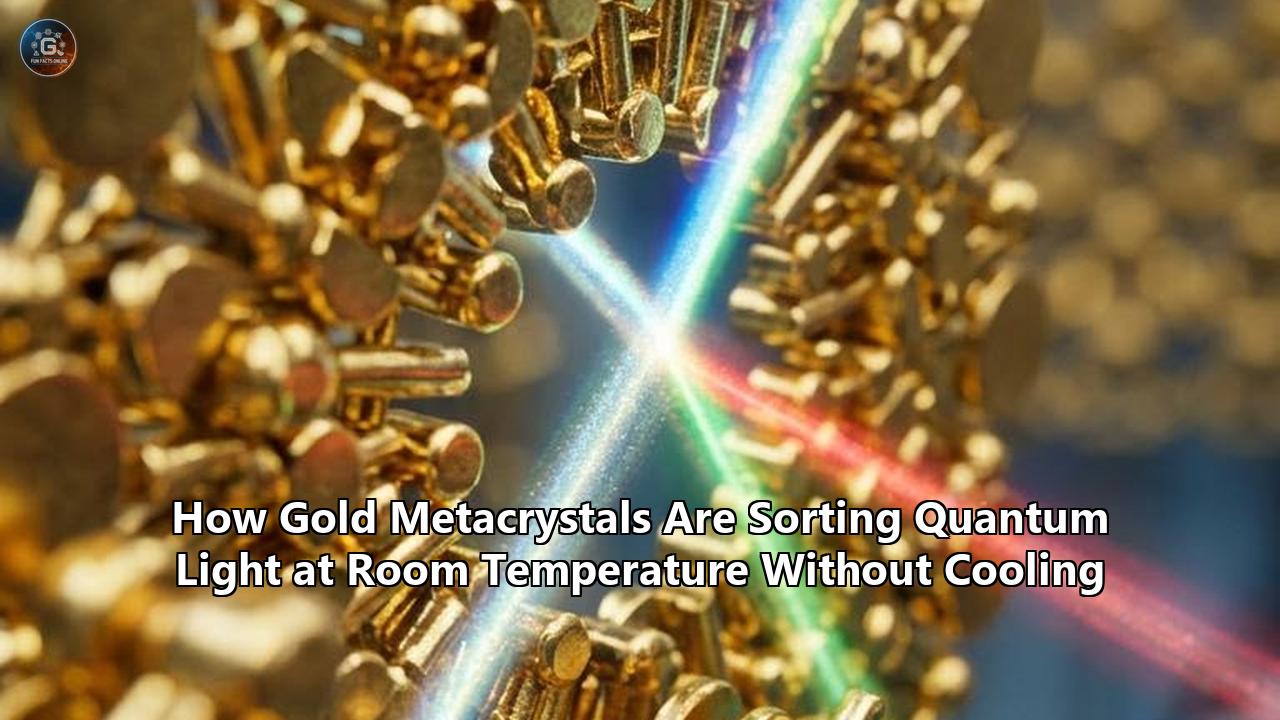
In a publication in Nature, physicists at Louisiana State University (LSU) demonstrated the world’s first quantum statistical plasmonic metacrystal—an engineered gold chip that sorts, filters, and transports quantum states of light entirely at room temperature.
The research team, led by Associate Professor Omar S. Magaña-Loaiza alongside researchers Chenglong You, Riley B. Dawkins, and Rima Bhandari, succeeded in bypassing one of the most stubborn bottlenecks in modern physics: the requirement for cryogenic refrigeration.
+---------------------------------------------------------------------------------+
|                         TRADITIONAL QUANTUM PLATFORMS                           |
|  - Requires bulky liquid helium dilution refrigerators                         |
|  - Operating temperatures: 10 mK to 4 K (-273°C)                                |
|  - High capital cost ($1M+), massive power consumption, immobile laboratory     |
+---------------------------------------------------------------------------------+
                                         │
                                         ▼
+---------------------------------------------------------------------------------+
|                 LSU ROOM-TEMPERATURE GOLD METACRYSTAL PLATFORM                  |
|  - Engineered 110 nm gold film with nanoscale slits ("meta-atoms")             |
|  - Operating temperature: Ambient Room Temperature (~295 K / 22°C)              |
|  - Passively filters & transports light by quantum statistical coherence        |
+---------------------------------------------------------------------------------+
For decades, harnessing quantum mechanics for computation, secure communication, and ultra-precise sensing has meant operating in cold, isolated environments. Most physical systems capable of exhibiting quantum behavior rely on delicate states that collapse the moment heat enters the equation. As a result, standard quantum hardware relies on multi-million-dollar dilution refrigerators cooled with liquid helium to fractions of a degree above absolute zero.
The LSU team avoided this constraint by abandoning the search for rare natural quantum minerals. Instead, they deposited an ultra-thin film of pure gold onto a glass chip and used focused ion beams to carve hundreds of sub-microscopic slits into the metal surface.
These engineered structures function as "meta-atoms," forming an artificial crystal thinner than a human hair that interacts directly with incoming photons.
Rather than sorting light by color, brightness, or polarization, the gold metacrystals quantum light system identifies and filters photons based on their fundamental quantum statistics. It separates chaotic, noisy optical states from structured quantum light while preserving the fragile quantum coherence needed to carry information.
By eliminating the need for bulky cooling systems, the discovery provides a blueprint for practical, chip-scale quantum devices that can operate in everyday room-temperature environments.
The Thermal Noise Wall: Why Quantum Technologies Are Frozen in Place
To understand why a room-temperature quantum sorter matters, one must first look at why quantum mechanics is normally so difficult to preserve outside a specialized laboratory.
At its core, quantum information relies on superposition and entanglement. Superposition allows a particle to exist in a combination of multiple physical states simultaneously, while entanglement links the quantum states of two or more particles regardless of the distance between them.
However, these states exist in a fragile balance known as quantum coherence. Any uncontrolled interaction with the surrounding environment causes decoherence, forcing the quantum system to collapse into a standard classical state.
THERMAL DECOHERENCE IN SOLID-STATE SYSTEMS:
High Heat (Room Temp)  ──>  Atomic Lattice Vibrations (Phonons)  ──>  Quantum State Destruction
Cryogenic Cooling      ──>  Frozen Lattice (Low Energy)          ──>  Quantum State Preserved
In room-temperature matter, heat manifests as rapid atomic and molecular vibration. At ambient temperatures (~295 Kelvin or 22°C), thermal energy ($k_B T \approx 25 \text{ meV}$) creates a chaotic background of lattice vibrations, known as phonons.
When researchers attempt to encode quantum information into solid-state particles—such as electrons in a semiconductor or superconducting loops—these thermal phonons collide with the qubits, destroying quantum coherence within nanoseconds.
To suppress this thermal noise, advanced quantum platforms must be housed inside multi-stage helium dilution refrigerators. These systems cool hardware down to 10 to 15 millikelvin (-273.14°C), effectively freezing atomic motion. While effective, this cooling infrastructure introduces severe real-world constraints:
- Footprint and Weight: Industrial cryostats stand several feet tall, weigh thousands of pounds, and require massive external compressors.
- Capital and Operational Costs: A single high-end dilution refrigerator costs between $500,000 and $2,000,000, with ongoing electricity and liquid helium costs exceeding tens of thousands of dollars annually.
- Scalability Bottlenecks: Routing thousands of optical fibers and microwave coax cables into a vacuum-sealed, sub-Kelvin chamber creates physical wiring bottlenecks that hinder scaling up quantum hardware.
Light, or optical photons, offers a potential way around this thermal issue. Photons travel at the speed of light, interact weakly with ambient environmental noise, and do not experience thermal phonon collisions in the same way electrons do in a solid lattice.
However, manipulating photon states on a solid-state chip usually requires non-linear optical materials or single-photon detectors that historically required cryogenic cooling to operate without thermal dark counts.
The LSU breakthrough changes this dynamic. By designing a metal surface that directly interacts with the statistical fluctuations of photon streams, the researchers created a passive solid-state device that filters and guides quantum light without needing thermal suppression.
From Bulk Metal to Meta-Atoms: Fabricating Artificial Physics
Natural crystals derive their physical and optical properties from the arrangement of their constituent atoms and chemical bonds. Silicon, diamond, and quartz all bend, absorb, or reflect light according to the natural electromagnetic limits set by their atomic structures.
Metamaterials, by contrast, bypass the periodic table. They gain their optical properties from human-engineered geometric patterns etched at scales smaller than the wavelength of light.
NATURAL CRYSTAL vs. PLASMONIC METACRYSTAL

Natural Silicon/Quartz Crystal:
[Atom] ── [Atom] ── [Atom] ── [Atom]  (Fixed by chemistry, scale ~0.1 nm)
  │          │        │          │
  Light interacts via natural atomic electron orbitals.

Engineered Plasmonic Metacrystal:
[Meta-Atom Slit] ── [Meta-Atom Slit]  (Engineered by ion beam, scale ~200-400 nm)
  │                    │
  Light couples with free electron gas to generate Surface Plasmon Polaritons.
To create their quantum material, the LSU team manufactured a "plasmonic metacrystal" through a precise nanofabrication workflow:
- Substrate Preparation: The team began with an optically flat glass chip (silica glass) as a rigid base.
- Thin-Film Deposition: Using vacuum deposition, a uniform, 110-nanometer-thin film of pure gold was deposited onto the chip surface. Gold was chosen for its electrical conductivity, resistance to oxidation, and high density of free conduction electrons.
- Focused Ion Beam (FIB) Nanofabrication: Using high-energy focused ion beams, the researchers etched hundreds of microscopic rectangular slits directly into the gold layer. Each individual slit measured approximately 200 nanometers wide by 400 nanometers long.
These etched slits function as artificial "meta-atoms". When light strikes the gold chip, it does not simply pass through or reflect back as it would off a ordinary mirror. Instead, incoming photons interact with the dense cloud of free electrons at the metal-glass boundary.
This interaction couples the light with the surface electrons, generating hybrid quasiparticles called surface plasmon polaritons (SPPs). SPPs act as ripples of optical energy that travel along the gold surface, squeezed into volumes smaller than the original wavelength of light.
By carefully adjusting the size, geometry, orientation, and spacing of these 200x400-nanometer meta-atom slits, the team altered how the SPP ripples interfere with one another.
The periodic arrangement of meta-atoms creates a artificial lattice. As gold metacrystals quantum light interactions occur along this metallic surface, the material enforces strict physical rules governing which optical field configurations can travel across the chip and which are blocked.
Quantum Statistics Unpacked: Filtering Photons by Coherence
To understand how the metacrystal filters light, it helps to look beyond conventional optics. Standard optical devices organize light using macroscopic properties:
- Wavelength / Frequency: Dictates color (e.g., separating 780 nm red light from 450 nm blue light).
- Amplitude: Dictates light brightness or intensity.
- Polarization: Dictates the orientation of the light's electric field vector.
The LSU gold metacrystal operates on a different fundamental level. It sorts light according to its quantum statistical properties—specifically, how individual photons within a beam are distributed over time.
PHOTON STATISTICAL DISTRIBUTION TYPES

1. Thermal / Chaotic Light (Sunlight, Incandescent Bulbs)
   Photon Bunching: Photons arrive in chaotic, clumped groups over time.
   Second-Order Correlation: g^(2)(0) > 1

2. Coherent / Classical Light (Ideal Lasers)
   Random Poissonian Arrival: Photons arrive independently with uniform probability.
   Second-Order Correlation: g^(2)(0) = 1

3. Non-Classical / Quantum Light (Single-Photon Sources, Squeezed Light)
   Photon Antibunching: Photons arrive evenly spaced, strictly one at a time.
   Second-Order Correlation: g^(2)(0) < 1
In optical physics, light sources can be classified by their photon statistics, which are measured using the second-order coherence function, denoted as $g^{(2)}(\tau)$, where $\tau$ represents the time delay between photon arrivals:
1. Super-Thermal / Thermal Light ($g^{(2)}(0) > 1$)
Produced by chaotic, incoherent sources like thermal bulbs, fluorescent lamps, or natural sunlight. Photons tend to arrive in unpredictable clumps, a phenomenon known as "photon bunching." For pure thermal light, $g^{(2)}(0) = 2.0$. Extreme chaotic states can exceed $g^{(2)}(0) = 2.0$.
2. Coherent Light ($g^{(2)}(0) = 1$)
Produced by standard stabilized lasers. Photons arrive according to a random Poisson distribution, meaning the arrival of one photon gives no information about when the next will arrive.
3. Sub-Thermal / Non-Classical Light ($g^{(2)}(0) < 1$)
Produced by single-photon emitters, quantum dots, or non-linear crystal down-conversion. Photons exhibit "photon antibunching"—they travel spaced out in time, arriving strictly one by one. This is the primary form of light used in quantum computing gates and quantum cryptography key generation.
Until now, sorting light based on these microscopic photon correlations required complex laboratory instruments, high-speed single-photon counting modules (SPCMs), delay lines, and millions of individual statistical measurements taken over long timeframes.
                                 METACRYSTAL STATISTICAL BAND FILTERING

  Incoming Optical Input                 Gold Plasmonic Metacrystal                Output Transmission

  Forbidden Thermal State   ───────►  [ Forbidden Band: Phase Shift / Filter ]  ───────►  Shifted Allowed State
  (g^(2)(0) = 2.15)                   [  Arrangement of Gold Meta-Atoms   ]            (g^(2)(0) = 2.58)
                                      [  Engineers SPP Wave Interference  ]
  Allowed Quantum State     ───────►  [ Allowed Band: Direct Transmission   ]  ───────►  Preserved Quantum State
  (Preserved Coherence)               [                                   ]            (g^(2)(0) Preserved)
The LSU metacrystal automates this sorting process at the material level. By adjusting the spatial array of the gold meta-atoms, the physicists created quantum statistical bands within the material.
These statistical bands are directly analogous to the electronic bandgaps found in silicon semiconductors. In a semiconductor, an electron with an energy level falling inside the forbidden bandgap cannot pass through the crystal lattice.
In the LSU metacrystal, light possessing a forbidden photon arrival statistic ($g^{(2)}(0)$ value) cannot pass through the material unchanged.
To prove this effect, the LSU team prepared 13 distinct multiphoton light sources, ranging from coherent laser light to complex thermal and non-classical state combinations, and passed them through the chip at an illuminated wavelength of 780 nanometers.
The experimental measurements confirmed the device's filtering behavior:
- Allowed Statistical Bands: Quantum light states whose statistics matched the metacrystal’s allowed band traversed the surface with their coherence intact.
- Forbidden Statistical Bands: Light states falling within forbidden statistical bands were systematically reshaped as they interacted with the surface plasmons. For example, a forbidden super-thermal field with an input second-order coherence of $g^{(2)}(0) = 2.15$ was shifted to an allowed value of $g^{(2)}(0) = 2.58$. Similarly, a forbidden sub-thermal input shifted from $g^{(2)}(0) = 1.25$ to $1.50$.
This confirmed that the chip acts as a physical filter for quantum statistics, allowing specific photon correlation profiles to pass while altering or suppressing others—all without requiring cryogenic cooling.
Robust Quantum Transport: Key Findings and Expert Perspectives
The core innovation of the LSU discovery lies in what the team terms "robust quantum transport". Historically, attempting to guide quantum light along metallic surfaces at room temperature resulted in rapid decoherence, as scattering losses and thermal phase shifts quickly destroyed photon correlation states. The gold metacrystal overcomes this by using collective surface plasmon interference to protect the light's statistical information.
+---------------------------------------------------------------------------------------------------+
|                                     RESEARCH TEAM INSIGHTS                                        |
+---------------------------------------------------------------------------------------------------+
|  "By engineering the distribution of meta-atoms in the plasmonic metacrystal, we can            |
|  systematically dictate which quantum statistics are allowed to pass through the structure. So,  |
|  our crystal essentially acts as a statistical filter on quantum states."                         |
|                                                                                                   |
|  — Dr. Riley B. Dawkins, NRC Postdoctoral Research Associate at NIST                              |
|    (Former LSU PhD researcher and study co-author)                                                |
+---------------------------------------------------------------------------------------------------+
|  "We call this robust transport. These quantum states carry information. Our crystal can          |
|  distinguish them and move them from one point to another in a robust way without requiring       |
|  cryogenic cooling. That's what opens the door to practical quantum technologies."                |
|                                                                                                   |
|  — Dr. Omar S. Magaña-Loaiza, Associate Professor of Physics at LSU                               |
|    (Lead Principal Investigator)                                                                  |
+---------------------------------------------------------------------------------------------------+
|  "One of the most exciting parts of this project was realizing that we could build a material    |
|  that does something nature doesn't provide on its own. Seeing it work exactly as we predicted    |
|  was incredibly rewarding."                                                                       |
|                                                                                                   |
|  — Dr. Chenglong You, Professor at UESTC                                                          |
|    (Former LSU Postdoctoral Scholar and study co-author)                                          |
+---------------------------------------------------------------------------------------------------+
Dr. Riley B. Dawkins, who co-authored the Nature paper during his doctoral research at LSU before joining the National Institute of Standards and Technology (NIST), explained how the structure manipulates light:
"By engineering the distribution of meta-atoms in the plasmonic metacrystal, we can systematically dictate which quantum statistics are allowed to pass through the structure. So, our crystal essentially acts as a statistical filter on quantum states."
Lead principal investigator Associate Professor Omar S. Magaña-Loaiza emphasized the practical advantages of maintaining quantum coherence without cooling:
"We call this robust transport. These quantum states carry information. Our crystal can distinguish them and move them from one point to another in a robust way without requiring cryogenic cooling. That's what opens the door to practical quantum technologies."
The team designed, fabricated, and tested the device entirely in-house. They managed the theoretical mathematical modeling, cleanroom nanofabrication, and multi-photon optical characterization within LSU's Quantum Photonics Group.
Dr. Chenglong You, now a professor at the University of Electronic Science and Technology of China (UESTC), noted that the project validates a custom metamaterial approach:
"One of the most exciting parts of this project was realizing that we could build a material that does something nature doesn't provide on its own. Seeing it work exactly as we predicted was incredibly rewarding."
Quantum Networks, Photonic Computing, and Solar Energy
By proving that gold metacrystals quantum light filtering can operate reliably in ambient room-temperature conditions, the LSU team has demonstrated a design strategy with broad practical applications.
                                  APPLICATIONS ARCHITECTURE

┌─────────────────────────┐  ┌─────────────────────────┐  ┌─────────────────────────┐  ┌─────────────────────────┐
│   Quantum Encryption    │  │   Photonic Computing    │  │    Quantum Sensing      │  │    Photovoltaic Energy  │
│      & Networks         │  │     Microprocessors     │  │    & Bio-Imaging        │  │       Harvesting        │
├─────────────────────────┤  ├─────────────────────────┤  ├─────────────────────────┤  ├─────────────────────────┤
│ Uncooled repeaters,     │  │ Chip-integrated logic   │  │ High-sensitivity phase  │  │ Reshaping broadband     │
│ robust QKD routers,     │  │ sorting photon states   │  │ detection without bulky │  │ solar statistics to     │
│ ambient quantum links   │  │ without cryostat racks  │  │ refrigeration systems   │  │ boost cell efficiency   │
└─────────────────────────┘  └─────────────────────────┘  └─────────────────────────┘  └─────────────────────────┘
1. Room-Temperature Quantum Key Distribution (QKD) & Repeaters
In quantum communications, information is encoded into individual photons to create tap-proof encryption keys. However, as quantum light travels through fiber optic cables, attenuation and environmental noise scramble the photons' statistics, limiting transmission distances.
Current quantum networks require cryogenic quantum repeaters every few dozen kilometers to clean and amplify signal states.
An uncooled gold metacrystal chip could serve as a passive, room-temperature filter at network nodes. It can clean incoming photon streams, strip away thermal noise, and route pristine quantum states along communication channels without requiring liquid helium refrigeration.
2. On-Chip Photonic Quantum Computing
Photonic quantum computers use light particles instead of electrical charges to perform calculations. While photons do not suffer from the same heat issues as superconducting circuits, conventional photonic chips still rely on bulky, off-chip single-photon sorters and cryogenic detectors to manage quantum state interference.
Integrating tailored plasmonic metacrystals directly onto photonic microprocessors allows quantum state sorting, statistical filtering, and logic routing to occur within a microscopic, ambient optical circuit. This makes it possible to build compact, scalable optical quantum processors.
3. Ultra-Sensitive Quantum Metrology and Sensing
Quantum sensors use squeezed or entangled light to measure magnetic fields, gravitational variations, or biological tissues with precision far beyond classical limits.
However, deploying these sensors in field environments—such as airborne mapping units, portable medical diagnostic tools, or deep-sea survey vessels—is often impractical due to the weight and cooling requirements of cryogenic systems.
Passive gold metacrystals allow portable sensor heads to process and separate phase-sensitive quantum light in field environments.
4. Advanced Photovoltaic Energy Harvesting
One unexpected application of this technology is in solar energy harvesting. Natural sunlight is a chaotic, super-thermal light source with a statistical variance of $g^{(2)}(0) = 2.0$. Traditional photovoltaic solar cells convert incoming solar photons into electrical current subject to the Shockley-Queisser limit, which caps single-junction solar cell efficiency at roughly 33.7%.
Part of this performance limit stems from thermal entropy and recombination losses caused by the chaotic distribution of incoming solar photons.
SUNLIGHT HARVESTING ENHANCEMENT CONCEPT

Natural Thermal Sunlight (g^(2)(0) = 2.0)
         │
         ▼
[ Gold Metacrystal Solar Surface ]  ──►  Reshapes Photon Arrival Statistics
         │
         ▼
Optimized Photon Stream  ──►  Reduces Thermal Entropy Losses  ──►  Higher Photovoltaic Efficiency
By placing engineered plasmonic metacrystal coatings on solar cell surfaces, researchers aim to reshape the statistical distribution of incoming sunlight photons before they enter the semiconductor absorber.
Modifying the statistical arrival times of photons can reduce recombination losses, allowing photovoltaics to capture a larger percentage of solar energy. The LSU team plans to test these metacrystal coatings on operational photovoltaic cells in upcoming research phases.
Comparing Room-Temperature Metacrystals Against Cryogenic Architectures
To see how the gold metacrystal platform fits into the broader field of quantum technology, it helps to compare it against existing quantum hardware platforms:
| Platform Architecture | Primary Operating Temperature | Core Physical Mechanism | Primary Advantage | Main Technological Challenge |
|---|---|---|---|---|
| Superconducting Qubits (IBM, Google, Rigetti) | ~15 mK (-273.13°C) | Josephson junction circuits carrying Cooper pairs | High gate speeds, established industrial manufacturing | Extreme cryogenic reliance, short coherence times, wiring bottlenecks |
| Trapped Ion Systems (IonQ, Quantinuum) | Room Temp to ~4 K | Individual ions suspended by RF electromagnetic fields in vacuum | Ultra-high gate fidelity, long coherence times | Complex optical laser alignments, slow gate operational speeds |
| Diamond NV Centers (Quantum Diamond Technologies) | Room Temp (~295 K) | Nitrogen vacancies in diamond crystal lattices | Compact physical footprint, stable ambient electron spin | Difficult to fabricate uniform arrays, high optical coupling losses |
| Quantum Plasmonic Metacrystals (LSU Discovery) | Room Temp (~295 K) | Gold film nano-slit arrays directing surface plasmon polaritons | Passive statistical filtering, ultrathin profile, no cryogenic cooling | Ohmic plasmonic attenuation losses in metallic gold |
Operating Environment and Footprint
Superconducting systems require multi-stage dilution refrigerators that consume significant power and space. In contrast, the gold metacrystal operates on a planar glass chip at standard room temperature, eliminating the physical footprint and power demands of cryogenic cooling.
Cost and Scalability
Building a cryogenic quantum facility requires millions of dollars in infrastructure, specialized vacuum systems, and closed-loop liquid helium supplies.
The gold metacrystal uses standard nanofabrication techniques—electron-beam evaporation and focused ion beam etching—that align with existing semiconductor and optical foundry manufacturing workflows. This compatibility makes high-volume, cost-effective production achievable.
Passive vs. Active Operation
Unlike trapped ion or superconducting platforms that require constant, active microwave or laser pulses to stabilize qubits, the gold metacrystal is a passive material. Incoming light interacts with the engineered geometry of the meta-atoms, sorting quantum states through structural interference alone.
Overcoming Plasmonic Loss and the 5-Year Scaling Horizon
While the LSU demonstration is a significant milestone, researchers face several technical challenges before gold metacrystals quantum light devices can move from laboratory proofs-of-concept into commercial products:
                                  DEVELOPMENT TIMELINE & ROADMAP

  Phase 1: Proof of Concept (Current - 2026)      Phase 2: Hybrid Integration (1-3 Years)          Phase 3: Commercial QPICs (3-5 Years)
  ┌────────────────────────────────────────┐     ┌────────────────────────────────────────┐     ┌────────────────────────────────────────┐
  │ • Single-layer gold metacrystals       │     │ • Hybrid dielectric-plasmonic arrays   │     │ • Mass foundry nanofabrication         │
  │ • Demonstration of statistical band   │ ──► │ • Integration with waveguide circuits  │ ──► │ • Commercial QKD repeater modules      │
  │   filtering at 780 nm                  │     │ • Optimization for lower optical loss  │     │ • On-chip room-temp quantum processors │
  └────────────────────────────────────────┘     └────────────────────────────────────────┘     └────────────────────────────────────────┘
1. Managing Plasmonic Dissipation (Ohmic Loss)
The primary challenge in plasmonic physics is Ohmic loss. Because gold contains free electrons, light traveling across its surface as a surface plasmon polariton generates small amounts of resistance, converting a fraction of the optical energy into heat.
Over long propagation distances (several millimeters), this absorption can cause signal loss.
To address this, researchers are exploring hybrid plasmonic-dielectric metacrystals. By pairing ultra-thin gold slit layers with low-loss dielectric materials—such as silicon nitride ($\text{Si}_3\text{N}_4$), titanium dioxide ($\text{TiO}_2$), or lithium niobate ($\text{LiNbO}_3$)—engineers can confine light efficiently at meta-atom boundaries while routing photons through transparent dielectric channels over longer distances.
2. Multi-Channel Band Customization
The current prototype operates on single-input, single-output optical channels. The next fabrication step involves creating multi-layered metacrystal arrays capable of sorting complex, high-dimensional quantum states (qudits) across dozens of parallel spatial paths simultaneously.
3. Broadening Spectral Wavelength Coverage
The LSU experiment was demonstrated at an optical wavelength of 780 nanometers. To integrate with existing telecommunications infrastructure, researchers need to scale the meta-atom geometries to operate at standard telecom wavelengths, specifically 1310 nm and 1550 nm (the O-band and C-band used in fiber-optic networks).
Because meta-atoms are scalable by design, tuning the operational wavelength is a straightforward matter of adjusting the nano-slit dimensions during ion-beam milling.
FUTURE QUANTUM PHOTONIC INTEGRATED CIRCUIT (QPIC)
┌────────────────────────────────────────────────────────────────────────┐
│                                                                        │
│  Unfiltered Optical Input ──► [ Hybrid Plasmonic Metacrystal ]         │
│                                           │                            │
│                                           ├──► Allowed Band Channel A │
│                                           │    (Pure Single Photons)   │
│                                           │                            │
│                                           └──► Allowed Band Channel B │
│                                                (Coherent Reference)    │
│                                                                        │
└────────────────────────────────────────────────────────────────────────┘
Looking ahead, the LSU team’s work, supported by the U.S. Department of Energy’s Office of Basic Energy Sciences, marks a shift in how researchers approach quantum hardware. Instead of searching for rare natural materials or building heavy cooling systems, physicists can now design artificial matter tailored to manipulate light at ambient temperatures.
As nanofabrication techniques continue to advance, room-temperature quantum metacrystals are poised to move out of high-budget research laboratories and into practical optical computing, secure communications, and energy systems.
Reference:
- https://daily.dev/posts/researchers-create-room-temperature-quantum-material-that-filters-light-by-its-quantum-statistics-yqaa2m99t
- http://www.sciencedaily.com/releases/2026/08/260806050706.htm
- https://www.lsu.edu/science/news/2026/07/rt-quantum-material.php
- https://www.technologynetworks.com/applied-sciences/news/physicists-create-worlds-first-room-temperature-quantum-material-414763
- https://screenrushreviews.com/article/tiny-gold-crystal-revolutionizes-quantum-tech-at-room-temperature
- https://www.sciencealert.com/the-first-room-temperature-quantum-material-of-its-kind-is-spun-from-atoms-of-gold
- https://scitechdaily.com/worlds-first-room-temperature-quantum-material-sorts-light-in-an-unprecedented-way/
- https://www.facebook.com/secretsofuniverse/posts/%EF%B8%8F-scientists-have-created-a-room-temperature-quantum-material-made-from-gold-and/1609888930784702/
- https://thegoodnewsbrief.com/stories/gold-metacrystal-sorts-quantum-light-at-room-temperature-dt23i7
- https://medium.com/@m.alfaro.007/open-sourcing-the-universes-code-a-metacrystal-that-sorts-photon-statistics-by-geometry-2675a44459c4
- https://www.facebook.com/physorg/posts/a-gold-on-glass-metacrystal-worked-at-room-temperature-to-distinguish-and-transp/1512583950896988/
- https://podimo.com/en/shows/science-news-today-2-min-news-the-daily-news-now/episode/3149848b-0bd5-5db0-a3b9-9d16e6db61f3