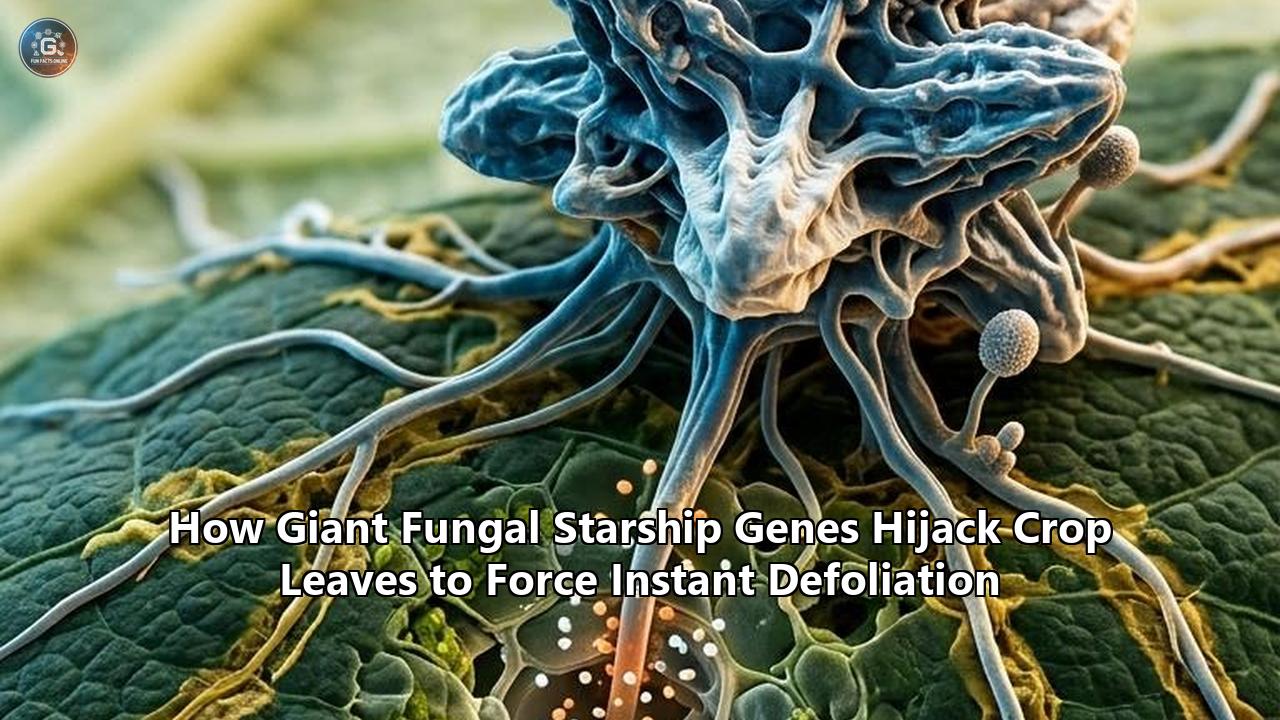
An international team of plant pathologists and geneticists has uncovered the molecular mechanism behind one of agriculture’s most devastating phenomena: how a aggressive soil pathogen forces crops to shed their leaves in a matter of days.
In a study published in Nature Communications, researchers led by Professor Dr. Bart Thomma from the University of Cologne, the MiBiNet Collaborative Research Centre, and the CEPLAS Cluster of Excellence for Plant Sciences identified a unique fungal protein effector responsible for triggering rapid, total defoliation in cotton fields and olive groves.
The critical discovery lies in where this destructive gene resides. Rather than being anchored permanently in the core genome of the soil-borne fungus Verticillium dahliae, the leaf-drop gene is carried inside a "Starship"—a massive, mobile genetic element capable of jumping between distantly related species of fungal plant pathogens.
┌─────────────────────────────────────────────────────────────────────────┐
│                    THE STARSHIP GENOMIC ARCHITECTURE                    │
│                                                                         │
│  [Captain Gene] ───► [Cargo Region] ─────────────────► [Cargo Region]   │
│  (Tyrosine Rec.)     (Virulence Effector: Leaf-Drop)    (Secondary Toxins) │
└─────────────────────────────────────────────────────────────────────────┘
When Verticillium dahliae infects a host through its root system, it colonizes the water-transporting xylem vessels and secretes this Starship-encoded effector protein. Once inside the plant’s vascular network, the protein hijacks the crop’s internal cellular signaling. It tricks the plant into prematurely activating its natural leaf abscission cascade, causing complete leaf loss across entire fields within days. Denuded of their photosynthesizing leaves, infected cotton plants and olive trees experience catastrophic hydraulic failure and die.
"Until now, the genetic mechanisms by which Verticillium dahliae causes this leaf loss were unknown," explains Professor Thomma. "The gene for the protein that causes leaf loss was discovered on a so-called 'Starship'. These are huge mobile genetic elements that can be transferred between different species of fungus and carry genes, including the gene responsible for leaf loss. Genetic analyses have detected remnants of a putative 'Starship' carrying the leaf-drop gene in several other fungi that cause wilt diseases."
This discovery exposes a fundamental vulnerability in global food and fiber production. It reveals that the most aggressive, defoliating traits in crop diseases do not necessarily evolve over millions of years of isolated mutation. Instead, they can be package-shipped across fungal species lines overnight in evolutionary terms.
Part I: The Challenge — The Leaf-Drop Threat to Global Agriculture
Vascular wilt diseases caused by soil-borne microbes have long plagued global agriculture. Among the most widespread culprits is Verticillium dahliae, a fungal pathogen capable of infecting more than 400 plant species, including high-value dicotyledonous crops such as cotton, olives, tomatoes, potatoes, and sunflowers.
Historically, pathologists categorized Verticillium infections into two distinct clinical syndromes based on symptom severity:
- Non-defoliating strains: Cause moderate leaf chlorosis (yellowing), stunting, and gradual wilting. Infected plants often survive, albeit with reduced yields.
- Defoliating strains: Trigger an abrupt, lethal reaction. Green leaves turn brown at the margins or drop prematurely while still green, completely denuding the plant canopy within one to two weeks of symptom onset.
┌─────────────────────────────────────────────────────────────────────────┐
│                     DEFOLIATION PATHWAY IN CROPS                         │
│                                                                         │
│  Fungal Invasion (Roots) ──► Xylem Colonization ──► Effector Secretion   │
│                                                            │            │
│  Plant Death ◄── Total Canopy Drop ◄── Abscission Zone ◄───┘            │
└─────────────────────────────────────────────────────────────────────────┘
The defoliating phenotype is overwhelmingly more destructive. In major cotton-producing regions such as the Mississippi Delta, the San Joaquin Valley, and Mediterranean basins across Spain, Turkey, and Greece, defoliating Verticillium strains can cause 100% crop loss in affected acreage. Olive growers in Southern Europe face an even dire threat: mature olive trees that took decades to establish can succumb to defoliating vascular wilt in a single season, forcing farmers to clear entire orchards.
The Mystery of the Sudden Virulence Shift
For decades, plant scientists were baffled by how defoliating strains emerged. Outbreaks of defoliating wilt would suddenly appear in regions where only mild, non-defoliating strains had historically been recorded. Standard genetic profiling of core fungal genes failed to explain these sudden shifts in virulence. Strains that appeared nearly identical across their core chromosomes exhibited vastly different impacts on host plants.
The mystery intensified when comparative field studies revealed that unrelated fungal species—such as certain Fusarium species that infect legumes and solitary trees—exhibited strikingly similar defoliation patterns in their respective hosts.
The research led by Thomma’s team demonstrates that the instructions for forcing instant defoliation are stored on hyper-mobile genomic islands—the Starships—that operate independently of the host fungus's primary chromosome.
Part II: What Went Wrong — The Mechanics of Fungal "Starship" Vectors
To understand why Starship-mediated defoliation poses such a systemic challenge to agriculture, one must look at how these mobile genetic elements function at the structural and genomic levels.
┌──────────────────────────────────────────────────────────────────────────────┐
│                    COMPARATIVE MAP OF FUNGAL TRANSPOSONS                     │
│                                                                              │
│  Standard DNA Transposon (1–10 kb)                                           │
│  [ITR]──[Transposase Gene]──[ITR]                                           │
│                                                                              │
│  Starship Mobile Element (25–700 kb)                                         │
│  [DR]──[Captain Recombinase]──[Effector Cargo]──[Metabolic Cluster]──[DR]     │
└──────────────────────────────────────────────────────────────────────────────┘
The Architecture of Giant Transposons
Transposable elements ("jumping genes") are widespread across eukaryotic life. However, traditional transposons are relatively small, typically ranging from 1,000 to 10,000 base pairs (1–10 kb). They usually contain only the minimal genetic code required for their own excision and integration into new genomic sites.
Starships represent a distinct class of eukaryotic mobile genetic elements. First identified in 2020 and formally named in 2022, Starships are colossal transposons. They span anywhere from 25,000 to over 700,000 base pairs (25 to 700 kb)—making them large enough to carry entire multi-gene biosynthetic clusters, metabolic pathways, and suites of effector proteins.
| Feature | Standard DNA Transposons | Fungal Starships |
|---|---|---|
| Size Range | 1 – 10 kilobases (kb) | 25 – 700+ kilobases (kb) |
| Primary Enzyme | Transposase | "Captain" Tyrosine Recombinase (DUF3435) |
| Genome Copy Number | Typically multicopy | Typically single copy per genome |
| Cargo Capacity | Minimal (self-propagation only) | Massive (effectors, toxins, metal resistance) |
| Phylum Distribution | Broad across all eukaryotes | Concentrated in Pezizomycotina fungi |
Starships are defined by a set of conserved features:
- The "Captain" Gene: Every functional Starship encodes a master mobility enzyme at its 5' terminal—a site-specific tyrosine recombinase containing a distinct protein domain known as DUF3435. This "Captain" protein orchestrates the excision of the Starship from the host chromosome and its integration into new sites.
- Direct and Inverted Repeats: Flanking boundaries that allow the Captain protein to precisely identify the element's start and end points.
- Massive Accessory "Cargo": The space between the element's boundaries is packed with auxiliary genes captured from host or donor genomes.
Horizontal Gene Transfer: Crossing the Species Barrier
In high-density microbial environments such as the rhizosphere (the soil zone directly surrounding plant roots), diverse fungal species continuously interact. Through occasional hyphal fusion (anastomosis) or transient cellular contacts, genetic material can pass directly between different species—a process known as Horizontal Gene Transfer (HGT).
When a Starship undergoes horizontal transfer, it carries its entire genetic cargo into the new fungal host. If that cargo includes virulence factors—such as the leaf-drop effector identified in Verticillium dahliae—a previously mild or harmless fungal strain can instantly transform into a hyper-virulent killer.
┌─────────────────────────────────────────────────────────────────────────────┐
│                      HORIZONTAL GENE TRANSFER IN SOIL                       │
│                                                                             │
│   Fungal Species A (Donor)                 Fungal Species B (Recipient)     │
│  ┌───────────────────────┐                ┌─────────────────────────────┐   │
│  │  [Starship: Leaf-Drop]│ ───► HGT ───► │  [Acquired Starship]        │   │
│  └───────────────────────┘                └─────────────────────────────┘   │
│             │                                            │                  │
│             ▼                                            ▼                  │
│   Causes Olive Defoliation                   Causes Cotton Defoliation      │
└─────────────────────────────────────────────────────────────────────────────┘
Research shows that this Starship-mediated transfer is actively shaping the evolution of fungal plant pathogens.
- *The ToxA Precedent: In wheat crops, the necrotrophic effector gene ToxA—which causes tan spot disease—was horizontally transferred between distantly related fungi (Pyrenophora tritici-repentis, Parastagonospora nodorum, and Bipolaris sorokiniana) via Starship-like elements known as Horizon and Sanctuary.
- Glomerella Leaf Spot: In apple orchards, key pathogenicity clusters in Colletotrichum fungi are mobilized by the Starships Peleus and Thetis.
- Heavy Metal Adaptation: Outside of plant pathology, the Starship Hephaestus has been documented transferring multi-gene clusters for zinc and cadmium resistance across distinct fungal genera.
The discovery in Verticillium dahliae confirms that the Starship element Limos (and its structural variants) is responsible for mobilizing the defoliation machinery across vascular wilt fungi, giving them the ability to decimate host crops.
Part III: The Molecular Hijack — How the Leaf-Drop Effector Forces Defoliation
The core mystery addressed by Thomma and his colleagues was how a fungal protein secreted inside the water conduits of a stem could cause green, living leaves meters away to detach and drop off.
┌─────────────────────────────────────────────────────────────────────────────┐
│                       PLANT CELL WALL BREAKDOWN CASCADE                     │
│                                                                             │
│  Fungal Effector Secretion ──► Binds Host Wall Receptor ──► Auxin Shutdown   │
│                                                                  │          │
│  Leaf Drop ◄── Cell Boundary Dissolution ◄── Polygalacturonases ◄┘          │
└─────────────────────────────────────────────────────────────────────────────┘
The Anatomy of Leaf Abscission
In healthy plants, leaf shedding (abscission) is an intentionally regulated developmental process. It typically occurs in autumn or during severe drought to conserve water and energy. The process is governed by a precise physical structure at the base of the leaf stem: the abscission zone.
- Hormonal Equilibrium: Under normal conditions, a continuous flow of the plant hormone auxin from the leaf blade through the petiole keeps the abscission zone insensitive to ethylene (the plant hormone that triggers cell degradation).
- Signal Inversion: When a leaf ages or experiences prolonged stress, auxin production drops, and local ethylene sensitivity increases.
- Enzymatic Digestion: The plant secretes cell-wall-degrading enzymes—specifically endo-polygalacturonases and cellulases—into the middle lamella (the adhesive layer between cell walls) within the abscission zone.
- Clean Separation: The adhesive middle lamella dissolves, allowing the leaf to separate cleanly without tearing neighboring stem tissues. A protective suberin layer then seals the exposed stem scar.
The Fungal Effector Strategy
The research team discovered that the Starship-encoded protein effector acts as an biochemical trigger.
Upon colonization of the root xylem, Verticillium dahliae secretes this specialized protein into the sap stream. Translocated upward through the plant's vascular network by transpiration, the effector accumulates in the parenchyma tissues surrounding the petiole junction and abscission zone.
Fungal Invasion (Roots)
  │
  ▼
Translocation via Xylem Sap
  │
  ▼
Accumulation at Petiole Junction (Abscission Zone)
  │
  ▼
Effector Binds Host Cell Wall / Receptors
  │
  ├─────────────────────────────────────────┐
  ▼                                         ▼
Suppresses Auxin Signaling         Activates Cellulase & Pectinase Genes
  │                                         │
  └────────────────────┬────────────────────┘
                       │
                       ▼
          Rapid Dissolution of Middle Lamella
                       │
                       ▼
          Instant Leaf Loss (Defoliation)
Once inside the target tissue, the fungal effector operates through a multi-pronged mechanism:
- Triggering Premature Signaling: The effector mimics host peptide signals or interacts directly with host leucine-rich repeat receptor-like kinases (LRR-RLKs), tricking the plant cell into sensing an extreme developmental end-of-life cue.
- Collapse of Auxin Transporters: It shuts down local PIN-FORMED (PIN) auxin efflux transporters in the leaf petiole, abruptly stopping the flow of auxin that normally prevents leaf drop.
- Hyper-Activation of Substrate Degradation: The effector upregulates host gene expression for pectinases and cellulases within the abscission zone while simultaneously secreting its own complementary enzymes.
The result is rapid, uncontrolled cell separation at the leaf base. Healthy, green leaves lose structural support and fall off while still photosynthetic. For the fungus, this creates an ideal environment: denuding the plant reduces water loss from transpiration, altering plant physiology and accelerating systemic fungal colonization throughout the dying host.
Part IV: Why It Matters — The Threat to Food and Agricultural Systems
The discovery that major pathogenicity traits are carried on mobile Starships alters how epidemiologists and agronomists evaluate threat levels from fungal plant pathogens.
┌─────────────────────────────────────────────────────────────────────────────┐
│                    GLOBAL IMPACTS OF STARSHIP PATHOGENESIS                  │
│                                                                             │
│  [Agricultural]              [Ecological]              [Economic]           │
│  • Total crop loss in        • Rapid host jump         • Millions in annual │
│    cotton and olives           to native plants          yield losses       │
│  • Soil contamination        • Displacement of         • High cost of       │
│    persisting decades          native flora              field clearance    │
└─────────────────────────────────────────────────────────────────────────────┘
The Ecological Wild Card
Historically, plant disease forecasting relied on the assumption that fungal strains evolve through slow, predictable mutation. Breeding programs could cross crop varieties to introduce resistance against specific known strains, confident that new virulence traits would take decades to emerge.
Starships shatter this paradigm. Because Starships can carry large, multi-gene operational units across species lines, a previously non-pathogenic soil fungus can transform into an aggressive crop killer in a single transfer event.
"Starships represent a unique mechanism among eukaryotes through which fungi can adapt," notes Dr. Emile Gluck-Thaler, a lead researcher in fungal mobile genomics. "The transfer of genes with adaptive functions via mobile genetic elements is well established in prokaryotes, where it is important for phenomena such as antimicrobial resistance. The discovery of a parallel system in fungi implies that horizontal gene transfer should be regarded as a recurrent mode of evolution in these fungi, not as a rare chance occurrence."
compounding Climate Drivers
This genomic vulnerability is compounded by shifting global climate patterns:
- Soil Warming: Higher ambient and soil temperatures increase the metabolic activity and hyphal growth rates of soil-borne fungi, elevating the frequency of hyphal fusion events where Starships are exchanged.
- Drought Stress: Plants experiencing thermal and water stress naturally produce higher baseline levels of stress hormones (such as ethylene and abscisic acid), making their abscission zones more susceptible to fungal effector signaling.
- Monoculture Vulnerability: Extensive global acreage planted with genetically uniform crops provides ideal conditions for a Starship-borne defoliation trait to spread rapidly once introduced into a regional fungal population.
Part V: The Solution — Modern Strategies Against Mobile Fungal Weapons
Identifying Starships as the primary delivery vectors for defoliation effectors allows scientists to pivot from reactive disease management to targeted molecular countermeasures. Addressing this problem requires action across genomic surveillance, RNA-based biological controls, CRISPR-driven plant breeding, and ecosystem-level soil management.
┌─────────────────────────────────────────────────────────────────────────────┐
│                      FOUR-PILLAR DEFENSE STRATEGY                           │
│                                                                             │
│  1. Genomic Early Warning    ──► Nanopore real-time soil field sequencing   │
│  2. Molecular Interventions  ──► Sprayable dsRNA targeting Captain genes    │
│  3. Gene-Edited Resistance   ──► CRISPR modification of host receptors      │
│  4. Biological Interventions ──► Endophytic competition in rhizosphere     │
└─────────────────────────────────────────────────────────────────────────────┘
Pillar 1: Long-Read Genomic Early-Warning Systems
Standard short-read DNA sequencing (such as traditional Illumina platforms) often struggles to assembly highly repetitive, large transposable elements like Starships, leaving them undetected in routine genomic surveys. The widespread adoption of long-read sequencing platforms (Oxford Nanopore and Pacific Biosciences) has fundamentally changed this dynamic.
Pathologists are now deploying real-time field sequencing frameworks using portable long-read instruments:
- k-mer Diagnostics: Bioinformatic tools analyze long sequencing reads from soil samples for the unique DUF3435 domain of the Starship "Captain" gene, alongside the specific sequences of the leaf-drop effector cargo.
- Pre-Symptomatic Detection: Farmers can sample field soils prior to planting to detect whether local fungal populations have acquired the defoliating Starship element, allowing them to adjust crop selection before symptoms ever appear.
- Global Tracking Databases: An international consortium of plant health organizations is assembling an open-access registry of known Starships, mapping their geographic distribution and tracking horizontal transfer events across continental regions.
Soil Sampling ──► Portable Nanopore Sequencing ──► Bioinformatic k-mer Scan
                                                            │
                                                            ▼
  Plant Resistant Crop ◄── High Risk Detected ◄── Starship Identified?
Pillar 2: Molecular Disarmament via Sprayable RNA Interference (SIGS)
One of the most promising direct control options is Spray-Induced Gene Silencing (SIGS). This technology uses double-stranded RNA (dsRNA) molecules applied topically to crops to trigger the plant and fungal RNA interference (RNAi) machinery, knocking out target genes without synthetic chemical fungicides.
┌─────────────────────────────────────────────────────────────────────────────┐
│                   SPRAY-INDUCED GENE SILENCING (SIGS)                        │
│                                                                             │
│  Formulated dsRNA Spray ──► Absorbed by Foliage/Roots ──► Fungal Uptake     │
│                                                                  │          │
│  Pathogen Disarmed ◄── Transcripts Degraded ◄── RISC Assembly ───┘          │
└─────────────────────────────────────────────────────────────────────────────┘
Researchers are developing dual-action dsRNA formulations designed to disarm Starship-bearing fungi through two targets:
- Targeting the "Captain" Recombinase: By silencing the tyrosine recombinase gene, the dsRNA prevents the Starship element from replicating or excising itself, halting its ability to jump to new fungal hosts.
- Targeting the Leaf-Drop Effector Transcript: By silencing the mRNA sequence encoding the defoliation protein, the dsRNA ensures that even if the fungus infects the root system, it cannot produce the protein required to force leaf drop.
Field trials of sprayable dsRNA delivered via protective clay nanoparticles (BioClay) have demonstrated stability against rain washout and UV degradation, providing targeted protection for up to 20 days per application.
Pillar 3: CRISPR-Cas9 Gene Editing for Host Receptor Resilience
Because the Starship effector forces leaf drop by binding to specific plant cell-wall proteins and leucine-rich repeat (LRR) receptors, modifying those host targets presents a durable solution.
Wild-Type Host:
Fungal Effector + LRR Receptor Binding ──► Abscission Cascade ──► Defoliation

CRISPR-Edited Host:
Fungal Effector + Modified Receptor ──► No Binding ──► Leaves Retained
Using CRISPR-Cas9 gene editing, plant biotechnologists are creating "effector-blind" crop cultivars:
- Target Identification: High-resolution X-ray crystallography and cryo-EM are used to map the precise binding interface between the Verticillium leaf-drop effector protein and the plant's native receptor complexes.
- Precision Amino Acid Swaps: Using base editing and prime editing, scientists make subtle, precise substitutions at key contact residues within the plant's receptor gene.
- Preserving Natural Physiology: These subtle edits alter the receptor's structure just enough so the fungal effector can no longer bind to it, while preserving the receptor's normal physiological role in plant growth and development.
When infected by a defoliating strain of Verticillium dahliae, these CRISPR-edited cotton and olive plants retain their leaves, isolate the fungal infection within small sections of the vascular system, and yield normal harvests.
Pillar 4: Microbiome Engineering and Biocontrol Agents
To combat soil-borne fungal plant pathogens before they ever reach the root surface, researchers are turning to soil microbiome engineering.
┌─────────────────────────────────────────────────────────────────────────────┐
│                 RHIZOSPHERE MICROBIOME EXCLUSION SYSTEM                     │
│                                                                             │
│  Beneficial Endophytes ──► Siderophore Release ──► Biofilm Barrier          │
│                                                           │                 │
│  Root System Protected ◄── Pathogen Suppressed ◄──────────┘                 │
└─────────────────────────────────────────────────────────────────────────────┘
Recent studies show that specific non-pathogenic, endophytic fungi (such as benign Fusarium oxysporum strains or beneficial Trichoderma species) can colonize the rhizosphere and outcompete pathogenic strains:
- Niche Pre-emption: Beneficial endophytes physically occupy the root entry points, preventing Verticillium dahliae* from invading the xylem vessels.
- Starship Sink Strains: Researchers are investigating the deployment of engineered "sink" fungal strains—non-pathogenic soil fungi that accept mobile Starship elements but contain internal genomic mechanisms that silence or degrade incoming transposable elements before their cargo genes can be expressed.
Synthesis: Comparing Disease Management Paradigms
The shift from conventional disease management to genomic-targeted strategies marks a new era in plant pathology.
| Dimension | Conventional Fungicidal Approach | Starship-Targeted Molecular Approach |
|---|---|---|
| Primary Target | Broad-spectrum cell processes (e.g., ergosterol biosynthesis) | Specific mobile elements ("Captain" recombinase) and effectors |
| Environmental Impact | Broad impacts on beneficial soil microbes | Highly targeted; non-target organisms unaffected |
| Durability | Low; high selection pressure leads to rapid fungicide resistance | High; targets mobility machinery and host susceptibility targets |
| Detection Timing | Reactive; applied after symptoms appear in the field | Proactive; detected in soil via long-read k-mer diagnostics |
| Cost Profile | High recurring chemical purchase and field application costs | Integrated into seed genetics and targeted biological sprays |
Looking Ahead: The Next Phase in Mobile Genome Defense
The discovery that giant Starship transposons move complex disease traits across species lines redefines our understanding of fungal evolution and crop pathology. What once appeared to be isolated outbreaks of aggressive wilt are now understood to be part of a dynamic, interconnected network of mobile genetic exchange operating beneath the soil surface.
Over the coming years, international research initiatives will focus on key milestones:
- Mapping the Global "Starshipome": Expanding long-read sequencing initiatives to map all major Starship lineages across agricultural soils worldwide.
- Regulatory Frameworks for RNAi Biopesticides: Streamlining approval pathways for sprayable dsRNA formulations designed for rapid deployment during sudden localized outbreaks.
- Deploying Effector-Blind Crops: Translating CRISPR-edited, effector-resistant cotton varieties and olive rootstocks from greenhouse trials into commercial field cultivation.
By mapping the molecular machinery of these mobile genetic elements, scientists are moving from reactive management to proactive protection—equipping global agriculture with the tools needed to neutralize mobile fungal weapons before they can strike.
Reference:
- https://idw-online.de/en/news875649
- https://research.wur.nl/en/datasets/starship-giant-transposons-dominate-plastic-genomic-regions-in-a-/
- https://pubmed.ncbi.nlm.nih.gov/40657948/
- https://pmc.ncbi.nlm.nih.gov/articles/PMC12257634/
- https://www.rothamsted.ac.uk/news/starship-discovery-reveals-new-frontiers-fungal-genome-evolution
- https://en.wikipedia.org/wiki/Starship_(genetics))
- https://www.biorxiv.org/content/10.1101/2025.06.18.660325v1.full
- https://research-portal.uu.nl/en/publications/istarshipi-giant-transposons-dominate-plastic-genomic-regions-in-/
- https://uu.diva-portal.org/smash/record.jsf?pid=diva2:1674547
- https://pubmed.ncbi.nlm.nih.gov/32492572/