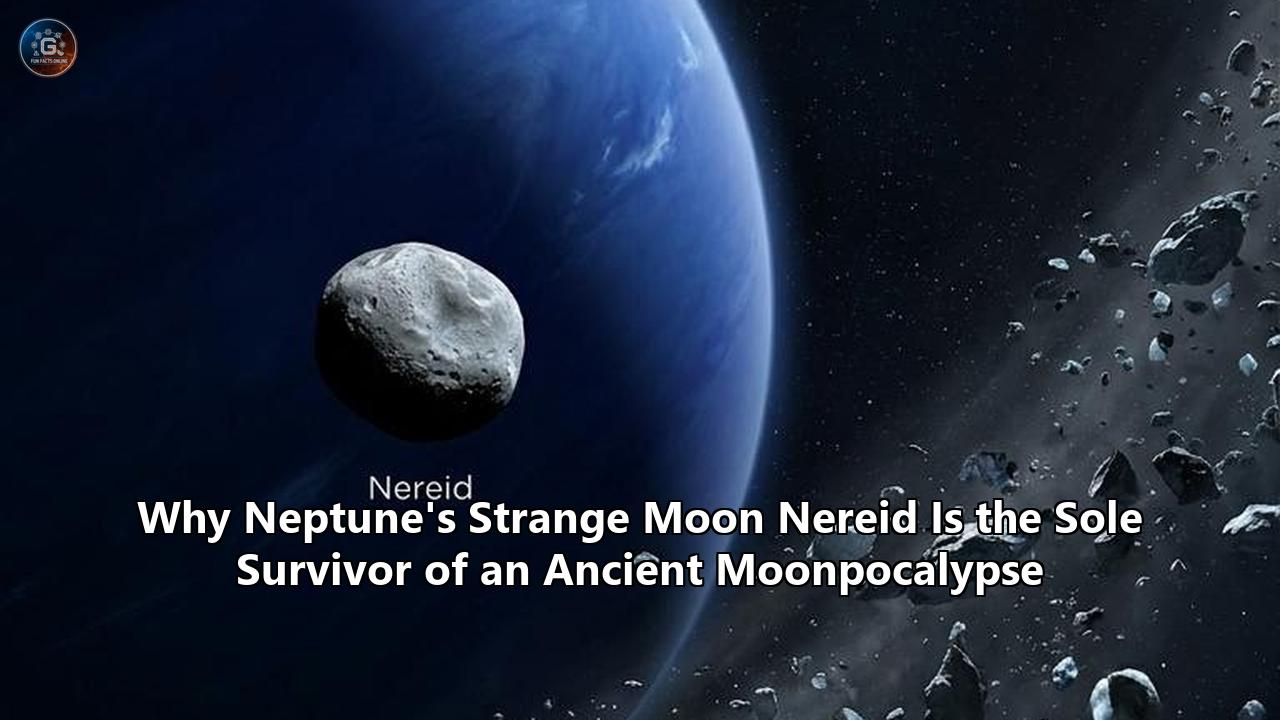
When the James Webb Space Telescope (JWST) swiveled its giant, gold-coated beryllium mirrors toward the outer solar system, it captured something far more consequential than a mere postcard of the icy depths. A team of planetary scientists, analyzing high-resolution infrared spectra gathered by the observatory, has solved a 70-year orbital mystery. The findings, published in the journal Science Advances, present a striking new narrative of the early solar system: the bizarre, highly elliptical orbit of the Neptune moon Nereid is not the mark of an captured interloper from the Kuiper Belt, but the battle scars of a survivor.
For decades, the standard model of planetary science classified Nereid as an irregular satellite—a passing space rock ensnared by Neptune's gravity long after the planet formed. However, the new spectral data reveals that Nereid’s chemical composition is a near-perfect match for the native, ice-rich regular moons of Uranus, rather than the dark, organic-laden objects of the outer Kuiper Belt. This chemical fingerprint suggests that Nereid was born in a quiet, flat, circular orbit alongside Neptune.
Its current path—a wild, swinging ellipse that takes it from 1.38 million kilometers to over 9.6 million kilometers from Neptune—is the direct result of a catastrophic orbital realignment. Billions of years ago, the violent gravitational capture of the planet-sized moon Triton initiated a chaotic "moonpocalypse". While Neptune’s other original moons were ejected into interstellar space, flung into the planet’s crushing atmosphere, or pulverized into rings of dust, Nereid was kicked outward. It found refuge in a distant, eccentric orbit, becoming the sole intact survivor of Neptune’s primordial satellite system.
The Anomalous Architecture of the Neptunian System
To appreciate why the origin of the Neptune moon Nereid has vexed astronomers for generations, one must examine the baseline architecture of the giant planets. Under the classical rules of planet formation, gas and ice giants acquire their major moon systems through in-situ accretion. As a proto-giant planet grows, it draws in a surrounding envelope of gas and dust, forming a flat, fast-spinning circumplanetary disk.
Over millions of years, the solid material within this disk coalesces into a family of regular satellites. These native moons share a distinct set of dynamical properties:
- Prograde Orbits: They orbit in the same direction as the host planet’s rotation.
- Low Eccentricity: Their paths are nearly perfect circles.
- Low Inclination: They travel within the plane of the planet’s equator, resembling a miniature solar system.
This orderly pattern is on display at Jupiter, Saturn, and Uranus. Jupiter possesses the four massive Galilean moons; Saturn has its system of mid-sized icy worlds dominated by Titan; Uranus hosts a tightly packed, coplanar quintet consisting of Miranda, Ariel, Umbriel, Titania, and Oberon.
Typical Gas/Ice Giant Moon System vs. Neptune's System

Typical (e.g., Uranus):
[Planet] ---> (Miranda) ---> (Ariel) ---> (Umbriel) ---> (Titania) ---> (Oberon)
* All orbit prograde, coplanar, and circular.

Neptune's Anomalous System:
[Neptune] ---> (Inner Rubble Moons) ----x<--- [TRITON (Retrograde, Massive)] ----> (NEREID [Eccentric, Prograde])
Neptune completely breaks this mold. Its satellite system is highly asymmetric and dominated by a single, colossal anomaly: Triton. Triton accounts for 99.9% of the mass of all objects orbiting Neptune. Yet, Triton orbits Neptune backward (a retrograde path) at a steep inclination of $157^\circ$ relative to the planet's equator.
Triton is a captured dwarf planet. It is an icy wanderer, a former twin of Pluto, that originated in the Kuiper Belt. Billions of years ago, as Triton ventured too close to the newly formed ice giant, a rare three-body gravitational interaction broke its heliocentric speed, dropping it into Neptune's gravitational well.
This capture was not a gentle transition. It was an event of unprecedented dynamical violence. As Triton was pulled into a highly eccentric retrograde orbit, its massive gravity began to warp, scatter, and destroy the pre-existing regular satellites that had formed alongside Neptune.
For decades, the Neptune moon Nereid was viewed as an accessory to this chaos—a fellow Kuiper Belt object captured during the same turbulent epoch. But the Caltech-led study, utilizing the world's most advanced space observatory, has demonstrated that Nereid is actually the last remaining native witness to this ancient cataclysm.
Gerard Kuiper’s Oddball and the Voyager 2 Clues
Before the advent of modern space telescopes, Nereid was little more than a fluctuating speck of light in the outer solar system. Discovered on May 1, 1949, by legendary Dutch-American astronomer Gerard Kuiper, Nereid was identified using photographic plates from the 82-inch telescope at the McDonald Observatory. Kuiper named the moon after the Nereids, the mythological sea nymphs who attended to the god Neptune.
For 40 years, Nereid remained the only known moon of Neptune besides Triton. Astronomers struggled to explain its extreme orbital parameters. The satellite has an eccentricity of 0.749—the second-most eccentric orbit of any known moon in the solar system, surpassed only by a tiny, recently discovered irregular moon of Saturn, S/2023 S 38.
Nereid's Orbit Compared to Triton's Orbit (not to scale)

                 Apoapsis (9.6 Million km)
                        o
                     .     .
                  .           .
               .                 .
             .                     .
            .     [Neptune]         .
            .       (Triton)        .
             .     /               .
               .  o               .
                  .           .
                     .     .
                        o
                 Periapsis (1.38 Million km)
This elongated path means Nereid’s distance from Neptune varies wildly:
- At Periapsis (closest approach): It swings within 1,381,500 kilometers of the planet, well inside Triton's gravitational sphere of influence.
- At Apoapsis (farthest reach): It drifts out to 9,626,500 kilometers, hanging on the absolute boundary of Neptune's gravitational control.
Despite this extreme orbit, Nereid travels in the prograde direction with an inclination of just $5.8^\circ$ to $7.1^\circ$ relative to the local Laplace plane. This low inclination is a key piece of the puzzle: true irregular satellites captured from the Kuiper Belt are almost always thrown into highly inclined orbits, with many traveling in retrograde directions. Nereid's prograde direction and low inclination hinted at a deeper connection to Neptune's equatorial plane, but its massive semi-major axis and eccentricity seemed to preclude an in-situ origin.
In August 1989, NASA’s Voyager 2 spacecraft made its historic flyby of the Neptunian system. While the probe sent back stunning images of Triton’s active nitrogen geysers and icy cantaloupe terrain, its encounter with Nereid was distant. Voyager 2 came no closer than 4.7 million kilometers to the enigmatic moon, capturing images where Nereid was only a few pixels across.
The Voyager data did, however, confirm several physical characteristics:
- Size: Nereid is roughly 357 kilometers in diameter, making it the third-largest moon in the system, roughly comparable in size to Saturn's moon Mimas.
- Albedo: It reflects approximately 24% of the sunlight hitting its surface. This is remarkably bright for an irregular satellite; most captured Kuiper Belt objects are incredibly dark, with albedos ranging from 4% to 8%.
- Rotation: Its light curves showed highly unusual, long-period variations. Scientists speculated that Nereid might be in a state of chaotic, non-synchronous rotation or forced precession, constantly tumbling as it is pulled by the complex gravitational field of Neptune and Triton.
These clues remained uncoordinated for decades. Without direct physical data on Nereid's surface chemistry, planetary scientists could only guess at its true heritage.
Behind the JWST Spectra: Ice vs. Volatiles
The breakthrough that redefined the Neptune moon Nereid was made possible by the Near-Infrared Spectrograph (NIRSpec) aboard the James Webb Space Telescope. Led by Matthew Belyakov, a graduate student in planetary science at Caltech, along with professors Konstantin Batygin and Mike Brown, a research team targeted Nereid during a series of observations designed to reconstruct the histories of the ice giant systems.
For years, ground-based spectroscopy of Nereid was hampered by the target’s extreme distance and faintness. At an apparent magnitude of 19.2, Nereid is exceptionally dim, and its light is easily drowned out by the glare of Neptune. JWST’s location at the Second Lagrange Point (L2), combined with its massive aperture and infrared sensitivity, allowed NIRSpec to isolate Nereid’s light and split it into its constituent wavelengths across the 1-to-5 micron spectrum.
The results were immediately striking.
Spectral Absorption Profiles (Reflected Light vs. Wavelength)

Reflectance
  ^
  |        _.-^-._               _.-^-._        KBO Spectrum (Phoebe / Pluto-like)
  |      .'       '.           .'       '.      - Dominated by complex organics,
  |    .'           '.       .'           '.      high volatiles, dark albedo.
  |  .'               '._  .'               '.
  +----------------------'--------------------> Wavelength (Microns)

Reflectance
  ^
  |        /\                  /\               Nereid Spectrum (JWST/NIRSpec)
  |       /  \    /\          /  \    /\        - Sharp, deep water-ice absorption bands
  |      /    \  /  \        /    \  /  \       - Clear CO2 features at 4.27μm
  |     /      \/    \______/      \/    \      - Matches Uranian moons (Titania/Umbriel)
  +-------------------------------------------> Wavelength (Microns)
The spectrum of a typical captured Kuiper Belt Object (such as Saturn's irregular moon Phoebe) is dominated by dark, reddish complex organic compounds known as tholins. These materials are formed when ultraviolet light irradiates methane and nitrogen ice over billions of years.
Nereid, however, showed a completely different chemical signature:
- Pure Water Ice: The spectrum displayed deep, symmetric absorption bands at 1.5, 2.0, and 3.0 microns, indicative of highly crystalline, clean water ice on the surface.
- Carbon Dioxide ($CO_2$): A highly pronounced absorption feature was detected at 4.27 microns, representing solid carbon dioxide trapped within the water ice matrix.
- Volatile Deficit: There was a complete absence of volatile organic compounds, methane ice, or nitrogen ice.
This chemical makeup is virtually identical to the regular, in-situ satellites of Uranus, specifically Titania and Umbriel. Uranus and Neptune are thought to have formed from a similar inventory of local materials. The regular moons that accreted within the ice giants' native circumplanetary disks are water-ice-rich worlds with modest amounts of $CO_2$ and neutral, gray surfaces.
"It is what we were expecting, but in a very gratifying way," Belyakov noted of the spectroscopic findings. "This does not look like it formed out past Neptune; it looks too much like it formed at Neptune, like a regular satellite would."
The JWST data "strongly ruled out" the capture hypothesis. Nereid was not a party crasher. It was a native Neptunian moon that had survived a system-wide apocalypse.
Reconstructing the Moonpocalypse: The Dynamics of Triton's Capture
To understand how Nereid survived, one must understand how Neptune's original moon system was destroyed.
Before Triton’s arrival, Neptune likely possessed a system of large, regular moons very similar to Uranus’s current family. This primordial family would have included several moons spanning 400 to 1,500 kilometers in diameter, orbiting in circular, prograde paths near Neptune's equator. Among this primordial group was a mid-sized moon orbiting at a moderate distance from the planet: the precursor to Nereid.
This orderly system was shattered when Triton entered the picture.
According to the binary-exchange capture model developed by planetary scientists Craig Agnor and Douglas Hamilton in 2006, Triton was originally part of a binary system—a pair of Kuiper Belt Objects orbiting each other. As this binary system made a close pass to Neptune, the planet’s immense gravity disrupted the pair. The companion object absorbed the excess orbital energy and was ejected into space at high velocity. Triton, stripped of its energy, fell into a bound orbit around Neptune.
The Binary-Exchange Capture of Triton

Step 1: Pluto-sized Binary enters Neptune's gravity well.
       (Triton) ==o== (Companion) ---->  [NEPTUNE]

Step 2: Tidal forces disrupt the binary bond at the Roche limit.
       (Companion) is flung away into heliocentric orbit (gains energy).
       (Triton) loses energy and is captured into a highly eccentric retrograde orbit.

       <--- (Companion)        [NEPTUNE] <==== (Triton) Retrograde Orbit
This capture orbit was extreme. Triton was bound on a massive, highly eccentric retrograde path, with its apoapsis stretching out to the outer edges of the Neptunian Hill sphere. Because Triton was massive—and orbiting retrograde—it was on a direct collision course with the stable, prograde primordial satellites.
This set the stage for a prolonged, violent process known as tidal circularization.
Triton's highly elliptical orbit meant that during every periapsis passage, it flew incredibly close to Neptune, experiencing severe gravitational squeezing. This tidal flexing dissipated massive amounts of orbital energy as internal heat (possibly melting Triton's interior and turning it into an ocean world). Over a timescale of 100 million to nearly a billion years, this energy loss slowly shrunk Triton's apoapsis, circularizing its orbit into the tight, retrograde path we observe today.
But during this circularization phase, Triton’s orbit was a giant, spinning scythe.
Triton's path repeatedly intersected the orbits of Neptune's regular moons. Each pass caused severe gravitational perturbations. As Triton plowed through the system, the primordial moons experienced three distinct fates:
1. Gravitational Scattering and Ejection
Many of the primordial moons were directly scattered by Triton's massive gravity. During close encounters, Triton transferred orbital energy to the smaller moons, kicking them into highly unstable orbits. Many of these moons were flung out of Neptune's system entirely, becoming heliocentric Centaurs or being cast into the interstellar void. Others were kicked inward, where they collided directly with Neptune or were torn apart by the planet’s tidal forces at its Roche limit.
2. High-Velocity Collisions
Because Triton was traveling in a retrograde direction, any collision between Triton and a prograde moon would occur at immense relative velocities—often exceeding several kilometers per second. At these speeds, impacts are not accretive; they are completely disruptive. Primordial moons that collided with Triton were instantaneously vaporized and pulverized into millions of fragments, rather than merging with the giant intruder.
3. The Collisional Cascade
The debris from these initial collisions formed a dense, chaotic ring of rock and ice. This debris disk was highly unstable. As Triton and the surviving primordial satellites continued to orbit through this thick sheet of shrapnel, a runaway chain reaction of secondary collisions occurred. The remaining moons were subjected to a constant bombardment of high-velocity debris, grinding them down into dust.
How Nereid Survived: The Physics of Outward Scattering
If Triton’s capture was a death sentence for Neptune’s original moons, how did the Neptune moon Nereid survive intact?
To answer this, Belyakov and his Caltech colleagues developed sophisticated N-body numerical simulations using advanced planetary dynamics integrators. The team simulated the arrival of Triton into a Neptune system populated by a variety of primordial regular moon configurations, tracking the resulting gravitational interactions over hundreds of thousands of orbital cycles.
The simulations revealed that Nereid’s survival was a game of cosmic billiards where the moon received a lucky, saving strike.
The Outward Scattering of Nereid

Phase 1: Primordial Configuration
[Neptune] ---> (Inner Regulars) ---> (Nereid Precursor)  <--- [Triton enters on retrograde path]

Phase 2: Close Encounter
Triton makes a close gravitational pass to the Nereid Precursor.
Instead of colliding, the gravity assist pumps orbital energy into Nereid.

Phase 3: Decoupling
[Neptune]                 (Triton's orbit shrinking) ========>   o (Nereid kicked to safe apoapsis)
* Nereid is now isolated from the inner collisional zone where the other moons are pulverized.
In the simulations, as Triton began its violent, eccentric trek through the inner system, it routinely made close passes to the outer members of the primordial satellite family. In approximately 20% to 25% of the simulation runs, a specific, elegant dynamical phenomenon occurred: a mid-sized moon orbiting near the outer edge of the regular system had a close gravitational encounter with Triton early in the capture sequence.
Instead of colliding with Triton or being kicked inward toward the planet, this moon received a series of prograde gravity assists. This transfer of orbital energy did three things to the moon’s path:
- Pumped the Semi-Major Axis: It flung the moon's average distance from Neptune far outward, deep into the outer reaches of the planet’s gravitational domain.
- Increased Eccentricity: It stretched the circular orbit into a highly elongated ellipse ($e \sim 0.75$).
- Lifted the Periapsis: Crucially, subsequent minor perturbations from Neptune's equatorial bulge lifted the moon's periapsis (its closest point of approach) far enough away from the planet to decouple it from the inner system.
Once Nereid was flung into this distant, eccentric orbit, it was in a "safe harbor".
Its new path kept it far away from the chaotic inner zone where Triton’s orbit was slowly circularizing. While the other primordial moons were trapped in the inner disk—doomed to be pulverized by high-velocity impacts or swallowed by Triton—Nereid spent the vast majority of its orbit hanging out at its distant apoapsis, nearly 10 million kilometers away from the carnage.
Triton continued to circularize its orbit closer to Neptune, draining its eccentricity through tidal friction. By the time Triton’s orbit had settled into a tight, circular retrograde path at 354,000 kilometers, the inner system had been completely cleared of its original moons. Nereid was left stranded in its distant, eccentric orbit—highly unusual, but incredibly stable.
"Maybe it got perturbed outward, rather than kicked inward," Belyakov explained. "Nereid is that last remaining signature of the original satellite system."
The Birth of Second-Generation Rubble Piles
If Nereid is the sole intact survivor of the original satellite system, what are the small, inner moons of Neptune that we see today?
Neptune currently possesses seven small regular moons interior to Triton's orbit: Naiad, Thalassa, Despina, Galatea, Larissa, Proteus, and Hippocamp. These moons orbit close to Neptune in nearly circular, prograde paths aligned with the planet's equator. At first glance, they look like a typical family of regular satellites.
Neptune's Satellites: Two Generations of Moons

Generation 1: Primordial Survivors
* Nereid: Sole intact survivor. Flung outward, pristine water-ice composition.

Generation 2: Reassembled Rubble Piles
* Inner Moons (Naiad, Proteus, etc.): Formed from the shattered remains of Nereid's original sibling moons.
* Highly fractured, dark, heavily cratered, "rubble piles" rather than solid bodies.
However, the Caltech simulations and Voyager 2 imaging suggest these inner moons are not primordial. They are second-generation bodies.
When Triton’s arrival pulverized the original inner moons, it reduced them to a massive disk of wreckage and dust. Once Triton’s orbit finished circularizing and the system settled into a new gravitational equilibrium, this debris disk began to cool and clump together. Over millions of years, the shards of the shattered original moons slowly re-accreted under their own weak gravity.
These inner moons are essentially "rubble piles"—loose conglomerates of ice and rock held together by weak gravitational forces, rather than solid, differentiated bodies.
This explains why Proteus, the largest of Neptune's inner moons, has a highly irregular, boxy shape and is covered in massive craters. It is a reassembled fragment of a lost world. Nereid, by contrast, is a solid, intact survivor that escaped this pulverization and re-accretion cycle entirely.
The Two-Stage Cataclysm Hypothesis
While the Caltech team's model of direct Triton-scattering is highly compelling, some planetary scientists argue that the "moonpocalypse" may have been even more complex.
Matija Ćuk, an astronomer at the SETI Institute, has raised an intriguing dynamical objection to the single-stage Triton capture model. In simulations where Triton circularizes in a Neptune system populated by massive, Uranus-like moons, the probability of a catastrophic collision between Triton and one of those massive moons is exceptionally high.
Because Triton is traveling retrograde, a collision with a moon as massive as Titania or Oberon would likely release enough energy to completely disrupt Triton itself. Triton would be smashed to pieces, and its debris would re-accrete into a flat, prograde Laplace plane, destroying its retrograde inclination.
To bypass this bottleneck, Ćuk and other researchers have proposed a Two-Stage Cataclysm Hypothesis:
The Two-Stage Cataclysm Hypothesis

Stage 1: The First Intruder (Triton-Prime)
- A massive, Pluto-sized KBO enters the Neptune system.
- It causes massive orbital chaos, kicking the native Nereid into its eccentric outer orbit.
- This first intruder eventually collides directly with Neptune or escapes into heliocentric orbit.
- Result: Neptune's moon system is severely depleted, with Nereid safely isolated.

Stage 2: Triton's Arrival
- Triton arrives later as a second captured KBO.
- Because the system has already been cleared of massive moons, Triton circularizes its orbit safely via tides without experiencing a disruptive collision.
In this two-stage scenario, Nereid is still the lone survivor of Neptune's original moon system, but its displacement occurred prior to Triton's arrival. The first cataclysm cleared the field, allowing Triton to make its dramatic entrance later and circularize its orbit without destroying itself in a high-velocity collision.
Whether Nereid was scattered by Triton itself or by an earlier, lost giant intruder, the result is the same: the Neptune moon Nereid is a rare, pristine time capsule of Neptune's primordial circumplanetary disk, surviving while all its siblings were ground to dust.
The Vexations of Nereid: What We Still Don't Know
Despite the spectacular success of the JWST observations, Nereid remains one of the most enigmatic major satellites in the solar system.
"What we know about Nereid is very limited," Belyakov admitted. "For its size, Nereid is extremely understudied."
Planetary scientists are currently grappling with several vexing unknowns that cannot be resolved from Earth orbit, even with Webb’s immense power:
1. The True Mass and Density
Currently, Nereid’s mass is estimated to be approximately $3.57 \times 10^{19}$ kilograms, but this number has massive error bars. Because no spacecraft has ever flown close enough to Nereid to measure its gravitational tug, scientists must infer its mass by assuming a density based on its water-ice spectrum ($\sim 1.5 \text{ g/cm}^3$). Knowing Nereid's exact density is critical; a lower density would indicate a highly porous, volatile-rich interior, while a higher density would suggest a rocky core, pinning down exactly where in the circumplanetary disk Nereid formed.
2. Chaotic Rotation vs. Forced Precession
Nereid’s rotation period is still highly debated. Early observations suggested a rotation period of 13.6 hours, while later studies proposed 11.5 hours.
Nereid's Chaotic Rotation Dynamics

        Apoapsis (Slow orbital speed, weak tidal forces)
           \
            o ---> (Nereid rotates slowly and tumbles)
           /
          /
  [Neptune]  <--- Extreme gravitational gradient
          \
           \
            o ---> (At Periapsis, rapid orbital speed, strong gravitational torque)
                   - Spin axis is precessed, creating chaotic rotation.
Because Nereid travels on a highly elliptical orbit, it experiences extreme variations in Neptune's gravitational torque. At periapsis, the gravitational gradient across the moon is massive; at apoapsis, it is virtually non-existent. This can induce chaotic rotation, where the moon tumbles unpredictably on its axis, similar to Saturn’s hyper-eccentric moon Hyperion.
Extended observations with the Kepler space telescope in 2016 showed only low-amplitude variations, suggesting Nereid might be moderately elongated and undergoing forced precession rather than true chaos, but a definitive rotation model remains elusive.
3. Surface Geology and Morphology
We have no idea what Nereid actually looks like. The best image we have is a pixelated, fuzzy blob captured by Voyager 2 from nearly 5 million kilometers away. Is Nereid’s surface heavily cratered like Uranus's Umbriel? Does it show signs of ancient cryovolcanism or tectonic fracturing induced by the intense gravitational kicks that flung it into its current orbit?
Only a dedicated space mission can answer these questions.
The Next Frontier: Flagship Missions to the Ice Giants
To fully unravel the mysteries of Nereid and Triton, planetary scientists are pushing for a return to the outer solar system. The 2023–2032 Planetary Science and Astrobiology Decadal Survey highlighted a mission to the Neptunian system as one of the highest priorities for NASA’s Flagship class.
The leading concept is Neptune Odyssey, a Flagship-class orbiter and atmospheric probe.
Neptune Odyssey Mission Concept Overview

* Class: Flagship-level Orbiter (similar to Cassini).
* Proposed Launch: Early 2030s (using Space Launch System).
* Journey: 12-to-16 year cruise utilizing a Jupiter gravity assist.
* Target System: Neptune, Triton, its small inner moons, and Nereid.
* Atmospheric Probe: Will descend into Neptune's atmosphere before orbit insertion.
Odyssey would orbit Neptune retrograde (which is prograde with respect to Triton), using Triton’s massive gravity to shape its orbital tour. This retrograde orbit would allow frequent, close flybys of Triton, but it also presents a unique opportunity to target the Neptune moon Nereid.
During its four-year prime mission, Odyssey would make several long-range excursions to Nereid’s distant orbital neighborhood. The spacecraft would carry a state-of-the-art payload:
- High-Resolution Narrow-Angle Cameras: To map Nereid’s topography, craters, and tectonic features down to a resolution of tens of meters per pixel.
- Infrared Mapping Spectrometers: To map the distribution of water ice, carbon dioxide, and any trace organics across Nereid's surface, confirming the spatial variations of its composition.
- Laser Altimeters: To measure Nereid's exact shape and determine if it is in a state of chaotic rotation or forced precession.
- Magnetometers: To detect any localized magnetic interactions as Nereid moves through the outer fringes of Neptune’s highly tilted, asymmetric magnetosphere.
"Understanding what transpired at Neptune is one of the ways that we can solve what happened in the early solar system, and Nereid is important for pinning down key events like Triton's capture," Belyakov emphasized. "We're hoping this work motivates people to do creative observations of Nereid, even though it is faint and distant."
Until a robotic explorer traverses the billions of kilometers to the edge of our solar system, Nereid will remain a silent sentinel—a bright, icy world suspended in an eternal, lonely swing, holding the secrets of a lost system of moons that existed before the dawn of the moonpocalypse.
Reference:
- https://www.sciencenews.org/article/neptunes-odd-moon-nereid-orbit-remnant
- https://www.caltech.edu/about/news/the-origins-of-nereid-neptunes-most-eccentric-moon
- https://www.space.com/astronomy/neptune/where-did-neptunes-mysterious-moon-nereid-come-from-it-may-be-the-only-survivor-of-the-planets-violent-history
- https://www.thenews.com.pk/latest/1403359-why-do-scientists-think-neptunes-moon-nereid-survived-violent-cosmic-collision
- https://skyandtelescope.org/astronomy-news/nereid-could-be-neptunes-only-original-moon/
- https://en.wikipedia.org/wiki/Nereid_(moon))
- https://www.thenews.com.pk/latest/1403359-why-do-scientists-think-neptunes-moon-nereid-survived-violent-cosmic-collision
- https://www.smithsonianmag.com/smart-news/neptunes-moon-nereid-might-be-the-sole-intact-survivor-of-an-ancient-lunar-collision-180988785/
- https://www.forbes.com/sites/startswithabang/2020/08/27/how-neptunes-triton-destroyed-nearly-all-of-its-moons/
- https://pmc.ncbi.nlm.nih.gov/articles/PMC6476549/
- https://en.wikipedia.org/wiki/Capture_of_Triton
- https://skyandtelescope.org/astronomy-news/nereid-could-be-neptunes-only-original-moon/
- https://www.caltech.edu/about/news/the-origins-of-nereid-neptunes-most-eccentric-moon
- https://www.researchgate.net/publication/354457244_Neptune_Odyssey_A_Flagship_Concept_for_the_Exploration_of_the_Neptune-Triton_System
- https://www.researchgate.net/publication/7093502_Neptune's_capture_of_its_moon_Triton_in_a_binary-planet_gravitational_encounter
- https://www.smithsonianmag.com/smart-news/neptunes-moon-nereid-might-be-the-sole-intact-survivor-of-an-ancient-lunar-collision-180988785/
- https://halifax.citynews.ca/2026/05/20/neptunes-mysterious-moon-nereid-may-be-an-original-study-shows/
- https://sciencesprings.wordpress.com/2026/05/22/from-the-california-institute-of-technology-the-origins-of-nereid-neptunes-most-eccentric-moon/
- https://researchimpact.caltech.edu/research-news/the-origins-of-nereid-neptunes-most-eccentric-moon
- https://mattbel.io/
- https://dailygalaxy.com/2026/05/neptunes-mysterious-moon-may-be-a-survivor/
- https://apnews.com/article/neptune-moon-nereid-nasa-webb-telescope-f546a59d7b7d10a2efcfb3a27aa89c43
- https://sci.esa.int/documents/35171/36506/1567258863163-4-ESLAB46-Day2-Agnor.pdf
- https://www.hou.usra.edu/meetings/lpsc2017/pdf/1820.pdf
- https://www.sciencenews.org/article/neptunes-odd-moon-nereid-orbit-remnant
- https://www.planetary.org/planetary-radio/2022-brenda-clyde-kirby-runyon-neptune-odyssey
- https://en.wikipedia.org/wiki/Nereid_(moon))
- https://en.wikipedia.org/wiki/Nereid_(moon))
- https://science.nasa.gov/wp-content/uploads/2023/05/NeptuneOdyssey.pdf
- https://en.wikipedia.org/wiki/Exploration_of_Neptune
- https://www.researchgate.net/figure/Odyssey-and-payload-schematics_fig5_354457244