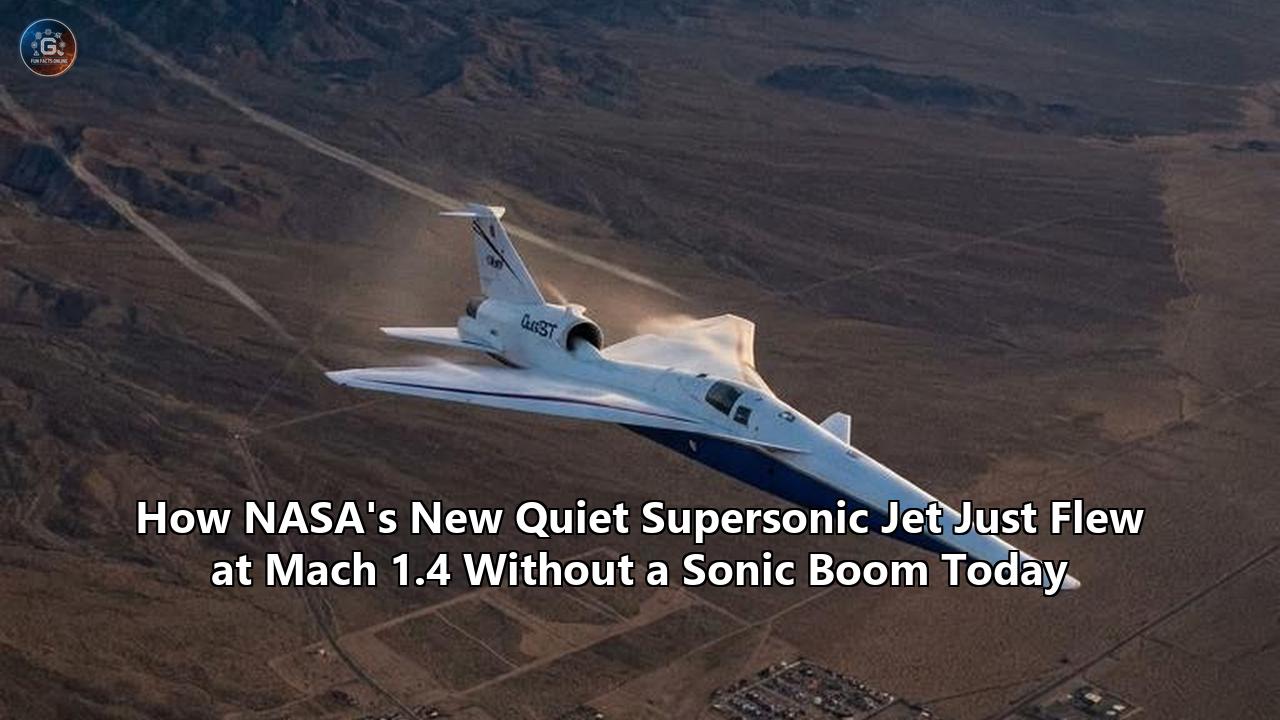
Over the high deserts of Southern California, the long-standing barrier to overland supersonic travel has begun to crack. On Friday, June 12, 2026, NASA’s experimental X-59 quiet supersonic research aircraft took off from Edwards Air Force Base and climbed rapidly into the stratosphere. Accelerating far beyond the speed of sound, the slender, needle-nosed aircraft reached its target cruise velocity of Mach 1.4—approximately 924 miles per hour—at an altitude of 55,000 feet.
This specific milestone, dubbed the "mission conditions" flight, represents the exact aerodynamic and atmospheric regime the aircraft must sustain to prove its core hypothesis: that an aircraft can travel faster than sound without generating a window-rattling sonic boom.
Unlike traditional supersonic aircraft that drop a thunderous double-bang across thousands of square miles on the ground, the X-59 is designed to produce a soft, barely perceptible "sonic thump". Under development for over a decade by Lockheed Martin’s famed Skunk Works, this NASA quiet supersonic jet represents the vanguard of a new age of civil aviation.
The success of the Mach 1.4 flight is not just a triumph of aerodynamic engineering; it is a critical regulatory gateway. By matching the precise cruising altitude and speed planned for future community overflights, NASA is preparing to gather real-world acoustic data that could convince global regulators to overturn half-century-old bans on civilian supersonic flight over land.
X-59 QueSST Mission Profile & Key Specifications
+-----------------------+---------------------------------------------+
| Parameter             | Value                                       |
+-----------------------+---------------------------------------------+
| Length                | 99.7 feet (30.4 meters)                     |
| Wingspan              | 29.5 feet (9.0 meters)                      |
| Nose Length           | 38.0 feet (11.6 meters)                     |
| Engine                | General Electric F414-GE-100                |
| Target Cruise Speed   | Mach 1.42 (approx. 925–937 mph)             |
| Operating Altitude    | 55,000 feet (16,800 meters)                 |
| Design Ground Noise   | 75 Perceived Level of Decibels (PLdB)       |
+-----------------------+---------------------------------------------+
To appreciate how the X-59 arrived at this pivotal moment, it is necessary to trace a story of engineering perseverance, regulatory stagnation, and a complete reimagining of flight physics. This timeline stretches from the premature death of first-generation commercial supersonic travel to the high-altitude success achieved today.
1973: The Legacy of the Boom and the Overland Ban
The quest for quiet supersonic flight is a direct response to a regulatory wall erected more than fifty years ago.
When Chuck Yeager broke the sound barrier in 1947 in the Bell X-1, the loud double-bang that trailed in his wake was treated as a badge of technological progress. As military jets multiplied throughout the 1950s and 1960s, however, that badge of honor quickly turned into an environmental nuisance. Sonic booms shattered greenhouse glass, cracked plaster in suburban homes, terrified livestock, and disrupted daily life.
The physics of a traditional sonic boom are unyielding. As an aircraft flies through the air, it pushes air molecules out of the way, creating a series of pressure waves. At subsonic speeds, these waves travel ahead of the aircraft at the speed of sound.
When the aircraft itself reaches or exceeds the speed of sound, the pressure waves cannot get out of their own way. Instead, they coalesce into a single, massive shockwave at the front of the vehicle and another at the rear. These are known as N-waves, named after the shape of their pressure profile over time:
- A sudden, sharp rise in pressure (the bow shock).
- A gradual decline below normal atmospheric pressure.
- A rapid snap back to ambient pressure (the tail shock).
To an observer on the ground, this sudden change in air pressure is heard as a violent, explosive double-bang.
By the late 1960s, the arrival of the Anglo-French Concorde and the Soviet Tupolev Tu-144 threatened to make these disruptive booms a daily reality for millions. In response, the United States Federal Aviation Administration (FAA) took decisive action. In April 1973, the FAA enacted a strict ban on all civil supersonic flights over the continental United States. Other nations quickly followed suit.
This regulatory ban crippled the commercial viability of first-generation supersonic transports. The Concorde, which had been envisioned as the future of global travel, was legally restricted to oceanic routes, primarily London and Paris to New York.
Restricted to a tiny fraction of its intended market, the Concorde could never achieve the economies of scale needed to survive. It flew for decades as a boutique transport for the wealthy before being retired in 2003.
For nearly half a century, commercial aviation remained firmly subsonic. Lifting the overland ban required a fundamental shift in how aircraft interacted with the air around them, and this high-speed endeavor is the primary objective of the X-59, the experimental NASA quiet supersonic jet designed to rewrite the rulebook of aviation acoustics.
2016–2018: The Genesis of QueSST
The path toward a quiet supersonic future began to materialize in the mid-2010s under NASA's Low-Boom Flight Demonstration (LBFD) project. Recognizing that computational fluid dynamics (CFD) and supercomputing had progressed to a point where airflows could be modeled with unprecedented precision, NASA engineers set out to prove that the shape of an aircraft could prevent shockwaves from merging into a loud N-wave.
In February 2016, NASA awarded a preliminary design contract to Lockheed Martin’s Skunk Works to develop the Quiet SuperSonic Technology (QueSST) concept. The mandate was clear: design a piloted, large-scale supersonic experimental aircraft that could limit the ground-level sound of a sonic boom to a gentle "thump" of 75 Perceived Level Decibels (PLdB) or less.
For comparison, a Concorde’s sonic boom registered at roughly 105 PLdB—loud enough to startle people indoors and shake structural foundations. A level of 75 PLdB is acoustically equivalent to the sound of a car door closing from twenty feet away.
Comparative Noise Levels (PLdB)
+-----------------------+-----------------------------+-------------------+
| Source/Aircraft       | Perceived Decibels (PLdB)  | Ground Experience |
+-----------------------+-----------------------------+-------------------+
| Concorde              | 105                         | Thunderous Boom   |
| Typical Thunderstorm  | 90–100                      | Loud Crack        |
| X-59 Target           | 75                          | Soft Thump        |
| Car Door (20 ft away) | 75                          | Dull Thud         |
| Suburban Street       | 50–60                       | Background Hum    |
+-----------------------+-----------------------------+-------------------+
From February to April 2017, NASA and Lockheed Martin began testing a 9%-scale model of the QueSST design inside the 8-by-6-foot Supersonic Wind Tunnel at NASA’s Glenn Research Center in Cleveland, Ohio. The model was subjected to wind speeds ranging from Mach 0.3 to Mach 1.6 to analyze how the shockwaves generated by its nose, wings, and engine intake interacted with one another.
The wind tunnel tests confirmed the computational models. By lengthening the nose and carefully tailoring the cross-sectional area of the fuselage, engineers could indeed prevent the individual shockwaves from merging.
With the design validated, NASA transitioned the program from a theoretical study into an active aircraft build. On April 2, 2018, NASA awarded Lockheed Martin a $247.5 million contract to finalize the design, construct the aircraft, and deliver the completed demonstrator to NASA’s Armstrong Flight Research Center.
Engineering the Architecture of Silence
Engineering the NASA quiet supersonic jet required discarding over a century of traditional aerodynamic assumptions. To prevent the shockwaves from combining, every physical feature of the aircraft had to be meticulously positioned to keep the waves separate, weak, and radiating at different times.
                  === SHOCKWAVE MITIGATION GEOMETRY ===

       [38-Foot Needle Nose]          [Top-Mounted Engine Inlet]
  _______________________________/\_                 ___|___
  \_______________________________/ \_______________/   |   \  <-- [Swept Wings]
                                     \_____________/    o    \
                                                   \_________/
                                                   [T-Tail Deflector]
The Needle-Shaped Nose
The most striking feature of the X-59 is its elongated, needle-shaped nose, which stretches 38 feet. Making up nearly 40% of the aircraft's total 99.7-foot length, this nose acts as a physical buffer.
When a typical jet flies supersonic, the nose generates a primary shockwave that immediately merges with secondary waves from the canopy and wings. The X-59's ultra-long nose spreads these pressure gradients over a much wider distance, preventing the initial bow shock from being reinforced by subsequent waves.
The eXternal Vision System (XVS)
Because the nose is so long and slender, the cockpit is set far back in the fuselage. This placement created a severe engineering dilemma: the pilot would have absolutely no forward-facing physical visibility. A traditional raised cockpit canopy would project into the supersonic airflow, creating a severe aerodynamic discontinuity that would generate its own powerful shockwave.
To solve this, NASA and Lockheed Martin eliminated the forward-facing windshield entirely. The pilot sits beneath a flush canopy with side windows, looking forward at a 24-inch diagonal ultra-high-definition monitor. This screen is the centerpiece of the eXternal Vision System (XVS).
The XVS combines a forward-facing 4K color camera mounted on top of the nose with a long-wave infrared and multispectral sensor array beneath the fuselage. Sophisticated image-processing software stitches these feeds together in real-time, overlaying flight symbology, terrain data, and active traffic tracking.
During testing on a surrogate Beechcraft King Air aircraft, pilots found that the XVS actually offered superior daytime traffic detection compared to standard human vision, providing an average of 15 seconds of additional warning time during see-and-avoid maneuvers.
                     === XVS ARCHITECTURE ===

     [Forward 4K Camera]               [XVS Processors]      [Pilot Display]
    +-------------------+              +--------------+    +-----------------+
    | 3840 x 2160 Color | -----------> | Real-Time    | -> | 24-Inch 4K      |
    | 33° x 19° Field   |              | Stitching &  |    | Cockpit Monitor |
    +-------------------+              | Symbology    |    +-----------------+
                                       | Overlay      |             ^
    +-------------------+              +--------------+             |
    | Collins EVS-3600  | --------------------/                     |
    | Multispectral IR  |                                           |
    +-------------------+                                           |
     [Under-Nose Camera]  <------------- [Pilot Inputs] -------------+
Top-Mounted Propulsion and T-Tail Acoustics
The engine of the X-59 is a single General Electric F414-GE-100 afterburning turbofan, producing 22,000 pounds of thrust. While this engine is a variant of the powerplant used in the F/A-18E/F Super Hornet, its integration into the X-59 is highly unconventional.
The engine is mounted on the upper surface of the aircraft, with its air intake sitting directly behind the cockpit canopy. This design choice is critical for acoustic control.
When an engine inlet is placed underneath or on the sides of a fuselage, the highly complex, turbulent shockwaves generated by the intake cascade downward toward the ground. By placing the engine and its intake on top of the airframe, the aircraft itself acts as a massive physical shield, forcing those acoustic signatures upward and away from populated areas below.
Directly behind the engine exhaust sits a high-mounted T-tail. This tail structure serves a dual purpose: it acts as an aerodynamic stabilizer and as an acoustic deflector.
The tail’s surfaces are angled to redirect the exhaust plume and its associated shockwaves upward, ensuring that the final acoustic signature that reaches the ground remains a dull, harmless thud.
2019–2024: The Road Through Palmdale
Building an entirely new experimental aircraft from scratch is an exercise in complex logistics, and the X-59 program had to navigate a series of profound global and technical disruptions.
Assembly of the aircraft began in mid-2019 at Lockheed Martin’s highly secure Skunk Works facility in Palmdale, California. Machining of the first structural parts commenced, and by June of that year, the initial wing-skin panels were being loaded into the tooling assembly. The plan was to utilize a variety of proven components from existing military aircraft to keep the overall program cost under control:
- The landing gear and flight systems were adapted from an F-16 Falcon.
- The aft cockpit and ejection seat were sourced from a T-38 Talon supersonic trainer.
- The control surface actuators were derived from parts used in the U-2 spy plane.
However, the onset of the COVID-19 pandemic in early 2020 threw global supply chains and manufacturing schedules into disarray. Skunk Works technicians had to adapt to socially distanced assembly environments, while key component deliveries from subcontractors faced severe delays.
Additionally, integrating the complex, government-furnished eXternal Vision System with the commercial Pro Line Fusion avionics package supplied by Collins Aerospace proved to be a highly demanding software engineering challenge.
                === CHRONOLOGICAL DEVELOPMENT TRACK ===

 2016                   2018             2020           2024          2026
  |----------------------|----------------|--------------|-------------|
[QueSST             [Lockheed         [Pandemic      [X-59 Rollout  [First Flight
 Contract]           Contract]         Delays]        & Engine       to Mach 1.4]
                                                      Testing]
Despite these setbacks, the team made steady progress. In early November 2022, technicians successfully installed the General Electric F414-GE-100 engine into the fuselage.
By late 2023, the airframe was fully integrated, structural proof-load testing was complete, and the aircraft was prepped for its public debut.
On January 12, 2024, NASA and Lockheed Martin rolled the X-59 out of the Palmdale hangar before a crowd of international journalists, aerospace executives, and agency officials. Painted in a striking scheme of white, blue, and sonic red, the NASA quiet supersonic jet stood as a physical manifestation of a decade’s worth of acoustic research.
At the rollout, NASA officials emphasized that the aircraft was not intended to serve as a prototype for a future commercial airliner, but rather as an aerodynamic testbed designed to prove the viability of low-boom shapes and establish the database needed to change global aviation laws.
Late 2024–Early 2026: The Subsonic Prelude
Before an experimental aircraft can fly faster than the speed of sound, it must first prove that it can fly safely and predictably below it. Following its public rollout, the X-59 entered an intensive, multi-phase ground and flight testing campaign.
The first major milestone occurred in November 2024, when the ground crew ran the F414 engine while integrated into the airframe for the first time. These static engine runs allowed engineers to verify that the fuel systems, electrical networks, and engine control units operated in harmony without interference or thermal buildup within the tightly packed upper fuselage.
With the propulsion system verified, ground testing transitioned to mobile operations. On July 17, 2025, the X-59 completed its first self-powered taxi test, moving under its own engine power down the runways of Air Force Plant 42 in Palmdale.
This was followed on July 25 by a critical system calibration test, where an instrumented NASA F-15B research aircraft flew overhead and taxied nearby to cross-reference the X-59’s ground instruments and telemetry links.
                 === KEY STEPS TO INITIAL FLIGHT ===

   [Hangar Rollout]       [Engine Run]       [Taxi Test]        [Maiden Flight]
     Jan 12, 2024         Nov 2024          Jul 17, 2025         Oct 28, 2025
          |-------------------|------------------|-------------------|
The tension culminated on the morning of October 28, 2025, when the X-59 took to the skies for its historic maiden flight. Taking off from Palmdale, the aircraft flew an hour-long subsonic profile, reaching an altitude of 12,000 feet and a top speed of 230 miles per hour before landing safely at NASA's Armstrong Flight Research Center on Edwards Air Force Base.
This initial flight stayed firmly within the subsonic regime, focusing on basic handling qualities, the functionality of the landing gear, and the performance of the eXternal Vision System in real-world flight conditions.
Over the next six months, the flight test team steadily expanded the aircraft's performance envelope. On April 3, 2026, the X-59 completed its first "wheels up" flight, during which the pilots retracted the landing gear for the first time in mid-air, allowing the aircraft to reach an altitude of 20,000 feet and a speed of approximately 460 miles per hour.
Between February and May 2026, NASA conducted a rigorous "Block One" flight campaign, completing 16 subsonic flights in 90 days. This rapid pace allowed the team to build up a steady test rhythm, verify the integrity of the structural modifications, and ensure the vehicle was ready for the extreme stresses of supersonic flight.
June 5, 2026: Breaking the Sound Barrier
On Friday, June 5, 2026, the X-59 team finally prepared to push the aircraft past the transonic threshold.
At 11:08 a.m. Pacific Daylight Time, NASA test pilot Jim “Clue” Less lined up on the main runway at Edwards Air Force Base. Pushing the throttle forward, he ignited the afterburner and climbed into the supersonic test corridor over the Mojave Desert—the very same airspace where Chuck Yeager had first broken the sound barrier 79 years prior.
As the X-59 climbed through 43,400 feet, Jim Less pushed the nose down slightly to gather speed and then leveled out. The cockpit telemetry display on his eXternal Vision System began to tick upward: Mach 0.95, Mach 0.98, Mach 1.01.
At Mach 1.1, the X-59 was officially supersonic.
                       === THE TRANSONIC MOMENT ===

         [Cockpit Display]                 [Pilot Experience]
    +-------------------------+      +---------------------------+
    | Mach: 1.10              |      | "I didn't feel anything.  |
    | Altitude: 43,400 ft     | ---> |  You only know you are    |
    | Cabin: Stable           |      |  supersonic when the      |
    +-------------------------+      |  gauges tell you so."     |
                                     +---------------------------+
Inside the cockpit, the transition was completely anticlimactic. "You know you are supersonic when gauges say you are supersonic. I didn't feel anything," Less remarked after landing. "It went smoothly, and we easily got to Mach 1.1."
The aircraft exhibited excellent stability, showing no signs of the violent buffeting or control reversals that characterized early supersonic aircraft.
However, NASA was not yet able to measure the aircraft's independent ground-level noise profile during this flight. To ensure the safety of the pilot and the experimental aircraft, the X-59 was accompanied by a NASA F-15B research chase plane.
Because the conventional F-15B generates its own powerful, standard sonic boom, its loud double-bang completely masked any quiet "thump" produced by the X-59. Isolating the X-59's unique acoustic signature would have to wait for later, dedicated testing phases.
The June 5 flight was an enormous success, confirming that the airframe, engine control systems, and unique cockpit visibility display functioned perfectly in the transonic and low-supersonic regime.
NASA Administrator Jared Isaacman celebrated the milestone, stating, "X-59 is getting ready for its quiet supersonic debut... In the coming days, we expect to take the next step and push to Mach 1.4."
June 12, 2026: Reaching Mach 1.4 "Mission Conditions"
The promise of that push was realized just one week later. On Friday, June 12, 2026, the X-59 took off from Edwards Air Force Base for its most critical flight to date: its first "mission conditions" sortie.
The flight plan called for the aircraft to climb far higher and fly significantly faster, targeting the precise cruise parameters of Mach 1.4 at an altitude of 55,000 feet. These are the exact speed and altitude conditions that the aircraft must maintain during its upcoming community overflights.
These specific parameters are critical because the density of the atmosphere at 55,000 feet, combined with a speed of Mach 1.4, is the sweet spot where the X-59's low-boom shaping is mathematically designed to perform at its peak efficiency.
                    === FLIGHT TEST ENVELOPE EXPANSION ===

  Altitude (ft)
   60,000 |___________________________________________[June 12: Mach 1.4 at 55k ft]
          |                                            (Mission Conditions)
   50,000 |
          |__________________[June 5: Mach 1.1 at 43.4k ft]
   40,000 |                  (First Supersonic Flight)
          |
   30,000 |
          |_________[April 3: 460 mph at 20k ft]
   20,000 |         (Wheels Up)
          |____[Oct 28, 2025: 230 mph at 12k ft]
   10,000 |    (Maiden Flight)
          |__________________________________________________________________
          0        0.4       0.8       1.2       1.6       2.0      Mach
The flight went flawlessly. The X-59 climbed into the thin, cold air of the upper stratosphere, where the temperature sits at a constant -69°F (-56°C).
At 55,000 feet, the air density is only about 10% of what it is at sea level, requiring precise control of the engine's fuel-air mixture and the intake duct’s pressure recovery systems.
As the aircraft reached its cruise station, the pilot stabilized the vehicle and pushed the throttle forward. On the eXternal Vision System main screen, the digital readout confirmed the historic achievement: Mach 1.4 at 55,030 feet.
For the first time, the X-59 was flying at its true design speed.
Once again, a NASA F-15 chase plane was on hand to monitor the flight, capture high-speed video, and provide safety backup. The flight confirmed that the X-59’s aerodynamic control surfaces—including its unique canards and the complex flight control software—remained highly responsive in the thin air of the stratosphere, with no adverse aeroelastic flutter or engine stability issues.
"Having the pilot reach this milestone is a massive leap forward," said a project manager at NASA’s Integrated Aviation Systems Program. "We’ve spent ten years modeling this aircraft in computers and testing scale models in wind tunnels. To see the full-scale vehicle flying perfectly at Mach 1.4 and 55,000 feet is a validation of the incredible work done by the entire NASA and Lockheed Martin team."
2026–2028: The Roadmap to Changing Global Policy
Now that the X-59 has successfully proven it can reach and sustain its target mission conditions, the program is transitioning from basic aerodynamic envelope expansion into its active scientific phase.
Over the next several months, the test team will conduct a series of highly specialized acoustic validation flights. The goal of this phase is to thoroughly map and measure the aircraft's actual supersonic shockwave signature to prove that the "quiet thump" is performing exactly as designed in the real world.
                         === THE ROAD TO REPEAL ===

   [Acoustic Validation]      [Community Overflights]     [Data to FAA/ICAO]
       Late 2026                 2026–2027                    2028
  +------------------+       +-------------------+       +------------------+
  | Measure thump    | ----> | Fly over cities   | ----> | Submit database  |
  | with ground mics |       | and survey public |       | to replace the   |
  +------------------+       +-------------------+       | overland ban     |
                                                         +------------------+
To capture this signature, NASA will employ several state-of-the-art testing methods:
- The Ground Microphone Array: A 30-mile-long carpet of highly sensitive ground microphones will be deployed across the Mojave Desert to record the exact pressure waves generated by the X-59 as it passes overhead at Mach 1.4.
- Air-to-Air Schlieren Photography: NASA will use an advanced, high-speed camera system mounted on a chase plane to capture Schlieren images of the shockwaves backlit by the sun. This technique allows researchers to physically see the density variations in the air, creating a visual map of the shockwaves to verify that they are indeed remaining separate and weak as they propagate away from the aircraft.
Once the acoustic signature is validated, NASA will initiate the most critical phase of the Quesst mission: the community overflight campaign.
Beginning in late 2026 and continuing through 2027, the X-59 will fly over several selected U.S. cities and communities. These flights will be conducted at Mach 1.4 and 55,000 feet.
During these overflights, NASA will operate an extensive, independent public survey system. They will gather feedback from thousands of residents on the ground to determine if they noticed the quiet supersonic thump, and if so, how they perceived the sound.
The resulting database will be entirely public, providing an objective, scientific measure of human response to low-boom supersonic flight.
This database is destined for a very specific and historic purpose: it will be delivered to the Federal Aviation Administration (FAA) and the International Civil Aviation Organization (ICAO) in 2027 and 2028.
For over fifty years, supersonic aviation has been governed by speed-based restrictions (i.e., a blanket ban on flying faster than Mach 1 over land). NASA’s goal is to replace these speed-based restrictions with noise-based standards.
If the data proves that a noise level of 75 PLdB is acceptable to the public, regulators can lift the 1973 ban and establish a new, data-driven maximum noise threshold for overland flight.
               === REGULATORY REFORM COMPREHENSIVE VIEW ===

      Current Policy (1973–Present)         Proposed Policy (Post-2028)
     +------------------------------+     +-------------------------------+
     |  Speed-Based Ban             |     |  Noise-Based Standards        |
     |                              |     |                               |
     | "No civilian aircraft        | --> | "Supersonic flight is allowed |
     |  may exceed Mach 1.0         |     |  if the aircraft generates    |
     |  over land."                 |     |  less than 75 PLdB on ground."|
     +------------------------------+     +-------------------------------+
The political machinery is already beginning to move in anticipation of these results. In March 2026, the U.S. House of Representatives passed the Supersonic Aviation Modernization Act, which directs the FAA to begin drafting the regulatory framework for lifting the overland ban.
A final rule is anticipated by mid-2027, aligning perfectly with the delivery of the X-59’s community noise data.
If the regulatory path is cleared, the economics of global aviation will change overnight. Aerospace startups and established manufacturers alike—such as Boom Supersonic, which is currently developing its own Mach 1.7 Overture airliner—will finally have a clear, predictable market.
Instead of being confined to the same ocean-only routes that doomed the Concorde, a new generation of quiet supersonic passenger jets will be able to fly routes like New York to Los Angeles in just two and a half hours, or Tokyo to Seattle in under five hours, without ever disturbing the peace of the communities below.
As the X-59 taxied back to its hangar on June 12, 2026, the quiet desert air settled once again. But the silence left behind was different.
By reaching Mach 1.4 without a boom, NASA and Lockheed Martin have proved that the future of aviation does not have to choose between speed and silence. The sound of tomorrow’s skies may not be a violent explosion, but a quiet, gentle thump.
Reference:
- https://migflug.com/jetflights/nasa-x-59-quesst-first-supersonic-flight-mach-1-june-2026/
- https://www.aerospacetestinginternational.com/news/nasa-x-59-flies-supersonic-for-first-time.html
- https://www.nasa.gov/blogs/quesst/2026/06/12/x-59-blog-061226/
- https://aerospaceamerica.aiaa.org/nasas-x-59-breaks-sound-barrier-in-first-supersonic-flight/
- https://en.wikipedia.org/wiki/Lockheed_Martin_X-59_Quesst
- https://www.nasa.gov/blogs/quesst/2026/06/08/x-59-blog-060826/
- https://ntrs.nasa.gov/api/citations/20205002812/downloads/AIAA%20Briefing%2C%20XVS%20RTOS%2C%20Version%202.pdf
- https://ntrs.nasa.gov/api/citations/20220006188/downloads/XVS%20Technical%20Overview%20-%20Short.pdf
- https://www.aerospacetestinginternational.com/news/nasa-x-59-flies-supersonic-for-first-time.html
- https://en.wikipedia.org/wiki/Lockheed_Martin_X-59_Quesst
- https://arc.aiaa.org/doi/10.2514/6.2020-3087
- https://aviationweek.com/business-aviation/aircraft-propulsion/x-59-supersonic-external-vision-system
- https://www.nasa.gov/aeronautics/x-59-first-supersonic-flight/
- https://aviationweek.com/aerospace/aircraft-propulsion/nasa-x-59-flies-mach-14-mission-conditions