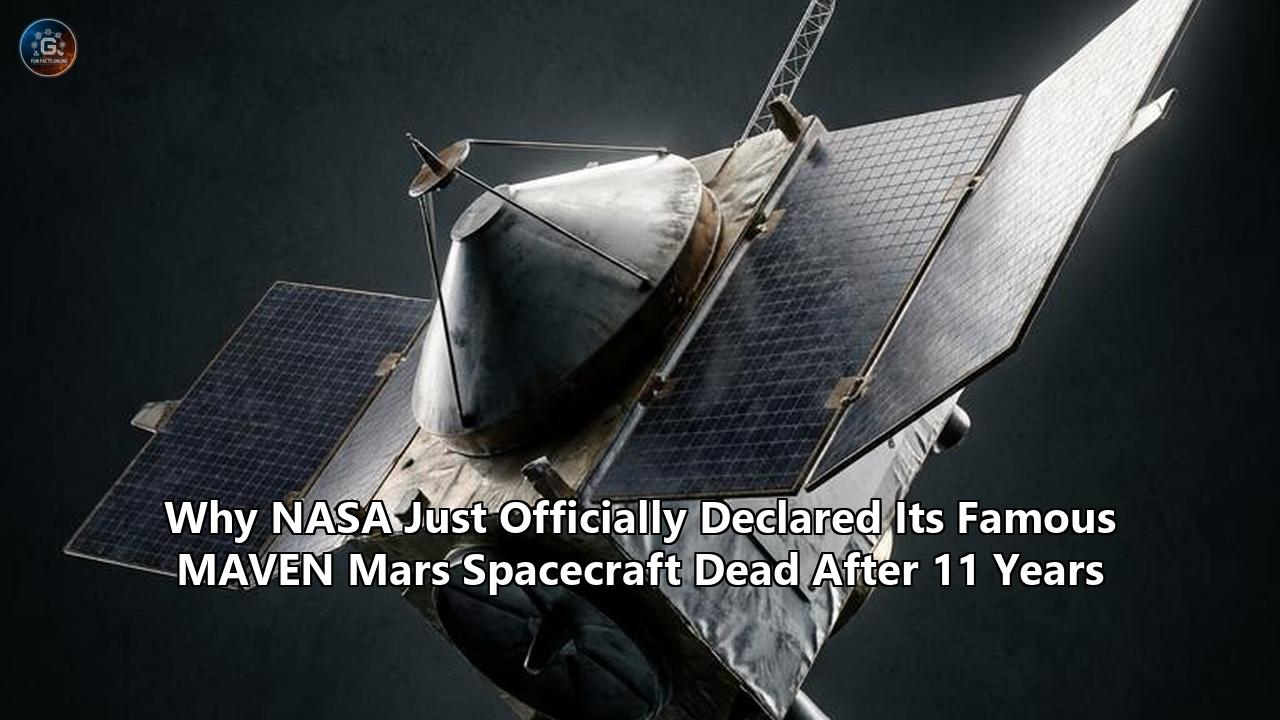
On June 3, 2026, NASA officially declared the mission of its celebrated Mars Atmosphere and Volatile EvolutioN (MAVEN) spacecraft at an end, closing the book on an eleven-year orbital odyssey that fundamentally rewrote human understanding of the Red Planet.
The decision to formally terminate the mission followed months of silent speculation and intense rescue operations, culminating in a definitive update to the NASA MAVEN spacecraft mission status on June 3. After MAVEN went quiet in late 2025 during a routine pass behind Mars, an intensive cross-agency effort failed to re-establish contact.
The loss of MAVEN is a double blow to the planetary science community. It silences the only dedicated orbital observer tracking the erosion of the Martian atmosphere in real time and cripples a vital relay point in the telecommunications network that brings data home from surface rovers like Curiosity and Perseverance.
An Abrupt End Behind the Red Planet
On December 6, 2025, MAVEN prepared for a routine orbital maneuver. The spacecraft was traveling in its standard highly elliptical orbit, which periodically took it behind the mass of Mars relative to Earth. This geometry, known as an occultation, typically blocks radio contact for 20 to 30 minutes.
Up to that point, every subsystem on the $582 million orbiter was performing nominally. There were no warning lights, no rising temperatures, and no indications of degradation in the weeks leading up to the pass.
When MAVEN was scheduled to emerge from the shadow of Mars and "phone home" via NASA’s Deep Space Network (DSN), only silence returned.
[Occultation Entry: Dec 6, 2025] ───► (Behind Mars: 20-30 min) ───► [Scheduled Reemergence]
         │                                    │                              │
   All systems nominal                 Anomalous spin begins           DSN detects no signal
As engineers and astronomers processed the devastating change in the NASA MAVEN spacecraft mission status, focus shifted from hope to forensic reconstruction. Operators combed through raw radio science data captured during the transition.
Ground-based receivers recorded a brief, fragmented snippet of telemetry as MAVEN slipped out from behind the Martian horizon on December 6. The data was alarming: the spacecraft was in safe mode and rotating at approximately 2.7 revolutions per minute (RPM).
For a three-axis stabilized spacecraft designed to point with high-precision instruments, a spin of nearly 3 RPM is a catastrophic kinetic event.
"Any kind of rotation was anomalous," said Mike Moreau, MAVEN project manager at NASA's Goddard Space Flight Center, during a June 3 press conference. "That's faster than the spacecraft is expected to rotate, and it points to a problem from which the spacecraft probably couldn't recover."
The uncontrolled tumble sealed MAVEN’s fate. Because the spacecraft was spinning erratically, its solar panels could not lock onto the Sun. Over several hours, the onboard batteries drained completely. Once the batteries died, the primary flight computers and radio transmitters lost all power, leaving MAVEN frozen, silent, and drifting.
Inside the Anomaly: The Months of Silent Hope
The official declaration of the spacecraft’s demise was not a rushed decision. Following the loss of signal, NASA engineers spent weeks sending "blind" recovery commands, hoping to force the spacecraft's primary flight computer to restart and realign its solar arrays.
The rescue efforts faced an immediate, scheduled complication. In late December 2025, Mars underwent solar conjunction—a periodic alignment where the Sun sits directly between Earth and the Red Planet. The hot plasma emitted by the Sun's corona severely disrupts radio signals, forcing NASA to temporarily suspend all communication attempts with Martian hardware from December 29, 2025, to January 16, 2026.
When the conjunction ended, recovery teams resumed their attempts. They even enlisted the help of the National Science Foundation’s massive 100-meter Green Bank Telescope in West Virginia to scan the heavens for any weak carrier signal MAVEN might be broadcasting. No signal was ever found.
+----------------------------------------------------------------------------+
|                          MAVEN RECOVERY TIMELINE                           |
+----------------------------------------------------------------------------+
|  Dec 6, 2025       | Initial loss of signal during scheduled occultation.  |
|  Dec 16-20, 2025   | Curiosity rover attempts to image MAVEN; no detection.|
|  Late Dec 2025     | Solar Conjunction blocks all Martian communications.  |
|  Jan 2026          | Post-conjunction recovery attempts using DSN & GBT.   |
|  Feb 2026          | NASA convenes formal Anomaly Review Board.            |
|  June 3, 2026      | Mission declared officially dead and decommissioned.  |
+----------------------------------------------------------------------------+
In February 2026, NASA convened an official Anomaly Review Board to evaluate the technical state of the orbiter. The board’s findings, presented on June 3, confirmed that MAVEN was permanently unrecoverable. While the final report detailing the root cause of the tumble will not be completed until later in 2026, engineers suspect several possibilities, including:
- A catastrophic hardware failure within the reaction wheels used to control spacecraft orientation.
- A localized flight software loop that triggered conflicting thruster firings.
- An impact from a micrometeoroid that physically knocked the spacecraft into an unmanageable spin.
"On a personal note, leading this team has been a privilege and an honor," said Shannon Curry, MAVEN's principal investigator at the University of Colorado Boulder's Laboratory for Atmospheric and Space Physics (LASP). "This team has worked tirelessly on operating the spacecraft and delivering exceptional science."
The Loss of a Vital Network Link: Impact on Surface Operations
While MAVEN is remembered for its scientific observations, its sudden silence creates an immediate operational crisis for NASA's active surface missions.
Rovers crawling across the Martian surface do not have the power or large high-gain antennas required to transmit massive files directly back to Earth. Doing so would require them to remain stationary for hours, draining precious battery reserves on slow direct-to-Earth links.
Instead, rovers utilize the Mars Relay Network (MRN). As orbiters fly overhead, surface missions beam their daily science, imagery, and engineering telemetry up to the spacecraft via ultra-high frequency (UHF) radio bands. The orbiters then save this data and use their much larger, higher-power high-gain antennas to transmit it to Earth’s Deep Space Network.
                     [ Earth: DSN Antennas ]
                                ▲
                                │ Deep Space Link
                                │ (X-band / Ka-band)
                                │
                    [ Mars Relay Orbiters ]
               (MRO, Odyssey, ESA TGO, Express)
                                ▲
                                │ Close-range Link
                                │ (UHF - Electra Radio)
                                │
                  [ Surface Rovers / Landers ]
                   (Curiosity, Perseverance)
The sudden shift in the NASA MAVEN spacecraft mission status leaves a critical vacancy in this Martian telemetry pipeline. MAVEN was equipped with an advanced Electra UHF relay radio payload provided by NASA’s Jet Propulsion Laboratory.
Though MAVEN was technically responsible for only about 8 percent of all scheduled relay sessions, its unique orbital characteristics meant it actually delivered nearly 18 percent of the total data hauled from the Martian surface back to Earth.
Unlike the Mars Reconnaissance Orbiter (MRO) or Mars Odyssey, which sit in low, near-circular orbits, MAVEN traveled in a highly elliptical orbit ranging from 180 kilometers to 4,500 kilometers above the surface. When MAVEN was at its highest point (apoapsis), it remained visible to surface rovers for long, continuous stretches.
These extended "view periods" allowed the spacecraft to execute massive data transfer sessions that low-altitude orbiters simply could not support.
Furthermore, MAVEN utilized an adaptive data rate system. As MAVEN swept across the Martian sky, the Electra radio automatically adjusted its transmission speed based on the changing distance and signal strength to the rover, maximizing data volume.
How the Fleet is Absorbing the Shock
To mitigate the loss of MAVEN's relay capacity, NASA and the European Space Agency (ESA) have adjusted the flight and communication schedules of the four remaining active orbiters in the Mars Relay Network:
- Mars Reconnaissance Orbiter (MRO): NASA's primary high-resolution imaging asset has dramatically increased its relay duties, boosting its average daily data transmission from roughly 447.5 Megabits per day to over 850.6 Megabits per day.
- ExoMars Trace Gas Orbiter (TGO): This ESA spacecraft has stepped up as the heavy lifter of the network, carrying its daily relay load from 1,562.7 Megabits to an astonishing 2,228.1 Megabits per day.
- Mars Odyssey: Launched in 2001, the aging spacecraft remains a reliable, though slower, backup node, transmitting around 107.3 Megabits per day.
- Mars Express: ESA’s veteran spacecraft (launched in 2003) continues to serve as an occasional backup relay.
While the immediate impact has been managed without halting surface rover operations, the margin of safety has grown thin. The remaining American orbiters are dangerously old. Mars Odyssey is 25 years old; MRO is 21 years old.
These systems are operating far past their design lifetimes and are prone to mechanical failures or fuel depletion. If MRO or Odyssey suffers a terminal anomaly tomorrow, the surface science pipeline will face a severe bottleneck.
The Science Deficit: Crucial Atmospheric Observations Silenced
MAVEN’s demise also creates a major scientific deficit. Since its arrival in orbit in September 2014, MAVEN was the only spacecraft specifically built to measure the upper atmosphere, ionosphere, and magnetosphere of Mars in situ.
To achieve this, the spacecraft was equipped with a highly specialized suite of instruments divided into three distinct packages:
The Particles and Fields Package
This suite characterized the Martian space environment and how it interacted with solar inputs.
- SWEA (Solar Wind Electron Analyzer): Mapped the distribution and energy of electrons to trace magnetic topologies.
- SWIA (Solar Wind Ion Analyzer): Measured the density, temperature, and velocity of the solar wind as it slammed into the planet.
- STATIC (Suprathermal and Thermal Ion Composition): Monitored low-energy ions escaping Mars to understand which gases were actively being lost.
- LPW (Langmuir Probe and Waves): Determined ionospheric density, electric fields, and wave-heating of escaping gas.
- SEP (Solar Energetic Particle): Tracked highly energetic protons and helium ions ejected during solar flares.
- MAG (Magnetometer): Provided high-resolution measurements of the local magnetic field environment.
The Remote Sensing Package
- IUVS (Imaging Ultraviolet Spectrograph): Created global maps of the upper atmosphere and ionosphere in ultraviolet wavelengths. This instrument was crucial for observing planetary-scale airglow, localized auroras, and tracking the hydrogen-to-deuterium ratio, which reveals how much water Mars has lost over its history.
The Mass Spectrometry Instrument
- NGIMS (Neutral Gas and Ion Mass Spectrometer): Directly sampled the chemical and isotopic composition of neutral gases and ions in the Martian upper atmosphere during the spacecraft's close flybys, or "deep dips".
                 +---------------------------------------+
                 |       MAVEN INSTRUMENT SUITES         |
                 +---------------------------------------+
                                     │
       ┌─────────────────────────────┼─────────────────────────────┐
       ▼                             ▼                             ▼
 [ Particles & Fields ]       [ Remote Sensing ]           [ Mass Spectrometry ]
  - SWEA, SWIA, STATIC         - IUVS (Ultraviolet          - NGIMS (Direct gas
  - LPW, SEP, MAG                Spectrograph for             & ion sampling
  (Solar wind & ion              global mapping)              during deep dips)
   environment tracking)
The loss of these instruments means scientists have lost their "space weather station" at Mars. This is particularly problematic because the Sun is currently at or near the peak of Solar Cycle 25/26, a period characterized by highly frequent and intensely powerful coronal mass ejections (CMEs) and solar flares.
Without MAVEN, there is no asset in orbit capable of measuring how these massive solar storms physically interact with and strip away the Martian upper atmosphere.
"We are missing a rare opportunity to watch how Mars behaves during the most violent solar storms in a generation," said Shannon Curry. "We have the compiled data from past storms, but we have lost the ability to observe the real-time dynamics of this highly active cycle."
The Science Legacy: A Decade of Rewriting Martian History
To understand the weight of MAVEN’s loss, one must examine its monumental scientific contributions. Before MAVEN, planetary scientists knew Mars had transitioned from a warm, wet, habitable world with ancient lakes and rivers to a frigid, hyper-arid desert. However, the exact mechanism of this transformation was a subject of fierce debate.
Over more than 11 years in orbit, MAVEN settled this debate by systematically tracing the historical theft of the Martian atmosphere.
1. The Solar Wind as a Thief
Unlike Earth, Mars lacks a global, internally generated magnetic field to shield it from cosmic forces. MAVEN's instruments proved that the solar wind—a continuous, supersonic stream of charged particles flowing from the Sun—is the primary driver of atmospheric escape.
The spacecraft's measurements showed that the solar wind strips away approximately 100 grams of gas (mostly oxygen and carbon dioxide) from the top of the Martian atmosphere every single second.
                             ( THE SOLAR WIND )
                        ~~~~~~~~~~~~~~~~~~~~~~~~~~~
                         ~~~~~~~~~~~~~~~~~~~~~~~~~
                                     │
                                     ▼
                          [ Martian Upper Atmosphere ]
                                     │
         ┌───────────────────────────┴───────────────────────────┐
         ▼                                                       ▼
 [ Steady State Escape ]                                 [ Solar Storm Spikes ]
  - Strips ~100g of gas per second.                       - Escape rate multiplies by 10x.
  - Slowly bleeds planet over eons.                       - Devastating stripping of atmosphere.
More importantly, MAVEN observed that this rate is not constant. During solar storms, when the Sun emits intense flares and coronal mass ejections, the atmospheric escape rate jumps by a factor of 10 or more.
Because the young Sun was much more active and produced far more frequent storms billions of years ago, MAVEN's data allowed scientists to calculate that Mars likely lost the majority of its thick, protective atmosphere early in its history, dooming its surface oceans.
2. Sputtering Observed for the First Time
In 2025, using 11 years of compiled data, MAVEN provided the first direct observation of an atmospheric escape process called "sputtering" on any planet. Sputtering is a kinetic process: energetic ions accelerated by the solar wind crash into the Martian atmosphere at such high velocities that they physically knock other, neutral gas molecules directly out into space—similar to the way a high-energy cannonball splash throws water out of a pool.
By analyzing the isotopes of the noble gas argon (which does not chemically react with other elements), MAVEN proved that sputtering had been slowly and continuously bleeding the planet dry for four billion years.
3. Dust Storm Elevators and Water Loss
In 2018, a massive, planet-wide dust storm enveloped Mars, providing MAVEN with a unique opportunity to study how localized weather affects global atmospheric loss. The orbiter discovered that the dust storm acted as an atmospheric elevator.
The intense heating of the dust lofted water vapor high into the upper atmosphere, where solar ultraviolet radiation broke the water molecules down into hydrogen and oxygen.
Once broken apart, these lighter atoms escaped into space at a highly accelerated rate. This crucial observation linked dust, climate, and the permanent loss of Mars' ancient oceans into a single, cohesive system.
4. Exotic Auroras and Invisible Light Shows
MAVEN also discovered that Mars experiences spectacular, planet-wide auroral displays. Unlike Earth's auroras, which are channeled toward the polar regions by our global magnetic field, Martian auroras can occur globally.
MAVEN detected "diffuse auroras" caused by solar energetic particles plunging deep into the atmosphere, causing the entire planet to glow in ultraviolet light.
The orbiter also identified "proton auroras," which occur when solar wind protons capture electrons from neutral hydrogen atoms in Mars' corona, allowing them to bypass the planet's localized magnetic field and glow in the daylit atmosphere.
The Long-Term Consequences: Future Mars Exploration and Human Spaceflight
The termination of MAVEN’s operations will reverberate far beyond the academic research community. As researchers adjust to the new NASA MAVEN spacecraft mission status, the long-term impact on the future planning of robotic and human missions to Mars is becoming painfully clear.
+---------------------------------------------------------------------------------+
|                         MAVEN LOSS: LONG-TERM IMPACTS                           |
+---------------------------------------------------------------------------------+
|  Space Weather &    | No real-time tracking of CME impacts on Mars.             |
|  Astronaut Safety   | Loss of critical data needed to design radiation shields.|
+---------------------+-----------------------------------------------------------+
|  Entry, Descent,    | Lack of upper-atmosphere density profiles.                |
|  & Landing (EDL)    | Higher risk of landing failure for large payloads.        |
+---------------------+-----------------------------------------------------------+
|  Mars Sample        | Depleted relay network forces reliance on aging orbiters. |
|  Return (MSR)       | Increases technical risk of returning physical samples.   |
+---------------------------------------------------------------------------------+
1. The Human Radiation Hazard
"The science MAVEN has given us is key to informing what kind of radiation protection and safety measures we must take before sending humans to Mars," said Louise Prockter, director of the Planetary Science Division at NASA Headquarters.
Mars lacks a thick atmosphere and a global magnetic shield, meaning astronauts on its surface will be exposed to dangerous levels of galactic cosmic rays and solar energetic particles. MAVEN was the primary instrument tracking how these radiation particles propagate through the thin Martian atmosphere.
Without MAVEN's continuous environmental data, aerospace engineers will have to design habitats and spacesuits with higher, more conservative safety margins, potentially driving up the weight, complexity, and cost of future crewed missions.
2. Aerocapture, Entry, Descent, and Landing (EDL) Challenges
Landing heavy payloads on Mars is incredibly difficult. The Martian atmosphere is thick enough to generate extreme friction and heat, yet too thin to slow down heavy spacecraft sufficiently using conventional parachutes alone.
Future missions—particularly those carrying humans or massive cargo—hope to utilize "aerocapture," a technique where a spacecraft uses a high-speed pass through the upper atmosphere to bleed off velocity and enter orbit without consuming massive amounts of fuel.
Aerocapture and precise landing profiles rely entirely on highly accurate, real-time measurements of upper atmospheric density. MAVEN's continuous profile tracking was the baseline dataset used to build global atmospheric models.
With MAVEN gone, mission planners must rely on static, historical models. Unexpected localized warming or cooling of the upper atmosphere could dramatically alter atmospheric density, introducing significant, unmonitored flight path errors during critical entry, descent, and landing phases.
3. The Mars Sample Return (MSR) Bottleneck
The loss of MAVEN’s robust data relay capabilities occurs at a sensitive moment for the Mars Sample Return (MSR) campaign. The complex, multi-spacecraft endeavor to retrieve rock and soil cores collected by the Perseverance rover and launch them back to Earth will require unprecedented levels of communication support.
The return ascent vehicle, orbital rendezvous spacecraft, and recovery landers will all need constant, low-latency data links. MAVEN was slated to play a key role in this relay network.
Its loss forces NASA to rely on the remaining, aging orbital constellation, increasing the technical risk profile of what is already one of the most complex space missions ever attempted.
What Lies Ahead: MAVEN’s Ghostly Final Decades
While MAVEN is functionally dead, its physical presence will remain in the skies of Mars for generations.
NASA will make no further attempts to contact or control the spacecraft. Because MAVEN is in a stable, high-altitude orbit (with its lowest point at 180 kilometers), there is very little atmospheric drag acting on its physical structure.
According to project manager Mike Moreau, the defunct orbiter is expected to remain in orbit around Mars for at least the next 50 to 100 years.
Eventually, over the course of many decades, tiny amounts of friction from the topmost layers of the Martian atmosphere will slowly decay MAVEN’s orbit.
In the late 2070s or early 2080s, the dead spacecraft will make its final, dramatic plunge, burning up as a artificial meteor in the very atmosphere it spent more than a decade studying. NASA officials have confirmed that MAVEN’s orbital path is far enough away from other active orbiters that it poses no collision hazard to current or planned missions.
Building the Mars Telecommunications Network
Recognizing the fragile state of its current orbital fleet, NASA has begun taking steps to replace the aging relay infrastructure. In May 2026, just weeks before officially declaring MAVEN dead, the agency issued a formal request for proposals (RFP) to commercial space companies for the development of a brand-new, purpose-built "Mars Telecommunications Network" (MTN).
       [ Current Status (2026) ]
       - Relay Network relies on aging, repurposed science assets (MRO, Odyssey).
       - Thin operational margins.
                           │
                           ▼
       [ Proposed Future (2030+) ]
       - Purpose-built Mars Telecommunications Network (MTN).
       - Continuous, high-bandwidth commercial communication nodes.
The MTN is envisioned as a dedicated constellation of small, high-throughput communication satellites placed in stationary or highly coordinated orbits around Mars. Rather than repurposing old scientific orbiters to double as communication relays, this new network will be designed from the ground up to provide continuous, high-bandwidth communication links.
These links will support the upcoming Mars Sample Return missions and lay the telecommunications foundation for eventual crewed exploration.
However, the MTN will not be ready until 2030 at the absolute earliest, leaving a four-to-five-year "vulnerability window" where the aging MRO and Odyssey spacecraft must carry the relay load alone.
A Legacy Locked in Archives
For now, the MAVEN team has begun the solemn process of decommissioning the mission, archiving its massive eleven-year dataset.
The compiled records—detailing solar storms, atmospheric escape rates, ionospheric shifts, and chemical profiles—will be preserved in NASA's Planetary Data System. This open-access archive will serve as a foundational resource for planetary scientists, climate modelers, and aerospace engineers for decades to come.
"The data collected from MAVEN will continue to provide valuable insight into Mars for decades," said Louise Prockter.
Though its radio has gone silent and its thrusters are cold, MAVEN’s decade of observations has forever altered how humanity views the Red Planet.
It showed us that Mars was not always a barren wasteland, but a world slowly, inevitably stripped of its life-giving atmosphere by the silent, relentless currents of our solar system’s star.
Understanding that dynamic is MAVEN’s true monument—a legacy that will guide our steps when human boots finally touch the Martian dust.
Reference:
- https://www.cbsnews.com/news/nasa-declares-end-mars-orbiter-maven-mission/
- https://www.nasa.gov/news-release/nasa-says-farewell-to-maven-mars-mission-hosts-media-call-today/
- https://www.astronomy.com/science/nasa-fails-to-reestablish-contact-decommissions-maven/
- https://www.sciencenews.org/article/nasa-maven-mars-atmosphere-dead
- https://skyandtelescope.org/astronomy-news/mars-maven-mission-may-be-lost-in-space/
- https://mashable.com/science/nasa-mars-orbiter-maven-decommissioning
- https://www.livescience.com/space/space-exploration/in-an-unrecoverable-state-nasa-confirms-maven-spacecraft-is-officially-dead-after-loss-of-signal-behind-mars
- https://universemagazine.com/en/what-made-the-maven-probe-memorable-to-space-enthusiasts/
- https://www.astronomy.com/science/nasa-fails-to-reestablish-contact-decommissions-maven/
- https://en.wikipedia.org/wiki/MAVEN
- https://science.nasa.gov/mars/mars-relay-network/
- https://discovery.larc.nasa.gov/PDF_FILES/28Mars_Relay_Description.pdf
- https://en.wikipedia.org/wiki/MAVEN
- https://lasp.colorado.edu/maven/2014/11/10/newest-nasa-mars-orbiter-demonstrates-relay-prowess/
- https://www.space.com/23617-nasa-maven-mars-mission.html
- https://atmos.nmsu.edu/data_and_services/atmospheres_data/MAVEN/logs/Mission%20and%20spacecraft%20description.pdf
- https://www.nasa.gov/image-article/mavens-instruments/
- https://www.nasa.gov/missions/maven/nasas-maven-observes-the-disappearing-solar-wind/
- https://mashable.com/science/nasa-mars-orbiter-maven-decommissioning
- https://www.sciencenews.org/article/nasa-maven-mars-atmosphere-dead
- https://lasp.colorado.edu/maven/2015/11/05/maven-reveals-speed-of-solar-wind-stripping-martian-atmosphere/
- https://caliber.az/en/post/nasa-formally-declares-end-to-maven-mars-mission-following-loss-of-contact