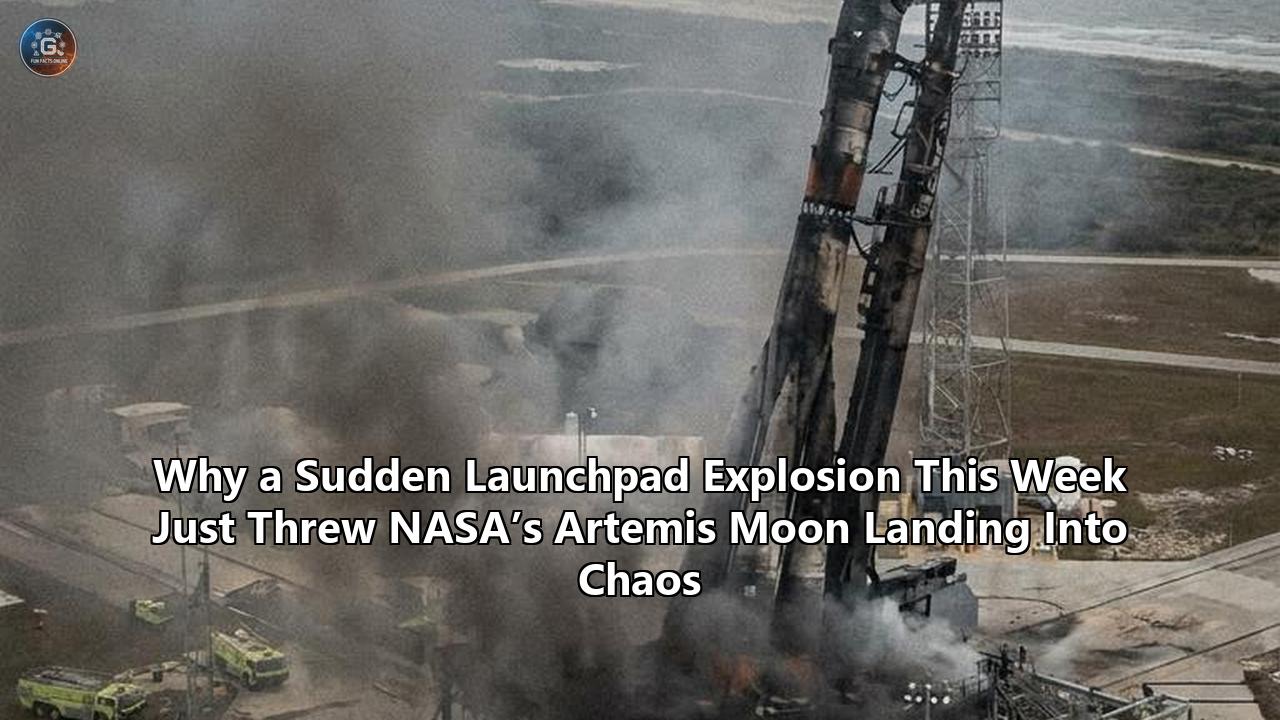
The night sky over Florida’s Space Coast was painted a sudden, violent shade of orange at approximately 9:00 p.m. EDT on Thursday, May 28, 2026. At Cape Canaveral Space Force Station’s Launch Complex 36, engineers for Jeff Bezos’s Blue Origin were counting down the final seconds of a static "hotfire" test of the massive New Glenn rocket’s first stage. It was supposed to be a routine check—a brief ignition of the seven methane-fueled BE-4 engines while the 321-foot-tall vehicle remained clamped securely to the pad. Instead, a structural anomaly near the base of the booster triggered an immediate and catastrophic conflagration.
As the engines ignited, a rapidly growing fire quickly enveloped the 188-foot-tall first stage. Within seconds, the 86-foot upper stage tilted and collapsed into the flames, triggering a massive secondary explosion that sent shockwaves felt more than 100 miles away. Col. Brian Chatman, commander of Space Launch Delta 45, later confirmed that the blast was the largest explosion the Cape Canaveral installation has ever recorded in its history.
While no personnel were injured, the physical and structural toll of the NASA Artemis launchpad explosion was devastating. The New Glenn booster was completely vaporized. The massive transporter-erector used to roll the rocket from its integration hangar to the pad was demolished. One of the pad's two tall lightning towers was obliterated, and the main support gantry was left heavily scorched and structurally compromised.
The fallout from this disaster extends far beyond the charred remains of Launch Complex 36. It has directly jeopardized NASA's flagship human spaceflight campaign. Newly confirmed NASA Administrator Jared Isaacman, who had only recently restructured the Artemis lunar landing timeline, was forced to address the growing crisis. Shifting the program’s trajectory away from a singular focus on landing, Isaacman had recently designated Artemis III (scheduled for late 2027) as an orbital docking and integration test between the Orion spacecraft and commercial lunar landers. The actual landing was deferred to Artemis IV in 2028.
Now, with Blue Origin's only orbital-class rocket grounded indefinitely and its single launchpad severely damaged, that fragile schedule has been thrown into complete chaos. The accident exposes the deep structural vulnerabilities of NASA’s modern commercial procurement strategy. It forces a critical comparison of the competing philosophies, technologies, and risk-management strategies that define the modern space age.
The Philosophy of Failure: "Fail Fast" vs. "Gradatim Ferociter"
The catastrophic failure at Launch Complex 36 highlights a profound divergence in how the world’s leading private aerospace companies approach engineering, risk, and hardware development. For over a decade, SpaceX and Blue Origin have represented two opposite ends of the philosophical spectrum in rocket design.
+---------------------------------------------------------------------------------+
|                         PHILOSOPHICAL COMPARISON                                |
+------------------------------------+--------------------------------------------+
| SpaceX ("Fail Fast")               | Blue Origin ("Gradatim Ferociter")         |
+------------------------------------+--------------------------------------------+
| - Hardware-rich prototyping        | - Simulation-heavy, paper-perfect design   |
| - Expects and plans for losses     | - Highly conservative, low hardware loss   |
| - Rapid manufacturing pipelines    | - Slower, bespoke manufacturing rates      |
| - Highly redundant pad systems     | - Single-pad bottleneck (Launch Complex 36)|
| - Rapid iterative development      | - Sequential, milestone-based progress     |
+------------------------------------+--------------------------------------------+
SpaceX’s Hardware-Rich, High-Risk Iteration
SpaceX’s development paradigm is rooted in rapid, hardware-rich prototyping. Under Elon Musk's direction, the company actively embraces spectacular mid-air and on-pad failures as a primary mechanism of learning. During the early development of Starship at Boca Chica, Texas, SpaceX routinely flew, exploded, and redesigned giant steel prototypes within weeks of each other.
This "fail fast" methodology operates on the assumption that computer simulations can only go so far; real-world stress testing of physical hardware yields the most valuable telemetry. Because SpaceX maintains a massive, vertically integrated manufacturing pipeline, the loss of an individual booster or spacecraft is not a program-ending catastrophe. It is merely a step in an ongoing iteration loop.
Furthermore, SpaceX has built substantial geographical and logistical redundancy. If a pad at Starbase in Texas is damaged, the company can rely on its highly active launch facilities at Kennedy Space Center (LC-39A) and Cape Canaveral Space Force Station (SLC-40).
Blue Origin’s Slow, Cautious Precision
Blue Origin, by contrast, operates under the Latin motto Gradatim Ferociter—"step by step, ferociously." Historically, this has manifested as a highly conservative, simulation-heavy, paper-perfect engineering philosophy. Blue Origin has traditionally preferred to spend years in the design and digital testing phases to ensure that when hardware is finally built, it does not fail. Before the May 28 disaster, Blue Origin had never lost an orbital-class vehicle, largely because they had never successfully flown one.
The trade-offs of this approach are now painfully clear. While Blue Origin’s slow-and-steady approach aims to avoid high-profile public failures, it lacks the hardware-rich resilience that SpaceX possesses. Because Blue Origin has built New Glenn on a slower, more bespoke manufacturing scale, they do not have a dozen back-up boosters waiting in a high-bay to replace the one destroyed on the pad.
More critically, Blue Origin’s philosophy did not account for the vulnerability of a single-pad bottleneck. By concentrating all of their orbital launch infrastructure at Launch Complex 36, they created a single point of failure. A catastrophic pad accident does not just destroy a piece of hardware; it entirely halts their orbital spaceflight program.
Engineering the Fire: BE-4 vs. Raptor Propulsion Architectures
At the heart of the NASA Artemis launchpad explosion lies the volatile physics of modern rocket propulsion. The disaster occurred during the ignition sequence of Blue Origin’s proprietary BE-4 engines. To understand why this test went so disastrously wrong, and how it compares to SpaceX's competing technology, it is necessary to examine the engineering trade-offs between the two most powerful methane-fueled engines in development today: the Blue Origin BE-4 and the SpaceX Raptor.
+---------------------------------------------------------------------------------+
|                          PROPULSION SYSTEM COMPARISON                           |
+------------------------------------+--------------------------------------------+
| Blue Origin BE-4                   | SpaceX Raptor (V3)                         |
+------------------------------------+--------------------------------------------+
| - Oxygen-Rich Staged Combustion    | - Full-Flow Staged Combustion (FFSC)        |
| - Liquid Methane / Liquid Oxygen   | - Liquid Methane / Liquid Oxygen (Methalox)|
| - Thrust: ~550,000 lbf             | - Thrust: ~593,000 lbf                     |
| - Chamber Pressure: ~134 bar       | - Chamber Pressure: ~350 bar               |
| - Specific Impulse: ~340s          | - Specific Impulse: ~350s - 380s           |
| - Simpler design, intensive seals  | - Complex design, dual pre-burners, no seals|
+------------------------------------+--------------------------------------------+
The Blue Origin BE-4: Oxygen-Rich Staged Combustion
The BE-4 is an oxygen-rich staged combustion engine. It burns a mixture of liquefied natural gas (LNG)—which is primarily methane—and liquid oxygen (LOX). In an oxygen-rich staged combustion cycle, all of the liquid oxygen oxidizer is routed through a high-pressure pre-burner alongside a small amount of methane fuel. This partial combustion creates an extremely hot, highly pressurized, oxygen-rich gas that drives the turbopumps, which in turn feed the main combustion chamber where the remaining methane is introduced.
The main advantage of this cycle is that it is highly efficient and structurally simpler than more advanced cycles. However, the primary engineering challenge of an oxygen-rich cycle is handling the highly corrosive, extremely hot oxygen gas as it moves through the turbopump and plumbing.
If any of the specialized metal alloys or dynamic seals inside the BE-4’s oxygen-rich pre-burner fail, the hot oxygen gas will immediately consume the engine itself, leading to a catastrophic structural breach. Because the BE-4 requires highly intensive dynamic sealing to prevent this pressurized oxygen gas from leaking back into the fuel lines, it is inherently maintenance-heavy and vulnerable to micro-fractures during startup transients.
The SpaceX Raptor: Full-Flow Staged Combustion
In contrast, the SpaceX Raptor utilizes a full-flow staged combustion (FFSC) cycle—the holy grail of liquid rocket propulsion. Unlike the BE-4, the Raptor does not rely on a single pre-burner. Instead, it uses two separate pre-burners: an oxygen-rich pre-burner that drives the oxidizer turbopump, and a fuel-rich pre-burner that drives the fuel turbopump. Because the oxygen and fuel loops are kept completely isolated until they reach the main combustion chamber, there is no need for the highly complex, high-maintenance dynamic seals found in the BE-4.
Furthermore, because both propellants enter the main combustion chamber entirely as hot, pre-vaporized gases, the Raptor achieves an incredibly clean, rapid, and efficient burn. This allows the Raptor V3 to run at an astronomical chamber pressure of 350 bar (over 5,000 psi), compared to the BE-4’s more conservative operating pressure of approximately 134 bar. This translates directly to performance: the Raptor achieves a vacuum specific impulse (efficiency) of up to 380 seconds, dwarfing the BE-4's 340 seconds.
The Structural Reality of Clustered Engines
The engineering challenge escalates when these engines are clustered together on a giant booster. New Glenn’s first stage relies on seven BE-4 engines clustered closely at its base, generating a combined 3.85 million pounds of thrust. SpaceX's Super Heavy booster clusters a staggering 33 Raptor engines, producing 16.7 million pounds of thrust.
While SpaceX’s 33-engine configuration is mathematically more complex and presents a higher statistical probability of an individual engine failure, the company has designed Starship with engine-out capability. The flight computer can immediately shut down a failing Raptor and throttle up the remaining engines to compensate.
Blue Origin’s New Glenn, with only seven larger BE-4 engines, has a much narrower margin. A single BE-4 engine experiencing a catastrophic turbopump failure or structural burn-through during startup cannot easily be compensated for.
During the May 28 static fire, telemetry indicates that something went catastrophically wrong at the base of the rocket just as the BE-4 engines began to ramp up to full thrust. The failure of a single engine’s high-pressure plumbing likely breached the adjacent propellant feedlines, turning a localized engine anomaly into a massive fuel-air explosion that consumed the entire launch vehicle.
The Redundancy Illusion: Why NASA’s Dual-Lander Strategy is Faltering
To understand how the NASA Artemis launchpad explosion has thrown the lunar landing timeline into absolute chaos, one must analyze NASA's broader procurement model. Following the transition away from the government-owned, cost-plus contracting structure of the Apollo era, NASA shifted to a commercial services model for the Artemis program. Rather than building, owning, and operating the lunar landers, NASA decided to purchase landing services from commercial partners.
To manage risk and prevent a single contractor from holding a monopoly over America's return to the Moon, NASA actively pursued a dual-provider strategy.
- In 2021, the agency awarded SpaceX a $2.89 billion contract to develop the Starship Human Landing System (HLS).
- In 2023, to establish a robust second pathway, NASA awarded Blue Origin a $3.4 billion contract to develop its own human lander, known as Blue Moon (Mark 2).
This dual-provider strategy was designed to ensure that if one contractor ran into technical, regulatory, or financial hurdles, the other could step up and keep the national schedule on track. However, the New Glenn explosion has exposed this safety net as an expensive illusion. True redundancy requires not just two separate spacecraft designs, but two entirely independent, fully operational, and mature launch ecosystems.
+---------------------------------------------------------------------------------+
|                            LANDER SYSTEM COMPARISON                             |
+------------------------------------+--------------------------------------------+
| SpaceX Starship HLS                | Blue Origin Blue Moon (Mark 2)             |
+------------------------------------+--------------------------------------------+
| - Single-vehicle, massive scale    | - Modular lander + Cislunar Transporter    |
| - Methane/Oxygen (Raptor engines)  | - Hydrolox (BE-7 engines)                  |
| - Requires 10-15 LEO tanker flights| - Requires New Glenn cryogenic refuel tugs |
| - High boil-off rate (cryogenic)   | - Extreme liquid hydrogen boil-off risk    |
| - Launched via Super Heavy booster | - Launched exclusively via New Glenn       |
+------------------------------------+--------------------------------------------+
The SpaceX Starship HLS Architecture
The Starship HLS is a giant, single-vehicle architecture. It relies on a specialized, crew-rated variant of the standard Starship upper stage, powered by vacuum-optimized and sea-level Raptor engines. Because of its immense dry mass, Starship HLS cannot launch directly from Earth to the Moon with a full load of fuel.
Instead, SpaceX must execute a highly complex, multi-launch propellant transfer campaign in low Earth orbit. A single Starship HLS must dock with a specialized orbital propellant depot, which itself must be filled by approximately 10 to 15 rapid-fire "tanker" Starship flights launching from Texas and Florida. Only when the depot has fully fueled the HLS can the lander depart for near-rectilinear halo orbit (NRHO) around the Moon to await the arrival of the Orion crew capsule.
The Blue Origin Blue Moon Architecture
Blue Origin’s Blue Moon Mark 2 HLS utilizes a modular, multi-component architecture. Rather than launching a single massive spaceship to perform the entire mission, Blue Origin splits the cargo and propulsion duties. The Blue Moon lander is paired with a heavy-duty space tug called the Cislunar Transporter, developed in partnership with Lockheed Martin.
The lander and the transporter are powered by Blue Origin's BE-7 engine, which burns liquid hydrogen and liquid oxygen (hydrolox). Hydrogen is an extraordinarily efficient rocket propellant, offering a specific impulse of roughly 460 seconds. This high efficiency allows the Blue Moon lander to be significantly lighter than Starship.
Furthermore, Jeff Bezos chose hydrogen because it aligns with future In-Situ Resource Utilization (ISRU) goals: extracting water ice from the permanently shadowed craters of the lunar south pole, splitting it into liquid hydrogen and liquid oxygen, and refueling landers directly on the lunar surface.
However, the storage of liquid hydrogen is an engineering nightmare. Hydrogen molecules are so tiny that they easily leak through solid metals, and the propellant must be kept at an ultra-chilled -423°F to prevent rapid boil-off. To get this complex, cryogenically delicate architecture into space, Blue Origin is completely dependent on its New Glenn heavy-lift rocket, which is designed to house the massive 7-meter-wide Blue Moon lander inside its giant payload fairing.
The Single-Point Failure of Launch Dependence
This is where NASA's dual-provider model breaks down. While the landers themselves are designed by different teams using different engineering parameters, both are bottlenecked by the development of unproven, highly experimental, next-generation heavy-lift launch vehicles.
Blue Origin was on track to launch a prototype uncrewed version of its lunar lander, the Blue Moon Mark 1, on a flight test to the Moon later this year. This flight was intended to validate the BE-7 engine in deep space and prove that Blue Origin could manage cryogenic hydrolox storage over long periods. Because that demonstration flight—and all subsequent launches of the Cislunar Transporter and Blue Moon landers—can only fly on the New Glenn rocket, the NASA Artemis launchpad explosion has completely halted the development pipeline for the second lander option.
If SpaceX’s Starship encounters a critical flight anomaly or regulatory hurdle, NASA has no backup. The agency is left entirely dependent on a single commercial partner, destroying the very competitive, risk-mitigating dynamic that the commercial HLS program was built to establish.
A Single Bottleneck: The High-Stakes Vulnerability of Launch Complex 36
In the immediate aftermath of the May 28 explosion, Blue Origin's leadership attempted to project confidence. On June 1, Blue Origin CEO Dave Limp released an update on X outlining the damage at Launch Complex 36. Limp noted that while the main support tower was damaged, it could be repaired in place rather than torn down and rebuilt. Crucially, the pad's long-lead infrastructure—including the propellant farm, water tower, liquid oxygen, liquid hydrogen, and liquefied natural gas (LNG) tanks—remained intact.
"This is good luck because these are very long-lead items," Limp wrote, concluding with an optimistic promise: "We will fly again before the end of this year."
The Reality of Launchpad Rebuilding
However, industry experts and historical precedents suggest that Blue Origin’s recovery timeline may be highly unrealistic. Rebuilding a launchpad after a catastrophic fuel-air explosion is an extraordinarily complex, multi-disciplinary engineering project that cannot be rushed, particularly under the scrutiny of federal regulators.
+---------------------------------------------------------------------------------+
|                       HISTORICAL PAD RECOVERY TIMELINES                         |
+------------------------------------+--------------------------------------------+
| SpaceX SLC-40 (September 2016)     | Blue Origin LC-36 (May 2026 Estimate)      |
+------------------------------------+--------------------------------------------+
| - Falcon 9 AMOS-6 pad explosion    | - New Glenn static fire pad explosion      |
| - Severe damage to support systems | - Heavy damage to tower/transporter-erector|
| - Return to flight: 4 months (KSC) | - Return to flight: 6-12 months (est.)     |
| - Pad rebuild: 15 months           | - Pad rebuild: 12-18 months (est.)         |
| - Alternate pad (LC-39A) available | - No alternate New Glenn pad exists        |
+------------------------------------+--------------------------------------------+
To understand the scale of the challenge Blue Origin faces, one must look to the September 1, 2016, Falcon 9 explosion at Cape Canaveral’s Space Launch Complex 40. In that incident, a Falcon 9 exploded during a pre-launch static fire test, destroying the rocket and its satellite payload, and causing massive damage to the pad's structural steel, electrical wiring, propellant lines, and concrete foundation.
While SpaceX was able to resume launching Falcon 9 rockets just four months later, they could only do so because they had a second, fully operational launchpad nearby: Launch Complex 39A at Kennedy Space Center. It took SpaceX more than 15 months and over $50 million to completely rebuild and recertify Space Launch Complex 40.
Blue Origin does not have a backup pad. Launch Complex 36 is the only facility in the world capable of integrating, fueling, erecting, and launching the New Glenn rocket. This means that until LC-36 is completely rebuilt, structurally certified, re-wired, and cleared by both the U.S. Space Force and the Federal Aviation Administration (FAA), Blue Origin's orbital flight rate is zero.
The Technical Complexity of Pad Certification
The damage to the transporter-erector is particularly devastating. A transporter-erector is not simply a heavy steel trailer; it is a highly advanced piece of aerospace support equipment packed with thousands of miles of high-pressure fluid lines, electrical data connections, cryogenic valves, and structural clamps that must align with the rocket with millimeter precision. Rebuilding this custom, one-of-a-kind structure from scratch is a massive industrial undertaking.
Furthermore, the intense thermal energy released by the burning of hundreds of thousands of gallons of liquid methane and liquid oxygen can severely compromise the structural integrity of the surrounding concrete pad foundation. The concrete must undergo extensive non-destructive ultrasonic testing to ensure that deep structural cracks have not formed.
If the concrete pad foundation or the underground flame trench tunnels have suffered thermal fracturing, Blue Origin will be forced to excavate and repour massive sections of the pad—a process that would immediately push any return-to-flight timeline deep into late 2027.
The Geopolitical and Financial Stakes: Moon Bases and Constellation Wars
The technical fallout from the NASA Artemis launchpad explosion occurs against a backdrop of intense geopolitical competition and commercial warfare. The timing of the explosion could not have been worse for NASA or the White House.
Just two days before the disaster, on Tuesday, May 26, 2026, NASA officially awarded Blue Origin a contract worth hundreds of millions of dollars to launch a pair of Lunar Terrain Vehicles (LTV)—the advanced, uncrewed moon buggies designed to scout the lunar south pole for future astronaut outposts. These rovers were supposed to be launched on New Glenn within the next few years to begin constructing the foundation of America’s permanent Moon Base.
+---------------------------------------------------------------------------------+
|                       GEOPOLITICAL & COMMERCIAL STAKES                          |
+--------------------+------------------------------------------------------------+
| Area of Impact     | Consequences of New Glenn / Pad LC-36 Delay                |
+--------------------+------------------------------------------------------------+
| Lunar Terrain      | - Postpones the deployment of the lunar buggies (LTV)      |
| Vehicles (LTV)     | - Delays early surface scouting at the lunar south pole    |
|--------------------+------------------------------------------------------------+
| Moon Base          | - Slows down the delivery of early habitat modules         |
| Infrastructure     | - Allows China's ILRS program to close the timeline gap    |
|--------------------+------------------------------------------------------------+
| Amazon Leo         | - Grounding of New Glenn delays Amazon's satellite deployment|
| Constellation      | - Leaves Elon Musk's Starlink with a virtual monopoly      |
|--------------------+------------------------------------------------------------+
| National Security  | - Postpones Space Force national security launch missions  |
| Space Launch (NSSL)| - Restricts military orbital transport alternatives        |
+--------------------+------------------------------------------------------------+
The Geopolitical Rush to the South Pole
The race to establish a permanent presence on the Moon is a direct, zero-sum geopolitical competition between the United States and its partners under the Artemis Accords, and a rival coalition led by China and Russia developing the International Lunar Research Station (ILRS). Both blocs have identified the exact same highly valuable, resource-rich locations at the lunar south pole—specifically the elevated crater rims that receive near-continuous sunlight for solar power, adjacent to permanently shadowed craters containing water ice.
NASA Administrator Jared Isaacman has repeatedly warned Congress that the window of opportunity is narrow. "We find ourselves with a real geopolitical rival challenging American leadership in the high ground of space," Isaacman told a House subcommittee. "The difference between success and failure will be measured in months, not years."
By severely delaying the flight qualification of New Glenn and the testing of the Blue Moon lander, the NASA Artemis launchpad explosion has handed China a significant strategic advantage. If the American landing timeline slips from 2028 into the early 2030s, the Chinese space agency is highly likely to beat NASA to the surface, establishing primary claims over critical lunar water-ice resources under the guise of scientific exclusion zones.
The Amazon Leo vs. Starlink Satellite War
Beyond the lunar program, the grounding of New Glenn is a massive blow to Jeff Bezos’s commercial satellite ambitions. The specific rocket that exploded on May 28 was scheduled to launch a batch of 48 Amazon "Leo" internet satellites into low Earth orbit on June 4. This constellation, designed to provide high-speed, low-latency broadband internet across the globe, is Amazon’s direct competitor to Elon Musk’s highly dominant Starlink network.
To maintain its FCC operating license, Amazon is legally mandated to deploy at least half of its planned 3,236-satellite constellation into orbit by July 2026. While Amazon has secured launch contracts with United Launch Alliance (ULA) and Arianespace, New Glenn was supposed to carry the lion’s share of the heavy-deployment manifests.
With New Glenn grounded and LC-36 out of commission, Amazon must now scramble to find alternative rides on competing rockets—including, in a twist of corporate irony, SpaceX’s Falcon 9—to avoid losing its multi-billion-dollar FCC spectrum rights.
What to Watch Next: The Hard Road to Pad Recovery and Artemis III
The coming months will be a critical testing period for the future of commercial spaceflight, NASA’s leadership, and America’s lunar ambitions. As Blue Origin, the U.S. Space Force, and the FAA begin the slow, meticulous process of investigating the root cause of the May 28 failure, several key milestones, technical pivots, and regulatory decisions will determine whether the Artemis timeline can be saved.
1. The FAA Investigation and Root-Cause Telemetry
The first major milestone to watch is the formal release of the FAA’s mishap investigation report. Because the explosion occurred during a ground test rather than an active flight, the regulatory path to a return-to-flight clearance is slightly different, but no less rigorous.
Investigators will focus heavily on the startup telemetry of the seven BE-4 engines. If the anomaly is traced to a fundamental design flaw inside the BE-4’s oxygen-rich turbopump or high-pressure pre-burner, Blue Origin will be forced to execute a major engine redesign. This would immediately ground not only New Glenn, but potentially United Launch Alliance’s Vulcan Centaur rocket, which also relies on dual BE-4 engines for its first stage.
If the failure was a simpler structural plumbing leak on the pad's ground support equipment, the path to recovery will be significantly faster.
2. Blue Origin's Pivot to Vertical Integration
In his June 1 update, CEO Dave Limp revealed a major operational pivot. Prior to the explosion, Blue Origin had been using a traditional horizontal integration model, where the New Glenn rocket is assembled horizontally in a nearby hangar, rolled to the pad on a giant transporter-erector, and raised to a vertical position.
Limp announced that Blue Origin will abandon the destroyed transporter-erector entirely and transition directly to an alternative vertical integration concept that the company had been developing in secret. Under this new operational plan, New Glenn stages will be integrated vertically inside a specialized facility and transported to the pad in an upright position.
While this eliminates the need to build a costly and complex new transporter-erector, executing vertical transport of a highly wind-sensitive, 321-foot-tall rocket is an incredibly complex engineering challenge that Blue Origin has never attempted in an operational environment.
+---------------------------------------------------------------------------------+
|                       INTEGRATION MODEL COMPARISON                              |
+--------------------+-------------------+----------------------------------------+
| Parameter          | Horizontal (Old)  | Vertical (New Pivot)                   |
+--------------------+-------------------+----------------------------------------+
| Assembly State     | Laid flat in bay  | Stood upright in high-bay tower        |
| Transport to Pad   | Transporter-Erector| Vertical crawler / mobile platform     |
| Wind Sensitivity   | Low during transit| High; requires calm weather windows    |
| Pad Infrastructure | Needs heavy erector| Needs massive vertical integration tower|
| Setup Complexity   | High mechanical   | High structural/aerodynamic            |
+--------------------+-------------------+----------------------------------------+
3. The Artemis III Crew Reveal and Mission Realignment
On June 9, 2026, NASA is scheduled to officially reveal the crew for the Artemis III mission. This announcement will thrust the program’s scheduling crisis back into the public eye.
With the crew selected, NASA Administrator Jared Isaacman will face intense pressure from Congress to clarify whether the late 2027 orbital docking demonstration can realistically proceed. If Blue Origin cannot guarantee that a prototype Blue Moon lander will be ready to launch on New Glenn by mid-2027, Isaacman may be forced to make a difficult programmatic decision:
- He could strip Blue Origin from the Artemis III test entirely, proceeding solely with a SpaceX Starship docking demonstration.
- Alternatively, if SpaceX’s own Starship HLS flights slip further behind schedule, the agency may be forced to push Artemis III back to 2028 or 2029, delaying the human lunar landing into the next decade.
4. SpaceX’s Flight Rate and the Starship IPO
As Blue Origin struggles to recover from the pad disaster, all eyes will shift to Boca Chica and Cape Canaveral to see if SpaceX can capitalize on its rival’s misfortune. Following a highly successful flight test of the newest version of Starship on May 22, 2026, SpaceX is pushing hard to ramp up its orbital flight rate and demonstrate the rapid-fire propellant transfer technology required for Artemis.
Any prolonged delay at Blue Origin will place immense pressure on SpaceX to perform, just as Elon Musk’s company prepares for what is rumored to be the largest Initial Public Offering (IPO) in financial history. If SpaceX can successfully execute orbital refuelling and land an uncrewed Starship on the Moon before Blue Origin can even repair Launch Complex 36, the competitive dynamic of the human landing program will be permanently altered, potentially leading to a monopolization of commercial deep-space transport.
Ultimately, the NASA Artemis launchpad explosion serves as a stark, fiery reminder of a fundamental truth in aerospace engineering: spaceflight is a brutal, unforgiving endeavor where the margin between historic achievement and catastrophic failure is incredibly thin. As the smoke slowly clears over the charred remains of Launch Complex 36, the international space community is left to watch a high-stakes reconstruction project that will not only test the resilience of a billionaire's space company, but will directly decide which nation, and which commercial philosophy, will lead humanity back to the lunar frontier.
Reference:
- https://www.cbsnews.com/news/blue-origin-new-glenn-rocket-explodes-launchpad-florida/
- https://www.gpb.org/news/2026/05/29/blue-origin-rocket-explodes-on-the-launch-pad-during-engine-firing-test
- https://time.com/article/2026/05/29/jeff-bezos-blue-origin-rocket-explodes-launch-pad-video-response/
- https://earthsky.org/human-world/blue-origin-mega-rocket-explodes-on-launch-pad/
- https://www.theguardian.com/science/2026/may/29/blue-origin-rocket-explodes
- https://www.airandspaceforces.com/blue-origin-rocket-explosion-largest-ever-cape-canaveral-range/
- https://www.thedeeping.eu/2026/06/04/blue-origin-rocket-exploded-on-launchpad-throwing-the-future-of-nasas-artemis-program-into-question/
- https://okdiario.com/techy/en/blue-origins-rocket-explosion-leaves-nasa-leaning-harder-on-spacex-and-the-moon-race-suddenly-looks-less-balanced-than-planned/4989/
- https://www.jalopnik.com/2189298/blue-origin-wants-new-glenn-to-fly-again-2026-despite-launchpad-explosion/
- https://www.fool.com/investing/2026/03/29/jared-isaacman-has-big-plans-for-nasa/
- https://en.wikipedia.org/wiki/Jared_Isaacman
- https://www.discovermagazine.com/major-changes-to-nasa-s-artemis-iii-and-artemis-iv-missions-to-the-moon-48771
- https://www.rmg.co.uk/stories/space-astronomy/nasa-moon-mission-artemis-program-launch-date
- https://www.skyatnightmagazine.com/news/blue-origin-rocket-explosion-28-may-2026
- https://spacepolicyonline.com/news/bezos-unveils-his-blue-moon-lunar-lander/
- https://www.bgr.com/2012796/spacex-raptor-engine-vs-blue-origin-be-4-whats-the-difference-rocket-engines/
- https://www.reddit.com/r/SpaceXLounge/comments/am4uk5/please_explain_in_layman_terms_the_engineering/
- https://www.slashgear.com/1582787/be-4-engine-blue-origin-vs-spacex-raptor-what-difference-between/
- https://en.wikipedia.org/wiki/Blue_Moon_(spacecraft))
- https://www.space.com/space-exploration/artemis/artemis-3-has-been-pushed-to-late-2027-can-nasa-still-land-astronauts-on-the-moon-in-2028
- https://en.wikipedia.org/wiki/BE-7
- https://www.youtube.com/watch?v=NS8BIkrVSiE
- https://www.space.com/blue-origin-lunar-lander
- https://www.pbs.org/newshour/science/blue-origin-rocket-explodes-on-the-launch-pad-during-an-engine-firing-test
- https://www.youtube.com/watch?v=LK-cFaVmIaE
- https://en.wikipedia.org/wiki/Artemis_III
- https://www.reddit.com/r/space/comments/1qu8drt/nasa_quietly_changed_artemis_iii_timeline_to_2028/