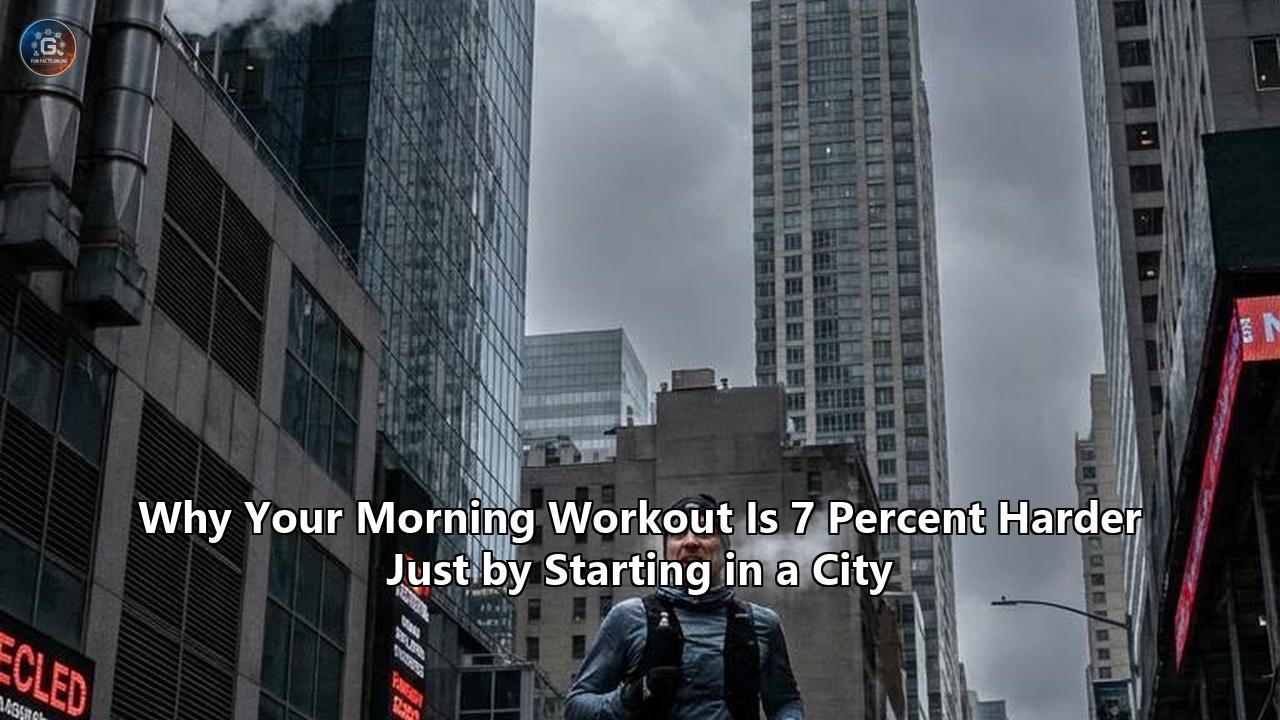
If you stepped out of your door at 6:30 AM today to squeeze in a run, a bike ride, or a park workout, you likely felt the familiar, heavy resistance of a body waking up. But if that door opened onto a city street rather than a country lane or a suburban cul-de-sac, you were fighting a silent, structural headwind.
Recent research across environmental physiology, sports biomechanics, and urban microclimatology has quantified a stark reality for metropolitan athletes: starting a workout in a dense city environment makes it physically and metabolically approximately 7 percent harder than performing the exact same routine in a green, rural setting.
This is not a matter of mental stamina or personal fitness. The "urban tax" on exercise is a physical reality driven by a complex combination of atmospheric chemistry, rigid surface physics, thermal dynamics, and nervous system stimulation. From the microscopic particles entering your lungs to the microscopic vibrations traveling up your shins, the city forces your body to work harder to achieve the same output, systematically degrading your morning workout efficiency.
Understanding why this happens requires looking closely at the intersection of human physiology and the built environment.
1. The Atmospheric Handbrake: Carboxyhemoglobin and the Morning Inversion
To understand why a city workout demands more of your cardiorespiratory system, you must first look at the air you breathe. The morning air in a major metropolitan area is not merely cooler; it is chemically distinct from suburban or rural air, especially during the early hours of the day.
┌────────────────────────────────────────────────────────┐
│             THE MORNING INVERSION LAYER                │
│                                                        │
│  ▲  Warm Air (Acts as a lid, trapping pollutants)     │
│  ───┼────────────────────────────────────────────────  │
│  ▼  Cold Air + Heavy Vehicle Exhaust (Concentrated)    │
│                                                        │
│               [ Urban Athlete's Lungs ]               │
└────────────────────────────────────────────────────────┘
The Physics of the Morning Inversion Layer
During the night, the earth's surface cools by radiating heat into space. In rural areas, this heat dissipates evenly. In cities, however, buildings and asphalt retain some warmth, while the air directly above the ground cools rapidly. This creates a meteorological phenomenon known as a temperature inversion or a morning inversion layer.
Under normal conditions, air temperature decreases with altitude, allowing warm air from the ground to rise and carry pollutants away. In a morning inversion, a layer of warm air sits on top of a layer of cooler, denser air close to the ground. This warm air acts as a physical lid, trapping vehicle emissions, industrial particulate matter, and chemical pollutants right at nose level.
For an athlete waking up early, this means that the air quality between 6:00 AM and 8:30 AM is often highly concentrated with toxic gases and fine particles, precisely when commuter traffic begins to surge.
The Chemistry of Carbon Monoxide and Oxygen Deprivation
The primary culprit behind the immediate 7 percent drop in aerobic capacity is carbon monoxide (CO) emitted from gasoline and diesel engines. When you inhale carbon monoxide, it passes through the alveoli in your lungs and enters your bloodstream.
Here, it encounters hemoglobin, the iron-containing protein in red blood cells responsible for transporting oxygen from your lungs to your working muscles.
- Affinity: Carbon monoxide has an affinity for hemoglobin that is approximately 200 to 250 times stronger than that of oxygen.
- Carboxyhemoglobin (COHb) Formation: The moment CO binds to hemoglobin, it forms a stable compound called carboxyhemoglobin. This permanently prevents that specific hemoglobin molecule from carrying oxygen during its lifespan.
- The Left Shift: Worse, the presence of COHb shifts the remaining oxygen-hemoglobin dissociation curve to the left (the Haldane effect). This means the hemoglobin molecules that do manage to carry oxygen hold onto it more tightly, refusing to release it to the oxygen-starved mitochondria in your active quadriceps, hamstrings, and calves.
Classic environmental physiology studies have demonstrated that when carboxyhemoglobin levels in the blood rise to between 4 percent and 7 percent—a common threshold for athletes breathing heavy commuter exhaust on urban roadways—maximal aerobic power ($VO_2\text{ max}$) is impaired by roughly the same margin. Your body must pump more blood and breathe at a higher rate just to deliver the same volume of oxygen to your muscles, making a moderate run feel like an intense sprint.
Particulate Matter (PM2.5) and Airway Resistance
Alongside gaseous pollutants, cities are saturated with Particulate Matter 2.5 ($PM_{2.5}$)—fine particles less than 2.5 micrometers in diameter, produced by tire wear, brake dust, and combustion.
When you exercise, your ventilation rate increases from a resting 6 liters of air per minute to upwards of 100 to 150 liters per minute. You also shift from nasal breathing (which filters larger particles) to mouth breathing, which bypasses your nasal filtration systems.
       [ Mouth Breathing During Exercise ]
                       │
                       ▼
          [ Bypass of Nasal Filters ]
                       │
                       ▼
    [ Deep Deposition of PM2.5 in Alveoli ]
                       │
             ┌─────────┴─────────┐
             ▼                   ▼
    [Acute Inflammation]  [Bronchoconstriction]
             │                   │
             └─────────┬─────────┘
                       ▼
       [ Increased Airway Resistance ]
                       │
                       ▼
   [ Higher Respiratory Muscle Energy Cost ]
As these fine particles settle deep into your pulmonary alveoli, they trigger an immediate, acute inflammatory response. The smooth muscles surrounding your bronchioles contract in a defensive reflex, causing micro-bronchoconstriction.
To force air through these narrowed passages, your respiratory muscles (primarily your diaphragm and intercostals) must work significantly harder. This respiratory effort consumes a higher percentage of your overall energy budget, redirecting oxygenated blood away from your legs to keep your lungs moving, further reducing your overall morning workout efficiency.
2. Sidewalk Biomechanics: The Cost of Concrete vs. Natural Turf
The second key reason your city workout feels harder lies directly beneath your feet. Concrete and asphalt are the structural foundations of the modern city, but they present a major biomechanical challenge to the human musculoskeletal system.
Young’s Modulus and Surface Compliance
To understand the biomechanical tax of urban running, we must examine the physical properties of the surfaces we step on. Materials science measures the stiffness of a material using Young's Modulus (measured in Gigapascals, or GPa), which quantifies how much a material deforms under a given load.
| Surface Type | Young's Modulus (Stiffness) | Surface Compliance (Deformation under foot strike) |
|---|---|---|
| Natural Turf / Soft Soil | ~0.01 – 0.05 GPa | High (deforms to absorb and disperse force) |
| Wooded Trail / Clay | ~0.1 – 0.5 GPa | Moderate (offers balanced impact absorption) |
| Asphalt (Roads) | ~1.0 – 3.0 GPa | Low (minimal give, high shock transmission) |
| Concrete (Sidewalks) | ~20.0 – 30.0 GPa | Negligible (virtually zero deformation) |
Concrete is roughly 10 times stiffer than asphalt and up to 3,000 times stiffer than natural soil or grass. When your foot strikes concrete, the surface does not deform to absorb energy. Instead, almost all of the kinetic energy of your footfall is reflected directly back up into your lower extremities as a high-frequency shockwave.
Ground Reaction Forces and Muscle Co-Activation
When your running shoe meets a concrete sidewalk, your body experiences a rapid spike in the vertical Ground Reaction Force (vGRF), particularly the transient impact peak that occurs within the first 10 to 30 milliseconds of contact.
Because concrete has zero compliance, your body cannot rely on the ground to slow your descent. Instead, your nervous system must use your muscles as active dampers.
To stabilize your joints—primarily the ankle, knee, and hip—against this sudden force, your brain initiates a protective reflex called antagonist muscle co-activation.
                     [ Concrete Impact ]
                              │
                              ▼
                 [ High-Frequency Vibration ]
                              │
                              ▼
           [ Sensory Receptors Signal Danger (CNS) ]
                              │
                              ▼
       [ Antagonist Muscle Co-Activation (Co-Contraction) ]
                   ┌──────────┴──────────┐
                   ▼                     ▼
          [ Tibialis Anterior ]   [ Gastrocnemius/Soleus ]
                   └──────────┬──────────┘
                              ▼
            [ Joint Splinting & Muscle Stiffness ]
                              │
                              ▼
          [ Increased Metabolic Demand (ATP & Oxygen) ]
On a soft trail, your muscles can relax during portions of the stride because the ground absorbs some of the shock. On concrete, however, your tibialis anterior and gastrocnemius (shin and calf), along with your quadriceps and hamstrings, must fire simultaneously to "splint" the joints.
This continuous, high-tension contraction requires a constant supply of adenosine triphosphate (ATP) and oxygen. This mechanical sacrifice translates directly into a loss of running economy, ultimately dragging down your overall morning workout efficiency.
The Loss of Elastic Strain Energy Return
The human body is evolved to run efficiently on natural surfaces by utilizing the stretch-shortening cycle (SSC) of our tendons. Your Achilles tendon and the plantar fascia of your foot act as highly efficient mechanical springs.
- Stretching Phase (Eccentric): As your foot lands, your body weight stretches these tendons, storing elastic strain energy.
- Shortening Phase (Concentric): During push-off, this stored energy recoils, returning up to 50 percent of the energy required for your next stride, completely free of metabolic cost.
However, this biological spring system relies on a compliant surface that allows for optimal foot contact time and joint angles. On concrete, the impact is so rapid and jarring that the nervous system shortens the contact time and alters joint kinematics to protect against bone bruising and joint damage.
As a result, your tendons cannot store and release energy as effectively. Instead of bouncing forward using elastic recoil, you must rely on active, concentric muscle contraction from your quadriceps and gluteal muscles to push yourself off the ground. You are essentially paying for every step with raw metabolic fuel rather than free elastic energy, adding a significant tax to every mile.
3. The Kinetic Penalty: Stop-and-Go Inelasticity
In a rural environment, an athlete can establish a steady pace and maintain it for hours. In a city, your workout is defined by a series of interruptions. This constant change in momentum is a primary driver of the urban exercise tax.
┌────────────────────────────────────────────────────────┐
│            THE KINETIC TAX OF CITY RUNNING             │
│                                                        │
│  Steady State (Country):                               │
│  ───────►  Constant Velocity (Minimal Energy Cost)     │
│                                                        │
│  Urban Stop-and-Go:                                    │
│  ──►[Stop] ──►[Sprint] ──►[Dodge] ──►[Stop] ──►[Sprint] │
│      ▲           ▲                    ▲          ▲     │
│      └───── Glycolytic / Anaerobic Bursts (Heavy) ┘     │
└────────────────────────────────────────────────────────┘
The Physics of Acceleration vs. Constant Velocity
Isaac Newton's Second Law of Motion ($F = ma$) dictates that the force required to accelerate an object is directly proportional to its mass and the desired acceleration. Once an object is in motion at a constant velocity, the energy required to maintain that motion is relatively low—needed only to overcome air resistance and minor internal friction.
- Steady-State Locomotion: Your muscles work under highly efficient, aerobic conditions, using slow-twitch fibers that consume fat and glucose slowly and cleanly.
- Deceleration and Acceleration: Every time you approach a red light, a curb, or a crowded intersection, you must decelerate. Stopping requires eccentric muscle work to absorb your forward momentum, which damages muscle fibers more than concentric work.
- The Re-Start: Once the light turns green, you must accelerate back to your target pace. This transition requires a massive spike in force production ($F = ma$).
The Metabolic Cost of the Anaerobic Transition
To generate the quick burst of power needed to return to your target pace, your nervous system recruits fast-twitch motor units. These fibers do not rely on slow aerobic pathways; they use the immediate phosphagen (ATP-PC) system and the anaerobic glycolytic pathway.
                [ Deceleration to a Complete Stop ]
                                │
                                ▼
               [ Eccentric Muscle Strain (Damaging) ]
                                │
                                ▼
                     [ Acceleration Phase ]
                                │
                                ▼
            [ Fast-Twitch Motor Unit Recruitment ]
                                │
             ┌──────────────────┴──────────────────┐
             ▼                                     ▼
     [ Phosphagen System ]               [ Glycolytic Pathway ]
     (Rapid ATP Depletion)               (Lactic Acid Accumulation)
             │                                     │
             └──────────────────┬──────────────────┘
                                ▼
              [ Elevated Post-Interval Oxygen Debt ]
This sudden shift has several immediate metabolic consequences:
- Rapid Glycogen Depletion: Anaerobic glycolysis burns through muscle glycogen at a rate up to 10 times faster than aerobic respiration.
- Lactic Acid and Hydrogen Ion Accumulation: The byproduct of this rapid energy production is the accumulation of lactate and hydrogen ions ($H^+$) in your muscle tissue. These hydrogen ions lower muscle pH, causing the classic burning sensation and interfering with calcium binding, which is necessary for muscle contraction.
- Oxygen Debt (EPOC): After you return to your target pace, your cardiorespiratory system must work overtime to clear this lactic acid and rebuild ATP stores. Your heart and breathing rates remain elevated long after the acceleration phase is over.
If your morning city run involves stopping or slowing down just three or four times per mile due to crosswalks, traffic, or pedestrian dodging, your workout is transformed from a smooth, aerobic run into an unintentional high-intensity interval session.
This continuous cycle of stopping and starting can increase the metabolic cost of your run by 5 to 8 percent compared to a steady-state run of the exact same distance and average pace, deeply impacting your morning workout efficiency.
4. Microclimates and the Urban Heat Island (UHI) Effect
Even in the early morning, cities do not cool down the way natural landscapes do. This difference in temperature creates a unique microclimate that places a direct burden on your cardiovascular system.
┌────────────────────────────────────────────────────────┐
│             URBAN HEAT ISLAND THERMAL BASIN            │
│                                                        │
│  [Asphalt/Concrete Roads]  ──►  Store Heat All Day     │
│  [Glass/Steel Buildings]   ──►  Radiate Heat All Night │
│                                                        │
│  Morning Ambient Air: 5°F to 10°F Warmer + Stagnant   │
│                                                        │
│  Cardiovascular Drift:                                 │
│  Heart Rate climbs while Stroke Volume falls           │
└────────────────────────────────────────────────────────┘
The Thermal Battery of the Built Environment
The physical structures of a city—concrete roads, brick buildings, asphalt parking lots, and steel towers—act as high-capacity thermal batteries. These materials have a high thermal mass and low albedo (reflectivity), meaning they absorb and store vast amounts of solar radiation during the day.
During the night, while open soil and grasslands cool rapidly through radiative cooling, urban materials slowly release this stored heat back into the lower atmosphere. This creates the Urban Heat Island (UHI) effect.
By 6:00 AM, the ambient temperature in a city center can be 5°F to 10°F (3°C to 6°C) warmer than in surrounding rural areas. This heat is trapped within urban canyons—narrow streets flanked by tall buildings that block wind and prevent stagnant, warm air from clearing.
The Physiological Cost of Thermoregulation
As you exercise, your muscles generate a massive amount of metabolic heat. In fact, the human body is only about 20 to 25 percent efficient, meaning that for every 100 calories of energy you burn, 75 to 80 calories are converted into waste heat. To keep your core temperature from rising to dangerous levels, your body must actively dissipate this heat through two primary mechanisms:
- Convective Heat Transfer: Warm blood is pumped from your core to the capillaries just beneath your skin, where the heat can be transferred to the cooler surrounding air.
- Evaporative Cooling: Your sweat glands release moisture onto your skin, which absorbs heat energy as it evaporates, cooling the blood underneath.
In a warm, stagnant urban microclimate, both mechanisms are compromised. If the air temperature is closer to your skin temperature, convective heat transfer is significantly reduced. Additionally, the lack of wind in urban canyons limits sweat evaporation, leaving moisture to pool on your skin without providing much cooling.
Cardiovascular Drift and Decreased Stroke Volume
When convective and evaporative cooling are impaired, your body must adapt to prevent overheating, leading to a phenomenon known as cardiovascular drift.
                [ Impaired Heat Dissipation ]
                              │
                              ▼
                 [ Core Temperature Rises ]
                              │
                              ▼
         [ Massive Cutaneous Vasodilation (Skin Blood Flow) ]
                              │
             ┌────────────────┴────────────────┐
             ▼                                 ▼
   [ Blood Pools in Extremities ]     [ Sweat Loss Lowers Plasma Volume ]
             │                                 │
             └────────────────┬────────────────┘
                              ▼
               [ Venous Return to Heart Drops ]
                              │
                              ▼
                   [ Stroke Volume Falls ]
                              │
                              ▼
          [ Heart Rate Spikes to Maintain Cardiac Output ]
To maximize heat dissipation, your brain orders a massive dilation of the blood vessels in your skin (cutaneous vasodilation). This causes a significant portion of your blood volume to pool in your skin's capillary beds.
At the same time, continuous sweating lowers your blood plasma volume, making your blood thicker and harder to pump.
This loss of plasma volume, combined with blood pooling in your skin, reduces the amount of blood returning to your heart (venous return). As a result, the volume of blood your heart pumps with each beat—its stroke volume—falls.
To maintain the cardiac output (${\text{Cardiac Output} = \text{Heart Rate} \times \text{Stroke Volume}}$) required to deliver oxygen to your working muscles, your heart must beat significantly faster.
Even at a moderate pace, your heart rate can climb by 10 to 15 beats per minute compared to a run in a cooler, greener setting. Under these conditions, your heart rate climbs, stroke volume drops, and your morning workout efficiency takes a measurable hit.
5. Auditory Pollution and Cortisol: The Mental Drag of the Metro
The toll of an urban morning workout is not purely physical. The sensory environment of a city acts as an invisible psychological drain that directly impacts your physical capabilities.
┌────────────────────────────────────────────────────────┐
│             NEUROLOGICAL TRAFFIC OF THE CITY           │
│                                                        │
│  Sirens / Engines / Horns (75–85 dB)                   │
│                       │                                │
│                       ▼                                │
│          Amygdala Activation (Threat!)                 │
│                       │                                │
│                       ▼                                │
│    Sympathetic Overdrive (Spike in Cortisol)           │
│                       │                                │
│                       ▼                                │
│  High Perceived Exertion (RPE) + Early Fatigue         │
└────────────────────────────────────────────────────────┘
The Acoustic Landscape of the Morning Commute
Even at dawn, a city center is filled with noise. Sirens, bus engines, car horns, train hums, and construction equipment combine to create a baseline noise level that often ranges between 75 and 85 decibels (dB).
To put this in perspective, a quiet park or rural path typically registers between 30 and 45 dB. Because the decibel scale is logarithmic, an 80 dB environment is not twice as loud as a 40 dB environment—it is 10,000 times more intense in terms of sound energy.
The Neurological Response: Sympathetic Overdrive
Your brain is evolved to treat loud, sudden, or deep, low-frequency noises as immediate threats. When your ears capture the sound of a rumbling truck engine or a blaring horn, these signals bypass your conscious cognitive processors and travel straight to the amygdala, the brain's emotional threat center.
The amygdala fires a distress signal to the hypothalamus, which immediately activates the sympathetic nervous system (SNS)—the "fight-or-flight" pathway. This triggers a cascade of hormonal responses:
- Cortisol Release: The adrenal glands release cortisol, the body's primary stress hormone. Elevated cortisol levels raise blood pressure and disrupt glucose metabolism.
- Adrenaline Spike: A burst of adrenaline increases your baseline heart rate and respiratory rate before you even begin to move.
- Skeletal Muscle Tension: Your muscles tighten in preparation to defend against a physical threat, increasing baseline muscle tone and reducing flexibility.
This state of sympathetic overdrive means your body is burning valuable energy just by being on alert. Your heart rate is elevated, your breathing is shallow, and your muscles are tense and resistant to smooth, fluid motion.
Perceived Exertion (RPE) and the Central Governor
The ultimate consequence of this sensory barrage is a significant increase in your Rating of Perceived Exertion (RPE). RPE is a subjective measure of how hard a workout feels, regulated by the brain's "Central Governor"—a subconscious survival mechanism that monitors physiological signals to prevent catastrophic organ failure.
                      [ Auditory Noise Pollution ]
                                   │
                                   ▼
                [ Amygdala Signals Sympathetic Threat ]
                                   │
                                   ▼
                  [ Stress Hormones Spiked (Cortisol) ]
                                   │
                                   ▼
             [ CNS Interprets Environment as High-Stress ]
                                   │
                                   ▼
                [ Central Governor Initiates Defensively ]
                                   │
                                   ▼
              [ Early Fatigue & Muscle Performance Reduction ]
When you exercise in a high-stress urban environment, your brain receives a constant stream of alarm signals: low-level carbon monoxide exposure, muscle vibrations from hard concrete, thermal strain from stagnant heat, and auditory warnings from traffic.
The Central Governor interprets these combined inputs as a high-threat state. To protect the body, it increases your perception of effort, making a standard 5:00/km pace feel as exhausting as a 4:30/km pace on a quiet trail.
You feel tired sooner, your stride becomes heavy, and you cut your workout short—not because your muscles have run out of fuel, but because your brain has decided the environmental cost of continuing is simply too high.
6. How Your Body Pays the 7% Tax: A Complete System Breakdown
To see how these five forces combine to create the 7 percent drop in performance, let's look at how they impact the body's systems during a standard 45-minute morning workout in the city compared to a suburban park.
┌────────────────────────────────────────────────────────────────────────┐
│                   THE PHYSIOLOGICAL URBAN TAX BALANCE                  │
│                                                                        │
│  CARDIOVASCULAR SYSTEM:                                                │
│  - Red blood cells blocked by COHb (less O2)                           │
│  - Blood volume shifted to skin for cooling                            │
│  - Heart rate increases by 10-15 bpm to maintain output                │
│                                                                        │
│  MUSCULOSKELETAL SYSTEM:                                               │
│  - Rigid concrete forces muscles to co-contract for joint safety       │
│  - Tendon energy return drops (fewer "free" steps)                     │
│  - Stop-and-go running burns glycogen 10x faster                       │
│                                                                        │
│  NERVOUS & ENDOCRINE SYSTEMS:                                          │
│  - Acoustic noise triggers cortisol and adrenaline                     │
│  - Sympathetic nervous system stays on high alert                      │
│  - Central Governor increases perceived effort (RPE), causing early fatigue│
└────────────────────────────────────────────────────────────────────────┘
The Cardiovascular Strain
- In the Park: Your blood vessels are clear. Blood flow is directed entirely to your active leg muscles, delivering oxygen to convert glycogen into ATP. Your heart rate remains steady and stable within your target training zone.
- On the City Street: Red blood cells are partially blocked by carboxyhemoglobin, reducing your blood's oxygen-carrying capacity. At the same time, warm, stagnant air forces blood to your skin for cooling, away from your working legs. Your heart must beat 10 to 15 times faster to deliver the same amount of oxygen, pushing your cardiovascular system into a higher, more demanding training zone than intended.
The Biomechanical Efficiency
- In the Park: Soft grass, packed dirt, or gravel pathways absorb the force of your footfalls. Your Achilles tendons and plantar fascia store and return up to 50 percent of this impact energy. Antagonist muscles remain relaxed, conserving energy and oxygen.
- On the City Street: Rigid concrete yields zero compliance, sending high-frequency vibration waves up your shins. To protect your joints, your muscles must co-contract, staying tense and consuming energy continuously. The loss of elastic energy return means your muscles must work harder on every stride, increasing the metabolic energy required to maintain your pace.
The Fuel Consumption
- In the Park: You maintain a steady, continuous pace. Your body relies almost entirely on clean aerobic metabolism, burning a balanced mix of fats and carbohydrates.
- On the City Street: Constant stops and starts at crosswalks and intersections force you to repeatedly accelerate your body weight. These bursts of acceleration rely on anaerobic pathways, consuming muscle glycogen up to 10 times faster and accumulating lactic acid, which causes early muscle fatigue.
7. Reclaiming Your Efficiency: Strategies for the Urban Athlete
While the city environment presents a clear physical challenge, reclaiming your lost morning workout efficiency is entirely possible if you understand how to navigate the city's unique obstacles. By adjusting your timing, route, gear, and training metrics, you can minimize the urban tax and optimize your training.
┌────────────────────────────────────────────────────────┐
│            STRATEGIES TO BYPASS THE URBAN TAX          │
│                                                        │
│  [ Timing ]      ──►  The 5:30 AM Sweet Spot (Pre-commute)│
│  [ Routing ]     ──►  Green Corridors & Mid-block Paths │
│  [ Gear ]        ──►  Max-Cushion PEBAX Footwear         │
│  [ Sensory ]     ──►  Active Noise Cancellation          │
│  [ Performance ] ──►  RPE / Heart Rate-Based Training    │
└────────────────────────────────────────────────────────┘
1. The 5:30 AM Sweet Spot
To minimize the impact of air pollution and the morning inversion layer, target your run before the commuter rush hour begins.
- Why it works: Between 5:00 AM and 6:00 AM, vehicle traffic is at its lowest point of the day. Although the temperature inversion layer may still be present, it has not yet been saturated with fresh, toxic carbon monoxide, nitrogen oxides, and $PM_{2.5}$ from the morning commute.
- The Benefit: You breathe cleaner air, keeping your hemoglobin clear to transport oxygen to your muscles and maintaining your cardiorespiratory efficiency.
2. Map Your Route Along Green Corridors
Avoid running directly along major roadways, transit lines, or commercial avenues. Instead, map out your routes to maximize your time in green spaces, residential streets, and linear parks.
┌────────────────────────────────────────────────────────┐
│               URBAN ROUTING COMPARISON                 │
│                                                        │
│  Avoid (Transit Corridor):                             │
│  [High Traffic] ── [PM2.5 / CO] ── [Stoplights]        │
│                                                        │
│  Preferred (Green Corridor):                           │
│  [Linear Park] ── [Tree Barrier] ── [Secondary Street] │
└────────────────────────────────────────────────────────┘- The Power of Tree Barriers: Deciduous and coniferous trees act as natural biofilters. Studies show that a single row of mature trees can reduce local $PM_{2.5}$ concentrations by up to 15 to 25 percent compared to bare streets.
- Mid-Block Routing: Running through residential zones or low-traffic secondary streets reduces both your exposure to vehicle emissions and the number of stoplights that force you to decelerate and accelerate, keeping your momentum steady.
3. Switch to Max-Cushion, High-Return Footwear
To counteract the rigidity of concrete sidewalks, choose running shoes designed with advanced, energy-returning midsole materials.
- PEBAX and Super-Foams: Traditional EVA (Ethylene-Vinyl Acetate) foam shoes quickly compress under heavy impact, losing their cushioning properties. Modern running shoes featuring PEBAX or supercritical polyurethane foams offer both high compliance (softness) and exceptional resilience (energy return).
- The Mechanical Solution: These foams compress under your foot strike to absorb the high-frequency impact wave, protecting your joints and reducing the need for muscle co-activation. They then expand rapidly during push-off, returning up to 80 to 85 percent of that energy, mimicking the natural elasticity of turf and restoring your biomechanical efficiency.
4. Use Active Sensory Downregulation
To protect your nervous system from the cognitive tax of sirens, engines, and construction noise, manage your auditory input during your workout.
- Pink Noise and Low-Frequency Masking: Use bone-conduction or secure-fit sports earbuds equipped with high-quality active noise-canceling (ANC) technology. Rather than listening to high-tempo music that can further elevate your heart rate, try playing ambient pink noise or natural sounds (like rainfall or wind).
- The Brain Hack: This helps mask the chaotic, high-decibel sounds of the city, preventing your amygdala from triggering a fight-or-flight response. Your cortisol levels remain low, your muscles stay relaxed, and your brain's Central Governor allows you to sustain your effort with less perceived strain.
5. Transition from Pace-Based to RPE or Heart Rate-Based Training
If you train strictly by pace (e.g., aiming for a flat 5:00/km pace on every run), you are likely overtraining and risking injury when running in the city.
                 [ Standard Goal: 5:00/km Pace ]
                                │
             ┌──────────────────┴──────────────────┐
             ▼                                     ▼
      [ In the Country ]                     [ In the City ]
      - Flat, soft trails                    - Hard concrete
      - Clear air                            - Polluted air (CO)
      - Constant velocity                    - Stop-and-go lights
      - Cool breeze                          - Stagnant heat
             │                                     │
             ▼                                     ▼
     [ RPE: 12 (Easy) ]                    [ RPE: 15 (Hard) ]
[ Heart Rate: 140 bpm ] [ Heart Rate: 158 bpm ]- The Adjusted Metric: Accept that a 5:00/km pace in a congested city environment is physically equivalent to a 4:40/km pace on a clean, open trail. Instead of focusing on your GPS watch, guide your effort using your Rating of Perceived Exertion (RPE) or a Heart Rate Monitor.
- The Benefit: If your target training zone is a moderate aerobic effort (RPE 12-13, or roughly 70 to 75 percent of your maximum heart rate), allow your pace to drop on city streets to stay within that target zone. This keeps you from pushing your body into an accidental, high-fatigue training zone and ensures your training remains consistent.
8. Looking Forward: The Architecture of Active Cities
As urban populations continue to grow, city planners, public health officials, and landscape architects are beginning to recognize the "urban tax" on exercise. The future of metropolitan design is shifting to address these environmental and physiological challenges, helping city dwellers exercise safely and efficiently.
┌────────────────────────────────────────────────────────┐
│              THE FUTURE OF ACTIVE URBANISM             │
│                                                        │
│  ◄─── Linear Parks (Green highway loops for runners) ──►│
│                                                        │
│  ◄─── Porous Asphalt (Reduces impact shockwaves)  ───► │
│                                                        │
│  ◄─── Micro-Climatology (Wind tunnels for cooling) ────►│
│                                                        │
│  ◄─── Low Emission Zones (Cleaner roadside corridors) ─►│
└────────────────────────────────────────────────────────┘
1. Linear Greenways and Continuous Run Corridors
To eliminate the kinetic penalty of stop-and-go running, cities are investing in long, uninterrupted linear parks.
- Examples: Projects like the Atlanta BeltLine, London's cycle superhighways, and Seoul's Cheonggyecheon stream restoration provide miles of continuous pathway completely isolated from vehicle traffic.
- The Impact: These corridors allow athletes to establish and maintain a steady-state pace, eliminating the metabolic cost of acceleration and reducing exposure to vehicle emissions.
2. Low-Emission Zones (LEZs) and Urban Forestry
Many major cities, including Paris, London, and Tokyo, are expanding Low-Emission Zones that restrict high-polluting vehicles from city centers, especially during morning hours. Alongside these restrictions, cities are planting dense, multi-layered urban forests along pedestrian pathways. These green barriers help filter particulate matter, lower local carbon monoxide levels, and provide essential shade to counteract the Urban Heat Island effect.
3. Surface Engineering: Porous and Low-Impact Materials
Materials science is stepping in to address the harshness of concrete sidewalks.
- Porous Asphalt: Some cities are testing porous asphalt designs, which contain tiny air pockets that absorb sound and allow water to drain quickly.
- The Biomechanical Advantage: These materials have a lower Young's Modulus than traditional concrete, providing a softer surface that absorbs impact force and returns energy more like a natural trail.
4. Smart Wearables with Localized Air Quality Routing
The next generation of athletic technology will likely integrate real-time environmental data directly into your training metrics. Future sports watches and mapping apps will not only track your pace and heart rate, but also analyze localized, block-by-block air quality, wind patterns, and heat retention.
These smart systems can dynamically adjust your routes or recommend pace corrections in real-time, helping you avoid high-emission zones, heavy traffic, and high-impact surfaces to maximize your training efficiency.
The next time you step out onto a city street for an early morning run and find your legs feeling heavy, your chest tight, and your heart rate climbing faster than expected, take a step back and adjust your expectations.
You are not imagining the extra difficulty, nor have you suddenly lost your fitness. You are simply paying the 7 percent physical and metabolic tax that the city demands from every athlete. By understanding the forces behind this urban headwind and adjusting your training strategies, you can bypass the challenges of the built environment, protect your body, and reclaim your fitness—one block at a time.
Reference:
- https://www.runnersblueprint.com/how-to-run-in-the-city-15-essential-tips-for-navigating-urban-roads-avoiding-traffic-and-staying-safe/
- https://egrove.olemiss.edu/cgi/viewcontent.cgi?article=4435&context=etd
- https://pubmed.ncbi.nlm.nih.gov/1120755/
- https://www.reddit.com/r/running/comments/r2w3uv/running_has_gotten_harder_when_im_in_my_suburb_vs/
- https://www.researchgate.net/publication/395783763_Relationship_between_Lower_Limb_Muscle_Activation_Characteristics_and_Running_Economy_in_Recreational_Runners
- https://www.reddit.com/r/running/comments/lt7pvr/city_running_vs_country_running/
- https://www.youtube.com/watch?v=P4LrO7I988s
- https://qz.com/what-to-know-before-running-seriously
- https://www.womenshealthmag.com/uk/fitness/fat-loss/a69858260/incline-walking-best-workout/
- https://pmc.ncbi.nlm.nih.gov/articles/PMC12058932/
- https://www.icsspe.org/system/files/WHO%20-%20A%20healthy%20city%20is%20an%20active%20city_0.pdf
- https://es.nothing.tech/products/cmf-watch-3-pro