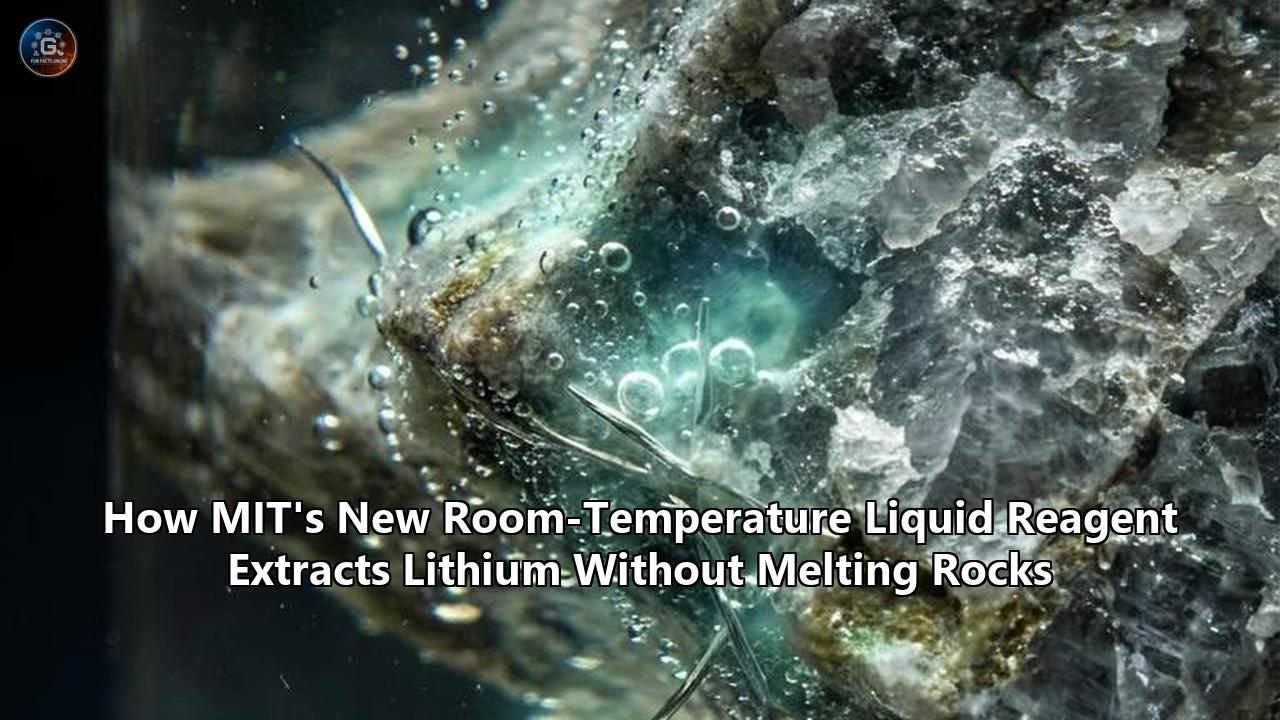
The global transition toward electrified transport and renewable grids has triggered an unprecedented hunt for scalable, clean lithium refining techniques. On May 28, 2026, a team of materials scientists and chemists at the Massachusetts Institute of Technology (MIT) published a peer-reviewed paper in the journal Science that represents a major disruption to this landscape.
The researchers, led by Yet-Ming Chiang, the Kyocera Professor of Materials Science and Engineering, have developed an acid-free, low-temperature process that extracts battery-grade lithium from spodumene—the most abundant lithium-bearing hard rock mineral on Earth. By treating crushed ore with a simple, room-temperature liquid reagent based on ammonium fluoride ($NH_4F$) and water, the team bypassed the energy-intensive, highly polluting thermal roasting and acid-leaching steps that have defined hard-rock mining for nearly a century.
Conventional Pyrometallurgical Refining (The Energy-Intensive Path)
[Spodumene Ore] ──> [Roasting Furnace (>1,000°C)] ──> [Acid Baking (H₂SO₄ @ 250°C)] ──> [Toxic Waste + Li₂CO₃]

MIT's Room-Temperature Silicate Subtraction Loop (The Closed-Loop Path)
[Spodumene Ore] ──> [Liquid NH₄F + H₂O @ 20°C] ──> [Precipitation & Gas Recovery] ──> [Battery-Grade Salts + Useful Alumina/Silica Byproducts]
This structural shift in lithium extraction technology cuts energy costs by an estimated 50 percent, eliminates toxic waste streams, and yields highly marketable byproducts, including smelter-grade alumina and cement-ready silica. The technology is already being commercialized by Rock Zero, an MIT spinout backed by federal funding agencies and a Fortune 100 automotive company.
To understand how this discovery reached its current breaking point, it is necessary to trace a developmental timeline spanning a quarter of a century—from a chance observation in a hardware store to a multi-million-dollar race for clean critical minerals.
2001–2021: The Home Renovation and the Cement Kiln
The intellectual foundation of this discovery dates back approximately 25 years to a routine trip to a hardware store. Materials scientist Yet-Ming Chiang was undertaking a bathroom renovation and searching for a chemical agent that could etch clear glass blocks to make them translucent. He purchased a commercial glass-etching cream and found that its primary active ingredient was ammonium fluoride ($NH_4F$).
At the atomic level, glass is made of silica ($SiO_2$), a network of exceptionally strong silicon-oxygen covalent bonds with a high bond dissociation energy of roughly $460\text{ kJ/mol}$. Standard acids cannot break these bonds, which is why glass containers are used to store highly corrosive chemicals.
Ammonium fluoride, however, acts as a chemical wedge. When dissolved in water, it releases fluoride ions ($F^-$) that exhibit an extreme thermodynamic affinity for silicon. The fluoride ions attack the silicon atoms, systematically cleaving the silicon-oxygen bonds to form highly soluble ammonium hexafluorosilicate ($(NH_4)_2SiF_6$) and water, effectively "eating" the glass at room temperature.
Chemical Attack of Ammonium Fluoride on Silica (Glass and Spodumene Matrix)
6 NH₄F (aq) + SiO₂ (s) ──[Room Temp]──> (NH₄)₂SiF₆ (aq) + 4 NH₃ (g) + 2 H₂O (l)
Chiang filed this chemical reaction away in his memory, focusing his research over the next two decades on battery architectures. He went on to co-found several prominent cleantech companies, including:
- A123 Systems (lithium iron phosphate batteries)
- Form Energy (multi-day iron-air grid batteries)
- Sublime Systems (low-carbon green cement)
The Dawn of Silicate Subtraction
By 2021, the climate crisis had shifted Chiang's focus toward decarbonizing heavy industry. In his MIT lab, researchers Camden Hunt and Benjamin Mowbray, alongside undergraduate student Jacqueline Prawira, were brainstorming ways to eliminate the massive greenhouse gas emissions associated with cement production.
Traditional cement manufacturing requires heating limestone ($CaCO_3$) and silica-rich sand or clay to approximately 1,500 degrees Celsius in massive, fossil-fueled rotary kilns. This process releases vast amounts of carbon dioxide ($CO_2$), both from the combustion of fuels and from the calcination reaction that converts limestone into lime ($CaO$).
The team co-invented a low-temperature chemical alternative they dubbed silicate subtraction. Instead of melting raw minerals to induce chemical reactivity, they used chemical reagents to strip silica away from calcium- and magnesium-bearing minerals at temperatures below 100 degrees Celsius. By "subtracting" the silica, they produced highly reactive, decarbonized precursor materials that could cure into structural cement without ever passing through a high-temperature kiln.
As the global demand for electric vehicles escalated in the early 2020s, Chiang, Hunt, and Mowbray realized that the physics of silicate subtraction applied directly to a different crisis: the carbon-intensive refining of battery-grade lithium.
2022–2024: Cracking the Spodumene Vault
To understand why the MIT team turned their cement-focused chemistry toward rock refining, it is necessary to examine the mineral spodumene. Spodumene is a pyroxene mineral with the chemical formula $\text{LiAlSi}_2\text{O}_6$. It is essentially a lithium-aluminum silicate rock held together by the same silicon-oxygen bonds that make glass so stable.
α-Spodumene Monoclinic Crystal Lattice (Dense, Space Group C2/c)
   [Si-O-Si-O Chains]  <── Tight Covalent Silicate Vault
       ( Li⁺ / Al³⁺ )  <── Trapped Ions
   [Si-O-Si-O Chains]

β-Spodumene Tetragonal Crystal Lattice (Open, Space Group P4₃2₁2)
   [Si-O-Si-O-Si-O]    <── Expands by ~30% when heated to 1,050°C
     ( Li⁺ ) ( Al³⁺ )  <── Becomes porous, accessible to hot sulfuric acid
Naturally occurring spodumene exists in the alpha ($\alpha$) phase, which features a dense, monoclinic crystal structure (space group $C2/c$). In this state, the lithium ions are trapped deep within a tightly packed silicate vault.
The Pyrometallurgical Status Quo
Because $\alpha$-spodumene is highly resistant to chemical leaching, conventional lithium extraction technology relies on pyrometallurgy. The process requires:
- Decrepitation (Roasting): Crushing the spodumene ore and heating it in a fossil-fueled rotary kiln to temperatures exceeding 1,050 degrees Celsius. This extreme thermal energy forces a phase transition from the dense $\alpha$-phase to the more porous beta ($\beta$) tetragonal phase, expanding the crystal volume by roughly 30 percent.
- Acid Sulfating Baking: Mixing the hot $\beta$-spodumene with concentrated sulfuric acid ($H_2SO_4$) and baking it at 250 degrees Celsius. The hydrogen ions from the acid displace the lithium ions, forming soluble lithium sulfate ($Li_2SO_4$).
- Neutralization and Purification: Adding massive quantities of sodium hydroxide ($NaOH$) or calcium carbonate ($CaCO_3$) to neutralize the highly acidic mixture. This step generates vast quantities of sodium sulfate waste and an impure lithium solution that requires heavy downstream refining to achieve battery-grade purity.
This pyrometallurgical pathway is highly energy-intensive and environmentally destructive. A 2021 life-cycle assessment found that refining battery-grade lithium from spodumene concentrates releases roughly 37 tons of carbon dioxide equivalent ($CO_2\text{e}$) per ton of lithium hydroxide produced, compared to approximately 11 tons of $CO_2\text{e}$ for evaporative brines.
Furthermore, because the pyrometallurgical process selectively extracts only the lithium—which accounts for less than 8 percent of the raw spodumene mass—the remaining 92 percent of the rock (primarily degraded aluminum and silicon) is discarded as acidic, toxic mining waste.
Reversing the Extraction Pattern
In late 2022, Chiang’s research team at MIT asked a fundamental question: instead of using massive thermal energy to crack the silicate vault, could they use chemistry to dissolve the vault itself at room temperature?
They returned to the chemical behavior of ammonium fluoride ($NH_4F$). Instead of attempting to leach the reactive metal (lithium) out of the inert rock, they designed a process to dissolve the silica first. This approach reversed the conventional metallurgical sequence.
Conventional Acid Leaching:
[Mineral Matrix] ──> Dissolve Reactive Metals (Li, Al) ──> Leave Silica Behind (Toxic Residue)

MIT Silicate Subtraction:
[Mineral Matrix] ──> Dissolve Silica First (with NH₄F) ──> Liberate and Separate Li and Al Stepwise
By mixing finely crushed spodumene ore with a liquid reagent composed of water and ammonium fluoride, the researchers found that the silicate matrix dissolved completely at room temperature. The fluoride ions stripped the silicon atoms out of the $\text{LiAlSi}_2\text{O}_6$ framework, converting the solid rock into a liquid solution of ammonium hexafluorosilicate, while simultaneously liberating the trapped lithium and aluminum ions.
However, dissolving the rock was only the first step. The team faced a daunting chemical separation challenge: they had a room-temperature liquid containing a highly complex mixture of lithium, aluminum, silicon, ammonium, and fluoride ions. To make the process commercially viable, they had to isolate each element in high-purity forms without creating new waste streams.
2024–2025: The Closed-Loop Breakthrough and the Birth of Rock Zero
Throughout 2024, Hunt and Mowbray worked to establish a series of highly selective chemical precipitation steps to separate the dissolved components of the spodumene rock.
                       [Crushed Spodumene Ore]
                                 │
                   Add Liquid NH₄F + H₂O (20°C)
                                 │
                                 ▼
                     [Silicate Dissolution]
                                 │
         ┌───────────────────────┴───────────────────────┐
         ▼                                               ▼
[Precipitate: LiF (insoluble)]                [Liquid Phase: Al³⁺ & Si-F Complexes]
         │                                               │
 Add CO₂ or Na₂CO₃                                       │  Add NH₃ Gas (Recycled)
         │                                               │
         ▼                                               ├──────────────────────┐
[Battery-Grade Li₂CO₃ / LiOH]                            ▼                      ▼
                                                [Precipitate: SiO₂]    [Precipitate: Al(OH)₃]
                                                (Cement-Ready Silica)  (Smelter-Grade Alumina)
                                                         │
                                                         ▼
                                                [Regenerated NH₄F] ──> Recycle back to start
1. Lithium Isolation
When spodumene is dissolved in the ammonium fluoride reagent, the liberated lithium ions ($Li^+$) immediately react with the abundance of fluoride ions to form lithium fluoride ($LiF$). Because $LiF$ is highly insoluble in water, it precipitates out of the liquid solution as a solid salt, leaving the dissolved silicon and aluminum behind. This provides an instant, highly selective separation of lithium from the rest of the mineral matrix.
However, lithium fluoride is not directly compatible with most battery cathode manufacturing lines, which require either lithium carbonate ($Li_2CO_3$) or lithium hydroxide ($LiOH$). To solve this, the team developed a low-temperature conversion step.
By treating the solid lithium fluoride with carbon dioxide ($CO_2$) or sodium carbonate ($Na_2CO_3$), they converted the $LiF$ into battery-grade lithium carbonate. Crucially, this conversion process operates at temperatures well below 100 degrees Celsius and achieves an extraction efficiency exceeding 95 percent.
2. Aluminum Recovery
With the lithium removed, the liquid phase contained dissolved aluminum and silicon complexes. To extract the aluminum, the researchers developed a highly controlled precipitation process.
By adjusting the pH and temperature of the liquid, they precipitated the aluminum out of the solution as aluminum hydroxide ($\text{Al(OH)}_3$). This precipitate is subsequently dried and converted into smelter-grade alumina ($\text{Al}_2\text{O}_3$), which meets the exact chemical specifications required by commercial aluminum smelters.
3. Silica Precipitation and Reagent Regeneration
The final remaining component in the liquid was the dissolved silica, present as ammonium hexafluorosilicate ($(NH_4)_2SiF_6$). Under normal circumstances, discarding this solution would create a major chemical disposal problem and consume the expensive ammonium fluoride reagent.
To close the loop, the team engineered a gas-re-absorption sequence:
- During the initial dissolution of the spodumene rock, the chemical reaction releases ammonia gas ($NH_3$).
- The researchers captured this ammonia gas and routed it back into the silicon-rich liquid phase.
- Reintroducing the ammonia gas shifts the chemical equilibrium, causing the dissolved silicon to precipitate out of the solution as pure, amorphous silica ($SiO_2$). This silica is a high-value additive for the green cement industry.
- Crucially, the precipitation of silica simultaneously regenerates the starting ammonium fluoride ($NH_4F$) and water.
This chemical sequence represents a completely circular, closed-loop extraction system. The reagent is recycled back to the beginning of the process to dissolve the next batch of spodumene rock, reducing waste levels to nearly zero.
Silicate Subtraction Closed-Loop Chemical Mass Balance

Inputs:
  - Raw Spodumene (LiAlSi₂O₆)
  - Carbon Dioxide (CO₂) / Sodium Carbonate (Na₂CO₃)
  - Recycled Ammonium Fluoride (NH₄F) & Water (H₂O)

Outputs:
  - High-Purity Lithium Carbonate (Li₂CO₃) or Lithium Hydroxide (LiOH)
  - Smelter-Grade Alumina (Al₂O₃)
  - Cement-Ready Silica (SiO₂)
  - Zero Liquid Waste Discharge
The Launch of Rock Zero
Recognizing the commercial potential of this lithium extraction technology, Chiang, Hunt, and Mowbray founded the startup Rock Zero in mid-2024. Headquartered at The Engine—MIT’s venture incubator designed to support "tough tech" companies tackling complex energy and climate challenges—Rock Zero set out to scale the silicate subtraction loop.
           Founding of Rock Zero
                    │  (Spun out of MIT DMSE in 2024)
                    ▼
          ARPA-E & VC Funding Securing
                    │  (Initial validation at lab-scale)
                    ▼
       17 Global Ore Sources Validation
                    │  (Proved consistency across diverse mineralogies)
                    ▼
    Science Publication (May 28, 2026)
                       (Unveiled 50% cost-reduction metrics)
The startup quickly secured financial backing, including grants from the U.S. Department of Energy’s Advanced Research Projects Agency-Energy (ARPA-E), the National Science Foundation, and private venture capital.
To prove that the process was robust enough for industrial scaling, the Rock Zero team spent 2025 testing their liquid reagent on 17 different spodumene ore concentrates sourced from mines all over the world, including Australia, Canada, Europe, and the United States.
The results were uniform: regardless of the specific geological origin, mineral impurities, or crystal variations of the ore, the room-temperature reagent achieved a lithium recovery rate of over 95 percent, proving that the chemical process was highly versatile and ready for the global market.
The Breaking Moment: May 2026
The publication of the MIT team's findings in Science on May 28, 2026, has brought this development to a head. The paper, co-authored by Camden Hunt, Benjamin Mowbray, Kalyn Fuelling, Jacqueline Prawira, Khashayar Jafari, and Yet-Ming Chiang, presents the thermodynamic, kinetic, and economic models of the silicate subtraction loop.
The data published in Science outlines several highly favorable economic and environmental metrics:
- Operating Cost Reductions: The researchers estimate that by eliminating the fossil-fueled rotary kilns and expensive acid-neutralization steps, the closed-loop silicate subtraction process is roughly half the cost of traditional pyrometallurgical hard-rock extraction.
- Competitiveness with Brine: Hard-rock refining using the Rock Zero process is estimated to be cost-competitive with South American brine extraction. Historically, brine extraction has been significantly cheaper than hard-rock mining, though far slower and more water-intensive.
- Byproduct Valorization: In conventional mining, the silicon and aluminum are liabilities that require costly waste-storage ponds. In the MIT process, the smelter-grade alumina and cement-ready silica are sold as commercial products. This "nose-to-tail mining" model offsets the cost of the lithium extraction, allowing mining companies to generate revenue from 100 percent of the mined rock.
                     Traditional Mining vs. Nose-to-Tail Mining
                     ──────────────────────────────────────────
Traditional Refining:
  [Spodumene Ore] ──────> 8% Battery-Grade Lithium + 92% Toxic Waste (Al/Si Residue)

MIT Nose-to-Tail Mining:
  [Spodumene Ore] ──────> 8% Battery-Grade Lithium
                  ──────> 35% Smelter-Grade Alumina (Sold to aluminum industry)
                  ──────> 57% Cement-Ready Silica (Sold to green cement industry)
                  ──────> 0% Waste Residue
"We believe this approach is the lowest-energy, lowest-cost way of getting lithium not only out of hard rock, but period," Chiang told reporters on the day of the announcement. "It will enable the energy transition through batteries that use lithium. This was one of the goals of The Climate Project at MIT—to work on projects that, within a short number of years, could transition from the lab to commercialization and impact."
The Geopolitical Dimension: Breaking the Critical Mineral Chokehold
The timing of this scientific breakthrough coincides with a period of severe geopolitical friction surrounding critical mineral supply chains.
According to 2025 data from the International Energy Agency (IEA), global lithium demand increased by more than 150 percent between 2022 and 2025, driven almost entirely by the rapid expansion of gigafactories in North America, Europe, and Asia.
However, while countries like the United States, Australia, Canada, and various European nations possess vast domestic reserves of lithium-rich spodumene, they have historically been unable to process it.
Global Lithium Refining Market Share (2025 IEA Data)
┌─────────────────────────────────────────┐
│ China (65%)                             │
├──────────────┬──────────────────────────┤
│ Rest (35%)   │
└──────────────┘

Domestic US Hard-Rock Refining Capacity (2025)
[  <5,000 tons/year ]
China currently processes approximately 65 percent of the world’s lithium, including nearly all hard-rock spodumene concentrates mined in Australia. Because Australia and other Western nations lack local, cost-effective refining capacity, they mine the raw spodumene rock, crush it, and ship it thousands of miles to Chinese chemical plants for thermal roasting and acid leaching.
This geographical separation of mining and refining presents major supply chain vulnerabilities and economic challenges:
- The Permitting Barrier: Building a conventional pyrometallurgical refining plant in the United States or Europe is exceptionally difficult. The high carbon footprint, heavy water usage, and generation of thousands of tons of acidic, toxic waste make such facilities nearly impossible to permit under Western environmental regulations.
- Transportation Inefficiencies: Shipping raw spodumene concentrates across oceans is highly inefficient. Spodumene concentrate typically contains only 5 to 6 percent lithium oxide ($Li_2O$), meaning that shipping fleets are burning fuel to transport 94 percent waste rock across the globe.
- Regulatory Pressure: The U.S. Inflation Reduction Act (IRA) and the European Critical Raw Materials Act mandate that a significant percentage of battery materials must be processed domestically or in countries with free trade agreements to qualify for clean vehicle subsidies.
Spodumene Shipping Inefficiency
┌──────────────────────────────────────────────┐
│ Raw Spodumene Concentrate (100% Mass)         │
├──────────────┬───────────────────────────────┤
│ Li₂O (6%)    │ Silicate/Alumina Waste (94%)   │
└──────────────┴───────────────────────────────┘
*94% of the fuel burned by shipping freighters is used to transport waste rock.
The MIT-developed lithium extraction technology alters this geopolitical dynamic. Because the silicate subtraction process operates at room temperature, uses zero harsh acids, and discharges no toxic waste, a refining facility can be built directly alongside the mine site.
This localized approach eliminates the need to ship raw rock across the ocean, complies with strict environmental standards, and qualifies mining operators for onshoring tax incentives.
"Hard rock is abundant; you can find it everywhere," said Camden Hunt, co-founder of Rock Zero and former project manager at MIT's Center for Electrification and Decarbonization of Industry. "But most hard rock refining is done in China. Our central thesis is if you can find an easier way to crack the rock, get lithium out, and make battery-grade lithium salts, you can change the lithium market. It aligns with the recent push to onshore production of critical minerals in the U.S."
Comparative Landscape: The Race for the Next-Gen Extraction Method
The breakthrough from MIT and Rock Zero is part of a broader, highly competitive race to reform global lithium refining. To evaluate its potential impact, we must compare the silicate subtraction loop with traditional extraction methods and other emerging low-temperature alternatives.
| Extraction Method | Resource Type | Operating Temperature | Primary Chemical Reagents | Waste Products | Key Advantages | Major Limitations |
|---|---|---|---|---|---|---|
| Traditional Hard-Rock (Pyrometallurgical) | Spodumene rock | ~1,050°C | Concentrated Sulfuric Acid ($H_2SO_4$), Sodium Hydroxide ($NaOH$) | Acidic silicate residues, sodium sulfate, heavy $CO_2$ | Fast processing time, high-purity yield | Extreme energy use, massive carbon footprint, difficult to permit |
| Traditional Brine Evaporation | Continental brines | Ambient (Solar heating) | Lime, Soda Ash | Spent salt piles, massive water loss via evaporation | Low energy input (uses the sun) | Extremely slow (12-24 months), highly sensitive to weather, high water consumption |
| Direct Lithium Extraction (DLE) | Continental and geothermal brines | 40°C - 80°C | Adsorbents, ion-exchange resins, switchable solvents | Minimal (brine is reinjected) | High speed, small physical footprint, low carbon footprint | Incompatible with solid hard-rock ores |
| Penn State Low-Temp Method (May 2025) | Spodumene rock | ~100°C - 200°C (Microwave heating) | Sodium Hydroxide ($NaOH$) | Sodium silicate residues | High efficiency (>99% extraction), rapid processing (minutes) | Requires microwave energy inputs, leaves silicate byproduct in a non-optimized form |
| Rice University Flash Joule Heating (Oct 2025) | Spodumene rock | >1,300°C (for seconds) | Chlorine gas ($Cl_2$) | Chlorinated gases, silicate residues | Ultrafast separation (seconds), high recovery | Requires extremely high voltage pulses, uses hazardous chlorine gas |
| MIT / Rock Zero Silicate Subtraction (May 2026) | Spodumene rock | 20°C (Room Temp) | Ammonium Fluoride ($NH_4F$) and Water | Zero waste (Closed-loop design) | Lowest cost, no acids, useful alumina and silica byproducts, high circularity | Must handle gaseous ammonia intermediate during loop recovery |
The Competitive Advantage of Silicate Subtraction
While other research groups have made strides in reducing the environmental footprint of lithium mining, the MIT room-temperature liquid reagent process holds several advantages:
- True Room-Temperature Operation: Unlike Penn State's microwave-heating method or Rice University's Flash Joule Heating—both of which require localized energy inputs to initiate the chemical reaction—MIT's silicate subtraction dissolves the rock matrix at ambient, room-temperature conditions. This virtually eliminates the electrical grid load of the processing plant.
- No Added Acid or Base: Traditional refining relies on a chemical shift from highly acidic states (sulfuric acid leaching) to highly basic states (sodium hydroxide neutralization) to precipitate lithium. This cyclic addition of strong acids and bases creates massive chemical consumption costs and generates low-value sodium sulfate waste. In contrast, the MIT process is entirely acid-free and maintains a neutral, non-corrosive aqueous environment throughout.
- Turning Waste into Wealth: The critical differentiator of the Rock Zero approach is its "nose-to-tail" economic model. While other processes still treat the silica and aluminum in spodumene as a disposal problem, the MIT process yields high-purity, smelter-grade alumina and cement-ready silica. This turns a waste-management liability into two high-volume revenue streams that offset the cost of processing the lithium.
Technical Analysis of the Silicate Subtraction Loop
The chemistry of the silicate subtraction process represents a significant departure from traditional mineral processing. Understanding how this system operates requires a look at the specific chemical steps developed by Chiang's team.
Step 1: Matrix Dissolution and the Fluoride Attack
The process begins with raw, un-roasted $\alpha$-spodumene ore. The ore is crushed to a fine powder using standard industrial milling equipment.
Unlike conventional refining, which requires separating the spodumene from other silicate minerals like quartz or feldspar, the ammonium fluoride reagent is highly effective at dissolving almost all silicate phases.
Room-Temperature Matrix Dissolution (Fluoride Substitution)
LiAlSi₂O₆ (s) + 12 NH₄F (aq) + 6 H₂O (l) ──[20°C]──> LiF (s) + AlF₃ (aq) + 2 (NH₄)₂SiF₆ (aq) + 8 NH₃ (aq)
In this reaction, the fluoride ions ($F^-$) break the silicon-oxygen bonds, converting the solid mineral silicate into soluble ammonium hexafluorosilicate ($(NH_4)_2SiF_6$).
Because lithium fluoride ($LiF$) has an extremely low solubility product ($K_{sp} \approx 1.84 \times 10^{-3}$ at 25°C), it immediately precipitates out of the liquid as a crystalline solid. This solid precipitate is collected via filtration, achieving an immediate, high-efficiency separation of lithium from the dissolved silicon and aluminum matrix.
Step 2: Cathode-Ready Salt Conversion
While lithium fluoride is a valuable chemical precursor for certain specialty battery electrolytes, cathode manufacturers primarily require lithium carbonate ($Li_2CO_3$) or lithium hydroxide ($LiOH$). To achieve this conversion without using high-temperature thermal steps, Rock Zero employs a low-temperature precipitation reaction.
The solid lithium fluoride is suspended in water and treated with carbon dioxide gas ($CO_2$) and sodium carbonate ($Na_2CO_3$):
Lithium Carbonate Precipitation
2 LiF (s) + Na₂CO₃ (aq) ──[<100°C]──> Li₂CO₃ (s) + 2 NaF (aq)
The resulting lithium carbonate precipitates as a highly pure, white powder that exceeds the 99.5 percent purity threshold required for battery-grade cathode materials. The sodium fluoride ($NaF$) remaining in the liquid is easily routed into downstream recovery loops.
Step 3: Alumina Purification
The filtrate remaining after the first step contains dissolved aluminum fluoride ($AlF_3$) and ammonium hexafluorosilicate. To extract the aluminum, the pH of the solution is adjusted, causing the aluminum to precipitate as aluminum hydroxide ($\text{Al(OH)}_3$):
Aluminum Hydroxide Precipitation
AlF₃ (aq) + 3 NH₃ (aq) + 3 H₂O (l) ──> Al(OH)₃ (s) + 3 NH₄F (aq)
The solid aluminum hydroxide is filtered, washed, and calcined at a moderate temperature to produce smelter-grade alumina ($\text{Al}_2\text{O}_3$), which is sold directly into the aluminum supply chain.
Step 4: Silica Subtraction and Reagent Regeneration
The final chemical hurdle is the recovery of the dissolved silicon and the regeneration of the ammonium fluoride reagent.
To accomplish this, the captured ammonia gas ($NH_3$) that evolved during the initial spodumene dissolution is bubbled back through the remaining ammonium hexafluorosilicate solution.
Amorphous Silica Precipitation and NH₄F Regeneration
(NH₄)₂SiF₆ (aq) + 4 NH₃ (aq) + 2 H₂O (l) ──> SiO₂ (s) + 6 NH₄F (aq)
This reaction drives the silicon out of the solution as pure, amorphous silica ($SiO_2$). At the same time, it regenerates the exact amount of ammonium fluoride ($NH_4F$) and water that was consumed in the first step.
The regenerated solution is filtered to remove the silica and pumped back to the front of the refining line to process the next batch of spodumene rock.
2026 and Beyond: Scalability, Challenges, and Milestones
As Rock Zero transitions from the pages of Science to real-world industrial deployment, the team must scale up this chemical process. While the chemistry has been validated on 17 distinct ore sources, building a multi-thousand-ton chemical refining plant introduces a new set of engineering challenges.
                      Rock Zero Scaling Roadmap
                      ─────────────────────────
Phase 1: Lab-Scale Validation (2024-2025)
  - Process 17 global ores at gram-scale
  - Patent circular silicate subtraction loop

Phase 2: Pilot Plant Deployment (2026-2027)
  - Target: 10 to 100 tons of lithium carbonate per year
  - Optimize ammonia gas capture and fluoride-handling equipment

Phase 3: Commercial Scale-Up (2028-2030)
  - Target: 25,000 tons of lithium carbonate per year
  - Onshore refining at major US and Australian spodumene mines
1. Handling Corrosive Fluorides at Scale
Ammonium fluoride is a highly reactive compound. When dissolved in water, it can form small amounts of hydrofluoric acid ($HF$) if the pH is not strictly controlled.
Hydrofluoric acid is highly corrosive to standard industrial metals, meaning that Rock Zero cannot build its refining plants out of traditional stainless steel.
Instead, the company must design its reactors, piping, and filtration systems using advanced fluoropolymer-lined vessels, titanium alloys, or specialized green plastics. This introduces higher initial capital costs for the physical plant, though these are projected to be offset by the 50 percent reduction in energy costs.
2. Optimizing Gas Capture Efficiency
The circularity of the process depends on capturing the ammonia gas evolved in the dissolution step and routing it to the silica precipitation step.
If any ammonia gas escapes the system, it reduces the efficiency of the reagent regeneration loop, requiring the plant to purchase fresh ammonium fluoride to make up for the loss.
Rock Zero’s engineering team is currently developing gas-tight, pressurized reaction vessels and high-efficiency scrubber systems to ensure that ammonia capture rates exceed 99.8 percent in continuous, automated operation.
3. Byproduct Offtake Agreements
Because the "nose-to-tail" mining model relies on selling alumina and silica to offset processing costs, Rock Zero must secure long-term offtake agreements with the cement and aluminum industries.
The green cement sector represents a natural partner for the company's silica byproduct, but certifying new materials for structural concrete is a slow, highly regulated process that can take years.
Rock Zero is already collaborating with concrete manufacturers to pre-certify their cement-ready silica for commercial construction projects.
What to Watch Next
The key milestones over the next 18 to 24 months will center on Rock Zero's pilot facility. The company plans to begin operating a larger version of its modular system capable of producing 10 to 100 tons of lithium carbonate per year.
If these pilot trials maintain the 95 percent recovery rate and closed-loop reagent circularity demonstrated in the MIT laboratories, Rock Zero plans to build a commercial facility capable of producing 25,000 tons of lithium carbonate annually. This would represent a major increase in the domestic refining capacity of the United States, which currently processes less than 5,000 tons of battery-grade lithium per year.
The publication of this room-temperature process in Science shows that the transition to clean energy does not have to rely on environmentally destructive mining practices. By leveraging the fundamental principles of inorganic chemistry, researchers are proving that the most difficult rock vaults can be unlocked with chemical precision rather than brute thermal force.
References
The Chemical Engineer, "A SPINOUT from the Massachusetts Institute of Technology (MIT) has developed a new lithium extraction process...", December 2, 2025.
MIT News, "Lithios, founded by Mo Alkhadra PhD '22 and Professor Martin Bazant, is scaling up...", November 14, 2025.
Royal Society of Chemistry, "The global lithium demand has surged by over 150%...", 2025.
MIT News, "A team of researchers from MIT and elsewhere has developed a low-temperature process...", May 28, 2026.
TechEBlog, "Materials scientist Yet-Ming Chiang and colleagues mix crushed spodumene with...", May 28, 2026.
Bioengineer.org, "Recent research led by a team at MIT has introduced a groundbreaking...", May 28, 2026.
Gizmodo, "The new process, detailed in a new study published today in the journal Science...", May 28, 2026.
ScienceDaily, "A new method, developed by researchers at Penn State and recently granted patent rights...", May 2, 2025.
MIT Climate Portal, "Lithium is found in rock ores, which are mined and crushed, or in briny water...", February 12, 2024.
Lithium Harvest, "Direct Lithium Extraction (DLE) from Brine - A Cleaner, More Efficient Alternative...", 2024.
Columbia University School of Engineering, "system known as switchable solvent selective extraction or S3...", May 25, 2026.
Stanford University, "A new method for extracting lithium from briny water...", August 21, 2024.
UCSB / University of Calgary, "Dr. Camden Hunt, Ph.D., 2019. Current position: Program Manager of CEDI, MIT...", 2024.
MIT News, "In the lab of Professor Yet-Ming Chiang, Prawira—alongside her direct supervisors, researchers Camden Hunt and Benjamin Mowbray—co-invented...", June 26, 2025.
MIT News, "The researchers successfully processed 17 different spodumene rock sources...", May 28, 2026.
Prospeo, "Rock Zero spun out of renowned MIT professor and cleantech entrepreneur Yet-Ming Chiang's Lab in 2024...", 2026.
NewsBytes, "MIT scientists have come up with a fresh, eco-friendly way to pull lithium...", May 28, 2026.
Bioengineer.org, "This pioneering work has now transitioned from academia to industry through the founding of Rock Zero...", May 28, 2026.
ResearchGate / Journal of Minerals, Metals and Materials Society, "Highly Selective and Green Recovery of Lithium from Coal Gangue...", December 2024.
TechEBlog, "MIT's Room-Temperature Mix Pulls Lithium From Common Rocks...", May 28, 2026.
ResearchGate / Science Advances, "One-step separation of lithium from natural ores in seconds...", October 3, 2025.
MIT News, "The process, called silicate subtraction, enables compounds to form at lower temperatures...", November 12, 2025.
ENTEC, "Implementing the Silicate Subtraction Loop process, which operates at temperatures below 100°C...", August 21, 2025.
MIT News, "Mowbray and Hunt, who both have their PhDs in chemistry, began exploring ways to refine those components...", May 28, 2026.
Thermochimica Acta, "Thermal and structural analysis of the reaction pathways of α-spodumene with NH4HF2...", April 2020.
Google Patents, "US2801153A: The precipitated lithium fluoride is heated with sulfuric acid to form a sulphate again...", 1957.
Reference:
- https://news.mit.edu/2026/mit-researchers-develop-low-cost-technique-lithium-from-rocks-0528
- https://bioengineer.org/mit-researchers-create-affordable-method-to-extract-lithium-from-rocks/
- https://gizmodo.com/mit-scientists-may-have-found-a-way-to-pull-lithium-from-rocks-without-trashing-the-planet-2000764525
- https://bioengineer.org/mit-researchers-create-affordable-method-to-extract-lithium-from-rocks/
- https://prospeo.io/c/rock-zero
- https://www.thechemicalengineer.com/news/mit-spin-out-develops-novel-extraction-tech-to-unlock-us-lithium-reserves/
- https://www.entec.or.th/news-entec-2025-08-21-entec-nstda-hosts-high-level-executive-talk-on-getting-cleantech-innovation-to-impact-and-scale/
- https://dmse.mit.edu/news/dmses-jacqueline-prawira-wins-barry-goldwater-scholarship/
- https://sciencesprings.wordpress.com/2025/11/12/from-the-department-of-materials-science-and-engineering-in-the-school-of-engineering-at-the-massachusetts-institute-of-technology-mit-senior-turns-waste-from-the-fishing-industry-into-bi/
- https://www.researchgate.net/publication/348400043_Low-temperature_lithium_extraction_from_a-spodumene_with_NH4HF2_Modeling_and_optimization_by_least_squares_and_artificial_neural_networks
- https://www.researchgate.net/publication/396179364_One-step_separation_of_lithium_from_natural_ores_in_seconds
- https://lithiumharvest.com/knowledge/lithium-extraction/lithium-extraction-methods/
- https://news.stanford.edu/stories/2024/08/new-technology-extracts-lithium-from-brines-inexpensively-and-sustainably
- https://www.sciencedaily.com/releases/2025/04/250430141916.htm
- https://patents.google.com/patent/US2801153A/en
- https://climate.mit.edu/ask-mit/how-lithium-mined
- https://www.techeblog.com/mit-extract-lithium-mineral-rock/
- https://news.mit.edu/2026/mit-researchers-develop-low-cost-technique-lithium-from-rocks-0528
- https://www.researchgate.net/publication/340697563_Thermal_and_structural_analysis_of_the_reaction_pathways_of_a-spodumene_with_NH4HF2
- https://news.mit.edu/2026/mit-researchers-develop-low-cost-technique-lithium-from-rocks-0528
- https://news.mit.edu/2026/mit-researchers-develop-low-cost-technique-lithium-from-rocks-0528
- https://www.techeblog.com/mit-extract-lithium-mineral-rock/
- https://bioengineer.org/mit-researchers-create-affordable-method-to-extract-lithium-from-rocks/
- https://www.newsbytesapp.com/news/science/mit-scientists-develop-ammonium-fluoride-process-for-hard-rock-lithium-extraction/tldr
- https://news.mit.edu/2025/mit-startup-lithios-expand-americas-lithium-production-1114
- https://www.menardgroup.org/team
- https://pubs.acs.org/doi/10.1021/acs.est.5c13571
- https://www.youtube.com/watch?v=-80YGrpAQVQ