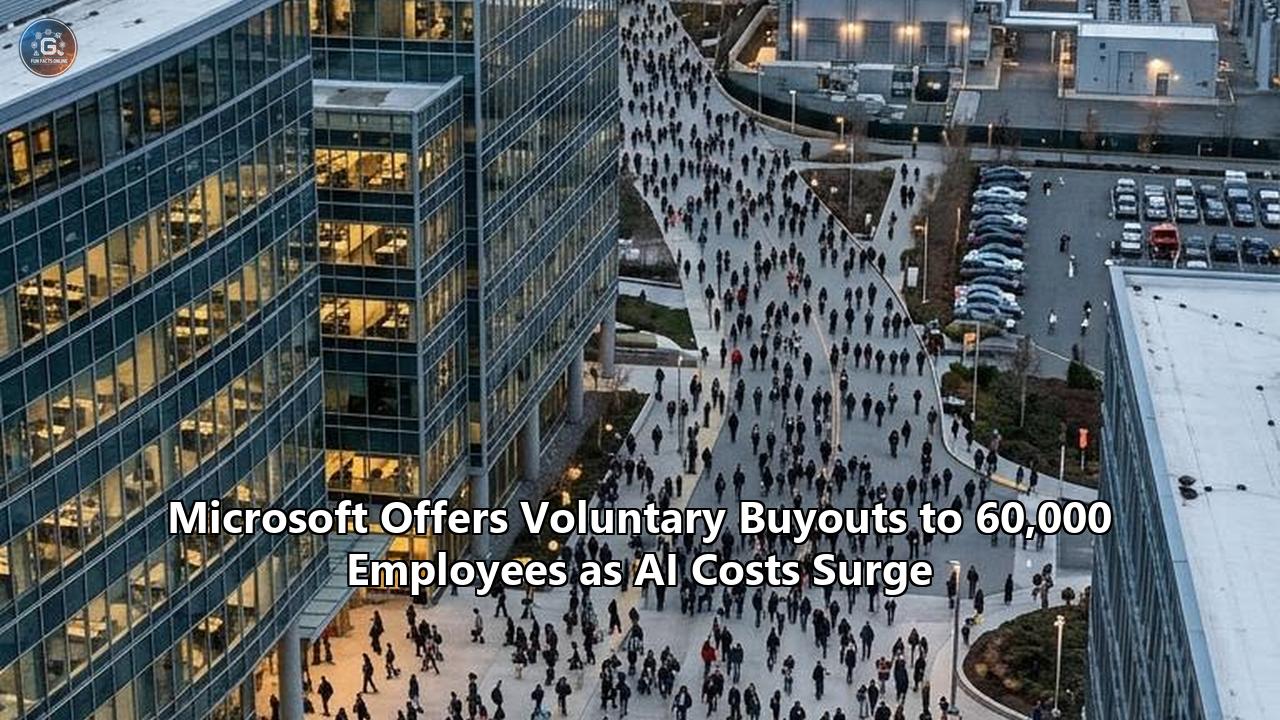
Microsoft announced a sweeping voluntary buyout offer to approximately 60,000 employees on October 26, 2026, marking an unprecedented attempt to rebalance corporate spending as the capital demands of artificial intelligence reach historic highs. The program, presented to staff in an internal memorandum by Chief People Officer Amy Coleman, extends across four primary operating countries—the United States, Canada, the United Kingdom, and India—and covers more than 27 percent of the company’s 223,000-person global workforce.
Eligible workers, spanning engineering, operations, and middle management positions up to internal Level 70, have until early December to decide whether to accept the severance terms, with approved separations slated for December 31, 2026.
The decision exposes a fundamental tension within enterprise technology: even record revenues cannot insulate white-collar workforces from the financial physics of the generative AI boom. Despite Microsoft posting fiscal 2026 revenue of $331.8 billion (an 18 percent increase) and operating income of $155.2 billion, the company's capital expenditures climbed to roughly $145 billion over the same period. With quarterly infrastructure run-rates eclipsing $50 billion and quarterly free cash flow dipping 23 percent to $19.64 billion, corporate leadership has moved to compress operational payroll expenses to protect cash reserves and maintain operating margins above 40 percent.
+--------------------------------------------------------------------------------+
|                         MICROSOFT FISCAL PROFILE (FY2026)                      |
+--------------------------------------------------------------------------------+
|  Annual Revenue               |  $331.8 Billion (+18% YoY)                     |
|  Operating Income             |  $155.2 Billion (+21% YoY)                     |
|  Capital Expenditures (FY26)  |  ~$145 Billion (Infrastructure & Datacenters)  |
|  Q2 Free Cash Flow            |  $19.64 Billion (-23% YoY)                     |
|  Total Global Workforce       |  223,000 Employees                             |
|  Buyout Eligibility Pool      |  ~60,000 Employees (~27% of Workforce)         |
+--------------------------------------------------------------------------------+
“The Voluntary Exit Offer reflects an important part of how we’re evolving our approach to change: creating greater flexibility and, where possible, more ways for employees to shape their next chapter,” Coleman stated in the memo. “This offer gives eligible employees who may be considering a future outside the company a new choice to make that transition now with support. It also gives participating organizations another way to adapt their workforce to changing needs”.
Beneath the human-resources framing lies an austere corporate realignment. As hyperscale cloud providers spend hundreds of billions on custom silicon, high-bandwidth memory, gigawatt-scale electrical grids, and multi-tenant data centers, human labor is no longer the primary driver of corporate scale. This buyout program serves as a critical lens through which to examine how tech enterprises are rearchitecting their capital allocations, managing talent attrition, and transforming balance sheets.
The Architecture of the Exit Offer: Severance, Tiers, and Ring-Fencing
The mechanics of the program clarify how Microsoft intends to reshape its organizational hierarchy. The initiative is not an indiscriminate staff reduction; rather, it selectively targets mid-tier and senior administrative tiers while strictly insulating the physical and direct-revenue backbones of the cloud infrastructure.
+-------------------------------------------------------------------------------+
|                      VOLUNTARY EXIT OFFER (VEO) MECHANICS                     |
+--------------------+----------------------------------------------------------+
| Eligibility Scope  | Level 70 and below (US, Canada, UK, India)               |
|                    | Reaches General Managers and select Vice Presidents      |
+--------------------+----------------------------------------------------------+
| Ring-Fenced Units  | Datacenter Operations, Physical Plant, Cloud Security,  |
| (Excluded)         | Direct Commercial Field Sales                            |
+--------------------+----------------------------------------------------------+
| Compensation:      | 1 week of base pay per 6 months of tenure                |
| Levels <= 64       | Minimum 60 days US payroll continuation                  |
+--------------------+----------------------------------------------------------+
| Compensation:      | 2 weeks of base pay per 6 months of tenure                |
| Levels 65-67       | Cap: Up to 39 weeks of base compensation                 |
+--------------------+----------------------------------------------------------+
| Equity & Benefits  | Standard vesting through separation date;                |
|                    | Fixed health continuation; professional career coaching  |
+--------------------+----------------------------------------------------------+
Under Microsoft’s internal leveling system, Level 70 functions as an organizational frontier. It encompasses senior directors, partner managers, and entry-level vice presidents who direct large teams and command compensation packages frequently running between $400,000 and $800,000 when factoring in equity distributions.
By capping the eligibility pool at Level 70, executive leadership has targeted the layers of management that accumulated during the rapid remote-work expansions between 2020 and 2022.
The severance formula balances corporate thrift with enough financial runway to entice voluntary exits:
- Levels 64 and Below: Staff receive one week of base salary for every six months of continuous service.
- Levels 65 through 67: Employees receive two weeks of base salary for every six months of service.
- Statutory and Payroll Floors: In the United States, eligible workers are guaranteed a minimum of 60 days on standard payroll to satisfy Worker Adjustment and Retraining Notification (WARN) provisions, with total severance payouts capped at 39 weeks.
- Ancillary Benefits: Participants retain equity that vests up through the December 31 exit date, receive subsidized health continuation coverage for a predetermined duration, and gain access to external outplacement services.
Crucially, Microsoft has excluded specific mission-critical departments. Teams charged with operating physical server farms, high-voltage electrical installations, cloud defense protocols, and active security intelligence operations cannot participate. Similarly, selected commercial sales units bound to direct enterprise quotas were deemed ineligible.
The structural rollout of Microsoft employee buyouts represents an operational pivot: human capital is reduced in redundant administrative, coordination, and secondary product functions, while technical and physical infrastructure roles remain protected.
The current move follows two earlier workforce calibrations earlier this year. In April, the company offered a Voluntary Retirement Program using a "Rule of 70" standard—requiring an employee's age and years of service to combine to at least 70. That initiative targeted approximately 9,000 domestic workers, achieving an uptake rate of roughly 30 percent.
Three months later, Microsoft implemented involuntary cuts across 4,800 positions, concentrated heavily inside the Xbox gaming hardware and publishing divisions following the integration of Activision Blizzard. By expanding the buyout pool to 60,000 individuals, leadership seeks to achieve structural headcount reductions without absorbing the severe cultural and public-relations fallout that accompanies repeated rounds of direct layoffs.
Balance Sheet Forensics: The Opex-to-Capex Cannibalization
To understand why a company generating more than $80 billion in quarterly revenue would offer buyouts to a quarter of its workforce, one must dissect the composition of enterprise operating margins. For decades, enterprise software enjoyed software-as-a-service (SaaS) gross margins exceeding 70 to 80 percent. Once a core platform—such as Windows, Office 365, or enterprise SQL servers—was engineered, the marginal cost of delivering that software to an additional user was functionally negligible.
Generative AI invalidates this economic model.
       TRADITIONAL SAAS ECONOMICS                     GENERATIVE AI HYPERSCALE ECONOMICS
+---------------------------------------+   +----------------------------------------------------+
|  Marginal Cost of Software: ~$0       |   |  Marginal Cost: High continuous GPU/power draw     |
|  Capital Allocation: High Opex (R&D)  |   |  Capital Allocation: Massive Capex ($145B/year)    |
|  Headcount Driver: Linear Scaling     |   |  Headcount Driver: Displaced by Compute Allocation |
|  Operating Cash Flow: High Free FCF   |   |  Operating Cash Flow: Squeezed by Fixed Asset Buys |
+---------------------------------------+   +----------------------------------------------------+
Every query directed toward an intelligent copilot, every automated coding prompt executed in GitHub Copilot, and every multi-modal enterprise reasoning workload requires active, high-power silicon. The compute cost is incurred on every transaction.
Consequently, Microsoft has engaged in an aggressive asset acquisition campaign. Over the past 36 months, the combined capital spending of Microsoft, Alphabet, Amazon, and Meta has surpassed $1 trillion. Microsoft alone deployed approximately $145 billion in fiscal 2026 capital expenditures, directed toward custom datacenters, high-bandwidth interconnect switches, advanced liquid cooling loops, and dedicated nuclear or renewable energy purchase agreements, including long-term power purchase commitments to resurrect shuttered facilities like Three Mile Island.
+--------------------------------------------------------------------------------+
|                    CAPITAL EXPENDITURE VS. CASH FLOW METRICS                   |
+--------------------------------------------------------------------------------+
|  Historical Tech SaaS Model:                                                   |
|  [Revenue] ---> [Operating Expenses: Payroll/SG&A] ---> [High Free Cash Flow]  |
|                                                                                |
|  Hyperscale AI Model:                                                          |
|  [Revenue] ---> [Capital Spending: Datacenters/GPUs] ---> [Cash Flow Squeeze]  |
|        |                                                                       |
|        +------> [Targeted Headcount Reductions (VEO)] (Preserves Operating %) |
+--------------------------------------------------------------------------------+
This capital expenditure surge creates immediate accounting liabilities. While capital equipment is capitalized on balance sheets and depreciated over multi-year asset lifespans (typically four to six years for servers and network gear), the upfront cash outflow is immediate.
Microsoft's Q2 fiscal performance revealed a 23 percent drop in free cash flow, landing at $19.64 billion. Wall Street equity analysts, while maintaining consensus buy ratings with average price targets above $610, have applied intense scrutiny to the return on invested capital (ROIC) generated by these infrastructure builds.
Chief Financial Officer Amy Hood has reiterated the requirement to discipline operating expenses (Opex) to balance elevated capital expenditures (Capex). In corporate finance, operational expenses include salaries, marketing budgets, travel, facilities, and benefits. Capital expenditures fund long-term physical assets.
When a company commits $50 billion in a single quarter to capital assets, every dollar shaved from ongoing operational payroll mitigates the aggregate cash drain.
A reduction of 10,000 mid-to-senior technical employees equates to roughly $2.5 billion to $3.5 billion in annual cash savings when tallying base compensation, equity incentives, health plans, and auxiliary overhead. In current market terms, that saved capital covers the acquisition of roughly 80,000 advanced AI accelerator chips or funds the power generation infrastructure for a 300-megawatt data campus. Microsoft is effectively swapping human payroll for computational horsepower.
The Efficiency Paradox: When Automation Displaces Its Builders
The broader case study embedded in Microsoft’s strategy highlights the efficiency paradox of artificial intelligence. Enterprise leadership throughout the technology industry spent three years marketing automated copilots to customers as tools that augment human potential, streamline operations, and boost productivity without requiring deep staffing reductions.
Within Microsoft's own engineering and operational organizations, internal telemetry paints a clear picture. The widespread integration of GitHub Copilot and customized internal coding models has automated standard unit testing, routine API documentation, legacy code migration, and basic interface programming.
Tasks that formerly required a multi-tiered engineering squad—composed of junior developers, a coordinating product manager, and dedicated quality assurance testers—are increasingly handled by a single senior engineer managing autonomous reasoning workflows.
TRADITIONAL PRODUCT SQUAD (5-7 ROLES)          AGENT-AUGMENTED MODEL (1-2 ROLES)
+-----------------------------------+          +-----------------------------------+
|  Lead Systems Architect           |          |  Principal System Architect       |
|  Mid-Level Frontend Developer    |  ======> |  (Orchestrating Autonomous AI     |
|  Mid-Level Backend Developer     |          |   Workflows & Copilot Generation)  |
|  Quality Assurance Tester         |          +-----------------------------------+
|  Scrum Master / Agile PM          |                   |
|  Technical Documentation Writer   |                   v
+-----------------------------------+          [Direct Autonomous Deployment]
This development compresses the internal labor pyramid. Throughout the software industry's expansion, organizations relied on a broad pyramid of mid-level contributors directed by operational managers. As autonomous developer platforms absorb basic execution work, the demand for traditional coordination overhead declines.
By deploying Microsoft employee buyouts instead of involuntary termination notices, the company provides an exit ramp for staff whose day-to-day functions have been automated or rendered non-essential by the very toolsets Microsoft sells.
Yet, this internal transformation exposes an unresolved contradiction. If productivity gains are as comprehensive as enterprise software providers assert, corporate output should multiply without expanding the budget. Instead, because running frontier AI models requires massive electrical and silicon overhead, productivity improvements are counterbalanced by the compute costs needed to realize them.
The software business is relinquishing its historical status as an asset-light industry. In becoming an asset-heavy utility reliant on hardware procurement and energy distribution, it must absorb the disciplined, lower-headcount workforce models characteristic of industrial and telecommunications sectors.
Strategic Principles: Lessons from the Buyout Blueprint
Microsoft's workforce maneuver provides corporate leaders, strategists, and human resource executives with a case study in large-scale workforce realignment during periods of capital-intensive disruption.
Analyzing the design of Microsoft employee buyouts exposes four core structural principles:
+---------------------------------------------------------------------------------+
|                    FOUR STRATEGIC WORKFORCE REALIGNMENT PRINCIPLES              |
+---+-----------------------------+-----------------------------------------------+
| 1 | Asymmetric Ring-Fencing     | Protect technical core; target middle tiers   |
+---+-----------------------------+-----------------------------------------------+
| 2 | The Self-Selection Hazard   | Mitigate reverse brain drain of top talent    |
+---+-----------------------------+-----------------------------------------------+
| 3 | Soft Attrition Management   | Protect employer brand; avoid WARN litigation |
+---+-----------------------------+-----------------------------------------------+
| 4 | The Flattened Hierarchy     | Phase out coordination layers for agentic ops |
+---+-----------------------------+-----------------------------------------------+
1. Asymmetric Ring-Fencing
Corporate restructurings often fail because leadership enforces uniform percentage cuts across every business vertical. Microsoft rejected this approach.
By explicitly insulating datacenter engineering, power system operations, hardware integration, and direct customer-facing enterprise security divisions, the company established a protected perimeter around its primary growth engines. Reductions are steered directly toward legacy products, regional marketing divisions, redundant management tiers, and support teams.
Strategic Principle: Never democratize workforce reductions. Protect foundational infrastructure and revenue-generating units while concentrating efficiency targets exclusively in non-differentiated operational strata.2. The Self-Selection Hazard
The greatest operational vulnerability of any voluntary buyout program is adverse self-selection, often termed the "reverse brain drain." When a buyout offer is extended across a large employee pool without explicit managerial gating, the highest-performing individuals—those who possess strong professional reputations, marketable skills, and outside job options—are often the first to take the cash payout and leave.
Conversely, marginal performers who recognize the challenging state of the broader tech hiring market may choose to remain, preserving their stable salaries.
Microsoft attempted to counter this dynamic by reserving organizational discretion. While the offer was publicized broadly, individual business units retained the authority to limit participation based on customer commitments and mission priorities.
Strategic Principle: Unchecked voluntary buyouts run the risk of purging top performers while retaining risk-averse personnel. Organizations must introduce managerial gating mechanisms to protect vital institutional knowledge.3. Soft Attrition as Brand and Legal Defense
Sudden mass layoffs, such as the sweeping reductions enacted across Silicon Valley in late 2022 and early 2023, inflict lasting damage on corporate recruitment pipelines, crater internal morale, and invite scrutiny from labor boards and regulatory bodies.
Offering standard severance through a voluntary framework—yielding identical compensation to what an employee would receive in an involuntary termination—functions as a risk-mitigation strategy. It reframes an operational cut as an employee choice.
Legally, voluntary separation agreements containing comprehensive release waivers severely limit exposure to age-discrimination, WARN Act, and constructive-dismissal lawsuits.
Strategic Principle: When facing multi-year structural adjustments, voluntary exit offers function as an insurance policy against labor litigation and employer brand degradation, even if the severance cash requirements match traditional layoffs.4. Dismantling the Coordination Layer
The eligibility ceiling of Level 70 signals an intentional flattening of enterprise management. In complex enterprises, middle managers often spend significant time generating internal reporting, moderating cross-team dependencies, and managing status updates. Modern AI-driven tracking environments automate much of this operational visibility.
Eliminating these coordination positions accelerates executive decision-making cycles and removes friction between senior leadership and technical execution teams.
Strategic Principle: The primary structural redundancy in the modern enterprise is not entry-level operational labor, but the middle-management coordination layer. Automating information synthesis enables broader spans of control and leaner corporate architectures.Cross-Industry Contagion: The Hyperscale Labor Reality
Microsoft does not operate in isolation. The strategies enacted in Redmond frequently establish the baseline for employment norms, compensation models, and capital expenditure discipline across the broader global technology ecosystem.
+---------------------------------------------------------------------------------+
|                       HYPERSCALE WORKFORCE REALIGNMENTS (2026)                  |
+-------------+-----------------------+-------------------------------------------+
| Company     | Structural Adjustment | Primary Capital Focus                     |
+-------------+-----------------------+-------------------------------------------+
| Microsoft   | 60,000-Worker Buyout  | Datacenters, Custom Silicon, Power Deals  |
| Meta        | Continuous Attrition  | Llama Model Infrastructure, GPU Clusters  |
| Alphabet    | Targeted Unit Trims   | Custom TPU Deployments, DeepMind Compute  |
| Amazon      | Management Delayering | Trainium Chips, AWS Nuclear Integrations  |
+-------------+-----------------------+-------------------------------------------+
Competitors face matching financial pressures:
- Alphabet continues to execute targeted reductions across core product lines to direct cash toward its custom TPU hardware deployments and DeepMind training clusters.
- Amazon has implemented a company-wide campaign targeting the elimination of 14,000 management positions, seeking to expand individual manager-to-employee ratios while reallocating billions into AWS data infrastructure and specialized nuclear energy pacts.
- Meta has held headcount growth near zero for consecutive quarters, operating under its stated efficiency discipline to fund massive GPU clusters.
This coordinated posture alters the landscape for white-collar technology professionals. Between 2012 and 2021, tech professionals operated in an environment characterized by persistent talent shortages, climbing compensation packages, and broad job mobility.
The current landscape, shaped by surging infrastructure costs, paints an entirely different picture. The ripple effects of Microsoft employee buyouts extend far beyond Redmond, signaling to the tech labor market that high compensation, stable tenure, and career progression will no longer be distributed across expansive middle-tier workforces.
+-----------------------------------------------------------------------------------+
|                        THE TECH SECTOR CAPITAL REALIGNMENT                        |
+-----------------------------------------------------------------------------------+
|               PAST DECADE (2012–2021)       |        CURRENT RUN-RATE (2026)      |
+---------------------------------------------+-------------------------------------+
| Capital Target: Human Headcount Expansion   | Capital Target: Compute & Megawatts |
| Margin Driver: Asset-Light Software (SaaS)  | Margin Driver: High Hardware Capex  |
| Organizational Model: Expansive Middle Mgmt | Organizational Model: Lean & Agentic|
| Talent Dynamic: Bidding Wars for Generalists| Talent Dynamic: Specialization Only |
+-----------------------------------------------------------------------------------+
For tech workers in the United States, the United Kingdom, Canada, and India, the macro environment offers limited landing spots.
Hiring across enterprise SaaS platforms has plateaued as businesses divert their software procurement budgets to fund generative AI experiments and infrastructure licensing. Employees weighing Microsoft's buyout offer face a tech job market marked by extended search timelines, lower baseline equity packages, and high employer leverage.
Critical Uncertainties and the Road Ahead
As the December deadline approaches for 60,000 eligible Microsoft employees, leadership faces key operational variables that will determine whether this strategy succeeds or necessitates further, more disruptive interventions.
+--------------------------------------------------------------------------------+
|                        CATALYST WATCH & STRATEGIC MILESTONES                   |
+----------------------+---------------------------------------------------------+
| Early December 2026  | Voluntary Exit Offer election deadline closes           |
|                      | Target uptake rate: 10% to 15% (~6,000 to 9,000 staff)  |
+----------------------+---------------------------------------------------------+
| December 31, 2026    | Official departure date for accepting employees         |
|                      | Final Q2 free cash flow and restructuring charges clear |
+----------------------+---------------------------------------------------------+
| Q1 2027              | Operational assessment: Were cost reductions achieved?  |
| (January Purge Risk) | Risk of involuntary layoffs if buyout uptake is low     |
+----------------------+---------------------------------------------------------+
| Mid-2027             | Capital return inflection: Can Copilot ARR justify     |
|                      | the ongoing $145B+ annualized infrastructure run-rate?  |
+----------------------+---------------------------------------------------------+
The first uncertainty centers on the aggregate participation rate. During the targeted retirement program implemented in the spring, approximately 30 percent of the eligible 9,000-person cohort accepted the package. However, that group was close to standard retirement and received specialized healthcare benefits.
The current voluntary exit program provides standard severance without extended post-retirement medical coverage, during a sluggish period for broader tech hiring. Analysts project an acceptance rate between 10 and 15 percent, representing roughly 6,000 to 9,000 departures.
If employee uptake falls below expectations, Microsoft executive leadership will confront a direct choice: allow operational expenses to dilute profit margins, or follow up in January 2027 with involuntary layoffs to hit internal headcount targets.
The second challenge involves maintaining operational performance across legacy platforms. While artificial intelligence dominates corporate strategy, the core of Microsoft’s quarterly profitability remains rooted in enterprise solutions: Windows OEM licensing, Office 365 enterprise agreements, SQL database maintenance, and Azure enterprise migrations.
If voluntary exits strip institutional knowledge from these established platforms, service delivery and customer satisfaction could degrade before AI services expand enough to fully replace legacy cash flows.
The ultimate benchmark is the monetization timeline of enterprise AI itself. Microsoft has staked its corporate strategy, balance sheet, and workforce stability on the thesis that generative interfaces will transform global commerce. The company is directing hundreds of billions into physical infrastructure to secure its position.
If enterprise software buyers demonstrate that the software increases worker output sufficiently to command premium licensing tiers, Microsoft will validate its capital reallocation strategy. But if enterprise adoption stalls, compute overhead remains elevated, and customers resist higher subscription prices, the company will have downsized its human workforce to finance overbuilt computational infrastructure.
The coming months will show whether trading human capital for computational horsepower is an effective corporate strategy, or a premature capitulation to the high capital costs of the AI transition.
Key Takeaways
- Event & Scope: Microsoft has extended a Voluntary Exit Offer to roughly 60,000 workers across the US, Canada, UK, and India, targeting positions at internal Level 70 and below.
- Financial Catalyst: Despite posting $331.8 billion in revenue for fiscal 2026, annual capital spending climbed to $145 billion, pressuring free cash flow and prompting management to cut payroll costs.
- Strategic Playbook: Microsoft has protected core technical infrastructure while offering buyouts to streamline middle-management layers, using voluntary attrition to reduce headcount while limiting severance lawsuits and brand damage.
- Next Steps: Staff have until early December to choose between the buyout or staying; if adoption falls short, the risk of involuntary workforce cuts early next year will increase.
Reference:
- https://www.tipranks.com/news/microsoft-offers-buyouts-to-60000-workers-as-ai-spending-soars
- https://www.mysanantonio.com/business/article/microsoft-buyouts-ai-22495261.php
- https://www.gurufocus.com/news/9144278/microsoft-offers-buyouts-to-60000-as-ai-spending-rises
- https://www.youtube.com/watch?v=OE2GeM5hbn4
- https://blogs.microsoft.com/blog/2026/10/26/introducing-a-voluntary-exit-offer/
- https://www.tomshardware.com/tech-industry/big-tech/60-000-microsoft-employees-offered-voluntary-buyouts-as-ai-buildout-costs-bite-program-covers-roughly-27-percent-of-workforce-across-us-canada-india-and-the-uk
- https://www.reddit.com/r/microsoft/comments/1xg0c5o/microsoft_is_offering_buyouts_to_around_60000/
- https://www.businessinsider.com/microsoft-is-offering-buyouts-read-the-memo-2026-10
- https://www.geekwire.com/2026/microsoft-makes-new-voluntary-exit-offer-to-more-than-a-quarter-of-its-workforce-including-some-execs/
- https://www.businessinsider.com/companies-microsoft-considering-voluntary-buyouts-pros-cons-2026-10
- https://www.sfgate.com/tech/article/microsoft-buyouts-22495637.php
- https://www.fox9.com/news/microsoft-offers-voluntary-buyouts-60000-employees-tech-giant-reshapes-its-workforce