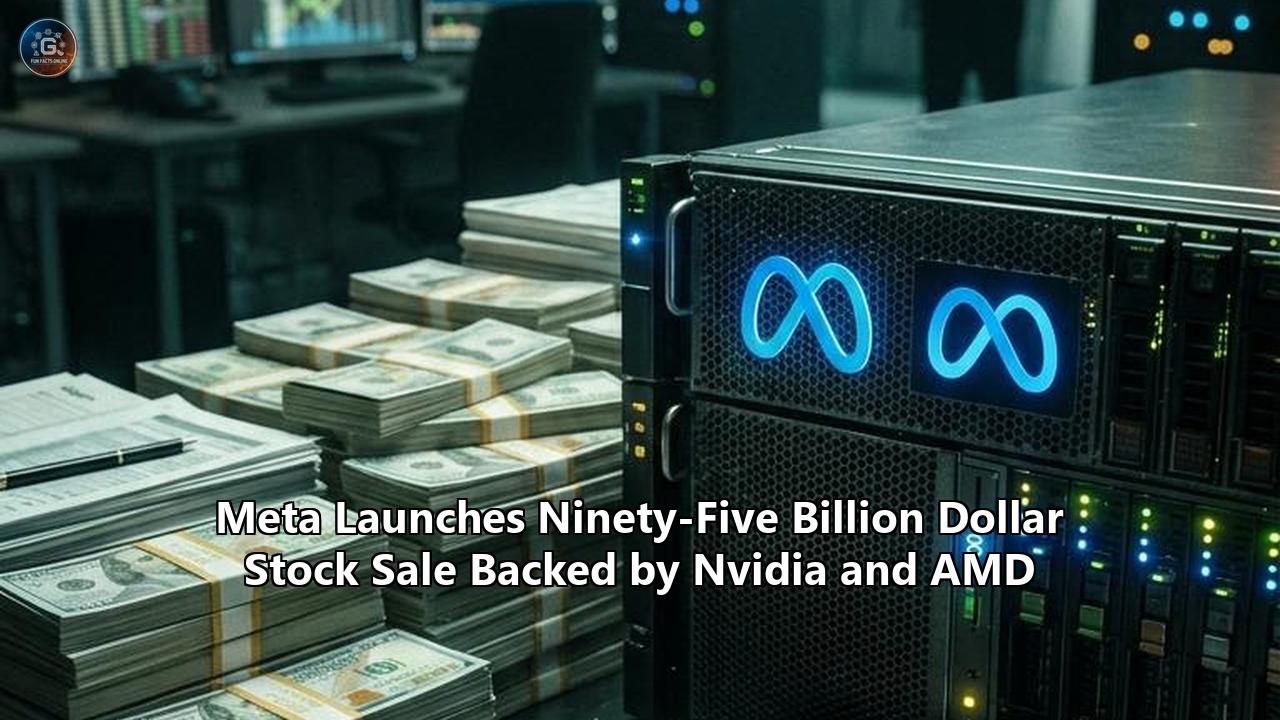
Meta Platforms has launched an unprecedented equity financing campaign to raise up to $95 billion, tapping public markets for primary capital for the first time in over a decade to bankroll its massive expansion into artificial intelligence infrastructure.
The financing plan, filed with the Securities and Exchange Commission, combines an immediate $35 billion concurrent public equity offering with a planned $60 billion at-the-market program scheduled for 2027. Underpinning the initial transaction is an extraordinary non-binding commitment: semiconductor titans Nvidia, Advanced Micro Devices, and Broadcom have signaled their collective intent to purchase up to $5 billion of Meta’s newly issued common stock on the same terms as public investors.
The announcement sent waves through global markets, pulling Meta’s shares through wild premarket swings between a 1.6% advance and a 4% decline as institutional investors digested the dual reality of massive dilution and an aggressive, vendor-backed cash injection. The financing arrives less than a week after Meta posted third-quarter capital expenditures of $34.91 billion—surpassing its quarterly operating cash flow and driving the company into negative free cash flow for the first time in its modern operating history.
The immediate tranche of the Meta stock sale consists of $22.5 billion in Class A common stock structured via forward sale agreements with Morgan Stanley Capital Services and Goldman Sachs, alongside $12.5 billion of depositary shares representing Series A mandatory convertible preferred stock. The second tranche, totaling up to $60 billion, will be issued through an at-the-market facility using a newly established class of nonvoting Class C common stock once those shares begin trading in the first quarter of 2027.
This multi-year capital campaign marks a decisive turning point in corporate finance for Silicon Valley. As computing demands accelerate beyond the organic cash generation of the world's most profitable advertising platforms, Meta is establishing a synthetic vendor-financing model where the suppliers building the AI supply chain are actively underwriting the equity of the hyper-scaler buying their chips.
October 2024 – June 2025: The Infrastructure Pivot and Capex Escalation
The trajectory toward this historic capital mobilization began two years prior, when Meta decisively broke with its post-2022 "Year of Efficiency" discipline. Through late 2024, Chief Executive Officer Mark Zuckerberg and Chief Financial Officer Susan Li progressively revised the company’s capital expenditure outlook upward, transitioning from an operating posture designed to appease Wall Street margins to an all-out race for sovereign-scale compute capacity.
Throughout 2024, Meta's capital expenditure hovered at approximately $37 billion to $40 billion, primarily allocated toward data center retrofits, customized cooling infrastructure, and acquiring hundreds of thousands of Nvidia H100 and H200 Tensor Core GPUs. However, internal benchmarks for the Llama family of large language models—alongside production demands for the multimodal recommendation algorithms powering Instagram Reels and Meta Ads Manager—rapidly exposed physical computing ceilings.
By early 2025, Meta engineers were bumping against severe electrical grid interconnect delays in Northern Virginia and Ohio. The company pivoted toward greenfield development of multi-hundred-megawatt computing campuses across rural sites in 23 states, requiring direct capital investments not just in server racks, but in proprietary transmission substations, high-voltage switchyards, and dedicated water-recycling closed-loop cooling circuits.
During earnings calls across the first half of 2025, Li repeatedly adjusted the forward capital spending trajectory, stating that the company viewed the downside of under-investing in physical AI capacity as structurally worse than the risk of over-building. The capex guidance floor for fiscal 2025 was repeatedly lifted from $38 billion to $42 billion, then settled north of $50 billion as contracts for high-bandwidth memory (HBM3e) and optical transceivers locked in long-dated balance sheet liabilities.
At the same time, Meta’s software engineering teams launched the early iterations of what would become the "Muse" personal agent framework, while Zuckerberg articulated an ambition targeting "personal superintelligence"—a network of agentic, context-aware AI models tailored for each of the company’s 3.64 billion daily active platform users. Delivering real-time generative inference at that scale made it apparent that Meta's historical cash-flow-from-operations run-rate could not self-fund the computing fleet required for both training frontier foundation architectures and serving planetary-scale inference workloads.
October 2025: The $30 Billion Debt Wall and Balance Sheet Realities
By autumn 2025, Meta confronted the mathematical constraints of relying exclusively on debt and operational profits to underwrite its hardware procurements. In October 2025, the company made its largest foray into the corporate bond markets to date, executing a $30 billion multi-tranche senior unsecured bond sale.
The institutional bond issuance was heavily oversubscribed, but the pricing reflected an expanding risk spread over benchmark U.S. Treasuries, driven by growing debt issuance across the entire hyper-scaler peer group. Credit rating agencies Moody’s and S&P Global Ratings maintained Meta’s high-grade investment ratings (Aa3/A+) but noted that the company’s ratio of gross debt to earnings before interest, taxes, depreciation, and amortization (EBITDA) was accelerating faster than that of Microsoft or Alphabet.
The $30 billion debt injection provided temporary liquidity, but it rapidly shifted Meta’s capital structure:
- Total long-term debt crossed the $80 billion threshold, reaching $80.92 billion by late 2026.
- Cash, cash equivalents, and marketable securities hovered at $82.45 billion, reducing Meta’s net cash cushion to near parity.
- Annual interest expenses scaled from negligible sums in the ultra-low interest rate era to a run-rate exceeding $3.5 billion annually.
- Contractual capital obligations—including long-term cloud leases, power purchase agreements (PPAs) with nuclear and geothermal operators, and non-cancellable chip purchase orders—snowballed toward a staggering $825 billion.
Financial analysts realized that issuing another $30 billion to $50 billion in senior debt throughout 2026 would risk credit downgrades, increasing the cost of capital across the enterprise. Meta was approaching the physical ceiling of debt financing at a time when chipmakers were introducing denser, exponentially more expensive compute architectures requiring upfront advance deposits.
February 2026: Silicon Alignment and the AMD Warrant Precedent
With debt capacity tightening, Meta looked toward strategic structural partnerships with its hardware vendors. The first major public signal of mutual corporate balance sheet integration arrived in February 2026, when Meta and Advanced Micro Devices finalized an expansive silicon procurement agreement.
Meta committed to deploy up to six gigawatts of AMD's next-generation GPU and accelerated processing unit (APU) architectures across its next-wave cluster facilities. In exchange for long-term supply guarantees and deep architectural co-design rights over AMD's ROCm software stack, AMD granted Meta warrants to purchase up to 160 million AMD common shares at an exercise price of one cent ($0.01) each.
The warrants were tied strictly to operational and performance milestones: Meta had to take delivery of specified volumes of AMD compute clusters and maintain deployment schedules through 2027 and 2028. The arrangement allowed Meta to capture financial upside in AMD’s stock as a direct consequence of its own procurement volume, while AMD secured a foundational customer capable of preventing total market monopolization by Nvidia.
Concurrently, Meta accelerated its collaboration with Broadcom to fabricate its internal Meta Training and Inference Accelerator (MTIA) silicon. Broadcom provided the critical high-speed SerDes interconnect IP, optical interface packaging, and physical design engineering to scale MTIA v2 and v3 ASICs, targeting standard recommendation workloads and freeing higher-cost GPUs for complex reasoning models.
Simultaneously, Meta remained Nvidia’s largest single commercial buyer alongside Microsoft, absorbing massive volumes of Blackwell architecture GB200 NVL72 rack-scale systems and signing initial commitments for next-generation Rubin platforms.
The February 2026 AMD agreement established the structural precedent: the traditional transactional relationship between chip designers and data center operators had dissolved. The relationship was evolving into bilateral balance sheet exposure, setting the stage for hardware vendors to take reciprocal equity positions in their primary client.
July – October 2026: Free Cash Flow Inversion and the End of Buybacks
The third quarter of 2026 delivered the operational catalyst that transformed strategic contemplation into an emergency financing mandate.
For years, Meta had deployed its vast advertising profits into aggressive capital return programs. Between 2021 and early 2026, Meta repurchased more than $130 billion of its own Class A common stock, steadily driving down its diluted share count to boost earnings per share (EPS). But as 2026 progressed, that repurchase engine abruptly ground to a halt.
By July 2026, regulatory filings revealed that Meta had paused open-market share buybacks entirely. Cash that had historically supported equity prices was redirected to pay suppliers for silicon packaging, liquid-to-air cooling manifolds, and multi-gigawatt grid infrastructure.
The structural pressure broke into public view on October 21, 2026, when Meta delivered its third-quarter financial results:
| Metric | Q3 2025 | Q3 2026 | Year-over-Year Change |
|---|---|---|---|
| Total Revenue | $51.27 Billion | $64.60 Billion | +26.0% |
| Operating Cash Flow | $27.40 Billion | $32.79 Billion | +19.7% |
| Capital Expenditures (PP&E) | $18.83 Billion | $34.91 Billion | +85.4% |
| Free Cash Flow | +$8.57 Billion | -$2.12 Billion | Inverted (-124.7%) |
| 2026 Full-Year Capex Guide | $92 Billion | $135B – $145B | Upward Revision |
While core digital advertising revenue grew an impressive 26% year-over-year to $64.60 billion—surpassing consensus projections of $63.37 billion—the expense profile shocked Wall Street analysts. Capex had escalated 85% year-over-year to $34.91 billion for the quarter alone, outstripping operating cash flow by more than $2.1 billion.
Meta had officially burned through its operational cash cushion, logging negative $2.12 billion in free cash flow.
Compounding the cash burn, Li announced an upward revision to full-year 2026 capex guidance, lifting the floor from $130 billion to a staggering $135 billion to $145 billion. With $86 billion already spent through the first nine months of the year, Meta's guidance implied that fourth-quarter capital expenditures would land between $49 billion and $59 billion—an unprecedented single-quarter spend for any corporate entity in peacetime history.
During the accompanying analyst call, Zuckerberg was blunt about the fiscal trajectory. He stated that the infrastructure necessary to develop and deploy autonomous agents, interactive holographic computing, and foundation reasoning models would require "hundreds of billions of dollars over several years".
The market’s reaction was punitive. Meta shares plummeted 7% during regular trading on Thursday, October 22, wiping out tens of billions of dollars in market capitalization as institutional funds confronted the end of the hyper-scaler free-cash-flow era.
October 22–25, 2026: The Class C Architecture and Governance Defense
Inside Meta’s Menlo Park headquarters, the executive committee realized that neither operational cash flow nor further debt issuance could bridge the widening funding gap. The enterprise faced a structural deficit of at least $60 billion to $100 billion over the following 24 months to support its data center build-out.
Yet, tapping the equity markets carried a major governance hurdle: voting control.
Since its 2012 initial public offering, Meta has maintained a dual-class share structure:
- Class A Common Stock: Entitled to one vote per share, held by public market investors and institutional index funds.
- Class B Common Stock: Entitled to ten votes per share, held predominantly by Mark Zuckerberg and affiliated trusts.
Through this structure, Zuckerberg retained over 58% of the voting control despite owning a fraction of the total economic equity. Issuing tens of billions of dollars in new Class A common shares directly to the market would dilute public equity holders and slowly shrink the total voting base, making Zuckerberg's majority hold increasingly fragile against aggressive activist campaigns.
Over the weekend of October 24–25, Meta’s board finalized the corporate re-engineering required to unlock massive equity liquidity while preserving managerial control:
- Creation of Nonvoting Class C Capital Stock: Mirroring the move executed by Google's parent company Alphabet in 2014, Meta authorized the creation of a nonvoting Class C share class carrying zero votes per share. This instrument was earmarked to feed a future $60 billion at-the-market equity issuance facility without altering the voting distribution.
- Forward Sale Agreement Architecture: To prevent an immediate flood of new Class A shares from depressing current market prices, Meta structured a forward transaction with Wall Street syndicates. This structure allowed investment banks to borrow and distribute shares immediately, while Meta deferred physical share delivery and cash intake until specific milestone dates stretching through late 2027.
- Mandatory Convertible Preferred Hybrid: To attract yield-focused institutional investors who might balk at common equity dilution, Meta designed a mandatory convertible preferred vehicle offering a structured yield with mandatory equity conversion scheduled three years out.
With the corporate governance firewall erected and the financial instruments defined, the underwriters engaged Meta’s primary silicon suppliers.
October 26, 2026: The Architecture of the Meta Stock Sale
Before U.S. exchanges opened on Monday, October 26, Meta filed a comprehensive offering prospectus with the SEC, formally unveiling the most ambitious equity capital raise in corporate history.
The total capital program encompasses up to $95 billion across two operational phases.
                          TOTAL EQUITY FACILITY: UP TO $95 BILLION
                                             |
             +-------------------------------+-------------------------------+
             |                                                               |
    PHASE 1: IMMEDIATE TRANCHE                                      PHASE 2: ATM FACILITY
         ($35 BILLION)                                                   ($60 BILLION)
             |                                                               |
     +-------+-------+                                             Commences Q1 2027
     |               |                                             Nonvoting Class C Stock
$22.5 BILLION   $12.5 BILLION                                      Zero Voting Rights
Class A Common  Series A Preferred                                 Preserves Founder Control
Forward Sales   Mandatory Convertible
(Goldman/MS)    (Ticker: METAM)
Settles by 2027 Converts Aug 2029
1. The $22.5 Billion Forward Sale of Class A Common Stock
Meta launched an underwritten public offering of $22.5 billion of its standard Class A common stock, with an option for underwriters to acquire an additional $3.375 billion in over-allotments within 30 days.
Instead of issuing shares directly into the market and taking cash proceeds upfront, Meta structured the offering via forward sale agreements with Morgan Stanley Capital Services LLC and Goldman Sachs & Co. LLC.
Under these forward contracts:
- The forward purchasers (Morgan Stanley and Goldman Sachs) borrow Class A shares from third-party institutional lenders and sell them to public investors at the offering price.
- Meta does not receive the cash proceeds on day one.
- Meta reserves the contractual right to settle the agreements on dates of its choosing between pricing and November 19, 2027.
- Upon settlement, Meta will issue and deliver physical Class A shares to the forward purchasers in exchange for cash based on the forward sale price, adjusted for the banks' carrying costs, underwriting discounts, and contractual dividend adjustments.
This mechanism delivers crucial strategic flexibility: it locks in committed equity valuations today while allowing Meta to draw down capital incrementally over the next 13 months as milestone payments for compute hardware, land acquisitions, and electrical substation construction come due.
2. The $12.5 Billion Series A Mandatory Convertible Preferred Stock
Concurrent with the Class A offering, Meta launched $12.5 billion in depositary shares, consisting of 250 million depositary units.
Each unit represents a 1/20th fractional interest in a newly authorized share of Series A Mandatory Convertible Preferred Stock. Key terms include:
- Listing: Meta applied to list the depositary shares on the Nasdaq Global Select Market under the trading symbol METAM.
- Upfront Liquidity: Unlike the forward common offering, the $12.5 billion preferred tranche delivers direct cash proceeds to Meta immediately upon transaction closing.
- Conversion Structure: The preferred shares carry a regular dividend (to be established upon final pricing) and will automatically convert into a variable number of Meta Class A common shares on or around August 15, 2029.
- Downside Floor and Upside Cap: The conversion ratio will float inversely to Meta’s share price within a structured collar, providing institutional buyers with guaranteed yield and downside protection while capping the equity dilution Meta faces if its common shares appreciate significantly by 2029.
3. The $60 Billion Nonvoting Class C At-The-Market (ATM) Facility
The third component of the financing architecture—bringing the theoretical aggregate ceiling to $95 billion—is an at-the-market equity program of up to $60 billion in Class C nonvoting shares.
The filing clarifies that this facility is not yet operative. Meta has not entered into distribution agreements for the ATM program and will not initiate sales until the first quarter of 2027, following the formal issuance and secondary market listing of the Class C equity.
Once active, the ATM facility will function like a flexible equity spigot. Meta will be permitted to sell newly printed Class C shares directly into the open market via designated broker-dealers at prevailing market prices whenever the company needs cash infusions for capital expenditures. Crucially, because Class C stock possesses zero voting rights, distributing $60 billion of this paper into the market will not dilute Zuckerberg’s voting majority by a single percentage point.
The structural execution of the Meta stock sale reflects an unprecedented effort to construct a $95 billion equity cushion without sparking an immediate, uncontrolled plunge in common share valuations.
The $5 Billion Chipmaker Consortium: Nvidia, AMD, and Broadcom Step In
The most notable revelation within Meta’s October 26 SEC filing was the identification of "Cornerstone Investors" stepping forward to back the common offering.
According to the free-writing prospectus, Nvidia, Advanced Micro Devices, and Broadcom indicated non-binding interest in purchasing up to an aggregate $5.0 billion of the Class A common stock offered through the forward sale mechanism, acquiring the stock on identical terms and pricing as institutional asset managers.
                         THE CIRCULAR AI LIQUIDITY LOOP

               +-----------------------------------------------+
               |                                               |
               |                                               v
    +--------------------+       Capital ($5B)       +--------------------+
    |  CHIP SUPPLIERS    |-------------------------->|   META PLATFORMS   |
    |  Nvidia            |                           |                    |
    |  AMD               |   Silicon & Infrastructure|  CapEx Spend       |
    |  Broadcom          |<--------------------------|  ($135B-$145B)     |
    +--------------------+     (Racks, ASICs, GPUs)  +--------------------+
               ^                                               |
               |                                               |
               +-----------------------------------------------+
While the prospectus explicitly outlines that these expressions of interest are non-binding—meaning any of the three semiconductor companies can purchase more, less, or none of the offered allocation, and the underwriters retain absolute discretion over share distribution—the strategic signaling is undeniable.
The three vendors are the primary beneficiaries of Meta’s capital expenditure:
- Nvidia: Supplying the massive volume of high-end GPU clusters, specialized networking gear (Quantum-2 InfiniBand and Spectrum-X Ethernet switches), and software libraries.
- AMD: Supplying alternative open-ecosystem GPU clusters under the multi-gigawatt procurement framework established earlier in the year.
- Broadcom: Providing physical ASIC design, custom accelerators (MTIA), high-bandwidth memory PHY interfaces, and optical transceivers critical for Meta’s cluster interconnect fabric.
If the full $5.0 billion allocation is exercised, it will forge unprecedented balance-sheet interlocks among the four tech giants.
The dynamic with AMD is especially layered. AMD previously issued Meta 160 million penny-warrants linked to hardware deployment milestones. Should AMD execute its portion of the proposed stock purchase, the two enterprises will effectively hold cross-equity stakes in one another: Meta holding equity exposure in AMD via milestone warrants, and AMD holding Class A shares in Meta via the primary offering.
The Mechanics of Circular AI Financing: Strategic Symbiosis or Structural Risk?
The involvement of Nvidia, AMD, and Broadcom as equity backers for their largest corporate client has instantly polarized financial analysts and corporate governance monitors, with many labeling the arrangement a synthetic form of circular vendor financing.
In traditional corporate debt markets, vendor financing occurs when an equipment manufacturer provides a loan directly to a buyer to enable the buyer to purchase the manufacturer's goods. During the late-1990s telecommunications buildout, networking equipment vendors like Lucent Technologies, Nortel, and Cisco extended tens of billions of dollars in vendor credit and loan guarantees to speculative telecom start-ups laying transcontinental dark fiber. When end-user demand failed to monetize fast enough to service the debt, the buyers defaulted, triggering cascading write-downs and credit crises across the equipment makers.
Meta’s equity-based structure is distinct from the 1990s telecom collapse, but it introduces an intriguing liquidity loop:
- Revenue and Cash Flow Generation: Meta generates tens of billions of dollars in gross profit each quarter from its core advertising engine across Facebook, Instagram, and WhatsApp.
- Capital Expenditure Outflow: Meta transfers that cash, alongside external financing, directly to Nvidia, AMD, and Broadcom to purchase server racks, silicon, and specialized optics.
- Vendor Balance Sheet Accumulation: The chipmakers capture historic operating margins (often 60% to 75% gross margins on accelerator packages), accumulating substantial corporate cash piles.
- Equity Reinvestment: The chipmakers allocate a portion of that cash pile to purchase equity in Meta via the Meta stock sale, replenishing Meta’s capital base so it can continue underwriting forward purchase orders for the chipmakers' products.
Proponents of the structure argue that this loop is an efficient alignment of strategic incentives. By holding Meta equity, semiconductor suppliers capture indirect financial exposure to the commercial applications, software monetization, and digital ad efficiency generated by their silicon. Furthermore, by committing capital to the offering, the chipmakers help ensure that their single biggest customer does not slow down its procurement cycles or downscale its cluster build-outs due to balance sheet constraints.
Conversely, skeptics point toward the accounting and market-pricing distortions generated when suppliers artificially subsidize the purchasing power of their end customers. If hyper-scale data center operators require capital injections from hardware vendors to maintain compute procurement schedules, the real underlying return on investment (ROI) of current artificial intelligence deployments becomes increasingly difficult for public equity markets to independently evaluate.
Wall Street short-sellers and corporate governance advocates are scrutinizing the transaction for potential circularity disclosures:
- Revenue Recognition: Auditors must verify that cash flowing from chipmakers into Meta equity is fully detached from procurement discounts or volume rebate agreements, ensuring that chipmakers do not improperly recognize revenue on sales indirectly enabled by their own equity capital.
- Pricing Leverage: If semiconductor makers are major shareholders in Meta, their willingness to offer price concessions or prioritize silicon allocations during supply shortages could prompt antitrust and competitive fairness challenges from rival hyper-scalers such as Amazon Web Services and Microsoft Azure.
The Macro AI Arms Race: Wall Street and Big Tech Confront the Multi-Trillion Capital Bill
Meta is far from alone in straining corporate balance sheets to fund the unprecedented physical compute build-out. The launch of the $95 billion equity program coincides with a systemic capital crunch gripping the entire technology sector, as hyper-scalers transition from purchasing hardware out of cash flow to deploying sophisticated structured finance.
According to comprehensive infrastructure projections compiled by Goldman Sachs, total global capital expenditure across computing hardware, specialized data centers, clean-energy generation, and electric transmission will reach approximately $7.6 trillion between 2026 and 2031.
No single technology company—regardless of its digital advertising dominance or cloud hosting monopoly—generates enough free cash flow to fund that scale of physical infrastructure from operations alone.
The capital mobilization across Meta’s peer group confirms this systemic shift:
- Alphabet: Recently outlined an expansive $85 billion equity-linked financing initiative to support Google Cloud’s data center campus expansion and customized TPU procurement.
- SpaceX: Closed an extraordinary $40 billion financing arrangement aimed at funding space-based and terrestrial AI supercomputing equipment and orbital data relay networks.
- Anthropic: Filed confidentially for a public stock market listing, disclosing a net loss of $80.7 billion for the first half of 2026 alone as it spends every dollar of available venture and cloud capital on foundation model training clusters.
The era of funding foundational computing through software margins is over. The technology landscape has effectively transformed into an ultra-heavy industrial manufacturing sector. Like railroad conglomerates in the 19th century or transnational oil and gas pipelines in the 20th century, the entities building sovereign computing clusters must raise multi-billion-dollar syndications of equity, debt, and synthetic vendor financing to survive the capital-intensive scaling phase.
The Execution Horizon: Critical Milestones Through 2029
The execution of Meta’s multi-part capital strategy will unfold across four distinct phases over the next three years, each serving as an operational checkpoint for the company’s financial stability and infrastructure expansion:
                               TIMELINE OF EXECUTION

         2026                          2027                          2029
          |                             |                             |
          v                             v                             v
   OCTOBER 26, 2026               Q1 2027                       AUGUST 15, 2029
   $35B Offering Launched         $60B ATM Launches             Series A Preferred
   $22.5B Class A Forwards        Class C Shares Debut          Mandatory Conversion
   $12.5B METAM Preferred         Zero Voting Dilution          Turns into Class A
   Nvidia/AMD/Broadcom $5B        Open-market issuances         Dilution formalized
          |                             |                             |
          +------------+----------------+--------------+--------------+
                       |                               |
                       v                               v
                 DECEMBER 2026                  NOVEMBER 19, 2027
                 Q4 Capex Print                 Forward Contracts Settle
                 $49B-$59B Projected            Meta delivers Class A
                 Largest quarter spend          Receives delayed cash
1. Late 2026: Pricing, Allotment, and the Q4 Capex Surge
The immediate focus centers on the final pricing of the $35 billion public offering and the formal execution of the forward contracts with Morgan Stanley and Goldman Sachs. Underwriters will determine whether to exercise their 30-day option to purchase up to an additional $3.375 billion in Class A shares, and the final dividend yield and mandatory conversion ratios for the METAM preferred units will be set.
Concurrently, the market will monitor SEC Form 4 filings to verify whether Nvidia, AMD, and Broadcom convert their non-binding expressions of interest into binding stock purchase agreements, alongside the exact allocation assigned to each chipmaker.
Operationally, the fourth quarter of 2026 will test Meta’s financial execution: capital expenditures are projected to land between $49 billion and $59 billion. If third-quarter revenue momentum falters while capex meets this projection, fourth-quarter negative free cash flow could widen to record territory, requiring the immediate deployment of the upfront preferred stock proceeds.
2. First Quarter 2027: The Class C Stock Debut and the $60 Billion ATM Launch
In early 2027, Meta plans to list its nonvoting Class C common stock on public exchanges. Once regulatory approvals clear and trading commences, Meta will execute distribution agreements to activate its $60 billion at-the-market equity issuance program.
The market’s reception of the Class C shares will be critical. If institutional investors demand a significant trading discount on Class C shares relative to voting Class A shares (a dynamic occasionally seen in Alphabet’s GOOG vs. GOOGL equity), Meta’s net proceeds from the $60 billion program could face structural headwinds, forcing the company to issue higher volumes of paper to hit its net dollar targets.
3. November 19, 2027: Final Settlement of the Class A Forward Contracts
The forward sale agreements covering $22.5 billion of Class A common stock must be physically or net settled no later than November 19, 2027.
Over the course of 2027, Meta will elect specific settlement dates, delivering physical Class A shares to Morgan Stanley and Goldman Sachs in exchange for scheduled cash infusions. The execution will reveal Meta’s true capital burn rate: if computing costs drop or software monetization accelerates faster than forecast, Meta could theoretically settle portions of the forward contracts in cash rather than shares, limiting long-term shareholder dilution. However, if infrastructure expansion continues on its current trajectory, full physical share issuance is all but guaranteed.
4. August 15, 2029: The Mandatory Preferred Conversion Point
The final act of the financing program will occur on August 15, 2029, when the 250 million depositary shares of Series A mandatory convertible preferred stock (METAM) automatically convert into Class A common shares.
By mid-2029, the long-term economic return on Meta’s infrastructure bet will be visible. By that date, the multi-gigawatt computing superclusters under construction today will have been operational for several years. The conversion will mark the final absorption of the preferred dilution into the common equity float, concluding a historic corporate capital transformation.
Meta's decision to launch a $95 billion equity campaign represents an acknowledgment that physical supercomputing cannot be built on software-style cash flows alone. By inviting its own silicon suppliers to take cornerstone stakes in its corporate equity, Meta has linked the financial fortunes of the hardware and software layers of the technology ecosystem together.
The success of the financing will ultimately be judged not by the speed with which Wall Street syndicates can price the paper, but by whether the hundreds of gigawatts of computing power it purchases can generate durable, high-margin commercial revenue before the dilution permanently alters Meta’s capital structure.
Reference:
- https://www.tipranks.com/news/meta-launches-95-billion-stock-offering-plan-to-fund-ai-expansion-nvidia-amd-and-broadcom-weigh-5-billion-purchase
- https://www.benzinga.com/markets/prediction-markets/26/10/62594709/meta-95-billion-ai-expansion-chipmaker-investments
- https://www.cryptopolitan.com/nvidia-amd-broadcom-meta-share-sale/
- https://mlq.ai/news/meta-launches-35-billion-equity-raise-for-ai-as-nvidia-amd-and-broadcom-signal-interest/
- https://www.tikr.com/blog/meta-stopped-buying-back-stock-in-2026-now-its-selling-up-to-95-billion-of-it
- https://techfundingnews.com/meta-95b-ai-stock-plan-12-5b-up-front/
- https://www.marketscreener.com/news/meta-eyes-95-billion-stock-sale-its-largest-ever-to-bankroll-ai-push-ce785cdcdf81f225
- https://www.irishtimes.com/business/2026/10/26/meta-plans-95bn-stock-offering-to-bankroll-ai-expansion/
- https://www.morningstar.com/news/marketwatch/20261026133/nvidia-amd-and-broadcom-could-buy-meta-shares-as-part-of-35-billion-stock-offering
- https://www.cityam.com/meta-unveils-95bn-share-sale-as-ai-spending-drains-cash-reserves/
- https://the-decoder.com/meta-plans-up-to-95-billion-in-stock-sales-to-fund-its-ai-buildout/
- https://www.tradingview.com/news/gurufocus:897f3a0eb094b:0-meta-s-35-billion-stock-sale-draws-nvidia-amd-and-broadcom/