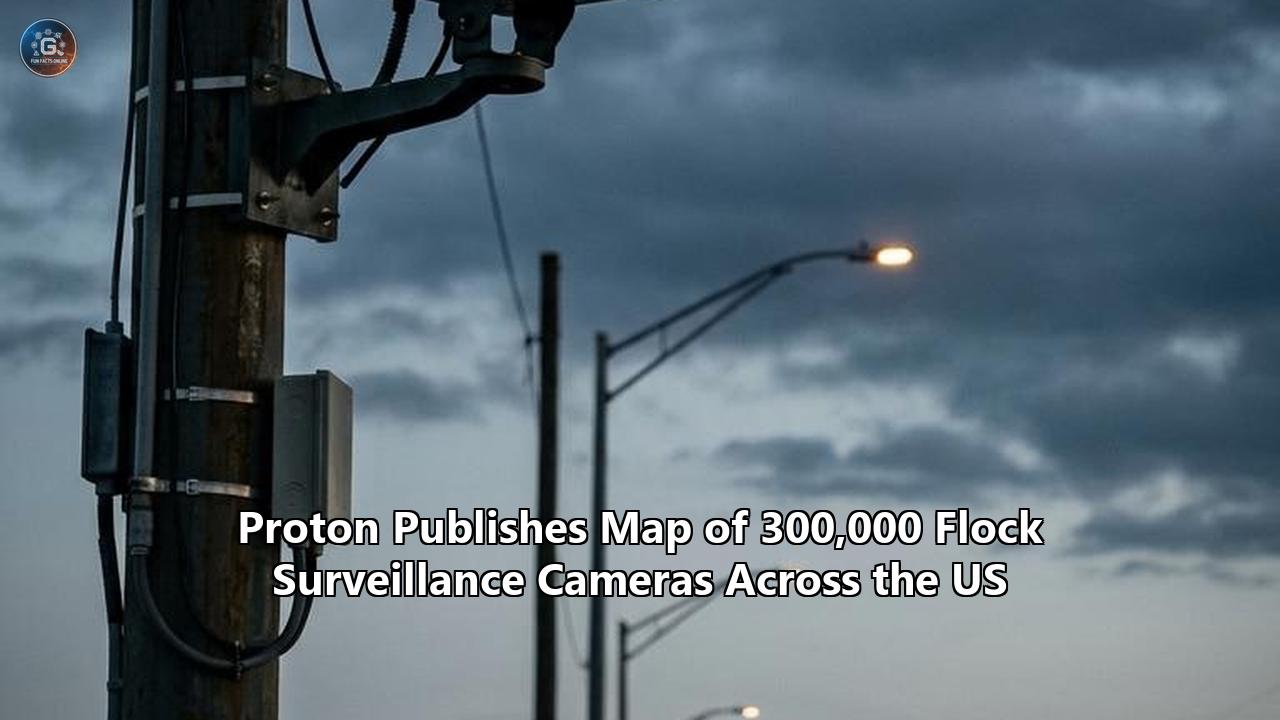
Geneva-based privacy company Proton published an interactive, nationwide database exposing the locations of more than 300,000 Flock Safety surveillance devices distributed across the United States. Hosted on Swiss infrastructure to place it beyond the reach of American legal threats, the release salvages and expands upon research by independent cybersecurity analyst Joshua Michael, whom Flock Safety attempted to silence with legal notices and threats of criminal referral.
The publication of the flock surveillance cameras map strips away the secrecy surrounding an automated tracking apparatus that has quietly spread across residential avenues, highway off-ramps, commercial plazas, and suburban intersections. By making the database searchable by ZIP code for anyone in the world, Proton has escalated an escalating confrontation over municipal surveillance, corporate transparency, and the privatized tracking of vehicular movement.
The dataset exposes a physical surveillance presence substantially larger than Flock Safety has admitted in corporate marketing and municipal sales pitches. While the Atlanta-based surveillance contractor told the public it operated roughly 120,000 cameras nationwide, the raw data extracted from Flock's own back-end infrastructure lists over 170,000 active automated license plate recognition (ALPR) cameras and upwards of 130,000 secondary devices, ranging from solar relays and environmental hardware to audio gunshot detectors and planned installations.
The emergence of the map crystallizes a profound technological and constitutional challenge: an unchecked, privately owned dragnet operating outside traditional Fourth Amendment constraints, sustained by commercial contracts with thousands of local police departments and homeowners associations. Yet this leak and Proton’s international intervention have catalyzed a counter-offensive, prompting privacy engineers, municipal leaders, civil rights litigators, and neighborhood collectives to construct legal and technological remedies against ambient surveillance.
Inside the Disclosure: How 300,000 Devices Were Unmasked
The path to Proton’s deployment began not with an adversarial network intrusion, but with a foundational security failure within Flock Safety’s own digital infrastructure. In November 2025, cybersecurity researcher Joshua Michael discovered that Flock’s servers were exposing an unauthenticated access token. The token allowed anyone who discovered it to query Flock’s internal geospatial mapping layers hosted on the ArcGIS platform without entering credentials or breaching an authentication gateway.
Using that exposed token, Michael retrieved an authoritative inventory directly from the company's back end, capturing the precise coordinates, device identifiers, and operational statuses of 335,701 hardware assets deployed across 49 states. The archive represented a frozen snapshot of Flock's entire domestic footprint as of December 2025.
Michael followed responsible disclosure protocols, informing Flock of the catastrophic leak. While the company quietly patched the token exposure, Michael took his findings public nine months later, releasing a research paper and launching an interactive map on September 23, 2026.
Flock’s response was immediate and aggressive. Rather than engaging with the findings or publicly clarifying the scale of its network, the company enlisted corporate brand-protection firm Doppel to issue cease-and-desist letters accusing Michael of trademark infringement. Flock claimed that using the word "Flock" on a site displaying camera locations caused commercial confusion, notified law enforcement agencies of the breach, and warned Michael of imminent litigation. Under intense legal pressure, Michael geoblocked access to his portal, restricting it to visitors within the United States while seeking avenues to keep the information available.
Recognizing that the researcher faced potential financial ruin through corporate lawfare, Proton intervened. Known for Proton Mail and its suite of encrypted communications products, the Swiss technology firm ingested Michael’s December 2025 dataset and mirrored the application on its Geneva servers, making the flock surveillance cameras map accessible globally without subscription barriers or regional geoblocks.
Proton’s head of legal, Marc Løebekken, publicly dismantled Flock’s trademark claims: "We believe Flock's attempts to take this map down are frivolous. Nobody confuses a map of Flock's cameras with Flock itself. This is an attempt to suppress information, not to prevent consumer confusion".
For Proton, the intervention represented a calculated act of jurisdictional defense. By anchoring the dataset under Swiss statutory protections, the company neutralized Flock's ability to weaponize American civil litigation to bury its internal inventory.
The Discrepancy: Marketing Numbers Versus Deployed Silicon
The database hosted by Proton exposes a systemic credibility gap between what mass surveillance vendors tell municipal overseers and what they actually install.
+--------------------------------------------------------------------------+
|                     FLOCK SAFETY FOOTPRINT COMPARISON                    |
+------------------------------------+-------------------------------------+
| Publicly Claimed Operating Fleet   | ~120,000 cameras                    |
+------------------------------------+-------------------------------------+
| Actual Documented ALPR Cameras     | 170,000+ active units (41.6% higher)|
+------------------------------------+-------------------------------------+
| Secondary & Auxiliary Hardware     | 130,000+ units                      |
| (Solar relays, audio units, nodes) |                                     |
+------------------------------------+-------------------------------------+
| Total Documented Infrastructure    | 335,701 cataloged devices           |
+------------------------------------+-------------------------------------+
| Monthly Recorded Vehicle Sighting  | >20,000,000,000 license reads       |
+------------------------------------+-------------------------------------+
The data shows that Flock's physical reach is at least 40 percent larger than stated. The presence of more than 130,000 auxiliary devices also highlights a critical architectural shift: Flock is no longer merely a camera company. It has built a comprehensive edge-computing network capable of aggregating multiple streams of sensory data.
These secondary hardware allocations include the "Raven" acoustic gunshot detection platform, proprietary long-range wireless backhaul repeaters, solar management units, and devices slated for activation in newly signed municipal jurisdictions.
The geographic distribution of these units reveals targeted clustering. Far from being confined to dense commercial districts or high-crime transit corridors, the devices are arrayed in tight perimeters around residential neighborhoods, quiet arterial roadways, suburban cul-de-sacs, and rural intersections. In hundreds of American municipalities, crossing from one neighborhood to another requires passing through an automated sensory cordon.
The Core Challenge: Warrantless Dragnet Surveillance by Private Proxy
The deployment patterns documented in the leak expose a structural transformation in American policing: the outsourcing of mass surveillance to private entities to bypass the procedural friction of the Fourth Amendment.
Flock does not merely sell hardware to law enforcement; it sells access to a real-time, searchable database of human travel. The cameras photograph every vehicle that enters their line of sight, capturing the license plate, direction of travel, timestamp, and precise GPS location. The platform's proprietary machine vision engine, marketed as "Vehicle Fingerprint," catalogs unique identifying markers:
- Vehicle make, model, color, and year bracket.
- Missing or altered license plates.
- Roof racks, bumper stickers, and specialty decals.
- Distinctive body damage, such as rusted quarter panels, dented doors, or mismatched wheels.
Every month, this hardware network logs more than 20 billion vehicle sightings across 49 states. The data does not stay isolated within the city that funded the camera. Through Flock’s inter-agency sharing network, known as the TALON network, law enforcement agencies across the country can pool search permissions. An investigator in Texas or Florida can run broad, retroactive queries on the travel history of a vehicle in Illinois, Ohio, or California, identifying every time that car traversed a camera-monitored intersection over the preceding 30 days.
This private architecture allows police agencies to sidestep long-standing legal limits. Under traditional American constitutional jurisprudence, law enforcement must demonstrate probable cause and obtain a judicial warrant to attach a physical GPS tracker to a citizen's vehicle, a principle solidified by the Supreme Court in United States v. Jones (2012).
By blanketing public roads with hundreds of thousands of interconnected, solar-powered cameras, Flock achieves the functional equivalent of a universal GPS tracker without requiring a single warrant. The police do not need to install tracking hardware on an individual car; the surveillance grid tracks every car continuously, recording habits, associations, medical visits, religious gatherings, and political rallies.
The sudden availability of the flock surveillance cameras map transformed abstract privacy warnings into an undeniable geographic reality. Residents who previously viewed Flock cameras as isolated traffic devices could now trace the uninterrupted camera corridors running along their daily commutes, exposing how completely the private sector has enclosed public transit spaces.
Systemic Failures: Internal Abuse, False Positives, and Security Flaws
The risks inherent in a centralized vehicular database are not theoretical. The expansion of the network has been accompanied by repeated, documented failures across multiple operational vectors.
Internal Abuse and Law Enforcement Misconduct
Because many police departments treat Flock searches as casual investigatory queries rather than searches requiring documented judicial oversight, the barrier to internal abuse is dangerously low.
A detailed investigation by The Washington Post revealed that at least 50 law enforcement officers across the country have been criminally charged or disciplined for misusing automated license plate readers. In 46 of those 50 cases, the system misused was Flock Safety.
Officers tapped into the national network to:
- Stalk estranged romantic partners, ex-spouses, and personal acquaintances.
- Track off-duty colleagues and municipal rivals.
- Conduct unauthorized surveillance on private citizens for commercial or retaliatory motives.
When questioned about these violations, Flock CEO Garrett Langley asserted that "any level of abuse greater than zero is unacceptable and makes me sick," pointing to audit logging features and optional algorithmic flags built into the software. But civil liberties groups observe that internal audits are routinely neglected by understaffed or permissive police departments, transforming the platform into an open portal for surveillance by individual officers.
+--------------------------------------------------------------------------+
|                     DOCUMENTED MODES OF SYSTEMIC ABUSE                   |
+----------------------+---------------------------------------------------+
| Interpersonal        | Officers querying license plates of ex-spouses,   |
| Stalking             | dating partners, and personal adversaries.|
+----------------------+---------------------------------------------------+
| Cross-Jurisdiction   | Agencies in restrictive states accessing data in  |
| Out-of-State Probes  | protective states to track interstate medical     |
|                      | travel (reproductive and gender-affirming care).  |
+----------------------+---------------------------------------------------+
| Algorithmic False    | Misread characters causing felony stops on        |
| Positives            | innocent drivers at gunpoint due to bad hits.    |
+----------------------+---------------------------------------------------+
| Edge Infrastructure  | Unauthenticated tokens and cleartext keys exposed |
| Security Failures    | on devices, creating hostile counter-tracking risks.|
+----------------------+---------------------------------------------------+
The False-Positive Danger: Armed Stops of Innocent Drivers
Automated plate recognition relies on optical character recognition (OCR) software that frequently misinterprets numbers, letters, state jurisdictions, and specialty plates. When a Flock camera triggers a false hit on a vehicle on an automated police "hotlist" (such as a database of stolen cars or wanted felons), dispatch systems relay an immediate alert.
Patrol officers responding to a "hotlist hit" execute felony stops: approaching the target vehicle with firearms drawn, ordering occupants out at gunpoint, and handcuffing drivers before verifying whether the physical car matches the vehicle in the alert.
In multiple documented instances, clerical errors or software glitches have placed innocent families, delivery drivers, and commuters in life-threatening encounters with police officers acting on automated machine vision alerts. The delegation of suspicion to an automated camera creates a presumption of guilt that field officers rarely pause to verify.
Cybersecurity Vulnerabilities on the Physical Edge
The irony of Flock’s expansion is that an infrastructure justified under the banner of "crime reduction" has repeatedly shown severe technical vulnerabilities. Joshua Michael’s discovery of the unauthenticated ArcGIS token was not an isolated incident.
Independent hardware hackers inspecting physically mounted Flock cameras discovered that the devices stored internal cryptographic encryption keys directly on local memory chips. By accessing physical devices mounted on public utility poles, researchers extracted operational keys and retrieved more than 27,000 video clips and image buffers directly from device memory.
As Michael noted in his research, Flock’s inability to detect data exfiltration created severe national security vulnerabilities. If foreign adversaries, criminal syndicates, or domestic extremists access Flock’s API pipelines, they can monitor the daily movements of federal law enforcement agents, military personnel traveling to and from defense installations, intelligence workers, and protected witnesses. By concentrating the movements of an entire nation into a centralized cloud repository, Flock constructed a lucrative high-value target for state-sponsored threat actors.
Grassroots Counter-Mapping and Tactical Defiance
Faced with expanding surveillance grids and institutional inertia, independent researchers, privacy technologists, and civic activists have organized counter-surveillance operations to map, expose, and mitigate these networks.
Proton’s publication of the flock surveillance cameras map gave civil society an authoritative weapon. Prior to Proton’s action, grassroots groups had to rely primarily on crowdsourcing to identify surveillance infrastructure. The most prominent of these initiatives, the DeFlock project, mobilizes volunteers across the country to spot physical cameras, photograph their distinctive compact solar arrays and camera housings, and tag their precise GPS coordinates into OpenStreetMap.
+--------------------------------------------------------------------------+
|                     CIVIC SURVEILLANCE MAPPING ECOSYSTEM                 |
+-------------------+----------------------------+-------------------------+
| Initiative        | Data Origin                | Primary Function        |
+-------------------+----------------------------+-------------------------+
| Proton Flock Map  | Internal company leak      | Point-in-time nationwide|
|                   | (Joshua Michael / ArcGIS)  | audit of 300K+ devices. |
+-------------------+----------------------------+-------------------------+
| DeFlock / OSM     | Crowdsourced visual field  | Dynamic, community-     |
|                   | surveys by local volunteers| verified global tracking.|
+-------------------+----------------------------+-------------------------+
| MapQuest          | Aggregated civic databases | Turn-by-turn routing to |
| Surveillance Layer| and commercial registries  | actively navigate around|
|                   |                            | ALPR cameras on the road.|
+-------------------+----------------------------+-------------------------+
While crowdsourcing is labor-intensive and prone to blind spots, Proton’s mirrored database provided an immutable baseline extracted from the vendor’s own ledger. Residents can cross-reference what their local police chiefs tell city councils against the actual deployment records.
The movement has also expanded into consumer navigation software. In late 2026, mapping pioneer MapQuest introduced a dedicated "Surveillance Layer" within its mobile routing application. Drivers can toggle the layer on to see markers for known ALPR units along their route, mirroring the way traffic apps notify drivers of red-light cameras or speed traps. This turns what was once an invisible dragnet into an interactive dashboard, allowing motorists to navigate around surveillance corridors if they choose to protect their locational privacy.
At the local level, hardware-focused pushback has taken on physical forms. Open-source 3D-printing communities have shared files for devices like the "Flock Sock"—a fitted sleeve that slips over pole-mounted cameras to obstruct the optical lens without destroying the hardware. Across the country, neighborhood groups have coordinated FOIA (Freedom of Information Act) requests to force city halls to publish every hardware deployment location, maintenance contract, and data-sharing compact executed with Flock.
Institutional Pushback: Municipal Bans, State Laws, and the Courts
While civic cartography provides public visibility, legal and legislative mechanisms are beginning to challenge the core business model of automated license plate recognition.
                          MUNICIPAL RESISTANCE PATHWAY
                                       │
        ┌──────────────────────────────┴──────────────────────────────┐
        ▼                                                             ▼
Legislative Interventions                                     Judicial Precedents
- CCOPS Local Ordinances                                      - State Const. Protections
- 24 to 48-Hour Purge Mandates                                - Extension of Jones/Carpenter
- Inter-State Extradition Firewalls                           - Class Action Warrant Claims
        │                                                             │
        └──────────────────────────────┬──────────────────────────────┘
                                       ▼
                   CONTRACT TERMINATIONS & ACTIVE REMOVALS
Municipal Contract Cancellations
When presented with concrete data showing the density of surveillance in their neighborhoods, multiple American municipalities have voted to terminate their contracts with Flock Safety.
Cities like South Burlington, Vermont, canceled deployments after recognizing that local traffic data was flowing into national networks without clear safeguards. In Austin, Texas, community coalitions mobilized around camera mapping data to halt municipal expansions, questioning the fiscal sanity and constitutional legitimacy of spending millions of dollars on private surveillance infrastructure that stores travel patterns indefinitely.
Dozens of communities have enacted Community Control Over Police Surveillance (CCOPS) ordinances. These statutes make it illegal for local police departments or city administrators to apply for surveillance grants, run pilot programs, or sign contracts with private vendors like Flock without explicit, prior authorization from an elected city council after public hearings.
State-Level Statutory Walls
The interstate weaponization of ALPR data has accelerated state-level pushback. Following the overturning of Roe v. Wade, civil rights organizations pointed out that out-of-state law enforcement agencies could weaponize Flock's nationwide network to track citizens traveling to seek reproductive healthcare or gender-affirming medical treatments.
In response, states including California, Washington, and Massachusetts enacted statutory firewalls. California’s Senate Bill 54 and related privacy statutes explicitly forbid local law enforcement agencies from sharing ALPR records or camera feeds with out-of-state departments investigating reproductive care, lawful protests, or immigration status.
Other states maintain outright bans on the technology. New Hampshire enforces comprehensive restrictions that bar public agencies from deploying automated license plate readers on public roads, rendering the state a blank spot on Proton’s map. State law strictly prohibits municipal and state buildings from using cameras that capture footage beyond their immediate property boundaries.
Constitutional and Judicial Challenges
The judicial system is steadily reevaluating whether continuous, uninhibited ALPR tracking conforms with constitutional principles. In landmark rulings such as Commonwealth v. McCarthy (2020), the Massachusetts Supreme Judicial Court warned that while monitoring a single intersection does not constitute a Fourth Amendment search, blanket deployments that log a vehicle's every arrival and departure across an entire city or region cross into unconstitutional surveillance.
Building on the US Supreme Court's ruling in Carpenter v. United States (2018)—which established that individuals retain a reasonable expectation of privacy in the whole of their physical movements—litigators from the American Civil Liberties Union (ACLU) and the Electronic Frontier Foundation (EFF) have filed lawsuits directly challenging warrantless ALPR use.
These challenges target Flock's cloud repository. Plaintiffs argue that an agency searching an individual's historical vehicle movements over weeks or months is executing a search that requires a warrant supported by probable cause, regardless of whether the camera sat on a public street.
A Strategic Framework for Surveillance Oversight
Halting the unchecked expansion of private surveillance requires moving beyond ad-hoc controversies toward enforceable, structural reforms. Addressing the systemic risks exposed by Proton’s leak demands a multifaceted framework that integrates statutory mandates, cryptographic accountability, and protections for security researchers.
+--------------------------------------------------------------------------+
|                  PILLARS OF SURVEILLANCE REFORM FRAMEWORK                |
+--------------------------+-----------------------------------------------+
| Mandatory Public         | Municipalities must maintain live, geolocated |
| Infrastructure Audits    | registries of every sensor funded or deployed.|
+--------------------------+-----------------------------------------------+
| 24-Hour Statutory        | Cloud platforms must purge non-hit travel     |
| Purge Architecture       | logs within 24 hours, enforced by code.       |
+--------------------------+-----------------------------------------------+
| Probable Cause Warrants  | Historical queries across multiple cameras    |
| for Aggregate Searches   | must require approval from a neutral judge.   |
+--------------------------+-----------------------------------------------+
| Cryptographic Audit      | Police queries must be logged on append-only, |
| Trails and Whistleblowers| third-party ledgers; researchers protected.   |
+--------------------------+-----------------------------------------------+
1. Mandatory Public Infrastructure Registries
Municipalities must legally prohibit the secret deployment of surveillance hardware. Any public camera, whether procured directly by the police or installed by a private homeowners association peering into a public roadway, must be cataloged in a public registry.
Utilizing data surfaced by the flock surveillance cameras map, municipal councils are beginning to audit their streets, requiring hardware vendors to submit exact coordinates, vendor identities, system capabilities, and data-retention schedules before any device receives a utility permit or solar installation approval.
2. Immediate Data Expungement Protocols
The core danger of ALPR systems is historical aggregation: the retention of innocent travel data on the chance it might prove useful later.
Reform models mandate that automated systems operate on an immediate "hit-or-purge" architecture. If a passing vehicle does not match an active, pre-loaded Amber Alert or judicial warrant list at the moment of capture, the image, timestamp, and coordinate data must be erased from volatile memory within 24 to 48 hours. Indefinite cloud storage must carry civil and criminal liability for vendors and law enforcement agencies alike.
3. Judicial Warrants for Aggregate Location Queries
Law enforcement agencies must no longer treat centralized ALPR databases as informal search engines.
State legislatures should mandate that querying a vehicle's movements across multiple locations, or running aggregate pattern-of-life queries (such as identifying all vehicles parked near a medical clinic or civil protest), requires an authorized search warrant signed by a neutral judge upon a showing of probable cause. Unchecked "fishing expeditions" using vehicle fingerprints, bumper stickers, or temporal corridors must be strictly prohibited.
4. Cryptographic Audits and Whistleblower Defenses
To prevent internal stalking and systemic abuse, every access event must be permanently recorded to an independently managed, cryptographically secured, append-only log.
These logs must be reviewed by independent civilian oversight boards, not internal police supervisors. Furthermore, federal and state legislation must shield cybersecurity researchers who expose corporate data vulnerabilities from frivolous trademark lawfare and retaliatory criminal prosecution. When private companies monitor hundreds of millions of citizens, exposing the locations and flaws of that infrastructure is an essential public service.
The Path Forward: Mapping the Road Ahead
The confrontation over Proton’s publication of Flock Safety’s camera inventory signals a permanent shift in how surveillance technology is contested. Corporate secrecy and marketing promises are no longer sufficient to shield nationwide tracking networks from public scrutiny.
The technical battle lines are already evolving. Surveillance vendors are racing to incorporate real-time facial recognition, autonomous drone first-responder networks, and predictive artificial intelligence into the existing pole-mounted infrastructure. If left unmonitored, the camera that recorded a passing car today will pilot an autonomous tracking drone or profile pedestrian movements tomorrow.
The resolution of this crisis will depend on whether democratic oversight can outpace private surveillance deployments. The coming months will test whether state supreme courts apply Carpenter protections to vehicular dragnet databases, whether Congress will establish baseline protections for interstate travel privacy, and whether more municipalities will reclaim their public streets from corporate networks.
By taking Joshua Michael’s research and placing it under Swiss legal protection, Proton forced an uncomfortable truth into the public consciousness. Mass surveillance is no longer an invisible, abstract threat; it is a physical reality bolted to hundreds of thousands of roadside poles. Whether that infrastructure remains an unaccountable corporate tracking web, or is reined in by public transparency and constitutional law, is an open contest playing out on the streets of every American city.
Reference:
- https://cyberinsider.com/proton-flock-map/
- https://cybernews.com/tech/proton-flock-map/
- https://www.cnet.com/news/privacy/proton-hosts-flock-surveillance-map/
- https://sea.mashable.com/tech/56339/this-flock-camera-map-shows-more-than-300000-devices
- https://www.reddit.com/r/technology/comments/1xdxq6z/proton_hosts_map_of_300000_flock_devices_amid/
- https://www.tomshardware.com/software/maps/proton-hosts-flock-map-revealing-over-300-000-cameras-defying-cease-and-desist-threats-against-creator-privacy-focused-company-hosts-site-on-swiss-servers-says-users-have-the-right-to-know-whos-recording-them
- https://proton.me/flock-camera-map
- https://protonprivacy.substack.com/p/flock-cameras-mapped
- https://www.tomshardware.com/tech-industry/cyber-security/flock-seeks-to-have-security-researchers-map-of-flock-cameras-taken-down-unauthenticated-flaw-exposed-335-701-camera-locations-nationwide
- https://mashable.com/tech/proton-flock-surveillance-camera-map