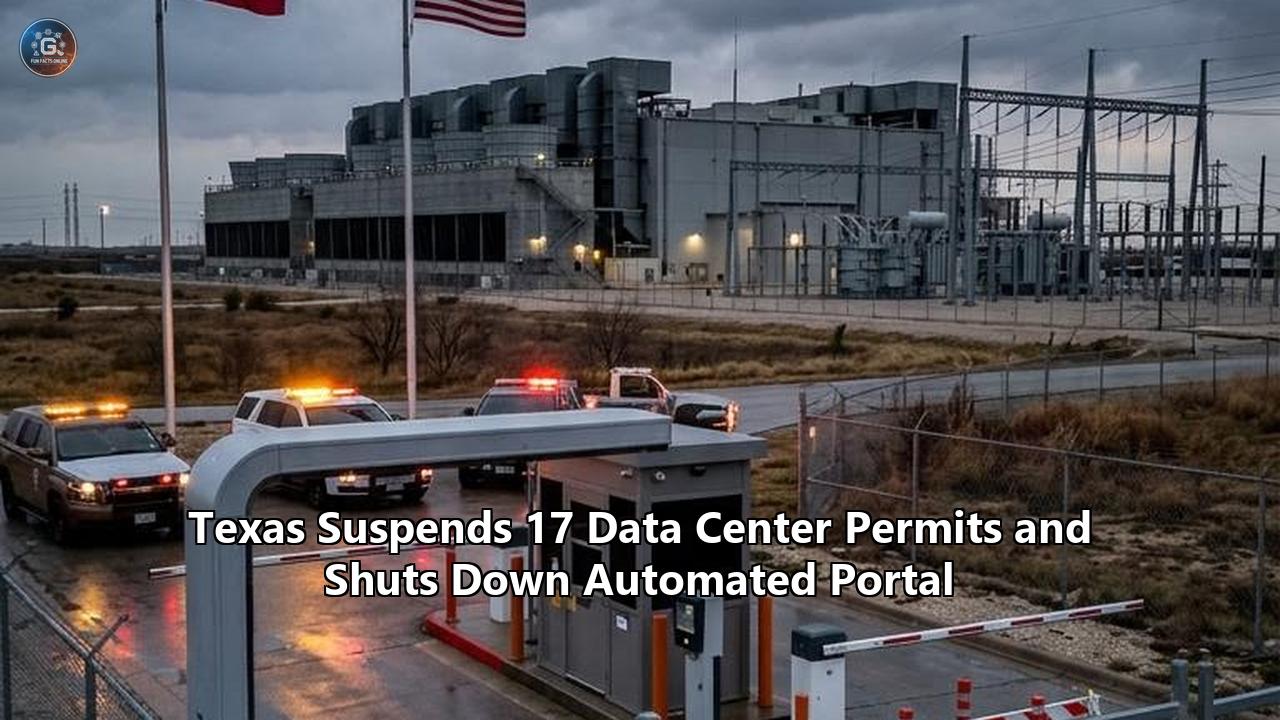
On Tuesday morning in late October 2026, the web servers hosting Texas’s most important environmental filing gateway went dark. Visitors attempting to log into the State of Texas Environmental Electronic Reporting System—known as STEERS—were greeted by an unceremonious HTTP 404 error.
By Wednesday afternoon, the Texas Commission on Environmental Quality (TCEQ) had replaced the broken link with a stark, red-bordered banner across its homepage:
“TCEQ's electronic filing application used for automatic authorizations has been temporarily shut down to ensure all applications are reviewed by agency staff to determine if they are related to data centers.”
Behind the scenes, the agency’s central registry database underwent a quiet purge. Overnight, at least 17 separate authorizations allowing industrial developers to clear land, bulldoze topsoil, and pour concrete across Central, North, and West Texas were abruptly toggled from “active” and “approved” to “suspended”.
The emergency shutdown of an essential state regulatory apparatus was not prompted by an internal audit, an IT failure, or an upgrade cycle. It was triggered when external watchdogs and investigative reporting exposed a glaring breakdown in Texas governance: for a full month after Governor Greg Abbott publicly ordered a total moratorium on state environmental authorizations for the computing sector, the state’s automated portal had continued quietly rubber-stamping authorizations for the world’s largest tech conglomerates.
The automated portal had handed out green lights to massive infrastructure builds connected to Amazon Web Services, Google, EdgeConneX, and developers tied to OpenAI’s expanding physical footprint, completely oblivious to executive orders issued from the governor’s mansion.
TIMELINE OF THE REGULATORY BREAKDOWN
--------------------------------------------------------------------------------------
Aug 3, 2026   | Abbott orders PUCT and ERCOT to audit large-load queue (410+ GW tracked)
Sep 14, 2026  | Abbott directs Texas Water Development Board (TWDB) to enforce water reporting
Sep 21, 2026  | Executive Directive to TCEQ: Halt ALL permits sought by data centers
Oct 14, 2026  | Watchdogs discover dozens of approvals moving through TCEQ databases
Oct 19, 2026  | Public Citizen & FracTracker publish exposé; Amazon & OpenAI approvals continue
Oct 20, 2026  | STEERS portal returns 404 errors as state scrambles internally
Oct 21–22, 2026| TCEQ suspends 17 permits, takes STEERS offline, mandates paper filings
To understand how Texas found itself shutting down a critical piece of digital infrastructure to halt an industry it spent a decade recruiting, one must follow a paper trail running from the server racks of Northern Virginia to the drought-parched aquifers of Bastrop County, through an overextended electrical grid, and straight into the blind spot of automated state bureaucracy.
The Paperwork Paper Tiger: The September 21 Mandate
The crisis reached a tipping point during the summer of 2026, when escalating warnings over the Texas electric grid collided with an explosive surge in artificial intelligence computing demands.
On August 3, 2026, Governor Abbott instructed the Public Utility Commission of Texas (PUCT) and the Electric Reliability Council of Texas (ERCOT)—the independent system operator managing the flow of electric power to roughly 90 percent of the state—to freeze advancement for conditional large loads and execute a sweeping audit of prospective data centers.
The numbers keeping grid operators awake at night were staggering: ERCOT was tracking approximately 474 gigawatts of prospective large-load interconnection requests through 2030, with roughly 90 percent of that volume driven by data center facilities. Texas’s all-time record peak electrical demand, logged during a blistering afternoon on July 22, 2026, sat at 91,089 megawatts—just over 91 gigawatts. The computing facilities asking to plug into the transmission network represented more than five times the grid’s entire peak load.
On September 14, Abbott widened the perimeter, directing the Texas Water Development Board (TWDB) to crack down on the massive, often undisclosed volumes of cooling water pulled by hyperscale campuses.
Then came the hammer. On September 21, Abbott sent a formal directive to TCEQ Executive Director Kelly Keel. The instructions were unambiguous:
“I am directing the Texas Commission on Environmental Quality to halt all permits sought by data centers until ERCOT completes its audit. Because the PUCT, ERCOT, and the TWDB require that information to make informed decisions, no state agency shall move forward with regulatory approvals related to data center development until it is acquired. Simply put, Texans must come first.”
The directive established a firm deadline: Keel was to provide the governor’s office with a comprehensive compliance update by October 19.
Inside agency offices, that order ran headlong into the reality of modern state administration: TCEQ had spent decades constructing an automated, deregulated assembly line designed to grant operational approvals with the least possible amount of human interference.
While state officials assured the public that a hard boundary had been set, developers in real estate holding offices and tech consulting firms were still logging onto the web, entering basic project parameters, and walking away with legal authority to begin site construction.
The Watchdogs and the Registry: Following the Digital Breadcrumbs
The disconnect between Abbott’s public moratorium and state regulatory output did not surface inside a legislative committee hearing. It was identified by two environmental policy researchers parsing the TCEQ Central Registry database.
Sam Law, a researcher and communications manager at the FracTracker Alliance, had spent months tracking industrial expansion across the Texas shale plays and Central Texas corridors. Working alongside Kathryn Guerra, director of Public Citizen’s TCEQ Watchdog Campaign and a former TCEQ regulatory employee, the researchers established automated scrapers to monitor agency filings for signs of compliance with the September 21 mandate.
What they uncovered was not a pause, but a continuing stream of industrial green lights.
“We went into the database expecting to see stop-work flags, pending review queues, or at least administrative holds,” Law explained during an interview detailing the investigation. “Instead, we saw permits moving smoothly through four distinct pipeline checkpoints across 23 Texas counties. Public notices for major air sources were being mailed out, emissions limits were being certified, and construction authorizations were landing daily. The agency’s left hand had no idea what its right hand was doing. Or worse, the machinery was so thoroughly automated that nobody had bothered to flip the breaker.”
Between September 21 and mid-October, the researchers logged 35 separate regulatory advances for data center campuses. The approvals crossed multiple categories, but the most actionable among them were authorizations granted under the Texas Pollutant Discharge Elimination System (TPDES) Construction General Permit (TXR150000).
HOW THE AUTOMATED PERMITTING PIPELINE OPERATED
--------------------------------------------------------------------------------------
1. Applicant registers a shell LLC (e.g., "Silver Creek Land Holdings")
2. Submits an electronic Notice of Intent (NOI) via the STEERS online portal
3. Enters basic project coordinates, disturbed acreage, and SIC/NAICS classification
4. STEERS algorithm runs basic formatting checks (credit card valid, fields populated)
5. Zero human review: System auto-generates formal authorization number (TXR15XXXX)
6. Status in TCEQ Central Registry flips automatically to "Active / Approved"
7. Legal authority established: Earthmovers, bulldozers, and trenching crews deploy
In the standard development lifecycle of a computing campus, the Notice of Intent (NOI) for stormwater discharge is far more than a minor environmental footnote. For projects clearing more than five acres of soil, receiving active coverage under the Construction General Permit is the critical threshold that legalizes dirt work. It gives earthmovers the green light to clear trees, level natural contours, alter hydrology, dig massive utility trenches, and lay structural foundations.
Without that coverage, breaking ground is a Class A administrative violation under Chapter 26 of the Texas Water Code, carrying potential statutory penalties of up to $25,000 per day.
When Law and Guerra cross-referenced the approval dates with Abbott’s September 21 decree, they discovered that developers were securing authorizations within seconds. An applicant simply logged into STEERS, completed an online form, paid an administrative processing fee by credit card, and received a machine-stamped approval letter in portable document format.
On Monday, October 19—the precise day Keel was scheduled to submit her compliance update to Abbott—the system was still issuing approvals. Among the projects gliding through the automated turnstile that week were sites linked to Amazon and a facility tied to OpenAI’s compute partners.
When watchdogs confronted the agency on October 14 to ask how these approvals squared with Abbott’s directive, the agency’s initial response was defensive. TCEQ representatives claimed that the agency had ceased issuing permits, arguing that administrative processing of filings did not constitute formal issuance.
“The agency was attempting to rely on a semantic shell game,” Guerra said. “They tried to make a distinction between an ‘affirmatively issued permit’ and an ‘authorization by rule.’ But to the construction superintendent standing on 200 acres in Bastrop with a fleet of Caterpillar scrapers idling behind him, there is zero legal difference. Once that database says ‘Approved’ and provides a permit registration number, you have lawful authority to destroy that topsoil. The rubber stamp was so automated that the agency literally could not stop its own machine.”
The Seventeen Suspensions: Where the Earthmovers Paused
Faced with detailed, publicly disclosed dockets compiled by FracTracker, Public Citizen, and independent newsroom 404 Media, TCEQ leadership realized its narrative was untenable. Late Tuesday afternoon, agency administrators accessed the central registry and began manually updating the state records for 17 high-profile projects, shifting their operational status from "active" to "suspended".
By Wednesday morning, the STEERS system was shuttered entirely.
TCEQ Media Relations Specialist Victoria Cann and agency spokesman Ryan Vise confirmed the unprecedented move. “TCEQ’s automated electronic filing application system has been shut down,” Cann said in a prepared statement. “To ensure all applications are thoroughly reviewed by agency staff to determine if they are related to data centers, applications must be physically provided to TCEQ.”
The list of suspended authorizations covers critical nodes of the global tech industry’s physical expansion into Texas:
1. EdgeConneX Campus II (Bastrop County)
Located east of Austin in one of the most contentious battlegrounds over technology infrastructure in the state, this hyperscale development sits directly over vulnerable pockets of the Carrizo-Wilcox Aquifer. The suspension applied to the site-wide stormwater authorization covering hundreds of acres designated for massive compute halls and substation connections.
2. Google Tarrant County Complex (North Texas)
Part of Google’s multi-billion dollar capital expenditure program expanding its cloud computing footprint across the Dallas-Fort Worth metroplex, this site’s grading and infrastructure authorizations were suddenly suspended, throwing planned construction schedules into disarray.
3. The Caldwell Technology Park (Central Texas)
A multi-hundred-acre development designed to attract hyperscale tenants seeking immediate access to transmission corridors between San Antonio and Austin. Watchdogs identified approvals pushed through the automated portal weeks after the September 21 moratorium took effect.
4. Amazon Web Services (AWS) Expansion Sites
Stormwater authorizations for land development affiliated with AWS logistics and infrastructure subsidiaries, including land-clearing packages that advanced within 48 hours of the shutdown.
5. OpenAI / Stargate-Affiliated Infrastructure
West Texas development packages linked to emerging multi-gigawatt supercomputing clusters, designed to draw massive volumes of power directly from nearby renewable installations and regional grid interties.
OVERVIEW: THE 17 SUSPENDED STORMWATER AUTHORIZATIONS
--------------------------------------------------------------------------------------
Key Affected Sites:
• EdgeConneX Campus II — Bastrop County (Carrizo-Wilcox Aquifer zone)
• Google Hyperscale Phase — Tarrant County (DFW Metroplex corridor)
• Caldwell Technology Park — Caldwell County (Central Texas rural interface)
• Amazon Web Services Nodes — Multiple regional locations
• Supercomputing/Stargate footprint — West Texas interconnection corridor

Regulatory Instrument:
• TPDES General Permit TXR150000 (Stormwater discharges from construction)
• Direct impact: Land grading, grubbing, excavation, and foundational prep halted
The immediate operational fallout across job sites was swift and chaotic. “If you run a tier-one general contracting firm on a multi-hundred-million-dollar data center project, you are operating under punitive milestone penalties,” explained Marcus Vance, an Austin-based civil engineering consultant specializing in industrial site entitlements.
“You have earthmoving subs, crane leases, concrete batch plants on retainer, and steel fabricators on fixed logistics tracks,” Vance added. “Having your stormwater permit yanked back into 'suspended' status from one day to the next is a catastrophic liability event. Legally, the moment that status flips, you cannot move a single yard of dirt without risking civil enforcement actions. Yet nobody from the state picked up the phone to call project managers; the status just flipped in an online registry.”
The Shell Game: Obfuscated LLCs and Algorithmic Blindness
The deeper mystery of the STEERS breakdown was technical: why did the agency have to shutter its entire automated permitting gateway for all Texas industries simply to stop issuing authorizations to data centers?
The answer exposes how tech companies disguise their footprints, paired with the complete inability of legacy state computers to detect those maneuvers.
Hyperscale operators rarely file state regulatory applications under their household parent names. A development funded by a trillion-dollar technology titan typically appears in county deeds and environmental filings as a newly minted corporate entity. Filings are handled under opaque titles such as Silver Creek Land Ventures LLC, Blue Sky Infrastructure Partners, or Horizon Industrial Development Group.
Furthermore, the Standard Industrial Classification (SIC) and North American Industry Classification System (NAICS) codes selected on environmental intake forms frequently obscure the true nature of the work. A developer might classify a project under broad construction headings—such as "General Warehousing and Storage" (NAICS 493110) or "Commercial Building Construction" (NAICS 236220)—rather than specific computing classifications.
THE TECH INDUSTRY'S FILING OBFUSCATION
--------------------------------------------------------------------------------------
Public Facing Brand:       Alphabet / Google
County Deed Holder:        Shavano Development Partners LLC
TCEQ Project Description:  "Phase III Industrial Commercial Distribution Facility"
NAICS Code Selected:       236220 (Commercial and Institutional Building Construction)
Environmental Impact:      400 MW load, 1.5M gallons/day evaporative cooling water
Result in STEERS:          Auto-approved in 18 seconds without human evaluation
When Governor Abbott told the TCEQ to halt all Texas data center permits, he was issuing an order to a bureaucracy whose automated systems lacked the data fields, code parameters, or analytical tools to identify one.
The STEERS software, built on decades-old relational database architectures, was designed with a single goal: process submissions quickly to clear agency workload. The intake scripts verified whether the applicant had entered text into required boxes, confirmed that geographic coordinates mapped inside Texas borders, checked that the credit card processed, and assigned a registration number.
The algorithms did not scan narrative descriptions for the words "data hall," "server racks," or "backup diesel generator". Nor did they cross-reference pending electrical interconnection requests sitting inside ERCOT’s confidential databases.
“The irony is striking,” said Sam Law of FracTracker. “The entire data center industry is selling generative AI to the world, claiming automated algorithms will manage everything from medical diagnostics to supply chain logistics. Yet their own developments were slipping through the state of Texas because a twenty-year-old regulatory web script couldn’t read beyond a drop-down menu. TCEQ couldn’t program a simple filter into STEERS to isolate data centers. The only way they could follow the governor's directive was to pull the plug on the entire portal and force companies to hand-deliver paper applications to Austin.”
For Kathryn Guerra, the breakdown reflected a long-term erosion of administrative resources. “Over the past two decades, the legislature systematically reduced TCEQ’s enforcement and review budgets, pushing the agency toward self-certification and automated authorizations,” Guerra said.
“STEERS was built so companies could certify their own compliance under penalty of perjury, receive immediate approvals, and bypass real agency staff scrutiny. When a true crisis hit and political leadership demanded a surgical pause, the agency discovered it had hollowed out the staff required to evaluate projects individually. The rubber stamp wasn't a flaw; it was the whole point of the system.”
The Grid Under Siege: The Arithmetic Behind the Moratorium
To understand why Governor Abbott was pushed to halt the state's economic development pipeline, one must examine the mathematics of ERCOT’s large-load interconnection queue.
For years, Texas actively recruited high-tech industry. State leaders pitched enterprise tech on low business taxes, light environmental regulation, rapid permitting timelines, and access to the world’s most deregulated, liquid energy market. Tech companies responded by pouring billions of dollars into Texas real estate.
Then came generative AI, fundamentally altering the physics of data centers.
A traditional enterprise data center designed for basic web hosting or software services might require 20 to 50 megawatts of electrical capacity. A hyperscale AI training facility requires 300, 500, or even 1,000 megawatts—a single gigawatt of constant, non-interruptible base power. One gigawatt equals the total electrical output of an entire commercial nuclear reactor, enough electricity to sustain 750,000 residential homes.
TEXAS POWER METRICS: PEAK DEMAND VS. SPECULATIVE PIPELINE
--------------------------------------------------------------------------------------
All-Time ERCOT Peak Demand (July 22, 2026):             91,089 MW (91.0 GW)
Total Currently Operational Generation Capacity:        ~103,000 MW (103.0 GW)
Tracked Interconnection Queue for Large Loads (2030):   474,000 MW (474.0 GW)
Share of Interconnection Queue Claimed by Data Centers: ~90% (~426.0 GW)
Peak Demand Projected by ERCOT for 2030:                150,000 MW (150.0 GW)
--------------------------------------------------------------------------------------
Grid Exposure Gap: If only 10% of requested load connects, Texas must build
generation and transmission equivalent to half its historical system capacity.
In testimony before the Texas Senate Committee on State Affairs, ERCOT Chief Executive Officer Pablo Vegas outlined projections that caught lawmakers off guard. ERCOT’s long-term forecasts showed peak grid demand surging from 85 gigawatts to roughly 150 gigawatts by 2030. Over half of that anticipated growth was driven by two industries: AI computing campuses and cryptocurrency mining facilities.
The growth of ERCOT’s large-load queue was compounding:
- Late 2023: 41 gigawatts under review
- Late 2024: 63 gigawatts under review
- Late 2025: 226 gigawatts under review
- Mid-2026: 474 gigawatts tracked across the system
In the first quarter of 2026 alone, developers dumped 198 gigawatts of new large-load connection requests onto ERCOT engineers—more than the previous three years combined.
ERCOT LARGE-LOAD PIPELINE GROWTH (2022–2026)
Year / Period     Requested Load (GW)
-------------------------------------
Dec 2022          15 GW
Dec 2023          41 GW
Late 2024         63 GW
Late 2025         226 GW
Mid-2026          474 GW
“The queue became entirely decoupled from physical reality,” said Dr. Michael Fisher, an energy valuation analyst tracking transmission models in deregulated markets. “Developers were speculative squatting on substation nodes. If a hyperscaler thought they might build a campus in 2029, they filed an interconnection request for 800 megawatts just to save their spot in line. But ERCOT is required by law to evaluate every one of those applications seriously.”
The danger was structural. ERCOT is an electrical island, largely cut off from the Eastern and Western Interconnections by federal jurisdictional boundaries designed to avoid interstate commerce regulation. The grid must balance generation and demand in real time down to the fractional hertz.
If hundreds of megawatts of uncoordinated, steady load suddenly drop onto localized transmission nodes, regional lines overheat, system reserves plummet, and wholesale prices spike to the market cap of $5,000 per megawatt-hour. Under Texas’s deregulated market rules, those massive wholesale transmission and generation expansion costs are largely rolled into regional transmission delivery fees—ultimately paid by ordinary residential and small business utility ratepayers.
Abbott’s June 10 and August 3 directives were clear political self-preservation: data centers had to fund their own transmission upgrades, confirm they wouldn't drive up residential electric bills, and prove they wouldn't crash the grid during the next severe summer heatwave or winter freeze.
When the governor discovered that TCEQ was continuing to approve stormwater authorizations without waiting for ERCOT to audit these campuses, the entire regulatory line snapped.
The Thirst of the Machine: The Hidden Water Crisis
While electrical strain captured boardroom headlines, the catalyst for local grassroots resistance across Texas was water.
Modern hyperscale server farms generate immense heat. To keep thousands of high-performance graphics processing units (GPUs) from throttling or burning out, facilities rely on sophisticated cooling systems. While some developers deploy closed-loop chilled water loops or direct-to-chip liquid cooling systems, the standard, lowest-cost approach for large-scale operations remains evaporative cooling towers.
An evaporative cooling tower cools air by evaporating water into the atmosphere. The consumption numbers are staggering: a typical 100-megawatt computing campus can consume between 500,000 and 2 million gallons of water every single day. For a 500-megawatt hyperscale campus, daily water loss can rival the domestic consumption of a city of 40,000 people.
THE WATER CONSUMPTION FOOTPRINT
--------------------------------------------------------------------------------------
Cooling Technology:          Direct Evaporative Cooling (Standard industry baseline)
100 MW Facility Use:         0.5 to 2.0 Million Gallons per Day (MGD)
500 MW Hyperscale Cluster:   2.5 to 10.0 Million Gallons per Day (MGD)
Regional Impact:             Draws from the Carrizo-Wilcox, Trinity, and Edwards Aquifers
Hydrological Reality:        Water consumed via evaporation is removed from the local
                             basin, preventing recharge of local residential wells.
In drought-prone Texas, those volumes collided directly with reality.
In Bastrop County, east of Austin, rural homeowners watched with mounting alarm as industrial campuses expanded over sensitive recharge zones for the Simsboro formation of the Carrizo-Wilcox Aquifer. Well owners formed coalitions after noticing water tables dropping in areas surrounding heavy industrial tracts.
“People move out here to run cattle, raise families, and live off private water wells,” said Elena Cruz, a member of a local landowner coalition monitoring groundwater withdrawals in Central Texas. “Then, an industrial developer comes in under an LLC name, buys up 300 acres of farmland, and cuts deals with local water supply corporations to secure millions of gallons a day for industrial cooling. That water doesn’t get recycled back into the local creek; it is vented straight into the atmosphere as steam. They are pumping ancient, non-renewable groundwater to cool chips running automated chat scripts.”
Abbott’s September 14 directive to the Texas Water Development Board had explicitly targeted this vulnerability, ordering the agency to enforce mandatory water-use reporting requirements and establish real penalties for computing facilities failing to disclose their hydrological draws.
When watchdogs revealed that TCEQ’s automated system was still issuing stormwater permits for these sites, rural communities saw it as a profound betrayal. A construction permit is what allows developers to lay high-volume industrial water utility mains into municipal lines and drill commercial water test wells.
The Air Quality Loophole: Flocks of Diesel Engines
The third layer of the investigation reveals an environmental paradox: data centers claim to be clean, zero-emission corporate facilities, yet they are quietly constructing the largest distributed fleets of fossil-fuel backup power generation in American history.
Because an unscheduled outage at a data center can cost millions of dollars a minute in contracted service-level agreement penalties, every major campus is engineered for extreme redundancy. If the ERCOT transmission grid fails, the computing load instantly transfers to uninterrupted battery arrays, which carry the load for 30 to 60 seconds while banks of backup diesel generators crank to life.
THE BACKUP POWER FOOTPRINT: HYPERSCALE GENERATOR ARRAYS
--------------------------------------------------------------------------------------
Standard Engine Rating:       2.0 to 3.0 MW heavy-duty internal combustion diesel unit
Campus Configuration:         50 to 200+ generators per hyperscale complex
Cumulative Power Capacity:    100 MW to 600+ MW of standby fossil generation per site
Permitting Instrument:        Permit by Rule (PBR 106.511) & Standard Air Authorizations
Regulatory Loophole:          Classified as "Emergency Use" (evades major NSR/PSD review)
Demand Response Risk:         EPA 50-hr non-emergency allowance used during grid shortages
These generator installations are immense:
- A 300-megawatt data center requires between 100 and 150 industrial diesel engines, each roughly the size of a shipping container and capable of generating 2 to 3 megawatts.
- Taken together, a single hyperscale campus houses a 300 to 500-megawatt fossil-fueled power plant installed directly alongside computing halls.
- Unlike regulated public utility power plants, which must install selective catalytic reduction systems to scrub nitrogen oxides (NOx) and capture fine particulate matter (PM2.5), data center backup fleets frequently exploit regulatory shortcuts.
In Texas, operators have routinely licensed these generator fleets using TCEQ’s Permit by Rule (PBR) 30 TAC § 106.511, which covers internal combustion engines and emergency turbines.
Under PBR 106.511, if an applicant claims an engine will only run during true emergencies and for limited routine testing (typically under 100 hours per year), the permit requires minimal public notice, no formal contested case hearings, and no cumulative regional air quality modeling.
Yet when dozens of these facilities cluster in single suburban corridors—such as North Texas, San Antonio, or Bastrop County—their cumulative emissions profiles become alarming. In a grid emergency where ERCOT orders rolling blackouts, hundreds of massive Tier 2 and Tier 4 diesel engines could fire simultaneously, spewing tons of soot, volatile organic compounds, and smog-forming nitrogen oxides into residential airsheds.
“The dirty secret of the AI revolution is that it is backed up by 19th-century diesel fuel technology,” Guerra noted. “In Virginia, data centers have permitted over 10,000 diesel generators totaling 27 gigawatts of fossil capacity. Texas was sliding down that exact same path without any cumulative air review. When the governor ordered TCEQ to stop issuing permits, the agency’s automated portals were still certifying engine emission limits under expedited rules. They were treating a 400-megawatt localized diesel power plant with the same regulatory scrutiny as an emergency backup generator at a rural hospital.”
COMPARATIVE REGULATORY SCRUTINY: UTILITY PLANT VS. DATA CENTER GENERATOR FLEET
Feature                      Traditional Gas Peaker Plant      Hyperscale Diesel Backup Fleet
--------------------------------------------------------------------------------------
Total Capacity               250–500 MW                        250–500 MW
Review Process               Full Prevention of Significant    Permit by Rule (PBR 106.511)
                             Deterioration (PSD) Review        / Standard Permit
Public Notice                Mandatory notice & hearings       Minimal to zero public hearing
Emissions Control            Selective Catalytic Reduction     Tier 2 / Tier 4 factory tune;
                             (SCR) mandatory                   no secondary SCR required (typical)
Primary Fuel                 Pipeline Natural Gas              Millions of gallons stored diesel
Political Shockwaves: When Suburban Rebellions Meet the Reelection Trail
The STEERS shutdown and permit suspensions highlight a major political shift: Governor Abbott’s about-face on the technology sector.
For years, the governor took credit for luring Silicon Valley firms away from California. He personally courted executives, celebrated campus groundbreaking ceremonies, and praised data infrastructure as the backbone of economic expansion.
Yet heading into the late-2026 political cycle, the ground beneath Texas politics shifted sharply. Data centers, once viewed as benign, revenue-generating commercial investments, faced mounting public opposition.
Across rural and suburban counties, conservative and progressive voters found common ground in resisting massive computing compounds. The flashpoints were consistent everywhere:
- The Noise Factor: High-frequency, continuous low-frequency drone produced by thousands of industrial cooling fans running 24 hours a day, disrupting sleep for miles around.
- The Fiscal Imbalance: Hyperscale campuses cost hundreds of millions of dollars to build, yet they employ only 30 to 50 permanent staff members once operational—mostly security guards and facility technicians.
- Property Tax Abatements: Developers regularly secured Chapter 312 and Chapter 380 tax abatements, depriving local school districts and county budgets of property taxes while consuming massive local infrastructure capacity.
- Ratepayer Resentment: Rising consumer utility bills, fueled by transmission projects built to deliver power to industrial compute corridors.
The suburban revolt was not unique to Texas, but part of a wider national backlash against untamed computing expansion:
- Northern Virginia: The global capital of data centers, Loudoun County, faced intense neighborhood protests that forced Amazon to abandon plans for four major facilities and reallocate land holdings.
- New York State: Governor Kathy Hochul signed Senate Bill S10642—the Responsible Data Center Development Act—placing a one-year moratorium on all facilities exceeding 50 megawatts.
- Minnesota: Regulators rejected Amazon’s request to waive utility certificate-of-need reviews for a 600-megawatt diesel backup farm outside the Sherco coal facility in Becker, stalling the multi-billion-dollar build.
In Texas, Abbott recognized that a catastrophic power grid event or runaway consumer electricity bills could create severe political liability. His series of executive directives was designed to reassert firm executive command: proving to voters that Texas resources would not be handed over unchecked to Silicon Valley tech empires.
The revelation that his own environmental agency had spent an entire month ignoring his directive, relying on an automated portal to pump out Texas data center permits to Google, Amazon, and OpenAI developers, directly undermined that message of control.
Taking STEERS offline wasn't just a technical fix. It was a dramatic bureaucratic move designed to shut down an embarrassing administrative slip-up.
The Bureaucratic Retrofit: Paper Filings and the Backlog Crisis
The fallout from taking the STEERS system offline rippled across the state’s economy.
Because STEERS handles not only data centers, but nearly all online environmental authorizations in the state, taking the portal offline created an immediate administrative bottleneck.
Every residential subdivision developer, road paving contractor, petrochemical plant operator, aggregate quarry, and municipal utility district suddenly lost the ability to submit routine environmental notices online.
TCEQ’s interim mandate—that all applications must be submitted on physical paper to Austin headquarters for individual human review—paralyzed review queues.
THE REAL-WORLD IMPACT OF THE REGULATORY BOTTLENECK
--------------------------------------------------------------------------------------
Permitting Method:           Online Instant Automation (STEERS)  -->  Physical Paper Review
Turnaround Time:             Under 1 hour                       -->  60 to 120+ days
Industries Caught:           Housing developments, commercial retail, road infrastructure,
                             municipal water districts, oil & gas midstream operations
Staffing Deficit:            Agency staff required to manually parse every paper application
                             to cross-reference ownership structures against tech shell LLCs
Litigation Exposure:         Vested rights challenges under Texas Local Government Code Ch. 245
Inside the agency's Park 35 complex in North Austin, staff were faced with reviewing boxes of paper permit applications, tasked with determining which corporate filers were legitimate warehouse operations and which were shell vehicles for hyperscalers.
“It is complete administrative chaos,” said an environmental attorney representing commercial developers who spoke on the condition of anonymity. “My clients are building grocery-anchored shopping centers and suburban apartment communities. Their stormwater applications were caught in the exact same net. Nobody at the agency can tell us how long a paper review takes. We’ve gone from instant digital turnarounds to an indefinite paper logjam.”
Beyond logistical headaches, the retroactive suspension of the 17 active permits created serious legal exposure for the state.
Under Texas law—specifically Chapter 245 of the Texas Local Government Code, commonly referred to as the "Vested Rights Statute"—once an applicant files a regulatory plan that meets agency criteria, their permit rights freeze relative to the rules in place at the time of filing.
Developers who spent millions of dollars acquiring land, securing contractors, and mobilizing heavy machinery based on an approved state registration suddenly found their authorizations revoked without administrative hearings, formal notice of violation, or contested evidence.
Corporate law firms representing suspended project developers are already drafting legal briefs challenging the move. Their argument: an informal executive directive from the governor cannot supersede established statutory review processes without an emergency rulemaking procedure conducted under the Texas Administrative Procedure Act.
Yet developers face their own dilemma. Suing the state’s primary environmental regulator or openly challenging Governor Abbott carries significant business risks, particularly for firms that must ultimately secure lucrative transmission interconnection agreements from the state-regulated ERCOT board.
The Road Ahead: What to Watch as the Audits Conclude
As the dust settles from the emergency shutdown of STEERS, attention shifts to mid-December 2026, when ERCOT and the Texas Water Development Board are scheduled to deliver their formal audit findings to the governor's office.
UPCOMING DECISION MILESTONES
--------------------------------------------------------------------------------------
December 2026:      ERCOT releases findings from its comprehensive large-load queue audit
December 2026:      Texas Water Development Board (TWDB) reports on industrial water use
January 2027:       89th Texas Legislative Session convenes in Austin
Key Legislation:    • Mandatory Legislative Data Center Moratorium bills
                    • Revision of PBR 106.511 backup generator review standards
                    • Restructuring of ERCOT large-load transmission cost-allocation rules
Pending Decisions:  Whether suspended projects will be cleared, cancelled, or forced
                    to redesign facilities around on-site power and dry-cooling arrays
Several critical questions will dictate whether the data center gold rush in Texas continues, slows down, or hits a hard regulatory wall:
1. The ERCOT Filtration Process
How many of the 474 gigawatts of prospective loads sitting in the interconnection queue will survive the state’s audit? ERCOT is widely expected to establish aggressive new operational requirements, compelling data centers to:
- Co-locate dedicated, behind-the-meter generation (such as on-site natural gas turbines or battery installations).
- Sign binding curtailable-load contracts requiring facilities to power down within seconds during system-wide grid emergencies.
- Pay substantial upfront financial security deposits to weed out speculative, empty queue requests.
2. The Fate of the 17 Suspended Sites
Will TCEQ quietly restore the 17 suspended stormwater permits once developers submit supplemental water and power disclosure forms, or will those projects be forced back to step one of the formal individual permitting review? If forced into the individual permitting pipeline, projects could face years of public notice periods, local opposition, and contested case hearings.
3. Reform of the Backup Generator Rules
Expect intense scrutiny during the 89th Texas Legislative Session over TCEQ’s Permit by Rule framework. Watchdog groups are lobbying lawmakers to amend the Texas Clean Air Act, requiring that any computing facility installing more than 50 megawatts of aggregate diesel generator capacity undergo full Prevention of Significant Deterioration (PSD) review, complete with mandatory selective catalytic reduction systems and ambient air monitoring.
4. A Shift to Dry Cooling
The era of cheap, evaporative cooling towers running on Texas groundwater is closing. The state will likely condition future site approvals on the adoption of dry-cooling or closed-loop liquid systems. While dry cooling protects regional aquifers, it carries a sharp trade-off: it consumes more electricity during hot summer afternoons, shifting pressure directly back onto ERCOT's electric transmission lines.
Physical Constraints Meet the Cloud
The shutdown of the STEERS portal and the suspension of 17 data center permits across Texas exposed a key vulnerability at the heart of the modern computing boom: the systems powering digital expansion cannot outrun the physical infrastructure of the real world.
For years, the technology industry operated under the premise that software moves at lightspeed, independent of physical constraints. Code, digital models, and neural network parameters could scale exponentially across server clusters.
Yet those calculations ultimately rely on concrete physical inputs. They require high-voltage copper transmission lines strung through cow pastures, millions of gallons of water pulled from underground limestone aquifers, miles of heavy corrugated steel conduit, arrays of massive diesel engines, and real, living soil that washes into creeks when heavy rains fall on a graded construction site.
For a month, a gap in Texas administration allowed the global computing boom to glide through automated loopholes, collecting digital approvals from unattended agency servers.
By pulling the plug on its own automated portal and forcing multi-trillion-dollar corporations to submit paper filings to state staff, Texas drew a hard line in the sand. The state confirmed that even in the epicenter of the global AI push, the physical realities of water, air, electricity, and community resources still have the power to bring the machines to a halt.
Reference:
- https://www.404media.co/texas-commission-on-environmental-quality-portal-down/
- https://www.citizen.org/news/tceq-backtracks-suspends-data-center-permits-issued-after-investigation-shows-it-ignored-abbotts-pause/
- https://www.tceq.texas.gov/agency/steers-down
- https://hwbusters.com/news/texas-data-center-permits-kept-auto-approving-after-abbotts-pause-and-17-are-now-suspended/
- https://communityimpact.com/bastrop-cedar-creek/texas-legislature/texas-continued-processing-some-data-center-permits-after-gov-abbott-s-pause-records-show/
- https://www.spartnerships.com/tceq-data-center-permits-automated-system-shutdown/
- https://www.corleyenergy.com/ercot-large-load-queue.html
- https://www.dlapiper.com/en-us/insights/publications/2026/09/governor-abbott-expands-data-center-permitting-pause
- https://www.ercot.com/files/docs/2026/07/29/ERCOT-Senate-July-29-Panel-1-Assessing-The-Grid.pdf
- https://www.instituteforenergyresearch.org/regulation/texas-pauses-data-center-construction/
- https://gov.texas.gov/news/post/governor-abbott-directs-tceq-to-halt-data-center-permits
- https://www.texastribune.org/2026/09/21/texas-data-center-moratorium-water-energy/
- https://texasscorecard.com/state/tceq-scrutinized-for-alleged-noncompliance-with-abbott-data-center-directive/
- https://www.kvue.com/article/tech/science/environment/tceq-shuts-down-online-permit-filing-system-data-center/269-52f31cf9-e802-438d-8790-ce641a217e88
- https://hwbusters.com/news/texas-data-center-permits-kept-auto-approving-after-abbotts-pause-and-17-are-now-suspended/
- https://www.citizen.org/news/tceq-backtracks-suspends-data-center-permits-issued-after-investigation-shows-it-ignored-abbotts-pause/
- https://superpowerdaily.com/posts/texas-shuts-automated-permit-portal-as-17-data-center-approvals-are-suspended
- https://www.texastribune.org/2026/10/21/data-center-permits-tceq-texas/
- https://davefriedman.substack.com/p/inside-texass-ai-data-center-queue
- https://www.ascendanalytics.com/blog/large-load-interconnection-queues-data-center-grid-access
- https://www.bdlaw.com/publications/texas-pauses-all-environmental-permitting-for-data-centers/
- https://www.tomshardware.com/tech-industry/data-centers/texas-has-suspended-17-data-center-construction-permits-and-shut-down-automated-portal-used-to-approve-them-site-was-left-running-for-a-month-after-greg-abbott-called-for-a-pause-on-approvals
- https://www.globaldatacenterhub.com/p/data-center-backup-diesel-generators
- https://betterdatacenterproject.com/wp-content/uploads/2026/03/Diesel-Generators-at-Data-Centers-Status-Impacts-and-Protective-Practices.pdf
- https://www.tceq.texas.gov/permitting/air/permitbyrule/subchapter-w/portable_power.html
- https://www.texastribune.org/2026/10/21/data-center-permits-tceq-texas/