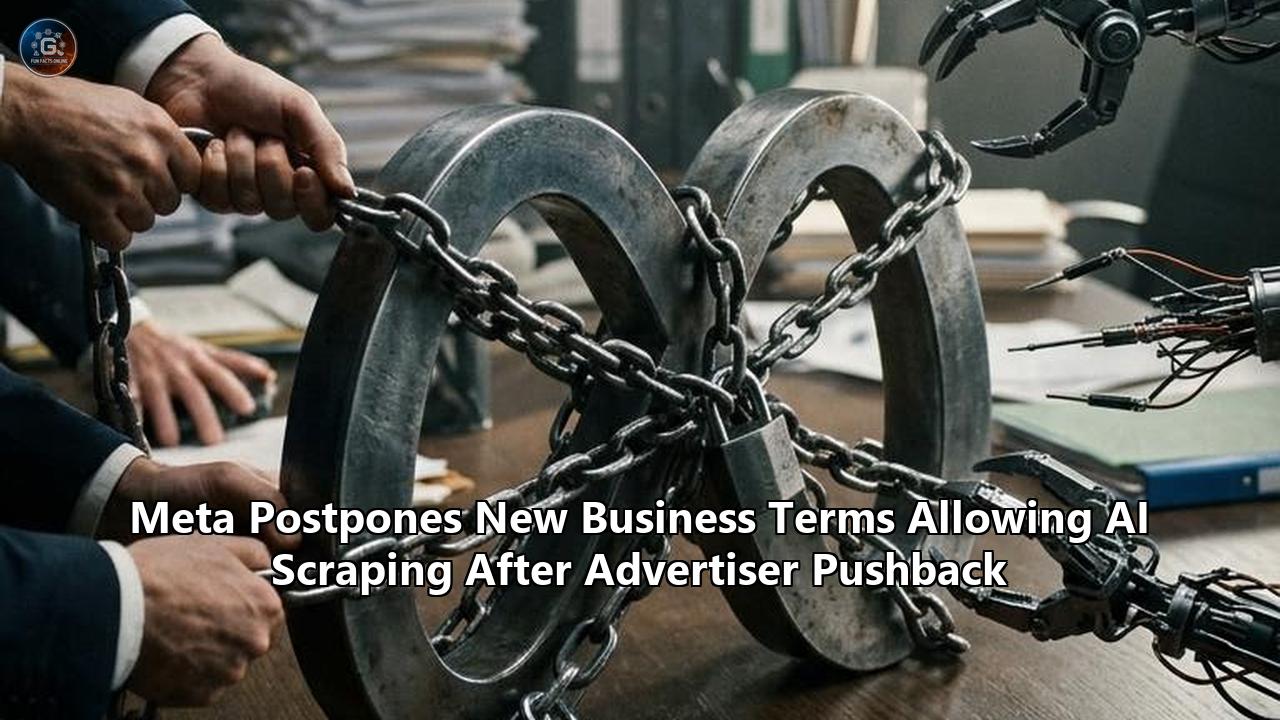
Meta Platforms has postponed the enforcement of its sweeping new Commercial Terms and Self-Serve Ad Terms from October 30 to November 20, 2026, retreating in the face of an unprecedented revolt by enterprise advertisers, news publishers, media trade coalitions, and transatlantic antitrust regulators. The controversial contract updates, quietly circulated to enterprise clients in mid-October, would have granted the tech giant broad automated authority to crawl, scrape, and ingest proprietary content from any website or domain tied to a Meta business account.
The three-week reprieve followed swift international fallout. In Washington, Senator Marsha Blackburn, chair of the Senate Judiciary Subcommittee on Privacy, Technology and the Law, sent a formal warning accusing the company of exploiting American businesses. Simultaneously, the News/Media Alliance—representing more than 2,200 North American publishing organizations—demanded the complete withdrawal of the language, labeling the policy coercive. Across the Atlantic, publisher coalitions filed formal petitions with the European Commission and the United Kingdom’s Competition and Markets Authority (CMA), alleging that Meta was abusing its dominant market position to create an involuntary content pipeline for its proprietary artificial intelligence models.
Meta frames the delay strictly as a communication interval rather than a structural surrender. "We are extending the effective date of our updated Commercial Terms and Self-Serve Ad Terms to 20 November to allow more time for us to explain to our partners and stakeholders what’s changing and what’s not," a Meta spokesperson said in a public statement. Daniel Roberts, another Meta spokesperson, maintained that the consolidated crawling provisions were intended solely for advertising and business products rather than general AI ingestion.
Despite Meta's public relations efforts, commercial clients recognize that the delay moves only the calendar, leaving the legal text essentially unchanged. The dispute has exposed a fundamental tension in digital platform economics: dominant tech platforms are leveraging contractual adhesion to turn essential commercial distribution channels into closed-loop data extraction engines for generative artificial intelligence.
+------------------------------------------------------------------------------------+
|                  THE META COMMERCIAL TERMS DISPUTE: AT A GLANCE                    |
+----------------------+-------------------------------------------------------------+
| Original Date        | October 30, 2026                                            |
| Extended Date        | November 20, 2026 (21-day grace period)                     |
| Primary Trigger      | Broad crawling permissions over business account domains    |
| Revisions Made       | Deleted explicit word "train"; narrowed to ad products      |
| Core Legal Snag      | "Develop and improve" remains legally broad enough for AI   |
| Technical Trap       | Single crawler token (Meta-ExternalAgent) bundles ad tools  |
|                      | with training ingestion, making robots.txt ineffective      |
| Regulatory Fronts    | US Senate Judiciary, European Commission, UK CMA            |
+----------------------+-------------------------------------------------------------+
The Contractual Mechanism: How Business Utility Was Converted into AI Harvesting
The genesis of the controversy lies in the boilerplate architecture of Meta’s Commercial Terms and Self-Serve Ad Terms. For millions of businesses—from independent news publications and regional retailers to multinational brands—maintaining an active Meta Business Manager account is not optional. It is a baseline operational necessity for audience distribution, customer acquisition, performance marketing, and conversion tracking across Facebook, Instagram, Messenger, and WhatsApp.
Historically, terms governing these business accounts were confined to the technical mechanics of transaction processing, conversion pixel reporting, and ad placement integrity. In mid-October, however, legal analysts and independent researchers discovered that Meta had fundamentally rewritten the terms.
The original revised text stated that Meta reserved the right to deploy automated scrapers and web crawlers:
"...to access, index, cache, analyze, collect, retrieve, or crawl the domains, web pages, or URLs (and any content available through them)" associated with any business account, and to use that harvested material to "provide, develop, improve, research, train, and maintain the integrity of, the Meta Company Products, services, and features."
+--------------------------------------------------------------------------------------------------+
|                              THE CONTRACTUAL EXPANSION PIPELINE                                  |
|                                                                                                  |
|   Standard Ad Account               Consolidated Scraping Terms          Meta Foundation Models  |
|  +--------------------+             +-----------------------------+     +----------------------+ |
|  | Brand or Newsroom  |             | Meta Crawlers Ingest:       |     | Llama & Generative   | |
|  | Domain Linked to   | ----------> | - Full Articles & Visuals   | --> | Creative Tools       | |
|  | Business Manager   |             | - Product Data & Pricing    |     | (Commercial Output)  | |
|  +--------------------+             | - Proprietary Copy          |     +----------------------+ |
|           ^                         +-----------------------------+                 |            |
|           |                                       |                                 |            |
|           +---------------------------------------+---------------------------------+            |
|                  Required for Ad Verification, Tracking & Audience Reach                         |
+--------------------------------------------------------------------------------------------------+
The language established an unprecedented operational scope. By maintaining a business presence or running paid campaigns on Instagram or Facebook, an enterprise would automatically grant Meta a blanket license to scrape every digital asset hosted on its public domains. This included paywalled investigative journalism, proprietary research reports, specialized e-commerce catalogs, and original digital media.
The legal hook was an adhesion contract: continued access to business tools after the effective date served as legally binding acceptance. The only opt-out mechanism provided by Meta was to completely terminate all commercial operations on its platforms.
The initial discovery ignited immediate pushback. In response, Meta quietly amended the proposed terms, excising the explicit word "train" and adjusting the target product category from "all Meta Company Products" to "advertising and business products." However, corporate counsel and intellectual property scholars noted that this semantic concession failed to resolve the core risk.
Cornell Law School digital and information law professor James Grimmelmann warned that the revised text remained broad enough to circumvent copyright protections entirely. Under modern legal definitions, granting a platform the right to use scraped content to "develop, improve, and research" commercial business products provides ample contractual room to train commercial machine learning models, build latent generative spaces, and build automated ad-generation agents that compete with the original creators.
Matt Topic, an intellectual property attorney at Loevy & Loevy, pointed out that in machine learning development, the semantic distinction between "improving a product" and "training a neural weights matrix" is legally negligible unless explicitly defined.
Through this contractual maneuvers, the Meta AI scraping policy became a major flashpoint across the commercial internet, transforming standard business agreements into uncompensated licensing conduits.
The Advertiser and Publisher Revolt: Market Hegemony and Coerced Consent
The pushback against the updated commercial terms did not emerge along traditional political or ideological lines. Instead, it united two groups that often find themselves at cross-purposes: news publishers guarding intellectual property, and enterprise advertisers protecting digital brand equity.
+----------------------------------------------------------------------------------------------------+
|                         THE COALITION OF OPPOSITION: STAKEHOLDER MATRIX                            |
+----------------------+-------------------------------+---------------------------------------------+
| Stakeholder          | Primary Vulnerability         | Core Demand / Regulatory Action             |
+----------------------+-------------------------------+---------------------------------------------+
| News Publishers      | Systemic IP appropriation;    | Withdrawal of terms; statutory licensing;   |
|                      | destruction of paywall models | formal complaints under EU DMA & UK CMA     |
+----------------------+-------------------------------+---------------------------------------------+
| Enterprise Brands    | Data leakage; uncompensated   | Independent audits; separate AI opt-in;     |
|                      | commercial derivative tools   | elimination of unilateral indemnity clauses |
+----------------------+-------------------------------+---------------------------------------------+
| Antitrust Regulators | Monopolistic tying; market    | Structural unbundling of utility tools from |
| (FTC, EC, CMA)       | foreclosures under gatekeeper | downstream generative training pipelines    |
|                      | designations                  |                                             |
+----------------------+-------------------------------+---------------------------------------------+
| Legislative Bodies   | Coercive commercial terms on  | Congressional hearings; targeted oversight  |
| (US Senate)          | domestic small businesses     | of corporate adhesion contracts in AI       |
+----------------------+-------------------------------+---------------------------------------------+
Publishers immediately identified the terms as an existential risk. Over the past decade, newsrooms have watched platform referrals collapse following deliberate algorithm pivots away from news links. Yet, digital publishers remain structurally dependent on Meta’s ad auction infrastructure and audience targeting mechanisms to run paid subscription campaigns, event marketing, and digital reader acquisition.
The News/Media Alliance sent a scathing open letter to Meta Chief Executive Mark Zuckerberg. Danielle Coffey, the alliance’s president and CEO, argued that the updated agreement amounted to an abusive contract of adhesion.
"News publishers will be forced into providing their valuable journalism to support the development of products that may be used to compete with them for readers and advertisers, under duress and without compensation," Coffey wrote.
The alliance noted that news publishers have spent hundreds of millions of dollars establishing digital paywalls and secure subscriber ecosystems. Meta’s proposed terms would effectively force these publishers to hand over proprietary, access-restricted reporting simply to keep running conversion pixels and advertising accounts.
The financial imbalance was highlighted by data from a Columbia University research paper, which calculated that Meta owes US publishers an estimated $1.9 billion annually for the economic value generated by news content on its platforms—a calculation made even before accounting for the value of training datasets for large language models.
+-----------------------------------------------------------------------------------------------+
|                             ESTIMATED VALUE & ECONOMIC EXPOSURE                               |
|                                                                                               |
|  $1.9 Billion           Annual estimated economic value of news content to Meta platforms,    |
|                         modeled by Columbia University researchers prior to generative AI.    |
|                                                                                               |
|  26 Percent             Year-over-year growth in Meta's advertising revenue reported during   |
|                         the same quarter enterprise clients were handed mandatory scraping.   |
|                                                                                               |
|  $0.00                  Proposed publisher and brand compensation for broad data scraping     |
|                         rights under the revised commercial agreements.                       |
+-----------------------------------------------------------------------------------------------+
The corporate advertising community reacted with equal alarm, focusing on data protection, corporate espionage, and downstream commercial competition. When an enterprise advertises on Meta, it connects product feeds, conversion APIs, dynamic creative variants, and landing page URLs. Under the revised terms, Meta could scrape all associated domains, ingest product pricing schemas, analyze proprietary customer-journey copy, and deploy those assets into generative tools that serve direct market competitors.
Agency media buyers noted that Meta’s Advantage+ creative suite—which uses machine learning to automatically modify, rewrite, and generate image variants for ad units—could be trained on the landing pages and branding assets of premium advertisers without payment or credit.
The pushback quickly caught the attention of federal lawmakers. In Washington, Senator Marsha Blackburn publicly challenged Zuckerberg’s regulatory compliance. Blackburn argued that the proposed changes demonstrated how Big Tech monopolies can unilaterally dictate unfair terms to dependent commercial clients.
"Without clear restrictions on how that information may be used, including whether it may be incorporated into AI systems, Meta’s revisions offer little assurance that creators’ intellectual property will be protected," Blackburn said, pointing out that creators, independent businesses, and newsrooms are left with no practical recourse when single platforms control the market.
The Technical Dilemma: Why robots.txt Fails as a Protection Tool
In defending the policy shift, Meta pointed to the traditional architecture of web crawling. Daniel Roberts repeatedly stressed that the company was not changing how its web crawlers operate, asserting that website operators retained complete autonomy to protect their assets:
"Content owners will still be able to use robots.txt to signal preferences."
However, network engineers, web architects, and cybersecurity specialists have widely dismissed this defense as technically misleading. Modern digital advertising and automated web crawling are tightly coupled, creating a structural trap for webmasters.
+--------------------------------------------------------------------------------------------------+
|                           THE ROBOTS.TXT TOKEN CONFLICT SCHEMATIC                                |
|                                                                                                  |
|                                   Meta-ExternalAgent Token                                       |
|                                              |                                                   |
|                        +---------------------+---------------------+                             |
|                        |                                           |                             |
|                        v                                           v                             |
|           [Ad Verification Function]                   [AI Ingestion Function]                   |
|                        |                                           |                             |
|     Verifies conversion pixels, landing page   Extracts editorial copy, visual imagery,         |
|     policy compliance, and dynamic product     and structural layout data to develop             |
|     catalog feeds.                             commercial algorithms and AI products.            |
|                        |                                           |                             |
|                        +---------------------+---------------------+                             |
|                                              |                                                   |
|                CRITICAL DILEMMA FOR BRANDS, ENTERPRISES, AND PUBLISHERS:                         |
|                Disallowing the token kills active ad campaigns and catalog tracking.             |
|                Allowing the token surrenders proprietary content to Meta's data pipeline.        |
+--------------------------------------------------------------------------------------------------+
The core issue is user-agent conflation. Meta deploys an automated crawler known under the user-agent token Meta-ExternalAgent. Unlike search engine bots, which maintain distinct tokens for search indexing versus specialized data collection, Meta uses Meta-ExternalAgent as a mixed-use crawler.
This single bot handles legitimate, mission-critical advertising verification functions:
- Validating landing page availability to ensure compliance with ad standards.
- Confirming destination URLs are free from malware or deceptive redirects.
- Caching dynamic imagery for user-shared links.
- Synchronizing live product catalogs, pricing updates, and stock availability for e-commerce checkouts.
If a digital publisher or e-commerce merchant blocks Meta-ExternalAgent via their site's robots.txt file to prevent AI scraping, they inadvertently break their core advertising infrastructure. Meta’s internal ad systems often reject campaigns whose destination URLs return a crawler error or block ad validation bots.
Consequently, brands are forced into an engineering catch-22: permit the crawler and expose proprietary content to Meta's data ingestion pipelines, or block the crawler and abandon performance advertising across Instagram and Facebook.
# The Problematic robots.txt Impasse
User-agent: Meta-ExternalAgent
Disallow: /

# IMPACT ANALYSIS:
# 1. Blocks Meta's LLM ingestion and content harvesting pipelines.
# 2. FATAL SIDE EFFECT: Triggers automated ad review rejections within Meta Ads Manager.
# 3. FATAL SIDE EFFECT: Breaks Catalog Sales dynamic feed updates.
# 4. FATAL SIDE EFFECT: Breaks link preview rich snippet generation across Facebook & WhatsApp.
Furthermore, relying on robots.txt introduces severe legal vulnerabilities. The Robots Exclusion Protocol, drafted in 1994, is merely an informal advisory convention rather than a legally enforceable barrier. The protocol does not authenticate web requests, offers no technical encryption, and does not constitute a legally binding copyright reservation under most global jurisdictions.
Crucially, in contract law, explicit contractual terms supersede general technical protocols. If a business signs Meta’s commercial agreement consenting to domain data collection, that bilateral contract overrides any conflicting signals in a robots.txt file.
By relying on this outdated standard, the Meta AI scraping policy shifted the operational burden onto site owners while avoiding binding commitments within the contract itself. As Nieman Lab’s legal analysis revealed, Meta omitted any contractual promise to respect robots.txt from the actual text of its Commercial Terms, relying instead on informal corporate blog posts and press statements.
The Liability Trap: Deep Indemnity Provisions Inside the Ad Agreements
Beyond automated crawling, corporate attorneys uncovered an indemnity clause inside the updated Self-Serve Ad Terms that created significant legal risk for advertisers.
In enterprise commercial contracts, indemnification clauses allocate financial risk for potential legal breaches. Historically, digital platforms indemnified advertisers against claims that the platform’s proprietary ad delivery systems infringed on third-party intellectual property. Meta’s updated terms, however, reversed this liability dynamic.
+----------------------------------------------------------------------------------------------------+
|                             SHIFTING THE INDEMNIFICATION BURDEN                                    |
+----------------------------------------------------------------------------------------------------+
| TRADITIONAL PLATFORM ARCHITECTURE:                                                                 |
|   Platform provides tools -> Platform guarantees IP safety of its own delivery architecture       |
|   -> Advertiser responsible only for their specific supplied creative assets.                      |
+----------------------------------------------------------------------------------------------------+
| META'S REVISED ADHESION MECHANISM:                                                                 |
|   Platform crawls advertiser domains -> Generates automated features, derivative assets & variants|
|   -> Advertisers indemnify Meta against all third-party IP, copyright, and privacy claims          |
|      stemming from scraped content or downstream AI outputs.                                       |
+----------------------------------------------------------------------------------------------------+
Under the proposed language, commercial accounts agreed to defend, indemnify, and hold harmless Meta, its subsidiaries, and its officers against any third-party legal claims, liabilities, damages, and regulatory penalties arising from:
- Any content, code, or metadata collected by Meta's crawlers from the business’s linked domains.
- Any alleged intellectual property infringement stemming from user-generated content, open comment sections, embedded media players, or licensed third-party code running on those scanned websites.
- Any regulatory non-compliance linked to tracking markers, privacy disclosures, or data protection laws identified during crawling operations.
This created a major legal vulnerability for enterprise advertisers. A major news publisher or multimedia company hosting syndicate material, licensed wire services, or user-submitted editorial comments would become legally liable if Meta’s automated bots scraped that syndicated content and ingested it into commercial AI models. The third-party copyright holder could sue Meta for copyright infringement, and Meta could invoke the indemnity clause to force the publisher to pay its legal fees and damages.
The terms also introduced an "AI Features" section, forcing businesses to acknowledge that Meta’s automated systems "may make mistakes and may not always produce accurate, complete, or suitable results." At the same time, the terms prohibited businesses from altering or stripping any synthetic watermarks or metadata that Meta’s systems generated across their creative assets.
Enterprise risk officers recognized that Meta was building a one-sided legal shield: claiming broad access to proprietary web data for product development while transferring intellectual property, regulatory, and financial liability back to the platform's commercial clients.
The Solution Framework: Regulatory, Contractual, and Technical Defenses
The delay to November 20 creates an urgent operational window. Rather than treating the delay as a resolution, media organizations, corporate advertisers, software developers, and antitrust enforcement agencies are actively deploying countermeasures to counter the Meta AI scraping policy.
Addressing this systemic challenge requires a multi-layered response, spanning regulatory antitrust enforcement, collective contractual bargaining, and technical perimeter defenses at the network edge.
+-----------------------------------------------------------------------------------------------+
|                            TRI-LAYER REMEDIATION BLUEPRINT                                    |
+-----------------------------------------------------------------------------------------------+
| 1. REGULATORY & LEGAL INTERVENTION                                                            |
|    - European Digital Markets Act (DMA) enforcement of anti-bundling and gatekeeper rules.    |
|    - UK CMA intervention regarding unfair commercial terms and market market foreclosures.    |
|    - US FTC / Clayton Act enforcement challenging coerced cross-market IP extraction.         |
+-----------------------------------------------------------------------------------------------+
| 2. CONTRACTUAL RESTRUCTURING                                                                  |
|    - Hard bifurcation of utility ad agreements from AI training and model development terms.  |
|    - Explicit commercial licensing agreements with transparent audits and revenue splits.     |
|    - Neutralization of unilateral advertiser indemnity requirements for scraped content.     |
+-----------------------------------------------------------------------------------------------+
| 3. TECHNICAL & ARCHITECTURAL MITIGATION                                                       |
|    - Edge firewall rules separating link validation tokens from automated data extraction.    |
|    - Dynamic payload poisoning, canary watermarking, and access gate verification.            |
|    - Cryptographic content protection frameworks (C2PA and automated machine licensing).      |
+-----------------------------------------------------------------------------------------------+
1. The Regulatory Route: Anti-Bundling and Antitrust Intervention
The fastest way to prevent Meta’s commercial terms from taking effect in their current form is through direct regulatory intervention. Under modern antitrust law, dominant platform operators cannot tie access to essential distribution services to forced concessions in unrelated product markets.
In the European Union, the European Publishers Council (EPC) filed an emergency request with the European Commission, calling for formal proceedings under the Digital Markets Act (DMA). Meta has already been designated as a platform "gatekeeper" under the DMA for its core platform services. Article 5 and Article 6 of the DMA expressly forbid gatekeepers from:
- Combining personal or commercial data collected from a core platform service with data gathered from separate external services without genuine, explicit user consent.
- Imposing unfair, discriminatory, or disproportionate commercial conditions on enterprise business users who depend on the gatekeeper's platform to reach consumers.
+----------------------------------------------------------------------------------------------------+
|                         REGULATORY JURISDICTIONS CHALLENGING THE POLICY                            |
+--------------------+-----------------------------+-------------------------------------------------+
| Jurisdiction       | Regulatory Agency           | Statutory Hook & Legal Theory                   |
+--------------------+-----------------------------+-------------------------------------------------+
| European Union     | European Commission         | Digital Markets Act (DMA) Arts 5/6:             |
|                    | (DG Competition)            | Anti-tying; prohibition of unconsented cross-   |
|                    |                             | service commercial data exploitation.           |
+--------------------+-----------------------------+-------------------------------------------------+
| United Kingdom     | Competition and Markets     | Digital Markets, Competition and Consumers Act: |
|                    | Authority (CMA)             | Abuse of Strategic Market Status (SMS); unfair  |
|                    |                             | trading terms for dependent media publishers.   |
+--------------------+-----------------------------+-------------------------------------------------+
| United States      | Federal Trade Commission &  | Section 5 of the FTC Act; Sherman Act Sec. 2:   |
|                    | Senate Judiciary Committee  | Unfair methods of competition; monopolistic     |
|                    |                             | extraction of intellectual property assets.     |
+--------------------+-----------------------------+-------------------------------------------------+
European competition litigators argue that Meta is unlawfully tying access to its digital advertising network (a dominant core service) to a mandatory, uncompensated license for commercial data collection (an upstream input for generative AI). If Brussels issues a preliminary injunction before November 20, Meta could be forced to withdraw the scraping clauses across the European Economic Area under threat of structural fines reaching up to 10% of its global annual turnover.
In the United Kingdom, the News Media Association (NMA) submitted evidence to the CMA under the newly enacted Digital Markets, Competition and Consumers Act. The NMA argues that Meta’s market dominance leaves independent news organizations with no countervailing bargaining power. The association is pushing the CMA’s Digital Markets Unit to designate Meta as possessing Strategic Market Status (SMS) in digital display advertising, and to issue an immediate conduct requirement barring the platform from extracting digital content via business adhesion contracts.
In the United States, bipartisan interest is building within the Senate Judiciary Committee. Legal analysts suggest that the Federal Trade Commission (FTC) could challenge the commercial terms under Section 5 of the FTC Act, which prohibits unfair methods of competition.
Forcing an enterprise to surrender its intellectual property portfolio as a condition of purchasing advertising services constitutes an unconscionable business practice under established commercial contract law.
2. Contractual Demands: The 4-Point Industry Framework
Industry trade groups are using the 21-day grace period to establish clear boundaries for negotiations. Danielle Coffey and the News/Media Alliance delivered a comprehensive four-point framework to Meta’s corporate leadership, outlining the minimum contractual standards acceptable to commercial publishers and advertisers:
+----------------------------------------------------------------------------------------------------+
|                          THE NEWS/MEDIA ALLIANCE 4-POINT FRAMEWORK                                 |
+---+----------------------------+-------------------------------------------------------------------+
| 1 | Transparent Scoping        | Explicitly list every internal product, neural architecture, and  |
|   |                            | commercial service trained on harvested business data.            |
+---+----------------------------+-------------------------------------------------------------------+
| 2 | True Unbundled Consent     | Provide an independent, affirmative opt-in toggle entirely        |
|   |                            | separate from access to Meta Ads Manager, APIs, and business tools.|
+---+----------------------------+-------------------------------------------------------------------+
| 3 | Structural Crawler Split   | Maintain separate, verified user-agent tokens for ad verification |
|   |                            | versus machine learning, research, and product development bots.  |
+---+----------------------------+-------------------------------------------------------------------+
| 4 | Technical Protocol Parity  | Contractually guarantee respect for paywalls, registration gates, |
|   |                            | and robots.txt directives across all automated company platforms. |
+---+----------------------------+-------------------------------------------------------------------+- Clear Purpose Limitation: Meta must abandon vague phrases like "develop, improve, and research business products." The contract must explicitly detail every downstream technology, generative model, ad-targeting algorithm, and commercial tool built with commercial data. If Meta intends to build generative creative features, those tools must be governed by transparent terms that exclude third-party editorial and brand assets.
- Unbundled Opt-In Mechanisms: Participation in AI data collection must be decoupled from the core Commercial Terms. Advertisers must be given a clear, affirmative opt-in choice within Meta Business Manager. Choosing not to participate must not affect ad pricing, delivery algorithms, account standing, API access, or campaign performance.
- Dedicated Crawler User-Agents: Meta must split its automated web bots. Legitimate ad integrity, link verification, and dynamic catalog syncing crawlers must operate under distinct user-agent tokens, separated from scrapers that gather data for machine learning and product research. This separation must be hardcoded into the platform's infrastructure, allowing site owners to welcome ad conversion checkers while blocking model training bots.
- Contractual Enforceability for Access Controls: Rather than issuing informal press assurances, Meta must explicitly guarantee in its commercial agreements that it will honor all industry-standard access restrictions. This includes strict compliance with robots.txt instructions, paywall access controls, digital rights headers, and user authentication walls. The terms must also remove the one-sided indemnity clause, ensuring advertisers are not held liable if Meta's crawlers pull third-party content from their public domains.
Technical Architectures for Enterprise Data Sovereignty
As corporate legal teams negotiate contractual protections, enterprise engineering teams are rolling out technical defenses to safeguard intellectual property. Relying entirely on a platform's promises is no longer considered a sound risk management strategy.
Leading content delivery networks (CDNs) and cybersecurity providers—including Cloudflare, Akamai, and Fastly—have updated their edge security suites to help publishers control platform crawler access.
+----------------------------------------------------------------------------------------------------+
|                       ENTERPRISE NETWORK EDGE PERIMETER ARCHITECTURE                               |
|                                                                                                    |
|    Incoming Request                                                                                |
|           |                                                                                        |
|           v                                                                                        |
|  +--------------------+                                                                            |
|  | CDN Edge Firewall  |                                                                            |
|  | TLS Fingerprinting |                                                                            |
|  +--------------------+                                                                            |
|           |                                                                                        |
|           +---- Request claims User-Agent: "Meta-ExternalAgent"                                    |
|           |                                                                                        |
|           v                                                                                        |
|  +-----------------------------------------------------------------------------------------+      |
|  | Dynamic Intent & Behavior Verification Engine                                           |      |
|  +-----------------------------------------------------------------------------------------+      |
|           |                                                      |                                 |
|   [Target: /cart, /checkout, /api/pixel]               [Target: /articles/*, /editorial/*]         |
|   Behavior: Low concurrency, specific URLs             Behavior: High-rate recursive crawling      |
|           |                                                      |                                 |
|           v                                                      v                                 |
|  +-------------------------------+              +------------------------------------------+       |
|  | ALLOW ACCESS                  |              | BLOCK / DEFLECT                          |       |
|  | Permits essential dynamic ad  |              | Emits HTTP 403 Forbidden,                |       |
|  | validation and pixel tracking |              | redirects to static summary, or returns  |       |
|  | checks to complete safely.    |              | poisoned synthetic data payloads.        |       |
|  +-------------------------------+              +------------------------------------------+       |
+----------------------------------------------------------------------------------------------------+
Edge Bot Mitigation and Dynamic Request Routing
Enterprises are implementing custom edge firewall rules that verify crawler intent using behavioral analysis, target endpoint classification, and TLS fingerprinting, rather than relying on standard user-agent strings.
# Advanced NGINX Edge Mitigation Architecture
# Isolates essential ad validation requests from automated data harvesting

map $http_user_agent $is_meta_crawler {
    default 0;
    "~*Meta-ExternalAgent" 1;
    "~*facebookexternalhit" 1;
}

map $request_uri $is_restricted_asset {
    default 0;
    "~*^/(news|articles|investigations|premium)/" 1;
    "~*^/(catalog|pricing|inventory|api)/internal" 1;
}

server {
    listen 443 ssl http2;
    server_name enterprise-media-hub.com;

    location / {
        # Allow standard traffic to proceed
        try_files $uri $uri/ /index.php?$args;

        # Inspect if incoming traffic matches Meta's multi-use crawlers
        if ($is_meta_crawler) {
            set $crawler_check "CRAWLER";
        }
        if ($is_restricted_asset) {
            set $crawler_check "${crawler_check}_RESTRICTED";
        }

        # Intercept and block ingestion crawlers targeting protected editorial assets
        if ($crawler_check = "CRAWLER_RESTRICTED") {
            access_log /var/log/nginx/meta_blocked_scrapes.log;
            # Return HTTP 403 Forbidden with custom policy headers
            add_header X-AI-Scrape-Policy "Consent-Denied-Commercial-Terms";
            return 403 "Access denied for proprietary data collection under commercial scraping policies.";
        }
    }

    # Maintain unrestricted accessibility for essential conversion pixels and checkout callbacks
    location /tracking/conversion-pixel/ {
        allow all;
    }
}
Through this edge architecture, an enterprise web team can split the operational footprint of Meta-ExternalAgent. When the bot touches dynamic conversion paths, tracking webhooks, or transactional confirmation pages, the CDN edge permits the request, ensuring marketing campaigns continue running smoothly.
Conversely, when the crawler attempts to scrape editorial databases, long-form reporting, high-resolution imagery, or proprietary product documentation, the edge firewall returns an immediate HTTP 403 Forbidden response.
This behavioral routing allows businesses to protect their core digital assets while preventing ad account disruptions.
+--------------------------------------------------------------------------------------------------+
|                            TECHNICAL PROTOCOL DEFENSE MATRIX                                     |
+----------------------+---------------------------+-----------------------------------------------+
| Defensive Mechanism  | Operational Implementation| Strategic Benefit                             |
+----------------------+---------------------------+-----------------------------------------------+
| Behavioral Splitting | Route Meta-ExternalAgent  | Protects core IP while preserving active      |
|                      | based on URL endpoints    | conversion pixels and paid ad campaigns       |
+----------------------+---------------------------+-----------------------------------------------+
| Synthetic Poisoning  | Deliver randomized,       | Dilutes value of scraped data; introduces     |
| (Nightshade/Canaries)| watermarked payloads      | high-dimensional noise into training sets     |
+----------------------+---------------------------+-----------------------------------------------+
| Cryptographic C2PA   | Embed tamper-evident      | Establishes verifiable provenance; creates    |
| Manifests            | provenance signatures     | clear audit trails for copyright litigation   |
+----------------------+---------------------------+-----------------------------------------------+
| Paywall Perimeter    | Terminate soft paywalls;  | Forces automated crawlers to hit hard auth    |
| Hardening            | require edge auth keys    | challenges, blocking unauthenticated scrapes  |
+----------------------+---------------------------+-----------------------------------------------+
Advanced Data Watermarking and Poisoning
Beyond perimeter blocking, publishers and commercial brands are adopting proactive technical countermeasures, including data watermarking and targeted data poisoning.
Using techniques adapted from adversarial machine learning research, such as the University of Chicago’s Nightshade and Glaze initiatives, content owners can add subtle digital watermarks to published images, vectors, and page layouts. These modifications are invisible to human readers but disrupt machine learning models that process the files:
- Models trained on the watermarked images misinterpret key visual elements, causing downstream generative engines to produce distorted outputs.
- Textual content is secured using hidden Unicode canary tokens, invisible zero-width spaces, and randomized semantic syntax markers.
- If a tech platform scrapes and processes this marked text, the canary sequences are embedded directly into the model's neural weights matrix.
These canary tokens give publishers concrete technical evidence for intellectual property litigation. By querying the platform's public generative AI models and ad engines, forensic analysts can prove that specific proprietary datasets were ingested and processed without authorization, directly undermining contractual claims of non-scraping.
Action Plan for Commercial Accounts Ahead of the Deadline
The postponement of the Meta AI scraping policy gives enterprise executives, in-house legal counsel, and digital marketing teams a crucial window to protect their organizations.
+----------------------------------------------------------------------------------------------------+
|                         ENTERPRISE AUDIT & REMEDIATION WORKFLOW                                    |
+----------------------------------------------------------------------------------------------------+
|                                                                                                    |
|  [PHASE 1: PERIMETER AUDIT]                                                                        |
|  Review all domains, brand sites, and digital properties currently linked to Meta Business        |
|  Manager, WhatsApp Business, and Commerce Manager accounts.                                       |
|                                                                                                    |
|                                         |                                                          |
|                                         v                                                          |
|  [PHASE 2: CONTRACTUAL AUDIT]                                                                      |
|  Identify enterprise-level Master Services Agreements (MSAs). Confirm whether tailored MSAs take   |
|  legal precedence over public Self-Serve and Commercial Terms updates.                             |
|                                                                                                    |
|                                         |                                                          |
|                                         v                                                          |
|  [PHASE 3: TECHNICAL CONTAINMENT]                                                                  |
|  Implement edge CDN rules to separate conversion tracking traffic from recursive site crawls.      |
|  Audit server logs to measure Meta-ExternalAgent scraping activity across proprietary pages.       |
|                                                                                                    |
|                                         |                                                          |
|                                         v                                                          |
|  [PHASE 4: COLLECTIVE ACTION]                                                                      |
|  File formal objections with legal counsel; coordinate through media and advertiser coalitions     |
|  (ANA, 4A's, News/Media Alliance); request custom addenda explicitly carving out AI data rights.   |
|                                                                                                    |
+----------------------------------------------------------------------------------------------------+
Step 1: Conduct an Immediate Brand and Domain Audit
Identify every domain, brand site, testing URL, and e-commerce portal currently linked to your Meta Business Manager accounts.
- Map out all registered assets: Facebook Pages, Instagram business accounts, WhatsApp commercial directories, and Commerce Manager catalogs.
- Audit linked tracking pixels, Conversion APIs (CAPI), and domain verification configurations.
- Determine whether high-value proprietary assets—such as internal code repositories, paywalled research hubs, or sensitive consumer databases—are hosted on the same subdomains used for paid marketing landing pages.
- Segregate protected intellectual property onto isolated, non-whitelisted domains that share no direct technical or commercial links with your Meta ad accounts.
Step 2: Review Contractual Hierarchies
Evaluate your legal exposure under current agreements. Large corporate advertisers that maintain direct, negotiated Master Services Agreements (MSAs) with Meta frequently have terms that supersede public click-through terms of service.
- Have in-house legal counsel examine your existing MSAs to confirm clear priority-of-terms language.
- Ensure the contract specifies that negotiated enterprise terms override any updates to online click-through commercial terms.
- Mid-sized businesses and independent publishers operating entirely under standard self-service agreements should submit formal written reservations of rights to Meta account representatives, registering clear, non-consent to the unilateral crawling provisions before the revised November 20 deadline.
+--------------------------------------------------------------------------------------------------+
|                            PRIORITY ACTIONS BEFORE NOVEMBER 20                                   |
+--------------------+-----------------------------------------------------------------------------+
| Operational Vector | Mandatory Execution Step                                                    |
+--------------------+-----------------------------------------------------------------------------+
| Domain Management  | Segregate high-value editorial, catalog, and IP assets onto isolated        |
|                    | root domains completely disconnected from Meta Business Manager.            |
+--------------------+-----------------------------------------------------------------------------+
| Network Firewall   | Deploy CDN edge rules that restrict Meta-ExternalAgent access to verified   |
|                    | ad-check endpoints (/cart, /checkout), blocking recursive site crawls.      |
+--------------------+-----------------------------------------------------------------------------+
| Legal Operations   | Submit formal objection notices reserving IP rights; coordinate with trade  |
|                    | associations to demand enterprise carve-outs before enforcement.            |
+--------------------+-----------------------------------------------------------------------------+
| Access Controls    | Secure premium digital assets behind hardened authentication walls and      |
|                    | server-side paywalls rather than simple client-side JavaScript gates.       |
+--------------------+-----------------------------------------------------------------------------+
Step 3: Implement Technical Access Controls at the Edge
Update network edge configurations to protect content assets from unauthorized collection:
- Review web server logs to assess historical crawler activity. Track access rates, hit distributions, and bandwidth consumption driven by Meta-ExternalAgent across your primary directories.
- Configure CDN bot-management tools to differentiate between ad validation requests (single hits to specific ad landing page URLs) and systematic site-wide scraping (recursive traversal of article archives and product libraries).
- Strengthen paywall architectures. Replace simple client-side JavaScript overlay gates with server-side authentication models. Crawlers processing standard HTML can easily capture content hidden behind client-side overlays, whereas server-side paywalls require valid user sessions before delivering full article assets.
Step 4: Coordinate with Industry Coalitions
Individual publishers and small-to-mid-sized businesses lack the leverage to challenge Meta’s terms alone. Collective action through established trade organizations is essential.
- Align with groups like the Association of National Advertisers (ANA), the American Association of Advertising Agencies (4A's), the News/Media Alliance, and the European Publishers Council.
- Support collective demands for an explicit enterprise addendum that guarantees complete protection against data harvesting for AI training, model optimization, and synthetic product development.
- Provide documentation of platform overreach to antitrust bodies, including the European Commission, the CMA, and the FTC. Regulators rely on hard commercial evidence from active advertisers to establish market coercion and build formal enforcement actions.
The Broader Shift: The Decline of Tacit Consent in the AI Era
Meta’s decision to delay its commercial terms until November 20 marks a critical turning point in platform-publisher relations.
For years, major technology platforms have expanded their terms of service with minimal pushback, leveraging standard agreements to secure broad user data rights. The rapid expansion of generative artificial intelligence, however, has disrupted this dynamic.
+--------------------------------------------------------------------------------------------------+
|                       THE EVOLUTION OF PLATFORM-PUBLISHER DATA CONTRACTS                         |
+--------------------------------------------------------------------------------------------------+
| THE WEB 2.0 RECIPROCAL DISCOVERY COMPACT (HISTORICAL CONSTRUCT)                                 |
| Platforms indexed and surfaced external web content. In exchange for indexing permissions,      |
| publishers and brands received direct web traffic, referral audiences, and user acquisition.     |
+--------------------------------------------------------------------------------------------------+
|                                                |                                                 |
|                                                v                                                 |
| THE GENERATIVE EXTRACTION DISRUPTOR (CURRENT REALITY)                                            |
| Platforms crawl proprietary external data to train autonomous generative systems and closed-loop |
| ad agents. Referral traffic drops, attribution vanishes, and platforms become competitors.       |
+--------------------------------------------------------------------------------------------------+
|                                                |                                                 |
|                                                v                                                 |
| THE EMERGING BOUNDARY (POST-NOVEMBER 20 LANDSCAPE)                                               |
| Contractual adhesion collapses under legal pushback. Technical edge defenses, regulatory         |
| gatekeeper rules, and statutory licensing frameworks force platforms to negotiate for data.      |
+--------------------------------------------------------------------------------------------------+
The underlying conflict centers on the economic value of proprietary content. In the early digital economy, publishers accepted broad crawling in exchange for platform traffic, link distribution, and reader referrals.
Generative AI completely breaks this historic balance. When an artificial intelligence model ingests a news story, a research paper, or a creative brand campaign, it doesn't direct users back to the source website. Instead, it absorbs the underlying information to generate zero-click answers, automated summaries, and synthetic marketing creative, competing directly against the content's original creator.
By pushing through commercial terms that allowed automated crawling of linked business domains, Meta attempted to secure uncompensated training data under the guise of standard advertising maintenance. The widespread industry resistance—uniting media competitors, global brands, and international regulators—demonstrates that the digital economy will no longer accept unilateral, uncompensated data collection.
The three-week extension buys Meta time to clarify its position, but semantic edits are unlikely to resolve the dispute. The core challenge remains unchanged: enterprises will not willingly finance their own obsolescence by handing over proprietary data to closed AI ecosystems.
Whether through the European Digital Markets Act, regulatory action in the UK and US, or network-level blocking at the CDN edge, the business community is drawing a clear line. The future of artificial intelligence will not be built on forced contractual consent. It will require transparent boundaries, technical accountability, and fair market licensing.
Critical Milestones to Monitor Ahead of November 20
As the revised deadline approaches, several key developments will determine whether Meta implements the controversial commercial terms or is forced back to the negotiating table:
- Antitrust Regulatory Filings (Early November 2026): Watch for preliminary injunctions or formal Statements of Objections from the European Commission’s Directorate-General for Competition, as well as formal inquiries under the UK's Digital Markets Unit. Any official finding of anti-tying violations could force Meta to issue a regional suspension of its terms.
- Revisions to Adhesion Contract Language: Monitor the public text of Meta’s Commercial Terms and Self-Serve Ad Terms. Does Meta introduce clear, legally binding definitions that explicitly exclude machine learning training, algorithmic model development, and synthetic creative generation?
- Crawler User-Agent Bifurcation: Track whether Meta engineers officially register dedicated user-agents to separate ad verification and product catalog syncing from broad data collection bots like Meta-ExternalAgent.
- Enterprise Advertiser Legal Coalitions: Look for joint statements, formal reservation-of-rights filings, and coordinated campaign adjustments from major trade bodies, including the 4A's, the ANA, and the European Publishers Council.
- Network-Level Bot Updates: Watch for updated web firewall rules and scraper mitigation signatures from major infrastructure providers like Cloudflare, Fastly, and Akamai, designed to isolate ad tracking from automated platform data extraction.
Reference:
- https://shattered.io/meta-delays-ai-terms-november-20-trust-problem-2026/
- https://wmbdradio.com/2026/10/23/senator-says-planned-meta-commercial-terms-update-could-harm-us-businesses/
- https://www.androidheadlines.com/2026/10/meta-delays-business-terms-ai-scraping.html
- https://www.androidheadlines.com/2026/10/meta-revises-ai-scraping-terms-update.html
- https://www.engadget.com/2296124/meta-delaying-controversial-business-terms-scraping-concerns/
- https://ppc.land/meta-delays-its-ai-terms-to-november-20-the-trust-problem-does-not-move/
- https://qz.com/meta-business-terms-ai-scraping-news-publishers-101926
- https://www.thehindu.com/business/Industry/meta-to-delay-new-commercial-terms-criticised-by-publishers-advertisers/article71616814.ece
- https://www.unite.ai/meta-delays-commercial-terms-update-as-publishers-demand-withdrawal/
- https://www.instagram.com/p/DeqgsGIFXCR/
- https://www.progressiverobot.com/2026/10/23/meta-ai-scraping-terms-delay/