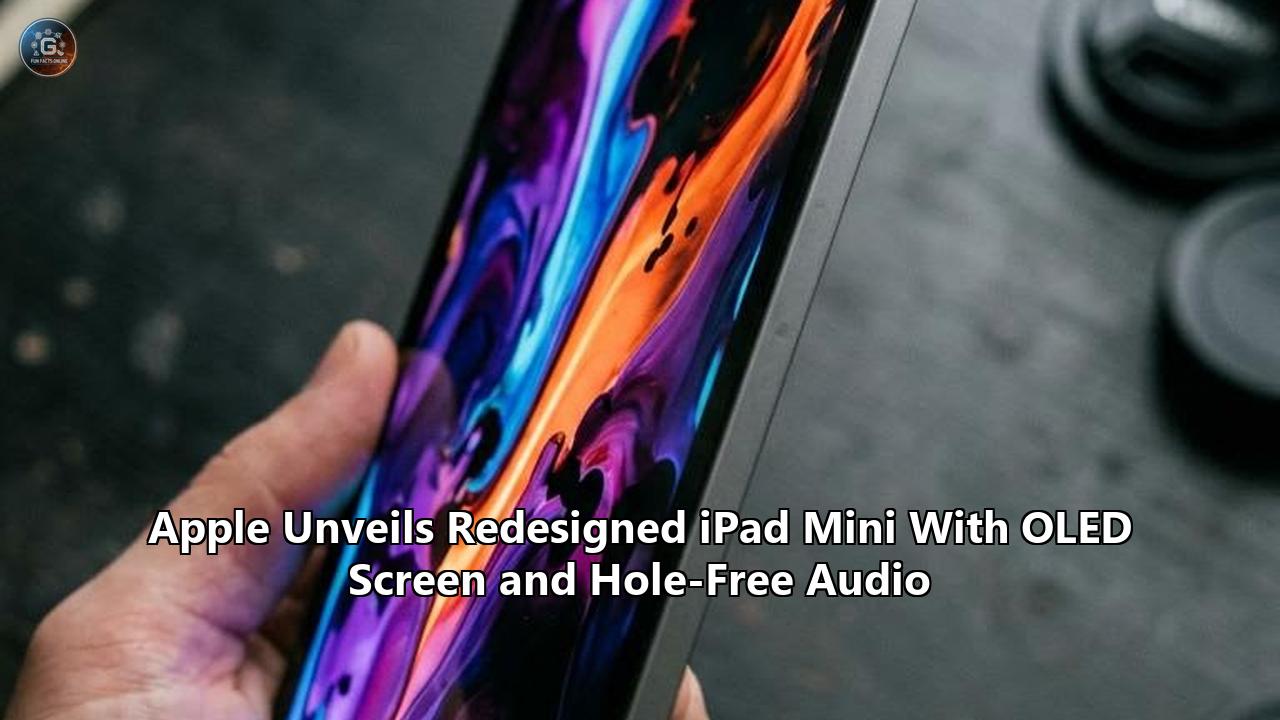
On Monday morning, Apple unveiled a fundamentally re-engineered iPad Mini, replacing the compact tablet’s legacy liquid crystal display with an 8.5-inch Super Retina XDR OLED panel and eliminating visible speaker grilles in favor of an under-glass acoustic system. The redesign marks the first time an iPad has achieved an IP67 rating for dust and water resistance, accompanied by a structural slimming to 5.4 millimeters and an internal upgrade to the 2-nanometer A20 Pro system-on-chip.
The eighth-generation tablet starts at $699 for the 128GB Wi-Fi model, climbing to $849 for cellular configurations, with pre-orders opening Wednesday, October 28, ahead of retail availability on Friday, November 6 across 36 countries. Dave Pakula, Apple’s vice president of Hardware Engineering, framed the revision as a consolidation of portable performance: "With a remarkably thinner and lighter design, a stunning new OLED display, the incredibly powerful A20 Pro, and water and dust resistance, the new iPad mini is a huge leap forward for users who love having the full iPad experience in the palm of their hand".
Beyond the marketing claims and the $200 price increase over the 2024 launch tier, the tablet represents an aggressive structural overhaul. By stripping away the acoustic apertures that have defined handheld Apple hardware since the original iPhone, the company’s industrial design and audio engineering teams have turned the tablet’s front glass and unibody housing into direct sound radiators. Examining the mechanical patents, display driver choices, silicon thermal envelopes, and manufacturing processes behind the device reveals how Apple resolved longstanding miniaturization bottlenecks—and where it accepted uncompromising engineering trade-offs.
Acoustic Display Mechanics: How Sound Traverses Glass
The absence of drilled speaker holes along the top and bottom edges is the machine’s most radical physical departure. Since the transition to the flat-edged industrial language in 2021, the iPad Mini relied on pairs of micro-machined acoustic ports drilled directly through the CNC-milled aluminum chassis to vent sound from compact dynamic drivers. In their place, the 2026 model introduces an audio architecture Apple calls Acoustic Display.
                     +---------------------------------------+
                     |         Cover Glass Surface           |
                     +---------------------------------------+
                                        | (Acoustic Coupling Layer)
                     +---------------------------------------+
                     |         OLED Display Substrate        |
                     +---------------------------------------+
                                        |
     +----------------------------------+----------------------------------+
     |                                                                     |
+----+-----------------------+                                       +-----+----------------------+
| High-Frequency Exciters    |                                       | Low-Profile Woofers        |
| (Piezoelectric bimorphs at |                                       | (Miniaturized balanced     |
| chassis perimeter)         |                                       | dynamic motors, sealed)    |
+----------------------------+                                       +----------------------------+
     |                                                                     |
     +----------------------------------+----------------------------------+
                                        |
                     +---------------------------------------+
                     |    Internal Structural Aluminum Tub   |
                     +---------------------------------------+
Traditional dynamic speakers in consumer electronics require three structural elements: a voice coil suspended in a permanent magnetic field, a flexible diaphragm (typically made of polyimide, aluminum, or paper composites) that displaces air, and a tuned acoustic back-volume that prevents out-of-phase rearward sound waves from canceling out forward radiation. In devices thinner than 6 millimeters, providing adequate back-volume without compromising battery capacity is a zero-sum mechanical puzzle.
Apple addressed this constraint by eliminating the standalone speaker diaphragm entirely. Instead, the display glass itself serves as the moving acoustic element.
The system relies on a hybrid transducer configuration split across the frequency band:
- High-to-Mid Frequency Range (Bimorph Exciters): Anchored directly along the inner perimeter of the display stack are custom electromagnetic and piezoelectric ceramic exciters. When alternating audio voltages pass across these transducers, the ceramic layers expand and contract laterally. Bound to the rigid substrate of the chemically strengthened display glass, this mechanical shear stress translates into microscopic flexural vibrations. The front glass acts as a distributed-mode loudspeaker (DML), exciting the ambient air directly in front of the user.
- Low-Frequency Foundation (Sealed Cavity Micro-Woofers): Because vibrating an entire sheet of glass to reproduce 100 Hz to 300 Hz tones requires high excursion that could destabilize the display’s optical bonding, Apple decoupled the lower register. Deep within the aluminum chassis, two ultra-thin, low-profile voice-coil woofers fire into a sealed, isolated acoustic internal chamber. The acoustic energy is vented through micro-clearances between the OLED module’s structural frame and the interior perimeter of the aluminum unibody.
Frequency Spectrum Allocation:
0 Hz ------------- 300 Hz ------------------------- 3,500 Hz --------------------- 20,000 Hz
       [Sealed Micro-Woofers]               [Distributed-Mode Surface Exciters]
       Chassis internal resonance           Glass panel flexural displacement
Moving sound through a display assembly presents material science challenges. Modern mobile displays are not monolithic sheets of glass; they are intricate laminations composed of aluminosilicate cover glass, an optically clear adhesive (OCA) resin layer, a circular polarizer, thin-film encapsulation (TFE), an organic light-emitting diode emission layer, and a polyimide thin-film transistor (TFT) backplane.
+--------------------------------------------------------+
| 1. Chemically Strengthened Cover Glass (~0.5 mm)      |
+--------------------------------------------------------+
| 2. Optically Clear Adhesive (Viscoelastic Modulus)     |
+--------------------------------------------------------+
| 3. Circular Polarizer & Touch Sensor Array Matrix      |
+--------------------------------------------------------+
| 4. Thin-Film Encapsulation (Inorganic/Organic Barrier) |
+--------------------------------------------------------+
| 5. Tandem OLED Organic Emissive Layers                 |
+--------------------------------------------------------+
| 6. Polyimide LTPS/LTPO Backplane                       |
+--------------------------------------------------------+
| 7. Structural Titanium-Graphite Heat Spreader Support  |
+--------------------------------------------------------+
Every layer in that stack possesses a distinct Young’s modulus and loss factor. Standard OCA materials are viscoelastic polymers designed specifically to absorb mechanical shock and dampen vibrations, protecting fragile internal circuitry when a device drops. If an audio engineering team attempts to vibrate a display through standard OCA, the adhesive layer acts as a mechanical low-pass filter, dissipating acoustic energy into heat and muddying high-frequency transient responses.
To clear this hurdle, Apple worked with adhesive suppliers to formulate an anisotropic acoustic coupling resin. This specialized adhesive exhibits high shear stiffness along the vertical Z-axis—efficiently transmitting high-frequency mechanical pulses from the exciters straight to the exterior face of the glass—while maintaining lateral elasticity in the X-Y planes to prevent shear delamination caused by thermal expansion differences between glass and aluminum.
Digital Signal Processing and Handheld Haptics
Surface-driven acoustics introduce an unavoidable byproduct: haptic feedback across the entire device. When a user holds a 255-gram slate playing uncompressed audio at maximum volume, structural vibrations naturally migrate into the chassis rail, threatening to turn prolonged handholding into a fatiguing, buzzing annoyance.
Apple counteracts this using the A20 Pro’s dedicated audio coprocessor and integrated DSP pipelines. The system employs real-time phase compensation. Because the tablet uses multiple exciters arrayed symmetrically behind the perimeter, the DSP can drive out-of-phase anti-vibrations across the chassis rails while maintaining in-phase constructive interference on the center of the display glass.
Transducer Left (+)  -----> \                                / <----- Transducer Right (+)
                             ===> Constructive Wave (Center) ===> Audio to Listener
Chassis Boundary (-) -----> /       (Display Glass)          \ <----- Chassis Boundary (-)
                                 [Destructive Cancellation]
                                  Zero-Net Handrail Vibration
Furthermore, by continuously sampling the capacitive grip sensors along the aluminum frame, the iPad Mini detects hand placement. When fingers clamp down on the edges, the DSP dynamically recalculates the equalization curves, boosting high frequencies that might otherwise be attenuated by tissue absorption and dropping the low-frequency drive voltage to mechanical thresholds that minimize structural feedback in the palms.
The OLED Display: Supply Chains, Bezel Reductions, and Panel Trade-Offs
The migration from an 8.3-inch IPS LCD to an 8.5-inch Super Retina XDR OLED panel resolves the display limitations that have shadowed the iPad Mini since the 2021 redesign.
+--------------------------+------------------------------+------------------------------+
| Metric                   | iPad Mini (6th/7th Gen)      | Redesigned iPad Mini (2026)  |
+--------------------------+------------------------------+------------------------------+
| Panel Type               | IPS Liquid Crystal (LCD)     | Super Retina XDR OLED        |
| Diagonal Size            | 8.3 inches                   | 8.5 inches                   |
| Resolution               | 2266 x 1488 (326 ppi)        | 2420 x 1586 (326 ppi)        |
| Peak Brightness (HDR)    | 500 nits                     | 1,200 nits                   |
| Sustained Full-Screen    | 500 nits                     | 600 nits                     |
| Black Level Floor        | ~0.4 nits                    | 0.00005 nits (Absolute Black)|
| Contrast Ratio           | 1,300:1                      | 2,000,000:1                  |
| Minimum Brightness       | 2 nits                       | 1 nit                        |
| Border / Bezel Width     | Nominal baseline             | Reduced by 24%               |
| Refresh Rate             | 60 Hz                        | 60 Hz (Fixed)                |
+--------------------------+------------------------------+------------------------------+
When Apple released the sixth-generation Mini, users immediately noticed "jelly scrolling"—an optical tearing artifact where one side of the panel refreshed milliseconds ahead of the other during vertical navigation in portrait orientation. This behavior was a physical consequence of placing the display’s column-driver integrated circuits along the shorter horizontal edge rather than the longer vertical edge. Because the display refreshed line-by-line along its vertical axis, fast scrolling made lines of text tilt asymmetrically. Apple mitigated this in the seventh generation by reorienting the timing controller (TCON), but the slow pixel-response times inherent to affordable a-Si (amorphous silicon) LCDs prevented the display from feeling truly responsive.
Liquid Crystal (IPS):
Pixel State A  ================>[Liquid Crystal Molecules Physically Rotate]===============> Pixel State B
Transition Time: ~15 to 25 milliseconds (Visible ghosting / smearing under motion)

Organic Light-Emitting Diode (OLED):
Pixel State A  ==>[Sub-microsecond Carrier Recombination]==> Pixel State B
Transition Time: < 0.1 milliseconds (Instantaneous response)
The switch to OLED solves this pixel-latency problem at the chemical level. Unlike liquid crystals, which must physically rotate under electric fields to block or pass backlight illumination, organic light-emitting subpixels modulate luminance via direct electrical carrier recombination in the organic thin-film layers. The response time drops from roughly 20 milliseconds to under 0.1 milliseconds, eliminating visible trailing and motion blur regardless of the TCON refresh sequence.
Display Panel Dimensions and Real Estate:
+-------------------------------------------------------+
|  Previous Chassis Footprint: 195.4 x 134.8 mm         |
|  +-------------------------------------------------+  |
|  |  Previous 8.3-inch LCD (Thicker Bezels)         |  |
|  |                                                 |  |
|  +-------------------------------------------------+  |
+-------------------------------------------------------+

+-------------------------------------------------------+
|  Identical 2026 Chassis Footprint: 195.4 x 134.8 mm   |
|  +-------------------------------------------------+  |
|  |  New 8.5-inch OLED Display                      |  |
|  |  [24% Thinner Bezels / Border Reduction]        |  |
|  +-------------------------------------------------+  |
+-------------------------------------------------------+
To expand the screen from 8.3 to 8.5 inches without inflating the 134.8 mm by 195.4 mm unibody footprint, Apple reduced the display borders by 24%. Achieving that shrinkage inside an ultra-slim enclosure required moving to a flexible polyimide substrate utilizing Chip-on-Film (COF) and COP (Chip-on-Plastic) packaging. Instead of mounting the driver IC flat on an extended glass lip at the edge of the panel, the flexible plastic base layer bends 180 degrees backward behind the active emissive area, tucking the interconnects and display controllers underneath the panel itself.
The 60Hz Decision: Packaging Realities vs. Marketing Tiers
Despite the leap in contrast and a doubling of peak brightness to 1,200 nits in HDR workflows, the panel remains fixed at a 60 Hz refresh rate.
The absence of 120Hz ProMotion stems from two intersecting constraints: silicon thermal envelopes and display fabrication yields.
To implement a variable refresh rate from 1 Hz up to 120 Hz, a display backplane must transition from standard Low-Temperature Poly-Silicon (LTPS) to Low-Temperature Polycrystalline Oxide (LTPO). LTPO combines high-electron-mobility LTPS drive transistors with ultra-low-leakage Indium Gallium Zinc Oxide (IGZO) switching transistors.
LTPS Pixel Circuit (Fixed 60Hz):
[Vdd] ---> [LTPS Drive TFT] ---> [OLED Diode]
                 ^
                 |
         [LTPS Scan TFT]  <--- Leakage occurs at low refresh rates, requiring
                               frequent 60Hz refresh cycles to avoid flicker.

LTPO Hybrid Circuit (Variable 1Hz - 120Hz):
[Vdd] ---> [LTPS Drive TFT] ---> [OLED Diode]
                 ^
                 |
         [IGZO Oxide TFT] <--- Extremely low sub-threshold leakage allows holding charge
                               statically down to 1Hz without parasitic flicker.
Adding the oxide deposition steps to the lithography line adds four to six additional photomask stages to the manufacturing process, cutting factory throughput and lowering glass substrate yields. While Apple leverages LTPO across iPhone Pro lines and the iPad Pro, applying this architecture to an 8.5-inch cut requires significant fab capacity on Gen 6 and Gen 8.6 glass production lines at suppliers like Samsung Display and LG Display.
Furthermore, driving an 8.5-inch display at 120 frames per second requires higher instantaneous power. In an iPad Pro, the battery capacity sits between 31 and 38 watt-hours, easily absorbing the load of an adaptive display controller. Inside the 5.4 mm enclosure of the iPad Mini, battery volume is severely restricted. Packaging an LTPO panel alongside dual exciters, the A20 Pro chip, and cellular modems would have forced Apple to accept sub-eight-hour runtimes under active drawing and gaming conditions. Keeping the panel at 60 Hz enabled the engineering team to preserve the standard 10-hour battery envelope while slashing 0.9 millimeters from the chassis profile.
Power Consumption Breakdown: Display Active State (Approximate)
+-----------------------------------------------------------+
| 60Hz LTPS OLED Panel (600 nits sustained):  ~2.1W         |
+-----------------------------------------------------------+
| 120Hz LTPO OLED Panel (Projected Draw):     ~3.4W (+62%)  |
+-----------------------------------------------------------+
A 1.3W disparity inside a ~19Wh battery system would slash overall runtime
by roughly 20-25% during active interaction.
The Nano-Texture Glass Option
For an extra $100 on the 256GB and 512GB tiers, Apple offers a nano-texture glass finish.
Standard anti-reflective coatings rely on thin physical vapor deposition (PVD) dielectric layers that use destructive light interference to suppress specular reflections. While effective in controlled indoor environments, high-intensity ambient light—such as direct sunlight on a flight deck or under studio lighting—washes out dark zones on glossy glass.
Standard Anti-Reflective Coating:
Incident Light  =====> \
                        \
                         =====> Specular Reflection (Mirror Glare directly into eye)
------------------------------------------------------------------------------------
Display Glass Substrate

Nano-Texture Etched Glass:
Incident Light  =====> \  /  \  /
                        \/    \/
                        =======> Diffuse Scattering (Light dispersed harmlessly)
~~~~~~~~~~~~~~~~~~~~~~~~~~~~~~~~~~~~~~~~~~~~~~~~~~~~~~~~~~~~~~~~~~~~~~~~~~~~~~~~~~~~
Display Glass with Chemical Nano-Etched Geometric Relief
Nano-texture glass bypasses surface coatings altogether. Apple uses a multi-stage chemical acid etching process that cuts directly into the exterior matrix of the aluminosilicate glass, forming nanometer-scale pyramids and geometric troughs. These micro-features disperse incoming specular light rays across wide viewing angles, neutralizing reflections without causing the optical haze, sparkle, or modulation transfer function (MTF) degradation common to cheap matte screen protectors.
The industrial manufacturing challenge on an Acoustic Display is ensuring that this surface etching does not create micro-fissures or stress concentrations. Because the glass acts as a dynamic acoustic radiator flexed by internal exciters, any structural flaw at the nanometer scale could serve as a fault line, causing stress fractures over millions of acoustic vibration cycles. Apple’s glass processing includes an extended secondary chemical ion-exchange bath, substituting smaller sodium ions with larger potassium and rubidium ions deep into the etched microscopic valleys to establish a deep compressive stress layer across the entire treated panel.
Silicon Architecture: Why the 2nm A20 Pro Bypassed the M-Series
A recurring debate surrounding the iPad Mini lineup has been Apple’s decision to power it with iPhone-tier A-series silicon rather than the M-series processors found in the iPad Air and iPad Pro. The 2026 iteration deepens this divergence by deploying the A20 Pro, fabricated on TSMC’s 2-nanometer (N2) node.
+--------------------------+------------------------------+------------------------------+
| Parameter                | Apple M4 (Baseline iPad Pro) | Apple A20 Pro (New iPad Mini)|
+--------------------------+------------------------------+------------------------------+
| Process Node             | TSMC N3E (3-nanometer)       | TSMC N2 (2-nanometer GAAFET) |
| Transistor Architecture  | FinFET                       | Nanosheet (GAA)              |
| Memory Bus Width         | 128-bit LPDDR5X              | 64-bit LPDDR5X               |
| Memory Bandwidth         | ~120 GB/s                    | ~68 GB/s                     |
| Target Sustained TDP     | 12W – 15W                    | 4.5W – 6.5W                  |
| Idle Package Power       | ~450 mW                      | ~85 mW                       |
| Thickness Budget Impact  | Requires heavy heat sink     | Direct chassis conduction    |
+--------------------------+------------------------------+------------------------------+
The choice between an M4/M5 and an A20 Pro is dictated entirely by thermal design power (TDP) and motherboard real estate. The Apple M-series architecture relies on a wide 128-bit memory interface paired with dual-channel DRAM packages placed side-by-side with the system-on-chip substrate. That layout occupies significant logic board space and demands a minimum cooling envelope of 10 to 15 watts under sustained graphics or video rendering tasks.
Inside a sealed 5.4 mm aluminum chassis lacking active fan ventilation, dissipating a 15-watt thermal surge is physically impossible without driving the device's outer shell beyond statutory skin-temperature limits (typically 43°C to 48°C for handheld electronics). Had Apple dropped an M-series chip into this enclosure, thermal throttling algorithms would have dropped CPU and GPU clock speeds within three minutes of intense load, reducing performance down to mobile chip baselines anyway.
Thermal Dissipation Profile: Sustained Workload (15 Minutes)
Clock Frequency (GHz)
4.0 |   M-Series (Unthrottled Pro Chassis with large thermal sink)
3.5 |   -------------------------------------------------
3.0 |
2.5 |               A20 Pro (Stable Sustained Ceiling in Mini)
2.0 |   .................................................
1.5 |   \
1.0 |    \ M-Series (Hypothetical Mini profile: Severe thermal throttling dive)
0.5 |     \______________________________________________
0.0 +----------------------------------------------------> Time (Minutes)
    0        3        6        9        12       15
The A20 Pro solves this through TSMC's 2-nanometer manufacturing node, which abandons traditional FinFET (Fin Field-Effect Transistor) geometry for Gate-All-Around (GAA) nanosheets.
FinFET (3nm and prior):
         +-------------+
         | Gate Metal  |
    +----+-------------+----+
    |    |  Silicon    |    |
    |    |    Fin      |    |  <--- Gate wraps around 3 sides of the channel fin;
    |    +-------------+    |       leakage still escapes along bottom boundary.
    +-----------------------+

Nanosheet / GAAFET (2nm A20 Pro):
         +-------------+
         | Gate Metal  |
    +----+-------------+----+
    | === Nanosheet === |   <--- Gate material completely encircles individual
    | === Nanosheet === |        horizontal silicon ribbons on all 4 sides.
    | === Nanosheet === |        Sub-threshold leakage current is tightly contained.
    +----+-------------+----+
         | Gate Metal  |
         +-------------+
By wrapping the conductive gate material completely around horizontal silicon nanosheet ribbons, the A20 Pro eliminates the parasitic current leakage that plagued FinFET structures at sub-3nm scales. The processor incorporates Backside Power Delivery Networks (BSPDN), decoupling signal wires from power delivery lines by moving power routing underneath the silicon substrate. This design reduces resistive voltage drops (IR drop) and increases operational power efficiency by 15% compared to N3E silicon at matched speeds.
Heterogeneous Core Binning and AI Performance
Apple splits the A20 Pro configurations across storage tiers, introducing an architectural segmentation quiet even by historical standards:
- 128GB and 256GB Configurations: Powered by a 5-core CPU (2 performance cores paired with 3 efficiency cores) and a 6-core GPU.
- 512GB Configuration: Features a fully enabled 6-core CPU (2 performance cores and 4 efficiency cores), a 7-core GPU, and an expanded Dual 16-core Neural Engine array.
This binning strategy reflects early 2nm wafer yields. Rather than discarding silicon dice exhibiting a minor defect in a single core or neural cluster, Apple bins those processors to serve the lower-cost base configurations, reserving top-tier, fully functional dice for high-capacity models.
The upgraded 512GB variant's Dual Neural Engine targets local, edge-based execution of machine learning models. Where cloud-reliant mobile tablets offload multi-billion-parameter large language models (LLMs) to external data centers, the top-tier configuration processes localized foundational models directly in unified system memory.
The GPU incorporates dedicated Neural Accelerators into each individual graphics compute unit. These accelerators execute concurrent matrix multiplication alongside standard rendering pipelines, enabling real-time ray-traced lighting calculations in 3D gaming alongside concurrent edge-model background processing without stalling graphics pipelines.
Custom Connectivity: In-House Silicon Deployment
The logic board also eliminates external third-party communications silicon, replacing legacy Broadcom and Qualcomm components with Apple-developed controllers:
- The N1 Wireless Subsystem: Handles dual-band Wi-Fi 7 (802.11be), Bluetooth 6, and Thread mesh routing. Operating over 160 MHz channels with 4K-QAM modulation schemes, the N1 reduces peak data-transmission energy consumption by roughly 30% compared to the Wi-Fi 6E radios of the prior generation.
- The C2 Cellular Modem: Deployed in the Wi-Fi + Cellular models, the C2 modem represents Apple's proprietary cellular baseband. Fabricated on an ultra-dense process node, it integrates both baseband processing and RF transceivers into a compact multi-chip module, enabling up to 50% faster data rates and reclaiming internal logic board space.
The Hermetic Shell: Achieving IP67 at 5.4 Millimeters
Consumer tablets have historically avoided certified Ingress Protection (IP) ratings. While smartphones have carried IP68 ratings for years, expanding that protection to a tablet involves challenging mechanical hurdles.
Enclosure Sealing Architecture:
                                         Cover Glass
                                  +-----------------------+
                                  |                       |
+---------------------------------+                       +---------------------------------+
| Anodized Aluminum Unibody Rail  | [ePTFE Gas Membrane]  |  Anodized Aluminum Unibody Rail |
|                                 |                       |                                 |
|                                 +-----------------------+                                 |
|  [LSR Precision Gasket]               Display Stack          [LSR Precision Gasket]       |
+-------------------------------------------------------------------------------------------+
|                          Hermetically Sealed Internal Chassis Tub                         |
|   (Zero acoustic pass-through ports; pressure equalized via micro-pore barometric vents)  |
+-------------------------------------------------------------------------------------------+
The fundamental obstacle to sealing a tablet is air volume. An iPad contains far more internal trapped air than a smartphone. When a device transitions from a cool environment to high workloads or ambient heat, the trapped air expands, raising internal pressure:
$$\Delta P = \frac{n R \Delta T}{V}$$
In an unsealed device, pressure equalizes through the speaker grilles and microphone ports. If engineers seal a tablet using standard phone-style adhesives without structural grilles, this pressure differential ($\Delta P$) exerts outward force against the largest flexible surface area: the display glass. Under repeated thermal expansion cycles, the outward pressure degrades the perimeter glue joints, causing display delamination or spontaneous water seal failure during minor submersions.
Thermal Air Expansion Mechanics:
Cold Idle State (Low Internal Pressure):
[==== Display Module Frame ====]
[   P_internal == P_ambient   ]
[======== Aluminum Base =======]

High Workload Thermal Spike (Internal Pressure Surges):
     /  Exerted Force (\Delta P)  \
    ^      ^      ^      ^      ^
[==== Distended Display Frame ===]  <--- Delamination risk at perimeter seal joints
[   P_internal >> P_ambient     ]
[======== Aluminum Base ========]
Apple cleared this hurdle on the redesigned iPad Mini through two mechanical changes:
- Eliminating the Speaker Holes: Precision speaker grilles have always been the primary point of moisture ingress. Traditional speaker assemblies require waterproof acoustic meshes—micro-perforated membranes that let sound waves pass while surface tension prevents water droplets from entering. These meshes are vulnerable to puncture, high-pressure streams, and degradation from household detergents or pool chlorine. By deleting the speaker cutouts entirely, Apple eliminated the largest mechanical opening on the tablet chassis.
- Barometric Equalization Vents: To relieve air pressure without letting moisture into the chassis, Apple embedded micro-bore equalization vents behind the chassis pinholes dedicated to the dual microphone array. These vents are sealed with expanded polytetrafluoroethylene (ePTFE) acoustic membranes. The ePTFE membrane features a microscopic pore structure engineered to be thousands of times smaller than a water droplet, but large enough to let individual gas molecules pass through freely. As internal air heats and expands, gas vents through the micro-pores in milliseconds, equalizing internal pressure without compromising the IP67 water-tight boundary.
ePTFE Micro-Pore Membrane Structure:
Ambient Air / Water Droplets
   (Water Droplet: ~2,000 µm)  ----->   [  X  ] Blocked by high surface tension
   (Gas Molecules: ~0.0004 µm) ----->   [======] Freely traverses ePTFE pore (~0.2 µm)
-------------------------------------------------------------------------------------
Internal Logic Board / Chassis Environment
The perimeter of the display is sealed using a liquid silicone rubber (LSR) compression gasket set into a precision micro-groove along the interior aluminum rail, supplemented by a secondary perimeter bead of reactive hot-melt polyurethane adhesive.
The USB-C port assembly is independently hermetically isolated. The connector housing is machined from a solid block of corrosion-resistant titanium alloy, press-fitted into the bottom chassis edge, and sealed against the internal logic board with an over-molded elastomeric boot. Even if the connector takes in salt water or debris, moisture cannot migrate from the port cavity into the logic board compartment.
Isolated USB-C Connector Assembly:
+---------------------------------------------------------------+
| Chassis Enclosure Wall                                       |
|     +---------------------------------------------------+     |
|     | Titanium Connector Housing Block                  |     |
|     |  +---------------------------------------------+  |     |
|     |  | Port Cavity (Water Tolerant / Open Ingress) |  |     |
|     |  +---------------------------------------------+  |     |
|     +---------------------------------------------------+     |
|                               |                               |
|        [Over-Molded Hermetic Elastomeric Seal Boot]           |
|                               |                               |
+-------------------------------+-------------------------------+
| Internal Logic Board (Hermetically Isolated / Dry Cavity)    |
+---------------------------------------------------------------+
The structural design also makes the tablet thinner and lighter. At 5.4 mm, the tablet is 14% thinner than the 6.3 mm model it replaces. Weight falls from 293 grams to 255 grams—a 13% reduction made possible by removing dynamic speaker boxes, thinning the glass stack via OLED integration, and machining structural support ribs directly into the unibody shell.
Chassis Thickness Evolution:
Previous iPad Mini (7th Gen): 6.3 mm | [==========================================]
Redesigned iPad Mini (2026):   5.4 mm | [===================================] (-14%)
Internal Packaging: Cameras, Inductive Coils, and Digitizer Filtering
Rearranging an ultra-compact tablet to fit an 8.5-inch panel, exciters, and an IP67 enclosure required rethinking internal component packaging.
Internal Layout Architecture:
+-----------------------------------------------------------------+
| [Piezo Exciter L]  [Landscape 12MP Camera Module]  [Pencil Coil]|
+-----------------------------------------------------------------+
| +-----------------------------+ +-----------------------------+ |
| |                             | |  Custom Miniaturized Logic  | |
| |                             | |  Board: A20 Pro SoC, C2, N1 | |
| |   Main Split-Cell Lithium   | +-----------------------------+ |
| |   Cobalt Battery Assembly   | |                             | |
| |   (~19.2 Watt-Hour Pack)    | |                             | |
| |                             | |  Sealed Acoustic Woofer     | |
| |                             | |  Internal Resonance Box     | |
| +-----------------------------+ +-----------------------------+ |
+-----------------------------------------------------------------+
| [Piezo Exciter R]        [Isolated USB-C]     [Piezo Exciter R] |
+-----------------------------------------------------------------+
The Landscape Camera Migration
The front-facing 12MP Center Stage ultra-wide camera has been moved from the top vertical bezel to the long horizontal landscape edge.
This repositioning matches how modern users orient the tablet for video calls and desktop workflows. However, it created an internal mechanical conflict with the magnetic charging dock for the Apple Pencil.
Landscape Rail Real Estate Conflict:
+-------------------------------------------------------------------+
| Upper Landscape Rail                                              |
| +-----------------------+   +-----------------------------------+ |
| | Landscape Camera Sub  |   | Inductive Wireless Charging Coil  | |
| | [CMOS Sensor + Prism] |   | [Apple Pencil Pro Magnetic Dock]  | |
| +-----------------------+   +-----------------------------------+ |
+-------------------------------------------------------------------+
In previous generations, the center of that long edge was occupied exclusively by the inductive magnetic charging coil and permanent alignment magnets for the Apple Pencil. To resolve this spatial conflict:
- Split-Magnet Array Geometry: Hardware engineers split the pencil alignment magnets, flanking the camera module on either side without weakening the magnetic retention force holding the accessory.
- Shifted Inductive Core: The inductive charging coil was shifted slightly off-center and redesigned as an elongated race-track ferrite core.
- Low-Profile Folded Camera Module: The camera sensor was replaced with a low-profile packaging design. By folding the sensor’s flexible printed circuit (FPC) beneath the active display margin, the camera module nestles between the glass perimeter and the frame without protruding into the active pixel zone of the OLED panel.
Touch Digitizer Signal Isolation
Directly vibrating the front cover glass introduces electrical noise to the touch-sensing layer. Modern capacitive digitizers measure microscopic shifts in mutual capacitance when a conductive object (such as a human finger or an Apple Pencil tip) alters the local electrostatic field across an intersecting grid of indium tin oxide (ITO) drive and sense electrodes.
Capacitive Touch Interconnect Interference:
Drive Line (Tx) -----[ Electrostatic Field Matrix ]-----> Sense Line (Rx)
                              |
                     [Finger Disturbance]
                              v
                 Capacitance Delta Detected

Acoustic Excitation Challenge:
Piezoelectric Transducer Vibrations ===> [Dynamic Dielectric Distance Variations]
                                                v
                                  Parasitic Capacitance Jitter
                                  (False Touches / Ghost Inputs)
Because piezoelectric exciters flex the glass substrate mechanically, that movement slightly alters the dielectric distance between the cover glass surface and the underlying touch-sensor lines. Without mitigation, high-volume audio playback would create microscopic electrostatic capacitance fluctuations, causing ghost touches, dropped pencil strokes, or jitter during fine drawing.
Apple mitigates this interference directly within the display driver silicon. The touch-controller firmware receives a live reference feed from the A20 Pro’s audio DSP. Using an adaptive digital notch-filtering algorithm, the touch controller subtracts known acoustic vibration frequencies from the digitized capacitive matrix in real time. As a result, the digitizer isolates and processes intentional physical touch inputs while filtering out acoustic surface vibrations.
The Strategic Balance: Upgrades, Pricing, and Lineup Real Estate
Evaluating the new iPad Mini features against the broader computing landscape reveals a targeted industrial strategy: consolidating components to serve specialized, demanding use cases.
+---------------------+-------------------+---------------------+-------------------+
| Feature Matrix      | iPad (10th/11th)  | New iPad Mini (8th) | iPad Pro (M4)     |
+---------------------+-------------------+---------------------+-------------------+
| Starting Price      | $349 – $449       | $699                | $999              |
| Display Technology  | 10.9" sRGB LCD    | 8.5" Tandem OLED    | 11" / 13" OLED    |
| Ingress Rating      | None (Unrated)    | IP67 Certified      | None (Unrated)    |
| Audio Implementation| Ported 2-Speaker  | Acoustic Display    | Ported 4-Speaker  |
| Silicon Node        | 4nm / 5nm A-Series| 2nm A20 Pro         | 3nm M4 / M5       |
| Form Factor Profile | 7.0 mm            | 5.4 mm              | 5.1 mm / 5.3 mm   |
| Primary Market      | Education / Entry | Field / Aviation    | Creative Pro      |
+---------------------+-------------------+---------------------+-------------------+
The $699 entry price moves the device out of the casual consumption tier. For context, the entry-level baseline iPad sits near $349, while the 11-inch iPad Air hovers around $599. At this elevated price point, the Mini is no longer designed to be an impulse purchase or an inexpensive digital reader.
Instead, the combination of IP67 water sealing, a 1,200-nit high-visibility display, nano-texture anti-glare glass, and an ultra-thin 255-gram profile positions the device for specialized field applications:
- Commercial Aviation and Electronic Flight Bags (EFB): The iPad Mini has become the default cockpit tablet worldwide. In unpressurized cockpits or under direct sunlight at altitude, standard glossy LCD panels often struggle with thermal shutdowns and distracting glare. The combination of 1,200-nit peak HDR brightness, the nano-texture finish, and an IP67 rating for handling cockpit spills makes this redesign an optimal cockpit tool.
- Field Medicine and Industrial Operations: In emergency rooms and industrial inspection facilities, handheld devices must endure regular sanitation with chemical disinfectant wipes. The absence of open speaker holes eliminates the risk of cleaning solutions seeping into the acoustic chambers, making the tablet significantly easier to decontaminate.
- Mobile Gaming and Edge Computing: The A20 Pro chip, paired with an OLED panel that eliminates motion blur, turns the device into an exceptionally compact, high-performance gaming slate.
Industrial Market Target Densities:
[ Casual Media Consumers ]        ===> Shift to Baseline iPad or iPhone
[ Commercial Cockpit / EFB ]      ===> Prime iPad Mini Adopters (Glare/Thermal/OLED focus)
[ Clinical / Medical Sanitation ] ===> Prime iPad Mini Adopters (Sealed IP67 focus)
[ Field Engineering / Telemetry ] ===> Prime iPad Mini Adopters (Pocketability/Durability focus)
The engineering decisions behind the tablet also highlight shifting component costs across Apple's supply chain. Fabricating on TSMC's 2-nanometer node is expensive; industry estimates place the cost of processed 2nm wafers upwards of $30,000 per unit, compared to roughly $18,000 to $20,000 for 3nm runs.
Simultaneously, cutting high-resolution OLED panels to custom 8.5-inch dimensions requires paying an initial price premium to panel fabricators. By packaging these new iPad Mini features into a unified chassis, Apple is testing key industrial processes ahead of broader hardware deployments.
Hardware Technology Deployment Timeline:
2024: Tandem OLED Architecture (Pioneered on iPad Pro)
2026: Acoustic Display & Hole-Free IP67 Architecture (Pioneered on iPad Mini)
Future: Prospective Migration to Portless/Aperture-Free iPhone Architectures
Acoustic Trade-Offs Under Independent Review
While the acoustic-display system delivers clean high frequencies, low visual profile, and robust water sealing, early hardware evaluations point to real-world acoustic compromises.
Acoustic Frequency Response Comparison:
Volume Output (dB)
     +                                       [Target Reference Profile]
     |                                          .-----------------------.
     |                                         /                         \
     |    [Acoustic Display Actual]           /                           \
     |               .-----------------------'                             \
     |              /
     |             /  <--- Bass Roll-off below 180Hz (Limited by physical chassis volume)
     |            /
     |___________/
   0 +-------------------------------------------------------------------------> Frequency (Hz)
     20         100        200        500        1k          5k          20k
Traditional dynamic speaker boxes utilize ported resonance chambers to produce sound down to 100 Hz. In a 5.4-millimeter chassis where the display glass serves as the speaker cone, moving sufficient air to reproduce deep bass frequencies below 180 Hz remains physically constrained. While DSP equalizers compensate by saturating harmonic mid-bass tones, the system cannot match the rich low-end presence found on the thicker, ported iPad Pro.
For voice calls, video streaming, and gaming, the audio output is crisp, clear, and direct. For critical audio monitoring or high-dynamic-range music playback, external headphones remain indispensable.
The Broader Hardware Trajectory
The redesign of the iPad Mini serves as a manufacturing testbed for the wider Apple ecosystem. Over the past decade, Apple has frequently tested ambitious structural innovations on specialized devices before deploying them across mass-market flagships. The unibody enclosure debuted on the MacBook Air before expanding across every portable Mac; the OLED panel debuted on the Apple Watch before reshaping the iPhone and iPad Pro.
In the 2026 iPad Mini, Apple has deployed a unified testbed of interconnected technologies:
- A completely hole-free, surface-actuated acoustic system.
- A sealed, IP-rated tablet enclosure with no physical speaker openings.
- An edge-to-edge flexible OLED integration on an intermediate-sized screen.
- The production debut of 2-nanometer Gate-All-Around processing silicon.
If the Acoustic Display proves structurally durable and reliable across millions of real-world users, it provides the engineering template Apple needs to eliminate exterior speaker grilles on future iPhones and MacBooks.
Removing drilled speaker apertures eliminates dust-clogging service failures, simplifies automated CNC manufacturing runs, and clears the path toward truly unibody, glass-and-metal hardware enclosures.
Industrial Design Trajectory:
[Drilled Holes & Open Ports] ===> [Acoustic Display & Sealed Vents] ===> [Continuous Unibody Monolith]
(Legacy Consumer Hardware)         (2026 iPad Mini Implementation)       (Future Product Architectures)
As pre-orders open on October 28 and retail units hit store shelves on November 6, technical teardowns from independent repair groups will soon reveal the physical implementation of the internal exciters, the exact adhesive chemistries bonding the display, and the precise battery capacity squeezed into this 5.4-millimeter enclosure.
What is already evident is that the new iPad Mini features represent an ambitious engineering realignment. By turning its display glass into a speaker cone and sealing its aluminum chassis against dust and water, Apple has transformed its smallest slate into one of its most structurally advanced computing platforms.
Reference:
- https://mb.com.ph/article/10942135/technews/apple-releases-ipad-mini-with-oled
- https://www.engadget.com/2296637/apple-updates-the-ipad-mini-with-an-a20-processor-and-oled-display/
- https://qz.com/apple-ipad-mini-oled-screen-699-unveiled-102626
- https://www.phonearena.com/news/the-oled-ipad-mini-is-here-a20-pro-acoustic-display-and-a-price-close-to-the-ipad-air_id184320
- https://www.youtube.com/watch?v=WKiJ3FrgNU8
- https://www.macrumors.com/2025/10/29/ipad-mini-8-vibration-speakers/
- https://www.theapplepost.com/2026/10/26/73592/apple-gives-ipad-mini-a-new-acoustic-display-audio-system/
- https://apple.gadgethacks.com/news/ipad-mini-8-could-ditch-speaker-holes-for-vibration-tech/
- https://www.tomsguide.com/computing/ipads/apple-just-announced-a-new-ipad-mini-with-an-oled-panel-and-a20-pro-chip
- https://www.lowyat.net/2025/371541/ipad-mini-8-variant-under-display-speaker/
- https://www.cnn.com/cnn-underscored/electronics/ipad-mini-8
- https://audionerds.org/apples-ipad-mini-8-may-revolutionize-audio-with-vibration-based-speakers/
- https://www.youtube.com/shorts/zaj1Seh_PzY?app=desktop