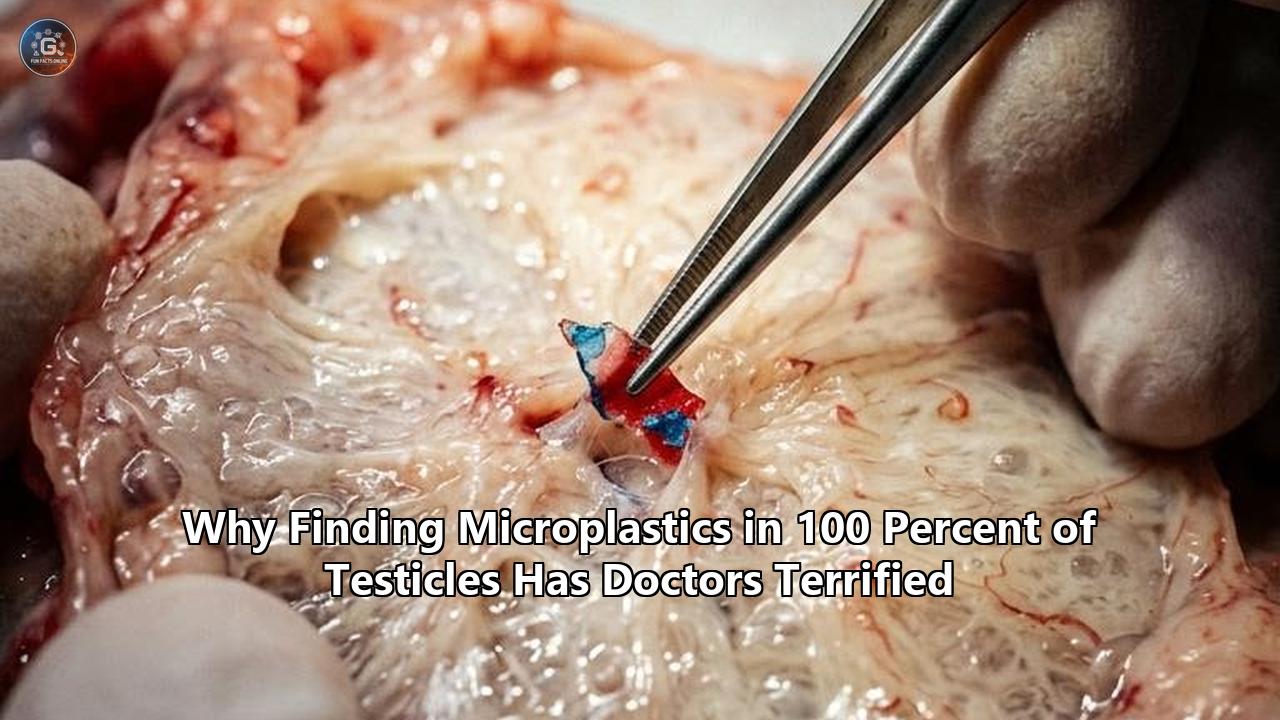
When the mass spectrometer at the University of New Mexico finished baking its final tissue sample at 600 degrees Celsius, the forensic readout revealed a reality that environmental toxicologists had long considered a biological impossibility. Inside every single human testicle evaluated—not a statistical sample, not a dominant majority, but 100 percent of the specimens examined—researchers identified embedded industrial plastics.
The study, published in Toxicological Sciences, dissected 23 preserved human testes alongside 47 canine testes. The results were unequivocal: zero samples were clean. Every gram of human testicular tissue held an average of 329.44 micrograms of microscopic polymer debris—a toxic load nearly three times higher than that found in the pet dogs sharing human households, and substantially higher than concentrations previously mapped inside human placentas.
"At the beginning, I doubted whether microplastics could penetrate the reproductive system," said Dr. Xiaozhong "John" Yu, a professor at the University of New Mexico College of Nursing and the investigation’s lead author. "When I first received the results for dogs, I was surprised. I was even more surprised when I received the results for humans".
The discovery has triggered alarm across reproductive medicine and urology. For decades, clinicians operated under the physiological assumption that the male gonads were shielded from environmental particulate contaminants by an anatomical fortress known as the blood-testis barrier. That fortress has failed. As medical researchers race to correlate this systemic contamination with the well-documented, catastrophic plunge in global sperm counts, the presence of microplastics in human testicles is forcing a profound reassessment of human exposure to petrochemical debris.
The question confronting toxicologists is no longer whether humans are absorbing the degraded runoff of industrial society into their deepest reproductive anatomy. The question is what happens to human reproduction when the organs responsible for propagating the species become repositories for synthetic waste.
The Fortress Breached: Anatomy of an Unprecedented Penetration
To understand why reproductive biologists and urologists view these findings with dread, one must first understand the architecture of mammalian reproduction. The human testicle is not merely an internal organ; it is an immunologically privileged sanctuary.
Because the development of sperm cells—spermatogenesis—involves genetic recombination, mature haploid spermatids express unique antigens that the host’s own immune system would otherwise recognize as foreign, attacking them with cytotoxic T-cells and antibodies. To prevent autoimmune sterilization, evolution constructed the blood-testis barrier (BTB), an intricate system of specialized tight junctions, gap junctions, and adherens junctions anchoring adjacent Sertoli cells near the basolateral membrane of the seminiferous tubules.
The BTB is among the tightest biological seals in the human body, rivaled only by the blood-brain barrier. It regulates the trafficking of amino acids, ions, carbohydrates, and signaling hormones while blocking heavy molecules, circulating blood-borne pathogens, and systemic cellular toxins. Medical textbooks long treated this barrier as an impermeable redoubt capable of walling off spermatogenesis from the insults of everyday life.
"The only two organs in the human body that are protected spaces are the testes and the brain," explained Dr. Ranjith Ramasamy, an expert in reproductive urology who has evaluated the structural implications of systemic particulate pollution. "If it's true that microplastics are invading testicles, that's of extra concern".
The University of New Mexico study demonstrated that the fortress has been breached on a massive scale. The synthetic fragments recovered were not merely coating the exterior tunica albuginea or resting in peripheral vascular beds; they had penetrated deep into the testicular parenchyma.
The implications are destabilizing. If industrial polymers can cross the blood-testis barrier, the microscopic fragments are small enough, chemically insidious enough, or metabolically escorted in ways that bypass the biological checkpoints that preserved mammalian reproduction across hundreds of millions of years of evolutionary history.
"This is an eyes-wide-open situation right now," said Dr. Matthew Campen, a Regents’ Professor of Pharmaceutical Sciences at the University of New Mexico and senior toxicologist on the study. "We're just now realizing how much plastic is in our bodies. We need a surge of research around this topic to confirm or deny a role for microplastics in driving infertility, testicular cancer, and other reproductive disorders".
Inside the Albuquerque Autopsy Vault: The Pyrolysis Trail
The investigation began not in a fertility clinic, but in the sterile storage lockers of the New Mexico Office of the Medical Investigator. The repository routinely archives post-mortem tissue samples collected during forensic autopsies, holding them for seven years under state medical-examiner retention laws before destruction.
Yu and Campen recognized a rare scientific opportunity: an untouched catalog of human testicular tissues harvested in 2016 from 23 individual decedents ranging in age from 16 to 88 years. Because these samples were locked in time prior to the latest surge in global plastic manufacturing, they offered an untainted window into deep-tissue contamination.
The team employed a specialized analytical protocol known as pyrolysis-gas chromatography-mass spectrometry (Py-GC/MS). For years, studies identifying microplastics in biological samples faced scientific pushback from skeptics who argued that visual techniques, such as Fourier-transform infrared (FTIR) microscopy or Raman spectroscopy, were prone to human error, optical bias, and laboratory dust contamination.
Py-GC/MS operates on a fundamentally different, purely chemical principle. Rather than attempting to spot particles under a lens, researchers place the dissolved, chemically digested biological tissue into a quartz vessel and subject it to extreme, rapid heat inside an oxygen-free chamber. As the tissue reaches hundreds of degrees Celsius, the embedded synthetic polymers crack apart into their unique chemical monomers and gaseous subunits. These gas streams are separated through a chromatographic column and injected into a mass spectrometer, which generates an unmistakable mass spectrum—a molecular fingerprint unique to each specific polymer.
The readout provides both precise identification and accurate mass quantification. The test can determine how many micrograms of specific industrial resins exist within a single gram of biological matter.
When the Albuquerque team ran the 23 human samples, the signatures were undeniable. Every sample yielded chemical fingerprints corresponding to synthetic polymers. In total, the researchers detected 12 distinct types of microplastic and nanoplastic materials embedded in the testicular architecture.
The concentrations stunned the lab:
- The 23 human testes averaged 329.44 micrograms of plastic per gram of tissue.
- In some individual human specimens, the concentration surged above 500 micrograms per gram—meaning that more than one-twentieth of one percent of the organ’s total biological mass consisted of synthetic petrochemical debris.
- By comparison, when the same team analyzed 62 human placenta samples using identical Py-GC/MS protocols, the placental tissues averaged roughly one-third of the testicular concentrations, despite the placenta being an intensely vascularized filter organ.
"In testes, the levels of plastic were three times as much as we saw in placentas," Campen noted. "You have to consider that the placenta only has a life of about eight to nine months". The testes, by contrast, accumulate environmental insults over an entire human lifespan.
Average Polymer Load in Tissue Samples (UNM Py-GC/MS Analysis)
┌───────────────────────────────────────────────┬────────────────────────┐
│ Tissue Source                                 │ Mean Plastic Load      │
├───────────────────────────────────────────────┼────────────────────────┤
│ Canine Testicular Tissue (n=47)               │ 122.63 µg/g            │
│ Human Placental Tissue (2024 Study, n=62)     │ ~108.70 µg/g           │
│ Human Testicular Tissue (n=23)                │ 329.44 µg/g            │
└───────────────────────────────────────────────┴────────────────────────┘
The composition of the recovered plastic revealed an intimate map of modern consumer convenience. Polyethylene (PE)—the primary polymer utilized in disposable shopping bags, single-use food films, squeeze bottles, and plastic wraps—accounted for 68 percent of the total plastic mass recovered from human gonads.
The second most prevalent material was polyvinyl chloride (PVC), an industrial polymer engineered with intensive chemical additives, widely used in plumbing pipes, flooring, synthetic leather, medical tubing, and rigid food containers. Beyond PE and PVC, the instruments identified nylon, polyethylene terephthalate (PET), polypropylene, and polystyrene.
The forensic evidence made one fact clear: the male reproductive system is serving as an unintended sink for the global economy’s primary packaging materials.
"Stabby Shards": The Nanoscale Mechanics of Cellular Destruction
When the public imagines microplastics, they often picture floating ocean debris or the microscopic beads used in cosmetic exfoliators. But the materials Campen and Yu extracted from testicular tissue are something far more physically abrasive.
"They look like little shards, tiny broken bits from very, very old plastics," Campen stated. "These plastics are often nanoscale, typically less than half a micron in length and maybe 20 to 200 nanometers in width. There are little shard-like, stabby bits because of the way they’ve gotten old and brittle and fragmented".
This dimensional scale is what terrifies cellular biologists. A red blood cell measures approximately 7,000 to 8,000 nanometers in diameter. The head of a human sperm cell is roughly 5,000 nanometers long and 3,000 nanometers wide. The plastic fragments identified in the Albuquerque study are small enough to be engulfed by individual cells through pinocytosis or endocytosis, effectively slipping past the surface defenses of Sertoli and Leydig cells.
Biological Scale Comparison (Nanometers)
┌───────────────────────────────────────────────┬────────────────────────┐
│ Biological / Synthetic Object                 │ Size (Diameter/Length) │
├───────────────────────────────────────────────┼────────────────────────┤
│ Testicular Nanoplastic Shards (Lower Bound)   │ 20 nm                  │
│ Testicular Nanoplastic Shards (Upper Bound)   │ 200 – 500 nm           │
│ Sertoli Cell Tight Junction Pore Dynamic Limit │ 1 – 2 nm               │
│ Human Sperm Head Width                        │ 3,000 nm               │
│ Human Red Blood Cell Diameter                 │ 7,000 – 8,000 nm       │
│ Sertoli Cell Diameter                         │ 20,000 – 30,000 nm     │
└───────────────────────────────────────────────┴────────────────────────┘
Once a nanoscopic, chemically resistant shard enters the cytoplasmic interior of a cell, the mechanical disruption begins. Biological cellular enzymes, honed by evolutionary history to metabolize organic carbohydrates, proteins, and lipids, cannot break the carbon-carbon backbone of synthetic polymers. The foreign body remains lodged indefinitely.
In vitro and animal models show that when cells internalize nanoscale plastic shards, the physical edges tear at the delicate internal membranes of organelles. The particles induce lysosomal destabilization, causing hydrolytic enzymes to leak into the cytosol. They disrupt the cristae of mitochondria—the cellular batteries responsible for supplying the massive quantities of adenosine triphosphate (ATP) required to drive sperm motility.
When mitochondria are mechanically agitated by foreign particulates, they hemorrhage reactive oxygen species (ROS). The resulting state of hyper-oxidative stress overwhelms the cell's native glutathione and superoxide dismutase defense systems.
For the germ cells within the testicle, oxidative stress is fatal:
- Membrane Peroxidation: Sperm membranes are uniquely rich in polyunsaturated fatty acids, rendering them fragile to oxidative degradation. ROS tears these lipids apart, destroying membrane fluidity and halting motility.
- Sperm DNA Fragmentation: Sperm cells lack extensive DNA repair enzymes once they undergo chromatin condensation. Free radicals cause single- and double-strand DNA breaks. When high-fragmentation sperm fertilize an oocyte, the risk of early embryonic arrest, miscarriage, and epigenetic abnormalities spikes exponentially.
- Apoptotic Cascades: Elevated intracellular ROS triggers caspase activation, commanding the Sertoli cells to cull developing spermatids through premature apoptosis.
The result is a direct mechanical assault on cellular vitality, carried out by billions of brittle synthetic flecks embedded inside fragile tissue.
The Canine Sentinel: Turning Correlation into a Causality Trail
While the autopsy tissue revealed the universal prevalence of microplastics, the dead could not tell the whole story. Because the 23 human testes samples were historically collected post-mortem and preserved through fixed chemical methods, the investigators could not measure active sperm count, sperm motility, or live tissue viability.
To resolve that clinical blind spot, the researchers turned to an animal proxy living alongside humanity: the domestic dog.
Canines represent an ideal epidemiological sentinel for human environmental exposure. Pet dogs live in the same houses, sleep on the same carpets, drink the same municipal water, inhale the same indoor dust, and absorb the same chemical background as their human owners. Yu’s team partnered with private veterinary practices and the City of Albuquerque’s municipal animal shelters, securing 47 testes removed during routine spay-neuter procedures.
The canine tissue was immediately processed fresh. The researchers divided the samples: half of each organ underwent Py-GC/MS to establish the precise microplastic mass, while the remaining fresh parenchyma was evaluated for testicular weight, epididymal weight, and total sperm reserves.
The canine data served as an explicit proof of concept:
- Microplastics were identified in 100 percent of the 47 dog testes.
- Total plastic concentrations averaged 122.63 micrograms per gram.
- When the researchers cross-referenced the chemical signatures against biological metrics, they identified a clear statistical pattern: higher concentrations of specific plastics correlated directly with lower sperm counts and reduced testicular weights.
The specific polymer driving this reproductive regression was polyvinyl chloride (PVC).
"The sperm count in the dogs' testes could be assessed and was lower in samples with higher contamination of PVC," Yu explained. "PVC can release a lot of chemicals that interfere with spermatogenesis, and it contains chemicals that cause endocrine disruption".
The animal data provided an urgent warning. The canine testes were operating under an identical environmental exposure route, exhibiting the identical universal saturation, and demonstrating measurable physical degeneration.
If pet dogs—whose plastic burden averaged less than half that of humans—suffered clear drops in reproductive capacity correlated to polymer concentration, the clinical assumption that the far heavier burden of microplastics in human testicles was benign dissolved overnight.
"The levels of microplastic shards and types of plastics in human testes were three times greater than those found in dogs, and the dogs are eating off the floor," Campen noted. "So, it really puts in perspective what we're putting into our own bodies".
The Trojan Horse: Petrochemical Additives and Endocrine Sabotage
The danger posed by microplastics extends beyond physical mechanical abrasion. In reproductive endocrinology, microplastics are understood to be chemical Trojan horses: vectors carrying complex cocktails of toxic additives, plasticizers, and persistent environmental pollutants straight past physiological filters.
Pure polymer chains—such as raw polyethylene—are relatively inert chemically. But commercial plastics are never pure polymers. To turn brittle resins into flexible packaging, transparent films, heat-resistant components, or stable piping, the petrochemical industry adds thousands of non-covalently bound chemical compounds. Because these additives are not chemically bonded to the polymer chain, they leach continuously into any organic lipid or aqueous matrix they touch.
Primary Plastic-Associated Endocrine Disruptors and Testicular Pathology
┌───────────────────────────────┬───────────────────────────────┬──────────────────────────────────────────┐
│ Chemical Agent                │ Primary Polymer Association   │ Primary Mechanism of Testicular Damage   │
├───────────────────────────────┼───────────────────────────────┼──────────────────────────────────────────┤
│ Phthalates (DEHP, DBP, BBzP)  │ Polyvinyl Chloride (PVC)      │ Suppresses StAR protein; inhibits        │
│                               │                               │ Leydig cell testosterone biosynthesis    │
├───────────────────────────────┼───────────────────────────────┼──────────────────────────────────────────┤
│ Bisphenols (BPA, BPS, BPF)    │ Polycarbonate, Epoxies, PET   │ Binds estrogen receptors; downregulates  │
│                               │                               │ tight-junction proteins (claudin-11)     │
├───────────────────────────────┼───────────────────────────────┼──────────────────────────────────────────┤
│ Heavy Metal Stabilizers       │ PVC, Low-grade Polyethylene   │ Induces mitochondrial ROS cascades; triggers │
│ (Cadmium, Lead, Organotins)   │                               │ premature Sertoli cell apoptosis         │
├───────────────────────────────┼───────────────────────────────┼──────────────────────────────────────────┤
│ PFAS ("Forever Chemicals")    │ Specialized coatings, fluoropolymers │ Disrupts androgen receptor signaling;  │
│                               │                               │ accelerates germline DNA fragmentation   │
└───────────────────────────────┴───────────────────────────────┴──────────────────────────────────────────┘
When PVC, polyethylene, or polystyrene particles settle inside the interstitial spaces of the testes, they begin an unceasing elution of endocrine-disrupting chemicals (EDCs):
1. Phthalates
Particularly concentrated in PVC, phthalates like di(2-ethylhexyl) phthalate (DEHP) are anti-androgenic agents. They suppress the expression of the steroidogenic acute regulatory (StAR) protein and cytochrome P450 enzymes within interstitial Leydig cells, effectively shutting down the enzymatic assembly line that converts cholesterol into testosterone.
Without adequate local intratesticular testosterone—which must remain up to 100 times higher than systemic blood levels to sustain spermatogenesis—germ cells halt differentiation, and mature sperm detach prematurely from the Sertoli cells.
2. Bisphenols
Bisphenol A (BPA) and its industrial replacements, BPS and BPF, possess molecular structures that mimic 17β-estradiol. These xenobiotics bind directly to estrogen receptor alpha (ERα) and beta (ERβ) inside testicular tissue, tipping the delicate androgen-to-estrogen balance required for healthy spermatogenesis.
Crucially, experimental toxicology demonstrates that bisphenol exposure actively dissolves the claudin-11, occludin, and ZO-1 proteins that knit the blood-testis barrier together. The plastic particle carries the chemical key that unlocks and weakens the very barrier designed to keep it out.
3. Organotins and Heavy Metal Stabilizers
PVC relies extensively on organotin compounds, lead, and cadmium as heat stabilizers to prevent thermal decomposition during manufacturing. These metals are direct cellular poisons that poison enzymes, bind sulfhydryl groups on functional proteins, and cause irreversible cell death in Leydig and Sertoli cell populations.
"Once inside the body, these minuscule particles can invade cells and tissues in major organs," said Dr. Leonardo Trasande, director of environmental pediatrics at NYU Langone Health and an international authority on endocrine disruption. "They interrupt cellular processes and deposit endocrine-disrupting chemicals such as bisphenols, phthalates, PFAS, and heavy metals. Endocrine disruptors can trigger genital and reproductive malformations, female infertility, and a profound drop in sperm count".
The presence of microplastics converts the testicular interstitial matrix into an active chemical distribution center, bathing immature germ cells in an unceasing cascade of anti-androgenic, estrogenic toxins.
The 50 Percent Collapse: Has the Missing Variable Been Found?
The Albuquerque study did not land in a scientific vacuum. It landed in the middle of a demographic crisis that reproductive epidemiologists have struggled to explain for half a century.
In 2017, a landmark systematic review and meta-regression analysis led by Dr. Hagai Levine and Dr. Shanna Swan examined hundreds of studies across five decades. The results, updated in 2022 with global data covering over 57,000 men from six continents, revealed that between 1973 and 2018, average sperm counts plummeted by 51.6 percent, while total sperm counts declined by 62.3 percent.
The trajectory is steepening: after the year 2000, the rate of decline doubled, dropping at more than 2.6 percent per year.
Global Sperm Count Decline Trajectory (Data derived from Levine et al., 2017/2022)
┌───────────────┬───────────────────────────────┬────────────────────────┐
│ Year          │ Mean Sperm Concentration      │ Cumulative Decline     │
├───────────────┼───────────────────────────────┼────────────────────────┤
│ 1973          │ 99.0 million / mL             │ Baseline               │
│ 1990          │ 78.4 million / mL             │ -20.8%                 │
│ 2000          │ 65.2 million / mL             │ -34.1%                 │
│ 2018          │ 47.1 million / mL             │ -52.4%                 │
└───────────────┴───────────────────────────────┴────────────────────────┘
For decades, academic camps offered competing theories. Some pointed to increasing rates of obesity and metabolic syndrome; others blamed the adoption of mobile devices, radiant heat from laptops, chronic sleep disruption, or persistent agricultural pesticides like organophosphates.
Yet none of these variables fully matched the unrelenting, ubiquitous, and geographically universal nature of the collapse. The curve of falling sperm counts mirrors another curve from the modern era: the exponential expansion of global plastic production, which skyrocketed from 2 million metric tons in 1950 to over 400 million metric tons annually today.
The discovery of universal plastic accumulation inside human testicular tissue has led many toxicologists to conclude that microplastics may represent the primary environmental driver of this reproductive decline.
Global Plastics Production vs. Male Reproductive Decline Curve
  450M Metric Tons ──────────────────────────────────────────┐ [Plastics: 2020s]
                                                             │
  300M Metric Tons ───────────────────────────────┐          │
                                                  │          ▼
  150M Metric Tons ────────────────────┐          │   [Global Sperm Counts]
                                       │          ▼   -51.6% Drop (1973-2018)
    2M Metric Tons ──────────┐         ▼          │   Rate of decline doubled
                             ▼         │          │   post-2000
                  Year:     1950      1980       2000       2024
"At this point, microplastics are starting to look a lot like cigarettes did in the early 1960s," said Dr. Tracey Woodruff, director of the Program on Reproductive Health and the Environment at the University of California, San Francisco. "A poorly understood health hazard in dire need of better study and aggressive regulation. In systematic reviews of thousands of microplastic research papers, we found that microplastics can harm the reproductive health of both men and women, while also driving up cancer risks".
A counterintuitive finding from the Albuquerque study adds weight to this toxicological theory.
When analyzing the human samples, the researchers anticipated that older men would demonstrate the highest concentrations of microplastics, reflecting decades of environmental accumulation. The data showed the opposite.
"It seems that in peak reproductive years for men—which is from 20 to 45—there are higher levels of plastics, which then begin to decline after the age of 55," Campen observed.
This non-linear age distribution offers two unsettling insights:
- Metabolic Attraction: The testicles of younger men possess high metabolic activity, elevated nutrient turnover, and intense blood perfusion. The physiological transport mechanisms that bring energy substrates to active Sertoli and germ cells appear to draw foreign particulates into the testicular matrix alongside vital nutrients.
- Generational Exposure: Men aged 20 to 45 were born between 1980 and 2005—the precise window when single-use plastics, synthetic clothing, composite food packaging, and bottled water consumption became universal across early childhood and developmental life. Older cohorts spent their formative adolescent development in an era with lower environmental plastic density.
The human reproductive system is accumulating synthetic waste during the peak years of biological reproduction.
The Global Evidence Trail: Semen, Biopsies, and the Asian Cohorts
The Albuquerque findings are not an isolated anomaly. Over the past 24 months, independent research groups operating across distinct geographic populations have produced corroborating evidence that confirms synthetic polymers have permeated human reproductive systems.
In late 2023 and throughout 2024, clinical investigators in China published a series of findings tracking plastics through reproductive tissue and seminal fluid:
- The Seminal Fluid Studies: Research led by Ning et al., Hu et al., and Zhao et al. evaluated human semen samples provided by healthy young men and fertility clinic attendees. Using a combination of Raman microspectroscopy and Py-GC/MS, researchers identified microplastics in 100 percent of the semen samples evaluated. Polystyrene (used in disposable coffee lids and Styrofoam), polyethylene, and PVC emerged as the primary contaminants.
- The Motility Correlation: The semen studies revealed an immediate clinical relationship: samples with higher total microplastic concentrations exhibited a significant drop in progressive sperm motility, an increase in morphological deformities (such as coiled tails, pinheads, and midpiece defects), and elevated sperm DNA fragmentation.
- Human Surgical Biopsies: Moving beyond post-mortem evaluations, researchers analyzed live testicular biopsies harvested from patients undergoing surgical intervention for obstructive and non-obstructive azoospermia. The biopsies confirmed the presence of polymer particles residing directly within the human seminiferous tubules, definitively proving that particulate intrusion is occurring in living men.
The geographical divergence between New Mexico and industrial China eliminates the hypothesis that the findings represent a localized, regional contamination event. Whether evaluating men from the American Southwest or urban centers in East Asia, analytical chemists are finding identical plastic polymers in the same biological compartments, accompanied by the same cellular damage.
Methodological Forensic Audit: Reality vs. Contamination
Given the stark implications of these findings, the scientific community subjected the methodology to intense scrutiny. In environmental analytics, plastic contamination is an ever-present hazard: researchers wear synthetic clothing, collect tissues with plastic-handled scalpels, use polymer-based tubing, and work in rooms filled with ambient air laden with synthetic textile fibers.
Could the detection of microplastics in human testicles simply be a phantom reading—a byproduct of laboratory contamination?
The protocol deployed by Yu and Campen was engineered specifically to answer that challenge. The researchers implemented strict forensic measures to eliminate false positives:
Methodological Controls Against External Contamination
┌───────────────────────────────┬────────────────────────────────────────────────────────────────────────┐
│ Exposure Vector               │ Mitigation Protocol                                                    │
├───────────────────────────────┼────────────────────────────────────────────────────────────────────────┤
│ Laboratory Reagents & Solvents│ Every chemical reagent was pre-filtered through ultra-fine glass-fiber │
│                               │ membranes and analyzed via Py-GC/MS prior to tissue digestion.         │
├───────────────────────────────┼────────────────────────────────────────────────────────────────────────┤
│ Ambient Air Contamination     │ All processing occurred under dedicated laminar-flow clean benches;   │
│                               │ open procedural blanks (petri dishes) were monitored concurrently.     │
├───────────────────────────────┼────────────────────────────────────────────────────────────────────────┤
│ Tools & Vessels               │ Zero plastic contact allowed. All dissections executed with stainless │
│                               │ steel scalpels and baked borosilicate glassware (450°C for 4 hours).   │
├───────────────────────────────┼────────────────────────────────────────────────────────────────────────┤
│ Blank Subtraction Protocol    │ Procedural blank values were systematically subtracted from raw tissue │
│                               │ reads; negative controls showed flat baseline readouts on Py-GC/MS.    │
└───────────────────────────────┴────────────────────────────────────────────────────────────────────────┘
Furthermore, the physical state of the recovered particles argues against modern procedural contamination. Under microscopic and spectroscopic evaluation, the polymers did not present as clean, modern fibers shed by laboratory gowns or technicians' clothing.
Instead, they displayed pitted surfaces, oxidized groups, and mechanically sheared edges—the unmistakable physical hallmarks of long-term weathering, chemical degradation, and biological processing inside living tissues. The plastics had been ground down over months or years within physiological systems.
The scientific debate has largely shifted. Urologists and toxicologists no longer dispute whether microplastics are in testicular tissue. They are focused on the physiological pathways these foreign particles use to reach the reproductive tract in the first place.
The Infiltration Routes: How Plastic Travels from Consumer Life to Germline
How does an engineered polymer packaging material travel from a retail shelf into an isolated reproductive organ? Toxicological modeling points to two primary bodily points of entry: ingestion and inhalation.
The Systemic Infiltration Pathway: From Environment to Germline
┌───────────────────────────────────────────────────────────────┐
│               PRIMARY ENVIRONMENTAL INTAKE                    │
│      Dietary Ingestion (5g/week)   •   Indoor Inhalation      │
└──────────────────────────────┬────────────────────────────────┘
                               │
                               ▼
┌───────────────────────────────────────────────────────────────┐
│               GASTROINTESTINAL / ALVEOLAR TRANSIT             │
│   • Microfold (M) cell endocytosis across Peyer's patches     │
│   • Translocation across pulmonary-capillary interface        │
└──────────────────────────────┬────────────────────────────────┘
                               │
                               ▼
┌───────────────────────────────────────────────────────────────┐
│               SYSTEMIC CIRCULATORY DISSEMINATION              │
│   • Free transport in systemic bloodstream                    │
│   • Chylomicron "lipid hitchhiking" via mesenteric lymphatics │
└──────────────────────────────┬────────────────────────────────┘
                               │
                               ▼
┌───────────────────────────────────────────────────────────────┐
│             GONADAL EXTRAVASATION & BTB ENTRY                 │
│   • Endothelial permeation through testicular microvasculature│
│   • Chemical breakdown of tight junctions (Claudin-11 loss)   │
│   • Intracellular accumulation in Sertoli & Leydig cells      │
└───────────────────────────────────────────────────────────────┘
The Ingestion Cascade
Humans ingest an estimated 5 grams of microplastics each week—roughly the weight of a credit card—through drinking water, food packaging, and agricultural products grown in plastic-mulched soils. Once swallowed, larger particles transit harmlessly through the gastrointestinal tract and are excreted.
However, particles broken down to nanometer dimensions (less than 1 micron) behave differently:
- In the small intestine, specialized epithelial cells known as microfold (M) cells overlying Peyer’s patches actively sample luminal contents via endocytosis.
- Nanoparticles bypass standard enterocyte barriers, crossing into the mesenteric lymphatic system.
- From there, nanoplastics can hitchhike on dietary fat transport systems, integrating into chylomicrons and lipid complexes that empty directly into the thoracic duct, pouring into the venous bloodstream.
The Inhalation Route
Every day, humans inhale thousands of microscopic synthetic fibers shed from polyester clothing, nylon carpets, and vehicle tire wear. When inhaled, particles smaller than 2.5 microns penetrate past the ciliated bronchial tree and settle into the alveolar sacs.
Because the alveolar-capillary membrane is extraordinarily thin (roughly 0.2 to 0.5 microns) to facilitate gas exchange, nanoscale shards can slip directly into pulmonary capillaries, securing access to arterial circulation without first passing through the detoxifying filter of the liver.
The Systemic Highway
Once suspended within the bloodstream, microplastics are carried throughout the vascular tree. In March 2024, a landmark study published in The New England Journal of Medicine proved that microplastics do not remain in passive circulation: they actively embed in vascular plaques. Patients with microplastics in their carotid artery plaques faced a 4.5-fold higher risk of heart attack, stroke, or all-cause mortality over a 34-month follow-up compared to those whose plaques were plastic-free.
From this arterial superhighway, particles reach the testicular microvasculature. Under constant hydraulic pressure, and aided by the chronic inflammation caused by circulating endocrine disruptors, nanoplastics cross the endothelial lining through paracellular gaps.
Once inside the interstitial space of the testicle, they contact the Sertoli cells. Through continuous chemical leaching of bisphenols and phthalates that dissolve claudin tight junctions, the particles compromise the blood-testis barrier, opening the door into the adluminal compartment where sperm develop.
Epigenetic Contamination: The Transgenerational Threat
While the immediate consequences—diminished sperm count, reduced motility, and anatomical testicular atrophy—are clinically concerning, reproductive geneticists warn of an even graver long-term hazard: transgenerational epigenetic inheritance.
Spermatogenesis is not merely a cellular assembly line; it is a delicate window of extensive epigenetic programming. During the final stages of sperm maturation, histones are replaced by protamines to compact the paternal DNA into a tight, transportable package. Concurrently, precise patterns of DNA methylation and small non-coding RNA (sncRNA) profiles are imprinted across the paternal genome. These marks serve as instructional software that guides embryonic development, placental formation, and offspring metabolic health.
Recent mammalian toxicological models demonstrate that exposure to nanoplastics and their associated phthalate and bisphenol additives disrupts this genetic programming:
- Altered Methylation Profiles: Particulate-induced oxidative stress causes aberrant methylation at imprinted gene loci in developing sperm cells. In rodent studies, these epigenetic errors survive fertilization and are faithfully copied into every somatic cell of the resulting offspring.
- Transgenerational Infertility: When male mice exposed to microplastics are bred with pristine, unexposed females, the second-generation (F2) and third-generation (F3) male offspring exhibit decreased sperm counts, structural testicular defects, and heightened rates of germ-cell apoptosis—despite never having been directly exposed to a single particle of plastic in their lifetimes.
- Metabolic and Developmental Disruption: The epigenetic scars passed through microplastic-damaged sperm drive elevated rates of glucose intolerance, insulin resistance, and early-onset neurodevelopmental variations in downstream generations.
The discovery of universal microplastics in human testicles means that humanity is not simply facing an acute exposure event. It means modern industrial pollution may be actively altering the biological code passed down to generations yet unborn.
Policy Gridlock, Clinical Realities, and Protective Steps
The convergence of the Albuquerque findings, the Chinese semen analyses, and the New England Journal of Medicine cardiovascular data has catalyzed debate across public health agencies and global environmental assemblies. Yet the policy response remains mired in regulatory gridlock.
At the United Nations level, negotiations for a legally binding Global Plastics Treaty have repeatedly stalled. Petrochemical-producing nations and plastics-industry trade associations continue to resist legally binding production caps, advocating instead for mechanical recycling programs and voluntary waste-management frameworks.
Recycling initiatives fail to address the underlying physiological crisis: human bodies are absorbing nanoscopic debris from normal daily interactions with existing consumer goods, packaging materials, and synthetic water distribution systems.
In clinical practice, reproductive endocrinologists and urologists are shifting from academic debate to patient guidance. Because microplastics have saturated the biosphere, completely eliminating exposure is impossible. However, physicians are counseling patients to adopt clear harm-reduction measures to reduce their internal toxic load:
Clinical Risk-Reduction Protocols for Endocrine Protection
┌───────────────────────────────┬────────────────────────────────────────────────────────────────────────┐
│ Intervention Domain           │ Evidence-Based Clinical Recommendation                                │
├───────────────────────────────┼────────────────────────────────────────────────────────────────────────┤
│ Food Storage & Preparation    │ Never microwave food or liquids in plastic containers or films. Heat   │
│                               │ accelerates the leaching of chemical plasticizers and shed particles.  │
├───────────────────────────────┼────────────────────────────────────────────────────────────────────────┤
│ Beverage Consumption          │ Transition from single-use bottled water to stainless-steel or glass   │
│                               │ vessels. Filter tap water using certified reverse-osmosis systems.     │
├───────────────────────────────┼────────────────────────────────────────────────────────────────────────┤
│ Domestic Environment          │ Use high-efficiency particulate air (HEPA) filtration systems indoors; │
│                               │ vacuum regularly with sealed HEPA equipment to clear synthetic dust.   │
├───────────────────────────────┼────────────────────────────────────────────────────────────────────────┤
│ Dietary Sourcing              │ Reduce consumption of ultra-processed foods heavily handled along      │
│                               │ automated plastic conveyances and wrapped in soft PVC/PE films.        │
└───────────────────────────────┴────────────────────────────────────────────────────────────────────────┘
"Avoid microwaving food or beverages in plastic, and don't put plastic in the dishwasher, because heat causes chemicals and particles to leach out," emphasized Dr. Leonardo Trasande. "One straightforward step is to reduce our plastic footprint by using stainless steel and glass containers whenever possible".
While these individual interventions can lower daily intake, clinical researchers emphasize that consumer-level choices cannot solve a planetary exposure crisis.
The Unresolved Trajectory
The finding of microplastics in 100 percent of evaluated human testicles marks an undeniable boundary line in human toxicological history. The clinical assumption that biological reproduction remained insulated from industrial pollution has been disproven.
Key questions now frame the research agenda for reproductive medicine:
- The Threshold Problem: What is the critical mass of testicular plastic accumulation required to permanently arrest spermatogenesis? Does an individual reach a tipping point where subfertility shifts irreversibly to total sterility?
- Biological Clearance: Can the human body shed, metabolize, or eliminate nanoscale plastic particles once they have crossed the blood-testis barrier, or do they remain permanently lodged in the reproductive parenchyma until death?
- The Synergy Factor: How do lodged plastics interact with concurrent exposures to heavy metals, agricultural pesticides, and synthetic pharmaceuticals already present in human biological tissues?
As multi-center, prospective longitudinal studies get underway across North America, Europe, and Asia to track plastic burdens in living fertility patients, the scientific community is confronting a sobering timeline. Global plastic production is projected to triple by 2060. The environmental half-life of these polymers spans decades to centuries.
The synthetic shards identified inside human testicles are not transient pass-throughs. They are the persistent physical remnants of the petrochemical era, accumulating directly within the anatomical engines that produce the next generation. For reproductive doctors looking at falling sperm counts and rising infertility rates, the evidence trail has arrived at the source: the biological foundation of human reproduction is quietly filling with plastic.
Reference:
- https://www.theguardian.com/environment/article/2024/may/20/microplastics-human-testicles-study-sperm-counts
- https://hscnews.unm.edu/news/hsc-newsroom-post-microplastics-testicular
- https://www.facebook.com/61586857935083/posts/scientists-found-microplastics-in-nearly-every-human-testicle-they-testedresearc/122141886627228597/
- https://www.healthday.com/health-news/environmental-health/scientists-discover-microplastics-abound-in-human-testicles
- https://www.livemint.com/science/health/microplastics-found-in-human-testicles-potentially-linked-to-declining-sperm-counts-says-report-science-health-research-11716258488680.html
- https://www.businessinsider.com/microplastics-found-in-human-testicles-what-to-do-2024-5
- https://www.ehn.org/microplastics-discovered-in-human-testicles-raising-health-concerns
- https://austinurologyinstitute.com/blog/microplastics-in-testicles-new-research-and-its-implications-for-male-fertility/
- https://www.newindianexpress.com/lifestyle/health/2024/May/22/human-testicles-contain-microplastics-and-nanoplastics-study
- https://www.huffingtonpost.co.uk/entry/microplastics-were-found-in-100-of-human-testicles-heres-what-that-means_uk_664e0045e4b087f368b5d165
- https://www.wmra.org/2024-05-23/new-research-suggests-that-microplastics-could-be-affecting-male-fertility
- https://saferdrinkingwater.blog/2024/05/22/microplastics-are-in-our-bodies-and-impacting-our-health/
- https://microplasticsapp.com/blog/microplastics-in-semen
- https://www.breakfreefromplastic.org/2024/09/16/microplastics-found-in-human-testicles/
- https://www.givelegacy.com/resources/microplastics-in-testicles
- https://cryochoice.com/blogs/news/microplastics-testicles-male-fertility
- https://austinurologyinstitute.com/blog/microplastics-in-testicles-new-research-and-its-implications-for-male-fertility/