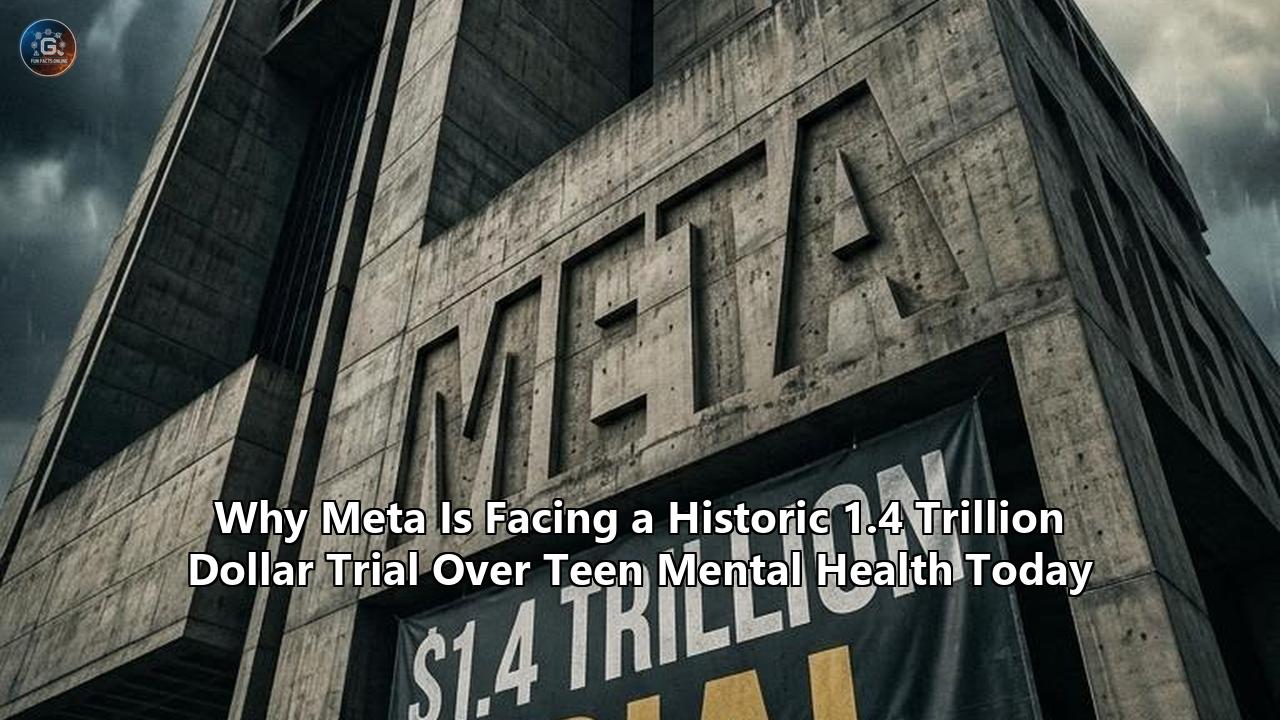
In the U.S. District Court for the Northern District of California in Oakland, federal Judge Yvonne Gonzalez Rogers presided over the opening session of what has become the largest financial and operational challenge in Big Tech history. Four states—California, Colorado, Kentucky, and New Jersey—commenced trial against Meta Platforms, Inc., seeking civil statutory penalties and disgorgement that could theoretically reach $1.4 trillion.
The $1.4 trillion sum, disclosed in pretrial filings by Meta’s legal defense team, represents approximately 93% of the corporation’s $1.5 trillion market valuation. The proceeding acts as the premier bellwether action within a consolidated multistate offensive, backed by a broader coalition of more than 33 state attorneys general and running parallel to more than 3,100 federal personal injury and public nuisance actions centralized under Multidistrict Litigation (MDL) No. 3047: In re Social Media Adolescent Addiction/Personal Injury Products Liability Litigation.
+---------------------------------------------------------------------------------------------------+
|                           THE OAKLAND TRIAL: AT A GLANCE (MDL NO. 3047)                           |
+------------------------------------+--------------------------------------------------------------+
| Metric / Parameter                 | Value / Detail                                               |
+------------------------------------+--------------------------------------------------------------+
| Forum                              | U.S. District Court, Northern District of California         |
| Presiding Judge                    | Hon. Yvonne Gonzalez Rogers                                  |
| Lead Plaintiff States              | California, Colorado, Kentucky, New Jersey                   |
| Additional Federal Claims          | 29 States (COPPA Multi-State Action)                         |
| Aggregate Damages Ceiling Sought   | Up to $1.4 Trillion (Statutory UDAP + COPPA penalties)       |
| Meta Enterprise Market Cap         | ~$1.50 Trillion                                              |
| Pending MDL No. 3047 Claims        | 3,137 Federal Actions (Personal Injury + School Districts)   |
| Underlying Adolescent User Base    | ~32 Million U.S. Minors on Instagram and Facebook            |
| Primary Causes of Action           | Deceptive Practices, Product Design Defect, COPPA Violations |
+------------------------------------+--------------------------------------------------------------+
The litigation moves beyond standard content liability by targeting the core architecture of algorithmic engagement. State attorneys general allege that Meta engineered dopaminergic feedback loops, bypassed federal children's privacy protections, and suppressed internal research documenting adolescent mental health crises—all to preserve user engagement and advertising revenue.
With Meta coming off two state-level court defeats earlier this year that produced nearly $1 billion in combined liabilities, the trial in Oakland represents a test of whether tech platforms can be held accountable as defective consumer products.
The $1.4 Trillion Math: How Statutory Multipliers Compound
The $1.4 trillion liability projection is rooted in statutory penalty stacking across state consumer protection statutes and the federal Children's Online Privacy Protection Act (COPPA). Rather than relying strictly on individualized compensatory damage models, plaintiff states structured their claims around per-violation civil fines applied across millions of active young users over an eight-year window (2016–2024).
+---------------------------------------------------------------------------------------------------+
|                        STATUTORY PENALTY MATRIX BY JURISDICTION & VIOLATION                       |
+----------------------+--------------------------+-----------------------+-------------------------+
| Jurisdiction         | Statutory Authority      | Maximum Civil Penalty | Scope of Application    |
+----------------------+--------------------------+-----------------------+-------------------------+
| California           | Bus. & Prof. Code §17206 | $2,500 per violation  | Each unlawful/deceptive |
|                      | / §17500 (UCL / FAL)     |                       | act directed at minors  |
| Colorado             | Colo. Rev. Stat.         | $20,000 per violation | Willful violations per  |
|                      | § 6-1-112                |                       | consumer transaction    |
| New Jersey           | N.J. Stat. Ann.          | $10,000 (1st offense) | Per deceptive practice /|
|                      | § 56:8-13 (CFA)          | $20,000 (subsequent)  | minor engagement event  |
| Kentucky             | Ky. Rev. Stat. Ann.      | $10,000 per violation | Willful trade practice  |
|                      | § 367.990                |                       | violations per account  |
| Federal (COPPA)      | 15 U.S.C. §§ 6501–6506 / | $50,120 per violation | Per data collection     |
|                      | 16 C.F.R. Part 312       | (inflation-adjusted)  | event on users under 13 |
+----------------------+--------------------------+-----------------------+-------------------------+
The mathematical escalation occurs when multiplying statutory base rates against platform usage metrics:
- User Population Base: Approximately 32 million American adolescents (ages 10–19) maintain active accounts across Instagram and Facebook.
- Session Frequency: The average adolescent user initiates between 15 and 32 sessions per day, generating roughly 7,300 discrete app sessions per user annually.
- Data Collection Events Under Age 13: Plaintiffs established that Meta possessed telemetry and account registry records indicating over 4.2 million accounts operated by pre-teens under age 13 who were tracked without verified parental consent.
Applying a baseline statutory penalty of $2,500 under California's Unfair Competition Law across the estimated 4.5 million California teen and child users active between 2018 and 2024—factoring in daily deceptive promotional exposures—generates raw statutory calculations exceeding $350 billion for a single state. When combined with the harsher $10,000 to $20,000 penalties from Colorado, Kentucky, and New Jersey, alongside cumulative COPPA violations across 29 participating states, the aggregate top-line damages calculation reaches $1.412 trillion.
                          THE COMPOUNDING MULTIPLIER EFFECT
                          ---------------------------------
  [ 32M Adolescent Users ]  x  [ 7,300 Annual App Sessions ]
                                    │
                                    ▼
       [ 233.6 Billion Annual Algorithmic Exposures & Data Collections ]
                                    │
                                    ▼
       [ Multiplied by Statutory Penalties ($2,500 - $50,120/Event) ]
                                    │
                                    ▼
            [ THEORETICAL DAMAGES CEILING: $1.4+ TRILLION ]
Meta's legal counsel argued in pretrial briefs that this statutory multiplication violates constitutional limits:
"Meta has not found any case, under any cause of action, where one defendant was ordered to pay over one trillion dollars—or any number remotely close to that staggering figure. A sanction of that size has no analogue in the history of consumer protection enforcement... The AGs' demand exceeds even historic enforcement records by several orders of magnitude and is wholly disproportionate under the Due Process Clause."
Meta presented an alternative penalty framework capping statutory exposure at $4 million, asserting that violations should be calculated per state enforcement action rather than per individual algorithmic delivery. Judge Gonzalez Rogers rejected both extremes during final pretrial motions, stating that while $1.4 trillion represented an unreasonable absolute recovery, Meta’s proposed $4 million figure failed to account for systemic corporate actions. The judge retained authority to set actual per-violation multipliers following the conclusion of the six-to-eight-week bench trial.
The Internal Evidence: What Meta’s Metrics Revealed
A primary driver of the Meta teen mental health lawsuit is the internal data unsealed during discovery. These documents, which expand upon the initial 2021 disclosures from whistleblower Frances Haugen, contain quantitative research conducted by Meta’s internal data science, user experience, and behavioral psychology teams.
+---------------------------------------------------------------------------------------------------+
|                         META INTERNAL DATA VS. PUBLIC STATEMENTS (2019–2024)                      |
+---------------------------------------+-----------------------------------------------------------+
| Metric / Research Area                | Unsealed Internal Finding                                 |
+---------------------------------------+-----------------------------------------------------------+
| Teen Body Image Degradation           | 32% of teen girls feeling bad about their bodies reported |
|                                       | Instagram made them feel worse; 48% engage in appearance- |
|                                       | based comparison.                                         |
| Suicidal Ideation Correlation         | 13.5% of teen girls reported Instagram amplified thoughts |
|                                       | of suicide/self-harm; 6% (US) and 13% (UK) traced origin  |
|                                       | of suicidal thoughts directly to the app.                 |
| Minor Exposure to Exploitative Risk   | 13% of 13–15-year-olds experienced unwanted sexual        |
|                                       | advances weekly; 8.4% encountered self-harm material.     |
| Underage Retention Superiority        | 11-year-olds demonstrated 4x higher session-return rates  |
|                                       | compared to other monitored age demographics.             |
| Negative Comparison Odds Ratio        | Adolescent girls showed an 8x higher odds ratio for       |
|                                       | negative social comparison relative to adult males (25+). |
| Sleep Fragmentation Index             | Compulsive evening use displaced an average of 1.8 to 2.4 |
|                                       | hours of adolescent sleep per night.                      |
+---------------------------------------+-----------------------------------------------------------+
The unsealed exhibits indicate that Meta's product management teams monitored these youth-retention metrics. Internal research presentations titled Teen Mental Health Deep Dive established that adolescent vulnerabilities were tied to platform design.
Researchers documented that appearance-based social comparison on Instagram operated differently than on competing networks like TikTok or YouTube. It produced sustained negative psychological states: 33% of affected adolescent respondents experienced self-perception drops lasting from several months to a full year.
                       ADOLESCENT NEGATIVE COMPARISON DURATION
                       ---------------------------------------
      [ 38% Minutes Only ]   ████████████████████
      [ 29% Hours/Days   ]   ███████████████
      [ 33% Months/Year  ]   █████████████████ (Persistent Self-Perception Harm)
The economic value of this young demographic explains why platform modifications were limited. Meta’s internal business intelligence metrics revealed:
- Ad Load Optimization: Meta maintained an ad-to-organic content ratio between 1:3.5 and 1:4.2 on Instagram feeds, maximizing ad delivery during peak adolescent evening usage (8:00 PM to 1:00 AM).
- Demographic Monetization: North American Average Revenue Per User (ARPU) rose from $32.76 in 2018 to over $68.40 per quarter by 2024.
- Customer Lifetime Value (LTV): Securing an active daily user prior to age 13 increased the net 10-year platform value of that individual by 380% compared to an individual acquired after age 18.
       NORTH AMERICAN ARPU (QUARTERLY) VS. YOUTH RETENTION TARGETING
       --------------------------------------------------------------
       2018: $32.76 ──► 2020: $41.41 ──► 2022: $58.77 ──► 2024+: $68.40+
             ▲                                                  │
             └────── [ 380% Higher LTV if Ensnared Under 13 ] ──┘
The state complaints identify more than 100 public statements made by Meta executives between 2019 and 2024 that conflicted with this internal research. When company leadership testified to Congress in 2021 that their research showed the app’s effects on teens were generally positive or neutral, internal data scientists were privately circulating analyses finding clear links to compulsive use and depressive symptoms.
The Legal Shift: Defective Product Design Bypasses Section 230
For nearly thirty years, Internet platforms relied on Section 230(c)(1) of the Communications Decency Act of 1996 to shield themselves from tort claims. The 26-word statute specifies:
"No provider or user of an interactive computer service shall be treated as the publisher or speaker of any information provided by another information content provider."
In this trial, the state attorneys general and MDL plaintiffs bypassed Section 230 by asserting strict product liability, defective design, and common-law negligence rather than publisher liability.
         HOW PLAINTIFFS DISMANTLED BIG TECH'S SECTION 230 DEFENSE
         --------------------------------------------------------
   TRADITIONAL CLAIMS (Blocked by §230)      NEW PRODUCT LIABILITY CLAIMS (Permitted)
  ┌────────────────────────────────────┐    ┌────────────────────────────────────────┐
  │ • Defamatory third-party posts     │    │ • Variable-ratio reward algorithms     │
  │ • Harassment by other users        │    │ • Infinite scroll / Removal of cues    │
  │ • Third-party graphic/illicit text │    │ • Biometric morphing facial filters    │
  │ • Hosting harmful user videos      │    │ • Deceptive time-management tools      │
  └────────────────────────────────────┘    └────────────────────────────────────────┘
Judge Yvonne Gonzalez Rogers established this distinction across a series of rulings leading up to the trial. In her decision sustaining the states' claims, she ruled that features like algorithmic recommendation feeds, auto-playing video mechanics, push notifications, and facial distortion filters constitute proprietary corporate product features rather than third-party speech:
+---------------------------------------------------------------------------------------------------+
|                        CHALLENGED PRODUCT FEATURES & MECHANISMS OF ACTION                         |
+--------------------------+------------------------------+-----------------------------------------+
| Design Feature           | Neurobiological Target       | Documented Clinical / Behavioral Impact |
+--------------------------+------------------------------+-----------------------------------------+
| Intermittent Variable-   | Dopaminergic pathway         | Compulsive checking; mimics operant     |
| Ratio Reward Schedules   | activation via erratic likes | conditioning of slot machines           |
| Infinite Scroll & Video  | Prefrontal cortex executive  | Eradicates stopping cues; creates 1.8–  |
| Autoplay Mechanics       | control / impulse regulation | 2.4 hour nocturnal sleep deficits       |
| Algorithmic Push /       | Salience network alerting &  | Elevated cortisol; persistent state of  |
| "Ghost" Notifications    | fear-of-missing-out (FOMO)   | vigilance and task interruption         |
| Anthropometric Beauty    | Visual cortex processing &   | Drives body dysmorphia; 48% of teen     |
| and Morphing Filters     | self-referential cognition   | girls report heightened self-critique   |
+--------------------------+------------------------------+-----------------------------------------+
Judge Rogers highlighted internal company documentation showing that time-limit tools and parental dashboards were described internally as public relations responses while platform algorithms were simultaneously updated to maximize daily active minutes.
Furthermore, on the COPPA claims, Judge Rogers granted summary judgment against Meta on its defense that it did not have actual knowledge of children under 13 using its service. Writing that "Meta's denial strains credulity," the court held that Meta's automated data harvesting, ad targeting systems, and internal documentation proved the company knew millions of pre-teens were using the platform, yet maintained their profiles to protect growth metrics.
The Verdict Precedents: How Earlier Trials Set the Stage
The Oakland trial follows three separate legal proceedings throughout 2026 that tested how juries and judges evaluate claims of social media addiction.
                     2026 BELLWETHER TRAIL OF VERDICTS & SETTLEMENTS
                     -----------------------------------------------
   MARCH 2026: Los Angeles (JCCP 5255) ──► $6 Million Total Award (Meta 70% liable)
   MARCH-AUG 2026: New Mexico AG Trial ──► $942 Million Total ($375M fine + $567M remedy)
   MAY-JUNE 2026: Breathitt County MDL ──► $27 Million School Settlement ($9M Meta share)
   AUGUST 2026: Oakland Federal Court  ──► Up to $1.4 Trillion Exposure Under Trial
+---------------------------------------------------------------------------------------------------+
| 2026 PRECEDENT BENCHMARK SUMMARY |
+--------------------+-------------------------+------------------------+---------------------------+
| Case / Proceeding | Court & Jurisdiction | Value / Penalty | Core Finding / Allocation |
+--------------------+-------------------------+------------------------+---------------------------+
| *K.G.M. v. Meta & | California State Court | $6,000,000 Verdict | Meta allocated 70% fault |
| Alphabet (YouTube)*| (Los Angeles JCCP 5255) | ($3M comp / $3M pun) | ($4.2M) for addicting a |
| | | | young user from childhood |
| *State of New | New Mexico First | $942,000,000 Total | $375M jury civil fine + |
| Mexico v. Meta* | Judicial District Court | ($375M + $567M) | $567M remediation fund |
| | | | for youth safety failures |
| Breathitt County | U.S. District Court, | $27,000,000 Settlement | Meta paid $9M; Snap $8M; |
| Board of Education | N.D. Cal. (MDL 3047) | (Consolidated 4 firms) | TikTok $8M; YouTube $2.01M|
| | | | for school district harms |
+--------------------+-------------------------+------------------------+---------------------------+1. The Los Angeles Personal Injury Bellwether (K.G.M. v. Meta & Google)
In March 2026, the first personal injury bellwether trial concluded in Los Angeles Superior Court. A jury found Meta and YouTube liable for causing severe depression, anxiety, and body dysmorphia in a 20-year-old plaintiff who began using the platforms at age nine.
The jury returned a $6 million verdict, apportioning 70% of the fault to Meta ($4.2 million) and 30% to Google ($1.8 million). The jury concluded that Meta's user interface constituted a defective product and that the company failed to warn users of known psychiatric risks. Co-defendants ByteDance (TikTok) and Snap Inc. settled confidentially days before jury selection.
2. The New Mexico Enforcement Trial (State of New Mexico v. Meta Platforms)
In March 2026, a Santa Fe jury found Meta liable for violations of New Mexico's Unfair Practices Act, levying $375 million in statutory civil penalties after concluding the company misled the public regarding platform safety and child sexual exploitation risks.
On August 6, 2026, the presiding judge ordered Meta to pay an additional $567 million into a state-administered equitable remediation and mental health treatment trust fund, bringing total liabilities to $942 million. The order mandated product modifications within the state, including an enforceable 90-hour monthly platform cap for users under 18 and an immediate restriction on direct messaging between unrelated adults and minors.
3. The Public School Infrastructure Settlement (Breathitt County, KY)
In May 2026, the first bellwether case brought by an American public school district settled ahead of trial for $27 million. Breathitt County Schools demonstrated that it spent an additional $1,420 per pupil annually between 2019 and 2024 to address behavioral disruptions, anxiety-induced absences, and self-harm incidents linked to compulsive social media use.
Meta contributed $9 million of the total $27 million payout, while Snap and ByteDance contributed $8 million each, and Google contributed $2.01 million. This established a settlement framework for the nearly 800 school districts awaiting trial in the federal MDL.
Balance Sheet Stress: Can Meta Absorb the Liability?
Meta's corporate disclosures reflect the financial impact of these mounting legal challenges. In its most recent quarterly SEC filing, the company posted a year-over-year net income decline driven by $2.4 billion in quarterly legal and regulatory expenses.
+---------------------------------------------------------------------------------------------------+
|                        META PLATFORMS, INC. — FINANCIAL PROFILE & RESERVES                        |
+------------------------------------+--------------------------------------------------------------+
| Balance Sheet Metric               | Q2 2026 Consolidated Total                                   |
+------------------------------------+--------------------------------------------------------------+
| Cash, Cash Equivalents & MS        | $58.2 Billion                                                |
| Annualized Free Cash Flow (TTM)    | $46.8 Billion                                                |
| Total Assets                       | $229.6 Billion                                               |
| Long-Term Debt Obligations         | $18.4 Billion                                                |
| Dedicated Litigation Loss Reserves | $11.2 Billion (Cumulative)                                   |
| Market Capitalization              | $1.48 Trillion – $1.52 Trillion                              |
+------------------------------------+--------------------------------------------------------------+
To evaluate the potential fallout of the Meta teen mental health lawsuit, legal and economic analysts model three scenarios:
                  FINANCIAL SCENARIO ANALYSIS FOR META PLATFORMS
                  ----------------------------------------------
  ┌───────────────────────┬───────────────────────┬────────────────────────┐
  │      SCENARIO A       │      SCENARIO B       │       SCENARIO C       │
  │   Moderate Settlement │ Global Restructuring  │    Statutory Maximum   │
  ├───────────────────────┼───────────────────────┼────────────────────────┤
  │ Range: $10B - $25B    │ Range: $45B - $85B    │ Range: $100B - $1.4T   │
  │ Net Income Hit: 15-30%│ Net Income Hit: 1-2 Yrs│ Equity Wipeout / Ch. 11│
  │ Absorbed via Cash     │ Structured over 10-15y│ Forced Divestitures    │
  └───────────────────────┴───────────────────────┴────────────────────────┘
+---------------------------------------------------------------------------------------------------+
| DETAILED FINANCIAL IMPACT PROJECTION MATRIX |
+-------------------+--------------------+------------------------+---------------------------------+
| Modeled Outcome | Projected Cash Out | Structural Resolution | Impact on Core Platform Model |
+-------------------+--------------------+------------------------+---------------------------------+
| Low / Moderate | $10B to $25B | Multi-state consent | Mandatory age-verification via |
| Settlement | (1–2 year payouts) | decree; minor tools | third-party ID; minor feed caps |
| Medium / Severe | $45B to $85B | Global Master | Elimination of algorithmic |
| Industry Accord | (10–15 year bonds) | Settlement Agreement | recommendation for users < 18 |
| Catastrophic Loss | $100B to $1.4T | Involuntary Chapter 11 | Structural breakup: Divestiture |
| / Maximum Award | (Uncapped orders) | / Equity Restructuring | of Instagram and WhatsApp |
+-------------------+--------------------+------------------------+---------------------------------+Scenario A: Moderate Settlement ($10B to $25B)
Meta absorbs payments out of its current cash reserves ($58.2 billion) and operating cash flows without issuing debt or cutting capital expenditures for artificial intelligence infrastructure. The financial impact would be comparable to the $5 billion FTC privacy penalty from 2019, temporarily reducing net income margins by 15% to 30% over a 24-month span while preserving its core algorithmic systems.
Scenario B: Comprehensive Multi-State Accord ($45B to $85B)
Modeled on the 1998 Tobacco Master Settlement Agreement ($206 billion over 25 years) or the National Opioid Settlement ($54 billion), this resolution would require annual installments of $4 billion to $7 billion over 10 to 15 years.
Meta would fund these payments from its annual free cash flow ($46.8 billion), reducing free cash flow margins by 250 to 450 basis points. The settlement terms would likely include binding structural remedies, such as disabling variable-reward recommendation engines by default for all users under 18 and establishing an independent oversight board to audit platform code.
       HISTORIC MASS TORT SETTLEMENT COMPARISON (IN BILLIONS USD)
       ---------------------------------------------------------
       Tobacco Master Settlement (1998):   $206.0B  ████████████████████
       Opioid Global Settlement (2022-26):  $54.0B  █████
       BP Deepwater Horizon (2015):         $65.0B  ██████
       Meta Modeled Accord (Scenario B):    $65.0B  ██████
       Meta Trial Damages Ceiling Sought: $1,400.0B  ██████████████████████████████+
+---------------------------------------------------------------------------------------------------+
| HISTORIC MASS TORT COMPARATIVE LITIGATION MATRIX |
+---------------------+-------------------+---------------------+-----------------------------------+
| Mass Tort Action | Aggregate Value | Number of Claimants | Core Industry Concessions Won |
+---------------------+-------------------+---------------------+-----------------------------------+
| Tobacco Master | $206 Billion | 46 States | Ban on cartoon marketing (Joe |
| Settlement (1998) | (25-year payout) | | Camel), billboard ads, youth sports|
| BP Deepwater | $65 Billion | Federal, States, | Clean Water Act penalties, massive|
| Horizon (2015) | (Cumulative) | 100k+ individuals | Gulf Coast environmental trust |
| Global Opioid | $54 Billion | 50 States, 4,000+ | Restrictions on sales incentives, |
| Litigation (2022-26)| (Multi-defendant) | municipalities | mandatory distribution monitoring |
| Meta Youth Health | Up to $1.4T | 33+ States, 3,100+ | Pending: Algorithmic shut-offs, |
| Action (Oakland) | (Ceiling claimed) | MDLs, 800 Schools | structural youth time limits |
+---------------------+-------------------+---------------------+-----------------------------------+Scenario C: Maximum Statutory Liability ($100B to $1.4T)
If the court issues a penalty exceeding $100 billion, Meta would face severe balance sheet distress. Legal scholar James Grimmelmann of Cornell Law School noted the implications of a multi-hundred-billion-dollar penalty:
"An award of that scale is not plausible simply in the sense that Meta does not possess liquid capital of that magnitude. A judgment approaching that level would force Meta into Chapter 11 bankruptcy restructuring, eliminate existing equity holders, and effectively place the enterprise under the control of a state creditor trust."
While an ultimate judgment of $1.4 trillion is unlikely to survive appellate review under BMW of North America v. Gore due to constitutional limits on punitive damages, an award between $20 billion and $50 billion remains feasible based on the statutory violation rates per verified underage user in the four plaintiff states.
The Co-Defendants: TikTok, Snap, and Alphabet Exposure
Although the Oakland trial focuses on Meta, the broader legal proceedings involve ByteDance (TikTok), Snap Inc., and Alphabet (Google/YouTube).
+---------------------------------------------------------------------------------------------------+
|                      CROSS-PLATFORM YOUTH ENGAGEMENT & LIABILITY RISK MATRIX                      |
+-------------------+-----------------+-----------------------+-------------------------------------+
| Platform / Entity | U.S. Teen Reach | Primary Design Issue  | Strategic Litigation Posture        |
+-------------------+-----------------+-----------------------+-------------------------------------+
| Meta Platforms    | 62% Instagram   | Social comparison,    | Contesting liability in court;      |
| (Insta/Facebook)  | 32% Facebook    | infinite scroll       | Lost $6M PI & $942M NM verdicts     |
| ByteDance         | 67% of Teens    | Hyper-personalized    | Settling bellwethers confidentially;|
| (TikTok)          |                 | "For You" algorithm   | Facing 3,000+ consolidated claims   |
| Alphabet          | 95% of Teens    | Autoplay mechanics,   | Contesting liability in court;      |
| (Google / YouTube)|                 | rabbit-hole loops     | Allocated 30% fault ($1.8M) in CA   |
| Snap Inc.         | 59% of Teens    | Ephemeral messaging,  | Settling early before trial;        |
| (Snapchat)        |                 | Snapstreaks pressure  | Contributed $8M to school settlement|
+-------------------+-----------------+-----------------------+-------------------------------------+
Data from the Pew Research Center indicates that 95% of American teens use YouTube, 67% use TikTok, 62% use Instagram, and 59% use Snapchat. Meta, however, accounts for the highest exposure in damages due to:
- Internal Documentation Depth: The extensive documentation of internal company research provided by whistleblowers leaves Meta with a challenging evidentiary record.
- Behavioral Impact Profile: Comparative clinical data submitted in MDL No. 3047 shows that Instagram creates higher rates of appearance-focused body dissatisfaction and depressive episodes than video-first feeds.
- Litigation Strategy: Snap and TikTok have repeatedly agreed to confidential individual settlements before trials commence to avoid public jury verdicts. Meta, by contrast, has contested the claims in open court, resulting in public verdicts in Los Angeles and New Mexico.
                       TEEN PLATFORM REACH VS. TRIAL POSTURE
                       -------------------------------------
      YOUTUBE  [ 95% Penetration ] ──► Contesting (Assessed 30% fault in LA)
      TIKTOK   [ 67% Penetration ] ──► Settling bellwethers prior to jury selection
      INSTAGRAM[ 62% Penetration ] ──► Primary target in $1.4T Oakland trial
      SNAPCHAT [ 59% Penetration ] ──► Settling bellwethers prior to jury selection
A ruling against Meta in the Oakland trial would establish legal precedents directly impacting YouTube, TikTok, and Snap as the remaining MDL actions proceed to trial.
The Trial Timeline: Key Milestones and Legal Questions
The Oakland trial is scheduled to run six to eight weeks before Judge Yvonne Gonzalez Rogers. It will feature testimony from top executives, data science personnel, and clinical experts.
+---------------------------------------------------------------------------------------------------+
|                        SIX-WEEK TRIAL CALENDAR & KEY ANTICIPATED WITNESSES                        |
+-----------------------+-----------------------------+---------------------------------------------+
| Trial Phase / Week    | Primary Focus Area          | Key Witnesses / Evidence Slated             |
+-----------------------+-----------------------------+---------------------------------------------+
| Week 1 (Opening)      | Unfair Competition &        | State AG Opening Statements;                |
|                       | Internal Document Reveal    | Whistleblower Deposition Transcripts        |
| Weeks 2–3 (Executive  | Corporate Knowledge &       | Mark Zuckerberg (Meta CEO),                 |
| Examination)          | Resource Allocation Choices | Adam Mosseri (Head of Instagram)            |
| Week 4 (Algorithmic & | Telemetry, Retention Logic, | Internal AI Architects, Product Designers,  |
| COPPA Architecture)   | Underage Detection Methods  | COPPA Compliance Officers                   |
| Week 5 (Psychiatric & | Neurobiology, Clinical Harm | Dr. Jean Twenge (Epidemiology Expert),      |
| Economic Modeling)    | & Statutory Multipliers     | Econometricians on per-violation metrics    |
| Week 6 (Closing &     | Advisory Jury Deliberation  | Final Arguments; Bench Determination        |
| Post-Trial Motions)   | & Judicial Assessment       | Formulation by Judge Gonzalez Rogers        |
+-----------------------+-----------------------------+---------------------------------------------+
PROJECTED LITIGATION TIMELINE (2026–2028)
-----------------------------------------
AUG–OCT 2026: Oakland Bench Trial & Advisory Jury Verdict Phase
│
▼
NOV–DEC 2026: Judge Yvonne Gonzalez Rogers Issues Formal Findings of Fact
│
▼
Q1–Q2 2027: Federal MDL Bellwether Trials (Remaining 25+ States & School Districts)
│
▼
2027–2028: Appellate Review in 9th Circuit Court of Appeals & Supreme Court PetitionsCritical Legal and Operational Questions
The proceedings in Oakland will address four central questions for the tech industry:
- The Validity of Algorithmic Product Liability: Will the federal courts uphold the ruling that algorithmic feeds, auto-scrolling features, and push notifications are defectively designed products rather than speech protected by Section 230?
- The Calculation of Statutory Fines: Will courts calculate consumer protection penalties on a per-user, per-day, or per-lawsuit basis? The difference between these approaches represents the gap between a $4 million penalty and a $1.4 trillion judgment.
- Mandatory Architectural Redesigns: If the court issues an equitable injunction, will Meta be required to disable algorithmic recommendation feeds for users under 18, impose verified parental consent mechanisms, or eliminate infinite scroll?
- App Store vs. Platform Accountability: Meta has sought to shift age verification burdens to platform operating systems managed by Apple and Google. The court's ruling will determine whether app developers bear direct legal responsibility for verifying user age under COPPA.
As testimony begins in Oakland, the Meta teen mental health lawsuit marks a pivotal legal test for the tech sector. With thousands of individual lawsuits, hundreds of school district claims, and dozens of state enforcement actions hanging in the balance, the trial's outcome will shape the economics of algorithmic engagement and the future of social media platform design.
Reference:
- https://www.motleyrice.com/social-media-lawsuits/verdicts
- https://www.btpm.org/2026-08-17/meta-heads-to-court-in-a-landmark-trial-about-kids-and-social-media-addiction
- https://www.engadget.com/2237547/meta-faces-a-1-4-trillion-reckoning-in-latest-trial-over-social-media-addiction/
- https://www.fox4news.com/news/states-seek-1-4-trillion-yes-trillion-from-meta-over-alleged-harm-kids
- https://gizmodo.com/metas-teen-safety-case-just-became-a-1-4-trillion-existential-threat-2000782306
- https://www.jurist.org/news/2026/07/meta-says-state-ags-seek-1-4t-over-youth-safety-claims/
- https://www.financialexpress.com/life/technology-meta-faces-1-4-trillion-penalty-in-teen-mental-health-lawsuit-biggest-fine-in-corporate-history-4286272/
- https://www.robertkinglawfirm.com/personal-injury/social-media-addiction-lawsuit/
- https://www.consumernotice.org/legal/social-media-harm-lawsuit/
- https://www.ktmc.com/featured-case/social-media-adolescent-addiction-personal-injury-products-liability/
- https://www.courthousenews.com/judge-orders-trial-for-meta-over-social-media-harms/
- https://www.spencer-law.com/post/social-media-addiction-lawsuits-2026-kgm-trial-mdl-3047
- https://www.fastcompany.com/91591243/upcoming-california-trial-against-meta-seeks-financial-damages-could-soar-1-4-trillion
- https://www.facebook.com/ibctv13/videos/13news-meta-ordered-to-pay-567-m-for-teen-mental-health/1043926748241705/
- https://gizmodo.com/metas-teen-safety-case-just-became-a-1-4-trillion-existential-threat-2000782306
- https://www.engadget.com/2237547/meta-faces-a-1-4-trillion-reckoning-in-latest-trial-over-social-media-addiction/
- https://www.cbsnews.com/news/facebook-instagram-dangerous-content-60-minutes-2022-12-11/
- https://www.facebook.com/ibctv13/videos/13news-meta-ordered-to-pay-567-m-for-teen-mental-health/1043926748241705/
- https://www.theguardian.com/technology/2021/sep/29/facebook-hearing-latest-children-impact
- https://metasinternalresearch.org/
- https://www.center4research.org/social-media-affects-mental-health/
- https://avalaw.com/social-media-mental-health-lawsuit/
- https://levinlaw.com/social-media-harm-lawsuits/
- https://www.llamalab.ai/blog/social-media-addiction-litigation-july-2026-update
- https://www.facebook.com/newshour/videos/facebook-owner-meta-says-it-will-appeal-a-ruling-by-a-new-mexico-court-ordering-/2161596061428078/
- https://www.facebook.com/VirginMediaNews/videos/meta-has-been-ordered-to-pay-567m-into-a-teenage-mental-health-fund-and-change-h/1687288362558139/
- https://www.fastcompany.com/91591243/upcoming-california-trial-against-meta-seeks-financial-damages-could-soar-1-4-trillion
- https://www.sokolovelaw.com/personal-injury/social-media-addiction/statistics/
- https://litpro.com/youth-social-media-addiction-lawsuits-2026-outlook/
- https://petapixel.com/2026/08/17/meta-faces-landmark-trial-that-could-reshape-its-platforms-and-cost-1-4-trillion/