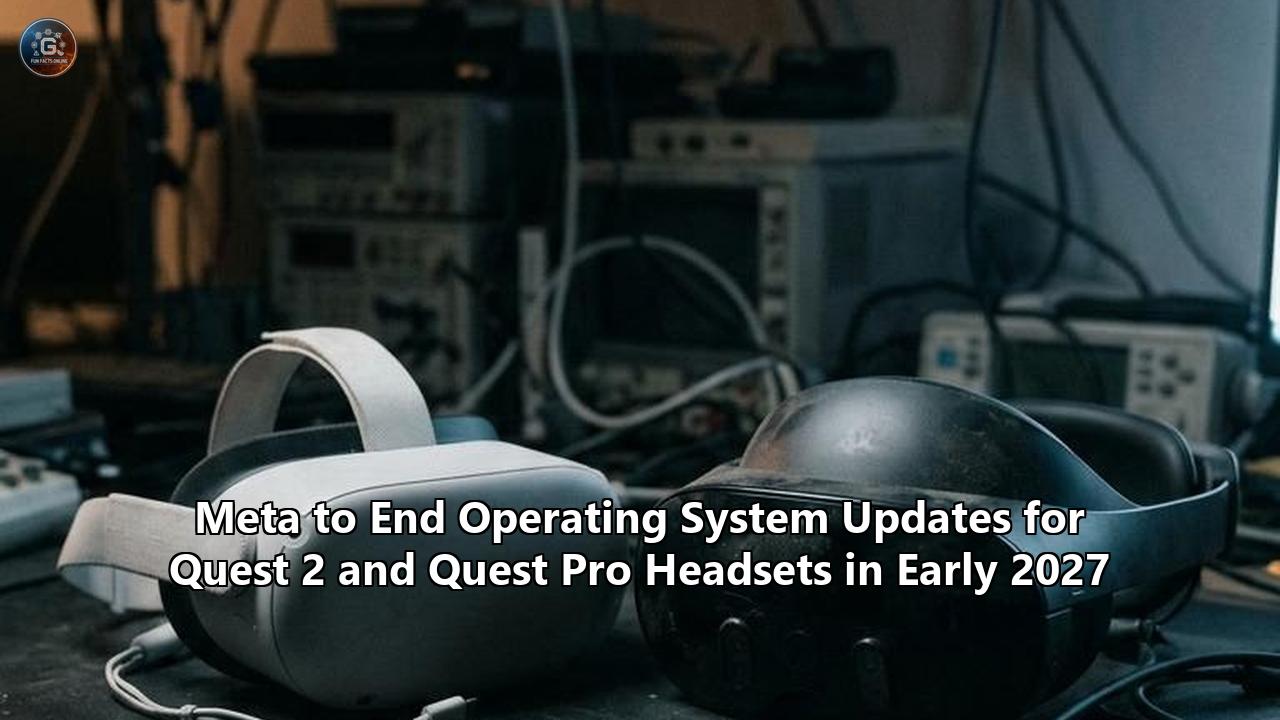
Meta has officially set an expiration date for the software that powered the consumer virtual reality boom. In a comprehensive roadmap issued to developers, the company confirmed that feature development for both the Meta Quest 2 and the enterprise-focused Meta Quest Pro will officially conclude in March 2027 with the release of Meta Horizon OS version v213.
The announcement establishes a multi-tier phaseout for the two standalone headsets. While March 2027 marks the final operating system update containing new features, user interface overhauls, and platform-level application programming interfaces (APIs), Meta will continue distributing quarterly security patches and critical bug fixes through December 2027. Furthermore, developers will be permitted to submit new applications that target the Quest 2 and Quest Pro until the end of December 2027. Starting in January 2028, all new submissions to the Meta Horizon Store will exclusively target newer hardware, beginning with the Quest 3 and Quest 3S baselines.
For the estimated 20 million consumers who purchased a Quest 2 since its October 2020 debut, existing software will not vanish overnight. Purchased apps and games will remain downloadable and playable, local and online multiplayer servers will stay open, and cross-play with users on modern headsets will continue unrestricted. However, the formal declaration of the Meta Quest 2 support end marks a pivotal transition in spatial computing. It closes the book on the first mass-market generation of standalone VR and reveals the intense technical, architectural, and financial pressures that dictate how long wearable computers can survive.
+-----------------------------------------------------------------------------------+
|               META QUEST 2 & QUEST PRO RETIREMENT TIMELINE                        |
+-----------------------------------------------------------------------------------+
|  Oct 2020 / Oct 2022  --> Launch of Quest 2 ($299) and Quest Pro ($1,499)         |
|  Dec 2024             --> Hardware sales officially discontinued                  |
|  March 2027           --> Final Horizon OS Feature Update (v213 / Final SDK)      |
|  Dec 2027             --> Security patches end; new app submissions close         |
|  Jan 2028 Onward      --> Maintenance phase: catalog playable, no new system code |
+-----------------------------------------------------------------------------------+
Silicon Aging: The Physical Limits of the Snapdragon XR2 Gen 1
To understand why Meta is drawing the line in early 2027, one must examine the silicon engine driving both devices. Beneath their plastic enclosures, the Quest 2 and Quest Pro rely on the same fundamental computing core: Qualcomm's Snapdragon XR2 Gen 1 architecture.
First brought to commercial hardware in 2020, the XR2 Gen 1 is a derivative of Qualcomm's Snapdragon 865 mobile processor, fabricated on TSMC's 7-nanometer (N7) node. The central processing unit (CPU) relies on an eight-core Kryo 585 arrangement consisting of:
- A single "Prime" ARM Cortex-A77 core running up to 2.84 GHz
- Three "Gold" Cortex-A77 performance cores clocked at 2.42 GHz
- Four "Silver" Cortex-A55 efficiency cores running at 1.80 GHz
- An Adreno 650 graphics processing unit (GPU) delivering roughly 1.2 teraflops of single-precision floating-point (FP32) performance
In a standard smartphone, an architecture of this vintage handles modern web browsing, high-definition video streaming, and casual 2D gaming without breaking a sweat. In a spatial computing headset, however, the workload is radically more punishing.
+--------------------------------------------------------------------------------------+
|                 QUALCOMM SNAPDRAGON XR SILICON EVOLUTION                             |
+----------------------+-------------------------------+-------------------------------+
| Specification        | Snapdragon XR2 Gen 1          | Snapdragon XR2 Gen 2          |
|                      | (Quest 2 & Quest Pro)         | (Quest 3 & Quest 3S)          |
+----------------------+-------------------------------+-------------------------------+
| Process Node         | TSMC 7nm (N7)                 | TSMC 4nm (N4P)                |
| CPU Architecture     | Kryo 585 (Cortex-A77 / A55)   | Kryo (Cortex-X3 / A715 / A510)|
| GPU Engine           | Adreno 650 (~1.2 TFLOPS FP32) | Adreno 740 (~3.1 TFLOPS FP32) |
| Graphic Lift         | Baseline                      | 2.5x to 3.0x peak performance |
| Memory Type          | LPDDR4X (Quest 2: 6GB)        | LPDDR5 (Quest 3: 8GB)         |
| Passthrough Latency  | High / Monoscopic or reproject| Sub-12ms hardware accelerated |
| Computer Vision ISP  | Dual-camera pipelining        | Dedicated low-latency CV block|
+----------------------+-------------------------------+-------------------------------+
Unlike flat-panel devices, a standalone virtual reality headset must continuously render two independent viewpoints—one for each eye—at resolutions exceeding 1832 x 1920 pixels. To prevent vestibular disorientation (motion sickness), those frames must be calculated, shaded, rasterized, and delivered to the displays at rock-solid refresh rates of 72, 90, or 120 frames per second.
Simultaneously, the same system-on-chip (SoC) must dedicate continuous compute cycles to the computer vision pipeline. Four wide-angle monochrome cameras on the Quest 2 constantly scan the user's physical environment, running Visual-Inertial Odometry (VIO) and Simultaneous Localization and Mapping (SLAM) algorithms. These algorithms cross-reference camera footage with raw readings from internal 1000 Hz inertial measurement units (IMUs) to recalculate the headset’s physical position in space every few milliseconds. Any latency spike exceeding 20 milliseconds across this "motion-to-photon" loop shatters immersion and can induce nausea.
When the Quest 2 launched, Meta pushed the XR2 Gen 1 to its thermal limits. Strapped to a human face, a VR headset cannot exceed a total thermal envelope of roughly 5 to 7 watts without requiring noisy, heavy cooling units or generating uncomfortable heat against the user's forehead. Over six years of firmware patches, Meta’s engineers steadily uncapped the chip's clocks, squeezed performance from dynamic GPU scaling, and introduced Application SpaceWarp—a machine learning technique that extrapolates synthetic intermediate frames to cut rendering demands in half.
By 2026, the 7nm node has hit a wall. Modern spatial operating systems no longer treat virtual reality as an isolated, single-app gaming loop. With Meta Horizon OS expanding into spatial productivity—featuring multiple concurrent web browser windows, high-fidelity spatial audio simulation, background pass-through feeds, and real-time environment meshing—the XR2 Gen 1 can no longer maintain its frame budgets. When an operating system cannot run its own home environment without thermal throttling, feature development must end.
Memory Bottlenecks and the Quest Pro Irony
While the processing limits of the 7nm node explain the retirement of the $299 Quest 2, the retirement of the $1,499 Quest Pro highlights an even more acute architectural bottleneck: memory hierarchy and packaging.
When Meta introduced the Quest Pro in October 2022, it targeted enterprise professionals, creative studios, and early adopters. The Pro included significant physical upgrades over the consumer headset: dual Quantum Dot LCD panels with local dimming, custom pancake lenses, motorized continuous inter-pupillary distance (IPD) adjustment, and ten internal and external optical sensors designed for eye tracking, face tracking, and stereoscopic color passthrough.
+--------------------------------------------------------------------------------------+
|                     THE SYSTEM MEMORY PARTITION CRISIS                               |
|                     (Average 6GB Pool on Quest 2 at Runtime)                         |
+--------------------------------------------------------------------------------------+
| [~1.5 GB] OS Kernel, SLAM Tracking, Safety Guardian Boundaries, Hand Tracking Models |
| [~0.8 GB] Display Framebuffers, Eye Buffers, Asynchronous TimeWarp Compositor Layers  |
| [~0.5 GB] Audio Engine, Microphone Denoising, Wi-Fi & Bluetooth Network Stacks        |
|--------------------------------------------------------------------------------------|
| [~3.2 GB] REMAINING ALLOCATION FOR APPLICATION CODE, TEXTURES, AND GAME ASSETS       |
+--------------------------------------------------------------------------------------+
To drive these features, Meta contracted Qualcomm for an augmented variant of the silicon called the Snapdragon XR2+ Gen 1. Crucially, the XR2+ Gen 1 did not introduce a new CPU or GPU architecture. Instead, Qualcomm split the dynamic random-access memory (DRAM) off the primary processor die, redesigning the packaging to improve thermal dissipation by 30%. This change allowed the Pro's processor to sustain its maximum clock speeds longer and let Meta equip the headset with 12 gigabytes of RAM—double the 6 gigabytes found in the Quest 2.
Yet, despite that price point and memory expansion, the Quest Pro is bound to the exact same retirement schedule. The reason boils down to the underlying instruction set and memory bandwidth.
The Quest 2 uses LPDDR4X memory operating over a constrained bus. As Horizon OS grew, the memory footprint required simply to keep the headset tracking and connected ballooned. By 2024, the operating system kernel, SLAM tracking engine, hand-tracking neural network models, and compositor layers consumed over 2.5 gigabytes of the Quest 2's 6-gigabyte pool. Developers of graphically intensive games were left with less than 3.5 gigabytes of usable memory to hold textures, physics engines, dynamic geometry, and spatial audio buffers.
The Quest Pro had the capacity to store those assets, but its memory bandwidth remained limited by the Gen 1 architecture. While its 12 gigabytes of RAM could comfortably juggle multiple virtual desktop windows, its GPU compute pipeline remained identical to the budget Quest 2.
More importantly, Meta could not justify maintaining two fundamentally different branches of Meta Horizon OS for devices sharing the same generation of silicon. Operating systems rely on unified hardware abstraction layers (HALs). Updating the Quest Pro's software while freezing the Quest 2 would require Meta to maintain legacy drivers, test sensor stacks, and validate APIs across a device that captured only a tiny fraction of the consumer headset's market share. When the XR2 Gen 1 architecture was deemed incapable of supporting future system features, the Quest Pro’s fate was sealed alongside the budget headset it was built upon.
What an Operating System Freeze Means: Horizon OS v213
In consumer computing, terms like "end of life" and "end of support" are frequently conflated. For headset owners evaluating the Meta Quest 2 support end, parsing the technical difference between an operating system freeze and a security deprecation is critical.
Meta Horizon OS is not a closed, proprietary firmware built entirely from scratch; it is an extensive, custom fork of the Android Open Source Project (AOSP), augmented with real-time spatial runtimes, tracking daemons, and low-latency display compositors. Every major milestone of Horizon OS coordinates two distinct components: the operating system user space and the software development kit (SDK) exposed to app creators.
+------------------------------------------------------------------------------------+
|                      HORIZON OS v213 PLATFORM REPOSITORY                           |
+------------------------------------------------------------------------------------+
|  [FROZEN AT v213] --> Underlying AOSP Base Kernel & Board Support Package (BSP)   |
|  [FROZEN AT v213] --> Spatial UI Manager, Native Window Engine, System Shell       |
|  [FROZEN AT v213] --> OpenXR Extensions, Spatial Anchor APIs, Scene Understanding |
|  [ACTIVE TO 2027] --> Kernel Cryptographic Patches & Zero-Day CVE Vulnerability Fixes |
|  [ACTIVE TO 2027] --> Identity Management, OAuth2 Logins, Account Authentication   |
|  [ACTIVE TO 2027] --> Meta Horizon Store Payment Gateways & License Verification   |
+------------------------------------------------------------------------------------+
When version v213 rolls out in March 2027, it will act as a permanent freeze point for the Quest 2 and Quest Pro:
1. Terminal SDK Parity
Version v213 will be the final release of the Meta Native OpenXR SDK, Meta XR Core SDK, and corresponding Unity and Unreal Engine integrations that can compile binaries for Gen 1 devices. If Meta introduces version v214 in April 2027 with an improved spatial audio API, a more efficient hand-tracking pipeline, or advanced passthrough occlusion tools, those software libraries will not run on Gen 1 headsets.
2. Frozen Board Support Packages
At the base of any Android-derived operating system sits the Board Support Package (BSP), a suite of low-level device drivers, kernel modules, and power management profiles supplied directly by the silicon fabricator—in this case, Qualcomm. Qualcomm maintains strict commercial lifecycles for its chips. Once the chipmaker halts updates to the BSP for the XR2 Gen 1, Meta cannot safely rebase the operating system onto newer upstream Linux kernels without risking tracking latency, broken sensor timing, or unstable thermal behavior.
3. Stability-First Freezing
Operating system updates in spatial computing carry physical risks that flat screens do not share. An unoptimized patch on a smartphone might cause a brief animation stutter. An unoptimized patch on a VR headset can introduce frame drops, asynchronous timewarp distortion, or tracking drift. These glitches disrupt the inner ear's vestibular ocular reflex, causing disorientation, nausea, and headaches. By locking the operating system at v213, Meta ensures that the final state of the Quest 2 and Quest Pro provides a stable, predictable runtime environment that will not degrade further over time.
From March 2027 through December 2027, the operating system enters an extended maintenance mode. Engineers will still monitor system components for critical bugs—such as Wi-Fi driver disconnects, memory leaks that cause boot loops, or store authentication failures—and patch them. However, the interface, functionality, and performance profile of the headset will remain fixed.
The Developer Dilemma: Escaping the Lowest-Common-Denominator Trap
For software studios building virtual reality applications, the timeline leading up to the Meta Quest 2 support end resolves an agonizing, years-long commercial stalemate.
Since late 2023, the VR software ecosystem has wrestled with an acute fragmentation problem. On one side stood the Meta Quest 3 and the Quest 3S, equipped with the Qualcomm Snapdragon XR2 Gen 2 chip. Built on TSMC’s advanced 4nm process, the XR2 Gen 2 delivers between 2.5 and 3 times the raw GPU compute power of its predecessor, handles dynamic lighting with ease, and features hardware-accelerated computer vision processing that can generate real-time 3D room meshes.
On the other side sat the Quest 2: an aging device, but one with an active user base of roughly 20 million units.
+------------------------------------------------------------------------------------+
|                         THE VR DEVELOPER ENGINE PARADOX                            |
+------------------------------------------------------------------------------------+
|                                                                                    |
|   Targeting Quest 3 / 3S Baseline                Targeting Quest 2 Compatibility   |
|   --------------------------------               -------------------------------   |
|   • Physically Based Shading (PBR)               • Baked, Static Lighting Maps     |
|   • Dynamic Volumetric Shadows                   • Zero Real-Time Shadow Casters   |
|   • Complex Ragdoll Physics Simulations          • Highly Simplified Kinematics    |
|   • High Draw-Call Geometries & Foliage          • Strict Low-Poly Asset Budgets   |
|   • High Texture Resolution (2K / 4K)            • Compressed Textures (512 / 1K)  |
|                                                                                    |
|   RESULT: Visual immersion at scale.             RESULT: Massive commercial reach, |
|   TRADE-OFF: Excludes older hardware.            TRADE-OFF: Stifles game design.   |
|                                                                                    |
+------------------------------------------------------------------------------------+
For an independent studio, the economic math was unavoidable. If a studio built a game exclusively for the Quest 3, it gained access to dynamic lighting, physical shadows, higher particle counts, and sharper textures—but deliberately cut itself off from the vast majority of the standalone VR market. If that same studio chose to support the Quest 2, it had to design its entire game engine around the limits of the XR2 Gen 1.
That compromise meant relying on baked lightmaps, restricting scenes to low-polygon meshes, cutting real-time shadows, and keeping draw calls strictly below 150 per frame. Consequently, many titles released between 2024 and 2026 looked like updated versions of mobile games from 2018, failing to harness the true capabilities of newer hardware.
Meta's announced timeline gives developers a transparent runway to resolve this conflict:
- Dual-Binary Management: Through December 2027, developers can maintain dual binaries within the Horizon Store. A single storefront entry can distribute an optimized XR2 Gen 2 build to Quest 3 users while delivering a legacy, scaled-down build to Quest 2 users.
- The 180-Day Notification Policy: Meta’s platform policies dictate that if a developer decides to drop Quest 2 support in an existing application—particularly games that rely on live-service infrastructure or multiplayer matchmaking—they must provide customers with at least 180 days of advance notice before turning off services.
- December 2027 Ingestion Cutoff: After December 2027, the ingestion pipeline for new applications that support Quest 2 or Quest Pro closes entirely. Studios will no longer be allowed to submit new releases containing Gen 1 configuration profiles. Any new games hitting the market in 2028 will treat the Quest 3S and Quest 3 as their absolute performance baseline.
+-----------------------------------------------------------------------------------+
|               META STORE APPLICATION INGESTION WORKFLOW                           |
+-----------------------------------------------------------------------------------+
|                                                                                   |
|  Today - Dec 2027:                                                                |
|  Developer Build ---> [Unified Horizon Store Manifest]                            |
|                       |                                                           |
|                       +---> Target A: Snapdragon XR2 Gen 2 (Quest 3 / 3S)         |
|                       |                                                           |
|                       +---> Target B: Snapdragon XR2 Gen 1 (Quest 2 / Pro) [OPEN] |
|                                                                                   |
|  Jan 2028 Onward:                                                                 |
|  Developer Build ---> [Unified Horizon Store Manifest]                            |
|                       |                                                           |
|                       +---> Target A: Snapdragon XR2 Gen 2 (Quest 3 / 3S)         |
|                       |                                                           |
|                       +---> Target B: Snapdragon XR2 Gen 1 (Quest 2 / Pro) [LOCKED]|
|                             (Existing titles remain; no new app entries permitted)|
|                                                                                   |
+-----------------------------------------------------------------------------------+
This structural shift transforms how studios allocate engineering time. Instead of spending costly development cycles retrofitting modern game mechanics to fit within a 6GB memory envelope, teams can redirect their resources toward larger environments, smarter artificial intelligence routines, and deeper spatial simulations.
A Tale of Two Headsets: Mass-Market Triumph Meets Luxury Experiment
The early 2027 cutoff groups together two devices that entered the technology landscape under wildly different circumstances and served distinct audiences.
+--------------------------------------------------------------------------------------+
|                     HARDWARE SPECIFICATIONS: GENERATION COMPARISON                   |
+----------------------+-----------------------+-----------------------+---------------+
| Feature              | Meta Quest 2          | Meta Quest Pro        | Meta Quest 3  |
+----------------------+-----------------------+-----------------------+---------------+
| Release Date         | October 2020          | October 2022          | October 2023  |
| Launch Price         | $299 USD              | $1,499 USD            | $499 USD      |
| Display Technology   | Single Fast-Switch LCD| Dual Quantum Mini-LED | Dual Fast LCD |
| Resolution (Per Eye) | 1832 x 1920           | 1800 x 1920           | 2064 x 2208   |
| Optical Elements     | Fresnel Lenses        | Pancake Lenses        | Pancake Lenses|
| IPD Adjustment       | 3 Mechanical Steps    | Continuous Motorized  | Continuous    |
| Biometric Tracking   | None                  | Eye & Face Tracking   | None          |
| Passthrough Mode     | Low-Res Monochrome    | Low-Res Color         | High-Res Color|
| Primary Market       | Consumer Gaming       | Enterprise / Prosumer | Consumer / Mixed|
+----------------------+-----------------------+-----------------------+---------------+
The Quest 2: The Consumer Breakthrough
When Meta introduced the Quest 2 in the autumn of 2020, it upended the economics of the VR industry. By pricing the base 64-gigabyte model at $299, Meta effectively sold the hardware at cost—and frequently at a calculated loss—to build a defensible platform network. The gamble paid off.
Over its four-year production run, the Quest 2 became the best-selling standalone virtual reality system in history, racking up an estimated 20 million sales. It sustained the VR ecosystem through the global pandemic, introduced tens of millions of users to titles like Beat Saber, Superhot VR, and Resident Evil 4, and accounted for more than 70% of all monthly active hardware on Valve's SteamVR analytics for years on end.
When its security patches wrap up in December 2027, the Quest 2 will have received over seven years of continuous software support. That seven-year lifespan matches or exceeds the support windows of top-tier consumer smartphones, home video game consoles, and personal computers. For a $299 piece of bleeding-edge, high-stress consumer electronics, the Quest 2 offered an exceptionally long, productive return on investment.
The Quest Pro: The Luxury Misfire
The Quest Pro tells a very different story. Launched with fanfare in October 2022, the $1,499 device was designed to establish an enterprise-class spatial computing footprint ahead of Apple’s long-rumored entry into the category. Meta marketed the Pro to remote creative teams, architectural firms, and corporate white-collar professionals, highlighting its sleek form factor, open-periphery design, and custom charging dock.
Yet, almost immediately, the device struggled to find its footing:
- Mixed Passthrough Quality: The stereoscopic color passthrough relied on an awkward hybrid system: it projected low-resolution color video feeds over low-latency monochrome tracking camera images, resulting in visual artifacts and warping.
- Battery Compromises: The power-hungry internal sensors, which tracked facial muscle movements and gaze direction at up to 90 Hz, cut battery life to a meager 90 to 120 minutes per charge.
- The Processor Mismatch: Most critically, the XR2+ Gen 1 chip inside the Pro simply did not offer enough processing power to justify its premium price tag. Corporate users who expected a laptop-class productivity powerhouse quickly realized the headset shared its processing ceiling with the sub-$300 consumer device their children played games on.
Within five months of launch, Meta took the unprecedented step of slashing the Quest Pro's price from $1,499 down to $999. By late 2024, production had ground to a halt.
For the early adopters, enterprise IT departments, and research labs that invested in the Quest Pro, ending feature support after just over four years stings. Devices sold at luxury enterprise price points are typically expected to have extended operational support lifecycles. Instead, because Meta built its enterprise ambitions on an aging mobile phone chip, the Quest Pro will be retired at the exact same moment as the mass-market gaming toy it was meant to transcend.
Security, Privacy, and Sensor Risks: What Happens Post-2027?
Because virtual reality headsets resemble gaming consoles in daily use, it is easy to forget that they are among the most sensor-dense, privacy-sensitive computing devices in any home.
A standard home laptop features a single webcam and a basic microphone array. In contrast, an active Quest 2 constantly operates four high-sensitivity outward-facing infrared tracking cameras. The Quest Pro ups the ante with ten active sensors, including inward-facing infrared cameras that capture real-time biometrics like pupil dilation, gaze vectors, and subtle facial micro-expressions. Furthermore, both systems maintain high-resolution spatial maps of users' physical environments—recording room dimensions, furniture locations, and the layouts of their living rooms and bedrooms.
+------------------------------------------------------------------------------------+
|                      HARDWARE SENSOR THREAT SURFACE                                |
+------------------------------------------------------------------------------------+
|                                                                                    |
|      [4x External IR Cameras]           [Stereoscopic Microphones]                 |
|      Captures room layouts,             Records ambient room audio,                |
|      furniture, and bystanders          voices, and private spaces                 |
|                 \                                 /                                |
|                  \                               /                                 |
|                   +-----------------------------+                                  |
|                   |  LOCAL SYSTEM-ON-CHIP (SoC) |                                  |
|                   |   Linux Kernel & AOSP Stack |                                  |
|                   +-----------------------------+                                  |
|                  /                               \                                 |
|                 /                                 \                                |
|      [Inward Biometric Sensors]         [Network Wi-Fi Transceiver]                |
|      Gaze direction, eye movement,      Local LAN broadcast vector,                |
|      and face telemetry (Quest Pro)     remote cloud communication                 |
|                                                                                    |
|  RISK POST-DECEMBER 2027:                                                          |
|  Without quarterly kernel security patches, zero-day privilege escalations could   |
|  allow rogue code to access sensor buffers without the user's knowledge.           |
|                                                                                    |
+------------------------------------------------------------------------------------+
This sensor density changes the conversation around the Meta Quest 2 support end date of December 2027 for security patches. When a smartphone stops receiving security updates, users risk data exposure, compromised passwords, and malicious tracking. When a spatial headset stops receiving security updates, the physical safety and privacy risks escalate:
1. Unpatched Kernel Exploits
Meta Horizon OS relies on a deeply modified Android/Linux kernel. Over time, independent researchers continually discover privilege escalation vulnerabilities (Common Vulnerabilities and Exposures, or CVEs) within Android network stacks and GPU drivers. Once quarterly security updates stop in December 2027, any newly discovered exploit targeting the XR2 Gen 1 driver pipeline will remain unpatched indefinitely. An attacker who successfully executes arbitrary code could theoretically break out of application sandboxes.
2. Sensor Buffer Hijacking
Platform security boundaries isolate camera and tracking streams within low-level hardware memory buffers, preventing untrusted third-party apps from directly viewing raw room video feeds. However, if security patches lapse, the operating system can no longer guarantee the integrity of those sandbox walls. A compromised device on a home Wi-Fi network could expose raw tracking telemetry, visual snapshots of living spaces, or ambient microphone recordings.
3. Identity and Payment Vulnerabilities
Standalone headsets process credit card transactions and manage digital identities through Meta Horizon Accounts and third-party OAuth2 portals. Unpatched cryptographic libraries make systems vulnerable to man-in-the-middle attacks over compromised local networks.
For individual consumers, keeping a Quest 2 for offline, single-player gaming after December 2027 poses a relatively low day-to-day risk. For enterprise IT environments, educational institutions, and healthcare clinics, the calculus is much stricter. Enterprise cybersecurity policies typically ban devices with unpatched, end-of-life operating systems from connecting to corporate networks. As a result, the arrival of 2028 will force businesses to retire any remaining Quest 2 and Quest Pro fleets to maintain digital compliance.
The Tethered Life: Quest 2 as a Dedicated PCVR Terminal
While native standalone gaming on the Quest 2 faces a strict endpoint, the headset holds a significant trump card that past mobile devices lacked: it can step down from being an independent computer and serve as a dedicated PC display.
Through wired Meta Quest Link (over USB-C 3.2), wireless Meta Air Link, or third-party streaming software like Virtual Desktop and Steam Link, the Quest 2 can function as a tethered terminal for a high-performance gaming computer. In this mode, the computational balance changes entirely:
+--------------------------------------------------------------------------------------+
|                     STANDALONE COMPUTE VS. TETHERED PCVR MODE                        |
+--------------------------------------------------------------------------------------+
|                                                                                      |
|  STANDALONE RUNTIME (Native Horizon OS):                                             |
|  [Headset Snapdragon XR2 Gen 1]                                                      |
|   |--> Renders 3D Scene Geometry                                                     |
|   |--> Calculates Complex Game Physics                                               |
|   |--> Executes AI Logic & Audio Rendering                                           |
|   |--> Manages Tracking, SLAM, and System Compositor                                 |
|                                                                                      |
|  PCVR STREAMING RUNTIME (Link / Air Link / Virtual Desktop):                         |
|  [Host PC: Nvidia GeForce / AMD Radeon GPU]                                          |
|   |--> Renders Ultra-High Fidelity 3D Visuals & Shaders                              |
|   |--> Calculates Physics, Game Code, and Audio                                      |
|   +--> Encodes Compressed Video Stream (H.264 / HEVC / AV1) ---> [USB / Wi-Fi 6]     |
|                                                                        |             |
|  [Headset Snapdragon XR2 Gen 1]                                        |             |
|   |--> Tracks Head & Controller Poses                                  |             |
|   +--> Pure Hardware Video Decoding (Decodes Stream & Reprojects) <----+             |
|                                                                                      |
+--------------------------------------------------------------------------------------+
When functioning as a PCVR terminal, the aging XR2 Gen 1 processor no longer handles 3D world geometry, lighting shaders, or game physics. Instead, a host PC running a dedicated graphics card (such as an Nvidia GeForce RTX or AMD Radeon GPU) shoulders the entire rendering workload. The PC generates the stereoscopic viewpoints, compresses the frames into an H.264 or HEVC (H.265) video stream, and transmits the data over a high-speed data cable or local Wi-Fi 6 network.
The headset’s processor only needs to handle two tasks: running the inside-out 6DoF tracking engine to report head and hand positions back to the PC, and using its onboard hardware media engine to decode the incoming video stream.
Because video decoding is handled by dedicated hardware circuits on the chip rather than general-purpose CPU or GPU cores, the XR2 Gen 1 can stream high-bitrate video feeds with minimal latency. Consequently, titles like Half-Life: Alyx, Microsoft Flight Simulator, and heavily modified builds of Assetto Corsa will remain just as playable on a Quest 2 in 2028 and beyond as they are today.
Yet, even this secondary life comes with expiration risks:
- Desktop Software Compatibility: The Meta Quest PC Link software running on Windows continues to evolve. Eventually, desktop client updates will transition to new protocol formats or require newer operating system runtimes that drop backward compatibility with Horizon OS v213. When that occurs, users will need to rely on independent software like Virtual Desktop, provided its developer continues to compile updates for legacy headsets.
- Physical Battery Degradation: Standalone VR headsets rely on lithium-ion pouch cells tucked inside the front visor. Over six to seven years of intense heat cycles and high-current drain, these batteries degrade physically. Internal resistance climbs, capacity drops, and cells can begin to swell. Even when tethered to an active power cable, a degraded battery eventually struggles to deliver the clean peak voltage required to keep the system running, causing abrupt system shutdowns during complex scenes.
Industry Lifecycles: VR Compared to Phones, Consoles, and PCs
The retirement timeline for the Quest 2 and Quest Pro highlights the unique, hybrid position spatial computing occupies within the consumer electronics landscape.
A standalone headset must balance the fast, aggressive iteration of mobile silicon with the long, stable software lifecycles consumers expect from gaming consoles. When placed side by side with other product categories, the Quest 2’s seven-year run reveals both the maturity and the physical constraints of modern hardware support.
+------------------------------------------------------------------------------------+
|               CONSUMER ELECTRONICS SUPPORT LIFECYCLES COMPARED                     |
+------------------------------------------------------------------------------------+
|                                                                                    |
|  Consoles (PlayStation 4 / Xbox One)                                               |
|  [=======================================================] 10 - 12 Years           |
|                                                                                    |
|  PC Hardware (x86 Architecture Baseline)                                           |
|  [================================================] 8 - 10 Years                   |
|                                                                                    |
|  Meta Quest 2 (October 2020 - December 2027)                                       |
|  [==================================] 7.2 Years                                    |
|                                                                                    |
|  Flagship Smartphones (Apple iPhone / Google Pixel)                                |
|  [==================================] 6 - 7 Years                                  |
|                                                                                    |
|  Meta Quest Pro (October 2022 - December 2027)                                     |
|  [========================] 5.2 Years                                              |
|                                                                                    |
|  Average Android Mobile Devices                                                    |
|  [==================] 3 - 4 Years                                                  |
|                                                                                    |
+------------------------------------------------------------------------------------+
The Console Comparison
Traditional game consoles like Sony’s PlayStation 4 or Microsoft’s Xbox One enjoyed active, mainstream software support for more than a decade. Their longevity was built on stationary, wall-powered architectures. With robust cooling systems, large power supplies, and unified graphics architectures, consoles offer developers a stable hardware target for five to seven years before their successors arrive—followed by another three to five years of cross-generation game releases.
Standalone VR headsets cannot afford that level of generational patience. In spatial computing, leaps in technology directly dictate physical comfort, visual clarity, and basic ergonomics. Migrating from 7nm silicon to modern 4nm and 3nm nodes brings critical benefits: it slashes weight, enables high-fidelity color passthrough, and supports compact pancake optics that move the center of gravity closer to the user’s face. Tying the industry to a single console-style hardware generation for ten straight years would stall improvements in visual clarity and comfort.
The Smartphone Comparison
In the smartphone sector, premium manufacturers like Apple, Google, and Samsung commit to between six and seven years of continuous operating system updates. However, these updates rarely push mobile processing requirements to the brink. A modern smartphone OS update primarily adds privacy toggles, UI tweaks, system widgets, and background optimizations. The basic rendering pipeline of a 2D screen does not fundamentally change from one year to the next.
In contrast, an operating system update for Meta Horizon OS demands significantly more compute over time. Transitioning from basic, flat app windows to a full spatial canvas—featuring real-time lighting interaction, spatial audio, environmental collision mapping, and eye-tracked foveated rendering—demands exponentially more processing power from the GPU and memory bus. Extending seven full years of operating system updates to a mobile chip running in a wearable form factor is an impressive engineering feat.
Competing Headsets
Meta’s clear, seven-year roadmap stands out across the wider spatial computing landscape:
- Sony PlayStation VR2: Bound to the PlayStation 5, Sony's headset avoids mobile processor obsolescence by offloading all compute tasks to the console. However, this tethered design ties its commercial fortunes directly to Sony's gaming platform, lacking standalone portability.
- Valve Index: Released in 2019, the tethered Index remains operational on modern PCs thanks to the open nature of the SteamVR runtime. Yet, its physical hardware—relying on external laser base stations, lower-resolution displays, and bulky Fresnel lenses—increasingly feels like an artifact of a bygone era.
- Apple Vision Pro: Apple's $3,499 headset, powered by an M2 desktop processor combined with a custom real-time R1 sensor chip, operates in a completely different performance league. However, Apple faces the opposite challenge: justifying an ultra-premium price tag while delivering software upgrades to an audience that represents only a tiny fraction of the active consumer market.
The Road Ahead: Horizon OS Licensing, Quest 3S, and Lightweight Glasses
The sunset of the Quest 2 and Quest Pro clears the deck for Meta's next, broader strategic push.
By establishing late 2027 as the definitive end-of-support deadline, Meta is actively cleaning house. The company is setting a firm baseline for developers while restructuring its spatial computing ecosystem around three distinct pillars:
+------------------------------------------------------------------------------------+
|                         META'S POST-2027 ECOSYSTEM MATRIX                          |
+------------------------------------------------------------------------------------+
|                                                                                    |
|   1. HARDWARE ENTRY TIER           2. HARDWARE PRO TIER       3. PLATFORM LICENSING|
|   [Meta Quest 3S - $299]          [Meta VR Glasses / Quest 4] [Horizon OS Third-Party]|
|   • Snapdragon XR2 Gen 2           • Next-Gen Compute Node     • Asus ROG (Gaming) |
|   • Fresnel Optics (Cost Saving)   • Micro-OLED Displays       • Lenovo (Productivity)|
|   • Universal Color Passthrough    • Ultralight Form Factor    • Dedicated Xbox Editions|
|                                                                                    |
|                                         |                                          |
|                                         v                                          |
|                        [UNIFIED MODERN HORIZON OS KERNEL]                          |
|                        Strict XR2 Gen 2+ Baseline Architecture                     |
|                                                                                    |
+------------------------------------------------------------------------------------+
1. The Quest 3S as the True Volume Successor
Meta's hardware strategy relies on preserving the entry-level price point established by the Quest 2. The Meta Quest 3S achieves this by pairing the older, cost-effective display and Fresnel optical stack of the Quest 2 with the advanced Snapdragon XR2 Gen 2 processor and color passthrough cameras of the Quest 3.
By offering modern processing power at a budget price, Meta provides existing Quest 2 owners with an affordable upgrade path that runs all current titles without holding back the rest of the ecosystem.
2. Horizon OS as an Open Platform
Meta is actively working to transition Horizon OS into the "Android of spatial computing." The company has opened its operating system to external hardware manufacturers, partnering with third-party brands to build specialized headsets for distinct audiences:
- Asus Republic of Gamers (ROG): Designing dedicated, high-performance spatial gaming headsets optimized for high-refresh-rate simulation titles.
- Lenovo: Developing productivity-focused, lightweight headsets tailored for enterprise virtual offices and spatial computing workspaces.
- Xbox Collaboration: Building limited-edition headsets bundled directly with Microsoft Xbox wireless controllers, tuned specifically for cloud gaming and virtual theater displays.
To make an open operating system model viable, Meta must offer its third-party hardware partners a modern, unified software stack. Maintaining backward compatibility for a retired 7nm chipset would only weigh down the platform, draining engineering resources that Meta needs to build competitive operating system features for modern partner devices.
3. Transition to Lightweight VR Glasses
Hovering just over the horizon is Meta's next major hardware pivot: advanced, lightweight VR glasses scheduled to debut in early 2027. By replacing bulky plastic visors and traditional single LCD panels with custom Micro-OLED displays and specialized, next-generation silicon, these upcoming headsets will dramatically reduce bulk and weight.
Supporting these advanced form factors requires a nimble, high-efficiency operating system capable of handling eye-tracked variable rate shading and instant environment mapping. That software cannot remain tied down by the memory limits and architectural baggage of 2020 mobile hardware.
Action Plan: What Quest 2 and Quest Pro Owners Should Do Now
For everyday users navigating the Meta Quest 2 support end announcement, understanding what actions to take—and what to ignore—is straightforward. The transition timeline provides a multi-year runway, meaning headsets will continue to function normally for the immediate future.
+------------------------------------------------------------------------------------+
|                  USER TRANSITION CHECKLIST & MILESTONE SCHEDULE                    |
+------------------------------------------------------------------------------------+
|                                                                                    |
|  [X] TODAY THROUGH EARLY 2027:                                                     |
|      • Continue using your headset normally; native catalog and multiplayer stay.  |
|      • Turn off automatic firmware updates if you prioritize absolute stability.   |
|      • Watch for developer deprecation notices (mandatory 180-day customer alerts).|
|                                                                                    |
|  [X] MARCH 2027 (OS v213 DEPLOYMENT):                                              |
|      • Verify system receipt of Horizon OS v213—the permanent feature freeze.      |
|      • Accept that new platform features and interface updates will now cease.     |
|                                                                                    |
|  [X] DECEMBER 2027 (SECURITY & INGESTION SHUTDOWN):                                |
|      • Note the final security patch distribution; local vulnerability fixes stop. |
|      • Disconnect devices from enterprise, clinical, or sensitive corporate LANs.  |
|      • Expect new game releases to shift exclusively to modern Quest hardware.     |
|                                                                                    |
|  [X] JANUARY 2028 AND BEYOND:                                                      |
|      • Transition headsets primarily to offline gaming or tethered PCVR streaming. |
|      • Regularly inspect the physical front visor for battery swelling or heat.    |
|      • Evaluate hardware migration to Quest 3S or next-generation spatial glasses. |
|                                                                                    |
+------------------------------------------------------------------------------------+
1. Don't Panic Buy Upgrades
Hardware is not being locked out, and Meta is not remotely bricking devices. The software ecosystem will transition gradually. Your games will continue to load, your social friends lists will remain intact, and popular multiplayer titles will function normally throughout the maintenance period.
2. Track 180-Day App Deprecation Notices
Keep an eye out for customer communications from live-service VR game developers. Studios that choose to drop Quest 2 compatibility must give you a six-month warning before terminating service. If a favorite multiplayer game announces plans to end support for Gen 1 hardware, you will have plenty of time to weigh an upgrade before losing access.
3. Consider PCVR for Long-Term Utility
If your Quest 2 is physically in good shape, consider repurposing it as a dedicated PC VR headset. A decent USB-C 3.2 link cable or a clean Wi-Fi 6 wireless setup will let you tap into SteamVR's sprawling library of PC games, completely bypassing the limitations of the headset's onboard mobile processor.
4. Monitor Battery Health and Physical Wear
As headsets pass the five-year mark, check their physical condition periodically. If the front plastic casing feels unusually hot, if the battery drains within 30 minutes, or if you spot any slight bulging around the plastic housing seams, the internal battery may be degrading. At that point, retiring the device is the safest choice.
By mapping out clear deadlines across 2027, Meta is giving consumers, developers, and enterprise customers a structured roadmap to the finish line. The Quest 2 democratized spatial computing and proved that consumer VR could thrive at mass-market scale.
Retiring its operating system is not a sign of failure—it is simply the natural, inevitable outcome for a mobile chip that spent seven years carrying the foundations of an entire medium on its shoulders.
Reference:
- https://developers.meta.com/vr/blog/meta-quest-2-quest-pro-end-of-feature-development-what-to-know/
- https://www.reddit.com/r/oculus/comments/1xmao29/meta_quest_2_and_meta_quest_pro_reach_end_of/
- https://9to5google.com/2026/11/02/the-meta-quest-2-and-quest-pro-are-receiving-their-last-os-updates-soon-heres-what-you-need-to-know/
- https://www.reddit.com/r/oculus/comments/1iiab7v/for_how_long_will_the_quest_2_be_supported_does/