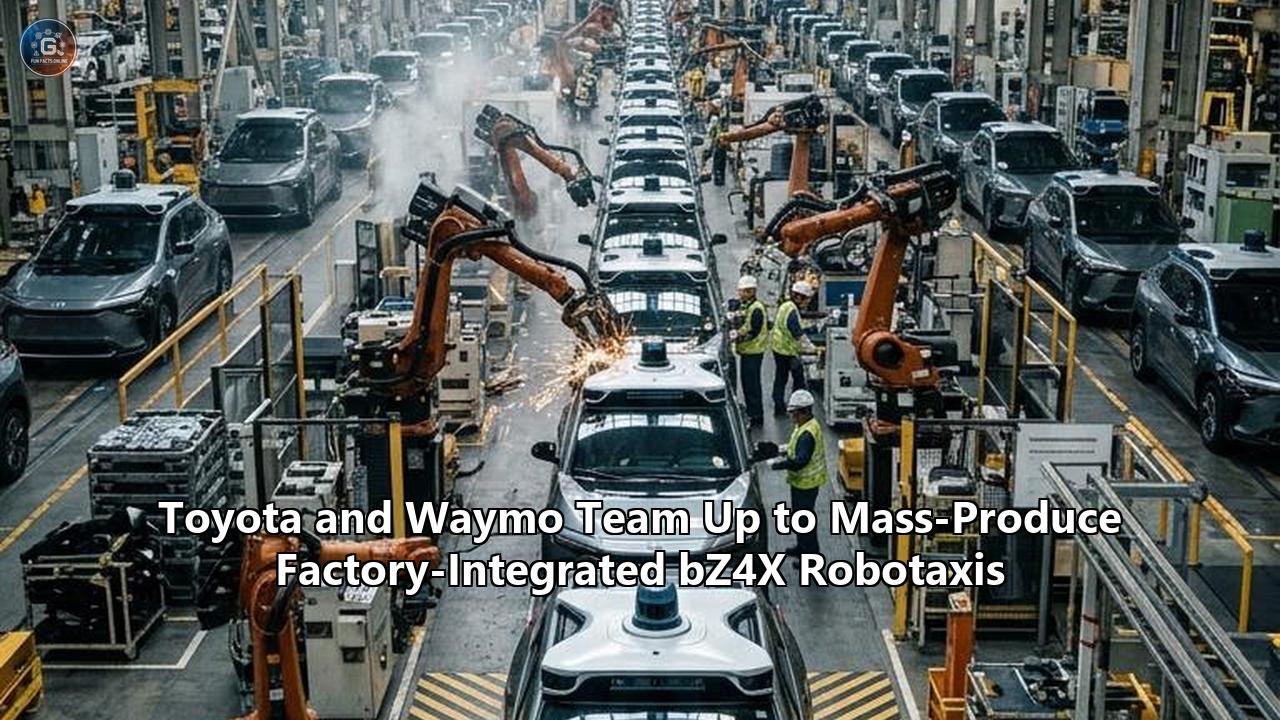
On October 30, 2026, Toyota Motor Corporation and Alphabet’s autonomous driving subsidiary, Waymo, formalized an agreement to mass-produce factory-integrated, fully autonomous electric vehicles at Toyota’s Takaoka plant in Toyota City, Aichi Prefecture. Rather than outfitting completed vehicles through secondary aftermarket retrofits, Toyota will install Waymo’s Level 4 autonomous driving hardware and compute architecture directly onto the assembly line of its bZ4X electric crossover.
The program begins testing and validation operations in Japan in 2027, with deployments to the United Kingdom and additional international ride-hailing territories planned in subsequent phases.
This development transitions the preliminary exploration agreement signed by the two companies in April 2025 into an operational industrial program. The custom-outfitted bZ4X combines Toyota’s mass-production capabilities with Waymo’s autonomous stack, incorporating structural revisions such as extended rear legroom, automatic passenger doors, a power liftgate, and passenger-centric ambient lighting tailored for commercial service.
Beyond initial ride-hailing deployments, both corporations confirmed ongoing joint research into integrating automated driving technology into personally owned consumer vehicles, alongside active safety initiatives handled by Toyota’s software subsidiary, Woven by Toyota.
“Safety technology makes the biggest difference when it reaches as many people as possible,” said Hiroki Nakajima, member of the board of directors and executive vice president of Toyota Motor Corporation. “This collaboration will help scale that technology and bring it to customers in Japan and beyond through Waymo’s ride-hailing service, and in parallel, Toyota will continue to explore how integrating vehicles with traffic infrastructure can make those roads safer still. No single company can achieve the goal of zero traffic accidents alone, but with partners like Waymo, we will get there one step at a time”.
Waymo co-CEO Dmitri Dolgov emphasized the scale advantages of leveraging an automotive heavyweight: “Toyota’s commitment to zero traffic accidents resonates deeply with us at Waymo, and we’re proud to work together toward that goal. In areas where Waymo operates, we’ve demonstrated that we are up to 20 times safer than human drivers when it comes to serious crash injuries, and our partnership with Toyota will help us bring the safety and convenience of autonomous driving to more people around the world, including key international markets like Japan”.
The venture marks the first time Japan will deploy a domestically manufactured, factory-assembled vehicle designed explicitly for fully autonomous commercial ride-hailing. For an autonomous vehicle industry long constrained by the bottlenecks of low-volume conversion workshops, the move signals a structural transition toward standard industrial mass production.
The Industrial Pivot: Moving from Secondary Retrofits to Assembly-Line Integration
To understand the operational shift occurring in Aichi Prefecture, one must look at how commercial autonomous fleets have been constructed over the past decade. Historically, virtually every robotaxi operating on public roads has been an aftermarket conversion. A technology developer would purchase a production-line vehicle from an original equipment manufacturer (OEM)—such as the Chrysler Pacifica Hybrid or the Jaguar I-PACE—transport it to a specialized secondary conversion facility, disassemble body panels, drill into roof structures to run external cabling, splice into factory wiring harnesses, and manually calibrate external sensor suites.
Traditional Retrofit Bottleneck:
[OEM Assembly Line] ──> [Transit to Conversion Shop] ──> [Manual Tear-Down & Splicing] ──> [Sensor Calibration] (Low Volume / High Unit Cost)

Takaoka Factory-Integrated Process:
[Body-in-White Stamping] ──> [Redundant Harness Insertion] ──> [Waymo Compute & Sensor Assembly] ──> [End-of-Line QA] (High Volume / Mass Scale)
This conversion workflow introduced severe engineering and economic penalties. Secondary retrofitting adds tens of thousands of dollars in labor and bespoke parts to each vehicle's cost basis, limits production throughput to dozens of units per week, and leaves critical sensor mounts vulnerable to thermal expansion mismatches and moisture ingress. Furthermore, splicing into proprietary controller area network (CAN) buses often triggered conflicts with factory electronic control units (ECUs), requiring convoluted workarounds to ensure steer-by-wire and brake-by-wire commands executed safely.
By moving vehicle assembly and system integration under one roof at the Takaoka plant, the Toyota Waymo partnership removes this conversion-shop bottleneck. The Takaoka facility, which opened in 1966 and has served as a crucible for the Toyota Production System (TPS), brings automated precision stamping, robotic welding, and automated quality assurance to the autonomous vehicle stack.
Integrating Waymo’s system directly into the vehicle's body-in-white (the welded sheet metal frame prior to painting) yields specific engineering advances:
- Integrated Wire Routing and Thermal Management: High-bandwidth automotive Ethernet and dual-redundant low-voltage power networks are integrated into the main chassis wiring harness on the assembly line, eliminating exposed conduits and exterior cabin intrusions.
- Aero-Acoustic and Weather Sealing: Primary sensor housings—incorporating Waymo’s long-range lidars, millimeter-wave radars, and high-dynamic-range cameras—are integrated directly into structural stampings and bumper assemblies, reducing drag, dampening wind noise, and utilizing the vehicle’s active climate and coolant loops for sensor thermal regulation.
- Dynamic Optical Alignment: Sensor calibration is performed using robotic target gantries at the end of the production line rather than through manual static calibration rigs, verifying alignment down to fractions of a millimeter before the vehicle ever rolls onto a transport carrier.
- Dual-Channel Chassis Actuation: Toyota’s e-TNGA (electric Toyota New Global Architecture) platform has been modified to supply dual-channel power steering actuators, redundant electronic braking modules, and isolated secondary battery buffers that meet international ISO 26262 ASIL-D functional safety ratings without requiring post-assembly circuit modifications.
Factory integration transforms the robotaxi from an experimental rolling laboratory into a standardized, repeatable automotive part number.
Strategic Realignment: Why Toyota Chose Waymo Over In-House Isolation
Toyota’s decision to build Waymo-driven commercial vehicles is a pragmatic shift in corporate strategy. For years, the world’s largest automaker pursued an independent, multi-pronged approach to vehicle intelligence through the Toyota Research Institute (TRI) and its software subsidiary, Woven Planet (later reorganized as Woven by Toyota). The company historically divided its automated driving research into two conceptual branches: "Guardian," an advanced driver-assistance envelope designed to blend human steering with machine intervention to avert collisions, and "Chauffeur," a fully automated Level 4 and Level 5 system capable of operating without human oversight.
However, the capital expenditures required to develop, validate, and certify a commercial Level 4 driverless stack have challenged automakers across the globe. Ford Motor Company and Volkswagen Group took billions in write-downs when they dissolved their joint venture, Argo AI, in late 2022. General Motors has poured more than $10 billion into Cruise, only to face protracted operational halts and regulatory restructuring following high-profile safety incidents. Developing the software stack, mapping real-world edge cases over hundreds of millions of commercial miles, and building the cloud infrastructure for remote fleet assistance demands financial resources and competencies fundamentally different from high-volume mechanical stamping and assembly.
                     Automotive Industry L4 Strategy Continuum

  Proprietary Vertical Integration              Pragmatic Open Hardware
  ┌───────────────────────────────┐            ┌──────────────────────────────┐
  │ Tesla (FSD / Unboxed Cybercab)│            │ Toyota (e-TNGA + Waymo Driver│
  │ GM (Cruise / Origin Cancelled)│            │ Hyundai (Ioniq 5 + Waymo)    │
  │ Zoox (Amazon Bespoke Pod)     │            │ Zeekr (Geely SEA-M + Waymo)  │
  └───────────────────────────────┘            └──────────────────────────────┘
Under Chief Executive Officer Koji Sato and Chairman Akio Toyoda, Toyota has embraced focused capital allocation: preserve balance-sheet discipline, dominate hybrid and zero-emission vehicle platforms, and license or co-develop specialized software when doing so accelerates market entry. By partnering with Waymo, Toyota bypasses the prolonged algorithmic validation phases of urban urban-core autonomy while guaranteeing production volume for its e-TNGA manufacturing lines.
Simultaneously, the arrangement functions as a dual-track hedge for Toyota:
- Immediate Commercial Validation: Toyota secures immediate operational footprints in driverless ride-hailing networks across Japan, the UK, and North America, generating immediate component and manufacturing revenue without assuming solo operational liability for early-stage software faults.
- Long-Term Consumer Integration: The agreement explicitly keeps the door open for deploying Waymo’s automated driving architecture into personally owned Toyota vehicles down the road. Toyota can evaluate Waymo’s software stability, compute requirements, and operational safety data in commercial fleets before deciding whether to deploy the technology on high-margin consumer models under the Lexus or Toyota badges.
Toyota retains its internal development on Woven by Toyota’s Arene operating system and vehicle-to-infrastructure (V2X) safety frameworks. Rather than surrendering its vehicle intelligence roadmap, Toyota is treating Waymo as a Tier-1 software and systems supplier for commercial fleets, preserving optionality across its portfolio.
Waymo’s Multi-OEM Scaling Strategy
From Waymo’s operational vantage point, landing Toyota represents a crucial milestone in its hardware-agnostic platform strategy. Having operated for years on modified Chrysler Pacifica minivans and aging Jaguar I-PACE crossovers, Waymo found itself vulnerable to platform obsolescence. Jaguar discontinued the I-PACE line as part of its internal brand transition, leaving Waymo dependent on an out-of-production vehicle that grew increasingly expensive to maintain, repair, and replace.
In response, Waymo’s leadership team—steered by co-CEOs Dmitri Dolgov and Tekedra Mawakana—formulated a resilient, multi-supplier vehicle playbook. The strategy is designed to insulate the autonomous software stack from geopolitical frictions, supply chain chokepoints, and regional market preferences:
Waymo's Global Vehicle Platform Portfolio
| Platform / Base Vehicle | Manufacturing Partner | Architectural Focus | Primary Target Markets | Production Status |
|---|---|---|---|---|
| bZ4X (e-TNGA) | Toyota Motor Corp | High-volume electric SUV; right-hand & left-hand drive configurations | Japan, United Kingdom, Global Waymo territories | Validating on-line assembly; testing starts 2027 |
| Ioniq 5 (E-GMP) | Hyundai Motor Group | 800V fast-charging crossover; high-uptime urban transit | North America, South Korea | Multi-year supply deal inked late 2024; initial testing underway |
| Ojai / CM1e (SEA-M) | Zeekr (Geely Holding) | Purpose-built, low-floor transit cabin; accessible ingress | United States, Global ride-hailing networks | Purpose-built prototype testing; volume subject to trade policies |
| I-PACE (Legacy) | Jaguar Land Rover | Luxury all-wheel-drive EV crossover | Initial US launch markets (Phoenix, SF, LA, Austin) | Legacy fleet operations; phased retirement as newer platforms scale |
This diversified portfolio solves several systemic operational challenges for Waymo:
- Circumventing Geopolitical and Tariff Barriers: Waymo’s partnership with Zeekr to produce the custom Ojai passenger pod provided an optimized cabin, but escalating Western tariffs on Chinese-manufactured electric vehicles and proposed United States Department of Commerce bans on Chinese-connected vehicle software and hardware complicated rapid North American scaling. Sourcing high-volume platforms from Toyota in Japan and Hyundai in South Korea ensures regulatory compliance and avoids tariff penalties in domestic and allied international markets.
- Unlocking Right-Hand-Drive (RHD) Geographies: The United Kingdom, Japan, Australia, and Singapore represent lucrative urban mobility markets with high transit density and elevated consumer willingness to pay. Yet developing, testing, and calibrating a right-hand-drive autonomous vehicle fleet from scratch presents distinct spatial sensor geometry challenges. Toyota’s domestic production lines in Aichi Prefecture natively master RHD mechanical architectures, giving Waymo an immediate, homologated vehicle platform for its expansion across Tokyo, London, and other RHD metropolitan centers.
- Industrial Pricing Leverage: By operating three distinct vehicle architectures simultaneously, Waymo avoids vendor lock-in. If supply chain disruptions or component cost spikes hit one manufacturer, Waymo can shift capital expenditures and deployment schedules to another, maintaining its expansion velocity across global operating domains.
Stakeholder Impact Analysis
The arrival of factory-integrated autonomous Toyotas introduces ripple effects across competitive, commercial, regulatory, and civic ecosystems. The following impact matrix evaluates the operational disruption across core stakeholder categories.
                                    STAKEHOLDER IMPACT MATRIX

  Stakeholder Domain        Disruption Level   Primary Operational Vector
  ──────────────────────────────────────────────────────────────────────────────────────────
  Legacy Automakers         HIGH               Forced to choose between software capitulation
                                               or unsustainable in-house R&D expenditures

  Autonomy Competitors      HIGH               Intensifies margin pressure; challenges non-
                                               redundant, vision-only commercial models

  Public Transit & Taxis    MODERATE-HIGH      Accelerates transition toward hybrid dispatch
                                               in aging markets with labor shortages

  Automotive Tier-1s        MODERATE           Demands structural pivot to ASIL-D redundant
                                               mechatronics, steer-by-wire, and sensor harnesses

  Urban Infrastructure      MODERATE           Shifts municipal focus toward curbside pickup
                                               allocation, grid demand, and automated safety audits
1. Legacy Automakers and the OEM Dilemma
For global automakers such as Stellantis, Honda, BMW, and Mercedes-Benz, the formalization of the Toyota Waymo partnership accelerates an uncomfortable strategic decision. Automakers must weigh whether to continue spending billions developing bespoke Level 4 stacks that may never reach commercial viability, or accept the role of hardware provider to dominant software platforms like Waymo, Baidu Apollo, or Mobileye.
Toyota’s participation gives other legacy OEMs an established precedent to follow. If the automotive company with the industry's highest production volume and strictest quality-control standards has determined that licensing Waymo’s automated driving architecture is commercially sound, smaller OEMs will find it difficult to justify internal software development programs to institutional shareholders. This dynamic threatens to divide the auto industry into two tiers: a small handful of vertically integrated tech giants, and a broader cohort of contract vehicle assemblers competing on manufacturing efficiency and interior ergonomics.
2. Autonomous Driving Rivals: Tesla, Zoox, and Baidu
The competitive pressure lands directly on firms pursuing alternative operational pathways:
- Tesla: Elon Musk’s robotaxi strategy hinges on a vision-only, end-to-end neural network architecture deployed via the proposed "Cybercab" on an unboxed manufacturing line. Tesla has eschewed lidar, radar, and sensor redundancy to drive hardware costs down. However, while Tesla still faces technical validation hurdles in achieving completely driverless unsupervised operation across varied weather conditions and geographies, Waymo is generating over 500,000 paid commercial driverless trips weekly across diverse urban markets. Backing that proven software with Toyota's industrial consistency yields a market reality Tesla must counter with verified safety data, not just forward-looking timelines.
- Amazon’s Zoox: Zoox has pursued a ground-up, bidirectional passenger pod with custom tooling, steering, and braking architectures. While this purpose-built approach optimizes the rider experience, Zoox must shoulder the astronomical capital expenditure of setting up low-volume manufacturing lines from scratch. Waymo’s ability to piggyback on Toyota’s amortized factories provides a lower capital intensity per deployed seat.
- Chinese Autonomy Developers (Baidu, Pony.ai): In China, Pony.ai previously partnered with Toyota to test bZ4X-based robotaxis under local joint-venture frameworks. Waymo’s capture of Toyota’s domestic Japanese production lines effectively blocks Chinese developers from expanding into key allied Asian and European markets using the world’s most trusted automotive brand, containing domestic Chinese players primarily within their home territory and select Middle Eastern testbeds.
3. Commercial Ride-Hailing and the Japanese Mobility Crisis
Japan faces an acute demographic crisis that makes autonomous transit an operational necessity rather than a Silicon Valley luxury. The country’s working-age population is shrinking rapidly, and the average age of a professional taxi driver in Tokyo has climbed past 58 years old, with regional prefectures regularly reporting driver averages exceeding 62. Fleet operators in Tokyo frequently run at 30% below vehicle capacity simply because there are not enough licensed drivers to fill shifts.
Recognizing this dynamic, Waymo chose not to confront Japan's entrenched taxi industry as an adversarial market entrant. In September, Waymo formed alliances with Nihon Kotsu, Tokyo’s premier taxi operator, and GO, Japan’s dominant ride-hailing and dispatch application. When the bZ4X robotaxis deploy for validation and initial public operations in Tokyo in 2027, they will be integrated directly into local dispatch channels. The vehicles feature automated passenger rear doors—a staple of Japanese taxi culture since the 1964 Tokyo Olympics—ensuring cultural and operational continuity for passengers accustomed to traditional service standards.
                     Tokyo Autonomous Dispatch Architecture

  ┌────────────────────────────────────────────────────────────────────────┐
  │                           Consumer Demand Layer                        │
  │                  (GO App Dispatch / Waymo One Platform)                │
  └───────────────────────────────────┬────────────────────────────────────┘
                                      │
  ┌───────────────────────────────────▼────────────────────────────────────┐
  │                         Fleet Operations & Depot                       │
  │                      (Nihon Kotsu Traditional Depot)                   │
  │            • Mechanical Maintenance       • Sensor Cleaning Loops      │
  │            • Energy Management / Charging • Depot Dispatch             │
  └───────────────────────────────────┬────────────────────────────────────┘
                                      │
  ┌───────────────────────────────────▼────────────────────────────────────┐
  │                          Vehicle Hardware Layer                        │
  │            (Toyota Takaoka Plant Factory-Integrated bZ4X)              │
  │            • Dual-channel e-TNGA Steer/Brake Redundancy                │
  │            • Waymo Gen-6 Driver Hardware Architecture                  │
  └────────────────────────────────────────────────────────────────────────┘
For platform aggregators like Uber and Lyft, this development solidifies their future role. Neither company operates internal vehicle development programs anymore. Instead, they must serve as demand-generation layers and fleet-dispatch brokers for autonomous vehicle fleets owned, built, and supported by partnerships like Toyota and Waymo.
The Unit Economics of Mass-Produced Autonomous Mobility
The core barrier preventing autonomous vehicle fleets from expanding from regional pilots into self-sustaining commercial businesses has always been the unit economics of the vehicle itself. A retrofitted Level 4 robotaxi historically carried a total cost of ownership that undermined the financial advantages of removing the human driver.
Estimated Capital Expenditure and Lifecycle Cost Comparison
| Cost Component (USD) | 2022 Retrofitted Fleet Vehicle (e.g., Jaguar I-PACE) | 2027 Factory-Integrated Vehicle (Toyota bZ4X) | Variance Analysis / Economic Driver |
|---|---|---|---|
| Base Vehicle Purchase | $72,000 | $36,000 | Shift from luxury crossover to mass-market e-TNGA electric SUV |
| Sensor Suite (Lidar, Radar, Cameras) | $45,000 | $14,000 | Maturation of solid-state lidars and custom Silicon imagers (Gen-6) |
| Compute & Power Infrastructure | $25,000 | $9,000 | Automotive-grade integrated domain controllers; lower thermal overhead |
| Assembly, Calibration, Integration | $38,000 (Manual conversion shop) | $4,500 (Integrated Takaoka line) | Elimination of secondary disassembly, hand-routing, and custom mounts |
| Initial Capital Expenditure per Unit | $180,000 | $63,500 | ~65% reduction in up-front hardware capital expenditure |
| Vehicle Useful Life (Miles) | 150,000 miles | 300,000 miles | Designed for commercial duty cycles; continuous component reliability |
| Hardware Depreciation per Mile | $1.20 / mile | $0.21 / mile | ~82% reduction in per-mile capital depreciation |
By slashing capital depreciation from $1.20 per mile to approximately $0.21 per mile, the financial profile of autonomous fleet operation shifts fundamentally.
When analyzing the operating expenses of a human-driven ride-hail vehicle:
- Driver compensation, incentives, and platform commissions account for 65% to 75% of the total fare, translating to roughly $1.60 to $2.20 per vehicle mile in major metropolitan areas.
- The remaining costs—fuel or electricity, mechanical depreciation, insurance, and routine cleaning—account for $0.60 to $0.90 per mile.
- Total consumer cost: $2.50 to $3.50 per mile.
A factory-integrated autonomous vehicle removes driver compensation entirely, but introduces alternative operating expenses: remote operations oversight, teleoperations cellular uplinks, cloud routing infrastructure, specialized sensor cleaning and maintenance, and depot turnaround. Historically, with high hardware depreciation, total autonomous operating costs exceeded $3.00 per mile, requiring corporate subsidies to remain price-competitive.
At an initial vehicle cost near $63,500 amortized over 300,000 operational miles, combined with Waymo’s 6th-generation sensor suite that requires fewer compute nodes, the total cost per autonomous vehicle mile approaches $0.85 to $1.15. This allows the fleet operator to price rides well below human-driven taxi services while achieving sustainable gross operating margins. Factory integration is the threshold requirement for unlocking this economic shift.
Regulatory and Certification Implications
Before an autonomous bZ4X carrying paying passengers can navigate the streets of Tokyo or London, it must secure regulatory clearances that were once theoretical, but have recently codified into law.
                    Regulatory Certification Roadmaps

   Japan Framework (2023–2027)                  United Kingdom Framework (2024–2027)
  ┌───────────────────────────────────┐        ┌───────────────────────────────────┐
  │ Road Traffic Act Amendment        │        │ Automated Vehicles (AV) Act 2024  │
  │ • April 2023: Level 4 legalized   │        │ • Establishes statutory liability │
  │ • Specific Operational Design     │        │ • Authorized Self-Driving Entity  │
  │   Domain (ODD) approval process   │        │   (ASDE) corporate licensing      │
  └─────────────────┬─────────────────┘        └─────────────────┬─────────────────┘
                    │                                            │
  ┌─────────────────▼─────────────────┐        ┌─────────────────▼─────────────────┐
  │ MLIT Safety Validation Process    │        │ Department for Transport (DfT)    │
  │ • Dual-fail-safe steer/brake tests│        │ • Type approval for L4 operations │
  │ • End-of-line sensor homologation │        │ • Elimination of human driver     │
  │ • Tokyo Met Police permit sign-off│        │   criminal liability when engaged │
  └───────────────────────────────────┘        └───────────────────────────────────┘
Japan's Road Traffic Act Framework
Japan laid the legislative groundwork for this rollout in April 2023, when an amended Road Traffic Act officially came into force, establishing permissions for Level 4 autonomous transit services under clearly defined Operational Design Domains (ODDs). To obtain a commercial Level 4 transportation permit, the operating entity must satisfy stringent statutory conditions enforced by the Ministry of Land, Infrastructure, Transport and Tourism (MLIT) and local prefectural public safety commissions:
- Fail-Safe Mechanical Redundancy: The vehicle platform must prove that an instantaneous, catastrophic failure in any primary control mechanism—whether an absolute loss of battery power, a locked steering rack, or a severed brake hydraulic line—will not prevent the car from executing a minimal risk maneuver (MRM) to reach a safe, roadside stop without human intervention.
- Remote Tele-Supervision Mandates: Under Japanese law, Level 4 operations require certified remote monitoring personnel capable of confirming operational status, interacting with emergency responders via two-way audio-video links, and instructing vehicles to clear intersections if blocked by unusual road conditions.
- Local Operational Approvals: In Tokyo, deployments must clear the Tokyo Metropolitan Police Department’s traffic division, which requires extensive validation testing to verify that autonomous vehicles handle narrow residential lanes, yield reliably to pedestrians in unmarked crosswalks, and interact predictably with commercial delivery vehicles. Testing in Japan starting in 2027 is specifically designed to satisfy these MLIT validation requirements.
The United Kingdom’s Automated Vehicles Act
For the subsequent deployment phase targeting the British market, the regulatory pathway runs through the United Kingdom's Automated Vehicles (AV) Act, passed into law in May 2024. The AV Act represents one of the most comprehensive national autonomous vehicle regulatory frameworks in the world, establishing clear statutory liability:
- Authorized Self-Driving Entities (ASDE): Under the British system, once a vehicle is officially categorized as self-driving, the human passenger inside is completely absolved of legal liability for moving violations, collisions, or operational infractions while the automated driving system is active.
- Corporate Accountability: Legal responsibility falls squarely on the registered ASDE—in this instance, the corporate partnership entity backing the autonomous driving software and hardware stack.
- Factory-Level Type Approval: Because the AV Act requires systems to be thoroughly audited at the hardware and software design level, factory-integrated vehicles produced under Toyota’s internationally recognized type approvals stand a much higher probability of securing rapid UK Department for Transport licensing than low-volume, bespoke aftermarket conversions.
Short-Term Consequences (2026–2028): Tooling, Testing, and Market Calibration
Between the October 2026 announcement and the scheduled 2027–2028 pilot deployments, specific technical, logistical, and operational milestones will unfold:
1. Plant Retooling and Line Balancing at Takaoka
Toyota’s production engineers face the immediate challenge of integrating specialized autonomous hardware into the Takaoka line without disrupting the takt time (the cycle time needed to match production pacing to demand) of conventional models sharing the facility.
Installing compute boxes, routing shielded coaxial and Ethernet lines, and fitting sensor mounts requires dedicating specialized assembly workstations along the main line. Toyota must also establish secure end-of-line optical and radio-frequency calibration tunnels to test lidars, radars, and camera sensor pods under simulated ambient conditions before vehicles leave the plant floor.
2. The 2027 Tokyo Pilot Phase
When the autonomous bZ4X fleet begins validation operations in Tokyo in 2027, initial runs will not immediately open to unrestricted commercial hail requests across the entire metropolis. In step with Waymo’s established playbook:
- Initial validation will begin in specific administrative wards—likely Minato, Chiyoda, and Shibuya—where street layouts are broad, lane markings are clear, and high-definition mapping data has already been accumulated by preliminary test vehicles.
- Operations will run in coordination with Nihon Kotsu depots, evaluating how traditional ground crews handle sensor-cleaning routines, high-voltage fast-charging turnaround, and overnight depot dispatch.
- Public access will open gradually via closed beta groups through the GO app, mirroring Waymo’s phased consumer rollouts in Phoenix, San Francisco, and Los Angeles.
3. Phasing Out the Jaguar I-PACE Fleet
In North America, Waymo will accelerate efforts to manage maintenance and spare parts availability for its operational I-PACE fleet. Because Jaguar has exited production of the vehicle, obtaining structural replacement parts, bespoke body panels, and replacement battery packs will grow steadily more expensive.
While the new Toyota platforms undergo initial validation testing in Japan, Waymo will prepare its North American operational depots for incoming Hyundai Ioniq 5 and subsequent bZ4X units to ensure fleet capacity can expand without interruption.
Long-Term Consequences (2029 and Beyond): Structural Shifts in Global Mobility
Looking past the initial operational rollout, the industrial alliance between Toyota and Waymo has the potential to alter the automotive business landscape in several fundamental ways.
                         Long-Term Structural Evolution

  Phase 1: 2026–2028             Phase 2: 2029–2032              Phase 3: 2033+
 ┌──────────────────────┐       ┌──────────────────────┐        ┌──────────────────────┐
 │ Commercial Fleet     │       │ International RHD    │        │ Personally Owned     │
 │ Validation           │──────>│ Scale                │───────>│ Autonomous Vehicles  │
 │ • Takaoka Line Launch│       │ • Tokyo Fleet (1,000s)│       │ • Consumer bZ Models │
 │ • Tokyo Pilot (100)  │       │ • London Launch      │        │ • Software-as-a-     │
 │ • Safety Certification│      │ • Fleet CapEx Parity │        │   Service Subscriptions│
 └──────────────────────┘       └──────────────────────┘        └──────────────────────┘
1. Consumer-Owned Level 4 Autonomy
The most transformative component of the agreement lies in the commitment to evaluate Waymo’s automated driving architecture for personally owned vehicles (POVs) sold to retail consumers. Historically, the industry has maintained a strict division between commercial fleet robotaxis (which can afford expensive sensor suites because they generate revenue around the clock) and consumer passenger vehicles (which face rigid consumer price caps, typically restricting automation to Level 2+ driver-monitoring systems).
If the Toyota Waymo partnership drives sensor, compute, and integration costs down toward automotive-grade consumer targets, Toyota could become the first automaker to offer retail consumers a truly driverless personal vehicle. Imagine a consumer purchasing an electric Lexus or high-spec Toyota crossover capable of dropping its owner off at an office entrance, navigating to a perimeter parking facility to recharge, and returning autonomously upon command.
Such a development would fundamentally disrupt Tesla’s consumer Full Self-Driving (FSD) monetization model and unlock high-margin recurring software subscription revenues for both Toyota and Alphabet.
2. The Separation of Vehicle Gliders from Mobility Software
The auto industry is increasingly showing signs of a long-predicted structural separation between "hardware gliders" (the battery, chassis, suspension, and body shell) and "operating systems" (the AI drivers, sensor perception engines, and real-time fleet dispatch algorithms).
If vehicle intelligence centralizes around a handful of dominant software operating platforms—analogous to Android and iOS in mobile computing—the economics of automotive manufacturing will permanently shift. Automakers that fail to build or partner with a leading software architecture risk becoming low-margin contract assemblers, competing purely on manufacturing volume and interior trim quality while the software platforms capture the lucrative, ongoing per-mile service revenues.
Toyota’s early embrace of an open partnership strategy demonstrates an understanding of this reality. By securing preferred manufacturing and systems-integration status with Waymo, Toyota guarantees its factories will build the hardware foundations of this coming mobility layer, even as proprietary vehicle ownership models evolve in dense urban environments.
3. Urban Redesign and Curb-Space Reallocation
As factory-built autonomous fleets expand in dense urban hubs like Tokyo, London, and San Francisco, municipal planners will face pressure to adapt the built environment.
Driverless commercial fleets reduce the need for expansive, street-level parking in high-density downtown districts. Cities will increasingly convert on-street parking spaces into active passenger loading and unloading zones, deploy intelligent curb-management systems, and establish high-throughput automated charging hubs along city perimeters. The inclusion of automatic doors and flat-floor entryways on the bZ4X robotaxi sets a clear structural precedent for universal accessibility, pushing municipalities to demand equal accessibility standards across all micro-mobility and mass-transit programs.
Unresolved Challenges and Critical Milestones to Monitor
Despite the industrial logic underpinning the collaboration, significant technical, commercial, and operational hurdles remain unresolved. Industry observers should track several key friction points as the program advances toward production:
                            CRITICAL WATCHLIST MATRIX

  Milestone Area         Target Horizon    Key Metric / Critical Indicator
  ────────────────────────────────────────────────────────────────────────────────────────
  Line Volume Disclosures 2026–2027         Annualized Takaoka build capacity (hundreds vs.
                                           tens of thousands of units)

  Tokyo Winter Testing   2027–2028         Perception performance in adverse weather,
                                           heavy rain, and optical sensor spray

  Liability Allocation   2027              Contractual indemnification breakdown between
                                           OEM mechanical hardware and Waymo software

  UK Type Approval       2028              First non-domestic certification under the
UK Automated Vehicles Act statutory framework- Production Volume and Allocation Numbers: The October 2026 announcement confirmed the vehicle model, production plant, and target validation year, but intentionally omitted concrete unit volume targets, capital commitments, or wholesale vehicle transfer pricing. Whether the Takaoka plant will assemble hundreds of validation vehicles or scale to tens of thousands of units per year remains the single most critical indicator of the partnership's true commercial scale.
- Adverse Weather and Operational Edge Cases: Tokyo experiences torrential typhoon downpours and seasonal winter sleet that degrade optical camera visibility, distort lidar point clouds, and test vehicle traction. Demonstrating that an automated bZ4X can operate with high uptime through severe Japanese weather conditions—without requiring frequent teleoperator interventions—will serve as a key technical hurdle before commercial operations can scale.
- Product Liability and Warranty Boundaries: When a factory-integrated autonomous vehicle experiences an operational failure, determining legal liability becomes complex. Did a collision occur because a steer-by-wire electromechanical actuator experienced an intermittent voltage drop, or because an algorithmic classification model failed to identify a dark, reflective obstacle? Toyota and Waymo must establish clear, unified warranty protocols and liability indemnification boundaries that satisfy international court systems and commercial insurance underwriters.
- Sensor Cleaning and Mechanical Longevity: Consumer passenger vehicles typically operate for 10,000 to 12,000 miles per year, primarily in daylight and moderate weather. Commercial robotaxis operate up to 20 hours per day, running 70,000 to 100,000 miles annually through road salt, construction dust, mud, and continuous vibration. Validating that delicate solid-state lidars and optical camera coatings can survive multi-year commercial duty cycles without frequent manual intervention remains an unproven reliability challenge for the automotive supply chain.
The industrialization of autonomous driving is moving out of regional testing sandboxes and into the world's most disciplined assembly facilities. By choosing to build the bZ4X robotaxi from the ground up at the Takaoka plant, Toyota and Waymo have signaled that the era of the converted prototype has reached its limit. The coming years in Tokyo and London will reveal whether traditional assembly-line discipline can finally transform fully driverless mobility into a high-volume, economically viable reality.
Reference:
- https://newsroom.toyota.eu/toyota-and-waymo-advance-autonomous-driving-collaboration-for-safer-streets-and-freedom-of-movement-for-all/
- https://shattered.io/waymo-toyota-vehicle-shortage-piecyk-500k-weekly-rides-2026/
- https://electrek.co/2026/10/30/waymo-toyota-bz4x-robotaxi-japan-2027/
- https://waymo.com/blog/2026/10/toyota-bz4x-partnership/
- https://www.autoblog.com/news/waymo-is-turning-toyotas-electric-suv-into-a-driverless-robotaxi
- https://aiweekly.co/alerts/waymos-next-robotaxi-a-toyota-bz4x-built-at-takaoka
- https://mlq.ai/news/waymo-and-toyota-to-test-factory-integrated-bz4x-robotaxis-in-japan-in-2027/
- https://www.forbes.com/sites/peterlyon/2026/10/30/toyota-built-the-ev-waymo-will-drive-it-tokyo-gets-to-judge/
- https://www.engadget.com/2301972/waymo-toyota-soon-start-testing-bz4x-robotaxis-japan/
- https://shattered.io/waymo-toyota-bz4x-factory-built-hardware-takaoka-2027-2026/