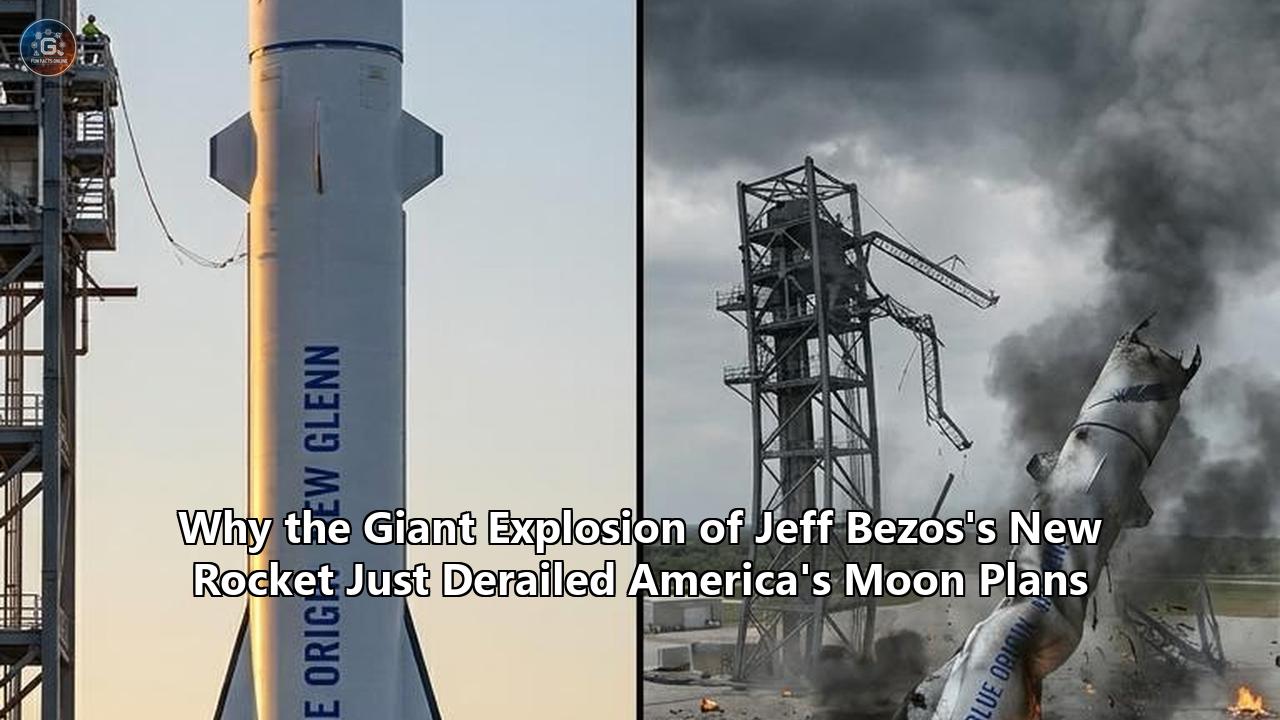
The Florida Space Coast has long been a theater of fire and ambition, but the night of May 28, 2026, will be remembered as the moment the stage itself burned down. At 9:00 PM EDT, as the dark Atlantic waters lapped against the shores of Cape Canaveral, Blue Origin’s heavy-lift New Glenn rocket stood on Space Launch Complex 36 (LC-36). It was undergoing a critical, pre-launch static fire test of its seven BE-4 engines. Within seconds, a routine check turned into a catastrophic conflagration.
Telemetry and video captured a sudden, violent anomaly near the base of the 188-foot-tall first-stage booster. As the engines ignited, a localized fire erupted, rapidly enveloping the rocket's base. Moments later, the structural integrity of the booster buckled; the 86-foot upper stage tilted sharply, collapsing into the growing inferno. What followed was a colossal, roiling fireball of ignited liquid methane and liquid oxygen that consumed the rocket, vaporized the mobile erector-gantry, and severely damaged the launchpad infrastructure, including one of the pad's massive lightning protection towers.
The blast was so immense that residents in Cocoa Beach and Cape Canaveral reported their homes shaking, while a faint orange glow was visible as far north as South Carolina. Early the next morning, Space Launch Delta 45—the U.S. Space Force unit managing the Eastern Range—issued a hazardous debris warning, alerting the public that sharp, toxic wreckage from the booster could wash ashore on public beaches over the coming weeks.
Launch Complex 36 (LC-36) Damage Assessment:
┌─────────────────────────────────┬─────────────────────────────────┐
│ Component                       │ Estimated Status                │
├─────────────────────────────────┼─────────────────────────────────┤
│ First-Stage Booster (Booster 3) │ Total Destruction (Vaporized)   │
│ Upper Stage & Payload Fairing   │ Total Destruction               │
│ Transporter-Erector Gantry      │ Severe Structural Collapse      │
│ Lightning Tower (East)          │ Missing/Destroyed               │
│ Ground Support Plumbing (GSE)   │ Extensive Cryogenic Damage      │
└─────────────────────────────────┴─────────────────────────────────┘
While Blue Origin’s founder, Jeff Bezos, quickly confirmed that all personnel were safe and struck a defiant tone—posting on X, “Very rough day, but we’ll rebuild whatever needs rebuilding and get back to flying”—the geopolitical and industrial damage was already done. The immediate fallout from the Jeff Bezos rocket explosion is shaking the foundations of the U.S. space sector. Only 48 hours prior, NASA had triumphantly announced a major expansion of its "Moon Base" initiative, awarding Blue Origin a $188 million contract to transport two state-of-the-art Lunar Terrain Vehicles (LTVs) to the moon's South Pole.
Now, with New Glenn grounded indefinitely and its sole launchpad in ruins, America’s path back to the lunar surface has suffered a structural fracture. This pad disaster does not merely delay a commercial rocket; it dismantles a fragile, dual-vendor architecture that NASA spent years constructing to prevent a monopoly in deep-space exploration, leaving the U.S. government critically dependent on Elon Musk's SpaceX as a geopolitical race with China looms over the lunar South Pole.
A Tale of Two Philosophies: "Gradatim Ferociter" Meets "Fail Forward"
To understand why this disaster is so devastating for Blue Origin, one must examine the profound divergence in engineering philosophy between Jeff Bezos’s firm and its chief rival, SpaceX. For a quarter of a century, Blue Origin has operated under the Latin motto Gradatim Ferociter—"Step by step, ferociously". This guiding light champions a slow, methodical, paper-perfect approach to aerospace engineering. The company’s culture has historically abhorred public failures, choosing to spend years, sometimes decades, in quiet development and exhaustive ground-testing before risking a launch.
Engineering Philosophies: Blue Origin vs. SpaceX
┌──────────────────────┬───────────────────────────┬───────────────────────────┐
│ Parameter            │ Blue Origin (Gradatim)    │ SpaceX (Fail Forward)     │
├──────────────────────┼───────────────────────────┼───────────────────────────┤
│ Development Cycle    │ High-simulation, slow-roll│ Rapid prototyping, flight │
│ Risk Tolerance       │ Extremely low (Grounded)  │ High (Accepts explosions) │
│ Infrastructure       │ Bespoke, single-site      │ Mass production, multi-pad│
│ Testing Style        │ Hardware-lean, exhaustive │ Hardware-rich, iterative  │
│ Hardware Buffer      │ Small, high-cost units    │ High-volume assembly line │
└──────────────────────┴───────────────────────────┴───────────────────────────┘
By contrast, SpaceX has spent the last two decades perfecting the art of "failing forward." Elon Musk’s engineering doctrine is rooted in rapid, hardware-rich iteration. SpaceX builds rockets with the expectation that they will explode during early test flights. They gather telemetry from the debris, implement immediate design changes, and launch another prototype within weeks.
This is made possible by SpaceX's colossal manufacturing footprint. In Starbase, Texas, and Hawthorne, California, SpaceX does not just build rockets; it builds factories that build rockets. A single Starship explosion on a landing pad, like the flight test anomaly seen in late May 2026, is viewed by SpaceX as a successful, data-generating milestone rather than a program-halting disaster.
The Jeff Bezos rocket explosion exposes the vulnerability of the Gradatim Ferociter model when applied to heavy-lift class orbital systems. Because Blue Origin has focused so heavily on avoiding flight failures, it has produced an incredibly lean inventory of physical hardware and highly centralized infrastructure.
Prior to the May 28 blast, New Glenn had flown only three times since its maiden voyage in January 2025. While it successfully demonstrated booster reuse on its second and third flights, the program lacked a deep bench of backup vehicles and alternative pads. The booster destroyed in the static fire, No. 3, nicknamed "No, It's Necessary", represented a significant fraction of Blue Origin's flight-ready first-stage inventory.
When SpaceX suffers an explosion, its mass-production assembly lines can roll out a replacement hull almost immediately. When Blue Origin suffers a pad explosion, the recovery is bottlenecked by a hardware-lean supply chain and a highly customized, low-volume production rhythm.
Bezos’s slow-and-steady approach was designed to guarantee that when New Glenn finally entered regular service, it would do so with flawless reliability. Instead, the company has suffered the worst of both worlds: a catastrophic, public pad failure that destroyed a booster and crippled its only launch site, without the industrial safety net of a mass-manufacturing pipeline to absorb the loss.
The Single Point of Failure: The Crippling of Launch Complex 36
In the aerospace industry, a rocket is only as good as the concrete and steel beneath it. While public attention naturally gravitates toward the spectacular destruction of the flying vehicle, engineers look to the launchpad. The destruction of LC-36 is the true bottleneck that will ground Blue Origin for the foreseeable future.
Physical Footprint of the Catastrophe:
- Launch Complex: Space Launch Complex 36 (LC-36A), Cape Canaveral
- Impact Radius: House rattling felt in Cocoa Beach/Cape Canaveral
- Visual Glow: Detected up to 185 kilometers (115 miles) south in Fort Pierce
- Marine Hazard: Air Force warnings of metal & carbon composite debris on beaches
Blue Origin spent nearly a decade and upwards of $1 billion transforming LC-36—a historic Cold War-era pad that once sent Pioneer and Mariner probes into deep space—into a state-of-the-art commercial launch facility. The complex features a massive, automated transporter-erector, ultra-high-pressure gas storage farms, extensive cryogenic liquid methane and liquid oxygen plumbing, and dual 300-foot-tall lightning protection towers designed to shield the massive rocket during Florida’s frequent electrical storms.
The physical mechanics of the static fire explosion suggest that the damage to LC-36 is profound. Because a static fire test occurs with the rocket held firmly to the launch mount, the vehicle was fully loaded with hundreds of thousands of gallons of supercooled propellants.
A mid-flight explosion consumes much of its propellant before detonating, and the resulting blast wave is dissipated in the open sky. A pad explosion, however, acts as a ground-level fuel-air bomb. The sudden release of liquid methane and liquid oxygen on the pad floor created an overpressure wave that sheared structural steel, melted copper cabling, and shattered the concrete foundation of the launch mount.
To understand the recovery timeline, one can compare this event to SpaceX's infamous AMOS-6 pad explosion on September 1, 2016. During a routine pre-launch static fire at Cape Canaveral’s Space Launch Complex 40 (SLC-40), a Falcon 9 rocket exploded due to a failure in an helium pressuritant tank.
The resulting fireball completely destroyed the rocket and its satellite payload, while causing catastrophic damage to the pad. It took SpaceX over 15 months and $50 million to completely rebuild and recertify SLC-40. However, SpaceX’s launch manifest barely stumbled. Why? Because SpaceX had alternative pads. They quickly pivoted their East Coast operations to the historic Launch Complex 39A (LC-39A) at the Kennedy Space Center and maintained their West Coast cadence from Vandenberg Space Force Base in California.
Blue Origin has no such redundancy. LC-36 is currently the only operational launchpad for New Glenn. While the company has secured Space Launch Complex 9 (SLC-9) at Vandenberg for future West Coast polar launches, that facility is still in the early stages of structural development and lacks the specialized propellant storage, plumbing, and erector infrastructure required to host a New Glenn flight.
With LC-36 out of commission, Blue Origin's flagship rocket is effectively homeless. Every single mission on its manifest—from civilian science to commercial satellite deployment—is frozen.
Commercial & Institutional Manifest Freeze:
┌─────────────────────────────────┬─────────────────────────────────┐
│ Mission / Payload               │ Original Target Date            │
├─────────────────────────────────┼─────────────────────────────────┤
│ Amazon Project Kuiper (48 sats) │ June 4, 2026 (Now suspended)    │
│ Blue Moon Mark 1 Pathfinder     │ Autumn 2026 (Now suspended)     │
│ NASA VIPER Rover Delivery       │ Late 2027 (At extreme risk)     │
│ LTV Moon Buggy Transport        │ 2028 (Highly compromised)       │
└─────────────────────────────────┴─────────────────────────────────┘
This pad freeze is particularly devastating for Amazon’s Project Kuiper, Jeff Bezos’s multi-billion-dollar effort to challenge SpaceX's Starlink satellite internet constellation. Amazon is facing a strict, legally binding Federal Communications Commission (FCC) deadline to launch half of its planned 3,236-satellite constellation into orbit by July 2026 or face the revocation of its operating license.
The June 4, 2026 mission, which was to carry 48 Project Kuiper satellites, was supposed to kick off a high-cadence campaign of New Glenn flights to meet this regulatory hurdle. With New Glenn grounded, Amazon must now scramble to purchase launch capacity on alternative rockets.
However, the global launch market is severely supply-constrained, leaving Amazon with few choices other than to buy more flights on United Launch Alliance’s Atlas V and Vulcan rockets—or, in a bitter pill for Bezos to swallow, negotiate further contracts with Elon Musk’s SpaceX Falcon 9.
Derailed on the Moon's Edge: The Cascading Artemis Collateral
While the commercial consequences for Amazon are severe, the strategic implications for NASA’s Artemis program and its "Moon Base" initiative are catastrophic. On May 26, 2026—just two days before the explosion—NASA leaders held a high-profile press conference to outline the first phase of an ambitious, long-term lunar habitat infrastructure program.
The centerpiece of this announcement was the award of a contract worth at least $188 million to Blue Origin to deliver two advanced Lunar Terrain Vehicles (LTVs) to the Shackleton Connecting Ridge near the lunar South Pole. These rovers, engineered by Lunar Outpost and Astrolab, were intended to scout terrain, map resources, and prepare the site for the arrival of Artemis astronauts in 2028.
NASA's Integrated Lunar Architecture:
                  ┌──────────────────────┐
                  │ NASA SLS / Orion     │
                  │ (Astronaut Transport)│
                  └──────────┬───────────┘
                             │
                             ▼ (Rendezvous in Earth Orbit)
                  ┌──────────────────────┐
                  │ Commercial Landers   │
                  │ (SpaceX & Blue Moon) │
                  └──────────┬───────────┘
                             │
                             ▼ (Lunar Surface Deployment)
       ┌─────────────────────┴─────────────────────┐
       ▼                                           ▼
┌──────────────┐                            ┌──────────────┐
│ VIPER Rover  │                            │ LTV Buggies  │
│ (Water-Ice)  │                            │ (Astronauts) │
└──────────────┘                            └──────────────┘
The physical transport of these heavy payloads relies on Blue Origin's Blue Moon cargo lander architecture. The first iteration, Blue Moon Mark 1 (MK1), is a single-launch cargo vehicle designed to deliver up to three metric tons of scientific and operational hardware to any point on the lunar surface.
However, the MK1 is not a standalone spacecraft; it is a parasitic payload that is entirely dependent on the lift capacity and physical volume of New Glenn. Standing over 26 feet tall, the MK1 requires New Glenn’s massive 7-meter-wide payload fairing to reach orbit.
Before the static fire failure, Blue Origin was on track to launch its first uncrewed lunar landing test, Pathfinder Mission 1, using the Blue Moon MK1-101 lander, nicknamed "Endurance," as early as late 2026. This mission was designed to validate the lander's liquid hydrogen propulsion systems, its advanced BE-7 engine, and its precision-landing sensors.
A second MK1 mission, scheduled for late 2027, was selected by NASA to carry the resurrected Volatiles Investigating Polar Exploration Rover (VIPER). The VIPER rover—a $450 million mobile laboratory designed to drill for water ice in permanently shadowed lunar craters—was controversially canceled in 2024 due to budget overruns with its previous commercial lander provider, Astrobotic.
NASA revived the project in late 2025, specifically choosing Blue Origin because the MK1 lander was the only commercial vehicle capable of accommodating the heavy, golf-cart-sized rover on an accelerated timeline.
The Jeff Bezos rocket explosion throws this entire sequence of robotic precursor missions into disarray. Because the Blue Moon landers are structurally integrated with the New Glenn rocket, they cannot simply be transferred to another launch vehicle. No other operational rocket in the U.S. commercial fleet—including SpaceX’s Falcon Heavy or ULA’s Vulcan Centaur—possesses a payload fairing wide enough to house the 7-meter-diameter base of the MK1 lander without undergoing extensive, multi-year engineering redesigns.
Consequently, if New Glenn remains grounded for 12 to 18 months, the following milestones will collapse:
- The Blue Moon Mark 1 Pathfinder Flight (Endurance): This crucial demonstration, intended to prove that liquid hydrogen can be safely managed and burned in lunar landing thrusters, will slide into late 2027 or 2028.
- The VIPER Mission: Already on life support politically, the water-hunting rover will be pushed to the end of the decade, depriving NASA of vital resource data before astronauts arrive.
- The Lunar Terrain Vehicles: The rovers built by Lunar Outpost and Astrolab will sit idle in cleanrooms. Without New Glenn to launch the heavy-class landers required to transport them, American astronauts landing in 2028 will have to explore the rugged South Pole on foot, severely limiting their scientific range and operational efficiency.
This cascading delay directly threatens the strategic timeline of the Artemis program. NASA's moon base concept is built on a "just-in-time" delivery model: robotic scouts, power grids, and habitats must land first, followed by crewed missions. By knocking out the primary heavy-lift transportation system for these precursors, the explosion has severed the logistical supply line to the lunar surface.
Interoperability and the Orion Rendezvous: The Strategic Buckling of Artemis III
The damage to America's lunar ambitions is not confined to uncrewed cargo flights; it strikes at the core of NASA's crewed landing strategy. In early 2026, under the direction of NASA Administrator Jared Isaacman, the agency underwent a dramatic and highly praised restructuring of the Artemis flight manifest.
Faced with ongoing technical delays in the development of SpaceX’s Starship Human Landing System (HLS) and concerns over the Orion capsule’s heat shield performance, Isaacman announced that Artemis III—originally slated as a crewed landing—would instead be a low Earth orbit (LEO) rendezvous and docking demonstration in late 2027.
Artemis III "Apollo 9-Style" LEO Demonstration (Late 2027):
- Spacecraft 1: NASA Space Launch System (SLS) carrying Orion Capsule & 4 Astronauts
- Spacecraft 2: SpaceX Starship HLS (Methane-based)
- Spacecraft 3: Blue Origin Blue Moon Mark 2 HLS (Hydrogen-based)
- Objective: Rendezvous, dock, transfer crew, and test interoperability in Earth orbit
This LEO rendezvous, heavily reminiscent of the historic 1969 Apollo 9 mission, was designed to test the "interoperability" of the two commercially developed human landing systems: SpaceX’s Starship HLS and Blue Origin’s Blue Moon Mark 2 (MK2) HLS.
The plan was for an Orion capsule, carrying four astronauts, to launch into orbit atop NASA's Space Launch System (SLS) rocket. Once in orbit, the crew would rendezvous and dock with both the Starship HLS and the Blue Moon MK2 HLS, practicing crew transfers, validating life-support systems, and testing docking hardware before attempting a landing with Artemis IV in 2028.
This "dual-vendor" approach was hailed as a masterstroke of strategic planning. It introduced healthy commercial competition, pushed both SpaceX and Blue Origin to meet their deadlines, and provided NASA with "dissimilar redundancy". If one company’s lander experienced a critical failure, the agency could pivot to the other, ensuring that the U.S. moon landing timeline would remain intact.
The New Glenn explosion has effectively shattered this competitive balance. Because Blue Origin’s crew-rated Blue Moon Mark 2 lander relies entirely on New Glenn for launch and refueling, any prolonged grounding of the rocket directly paralyzes the development of the MK2 HLS. To appreciate the severity of this bottleneck, one must compare and contrast the starkly different technological architectures of the two competing landing systems:
Human Landing Systems (HLS): SpaceX vs. Blue Origin
┌──────────────────────────┬─────────────────────────────────┬─────────────────────────────────┐
│ Feature                  │ SpaceX Starship HLS             │ Blue Origin Blue Moon MK2 HLS   │
├──────────────────────────┼─────────────────────────────────┼─────────────────────────────────┤
│ Propellant Combination   │ Liquid Methane / Liquid Oxygen  │ Liquid Hydrogen / Liquid Oxygen │
│ Launch Vehicle           │ Super Heavy - Starship          │ New Glenn                       │
│ Tanker Flights Required  │ High (Estimated 8 - 20)         │ Low (Estimated 3 - 4)           │
│ Landing Thruster Position│ High on hull (Prevents dust)    │ Bottom (Traditional, low CG)    │
│ Structural Material      │ Stainless Steel                 │ Aluminum-Lithium Alloy          │
│ Cryogenic Management     │ Moderate (Methane boils at -161│ Extreme (Hydrogen boils at -253 │
│                          │ °C)                             │ °C)                             │
└──────────────────────────┴─────────────────────────────────┴─────────────────────────────────┘
The SpaceX Starship HLS Architecture
SpaceX’s approach is defined by sheer, brute-force scale. Starship HLS is a giant, 164-foot-tall stainless-steel vehicle powered by Raptor 3 engines burning liquid methane and liquid oxygen. Because of its immense mass, Starship HLS cannot reach the moon on its own propellant.
It requires a "depot" system in LEO, where a succession of orbital tanker flights—estimated between 8 and 20 launches—must transfer thousands of tons of cryogenic propellants to the lander before it can depart for lunar orbit.
The primary advantages of the Starship HLS are its massive pressurized volume (providing spacious habitats for astronauts) and its landing thruster configuration, which are placed midway up the vehicle's hull to avoid kicking up hazardous lunar regolith during touchdown.
However, the primary trade-off is the sheer complexity of the orbital refuelling train. If SpaceX cannot master rapid, high-cadence launches of its Super Heavy booster, the Starship HLS remains trapped in LEO, star-starved of propellant.
The Blue Origin Blue Moon Mark 2 HLS Architecture
Blue Origin’s lander is a more conservative, traditional design, constructed from lightweight aluminum-lithium alloys and standing roughly 52 feet tall. It is powered by the BE-7 engine, which burns liquid hydrogen and liquid oxygen.
Because hydrogen is a highly efficient rocket fuel—providing a specific impulse of roughly 450 seconds compared to methane’s 380 seconds—the Blue Moon lander is highly maneuverable and requires far fewer orbital refueling flights (typically three to four New Glenn launches to top off its tanks). Furthermore, the lander’s traditional, low-slung, four-legged design provides an exceptionally low center of gravity, making it highly stable when landing on the uneven, sloped terrains of the lunar South Pole.
The fatal flaw of the Blue Moon architecture, however, is its choice of fuel. Liquid hydrogen is the "finicky" prima donna of rocket propellants. It must be kept at an astonishingly cold -253 °C (-423 °F), only 20 degrees above absolute zero. Because hydrogen molecules are so tiny, they easily leak through the microscopic imperfections of metal joints and welds.
Furthermore, storing hydrogen in orbit for months without it boiling off requires advanced, unproven "zero-boil-off" active cryocooling technologies that Blue Origin was planning to test on its Mark 1 cargo flights.
The Jeff Bezos rocket explosion means that Blue Origin cannot launch the New Glenn flights required to test these critical hydrogen-transfer and cryocooling systems. While SpaceX is actively flying its Starship prototypes—recently launching its Version 3 vehicle and rapidly checking off flight milestones—Blue Origin’s HLS program has been halted at the starting line.
Strategic Impact of the Pad Failure:
                 ┌─────────────────────────────────┐
                 │    New Glenn Pad Explosion      │
                 └────────────────┬────────────────┘
                                  │ (LC-36 Grounded)
                                  ▼
                 ┌─────────────────────────────────┐
                 │ No Cryogenic Hydrogen Orbit     │
                 │          Testing               │
                 └────────────────┬────────────────┘
                                  │ (Schedule Slip)
                                  ▼
                 ┌─────────────────────────────────┐
                 │ Blue Moon HLS Fails late 2027  │
                 │         LEO Deadline            │
                 └────────────────┬────────────────┘
                                  │ (No Dissimilar Redundancy)
                                  ▼
                 ┌─────────────────────────────────┐
                 │ SpaceX holds sole-source        │
                 │    monopoly for Artemis III/IV  │
                 └─────────────────────────────────┘
This technical disparity creates a dangerous geopolitical vulnerability. NASA’s strategic pivot to LEO testing was intended to foster a healthy, competitive ecosystem where the agency was not beholden to a single commercial provider.
With New Glenn out of the picture for the foreseeable future, NASA’s "dissimilar redundancy" has collapsed. The agency is left with no choice but to rely entirely on SpaceX’s Starship for the Artemis III orbital tests and the Artemis IV landing.
If Starship encounters its own developmental hurdles or structural setbacks, the United States has no backup plan, no alternative lander, and no secondary heavy-lift launch vehicle capable of carrying out the mission. The space agency is now hostage to a sole-source monopoly.
The BE-4 Engine Crisis: Cascading Risks to ULA and National Security
To truly appreciate how deeply the Jeff Bezos rocket explosion has penetrated the bedrock of the U.S. aerospace sector, one must look beyond Blue Origin and examine its industrial cousin: United Launch Alliance (ULA). The common denominator linking these two giants is the BE-4 engine—the high-performance, methane-fueled engine designed, engineered, and manufactured by Blue Origin.
BE-4 Engine Architecture & Industrial Footprint:
- Propellant: Liquefied Natural Gas (Methane) and Liquid Oxygen
- Thrust: 550,000 lbs (Sea Level) per engine
- Cycle: Oxygen-Rich Staged Combustion (ORSC)
- Applications:
  * Blue Origin New Glenn first stage: 7 x BE-4 engines
  * ULA Vulcan Centaur first stage: 2 x BE-4 engines
The BE-4 is an engineering marvel, operating on an oxygen-rich staged combustion (ORSC) cycle. This cycle is notoriously difficult to master, as it requires plumbing high-pressure, highly reactive, superheated gaseous oxygen through turbopumps and combustion chambers without causing the metal itself to ignite and burn.
Because of its high performance and domestic manufacturing, ULA selected the BE-4 to power the first stage of its next-generation Vulcan Centaur rocket. The Vulcan, which utilizes two BE-4 engines, is a cornerstone of the U.S. Space Force’s National Security Space Launch (NSSL) program, tasked with launching billions of dollars worth of classified military spy satellites, missile warning systems, and secure communications arrays.
The explosion at LC-36 occurred during the start sequence of New Glenn’s seven BE-4 engines. While Blue Origin has not yet released full telemetry data, initial video analysis reveals a massive ignition anomaly at the base of the rocket's first stage. This leaves investigators facing two distinct, highly consequential technological scenarios:
Scenario A: A Catastrophic Engine-Related Failure
In this scenario, the anomaly originated within one of the seven BE-4 engines. Potential causes include a high-pressure turbopump explosion, a combustion chamber rupture, or a failure in the main fuel control valves.
If the failure was engine-related, the industrial consequences will cascade across the entire defense and civil space sectors. The Federal Aviation Administration (FAA) and military safety boards will likely ground not only New Glenn, but also demand a thorough design and manufacturing audit of all BE-4 engines in service.
Cascading Engine Grounding:
                   ┌───────────────────────────────┐
                   │    Catastrophic BE-4 Failure  │
                   └───────────────┬───────────────┘
                                   │
                   ┌───────────────┴───────────────┐
                   ▼                               ▼
       ┌──────────────────────┐       ┌──────────────────────┐
       │ Grounding of         │       │ Grounding of         │
       │ New Glenn Rocket     │       │ ULA Vulcan Rocket    │
       └──────────────────────┘       └──────────────┬───────┘
                                                     │
                                                     ▼
                                      ┌──────────────────────┐
                                      │ National Security    │
                                      │ Space Launches (NSSL)│
                                      │ Frozen               │
                                      └──────────────────────┘
This would immediately halt ULA’s Vulcan launch manifest. Vulcan is scheduled to carry out dozens of critical national security missions for the Space Force and the National Reconnaissance Office (NRO).
If Vulcan is grounded due to a shared engine defect, the Pentagon’s launch schedule will freeze. The military would be forced to pay massive premiums to shift its heaviest, most sensitive payloads to SpaceX’s Falcon 9 and Falcon Heavy—deepening the government's uncomfortable reliance on Elon Musk’s rocket empire.
Scenario B: A Ground Support Equipment (GSE) or Pad Failure
In this scenario, the BE-4 engines performed flawlessly, but a catastrophic failure occurred in LC-36’s ground plumbing, cryogenic propellant loading lines, or electrical systems. For example, a high-pressure methane fuel line on the launch mount may have ruptured during the final ignition sequence, releasing a massive cloud of gas that ignited upon engine start.
While a GSE failure is "good news" for ULA and the BE-4 engine program—as it would allow Vulcan to continue launching without interruption—it represents a worst-case scenario for Blue Origin's internal engineering practices. It would indicate a fundamental flaw in the design and safety of LC-36’s launch pad architecture.
Fixing a structural pad defect, redesigning high-pressure cryogenic plumbing, and rebuilding the physical concrete and steel foundations of LC-36 is an incredibly slow, grueling process that can take up to two years.
Regardless of which scenario proves true, the Jeff Bezos rocket explosion highlights the extreme industrial danger of "common-mode failure" in the modern space economy. In its bid to foster competition, the U.S. government believed that by supporting two heavy-lift commercial families—Vulcan and New Glenn—it had secured a resilient, diversified launch infrastructure.
However, by allowing both of these separate rocket families to rely on the exact same engine (the BE-4), the government unwittingly created a single point of failure that spans across civilian exploration and national defense.
The Geopolitical Stakes: The Race to the South Pole Against China
The structural delays hitting NASA's Artemis program do not exist in a geopolitical vacuum. The United States is currently locked in a fierce, high-stakes space race with the People's Republic of China to establish a permanent presence at the lunar South Pole.
The Geopolitical Lunar Race: U.S. vs. China
┌──────────────────────┬───────────────────────────┬───────────────────────────┐
│ Parameter            │ United States (Artemis)   │ China (ILRS Program)      │
├──────────────────────┼───────────────────────────┼───────────────────────────┤
│ Core Program         │ Artemis & Moon Base [2.3] │ International Lunar       │
│                      │                           │ Research Station (ILRS)   │
│ Target Region        │ Lunar South Pole  │ Lunar South Pole          │
│ Institutional Model  │ Decentralized, commercial │ State-directed, vertically│
│                      │ public-private partnership│ integrated                │
│ Scheduled Landing    │ Artemis IV: 2028  │ Chang'e 7/8 & Crewed: 2030│
│ Heavy Lift Rockets   │ SLS, Starship, New Glenn  │ Long March 9, Long March  │
│                      │                           │ 10                        │
└──────────────────────┴───────────────────────────┴───────────────────────────┘
The lunar South Pole is the most valuable piece of real estate in the solar system. Deep within its permanently shadowed craters—where temperatures hover near absolute zero—lie massive deposits of ancient water ice.
This ice is not merely a scientific curiosity; it is the "oil" of the future space economy. By harvesting lunar water ice, spacefarers can split the molecules into liquid hydrogen and liquid oxygen, producing rocket propellant directly on the lunar surface.
This "in-situ resource utilization" (ISRU) will allow the moon to serve as a deep-space gas station, enabling human exploration of Mars and the outer solar system without the ruinous cost of launching all propellant from Earth's deep gravity well.
However, the geographic regions containing this ice—such as the Shackleton Connecting Ridge, Mons Mouton, and the crater rims—are extremely small, narrow, and topographically challenging. There are only a handful of prime landing sites that offer both access to water-ice craters and elevated peaks with continuous sunlight to power solar arrays.
Under international space law—specifically the Outer Space Treaty of 1967—no nation can claim sovereign territory on the moon. However, the Artemis Accords (championed by the U.S.) allow nations to establish "safety zones" around their active equipment and outposts to prevent interference from other countries' operations.
This legal framework means that whoever lands first and establishes a functioning outpost will effectively claim first-mover advantage, dictating the norms, rules, and physical boundaries of the lunar South Pole.
Lunar "Safety Zones" & Geopolitical First-Mover Advantage:
- First-Mover Landing ──► Establishes Active Lunar Outpost
- International Law  ──► Asserts "Safety Zone" under Artemis Accords
- Tactical Reality   ──► Denies rival nations access to premium water-ice ridges
China is advancing toward this goal with military precision. The China National Space Administration (CNSA) has executed a series of flawless robotic lunar missions, including the historic Chang'e 6 mission, which successfully returned soil samples from the lunar far side.
China’s upcoming Chang'e 7 and Chang'e 8 missions are scheduled to land at the South Pole by the end of the decade, deploying rovers, flying drones, and testing 3D-printing technologies to construct a permanent base, the International Lunar Research Station (ILRS). China has declared its intention to land its first crewed mission on the moon by 2030.
The Jeff Bezos rocket explosion directly threatens to hand China this strategic victory. The U.S. strategy for winning this race is built on the speed, innovation, and agility of its commercial space sector.
By relying on companies like SpaceX, Blue Origin, Lunar Outpost, and Astrolab, NASA hoped to leapfrog China’s state-directed program, delivering heavy infrastructure (like the LTVs and the VIPER rover) to the moon years before China’s Long March 10 crewed rocket is ready.
This commercial-dependent model, however, has a critical weakness: it is highly decentralized and vulnerable to single-point corporate failures. While China’s state-directed space program lacks the flashy commercial dynamism of Silicon Valley, it benefits from unified state planning, consistent funding, and a risk-averse, highly disciplined progression that is shielded from stock market pressures, private capital bottlenecks, and corporate rivalries.
With New Glenn grounded and Blue Moon’s cargo flights delayed, the U.S. is facing a multi-year gap in its robotic precursor schedule. If the U.S. cannot deliver the VIPER rover to map the water ice, and cannot land the Lunar Terrain Vehicles to scout habitat sites, the planned Artemis IV human landing in 2028 could be postponed.
A two-year delay to Artemis IV would push the first American human landing to 2030—aligning it perfectly with China’s crewed timeline. In the high-stakes chess match of lunar exploration, a single rocket explosion in Florida may have just cleared the board for a Chinese flag to stand first on the premium ice-rich ridges of the lunar South Pole.
Technical Tradeoffs: Methane vs. Hydrogen on the Launchpad and in Deep Space
To understand the core technical challenges that investigators must solve in the wake of the Jeff Bezos rocket explosion, one must analyze the complex physics and thermodynamic tradeoffs of the propellant systems used by the competing launch vehicles.
The primary battleground in modern rocket design is the choice of cryogenic fuel: Liquid Methane ($CH_4$) versus Liquid Hydrogen ($LH_2$), each balanced against Liquid Oxygen ($LOX$).
Propellant Physical Properties: Methane vs. Hydrogen
┌─────────────────────────────────┬─────────────────────────────────┬─────────────────────────────────┐
│ Property                        │ Liquid Methane (CH4)            │ Liquid Hydrogen (LH2)           │
├─────────────────────────────────┼─────────────────────────────────┼─────────────────────────────────┤
│ Boiling Point                   │ -161.6 °C                       │ -252.87 °C                      │
│ Density                         │ 422.6 kg/m³                     │ 70.85 kg/m³                     │
│ Specific Impulse (vacuum)       │ ~380 seconds                    │ ~450 seconds                    │
│ Molecular Leakage Risk          │ Low (Large molecules)           │ Extreme (Tiny molecules)        │
│ Storage Insulation Requirements │ Moderate (Single-walled vacuum) │ Extreme (Active cooling, multi) │
│ Infrastructure Plumbing         │ Standard stainless steel        │ Specialized cryogenic alloys    │
└─────────────────────────────────┴─────────────────────────────────┴─────────────────────────────────┘
The Case for Liquid Methane (CH4)
Methane, the primary fuel of New Glenn's first stage (and SpaceX’s Starship), has recently emerged as the industry standard for next-generation reusable rockets. Methane offers several critical advantages over traditional fuels:
- Soft Cryogenic Management: Methane boils at -161.6 °C, which is remarkably close to the boiling point of liquid oxygen (-182.96 °C). This allows the fuel and oxidizer tanks to share a single common bulkhead without requiring massive thermal insulation layers, reducing the dry mass of the rocket.
- High Density: Methane is nearly six times denser than liquid hydrogen. This means the rocket's fuel tanks can be much smaller, reducing the aerodynamic drag of the vehicle and minimizing the structural mass of the airframe.
- Clean Burning: Unlike rocket-grade kerosene (RP-1), which leaves thick deposits of soot and carbon residue inside the engine's turbopumps and combustion chambers, methane burns exceptionally clean. This eliminates the need for extensive engine teardowns and refurbishments between flights, making methane the ideal propellant for rapid, high-frequency booster reuse.
However, the primary trade-off of methane is its lower specific impulse (efficiency) compared to hydrogen. A methane-fueled engine cannot generate the high exhaust velocities required to carry heavy payloads directly to deep-space destinations without carrying immense amounts of fuel, requiring larger, heavier first stages like New Glenn's 7-meter booster.
The Case for Liquid Hydrogen (LH2)
Liquid hydrogen, the fuel of choice for New Glenn’s second stage and Blue Origin’s Blue Moon landers, is the gold standard for high-performance upper stages and deep-space transport.
- Maximum Efficiency: Hydrogen offers the highest chemical efficiency of any rocket fuel in existence, generating a specific impulse of up to 455 seconds. This allows second stages and landers to carry exceptionally heavy payloads to high-energy orbits or directly to the moon while using far less propellant mass.
- Ideal for Lunar Ascent: Because of its high exhaust velocity, hydrogen-fueled landers require far less thrust to lift off from the lunar surface and return to orbit, reducing the dry weight and physical size of the landing vehicle's engines.
However, the physical properties of hydrogen make it an absolute nightmare to manage, both on the launchpad and in the vacuum of space:
- The Density Problem: Liquid hydrogen is incredibly light, with a density of only 70.85 kg/m³—making it less dense than styrofoam. To carry a useful mass of hydrogen, a rocket must utilize colossal, voluminous tanks. This is why New Glenn’s second stage is so physically massive, and why the Blue Moon Mark 1 lander stands over 26 feet tall despite carrying a relatively small payload.
- Extreme Cryogenics and Leakage: Hydrogen must be kept at -252.87 °C. At these ultra-cold temperatures, standard metals become brittle and prone to cracking. Because the hydrogen molecule ($H_2$) is the smallest in the universe, it can slip through the tiniest, microscopic gaps in seals, gaskets, and welds.
- Explosion Hazards: On the launchpad, escaping hydrogen gas immediately rises and mixes with air, forming an extremely volatile, explosive mixture that can be ignited by a single static spark. This requires complex, highly reliable pad vent and flare systems to safely burn off escaping gas.
The static fire explosion of New Glenn occurred during a transition phase of the countdown when both the first-stage methane tanks and the second-stage hydrogen tanks were fully loaded.
If the anomaly was triggered by a leak in the second-stage hydrogen system or the associated pad plumbing, it highlights the extreme difficulty of scaling up liquid hydrogen ground support systems to meet the demands of a heavy-lift rocket program.
While SpaceX has sidestepped the hydrogen problem entirely by utilizing a pure methane-methane architecture for Starship, Blue Origin has chosen to tackle the dual-propellant challenge head-on, running methane on the bottom and hydrogen on top.
This hybrid approach offers superior payload performance, but it doubles the architectural complexity of the launch pad, requiring two completely separate, highly specialized cryogenic fuel loading and venting systems on a single pad—a decision that has now cost Blue Origin its only launch site.
Rebuilding the Path: Key Milestones in the Wake of the Blast
As the soot settles over the twisted steel of Space Launch Complex 36, the focus of the global space community shifts from the spectacle of destruction to the grueling, meticulous process of recovery. The road ahead for Jeff Bezos, Blue Origin, and NASA is long, complex, and fraught with technical and political hurdles.
Over the next 12 to 24 months, several critical milestones and indicators will determine whether America can salvage its dual-pathway moon strategy or if the timeline is permanently lost.
The 24-Month Recovery Roadmap:
┌──────────────────────┬─────────────────────────────────────────────────────────┐
│ Timeline             │ Milestone / Action Item                                 │
├──────────────────────┼─────────────────────────────────────────────────────────┤
│ Month 1 - 3          │ FAA Mishap Investigation & BE-4 Engine Metallurgy Audit  │
│                      │                                          │
│ Month 4 - 6          │ Demolition of LC-36 debris; structural foundation test  │
│                      │                                          │
│ Month 6 - 9          │ Redesign of cryogenic plumbing & Transporter-Erector    │
│                      │                                          │
│ Month 9 - 12         │ Acceleration of SLC-9 at Vandenberg Space Force Base    │
│                      │                                                 │
│ Month 12 - 15        │ First cold-flow propellant loading test at rebuilt      │
│                      │ LC-36                                                   │
│ Month 15 - 18        │ Uncrewed New Glenn Return to Flight (Reflight of        │
│                      │ Booster 4)                                              │
│ Month 18 - 24        │ Launch of Blue Moon Mark 1 "Endurance" Pathfinder       │
│                      │ Mission                                  │
└──────────────────────┴─────────────────────────────────────────────────────────┘
1. The FAA Investigation and Root-Cause Analysis
The first and most immediate step is the official investigation. Because the explosion occurred during a ground-test static fire on a Space Force station, the Federal Aviation Administration (FAA) will oversee the mishap investigation, with Blue Origin leading the technical analysis under federal observation.
The primary question that investigators must answer is whether the failure was an Engine/Vehicle anomaly or a Pad/GSE anomaly.
If telemetry reveals that a BE-4 engine turbopump or combustion chamber exploded, the investigation will be long, painful, and structurally invasive. Engineers will have to conduct microscopic metallurgical analyses of the destroyed engine components, review the casting and manufacturing tolerances at Blue Origin’s Huntsville, Alabama factory, and potentially implement design changes to the engine’s oxygen-rich pre-burners.
This would ground New Glenn for at least a year and cast a dark shadow over ULA’s Vulcan Centaur, halting national security launches.
If, however, the investigation points to a Pad/GSE failure—such as a ruptured fuel line on the launch mount or an electrical short-circuit in the transporter-erector—the engine program will be cleared. This would allow ULA to continue flying Vulcan without interruption, isolating the crisis to Blue Origin’s ground infrastructure.
2. The Rebuild of Space Launch Complex 36
Once the FAA clears the pad for cleanup, Blue Origin must execute one of the most complex civil engineering projects in modern aerospace history. The demolition crews must remove the melted remains of the transporter-erector, clear the twisted steel of the collapsed lightning tower, and core-drill the launch mount's concrete foundation to determine if the intense heat of the methane fireball compromised the structural integrity of the pad’s underground pylons.
LC-36 Rebuild Priorities:
- Excavation: Core-drilling the launch mount concrete to assess subsurface heat damage
- Fabrication: Manufacturing a new, ultra-heavy transporter-erector gantry
- Redundancy: Redesigning cryogenic methane/oxygen valves to include secondary shutoffs
- Shielding: Enhancing thermal protection barriers for neighboring ground support tanks
Blue Origin will likely take this opportunity to redesign LC-36’s ground support systems to prevent future failures. This will include implementing more robust, redundant cryogenic shut-off valves, improving thermal shielding around sensitive instrumentation lines, and redesigning the automated fire-suppression deluge system to flood the pad with millions of gallons of water within milliseconds of a detected fuel leak.
The speed of this rebuild will be a direct reflection of Jeff Bezos’s willingness to inject billions of dollars of his personal Amazon fortune directly into the company’s recovery efforts.
3. The West Coast Pivot: Space Launch Complex 9
To mitigate the existential risk of relying on a single launch pad, watch for Blue Origin to dramatically accelerate construction of Space Launch Complex 9 (SLC-9) at Vandenberg Space Force Base in California.
Originally planned as a secondary, slow-rolled launch site for future polar-orbiting payloads, SLC-9 could now be fast-tracked to serve as an alternate launchpad for New Glenn.
By building a redundant pad on the West Coast, Blue Origin can ensure that even if LC-36 suffers another catastrophic anomaly in the future, the company will not be paralyzed.
However, building a heavy-lift launch pad from scratch is a multi-year endeavor, and accelerating SLC-9 will require navigating complex environmental reviews, California state regulations, and the physical constraints of transporting massive, 7-meter-diameter rocket boosters across the country from their manufacturing facility in Florida.
4. Realigning the Artemis Manifest: Jared Isaacman's Management Crisis
Inside NASA, Administrator Jared Isaacman and his team are now facing a severe managerial crisis. The upcoming June 9, 2026 crew announcement for Artemis III—which was supposed to be a moment of national celebration—will now be overshadowed by tough questions regarding the mission's realistic timeline and the agency's total reliance on SpaceX.
NASA's Immediate Policy Decisions:
┌─────────────────────────────────┬─────────────────────────────────┐
│ Decision Area                   │ Strategic Trade-offs            │
├─────────────────────────────────┼─────────────────────────────────┤
│ Artemis III LEO Test    │ Proceed with SpaceX only (High  │
│                                 │ risk) OR delay for Blue Moon    │
│                                 │                         │
│ VIPER Rover Mission     │ Keep on Blue Moon MK1 (Delayed) │
│                                 │ OR transfer to Falcon Heavy     │
│                                 │                         │
│ LTV Scout Deployment    │ Wait for New Glenn recovery     │
│                                 │ OR purchase alternative │
│                                 │ launch services                 │
└─────────────────────────────────┴─────────────────────────────────┘
Isaacman must make several hard decisions:
- The Artemis III Profile: Will NASA proceed with the late 2027 Earth-orbit docking test utilizing only SpaceX’s Starship HLS, or will they delay the mission to wait for Blue Origin’s Blue Moon Mark 2 to recover?
- The VIPER Rover Rescue: Can NASA afford to let the completed, $450 million VIPER rover sit in a storage cleanroom for another three years while Blue Origin rebuilds LC-36? Or will Isaacman force a pivot, stripping the VIPER contract from Blue Origin and transferring the rover to a SpaceX Falcon Heavy or a Starship flight?
- Re-evaluating "Dissimilar Redundancy": Congress will likely launch hearings to investigate how NASA allowed its lunar program to become so vulnerable to a single corporate pad failure. Isaacman will have to defend the agency’s "public-private partnership" model, demonstrating that the cost savings and innovation of commercial space are still worth the inherent, volatile risks of pad explosions and program-halting anomalies.
Rebuilding the Path
The cosmos is a brutal, unforgiving master that operates on the strict, immutable laws of thermodynamics and structural mechanics, entirely indifferent to human deadlines, geopolitical rivalries, or the net worth of billionaires. Jeff Bezos has spent twenty-six years and tens of billions of dollars trying to buy his way into orbit and onto the lunar surface, building a corporate empire designed to challenge Elon Musk's dominance of the heavens.
Yet, on the night of May 28, 2026, the harsh reality of rocketry caught up with Blue Origin.
The catastrophic destruction of New Glenn booster No. 3 and the ruin of Launch Complex 36 is more than a commercial setback; it is a profound lesson in the perils of centralizing critical national capabilities in lean, single-point-of-failure architectures.
By relying on a single launchpad and a slow, low-volume production rhythm, Blue Origin built a magnificent, towering edifice that was physically incapable of absorbing a single catastrophic day.
For NASA and the United States, the Jeff Bezos rocket explosion is a wake-up call. The agency’s elegant, competitive "dual-vendor" strategy for returning to the moon has buckled under the weight of this single blast.
As the country races against a highly disciplined, state-directed Chinese space program, the U.S. now finds its lunar timeline fractured and its strategic eggs placed almost entirely in a single, SpaceX-branded basket.
Rebuilding LC-36 and restoring America's dual-pathway to the moon will require more than Jeff Bezos's capital. It will require a profound, grueling engineering renaissance—a transition from the slow, paper-perfect comfort of Gradatim Ferociter to a more resilient, redundant, and industrially muscular presence on the launchpad.
Until that transformation is complete, the craters of the lunar South Pole—and the ancient ice hidden within them—will remain just out of America’s reach, waiting to see which flag arrives first to claim the final frontier.
References
- The Washington Post: "A Blue Origin New Glenn rocket exploded during testing on a Florida launchpad Thursday..." (May 29, 2026).
- Business Insider: "A Blue Origin rocket exploded on the launchpad during testing on Thursday night..." (May 29, 2026).
- CBS News: "The destruction of Blue Origin's unmanned New Glenn rocket in a catastrophic launchpad explosion... sent shock waves through the U.S. space community..." (May 29, 2026).
- Space.com: "Blue Origin's fourth New Glenn rocket exploded during a prelaunch engine test on Thursday night..." (May 29, 2026).
- The Washington Post: "The destruction of Jeff Bezos's New Glenn rocket clouds NASA's lunar timeline and deepens reliance on SpaceX..." (May 29, 2026).
- Air & Space Forces Magazine: "Officials at Cape Canaveral Space Force Station, Fla., said the range is 'fully mission capable'..." (May 29, 2026).
- CBS News: "A powerful New Glenn rocket owned by Jeff Bezos' Blue Origin exploded in a spectacular fireball..." (May 29, 2026).
- Wikipedia: "On May 28, 2026, a Blue Origin New Glenn rocket's first-stage booster No.3 named 'No, It's Necessary' experienced an explosive anomaly..." (May 29, 2026).
- Fox 35 Orlando: "A Blue Origin New Glenn rocket exploded during a static fire test Thursday night..." (May 29, 2026).
- Payload Space: "During a static fire test at Blue Origin's Cape Canaveral launch pad, New Glenn's first stage exploded..." (May 29, 2026).
- The Guardian: "Nasa's plans to build a lunar base and return humans to the moon... thrown into jeopardy..." (May 29, 2026).
- PBS: "Blue Origin said its New Glenn rocket exploded during an engine-firing test..." (May 29, 2026).
- The Daily Beast: "Jeff Bezos' space ambitions went up in flames on Thursday night..." (May 29, 2026).
- Global News YouTube: "Massive fireball consumes Bezos Blue Origin rocket..." (May 29, 2026).
- Space.com: "With the Artemis 2 crew back home... attention now turns to getting astronauts back..." (May 5, 2026).
- Wikipedia: "Artemis III... target launch in late 2027... conduct rendezvous and docking tests in low Earth orbit..." (May 2026).
- NASA.gov: "Artemis III: Scheduled for 2027... Artemis IV: Target early 2028 for first landing..." (May 2026).
- Space.com: "Artemis 3 orbital tests put both HLS companies on an even tighter timeline..." (April 30, 2026).
- CBS News: "NASA is already ordering landers, rovers and drones for a sprawling moon base..." (May 26, 2026).
- Wikipedia: "VIPER (Volatiles Investigating Polar Exploration Rover) is a lunar rover..." (May 2026).
- Space Launch Now: "Blue Moon MK1 lunar lander test missions to validate necessary technologies..." (May 2026).
- India Today: "Blue Origin's New Glenn explosion is major blow not just for Jeff Bezos but also Nasa..." (May 29, 2026).
- Astronomy.com: "Under a new contract, Jeff Bezos's company will potentially deliver the water-hunting rover..." (September 24, 2025).
- Payload Space: "Blue Origin had been preparing to send its first lunar lander, Blue Moon Mark 1..." (May 29, 2026).
- The Washington Post: "Blue Origin has secured a multimillion-dollar contract to deliver lunar rovers..." (May 27, 2026).
- Sky at Night Magazine: "A new generation of Moon buggies... models showing NASA's upcoming range..." (May 28, 2026).
- PBS: "NASA is already ordering landers, rovers and drones for a sprawling moon base..." (May 26, 2026).
- UTV Driver: "NASA wants to put astronauts on the moon with the Artemis IV mission..." (May 29, 2026).
- The Colorado Sun: "Colorado's own Lunar Outpost will provide one of two lunar terrain vehicles..." (May 26, 2026).
- Blue Origin: "Blue Moon Mark 1 (MK1)... delivers up to three metric tons of cargo..." (May 2026).
- Blue Origin: "Pathfinder Mission proves out critical systems including the BE-7 engine..." (May 2026).
- YouTube / Space Flight Now: "Blue Moon Mark 1 robotic lander... named Endurance... thermal vacuum testing..." (January 2026).
- Wikipedia: "New Glenn is a family of launch vehicles developed and operated by the American company..." (May 2026).
- Wikipedia: "Blue Moon Pathfinder Mission 1... uncrewed landing flight test NET 2026..." (May 2026).
Reference:
- https://www.businessinsider.com/blue-origin-rocket-exploded-fireball-launchpad-jeff-bezos-cape-canaveral-2026-5
- https://www.cbsnews.com/news/blue-origin-new-glenn-rocket-explodes-launchpad-florida/
- https://www.space.com/space-exploration/launches-spacecraft/blue-origins-new-glenn-rocket-explodes-in-massive-fireball-during-prelaunch-test
- https://www.theguardian.com/science/2026/may/29/blue-origin-rocket-explodes
- https://www.cbsnews.com/news/blue-origin-explosion-threatens-delays-for-nasas-moon-program/
- https://payloadspace.com/blue-origins-new-glenn-explodes-on-the-pad/
- https://www.cbsnews.com/news/nasas-moon-base-landers-buggies-drones-mission/
- https://www.youtube.com/watch?v=kEwE3jXfaps
- https://www.space.com/space-exploration/artemis/artemis-3-has-been-pushed-to-late-2027-can-nasa-still-land-astronauts-on-the-moon-in-2028
- https://www.indiatoday.in/science/story/blue-origin-new-glenn-explosion-nasa-moon-missions-jeff-bezos-2918913-2026-05-29
- https://en.wikipedia.org/wiki/2026_New_Glenn_rocket_explosion
- https://www.airandspaceforces.com/cape-canaveral-mission-capable-blue-origin-rocket-explosion/
- https://www.fox35orlando.com/news/blue-origins-new-glenn-rocket-explodes-during-static-fire-test-florida
- https://en.wikipedia.org/wiki/New_Glenn
- https://www.thedailybeast.com/jeff-bezos-rocket-explodes-into-giant-fireball-in-epic-fail/
- https://www.pbs.org/newshour/science/blue-origin-rocket-explodes-on-the-launch-pad-during-an-engine-firing-test
- https://www.skyatnightmagazine.com/news/nasa-moon-base-announcement-may-2026
- https://coloradosun.com/2026/05/26/colorado-lunar-rover-nasa-artemis-moon/
- https://www.utvdriver.com/utv-news/nasa-awards-contracts-for-lunar-terrain-vehicles/
- https://www.blueorigin.com/blue-moon/mark-1
- https://www.blueorigin.com/blue-moon
- https://en.wikipedia.org/wiki/Blue_Moon_Pathfinder_Mission_1
- https://en.wikipedia.org/wiki/VIPER_(rover))
- https://www.astronomy.com/space-exploration/nasa-revives-viper-moon-rover-taps-blue-origin-for-lunar-landing/
- https://www.space.com/space-exploration/artemis/nasa-wants-to-land-astronauts-on-the-moon-in-2028-will-spacexs-starship-or-blue-origins-blue-moon-lander-be-ready-in-time
- https://en.wikipedia.org/wiki/Artemis_III
- https://spacelaunchnow.me/launch/new-glenn-blue-moon-pathfinder-mission-2-viper/
- https://www.pbs.org/newshour/science/watch-nasa-shares-plans-to-construct-moon-base
- https://www.youtube.com/watch?v=5raCbOs5J_I
- https://www.nasa.gov/humans-in-space/artemis/
- https://payloadspace.com/blue-origins-new-glenn-explodes-on-the-pad/