The Soho War Room: A Half-Billion Dollar Bet on Wet-Lab Intelligence
In a converted industrial warehouse in West SoHo, New York, a physical juxtaposition reveals the next battleground of artificial intelligence. On one side of the facility sits a custom, ultra-dense data center humming with high-performance processors; on the other, a pristine biological wet lab dominated by automated transmission electron microscopes (TEMs). This is the headquarters of Flourish Inc., an artificial intelligence startup that stepped out of stealth in June 2026 with a staggering $500 million financing round at a $2.5 billion valuation.
The anchor check-writer behind this massive play is Amazon founder Jeff Bezos. Bezos personally committed close to $100 million to the round, nearly doubling an initial $50 million commitment after a syndicate of premier deep-tech and life-sciences venture firms—including Lux Capital, Alphabet's GV, and the healthcare-focused fund Catalio Capital—rallied to join the cap table.
Flourish Inc. June 2026 Financing Round
┌─────────────────────────────────────────────────────────┐
│ Total Round Size: $500 Million                          │
├─────────────────────────────────────────────────────────┤
│ Post-Money Valuation: $2.5 Billion                      │
├─────────────────────────────────────────────────────────┤
│ Lead Anchor Investor: Jeff Bezos (~$100M personal check)│
├─────────────────────────────────────────────────────────┤
│ Syndicate: Lux Capital, GV, Catalio Capital             │
└─────────────────────────────────────────────────────────┘
Why would Bezos, who built Amazon's cloud dominance via AWS, write a massive personal check for an early-stage company that does not have a public commercial product, has no active revenue, and operates more like a biological research institute than a Silicon Valley SaaS startup?
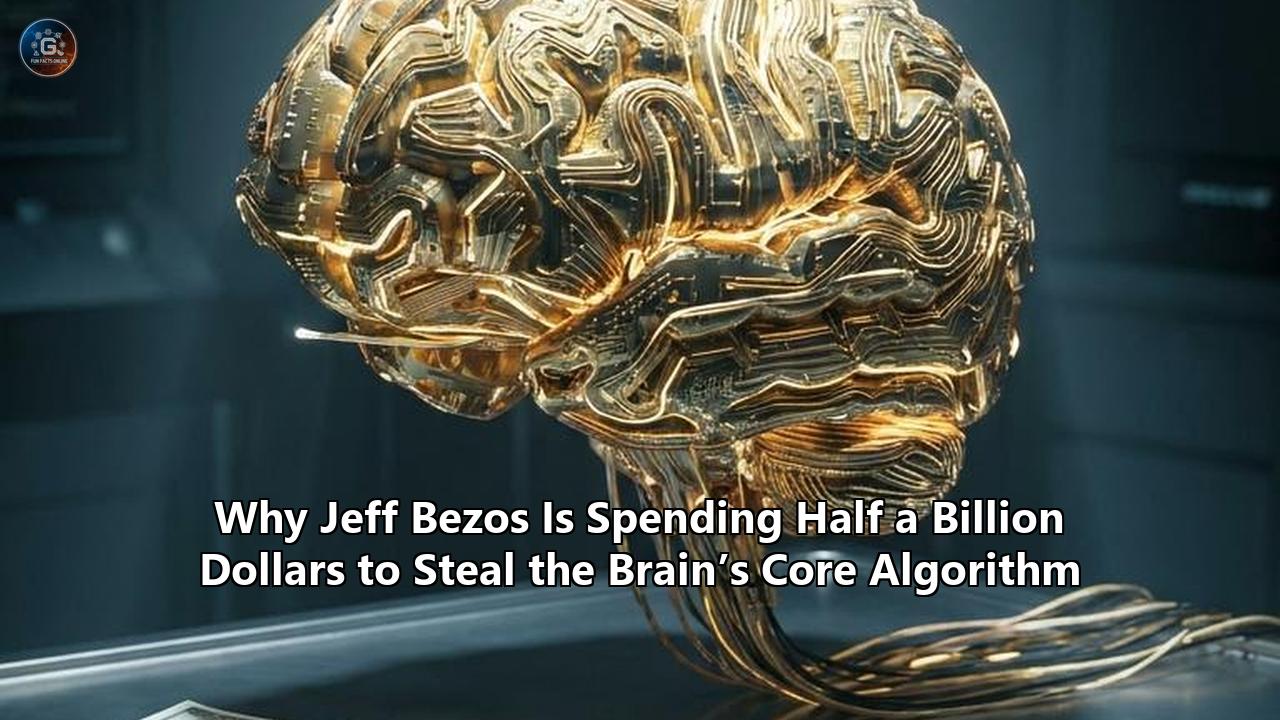
The answer lies in the acute power crisis grinding the frontier artificial intelligence industry to a halt. As hyperscalers compete for nuclear-power grids, massive water cooling systems, and gigawatt-scale data centers just to keep training their next-generation Large Language Models (LLMs), Bezos is funding a highly contrarian rebellion. He is betting half a billion dollars that the entire AI industry is optimizing at the wrong layer.
Rather than relying on brute force—building ever-larger silicon chips to process trillions of parameters—Flourish plans to reverse-engineer the biological architecture of the human brain to unlock what its founders call the brain's "core algorithm". They are building "Cortex AI," a system modeled after biological brain structures designed to run at just 20 to 50 watts of power. This is the energy envelope of a standard laptop or a single human brain, representing an order-of-magnitude energy efficiency improvement over modern GPU architectures.
The Cast: Teen Prodigies, S-Team Executives, and DeepMind Recruits
To understand why hard-nosed venture capitalists valued a product-less research lab at $2.5 billion, one must look at the minds behind the project. Flourish was co-founded by Thomas Reardon and Rob Williams.
Reardon's career has defied conventional tech trajectories. In the 1990s, he built Microsoft's Internet Explorer as a teenager. Seeking answers to how humans interact with technology, he walked away from pure software to earn a PhD in neuroscience from Columbia University. He then co-founded CTRL-labs, a brain-computer interface (BCI) company that designed non-invasive wristbands that translated motor neuron electrical impulses into digital inputs. Meta acquired CTRL-labs in 2019 for an estimated $1 billion, utilizing its technology to power the neural wristbands for their Reality Labs smart glasses.
After directing neuromotor interface research at Meta Reality Labs and serving as a venture partner at Lux Capital, Reardon is back. But this time, instead of using computers to read the brain, he is using the brain to rebuild the computer.
His co-founder, Rob Williams, brings a different kind of pedigree. Williams is a former senior executive from Amazon’s prestigious "S-team"—the tight-knit group of executives that advised Jeff Bezos directly on the company’s most critical strategic decisions. This S-team connection provided a direct line of trust to Bezos, giving him the confidence to anchor the massive $500 million round.
The co-founders have quietly assembled a formidable war room in SoHo, recruiting veteran talent like longtime DeepMind researcher Greg Wayne. They have staffed the company with roughly two dozen neuroscientists, computational biologists, and machine learning engineers working side-by-side. Their mission is singular: to stop approximating how the brain works with cartoonish mathematical abstractions and start physically studying its structural reality.
The Metabolic Insanity of Modern Silicon
The biological turn in AI is driven by a stark reality: modern artificial neural networks are built on a thermodynamic lie.
An NVIDIA H100 or B200 Blackwell GPU is an engineering marvel, containing billions of transistors packed into microscopic arrays. Yet, a single one of these chips consumes up to 700 to 1,200 watts of power during high-performance runs. A standard frontier AI training cluster—consisting of tens of thousands of these GPUs working in parallel—requires dedicated substations, drawing dozens or even hundreds of megawatts of electricity.
The biological brain, meanwhile, performs complex visual recognition, real-time motor control, linguistic reasoning, and continuous lifelong learning on a thermodynamic budget of roughly 20 watts—about the power draw of a single dim household lightbulb.
This massive efficiency gap is not a failure of semiconductor manufacturing; it is a structural failure of computer architecture. Modern computers are shackled to the Von Neumann bottleneck. This is the physical separation between the central processing unit (CPU or GPU) that executes instructions and the memory unit (DRAM or High Bandwidth Memory) that stores the data.
The Von Neumann Bottleneck (Silicon)
┌──────────────┐     Data Bus (High Energy Cost)     ┌──────────────┐
│ Compute Unit │ <=================================> │ Memory Unit  │
│  (CPU / GPU) │                                     │  (DRAM/HBM)  │
└──────────────┘                                     └──────────────┘

The Biological Synapse (Co-located)
┌───────────────────────────────────────────────────────────────────┐
│                        Synaptic Connection                        │
│                 Memory & Compute Co-located Here                  │
└───────────────────────────────────────────────────────────────────┘
In a typical transformer-based LLM, trillions of weight values must be shuttled back and forth between memory and compute cores during every single token generation step. The vast majority of the electricity consumed by an AI data center is wasted not on actual computation, but on the electrical capacitance required to charge the microscopic wires moving data across buses.
Biology does not separate memory from computation. In the brain, synapses—the connections between neurons—serve as both the storage device (memory) and the processing unit (logic gates). Computation occurs locally, right where the data resides.
Furthermore, modern AI models rely on dense computation. During a forward pass of a standard LLM, every single parameter in the model is activated to process a single word. If a model has 400 billion parameters, all 400 billion are mathematically computed for every token.
The brain operates on sparse, event-driven signaling. At any given millisecond, only a tiny fraction (often less than 1 to 2 percent) of your brain’s 86 billion neurons are firing action potentials. The system is largely quiet, only consuming power when there is a specific, local signal to process.
Flourish’s core wager is that the industry has spent billions optimizing the wrong layer of the stack. While companies like Groq, Cerebras, and Etched are building specialized silicon to speed up inference or run transformers more efficiently, they are still running the same brute-force, dense mathematical models. Flourish is going one level higher, aiming to copy the brain’s software architecture so it can run efficiently on standard, existing hardware.
Inside the Cortical Column: The Search for the "Core Algorithm"
How do you extract a software program from three pounds of wet, biological tissue? The answer is a field known as connectomics: the mapping of every individual neuron, axon, dendrite, and synapse within a biological brain.
Until recently, connectomics was considered a pipe dream. The brain is too dense, the synapses too small, and the imaging tools too slow. However, the field reached a watershed moment when researchers successfully emulated the entire brain of a fruit fly. By preserving, slicing, scanning, and digitally reconstructing 139,255 neurons and 50 million synaptic connections, scientists built a virtual insect brain that could navigate, walk, and respond to light with 91 percent accuracy to its biological counterpart—using only the mapped connectivity structure and neurotransmitter data, with no hand-coded behavior.
Flourish is bypassing simple insects and setting its sights on the mammalian neocortex. Specifically, they are focusing on cortical columns.
Cortical columns are repeating cylindrical microcircuits that run vertically through the mammalian neocortex. Each column is less than a millimeter in diameter and contains roughly 100,000 tightly packed neurons. Crucially, these columns are structurally identical, whether they reside in the visual cortex processing light, the auditory cortex processing sound, or the prefrontal cortex processing abstract language.
This structural uniformity has led neuroscientists to a stunning hypothesis: the neocortex uses a single, universal "core algorithm" to process every form of information. Whether you are reading a book, catching a baseball, or writing code, your brain is applying the exact same local mathematical computation over and over again, simply routing different sensory inputs to different columns.
Information Flow in the Canonical Cortical Column (Douglas & Martin Model)
┌─────────────────────────────────────────────────────────┐
│ Layer 1: Dendritic Inputs (Top-down feedback)           │
├─────────────────────────────────────────────────────────┤
│ Layers 2/3: Pyramidal Cells (Intra-cortical processing) │
├─────────────────────────────────────────────────────────┤
│ Layer 4: Granule Cells (Primary sensory input)          │
├─────────────────────────────────────────────────────────┤
│ Layers 5/6: Pyramidal Cells (Output to subcortex/motor) │
└─────────────────────────────────────────────────────────┘
Flourish's wet-lab in SoHo is designed to hunt down this core algorithm. Using ultra-high-resolution electron microscopes capable of resolving structures smaller than the wavelength of light, they slice tissue samples and capture the precise, three-dimensional physical networks of cortical columns.
The process of preparation is grueling:
- Tissue Fixation: Brain tissue is preserved using chemical fixatives to lock cellular structures in place.
- Staining: The tissue is stained with heavy metals (such as osmium and lead) to make cell membranes electron-dense.
- Ultramicrotomy: Using a diamond knife, the tissue is sliced into sections as thin as 30 nanometers.
- Electron Microscopy: These slices are imaged under automated TEMs to capture raw, high-resolution 2D pictures.
- AI Reconstruction: Flourish's computational team uses specialized convolutional neural networks (CNNs) to trace axons, dendrites, and classify synapses, creating a 3D digital map of the connectome.
By mapping how these columns are wired, Flourish’s computational team can reconstruct the mathematical logic of biological information processing. They are not looking to build virtual brains neuron-by-neuron on a massive supercomputer. Instead, they want to extract the mathematical principles of the cortical column and express them as software algorithms that can run on existing computer chips.
The Bezos Cognitive Unified Theory: Reprogramming Cells, Reconstructing Minds
Jeff Bezos’s nine-figure personal investment in Flourish is not an isolated speculative bet. It is part of a grander, unified investment thesis that treats biology as the ultimate computational platform. To understand why Bezos is funding a search for the brain's core algorithm, one must look at his other massive biological moonshot: Altos Labs.
Launched with $3 billion in capital, Altos Labs research is focused on cellular rejuvenation programming. The core scientific premise of Altos Labs research is biological reprogramming—a technology pioneered by Nobel laureate Shinya Yamanaka. By using specific proteins known as Yamanaka factors, scientists can reset older, stressed, or damaged cells back into a youthful, resilient state.
Bezos's Biological Computing Thesis
┌─────────────────────────────────────────┬─────────────────────────────────────────┐
│               Altos Labs                │                Flourish                 │
├─────────────────────────────────────────┼─────────────────────────────────────────┤
│ Targets: Cellular Epigenetic Code       │ Targets: Neural Connectome              │
│ Premise: Aging is a software error      │ Premise: Energy waste is a design error │
│ Method: Rejuvenate cells via OSKM       │ Method: Extract cortical math           │
└─────────────────────────────────────────┴─────────────────────────────────────────┘
Within the context of Altos Labs research, cells are treated as biochemical computers. The DNA is the hard drive, containing the read-only memory of the genome. The epigenome—the chemical marks on the DNA that dictate which genes are turned on or off—acts as the read-write memory. Over time, environmental noise and cellular stress degrade the write state of the epigenome, causing the cell to lose its functional identity, which we experience as aging. Altos Labs research seeks to rewrite this epigenetic program, executing a system restore to return the cell to its factory settings.
The intellectual overlap between Altos Labs research and Flourish's quest for Cortex AI is profound. Both projects reject the brute-force, artificial engineering models of the past. Why build massive, artificial carbon-scrubbing machines when you can program trees? Why build massive, gigawatt-scale silicon server farms when you can program the math of a 20-watt biological brain?
To Bezos, the human body and brain are not just biological organisms; they are the most sophisticated, self-assembling, self-repairing, ultra-efficient computing systems in existence. Just as Altos Labs research treats cellular decay as an information-processing problem, Flourish treats the energy inefficiency of modern AI as a failure to understand biological communication networks.
This "patient capital" allows researchers at both Altos Labs and Flourish to pursue fundamental, curiosity-driven science without the pressure of producing immediate commercial products or satisfying quarterly earnings reports. It is a return to the classic era of Bell Labs, where deep-pocketed patrons funded basic scientific inquiries that ultimately reshaped entire industries.
The Architectural Battleground: Neuromorphic Silicon vs. Algorithmic Software
The quest for brain-inspired computing has traditionally been dominated by hardware engineers. For years, the neuromorphic computing sector—led by major research programs like Intel's Loihi or IBM's TrueNorth—has focused on building specialized physical chips that mimic neural behavior in silicon.
These neuromorphic chips utilize physical transistors configured as artificial "neurons" and "synapses," processing electrical signals that mimic biological spikes. While these chips are highly energy-efficient, they suffer from a major commercial bottleneck: they require completely new, highly non-standard hardware architectures. They cannot run standard software frameworks, and integrating them into existing cloud infrastructure or consumer devices is an engineering nightmare.
Flourish is taking a fundamentally different approach. Instead of building physical, neuromorphic hardware, they are working at the algorithmic and mathematical layer.
If Flourish can successfully decode the mathematical principles of the cortical column, they can write software architectures that emulate these biological processes. These mathematical models can then be compiled and run on existing, widely distributed hardware—whether it is standard GPUs, CPUs, or the NPUs (Neural Processing Units) already built into modern smartphones and laptops.
This software-first approach is also what distinguishes Flourish from hardware-centric AI efficiency plays like Groq (which relies on LPU architectures for fast inference) or Etched (which prints specialized, hard-wired transformer ASICs). While those companies are building better engines to run the transformer algorithm, Flourish is building an entirely different kind of engine.
This algorithmic divergence centers on several key principles:
- Non-Differentiable Learning: Standard AI relies on backpropagation, which requires calculating global derivatives across the entire network to update weights. The brain cannot do this; it lacks a global supervisor. Instead, the brain uses local learning rules, such as Spike-Timing-Dependent Plasticity (STDP) and dendritic computation, to update synaptic strengths locally. By eliminating global backpropagation, Flourish can train models without keeping the entire network's weight states in memory, drastically reducing the active memory footprint.
- Hippocampal Memory Management: Flourish is already translating these biological insights into near-term software applications. The company is reportedly developing a memory management system inspired by the biological hippocampus.
In the human brain, the hippocampus acts as a temporary buffer, encoding new experiences throughout the day and gradually consolidating them into the neocortex for long-term storage during sleep. This allows the brain to learn continuously without overwriting old memories.
Modern AI models, by contrast, are static. Once a model is trained, its weights are frozen. If you want to teach it new information, you must run a costly "fine-tuning" process or retrain the model entirely from scratch. If you try to feed it new data directly, it suffers from "catastrophic forgetting," erasing its previous knowledge. By mimicking the hippocampus's dual-stage memory consolidation system, Flourish claims to have already built prototype models capable of continuous, online learning—adapting to new data in real-time without requiring massive retraining cycles.
The Geopolitical Shift: Demolishing the Energy Wall
If Jeff Bezos’s half-billion-dollar bet pays off, it will rewrite the geopolitical and economic maps of the AI industry.
The current artificial intelligence landscape is defined by capital intensity and physical constraints. The entities that control the future of AI are those that can afford to spend tens of billions of dollars on hardware, secure gigawatts of electrical grid capacity, and build massive cooling infrastructures. This has created a natural monopoly, concentrating frontier AI capabilities in the hands of a few tech giants and wealthy nation-states that can absorb these staggering infrastructure costs.
An AI that runs on 20 to 50 watts of power completely democratizes this landscape.
If a model with the reasoning capabilities of a frontier LLM can be deployed on a standard consumer device drawing the power of a laptop, the physical constraints of the AI boom evaporate. There is no longer a need for dedicated nuclear reactors to power massive training centers. The unit economics of running an AI query drop by orders of magnitude, making local, private, and highly personalized intelligence accessible to anyone with a smartphone.
Furthermore, it shifts the focus of the geopolitical tech race away from hardware manufacturing and energy access back toward algorithmic design. For years, US and international policies have focused on controlling the supply chain of high-end lithography machines (like ASML’s EUV systems) and advanced semiconductor fabrication facilities in Taiwan. But if the brain's core algorithm can run efficiently on older, less dense, or standard silicon, the strategic value of advanced semiconductor bottlenecks decreases.
Geopolitical Impact Matrix
┌─────────────────────────┬─────────────────────────────────────────┬─────────────────────────────────────────┐
│ Resource Constraint     │ Current Paradigm (Brute Force)          │ Brain-Inspired Paradigm (Flourish)      │
├─────────────────────────┼─────────────────────────────────────────┼─────────────────────────────────────────┤
│ Primary Compute Power   │ Megawatt-scale dedicated substations    │ 20-50 watts (consumer edge devices)     │
│ Hardware Bottleneck     │ Advanced nodes (TSMC CoWoS, ASML EUV)   │ Legacy nodes, standard architectures    │
│ Infrastructure Capital  │ Concentrated in hyperscalers/states     │ Decentralized, highly democratized      │
│ Environmental Footprint │ Massive carbon & water cooling demands  │ Negligible, runs within local grids     │
└─────────────────────────┴─────────────────────────────────────────┴─────────────────────────────────────────┘
The Road Ahead and Unresolved Scientific Questions
Despite the pedigree of the founders and the eye-watering size of the funding round, Flourish’s mission is one of the most high-risk scientific gambles in modern tech.
Many neuroscientists remain deeply skeptical that a single "core algorithm" for intelligence actually exists. The brain is a messy, biological organ shaped by millions of years of evolutionary compromises. It is entirely possible that the brain's efficiency is not the result of a single, elegant mathematical formula, but rather a complex, chaotic web of biological hacks, chemical pathways, and evolutionary vestigial structures that cannot be easily abstracted into silicon.
Moreover, mapping the connectome at synaptic resolution remains a monumentally difficult technical task. Slicing biological tissue, imaging it with electron microscopes, and using AI computer vision algorithms to trace the path of every branch and synapse is prone to errors. A single mismapped connection can completely alter the functional output of a simulated circuit.
Additionally, critics point out that the connectome alone is not enough. A static physical map of neural connections misses the dynamic layer of neuromodulators—chemical signals like dopamine, serotonin, and acetylcholine that diffuse across the brain and dynamically alter connection strengths on the fly. These chemicals act like a "wireless" network overlay on the wired connectome, modifying its behavior in ways a physical map cannot fully capture.
For AI practitioners and industry watchers, there are several key milestones to watch for over the next five years to see if Flourish's thesis holds water:
- Spiking Development Kits: Look for Flourish to release early software development kits (SDKs) that allow researchers to experiment with brain-inspired, sparse, or continuous-learning architectures on standard consumer hardware.
- Peer-Reviewed Benchmarks: Watch for academic publications demonstrating that their Cortex AI models can match or exceed the accuracy of standard transformer models on common benchmarks, particularly in tasks requiring continuous learning or multi-step reasoning.
- Physical Hardware Partnerships: Flourish is reportedly in talks with unnamed semiconductor manufacturers. The release of a standard processor optimized to run Flourish's mathematical models would be a major leap toward commercialization.
- Connectomics Discoveries: Pay close attention to whether Flourish’s in-house wet lab publishes original, peer-reviewed connectomics data mapping the mammalian neocortex. Even if they do not build a commercial AI, their basic scientific research could yield historic breakthroughs in our understanding of brain diseases and neural function.
Jeff Bezos’s massive investment is a declaration of war on the brute-force, data-center-heavy status quo of modern artificial intelligence. By funding a search for the brain's core algorithm, he is wagering that the future of intelligence will not be found in the scaling of bigger silicon chips, but in the elegant, quiet efficiency of biology. Whether this half-billion-dollar scientific treasure hunt succeeds or fails, it has already forced the tech world to look past the hardware race and confront a fundamental truth: the most powerful computer in the universe is still the one sitting inside our own heads.
Reference:
- https://hoodline.com/2026/06/bezos-bets-big-on-secretive-soho-lab-chasing-50-watt-ai-brain/
- https://greyjournal.net/news/flourish-ai-bezos-500-million-funding/
- https://www.aicerts.ai/news/jeff-bezos-bets-big-on-neuromorphic-ai-systems/
- https://cryptobriefing.com/flourish-500m-bezos-brain-ai-research/
- https://fundup.ai/recently-funded-startups/company/7646ce392640d55b72e4a57cca3cc50cb5d369f5a16da6c542b75bc9715511ac/flourish
- https://greyjournal.net/news/flourish-ai-bezos-500-million-funding/
- https://startup.economictimes.indiatimes.com/news/funding-deals/bezos-commits-nearly-100m-to-flourish-for-brain-inspired-ai/131546655
- https://cryptobriefing.com/flourish-500m-bezos-brain-ai-research/
- https://techfundingnews.com/bezos-flourish-500m-brain-inspired-ai-power-crisis/
- https://www.techtimes.com/articles/317921/20260606/jeff-bezos-bets-flourish-500-million-startup-trying-copy-brain-fix-ais-power-crisis.htm
- https://fenado.ai/articles/flourish-seeks-500-million-funding-at-25-billion-valuation-for-energy-efficient-ai
- https://www.techtimes.com/articles/317921/20260606/jeff-bezos-bets-flourish-500-million-startup-trying-copy-brain-fix-ais-power-crisis.htm
- https://pulse2.com/flourish-500-million-at-2-5-billion-valuation-raised-to-reinvent-ai-by-decoding-the-brains-core-algorithm/
- https://eon.systems/
- https://www.forbes.com/sites/josipamajic/2025/11/19/science-is-bottlenecked-by-institutions-not-talent/
- https://siliconvalley.um.dk/media/zkpcwegv/future_of_longevity_icdk_silicon_valley.pdf
- https://www.pharmaceutical-technology.com/features/billionaires-anti-ageing-research/
- https://www.reddit.com/r/longevity/comments/1fnqay8/new_partial_reprogramming_result_from_altos_labs/
- https://thenextweb.com/news/flourish-reardon-brain-inspired-ai-efficiency
- https://pulse2.com/flourish-500-million-at-2-5-billion-valuation-raised-to-reinvent-ai-by-decoding-the-brains-core-algorithm/
- https://agenticaihype.substack.com/p/anthropic-files-to-go-public-at-965b
- https://www.geekwire.com/2011/amazon-founder-brainiac-jeff-bezos-donates-15-million-princeton-neuroscience-institute/
- https://meteoraweb.com/en/news/ai-everywhere-health-productivity-courts-and-the-human-brain-june-2026-updates