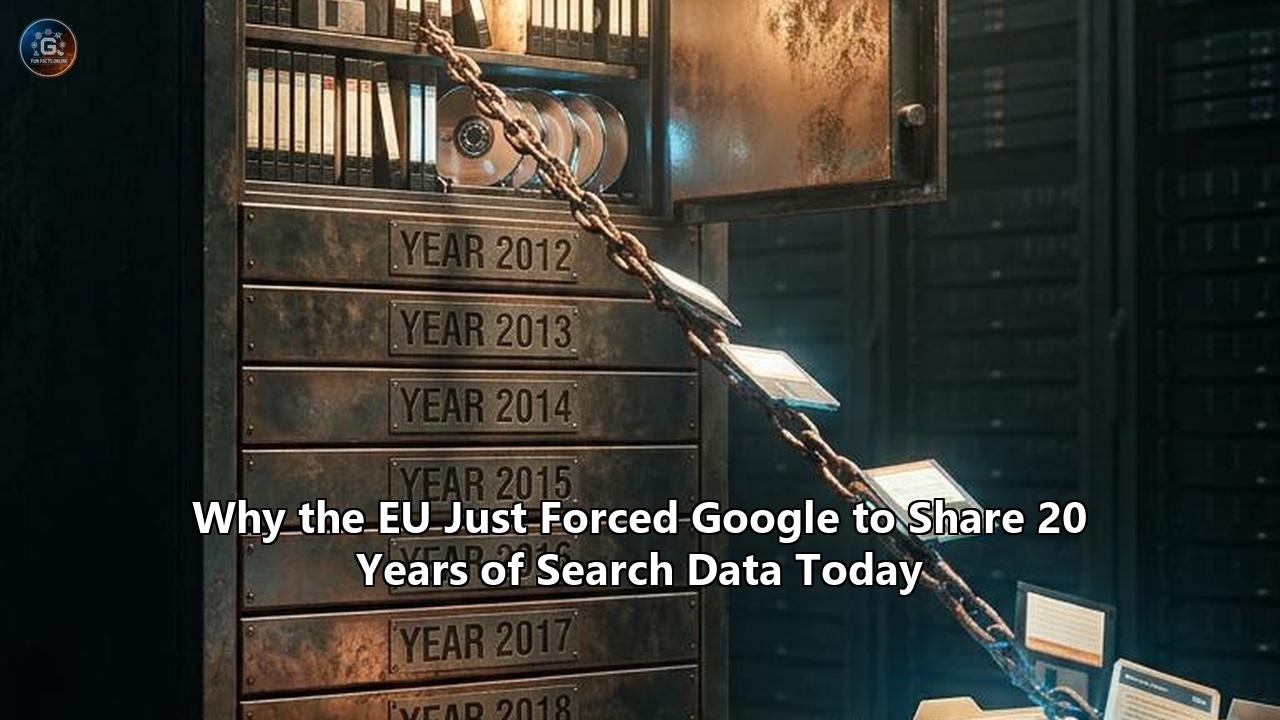
The European Commission rendered two legally binding specification decisions under the Digital Markets Act (DMA) against Alphabet Inc.. The primary ruling mandates that Google must share its proprietary search data—comprising more than 20 years of accumulated query, click, view, ranking, and result-position logs—with competing online search engines and AI chatbots.
Under the second decision, Google is ordered to dismantle system-level barriers on its Android operating system, forcing the platform to grant rival AI assistants the exact same hardware and software integrations currently enjoyed by Google’s native Gemini assistant.
The decision marks a turning point in digital competition policy. By enforcing Article 6(11) and Article 8(2) of the DMA, Brussels is moving beyond financial penalties to order the structural sharing of core data assets. The binding measures establish a firm compliance calendar: Google must begin sharing search data with qualified competitors by January 2027, with Android interoperability mandates taking effect in July 2027. Failure to comply exposes Alphabet to severe enforcement mechanisms, including fines of up to 10% of its total global annual turnover.
"Thanks to these measures, we hope to see emerging alternatives to Google Search and Google's AI services, such as Gemini, and that users in the EU can enjoy greater choice of services," stated Henna Virkkunen, Executive Vice President of the European Commission overseeing tech policy.
Alphabet mounted an immediate defense, arguing that the mandatory data transfers threaten the fundamental privacy of European citizens.
"Europeans' private searches would be exposed to unfamiliar companies, without adequate anonymisation of the data and without user knowledge or consent," warned Kent Walker, President of Global Affairs at Alphabet. "This would weaken citizens' privacy, risk business trade secrets, and endanger national security."
This regulatory enforcement illustrates the global divergence in digital governance. As Brussels applies its proactive framework, this enforcement action under EU Google antitrust regulation establishes a precedent for how governments manage data scale, market entry, and the competitive landscape of generative artificial intelligence.
+-----------------------------------------------------------------------------------+
|                        EU DIGITAL MARKETS ACT: ARTICLE 6(11)                      |
|                                DATA ACCESS MANDATE                                |
+-----------------------------------------------------------------------------------+
                                         |
                                         v
+-----------------------------------------------------------------------------------+
|                            ALPHABET / GOOGLE SEARCH LOGS                          |
|             (20+ Years of Historical Queries, Clicks, Views, & Rankings)           |
+-----------------------------------------------------------------------------------+
                                         |
                 +-----------------------+-----------------------+
                 |                                               |
                 v                                               v
+----------------------------------+           +----------------------------------+
|  MULTI-LAYERED ANONYMIZATION     |           |  FRAND LICENSING FRAMEWORK       |
|  - k-Anonymity & Suppression     |           |  - Fair, Reasonable, & Non-      |
|  - Differential Privacy Filters  |           |    Discriminatory Terms          |
|  - Removal of Identifiers        |           |  - Cost-Oriented Fee Structure   |
+----------------------------------+           +----------------------------------+
                 |                                               |
                 +-----------------------+-----------------------+
                                         |
                                         v
+-----------------------------------------------------------------------------------+
|                              ELIGIBLE BENEFICIARIES                               |
|        Requirements: 50k+ EU Users | 2-Yr Track Record or Investment Test      |
|                        Independent Security Audit                                 |
+-----------------------------------------------------------------------------------+
                 |                                               |
                 v                                               v
+----------------------------------+           +----------------------------------+
|    TRADITIONAL SEARCH ENGINES    |           |   GENERATIVE AI CHATBOTS & RAG   |
|   (Bing, DuckDuckGo, Ecosia)     |           |   (Perplexity, OpenAI, Mistral)  |
|  - Train Learning-to-Rank        |           |  - Live Search Grounding         |
|  - Improve Index Coverage        |           |  - Query Intent Optimization     |
+----------------------------------+           +----------------------------------+
Unpacking the Surrendered Asset: Ranking, Query, and Click Data
To understand why this ruling is significant, one must first look at the asset Google is being forced to share. Search data is not merely a passive record of historical text entries; it is a continuous, dynamic training corpus that drives modern information retrieval.
For more than two decades, Google Search has processed trillions of queries. Every interaction generates a rich stream of behavioral telemetry:
- Query Logs: The exact phrases, typos, long-tail questions, and localized search strings entered by users.
- Click Data: Which specific URLs users clicked after seeing a list of results.
- View and Positional Data: How long a user stayed on a page (dwell time), whether they bounced back to the search page (pogo-sticking), and how high a specific result was ranked when clicked.
- Metadata Context: Device types, language settings, approximate geographic region, and temporal distribution.
In modern search architecture, this interaction data forms the backbone of machine-learning models known as "learning-to-rank" (LTR) systems. Algorithmic code alone cannot determine whether a newly published web page satisfies user intent for a ambiguous query. It requires real-world feedback loops. When millions of users search for a term and consistently click the third link instead of the first, Google’s algorithms automatically adjust the ranking of that result. This continuous, self-reinforcing feedback loop creates a massive scale advantage: more users generate more interaction data, which produces better search rankings, attracting even more users.
+-----------------------------------------------------------------------------------+
|                        THE SEARCH DATA FEEDBACK LOOP                              |
+-----------------------------------------------------------------------------------+
|                                                                                   |
|    +--------------------+       More Searches       +-----------------------+     |
|    |  Trillions of User | ------------------------> | Vast Behavioral Data  |     |
|    |      Queries       |                           |  (Clicks, Views, LTR) |     |
|    +--------------------+                           +-----------------------+     |
|              ^                                                  |                 |
|              |                                                  |                 |
|   Attracts   |                                                  v     Refines     |
|  More Users  |                                          +-----------------------+ |
|              |                                          | Optimized Ranking &   | |
|              |                                          |  Search Relevance     | |
|              +----------------------------------------- |                       | |
|                                                         +-----------------------+ |
+-----------------------------------------------------------------------------------+
Critically, the European Commission’s specification decision explicitly extends this data access obligation to AI chatbots offering search features. This bridges traditional information retrieval and modern generative AI. Large Language Models (LLMs) rely on a process called Retrieval-Augmented Generation (RAG) to answer real-time, factual questions without hallucinating. When an AI agent generates an answer, it uses search engines to pull current web data—a process Google internally optimizes via systems like FastSearch.
Without access to real-time query intent logs and click-verified web indices, third-party AI search engines struggle to match the speed, relevance, and accuracy of Google's Gemini. The EU's mandate compels Google to surrender the exact behavioral dataset required to train, validate, and ground competing AI models.
Google is not required to turn over its source code, proprietary neural network parameters, or underlying ranking algorithms. It must, however, share the raw behavioral inputs that allowed those algorithms to become so accurate.
Comparing Regulatory Philosophies: Brussels’ Ex-Ante DMA vs. Washington’s Ex-Post Antitrust Remedies
The decision highlights the stark contrast between European and American approaches to regulating dominant technology companies. Examining these competing enforcement models reveals two fundamentally different theories of market regulation.
+----------------------------------------------------------------------------------------------------+
|                                STRUCTURAL COMPARISON OF REGULATORY MODELS                          |
+-----------------------------------+--------------------------------+-------------------------------+
| COMPONENT                         | EU DIGITAL MARKETS ACT (DMA)   | US ANTITRUST JUDICIAL REMEDY  |
+-----------------------------------+--------------------------------+-------------------------------+
| Legal Basis                       | Article 6(11) DMA (Ex-Ante)    | Section 2 Sherman Act         |
| Core Focus                        | Contestability & Opportunity   | Proven Anticompetitive Harm   |
| Scope of Data Mandate             | Sector-Wide Search & AI Logs   | Targeted Datasets             |
| Trigger Mechanism                 | Statutory Gatekeeper Status    | Ex-Post Judicial Finding      |
| Anonymization Approach            | Multi-Layered Regulatory Rule  | Technical Committee Cap       |
+-----------------------------------+--------------------------------+-------------------------------+
The European Union: Ex-Ante Structural Intervention
The DMA operates on an ex-ante basis. Regulators do not need to wait for a company to engage in an illegal act or prove specific consumer harm in a court of law. Instead, companies meeting criteria regarding revenue, market capitalization, and user counts are designated as "gatekeepers."
Under Article 6(11) of the DMA, gatekeepers managing core online search engines are automatically subject to data-sharing mandates. The law assumes that market concentration in search is inherently self-perpetuating due to network effects and data scale advantages. The goal of EU Google antitrust regulation is to proactively lower barriers to entry, making the market structurally contestable.
The EU approach treats search interaction data almost like a public utility or essential facility. By requiring continuous, real-time access on fair, reasonable, and non-discriminatory (FRAND) terms, Brussels aims to eliminate the structural advantage that decades of market dominance have provided.
The United States: Ex-Post Judicial Remedies
In contrast, antitrust enforcement in the United States relies on an ex-post judicial model. In the landmark U.S. v. Google litigation overseen by Judge Amit Mehta in the D.C. District Court, remedies are tied to specific, proven violations of Section 2 of the Sherman Act. The court found that Google maintained an illegal monopoly through exclusionary distribution contracts—such as paying billions of dollars to Apple and Android phone manufacturers to be the default search engine.
When evaluating data-sharing remedies, Judge Mehta’s approach was much narrower than the EU's. US remedies focus strictly on eliminating the specific benefits gained from unlawful default agreements. For example, the US court considered requiring Google to share access only to specific underlying click-and-query datasets—such as the "Glue" and "RankEmbed" systems—that feed Google's ranking components.
Furthermore, US judicial remedies incorporate anti-mimicry safeguards. The US court recognized that forcing a company to share all its data could allow competitors to clone its product, undermining their incentive to build independent technology. The US approach uses data caps, specific oversight committees, and narrow access rules designed to help rivals improve long-tail queries without handing them a complete duplicate of Google’s search engine.
The Core Tradeoff
This divergence presents a central regulatory tradeoff:
- The EU Model prioritizes immediate market contestability and competitor access. Its broader scope gives emerging search engines and AI startups immediate access to user signals. However, it carries significant compliance burdens, creates complex privacy risks under GDPR, and risks turning third-party search engines into dependent redistributors of Google’s underlying data stream.
- The US Model prioritizes preserving long-term innovation incentives and protecting trade secrets. By tying remedies strictly to proven illegal conduct, it avoids broad regulatory intervention. However, its slow, multi-year court cases mean that by the time remedies are ordered, market dynamics may have shifted—such as the transition from standard search bars to AI-driven generative search interfaces.
The Anonymization Paradox: Privacy Safeguards vs. Data Utility
The mandate creates a direct tension between two major EU legal frameworks: the competitive access requirements of the Digital Markets Act (DMA) and the privacy mandates of the General Data Protection Regulation (GDPR).
+-----------------------------------------------------------------------------------+
|                        THE ANONYMIZATION TRADE-OFF PARADOX                        |
+-----------------------------------------------------------------------------------+
|                                                                                   |
|     HIGH DATA UTILITY                                       HIGH PRIVACY          |
|    (Low Anonymization)                                  (Heavy Anonymization)     |
|                                                                                   |
|  * Includes Rare / Long-Tail Queries               * Strips Unique Queries        |
|  * Retains Specific Search Patterns                * Applies High k-Anonymity     |
|  * Maximum Value for AI Training                   * Removes Identifiers          |
|                                                                                   |
|  [----------------------------------------------------------------------------]   |
|  | RISKS:                                            | RISKS:                 |   |
|  | - GDPR Violations                                 | - Excludes ~99% Data   |   |
|  | - Re-identification of Users                      | - Destroys Utility for |   |
|  | - Exposure of Sensitive Searches                  |   Emerging Competitors |   |
|  [----------------------------------------------------------------------------]   |
|                                                                                   |
+-----------------------------------------------------------------------------------+
Article 6(11) of the DMA requires that any query, click, or view data that constitutes personal data must be anonymized before it is shared. Achieving effective anonymization while preserving the data's competitive value is a complex technical challenge.
The Technical Dilemma of Anonymizing Search Queries
Search queries are uniquely revealing window into human intent. Unlike structured database records, search queries often contain deeply personal, identifiable information. Users routinely type their own names, national identification numbers, unique medical conditions, specific street addresses, or private corporate financial data directly into search boxes.
Under EU legal doctrine, anonymization requires meeting a high legal bar: the process must make re-identification impossible, even if the data is combined with external datasets. True anonymization falls outside the scope of GDPR; however, pseudonymized data remains fully subject to GDPR strictness.
Google argues that effectively anonymizing search queries requires stripping out all "unique" or low-frequency searches—the long tail of search traffic. Because unique queries appear only once or twice across millions of searches, they carry a high statistical risk of re-identification.
Google notes that removing all unique queries eliminates up to 99% of all distinct search terms from the shared dataset. This creates a paradox:
- If Google applies aggressive privacy filtering to eliminate all potential re-identification risks, it destroys the long-tail search data that competing search engines and AI assistants need most.
- If Google releases less aggressively filtered data to preserve utility, it risks exposing European citizens' private searches to third-party companies, violating GDPR principles.
The European Commission’s Multi-Layered Approach
To resolve this paradox, the European Commission’s specification decision mandates a multi-layered anonymization process that combines technical processing with legal safeguards:
- Differential Privacy & k-Anonymity: Technical filters that automatically aggregate query data. Queries are suppressed unless they meet a minimum threshold of identical instances across a specific population segment.
- Identifier Suppression: Mandatory stripping of user account details, IP addresses, precise geolocations, exact timestamps, and device serial numbers.
- Contractual and Operational Guardrails: Beneficiaries must sign binding legal agreements prohibiting any attempt to re-identify individuals or use search data for targeted advertising. Data can only be used to refine online search and AI retrieval functions.
- Independent Security Audits: Recipients must undergo third-party technical reviews to ensure their data ingestion pipelines comply with European data protection standards.
Alphabet's leadership remains unconvinced. Kent Walker highlighted that distributing user search logs to third parties creates privacy and security vulnerabilities. "Europeans' private searches would be exposed to unfamiliar companies, without adequate anonymisation of the data and without user knowledge or consent," Walker asserted.
This privacy counter-argument illustrates how gatekeeper platforms can use privacy compliance as a strategic defense against regulatory data-sharing mandates.
Legacy Search Engines vs. Next-Generation AI Search Engines
The decision to open 20 years of search interaction data creates a complex matrix of winners, losers, and emerging beneficiaries. How different industry players are positioned to capitalize on this data mandate varies across the competitive landscape.
+----------------------------------------------------------------------------------------------------+
|                             BENEFICIARY CAPABILITY & IMPACT MATRIX                                 |
+-----------------------------------+--------------------------------+-------------------------------+
| CATEGORY                          | LEGACY ALTERNATIVE SEARCH      | NEXT-GEN GENERATIVE AI        |
+-----------------------------------+--------------------------------+-------------------------------+
| Primary Representatives           | Bing, DuckDuckGo, Ecosia       | Perplexity, OpenAI, European  |
|                                   | Qwant                          | AI Scale-ups (e.g., Mistral)  |
+-----------------------------------+--------------------------------+-------------------------------+
| Primary Data Use Case             | Refine Learning-to-Rank (LTR); | Grounding LLM Responses;      |
|                                   | Expand Web Indexing            | Optimizing RAG Pipelines      |
+-----------------------------------+--------------------------------+-------------------------------+
| Existing Infrastructure           | High (Crawlers & Indices)      | Low-to-Moderate (Indexing)    |
+-----------------------------------+--------------------------------+-------------------------------+
| Ability to Ingest Data           | Immediate Ingestion Capacity   | Requires Technical Adaption   |
+-----------------------------------+--------------------------------+-------------------------------+
| Regulatory Threshold Readiness    | Readily Clears 50k User Floor  | Needs Growth or Consortiums   |
+-----------------------------------+--------------------------------+-------------------------------+
Established Search Engines: Immediate Ingestion Capabilities
Legacy alternative search engines—such as Microsoft Bing, DuckDuckGo, Ecosia, and France’s Qwant—stand to gain immediate benefits. These entities already operate active Web crawling infrastructure, maintenance pipelines, and ranking engines.
For companies like DuckDuckGo and Ecosia, which historically relied heavily on syndicated search feeds from Bing or Google, access to raw ranking, query, and click data allows them to build truly independent ranking models. They possess the engineering capacity to immediately feed Google’s anonymized click telemetry into their own learning-to-rank algorithms. This helps eliminate the historical relevancy gap for non-English queries, localized European searches, and complex long-tail topics.
Generative AI and Search-Enabled Chatbots: Grounding and Query Intent
The decision specifically grants access to AI chatbots offering search functionality, extending the mandate beyond traditional query-and-link search engines.
For AI search engines like Perplexity, OpenAI’s search capabilities, or emerging European AI scale-ups like Mistral, raw search log data addresses a fundamental vulnerability: context retrieval. When a user asks an AI assistant a complex question, the AI must translate that prompt into optimized search queries to retrieve relevant web documents. Access to two decades of query patterns and user click validation gives AI developers a massive dataset to train query-formulation and document-reranking models.
This levels the playing field against Google's Gemini. By utilizing Google’s click-through data to evaluate web page authority, third-party AI agents can generate grounded, factually accurate answers without needing to independently discover which web sources real users trust.
Regulatory Thresholds and Safeguards
To prevent data misuse, the European Commission established strict eligibility criteria:
+-----------------------------------------------------------------------------------+
|                        DMA ARTICLE 6(11) ACCESS QUALIFICATION                     |
+-----------------------------------------------------------------------------------+
                                         |
                                         v
                      +-------------------------------------+
                      |  APPLICANT SEARCH OR AI PROVIDER    |
                      +-------------------------------------+
                                         |
                                         v
+-----------------------------------------------------------------------------------+
|  STEP 1: USER & ESTABLISHMENT THRESHOLD                                           |
|  - Must maintain at least 50,000 monthly active users in the EU                   |
|  - Must possess 2-year operating history OR pass an approved Investment Test     |
+-----------------------------------------------------------------------------------+
                                         |
                                         v
+-----------------------------------------------------------------------------------+
|  STEP 2: SECURITY & COMPLIANCE SCREENING                                          |
|  - Mandatory independent cybersecurity infrastructure audit                       |
|  - Verified EEA organizational presence or legal representation                   |
+-----------------------------------------------------------------------------------+
                                         |
                                         v
+-----------------------------------------------------------------------------------+
|  STEP 3: RESTRICTED PURPOSE BINDING AGREEMENT                                     |
|  - Sole purpose: Enhancing search and AI retrieval functions                      |
|  - Strictly PROHIBITED: Ad targeting, profiling, or re-identification             |
+-----------------------------------------------------------------------------------+
                                         |
                                         v
                      +-------------------------------------+
                      |    AUTHORIZED DATA ACCESS GRANTED   |
+-------------------------------------+- User Floor Threshold: Applicants must demonstrate a base of at least 50,000 active monthly users within the European Economic Area (EEA).
- Operational Capability: Companies must show either a two-year operational history in online search or pass a rigorous investment test demonstrating technical capacity to ingest and utilize the data.
- Security Audits: Entities must pass independent cybersecurity screening to ensure their infrastructure can handle large-scale datasets securely.
- Purpose Limitation: Recipients are strictly prohibited from utilizing the shared data for targeted advertising, individual user profiling, or commercial activities outside of search and retrieval optimization.
Ecosystem Neutrality: Android Operating System Interoperability
While the search data mandate captured headline attention, the European Commission’s simultaneous ruling on Android ecosystem access represents an equally significant application of EU Google antitrust regulation.
+-----------------------------------------------------------------------------------+
|                     ANDROID HARDWARE & OPERATING SYSTEM LAYER                     |
+-----------------------------------------------------------------------------------+
                                         |
                 +-----------------------+-----------------------+
                 |                                               |
                 v                                               v
+----------------------------------+           +----------------------------------+
|  PREVIOUSLY RESTRICTED TO GEMINI |           | MANDATED UNDER DMA (JULY 2027)   |
+----------------------------------+           +----------------------------------+
|  - Hotword Hardware Activation   |           |  - Equal Access for Third-Party  |
|    ("Hey Google")                |             AI Assistants (OpenAI, Perplexity) |
|  - System Intent Triggers        |           |  - Native Hotword Mapping        |
|  - App-Level Background Execution|           |  - Cross-App System Interoperability|
|  - Contextual On-Screen Queries  |           |  - System-Level Preference Toggle|
+----------------------------------+           +----------------------------------+
Historically, operating systems have served as gatekeeping chokepoints. On Android, which powers roughly 60% of the European smartphone market, Google integrated its native Gemini assistant directly into the core user experience. Gemini enjoyed exclusive platform advantages, including:
- Native voice-activation triggers listening at the hardware level (e.g., long-pressing the power button or "Hey Google" hotword detection).
- Deep background execution permissions allowing it to complete tasks across third-party apps—such as reserving tables, booking flights, or composing messages.
- Contextual screen awareness, allowing the assistant to read on-screen text and summarize content instantly.
Third-party AI assistants, by contrast, were relegated to standard app status. They could not access low-level system APIs, execute background app tasks, or map custom hardware triggers, creating a artificial friction for competitors.
The Commission’s specification decision under the DMA forces Google to make these system features fully interoperable by July 2027. Under the binding rules:
- System-Level Assistant Choice: European consumers must be given a clear choice to select any installed third-party AI assistant as their default system assistant.
- Equal Hardware Access: System voice triggers and hardware buttons must map seamlessly to whichever assistant the user chooses.
- Cross-App Execution APIs: Third-party AI agents must be granted secure APIs to perform background actions across apps, placing them on equal technical footing with Gemini.
This requirement alters mobile device economics. By stripping Google of its home-field advantage on Android, the EU is attempting to prevent Google from extending its search monopoly into the emerging market for hardware-integrated AI agents.
Economic Tradeoffs, Innovation Incentives, and FRAND Licensing
The imposition of mandatory data sharing introduces complex economic questions regarding property rights, capital investment, and pricing models.
+-----------------------------------------------------------------------------------+
|                        FRAND PRICING & INCENTIVE BALANCING                        |
+-----------------------------------------------------------------------------------+
                                         |
                 +-----------------------+-----------------------+
                 |                                               |
                 v                                               v
+----------------------------------+           +----------------------------------+
|    COST-BASED BENCHMARKING       |           |   INNOVATION & CAPITAL INCENTIVES|
+----------------------------------+           +----------------------------------+
|  * Covers Incremental Costs of   |           |  * Prevents Excessive Rent-      |
|    Anonymization & Distribution  |             Seeking                        |
|  * Prevents Prohibitive Pricing  |           |  * Preserves Capital Investment  |
|    Designed to Block Competitors |             in Infrastructure              |
|  * Subject to EC Oversight       |           |  * Avoids Free-Rider Disincentive|
+----------------------------------+           +----------------------------------+
The FRAND Pricing Mechanics
Article 6(11) specifies that access to search data must be provided on "fair, reasonable, and non-discriminatory" (FRAND) terms. However, translating FRAND principles into concrete financial agreements for dynamic data streams is notoriously difficult.
If Google charges market rates based on the value of its search data, small competitors and open-source AI initiatives will be priced out. Conversely, if the European Commission mandates near-zero, marginal-cost pricing, it effectively forces Google to subsidize the core research and development pipelines of its direct rivals.
The European Commission’s specification framework addresses this by tying FRAND fees directly to Google’s cost of compliance:
- Google can charge fees that reflect the actual, audited cost of processing, anonymizing, serving, and maintaining the data infrastructure.
- Google cannot include monopoly rents or artificial premiums in its pricing structure.
- Dispute resolution mechanisms are built in, allowing third parties to challenge access fees before European regulators if they believe pricing is being used as a barrier to access.
The Innovation Incentives Debate
Economists and policy experts remain divided on the long-term impact of mandatory data sharing. Organizations like the International Center for Law & Economics (ICLE) argue that forcing successful tech companies to turn over core assets creates a classic free-rider problem.
If an enterprise invests billions of dollars in server infrastructure, network connections, web crawlers, and product features to attract users, only to be forced to share the resulting data assets with competitors, its incentive to invest in capital-intensive breakthroughs decreases. Furthermore, data access alone does not guarantee competitive success. Data displays diminishing returns if a competitor lacks the computing capacity, index size, and talent needed to utilize it effectively.
Proponents of the EU approach, including digital rights advocacy groups and independent search operators, counter that network effects in digital markets are so powerful that traditional competition is impossible without structural data intervention. From this perspective, data sharing is not a penalty, but a necessary correction to reopen locked markets and foster long-term innovation.
Global Precedents and the January 2027 Horizon
The European Commission's decision sets off a high-stakes timeline that will redefine digital antitrust enforcement worldwide.
+-----------------------------------------------------------------------------------+
|                           DMA COMPLIANCE TIMELINE & MILESTONES                    |
+-----------------------------------------------------------------------------------+
|                                                                                   |
|  JULY 16, 2026: European Commission Issues Binding Specification Decisions        |
|  |                                                                                |
|  v                                                                                |
|  FALL 2026: Expected Alphabet Legal Appeal Filing at the CJEU                     |
|  |                                                                                |
|  v                                                                                |
|  JANUARY 2027: Mandatory Search Data Sharing Implementation Deadline              |
|  |                                                                                |
|  v                                                                                |
|  JULY 2027: Mandatory Android AI Assistant Interoperability Implementation        |
|                                                                                   |
+-----------------------------------------------------------------------------------+
The Compliance Roadmap and Legal Appeals
Alphabet is widely expected to appeal the specification decisions to the Court of Justice of the European Union (CJEU). However, under the DMA’s legal framework, filing an appeal does not suspend the implementation timetable.
Unless the CJEU grants an emergency interim stay, Google must proceed with technical implementation:
- January 2027: Google must launch its operational data pipelines, allowing qualified third-party search engines and AI assistants to ingest anonymized ranking, query, click, and view data on FRAND terms.
- July 2027: Google must complete API updates on Android, granting alternative AI agents full voice-trigger and hardware-button access.
Should Google fail to satisfy the Commission's measures, regulators can initiate formal non-compliance proceedings, potentially resulting in daily periodic penalty payments or fines up to 10% of Alphabet's global annual revenue.
Global Jurisdictional Fallout
The impact of this ruling extends far beyond Brussels. Competition authorities worldwide are evaluating the EU’s binding specification model:
- United Kingdom: The Competition and Markets Authority (CMA), utilizing its Digital Markets, Competition and Consumers (DMCC) Act powers, is closely watching the EU's data-sharing protocols to inform its own targeted interventions.
- Japan and South Korea: Both nations have enacted gatekeeper regulations targeting mobile platform ecosystems and search monopolies, positioning them to adopt similar data access frameworks.
- United States: The decision adds complexity to US-EU trade relationships. Officials in Washington have expressed concerns over European regulations targeting American tech firms. Yet, at the same time, the US Department of Justice continues to push forward with its own court-mandated remedies following its antitrust victory over Google Search.
+-----------------------------------------------------------------------------------+
|                        GLOBAL REGULATORY RIPPLE EFFECTS                           |
+-----------------------------------------------------------------------------------+
|                                                                                   |
|    UNITED STATES                 EUROPEAN UNION                REST OF WORLD      |
|  (DOJ Judicial Action)        (DMA Article 6(11))          (UK DMCC, Japan, SK)   |
|                                                                                   |
|  * Ex-Post Remedies           * Ex-Ante Data Sharing       * Hybrid Frameworks    |
|  * Targeted Datasets          * Mandatory AI Interop.      * Platform Regulation  |
|  * Judicial Oversight         * January 2027 Deadline      * Interoperability     |
|                                                                                   |
|  [----------------------------------------------------------------------------]   |
|  | GLOBAL MATRIX IMPACT:                                                      |   |
|  | - Forces Tech Giants to Architectural Neutrality                           |   |
|  | - Establishes Global Anonymization & Data Transfer Standards               |   |
|  | - Reshapes Global Competition for Next-Gen Artificial Intelligence         |   |
|  [----------------------------------------------------------------------------]   |
|                                                                                   |
+-----------------------------------------------------------------------------------+
What to Watch Next
As the January 2027 compliance deadline approaches, market analysts, AI developers, and legal experts will focus on several key indicators:
- The Anonymization Threshold Benchmark: How the European Commission and national data protection authorities evaluate Google's anonymization filters, and whether those filters preserve enough long-tail data to satisfy third parties.
- Third-Party Data Uptake: Which qualified search engines and AI startups actively sign data-access agreements, and whether this access translates into measurable shifts in search market share or improved AI grounding accuracy.
- Android AI Integration Dynamics: How major AI developers modify their mobile applications to take advantage of Android's opened system APIs ahead of the July 2027 deadline.
This enforcement action under EU Google antitrust regulation represents a landmark effort to dismantle digital network monopolies. By forcing the surrender of behavioral data, the European Union is attempting to build a digital economy where market position is determined by technological innovation rather than control over data. Whether this bold regulatory experiment succeeds in fostering genuine competition without compromising user privacy remains the central question facing the global digital economy.
References
- European Commission. (2026, July 16). Commission Decision on measures to ensure effective compliance by Alphabet with search data sharing obligations under Article 6(11) of the Digital Markets Act (DMA.100209). Directorate-General for Competition. https://ec.europa.eu/competition/
- European Commission. (2026, July 16). Commission Decision on specification measures for Alphabet regarding Android interoperability for AI assistants under Article 8(2) DMA. Directorate-General for Competition.
- European Parliament & Council of the European Union. (2022). Regulation (EU) 2022/1925 of 14 September 2022 on contestable and fair markets in the digital sector (Digital Markets Act). Official Journal of the European Union, L 265/1.
- U.S. District Court for the District of Columbia. (2025, September 3). United States v. Google LLC, Civil Action No. 20-3010 (APM). Memorandum Opinion on Equitable Remedies.
- International Center for Law & Economics (ICLE). (2026, April 16). Comments of the International Center for Law & Economics on the European Commission's Proposed Specification Measures for Alphabet Under Article 6(11) DMA. ICLE Policy Papers.
- Ribera Martínez, A., & Botta, M. (2026, June 19). Anonymisation vs. Data Utility under Article 6(11) DMA: Balancing Privacy and Market Contestability. Wolters Kluwer Competition Law Blog.
Reference:
- https://eutechloop.com/eu-orders-google/
- https://www.dataguidance.com/news/eu-european-commission-issues-binding-specification
- https://www.searchenginejournal.com/google-must-share-anonymized-search-data-with-rivals/582922/
- https://dig.watch/updates/eu-commission-google-android-search-under-dma
- https://digital-markets-act.ec.europa.eu/dma100209-consultation-proposed-measures-google-search-data-sharing_en
- https://truthonthemarket.com/2025/09/03/comparing-the-eu-dma-to-the-search-query-data-sharing-remedy-in-us-v-google/
- https://siliconangle.com/2026/07/16/eu-orders-google-share-search-data-rivals-broaden-android-feature-access/
- https://economictimes.indiatimes.com/tech/technology/eu-forces-google-to-share-search-data-open-android-to-rival-ai-companies/articleshow/132439287.cms?from=mdr
- https://www.thenews.com.pk/latest/1399320-eu-wants-google-to-share-search-data-google-is-fighting-back
- https://wfmj.producer.immergo.tv/story/328976418/eu-forces-google-to-share-search-data-and-open-android-to-rival-ai-companies-1
- https://legalblogs.wolterskluwer.com/competition-blog/unique-does-not-mean-identifiable-google-search-data-sharing-under-article-611-dma/
- https://digital-markets-act.ec.europa.eu/developer-portal/data-access/alphabet-specification-proceedings-sharing-google-search-data_en
- https://laweconcenter.org/wp-content/uploads/2026/04/Proposed-Measures-for-Google-Search-Data-Sharing-under-Article-611-of-the-Digital-Markets-Act-Case-DMA.100209.pdf
- https://am920theanswer.com/top-stories/eu-forces-google-to-share-search-data-and-open-android-to-rival-ai-companies/184b3067120e56d858cb8c81aee26d45