On June 18, 2026, a paper published in The Astronomical Journal quietly upended over a decade of planetary science.
The study, led by Aneesh Baburaj, a NASA FINESST and postdoctoral associate at Northwestern University’s Center for Interdisciplinary Exploration and Research in Astrophysics (CIERA), announced a discovery both beautiful and deeply unsettling: the famous "Pink Planet," located 57 light-years from Earth, is wrapped in thick, choking clouds of vaporized salt.
Formally designated GJ 504b, the Pink Planet has been a darling of space enthusiasts and a headache for astrophysicists since its discovery in 2013. Photographed directly as a dull, cherry-blossom magenta dot, this massive world has stubbornly refused to reveal its chemical secrets to ground-based telescopes. Its light was too faint, its host star too blindingly bright.
But in a mere two-hour observation, the James Webb Space Telescope (JWST) pierced the magenta haze. What it found was a world where salt is not a seasoning, but a relentless, abrasive weather system.
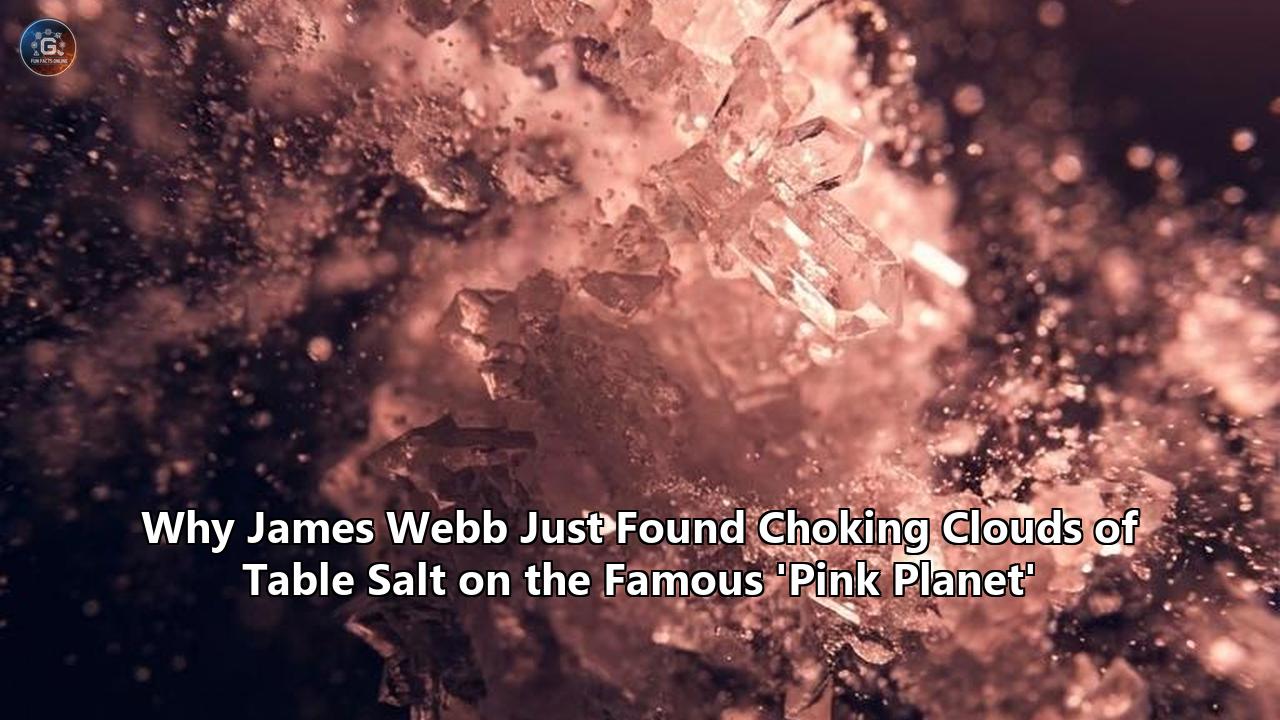
The discovery of sodium chloride (table salt) and potassium chloride clouds on GJ 504b represents the first direct spectroscopic evidence of mineral-salt clouds in a cold, planetary-mass object’s atmosphere.
The revelation does more than explain why the Pink Planet glows the way it does. It exposes a vast, missing link in our understanding of how alien climates evolve—and it links the rosy skies of this frozen giant to the blisteringly hot chemistry of transiting worlds half a galaxy away.
The Rosy Phantom of 59 Virginis
To understand why this discovery is such a triumph, one must first look at the bizarre history of the planet itself.
GJ 504b was discovered during the Strategic Explorations of Exoplanets and Disks with Subaru (SEEDS) survey, using the 8.2-meter Subaru Telescope atop Mauna Kea, Hawaii. It was a rare prize. Most of the thousands of exoplanets discovered to date have been found indirectly, either by watching a star dim as a planet passes in front of it (the transit method) or by measuring the star's tiny wobble (the radial velocity method). GJ 504b was different. It was directly imaged—a literal speck of light captured on an infrared detector.
"If we could travel to this giant planet, we would see a world still glowing from the heat of its formation with a color reminiscent of a dark cherry blossom, a dull magenta," Michael McElwain, a member of the discovery team at NASA’s Goddard Space Flight Center, said at the time.
Yet, capturing an image of a planet is not the same as understanding it. GJ 504b orbits its host star, 59 Virginis (Gliese 504), a Sun-like star in the constellation Virgo, at a massive distance: 43.5 Astronomical Units (AU). That is nearly nine times farther than Neptune orbits our Sun, placing it in a deep, cold exile.
Because it is so far from its star, it should have been easy to study. But GJ 504b is exceptionally cold for a directly imaged companion—hovering at a relatively chilly 550 degrees Fahrenheit (290 degrees Celsius). While hot enough to bake bread, in the realm of directly imaged worlds, which routinely blister at 1,000 to 2,000 degrees Fahrenheit, GJ 504b is a deep-freeze anomaly.
Because of this low temperature, the planet was incredibly dim. For over a decade, astronomers pointed Earth’s largest ground-based observatories at GJ 504b, desperate to split its faint light into a spectrum—the chemical barcode that reveals what an atmosphere is made of. Every attempt failed.
"In the past, other astronomers observed the companion for an entire night with some of the biggest telescopes in the world to obtain a spectrum," Baburaj said in a statement following the release. "And they could not see the object. With JWST, our entire observation took around two hours, and we were successful."
                       [ 59 Virginis (Host Star) ]
                                   |
                                   | ~43.5 AU (Immense Distance)
                                   v
                             [ GJ 504b ]
                     • Cherry-blossom magenta hue
                     • Temp: ~550°F (290°C)
                     • Mass: ~25.2 Jupiter masses
                     • Wrapped in dense salt clouds
How JWST Stripped the Starlight
The team turned to JWST’s Near-Infrared Spectrograph (NIRSpec), an instrument capable of capturing infrared wavelengths with unprecedented sensitivity. But even with the premier space telescope in operation, isolating the planet’s light was an analytical nightmare.
At 57 light-years away, GJ 504b is visually huddled close to a host star that is hundreds of thousands of times brighter than the planet itself. To overcome this blinding glare, the Northwestern-led team used a combination of coronagraphic imaging and a post-processing technique known as Angular Differential Imaging (ADI).
ADI takes advantage of the fact that as the telescope tracks a target over time, the sky rotates relative to the instrument's detector. The optical artifacts of the telescope—the "glare" of the star—remain fixed, while the planet slowly moves along an arc. By taking a series of exposures and mathematically subtracting the static stellar noise, the team isolated the pristine, unadulterated photons bleeding from the Pink Planet’s atmosphere.
When the data was processed through the Space Telescope Science Institute pipeline, it yielded a spectacular, high-contrast spectrum spanning 2.9 to 5.3 microns, boasting a signal-to-noise ratio greater than 300 in key bands.
For the first time, scientists were looking at the true chemical signature of the Pink Planet. And immediately, they realized something was deeply wrong.
The "Broken" Spectrum
The extracted spectrum showed clear, unmistakable dips and peaks. The team identified the classic molecular signatures of a cold gas giant: water vapor ($H_2O$), carbon dioxide ($CO_2$), methane ($CH_4$), and ammonia ($NH_3$). There were even traces of carbon monoxide ($^{12}C^{16}O$) and hydrogen sulfide ($H_2S$).
But when the researchers fed these chemical signatures into standard atmospheric models—simulations designed to predict how gas behaves under specific temperatures and pressures—the models flatly refused to match the data.
In a cloud-free atmosphere, the absorption lines for methane and water should have been sharp, deep valleys. Instead, they were weirdly muted, flat, and suppressed, as if someone had draped a heavy wool blanket over the planet’s lower atmosphere, preventing the light from escaping.
"When we finally obtained its spectrum, it immediately looked interesting," Baburaj recalled. "But once we started digging deeper into the data, we realized it was not like anything we have analyzed before."
The team realized they were dealing with clouds. But what kind?
On Earth, clouds are made of water ice and liquid droplets. On Jupiter, they are made of ammonia ice. But at 550°F (290°C), GJ 504b is far too hot for water or ammonia to condense into clouds—both molecules exist there exclusively as gases.
Conversely, the planet is too cold for the exotic clouds found on hotter brown dwarfs and "hot Jupiters". Those blisteringly hot worlds are known to host clouds made of vaporized rock and metal, such as silicate grains (enstatite, forsterite) or liquid iron. On GJ 504b, those minerals have already condensed and sunk deep into the planet’s interior, far below the visible atmosphere.
The team was stuck in a meteorological "no man's land."
To resolve the impasse, they ran thousands of atmospheric simulations, testing different cloud compositions. They tried iron clouds; they tried silicate clouds; they tried leaving the atmosphere completely clear. None of the configurations matched the JWST data.
Then, they looked at the condensation curves of alkali metals.
"We ran simulations with clouds, and the results aligned with what we know about cold planets," Baburaj explained. "We tried three different types of clouds, and salt clouds fit best."
                             Cloud Condensation Zoo

   Temp (K)   Temp (°F)      Primary Cloud Condensate       Planet Examples
   -------------------------------------------------------------------------
   >1500 K    >2240°F        Liquid Iron, Silicates         WASP-12b
   ~1000 K    ~1340°F        Sodium Sulfide (Na2S)          WASP-39b
   ~550 K     ~530°F         Alkali Halides (KCl, NaCl)     GJ 504b  <-- [YOU ARE HERE]
   ~150 K     ~-190°F        Ammonia Ice (NH3)              Jupiter
   ~273 K     ~32°F          Water Ice (H2O)                Earth
The Alchemy of Salt Clouds
How does a planet end up with clouds of table salt? The answer lies in the extreme thermodynamic journey of alkali metals as they rise from a planet's molten core toward the vacuum of space.
In the deep, crushing interior of a gas giant like GJ 504b, temperatures soar to thousands of degrees. At these extreme depths, elements like sodium, potassium, chlorine, and fluorine are stripped of their molecular bonds and exist as a hot, ionized soup of free atoms.
As powerful thermal currents dredge these gases upward into the cooler, upper layers of the atmosphere, they begin to seek out chemical partners. Sodium ($Na$) eagerly binds with chlorine ($Cl$) to form gaseous sodium chloride ($NaCl$), while potassium ($K$) binds with chlorine to form gaseous potassium chloride ($KCl$).
At temperatures above 1,000°F, these salts remain completely vaporized, invisible to the eye but acting as trace gases in the air. But as the gases continue their upward ascent, they eventually cross a critical thermodynamic threshold: the condensation line.
For alkali salts, this line is crossed at around 500°F to 800°F, depending on the atmospheric pressure.
When the gas cools past this point, the vaporized salt molecules begin to rapidly nucleate. They cling to microscopic dust particles or group together, condensing directly from a gas into tiny, solid crystalline grains. These grains drift through the atmosphere, growing larger as more vapor condenses onto them, eventually forming vast, reflective, and highly opaque cloud decks.
When Baburaj’s team incorporated these salt clouds into their models, the simulated spectrum underwent a dramatic transformation. The salt clouds effectively masked the deeper layers of the atmosphere. They scattered and absorbed the infrared light, subduing the deep molecular valleys of methane and water just enough to match the JWST spectrum perfectly.
The mystery of the Pink Planet’s flat, faint spectrum was finally solved.
The WASP-39b Connection
While the discovery of salt clouds on GJ 504b is a monumental achievement, it did not happen in a vacuum. To fully appreciate the chemical pathways at play, scientists have spent years studying the conceptual groundwork laid by a very different, highly famous exoplanet: WASP-39b.
WASP-39b is a "hot Saturn" orbiting a sun-like star roughly 700 light-years away. Unlike the directly imaged GJ 504b, WASP-39b is a transiting planet, meaning it passes directly in front of its host star. Because of its incredibly bloated, puffy atmosphere—it has roughly the mass of Saturn but is 1.3 times larger than Jupiter—it has served as the ultimate laboratory for JWST’s transmission spectroscopy.
                     WASP-39b vs. GJ 504b: A Tale of Two Worlds

                     [ WASP-39b ]                [ GJ 504b ]
  -------------------------------------------------------------------------
  Planet Class:      Hot Saturn (Transit)        Cold Giant (Directly Imaged)
  Distance:          700 light-years             57 light-years
  Temperature:       ~1,100 K (1,520°F)          ~564 K (550°F)
  Primary Chemistry: Free Na & K, Gaseous Salts  Condensed Salt Clouds (KCl, NaCl)
  JWST Milestone:    First Photochemistry (SO2)  First Direct Salt Cloud Spectrum
JWST’s early observations of WASP-39b famously revealed the first-ever detection of carbon dioxide in an exoplanet, along with sulfur dioxide produced by photochemistry (chemical reactions triggered by starlight). But as astronomers attempted to map out the elemental abundances of WASP-39b, they ran into a recurring puzzle involving its alkali metals: sodium and potassium.
For years, high-temperature models predicted that a significant fraction of a planet's sodium budget should be bound up in molecular forms. However, because WASP-39b is blisteringly hot (around 1,100 Kelvin, or 1,520°F), the thermal energy is high enough to keep these molecules dissociated.
Theoretical models analyzing the potential for WASP-39b table salt vapor (gaseous sodium chloride) indicated that at these extreme temperatures, the salt molecules are largely ripped apart by the intense heat and stellar radiation, leaving behind free, neutral sodium atoms that produce the dramatic absorption lines seen in transit spectra.
Yet, the atmospheric models of WASP-39b table salt chemistry also showed that as gas circulates from the scorching, star-facing dayside to the cooler nightside and the planetary terminator, a dramatic chemical transition occurs.
At the cooler margins of the planet, neutral sodium begins to react with chlorine. If the local temperature dips even slightly, the equilibrium shifts, forcing the free sodium to lock up.
A key challenge in interpreting these observations was model degeneracies—the difficulty in distinguishing whether a muted spectral feature was caused by a lower abundance of gas or by the presence of clouds obscuring the signal.
By studying the thermodynamics of WASP-39b table salt vapor and its condensation pathways, atmospheric modelers realized that exoplanets of intermediate temperatures must act as giant distillation chambers.
If a planet is as hot as WASP-39b, the salt remains mostly gaseous or dissociated. But if the planet cools down to the temperature of GJ 504b, the vaporized minerals must condense out entirely.
The detection of salt clouds on GJ 504b is the smoking gun that proves this "unified theory" of exoplanet cloud microphysics is correct. It bridges the gap between the blisteringly hot, clear-sky planets where free alkali metals scream their presence, and the colder, cloud-shrouded worlds where those same metals have been quieted, locked away in solid, drifting decks of salt.
Without the exhaustive modeling of WASP-39b table salt chemistry, astronomers would not have had the theoretical templates required to identify the muted, salty spectrum of the Pink Planet.
Descent Into the Pink Abyss
What would it actually look like to descend into the atmosphere of GJ 504b?
For an unshielded human observer or a standard robotic probe, the journey would be a descent into a beautifully hostile hellscape.
As your spacecraft approaches the planet, the visual scene is breathtaking. The planet glows with a soft, warm, magenta hue, reminiscent of cherry blossoms or a dark, neon rose. This color is not a trick of the light; it is the physical manifestation of the planet's internal heat escaping into space, filtered through a unique chemical haze.
Passing through the outermost layers of the exosphere, the pressure is low, and the air is thin, dominated by hydrogen and helium gas.
But as you drop deeper, the temperature rises steadily toward 550°F (290°C), and the pressure builds.
Suddenly, you hit the first cloud deck.
On Earth, entering a cloud means passing through a wet, cool mist of water droplets. On GJ 504b, you plunge into a blinding, dry, and highly reflective blizzard of microscopic salt crystals.
These are not soft snowflakes. The clouds are composed of tiny, cubic crystals of sodium chloride and needle-like grains of potassium chloride, swirling at ferocious speeds.
Because GJ 504b is a massive world with a rapid rotation rate, its atmosphere is sheared by intense, planetary-scale zonal winds. The salt crystals are whipped into a continuous, abrasive sandstorm that would sandblast the hull of any spacecraft in seconds.
The density of these clouds is immense. The salt grains scatter and reflect the light from 59 Virginis, the distant, Sun-like star.
Inside the cloud deck, the sky is a hazy, glowing orange-pink, the starlight scattering through the crystalline salt lattice like a sunset that never ends.
As you descend further, the pressure becomes crushing. The temperature climbs well past the melting point of salt.
Beneath the cloud deck, the salt crystals begin to melt and vaporize, turning back into a hot, corrosive gas of sodium and chlorine, which is swept back down into the lower, glowing depths of the planet's mantle in a continuous, heavy rain of molten minerals.
"We are not looking at water clouds or even ammonia clouds," explained Dr. Mark Gorski, an atmospheric modeler involved in the data analysis. "We are looking at an alien sky dominated by rock-forming minerals that have been completely vaporized. It is a beautifully hostile environment."
The Identity Crisis: Planet or Failed Star?
The discovery of salt clouds has solved one mystery, but it has reignited another: what, exactly, is GJ 504b?
Despite its popular nickname, the "Pink Planet," astronomers are deeply divided over its true classification. With a mass estimated at roughly 25.2 times that of Jupiter, GJ 504b is a heavyweight.
This mass places it squarely in a cosmic grey area. It lies near the boundary that separates massive gas giant planets from brown dwarfs.
                          The Substellar Spectrum

  [ Jupiter-Class Planets ]    [ Brown Dwarfs ]         [ Stars ]
  -------------------------    -----------------        ---------
  • 1 to ~13 M_Jup             • ~13 to ~80 M_Jup       • >80 M_Jup
  • Cannot fuse deuterium      • Can fuse deuterium     • Can fuse hydrogen
  • Form in gas disks          • Collapse like stars    • Ignite nuclear fusion
            ^                           ^
            |                           |
            +-------[ GJ 504b ]---------+
               Mass: ~25.2 M_Jup
               Origins: Highly Debated
Brown dwarfs, often called "failed stars," are objects that formed the way stars do—through the direct gravitational collapse of a giant cloud of gas and dust—but failed to gather enough mass to ignite the nuclear fusion of hydrogen into helium in their cores. They are too massive to be typical planets, but too small to shine as stars.
Because of this ambiguity, astronomers often refer to GJ 504b by the neutral term "planetary-mass companion."
The JWST spectrum, however, has provided some critical new clues that tip the scales back toward the "planet" camp.
The key lies in the planet's metallicity—an astronomical term for the abundance of elements heavier than hydrogen and helium.
According to standard models of star formation, a brown dwarf that collapses directly from a gas cloud should have a chemical composition nearly identical to its parent star, as both formed from the same parental reservoir of gas.
A planet, on the other hand, forms via a process called core accretion. In this scenario, a solid core of rock and ice builds up first within a circumstellar disk of dust. Once this core reaches a critical mass, it rapidly vacuums up the surrounding gas. Because the young planet has already swept up a massive amount of solid material (planetesimals and pebbles) from the disk, its resulting atmosphere ends up highly enriched in heavy elements (metals) compared to its host star.
The JWST data revealed that GJ 504b is indeed highly metal-rich.
The spectrum showed an unusually high abundance of carbon, sulfur, and oxygen relative to its host star, 59 Virginis. This metal enrichment provides tentative evidence that GJ 504b formed like a giant planet within a dusty disk, rather than as a failed star.
Yet, this planet-like origin story introduces a glaring paradox.
At 43.5 AU from its star, the protoplanetary disk of dust and gas should have been incredibly sparse when the system was young. Under standard theories of planet formation, there simply should not have been enough solid material at that immense distance to build a core massive enough to trigger the runaway accretion of a 25-Jupiter-mass planet.
Did GJ 504b form closer to its star and get violently flung outward by a gravitational tussle with another, undiscovered giant planet? Or did the protoplanetary disk around 59 Virginis possess an unprecedented, massive concentration of heavy dust grains?
While the salty clouds have given up their secrets, the origin of this cherry-blossom giant remains an open, tantalizing puzzle.
peeling Back the Cosmic Layers
The successful detection of salt clouds on GJ 504b is a watershed moment for exoplanet meteorology. It represents a major leap forward in our ability to decode the climates of cold, faint, and isolated worlds that were previously completely beyond our reach.
"This is the first time we've found that salt clouds are critical to explaining the spectrum of an object," Baburaj said. "It's a good reminder to account for clouds in our models."
                       Exoplanet Atmosphere Timeline

  [ Pre-JWST Era ] ------------------------> [ Current JWST Era ]
  • Rough brightness measurements            • Detailed chemical spectra
  • Heavy model degeneracies                 • Direct cloud profiling
  • Invisible cold worlds                    • Detection of mineral salts
  • Clear skies assumed by default           • Complex cloud chemistry
For decades, exoplanet science was a game of silhouettes and shadows. Astronomers could tell you how big a planet was, or how close it orbited its star, but its atmosphere was a blank canvas, often assumed to be clear and pristine by default.
JWST has shattered that simplicity.
By proving that we can isolate and analyze the faint, heavily filtered light of a cold, directly imaged giant like GJ 504b, the telescope has opened a new window into the true diversity of the cosmos.
The lesson is clear: the universe does not limit its weather to the familiar cycles of water and ammonia. In the vast, high-energy crucibles of alien worlds, the most mundane ingredients of our daily lives—like the salt sitting on our kitchen tables—are transformed into monumental, churning weather systems that shape the very light we receive from the stars.
What to Watch for Next
As scientists digest the implications of the Pink Planet's salty atmosphere, several key milestones lie on the horizon:
- The Hunt for More Cold Companions: Astronomers are actively searching for other sub-600 Kelvin directly imaged companions to see if salt clouds are a universal feature of this temperature regime, or if GJ 504b is a chemically unique outlier.
- The Nancy Grace Roman Space Telescope: Set to launch in the late 2020s, the Roman Space Telescope will carry a state-of-the-art coronagraph designed specifically to directly image cooler, smaller giant planets. Roman will be able to search for similar mineral and salt cloud decks on worlds that orbit even closer to their stars.
- Refining Cloud Microphysics: Computational modelers are currently revising their atmospheric simulation codes to include a wider array of alkali metal and sulfide salts, ensuring that the lessons learned from GJ 504b and WASP-39b are fully integrated into future exoplanet characterizations.
- The Search for the "Second Giant": If GJ 504b formed via core accretion and was migrated outward, a massive sibling planet may still be hiding closer to 59 Virginis. High-precision radial velocity surveys are continuing to monitor the host star for any subtle, long-period wobbles that would reveal its presence.
The universe, as it turns out, is a remarkably salty place. And as our instruments grow more sensitive, we are finding that the most beautiful, exotic worlds are often hiding behind a choking, crystalline haze of the most common materials.
Reference:
- https://www.researchgate.net/publication/407322273_JWST-TST_High_Contrast_First_Direct_Spectroscopy_of_GJ_504_b_Reveals_Clouds_and_Possible_Metal_Enrichment
- https://www.universetoday.com/articles/that-pink-planet-astronomers-found-turns-out-to-be-a-salty-customer
- https://www.space.com/astronomy/exoplanets/james-webb-space-telescope-finds-a-salty-surprise-on-famous-pink-planet
- https://en.wikipedia.org/wiki/Gliese_504_b
- https://www.science.gov/topicpages/j/jupiter+mass+planets
- https://www.popsci.com/science/pink-planet-salty-secret/
- https://www.ozonedailynews.com/science/jwst-gj504b-salty-clouds-pink-planet-2026
- https://www.ozonedailynews.com/science/jwst-gj504b-salty-clouds-pink-planet-2026
- https://gizmodo.com/this-famously-pink-planet-is-hiding-a-surprising-secret-2000776066
- https://starlust.org/the-12-zodiac-constellations-in-the-night-sky/
- https://www.indiatoday.in/science/story/indian-astronomer-finds-salty-clouds-on-a-planet-that-is-completely-pink-2929738-2026-06-19
- https://www.zmescience.com/science/news-science/famous-pink-planet-mystery-decoded-jwst-says-salt-clouds-are-the-culprit/
- https://lpl.arizona.edu/postdoc/news/webb-space-telescope-uarizona-astronomers-help-detect-carbon-dioxide-exoplanet-atmosphere
- https://mashable.com/science/james-webb-space-telescope-pink-planet-salt-clouds
- https://astrobiology.com/2026/06/21/famous-pink-planet-harbors-a-salty-surprise/
- https://en.wikipedia.org/wiki/Extraterrestrial_atmosphere
- https://www.researchgate.net/profile/Leen-Decin-2/2
- https://www.repository.cam.ac.uk/items/9ebb1146-8fc4-4b7e-a2ec-12fd145195f1
- https://www.space.com/17021-virgo-constellation.html
- https://mashable.com/article/james-webb-carbon-dioxide-exoplanet
- https://physicsworld.com/wp-content/uploads/2023/05/PW2023-04-whole-issue-e-mag.pdf
- https://www.spectroscopyonline.com/view/unlocking-the-secrets-of-exoplanet-wasp-39b-early-release-science-with-jwst-niriss-reveals-intriguing-atmospheric-composition
- https://wasp-planets.net/tag/sodium/
- https://www.youtube.com/shorts/2AZrxItzih4
- https://mashable.com/science/james-webb-space-telescope-pink-planet-salt-clouds
- https://www.tiempo.com/noticias/astronomia/uno-de-los-planetas-mas-extranos-es-rosa-y-tiene-nubes-llenas-de-sal-metalica.html
- https://www.youtube.com/watch?v=HWPB5vIYcSs
- https://arxiv.org/pdf/2410.11138
- https://earthsky.org/space/pink-planet-gj504b-james-webb-space-telescope-salt-clouds/
- https://spacelaunching.org/en/cycle-observation/details/8