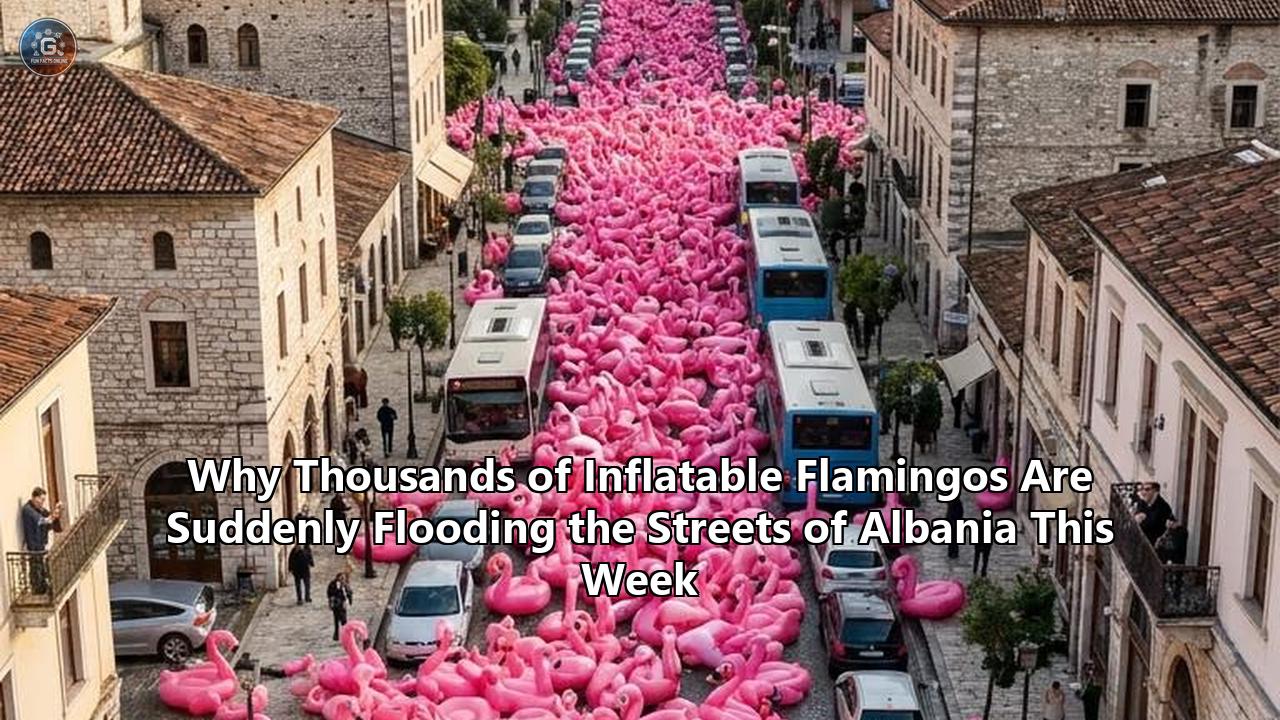
Every evening this week at exactly six o’clock, the main boulevard of Albania’s capital city, Tirana, has transformed into a sea of neon pink. Thousands of citizens, students, and environmental activists have blocked the traffic in front of the Prime Minister’s Office. Yet, the most striking feature of these mass demonstrations is not the standard array of banners or megaphones, but the thousands of bright, plastic, inflatable flamingos bobbing above the heads of the crowd. What began as a localized attempt by villagers to block bulldozers on a remote stretch of the Adriatic coast has rapidly escalated into a national uprising. Dubbed the "Flamingo Revolution" by local media and international observers, the movement has pushed the thirteen-year-old administration of Prime Minister Edi Rama into its most severe political crisis in a generation.
The immediate trigger for this sudden deluge of inflatable flamingos Albania is a controversial $1.6 billion luxury resort project backed by Affinity Partners, a private equity firm founded by Jared Kushner, the son-in-law of U.S. President Donald Trump. The proposed development aims to build up to 10,000 high-end hotel rooms, luxury villas, and a massive marina on Sazan Island—a former secret military base—and across the nearby protected coastal wetlands of the Vjosa-Narta lagoon and Zvërnec. To make the deal possible, the Albanian parliament quietly amended its Law on Protected Areas, dismantling decades of environmental safeguards to allow five-star construction projects in previously sacrosanct wild zones.
For environmentalists, the project is a death sentence for one of Europe's last pristine coastal sanctuaries. The Vjosa-Narta lagoon is a critical stopover along the Adriatic Flyway, hosting over 200 bird species and sheltering more than one percent of the entire global population of pink flamingos.
As heavy machinery began rolling onto the dunes of Zvërnec in late May, local resistance flared. A viral video showing private security guards violently dragging away an activist while state police stood by passively acted as the catalyst, transforming a localized conservation struggle into a nationwide revolt against state capture, opacity, and corporate greed.
By analyzing the specific dynamics of this Albanian revolt, we can extract profound lessons about the changing nature of modern protest, the friction between mobile global capital and local sovereignty, and the limits of state narrative control. The sudden prominence of inflatable flamingos Albania serves as an ideal lens through which to examine these broader global patterns.
The Spark on the Sand: Enclosure and the Romantic Narrative
To understand the deeper political and economic structures at play, one must first look at the official narrative surrounding the Sazan and Vjosa-Narta developments. The project was presented to the international public not as a commercial land grab, but as a tale of spontaneous discovery.
In a recent podcast appearance, Ivanka Trump recounted how she and Kushner first "discovered" Sazan Island during a private yacht trip in 2021. "We swam to the island, we went on a hike, barefoot all the way up to the top, and we were just captivated," she told listeners, presenting an image of untouched, vacant wilderness ripe for "realizing its potential".
However, local investigative journalists and activists quickly pierced this romantic veil. The "spontaneous" discovery was, in reality, a meticulously arranged political pitch. Prime Minister Edi Rama had personally boarded the yacht in 2021, presenting Kushner with his administration's "avant-garde" vision of high-end tourism freed from the typical regulatory burdens found elsewhere in Europe. By late 2024, only weeks after Donald Trump’s reelection, the Albanian government granted Sazan Island "Strategic Investor" status, fast-tracking the permits and laying the legal groundwork for Sazan Real Estate Development LLC.
When bulldozers and fences appeared on the beaches of Zvërnec, the local population was suddenly locked out of lands they had used, farmed, and fished for generations. This is a classic example of what political economists call the "enclosure of the commons."
By converting a state-owned, globally recognized biosphere reserve into an exclusive enclave for the ultra-wealthy, the state effectively severed the public’s connection to its own natural heritage.
The physical fencing of Zvërnec became a concrete manifestation of a broader systemic grievance: the feeling among ordinary Albanians that their country is being partitioned and sold to the highest foreign bidder while they are left to inherit the ecological and economic fallout.
Principle 1: Absurdist Symbolism as a Counter-Narrative Weapon
The rapid spread of the inflatable flamingo as the primary symbol of the protests highlights a crucial principle of modern social movements: the strategic deployment of absurdist, highly visual imagery to bypass state-controlled communication channels.
In Albania, the media landscape is heavily consolidated, with major television networks and print outlets largely dependent on government advertising, state-aligned oligarchic funding, or direct political patronage. In such an environment, traditional political rhetoric is easily neutralized. The state can readily dismiss dry policy debates, technical environmental impact reports, or standard opposition speeches as "partisan bickering" or "obstruction to economic progress".
The introduction of the pink flamingo completely disrupted this playbook. By adopting a highly visible, inherently ridiculous, and universally recognizable object, the protesters achieved several critical communication victories:
- Bypassing Censorship via Visual Irresistibility: A march filled with standard political banners can be easily ignored by state-aligned media. A boulevard choked with thousands of neon-pink, towering inflatable flamingos cannot. It is visually arresting, highly photogenic, and instantly compatible with social media algorithms. The absurdity of the imagery forced mainstream news outlets to cover the events, as ignoring such a spectacle would destroy their remaining journalistic credibility.
- The "Flamingo Eagle" and Identity Subversion: Albanian anarchists and youth groups took the subversion a step further by modifying the national flag. They replaced the historical black double-headed eagle on the traditional red field with a pink flamingo, changing the background from blood-red to a deep sea-blue. This bold graphic gesture did not merely protest a resort; it redefined patriotism. It argued that true love for the nation lies in defending its soil, its wild rivers, and its living fauna, rather than worshipping static state symbols used by corrupt politicians to cover up the sale of national territory.
- Neutralizing the State’s Monopoly on Violence: When police forces clad in heavy, black riot gear, armed with water cannons and tear gas, are deployed to disperse a crowd holding cheap, squeaking, pink pool toys, the optics are disastrous for the regime. The state's projection of sober, authoritative power is instantly transformed into a farcical performance. The contrast between the state’s grim violence and the playful, non-threatening nature of the inflatable flamingos stripped the government of its moral authority, making any attempt at a heavy-handed crackdown appear absurd on the international stage.
The strategic use of inflatable flamingos Albania illustrates how contemporary grassroots campaigns use "meme warfare" and physical pop-art to level the playing field against highly centralized, state-backed media monopolies.
Principle 2: The Mirage of Top-Down "Strategic Investment"
The political justification offered by Prime Minister Edi Rama is rooted in a familiar neoliberal developmental doctrine: that massive injections of foreign direct investment (FDI) are the only viable path to elevate a developing nation into a modern, high-income economy. Rama has repeatedly defended the $1.6 billion project as a "blessing" that will generate thousands of jobs, modernize Albania’s tourism sector, and align the country with elite Mediterranean destinations like Saint-Tropez or Monaco.
However, the case of the Vjosa-Narta resort exposes the systemic flaws and false promises of this top-down developmental model:
+-------------------------------------------------------------------------------+
|                      THE MIRAGE OF "STRATEGIC INVESTMENT"                     |
+------------------------------------+------------------------------------------+
|          Official Promise          |            Socio-Economic Reality         |
+------------------------------------+------------------------------------------+
|  Economic growth & job creation    |  Wealth concentration in offshore tax    |
|  for local communities.            |  havens; low-wage seasonal labor.        |
+------------------------------------+------------------------------------------+
|  Modernization of infrastructure   |  Destruction of shared public space;    |
|  and international prestige.       |  "enclosure" of natural heritage.        |
+------------------------------------+------------------------------------------+
|  "Eco-friendly" design and         |  Barbed wire, uprooted coastal dunes,    |
|  responsible stewardship.          |  and fragmented wildlife corridors.      |
+------------------------------------+------------------------------------------+
As local environmental officer Dorina Guri observed, the economic benefits of such ultra-luxury enclaves are rarely distributed to the local population. These developments are designed as self-contained bubbles. The elite visitors fly into private airstrips, stay within private, fenced-off resort boundaries, and spend money that flows directly back to offshore holding companies and foreign developers.
The local population is left with low-wage, seasonal service jobs, while bearing the brunt of increased living costs, inflated land prices, and the irreversible destruction of their regional environment.
Furthermore, the fast-track mechanism used to approve the project bypasses the very institutional checks and balances that protect a developing democracy from slipsliding into autocracy. When a government routinely rewrites national conservation laws to accommodate specific foreign billionaires, it signals to both citizens and domestic businesses that the law is not a neutral framework for justice, but a flexible instrument of political patronage.
This erosion of the rule of law is precisely why Albania's Special Anti-Corruption Prosecution Office (SPAK) has opened an active investigation into the acquisition of the Vjosa-Narta land and the sudden 2024 legislative rollbacks.
Principle 3: Besa and Cultural Memory as a Catalyst for Mobilization
While Western commentators often analyze the "Flamingo Revolution" purely through the lens of modern, progressive environmental activism, the movement’s rapid escalation relies on a much older, deeper cultural current unique to the Albanian psyche: the ancient ethical code of Besa.
Besa, which translates roughly to "keeping one's word" or "the sacred promise," is a foundational pillar of traditional Albanian society, predating modern legal codes, religious divisions, and political statehood. Historically, Besa demands an absolute, uncompromising obligation to protect the vulnerable, to defend those who seek refuge under your roof, and to guard your ancestral home, even at the cost of your own life. It is the same moral code that famously drove Muslim and Christian Albanians alike to shelter and save thousands of Jewish refugees during the Holocaust, refusing to hand them over to occupying Nazi forces.In the context of the "Flamingo Revolution," this ancient cultural memory has been powerfully reactivated. The pink flamingos of the Vjosa-Narta lagoon are not viewed merely as ecological assets or tourism attractions; they are seen as "guests" of the Albanian territory—vulnerable, voiceless creatures that have chosen these shores as their sanctuary.
When the state allowed foreign private security guards to fence off the lagoon and violently assault local residents defending the land, it did not just violate environmental regulations—it violated Besa.
           +-------------------------------------------------------+
           |           THE CULTURAL SYNTHESIS OF BESA              |
           +-------------------------------------------------------+
                                       |
                     +-----------------+-----------------+
                     |                                   |
                     v                                   v
       [ Ancient Code of Honor ]             [ Modern Civic Ecology ]
       - Absolute duty to protect            - Wildlife conservation
       - Sacred protection of guests         - Preservation of ecosystems
       - Defending ancestral land            - Global climate solidarity
                     |                                   |
                     +-----------------+-----------------+
                                       |
                                       v
                     +-----------------------------------+
                     |    THE "FLAMINGO REVOLUTION"      |
                     |  A powerful moral imperative for  |
                     |   uncompromising resistance.      |
                     +-----------------------------------+
This cultural synthesis explains why the protests are far more militant and resilient than typical European green movements. For the people marching with inflatable flamingos Albania is not just a place of scenic real estate; it is a sacred trust.
When protesters chant "Albania is not for sale," they are not merely reciting a catchy political slogan; they are invoking a deep-seated, historically proven cultural defense mechanism against existential threats.
Principle 4: The Autocrat’s Reflex and the "Hybrid War" Deflection
Another crucial global pattern illustrated by this case study is the predictable manner in which long-ruling political elites attempt to delegitimize organic, grassroots dissent.
As the demonstrations in Tirana grew, stretching over half a mile down the city’s central boulevard, Prime Minister Edi Rama chose not to address the core demands of transparency, environmental preservation, and public consultation. Instead, he reached for a familiar geopolitical deflection: he claimed Albania was the victim of a "hybrid war" of disinformation orchestrated by foreign adversaries, specifically pointing the finger at the Islamic Republic of Iran.
                       STATE CONSTRUCTED NARRATIVE
              +-------------------------------------------+
              | "Protests are a 'hybrid war' of foreign   |
              | disinformation orchestrated by Iran."     |
              +-------------------------------------------+
                                    |
                                    v [Deconstructed by Social Media]
                                    |
                       ORGANIC GRASSROOTS REALITY
              +-------------------------------------------+
              | - Real-time videos of environmental ruin. |
              | - Transparent local organizing.           |
              | - High-profile, public legal corruption.  |
              +-------------------------------------------+
To understand this deflection, one must look at recent regional history. In 2022, Albania suffered catastrophic cyberattacks targeting its state digital infrastructure, which Western intelligence agencies traced back to state-sponsored Iranian hackers. In response, Albania severed all diplomatic ties with Tehran.
When the Vjosa-Narta protests erupted, a bizarre, online conspiracy theory began circulating on social media, claiming that Sazan Island was actually being sold to Kushner to serve as a covert settlement zone for displaced Palestinians from Gaza. Rama quickly seized on this fringe rumor, framing the entire domestic protest movement as an Iranian-engineered plot to destabilize Albania’s pro-Western government.
This "foreign agent" playbook is a classic tactic used by governments worldwide to evade domestic accountability:
- De-platforming Domestic Grievance: By labeling the protests as a foreign plot, the state attempts to shift the public focus away from local ecological destruction and corrupt land deals, reframing the issue as a matter of national security and geopolitical survival.
- Exploiting National Trauma: The regime attempts to weaponize the genuine national anxiety of the 2022 cyberattacks, hoping to frighten moderate citizens into abandoning the streets out of fear of being labeled foreign collaborators.
- Appealing to Western Patrons: By framing his domestic critics as Iranian puppets, Rama seeks to secure continued political backing from the United States and European allies, presenting himself as a bulwark of Western security in the volatile Western Balkans.
However, in the era of decentralized digital communication, this deflection strategy has spectacularly backfired. The sheer physical presence of the inflatable flamingos—carried by local grandmothers, university students, and well-known public intellectuals—rendered the state’s dark geopolitical narrative completely implausible.
The absurdity of the government’s claim was highlighted when Iran’s Foreign Ministry spokesman, Esmaeil Baghaei, mocked Rama’s accusations on social media, quoting actual Albanian protest slogans in their original language and joking that the Prime Minister would "probably also say the flamingos themselves are Iranian secret agents".
When a state is reduced to claiming that plastic pool toys are the vanguard of an Iranian cyber-conspiracy, it reveals the intellectual bankruptcy of the regime's defensive narrative.
What Lies Ahead: Sazan, SPAK, and the Road to Brussels
As the "Flamingo Revolution" enters its second week, the immediate future of Albania's political and ecological landscape hangs in a delicate balance. Unlike previous protests in Albania’s post-communist history, which were often partisan, highly centralized, and easily co-opted by the mainstream opposition Democratic Party, this movement remains highly decentralized, youth-led, and driven by a broad coalition of civic actors.
                     +-----------------------------------+
                     |  THE FLAMINGO REVOLUTION (2026)   |
                     +-----------------+-----------------+
                                       |
          +----------------------------+----------------------------+
          |                                                         |
          v                                                         v
[ Strategic Milestones to Watch ]                        [ Systemic Risks to Monitor ]
- SPAK's land acquisition probe           - Government "hybrid war" crackdowns
- European Commission EU accession review        - Co-optation by corrupt political parties
- Physical defense of Vjosa-Narta          - Irreversible ecological destruction
There are several critical milestones to watch in the coming weeks and months:
The SPAK Investigation
The Special Anti-Corruption Prosecution Office (SPAK) holds the potential to legally dismantle the resort deal. If investigators find evidence of bribery, systemic abuse of office, or illegal transfer of public land regarding the 2024 amendments to the Law on Protected Areas, the contracts with Sazan Real Estate Development LLC could be nullified. This would mirror the collapse of Affinity Partners’ planned hotel project in Belgrade, Serbia, which was scrapped in late 2025 after four high-ranking government officials were indicted for corruption connected to the deal.
The European Union Accession Test
Albania’s primary foreign policy goal is achieving full membership in the European Union. However, the European Commission has officially warned the Rama administration that stripping environmental protections from Vjosa-Narta directly violates the EU's strict environmental acquis.
If the Albanian government insists on paving over a crucial European ecological sanctuary, it faces the very real prospect of Brussels freezing its accession negotiations. For a government that has staked its entire political legitimacy on delivering EU membership, the price of Kushner's concrete may prove far too high.
The Physical Battle on the Dunes
Despite the massive nightly protests in Tirana, heavy machinery remains stationed at the Vjosa-Narta site. Local activists and international conservation networks have warned that they are preparing for a sustained campaign of non-violent civil disobedience directly on the beaches.
Should the developers attempt to resume excavation while the eyes of the international community are fixed on Albania, the risk of escalation remains high.
Regardless of whether the luxury villas of Sazan are ever built, the "Flamingo Revolution" has already permanently altered the domestic political landscape. It has shattered the illusion of public passivity, demonstrated the power of creative, decentralized civic organizing, and proven that the natural heritage of a nation cannot be quietly bartered away in closed-door deals.
The thousands of inflatable flamingos Albania has seen filling its capital streets this week are no longer just symbols of a threatened wetland; they are the vibrant, squeaking heralds of a newly awakened democratic accountability.
Reference:
- https://metla.mk/en/news/flamingo-revolution-albania-rama/
- https://www.balcanicaucaso.org/en/cp_article/the-flamingo-revolution-for-a-different-albania/
- https://www.straitstimes.com/world/europe/albania-is-not-for-sale-protesters-say-over-kushner-linked-luxury-resort-near-a-protected-wetland
- https://en.wikipedia.org/wiki/Flamingo_Revolution
- https://freedomnews.org.uk/2026/06/09/revolt-in-albania-besa-and-flamingos/
- https://www.rferl.org/a/tehran-tirana-flamingo-revolution-kushner/33778450.html
- https://socialistworker.co.uk/international/inside-the-flamingo-revolution-albania-rises-up-against-kushner-trump-land-grab/
- https://www.motherjones.com/politics/2026/06/how-the-flamingo-became-a-potent-protest-symbol/
- https://time.com/article/2026/06/05/jared-kushner-backed-luxury-resort-albania-protests/
- https://www.forbes.com/sites/alisondurkee/2026/06/09/why-jared-and-ivankas-island-project-could-ruin-albanias-bid-to-join-eu/
- https://earth.org/protesters-call-on-albanian-government-to-halt-jared-kushner-backed-construction-of-luxury-resort-in-protected-wetlands/
- https://www.youtube.com/watch?v=Bb3yfAkr6-0
- https://www.biepag.eu/blog/the-flamingo-revolution-how-albanias-civic-protest-exposes-lack-of-transparency-and-media-capture
- https://marxist.com/albania-flamingo-revolution-erupts-against-albanian-establishment.htm
- https://www.balcanicaucaso.org/en/cp_article/albania-when-flamingos-fly/
- https://en.wikipedia.org/wiki/Sazan_Island_Resort
- https://www.forbes.com/sites/alisondurkee/2026/06/11/albanias-protests-against-jared-and-ivankas-resort-plans-are-getting-bigger/
- https://freedomnews.org.uk/2026/06/09/revolt-in-albania-besa-and-flamingos/
- https://www.theguardian.com/world/2026/jun/04/protests-in-albania-grow-over-jared-kushner-backed-luxury-resort
- https://www.theguardian.com/world/2026/jun/04/protests-in-albania-grow-over-jared-kushner-backed-luxury-resort
- https://www.rferl.org/a/tehran-tirana-flamingo-revolution-kushner/33778450.html
- https://marxist.com/albania-flamingo-revolution-erupts-against-albanian-establishment.htm
- https://www.collater.al/en/albania-protest-tirana-resort/
- https://en.wikipedia.org/wiki/Flamingo_Revolution
- https://www.deccanchronicle.com/world/americas/what-to-know-about-the-growing-opposition-to-trump-family-linked-resort-in-albania-1962873