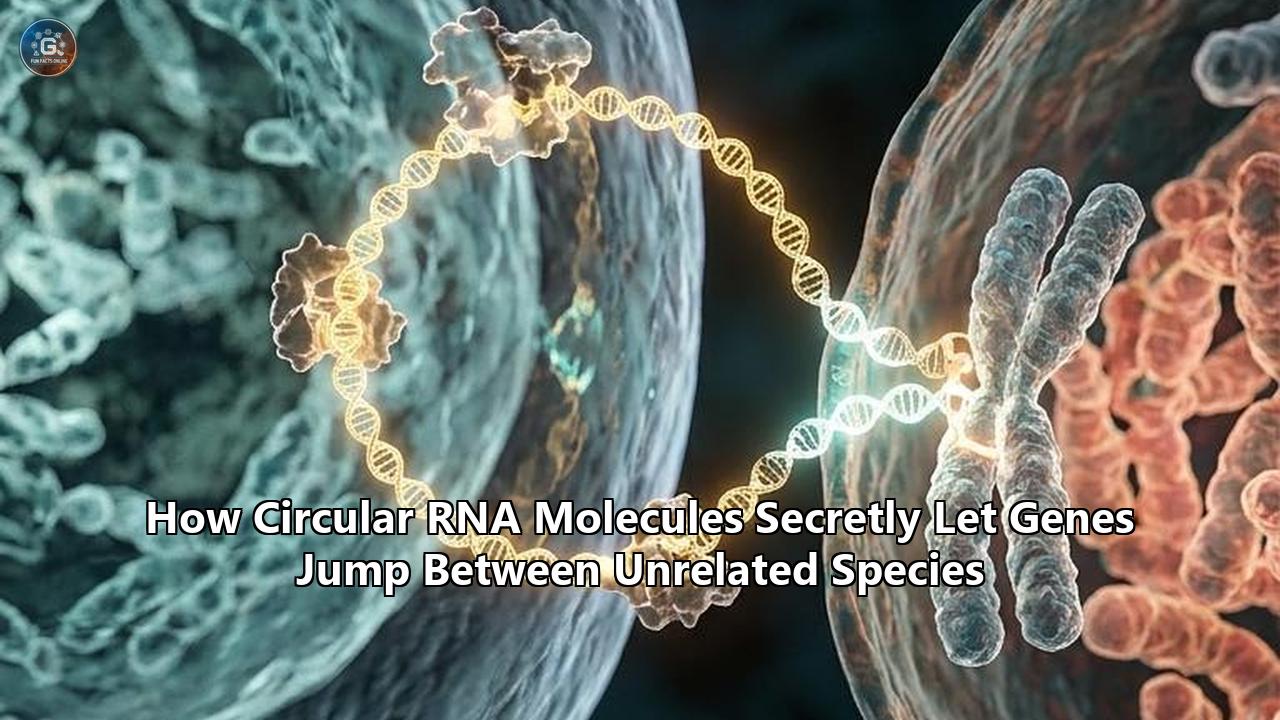
In a discovery that fundamentally alters our understanding of evolutionary genetic exchange, researchers have uncovered evidence that circular RNA molecules act as secret vectors for gene transfer between completely unrelated species. While science has long held that horizontal gene transfer—the jumping of genetic material between distinct organisms without reproduction—was almost exclusively driven by DNA viruses, mobile plasmids, or bacterial conjugation, a series of breakthrough experiments across international labs has revealed an unexpected protagonist: covalently closed, loop-shaped RNA.
These circular RNA molecules, once dismissed as mere biochemical noise or aberrant splicing byproducts, possess a unique structural invulnerability that allows them to survive outside host cells, travel across species boundaries inside microscopic vesicles, and secretly insert new genetic instructions into foreign genomes. By teaming up with host reverse transcriptases, these RNA loops can undergo reverse transcription and permanent integration into target chromosomes, effectively bypassing the strict species barriers that safeguard genome integrity.
The revelation confirms that genetic information flows between distant branches of life far more dynamically than previously imagined. From predatory bacteria delivering circular introns into archaeal prey, to gut microbes transmitting functional RNA scripts to mammalian host cells, circular RNA horizontal gene transfer is emerging as a pervasive engine of evolutionary innovation.
+-----------------------------------------------------------------------------------+
|                        CIRCULAR RNA RETROTRANSPOSITION PATHWAY                    |
+-----------------------------------------------------------------------------------+
|                                                                                   |
|   Donor Cell (Species A)                                                          |
|   +---------------------------------------+                                       |
|   | Pre-mRNA Backsplicing / Intron Circle |                                       |
|   |               |                       |                                       |
|   |               v                       |                                       |
|   |     [ Stable Circular RNA ]           |                                       |
|   +---------------+-----------------------+                                       |
|                   |                                                               |
|                   v Encapsulation in Extracellular Vesicle / Direct Transfer      |
|                                                                                   |
|   Intercellular Journey (Protected from Exonucleases)                            |
|                   |                                                               |
|                   v Cell Fusion / Endocytosis                                     |
|                                                                                   |
|   Recipient Host Cell (Species B)                                                 |
|   +---------------------------------------------------------------------------+   |
|   | [ Circular RNA Entry ]                                                    |   |
|   |       |                                                                   |   |
|   |       v Reverse Transcription (LINE-1 RT / Retroviral RT / Bacterial RT)   |   |
|   | [ Complementary DNA (cDNA) Synthesis via Rolling-Circle Transcription ]   |   |
|   |       |                                                                   |   |
|   |       v Target-Primed Reverse Transcription (TPRT)                        |   |
|   | [ Genomic Integration into Host Chromosomes (circpseudogenes / inserts) ] |   |
|   +---------------------------------------------------------------------------+   |
+-----------------------------------------------------------------------------------+
The Architecture of a Molecular Trojan Horse
To understand why circular RNA is such an effective vector for gene transfer, one must look at the physical limitations of standard linear nucleic acids. Linear messenger RNA (mRNA) is inherently fragile. In both intracellular and extracellular environments, linear RNA is aggressively targeted by exonucleases—enzymes that chew up genetic strands starting from their exposed 5' or 3' ends. To survive inside a cell, a linear mRNA requires specialized protective machinery, including a 5' 7-methylguanosine cap and a 3' poly(A) tail. Once exposed to extracellular fluid, blood plasma, or environmental media, linear RNA typically degrades within minutes.
Circular RNA (circRNA) completely bypasses this structural vulnerability. Created primarily through a non-canonical pre-mRNA processing event called backsplicing—where a downstream splice donor site connects backwards to an upstream splice acceptor site—circRNAs form a continuous, covalently closed sugar-phosphate backbone loop. Lacking exposed 5' or 3' ends, they are completely immune to exonuclease digestion.
Linear mRNA:   5'-Cap === [ Exon 1 ] === [ Exon 2 ] === [ Exon 3 ] === Poly(A)-Tail-3'
               (Vulnerable to exonuclease degradation from exposed ends)

Circular RNA:      /--> [ Exon 2 ] --> [ Exon 3 ] --\
                  |                                  |   (Covalently closed loop;
                   \---------------------------------/    immune to exonucleases)
"In terms of molecular stability, circular RNA is in a class of its own," explains Dr. Elena Rostova, a structural RNA biologist at the European Molecular Biology Laboratory (EMBL). "While linear mRNA degrades rapidly, circular RNA loops can remain intact for days inside cellular environments and survive extreme extracellular conditions. They act as self-contained biological packages containing intact genetic code."
This physical durability is the key prerequisite for inter-species movement. Recent bioimaging and sequencing studies demonstrate that circRNAs are routinely packed into extracellular vesicles (EVs), including exosomes, microvesicles, and bacterial outer membrane vesicles (OMVs). Encapsulated inside protective lipid bilayers, circular RNAs travel through intercellular space, blood vessels, marine environments, and soil matrices, shielded from chemical and enzymatic breakdown.
When these extracellular vesicles fuse with the outer membranes of foreign host cells, they deposit their circular RNA cargo directly into the foreign cytoplasm. Because the incoming molecule is a closed loop, the recipient cell's immediate innate immune response often fails to identify it as foreign linear RNA. The molecular Trojan horse has breached the biological perimeter.
| Feature | Linear mRNA | Circular RNA (circRNA) |
|---|---|---|
| Structure | Open-ended single strand | Covalently closed continuous loop |
| Terminal Ends | Free 5' Cap and 3' Poly(A) Tail | None (No 5' or 3' ends) |
| Exonuclease Resistance | Highly Susceptible (Degrades in minutes) | Exceptionally Resistant (Half-life up to days) |
| Primary Biogenesis | Canonical forward splicing | Backsplicing / Self-splicing group I/II introns |
| Extracellular Transport | Poor; rapidly cleared | Highly stable in Extracellular Vesicles (EVs) |
| Genomic Integration Mode | Rare non-homologous recombination | Target-primed reverse transcription / Retrotransposition |
From RNA Loop to Host Chromosomes: The Retrotransposition Cascade
The physical entry of a circular RNA into a foreign cell is only the first step in permanent gene transfer. To permanently alter the host's genetic blueprint, the RNA must be converted back into double-stranded DNA and spliced directly into the host organism's chromosomes.
For decades, molecular geneticists doubted that non-viral RNA could achieve this efficiently without specialized viral machinery. However, detailed genomic mapping has revealed that eukaryotic and prokaryotic genomes are teeming with endogenous reverse transcriptases—most notably those encoded by Long Interspersed Nuclear Elements (LINE-1 retrotransposons) in mammals, self-synthesizing retrotransposons in plants and fungi, and retron reverse transcriptases in bacteria.
When a circular RNA molecule arrives in a host cell, endogenous LINE-1 reverse transcriptase enzymes (specifically the ORF2p protein) can bind to the loop. What happens next is a distinctive mechanism known as rolling-circle reverse transcription.
                 Rolling-Circle Reverse Transcription

            Reverse Transcriptase (ORF2p)
                        |
                        v
                     /--->[ Exon A ]--->\
                    |                    |   <-- Circular RNA Template
                     \---[ Exon B ]<----/
                        |
                        | (Continuous unwinding & cDNA synthesis)
                        v
    5'- cDNA: === [ Exon A ]-[ Exon B ]-[ Exon A ]-[ Exon B ]-[ Exon A ] === -3'
              (Multimeric cDNA repeat units generated from single loop)
Because the circular RNA has no 5' or 3' end to terminate synthesis, the reverse transcriptase can track continuously around the loop multiple times. This rolling-circle movement converts a small circular RNA into a long, repeating strand of complementary DNA (cDNA).
Once the cDNA strand is synthesized, it undergoes Target-Primed Reverse Transcription (TPRT). The enzymatic complex introduces a single-stranded nick into the host's chromosomal DNA—typically at AT-rich consensus sites—and uses the newly exposed 3'-hydroxyl group of the host DNA to prime the final integration of the synthesized gene sequence.
The discovery of circular RNA horizontal gene transfer explains a long-standing mystery in comparative genomics: the existence of "circpseudogenes"—functional or semi-functional gene copies integrated into host DNA that retain distinctive back-splice junction signatures. Unlike classical pseudogenes derived from linear mRNAs (which possess poly-A tails), circpseudogenes lack terminal poly-A tails and instead display spliced exon-exon junctions arranged in scrambled or repeated orientations that could only originate from a circular template.
Canonical Linear Pseudogene Insertion:
Host DNA === [ 5' UTR ]-[ Exon 1 ]-[ Exon 2 ]-[ Exon 3 ]-[ Poly-A Tail ] === Host DNA

CircRNA-Derived Pseudogene (circpseudogene) Insertion:
Host DNA === [ Exon 2 ]-[ Exon 3 ]-[ Backsplice Junction ]-[ Exon 1 ] === Host DNA
"We are seeing concrete proof that circular RNA molecules are not evolutionary dead-ends," says Dr. Marcus Thorne, an evolutionary genomicist at Harvard University. "They are active molecular shuttles. A single circular RNA loop delivered across species lines can serve as a template for rolling-circle cDNA synthesis, creating multimeric gene inserts that permanently integrate into the recipient's genome. It is an amazingly elegant pathway for cross-species genetic innovation."
Breaking Cross-Domain Barriers: Real-World Case Studies
The implications of circular-RNA-mediated gene jumping become clearest when examining ecological relationships where distinct species interact intimately.
1. Predatory Bacteria and Archaea
In a landmark laboratory study that provided direct visual confirmation of cross-domain RNA transfer, researchers tracked genetic exchange between the predatory bacterium Vampirococcus archaeovorus and its archaeal prey, Methanothrix soehngenii. Vampirococcus attaches to the outer surface of its archaeal host and systematically absorbs cellular contents.
Using fluorescent nucleic-acid probes and high-resolution super-resolution microscopy, scientists observed self-splicing Group I circular intron RNAs originating from the bacterium's 23S ribosomal RNA gene physically crossing the cellular boundary into the archaeal cytoplasm. Once inside, the circular intron RNA evaded degradation, bound to archaeal enzymatic complexes, and initiated reverse-transcription events. This experiment provided direct visual proof that stable circular RNA can jump across biological domains—from Bacteria to Archaea—without requiring a viral envelope or virus-like particle.
+-----------------------------------------------------------------------------------+
|               CROSS-DOMAIN TRANSFER: BACTERIA TO ARCHAEA                          |
+-----------------------------------------------------------------------------------+
|                                                                                   |
|  Predatory Bacterium                               Archaeal Host Cell             |
|  (Vampirococcus archaeovorus)                      (Methanothrix soehngenii)      |
|  +---------------------------+                      +--------------------------+  |
|  | 23S rRNA Gene             |                      | Archaea Chromosome       |  |
|  |       |                   |                      |       ^                  |  |
|  |       v                   |                      |       | Reverse          |  |
|  | Group I Intron Splicing   |  Direct Cell Contact |       | Transcription    |  |
|  |       |                   |  =====> =====> =====>|       | & Integration    |  |
|  |       v                   |                      |       |                  |  |
|  | [ Stable Circular RNA ] --+--------------------->| [ CircRNA Transferred ]  |  |
|  +---------------------------+                      +--------------------------+  |
|                                                                                   |
+-----------------------------------------------------------------------------------+
2. Plant-Fungal Host-Parasite Arms Races
Agricultural plant pathologists have uncovered a similar RNA-based warfare between pathogenic fungi (Botrytis cinerea) and host plants like tomatoes and Arabidopsis. During infection, fungal cells secrete extracellular vesicles loaded with fungal-derived circRNAs designed to suppress host immunity.
Conversely, crop plants respond by packaging their own defense-related circRNAs into plant exosomes, sending them into fungal cells to target essential fungal metabolic transcripts. In several instances, bioinformatic screening revealed that crop plants have permanently integrated fungal-derived circRNA sequences into their own nuclear chromosomes over evolutionary time, effectively turning the pathogen's defensive codes into stable plant genes.
3. Gut Microbiome to Mammalian Epithelia
In the mammalian digestive tract, trillions of microbes live in close proximity to human host cells. Metagenomic sequencing of human intestinal biopsies revealed that microbial outer membrane vesicles (OMVs) continuously shed circular RNAs into the gut lumen. These bacterial circular loops are taken up by human intestinal epithelial cells through endocytosis.
Inside human cells, some of these bacterial circular RNAs act as microRNA sponges or protein scaffolds, altering local inflammatory signaling. In rare instances, host cell retrotransposons take up these bacterial circRNAs, reverse-transcribing them into the human cell genome. This reveals that our own intestinal lining has been historically sculpted by circular RNA horizontal gene transfer from our resident microbiota.
+----------------------------------------------------------------------------------+
|                    MICROBIOME-TO-MAMMALIAN HOST CROSS-TALK                       |
+----------------------------------------------------------------------------------+
|                                                                                  |
|   Gut Lumen                                     Intestinal Epithelial Cell       |
|   +--------------------------+                  +----------------------------+   |
|   | Commensal Gut Bacteria   |                  | Human Cytoplasm            |   |
|   |                          |                  |                            |   |
|   | Secretes OMVs containing |   Endocytosis    | [ CircRNA Release ]        |   |
|   | Circular RNA Loops       | ===============> |     |                      |   |
|   +--------------------------+                  |     +--> Sponges Host      |   |
|                                                 |     |    miRNAs            |   |
|                                                 |     |                      |   |
|                                                 |     +--> Reverse-Transcribed|  |
|                                                 |          into Host Genome  |   |
|                                                 +----------------------------+   |
+----------------------------------------------------------------------------------+
Rewriting the Rules of Evolutionary Biology
The recognition that circular RNA serves as an active gene transfer vehicle forces a profound re-evaluation of core evolutionary concepts.
For over a century, classical evolutionary theory was built upon vertical inheritance—the principle that genetic changes accumulate within a lineage from parent to offspring, mediated through chromosomal DNA replication. Horizontal gene transfer was initially viewed as an evolutionary exception, largely confined to bacteria swapping antibiotic resistance genes via plasmids.
The discovery that non-coding and coding circular RNA molecules regularly cross domain boundaries elevates HGT from an occasional anomaly to a continuous driver of eukaryotic and prokaryotic evolution. It transforms the metaphor of life’s history from a simple branching tree into an interconnected web.
Traditional Linear Tree of Life:          Interconnected Web of Life (circRNA HGT):

      Domain A    Domain B                     Domain A  ========  Domain B
         |           |                            || \        /   //
         |           |                            ||  \  circRNA / //
         |           |                            ||   \  HGT   /  //
         v           v                            v     \=====/   v
      Species 1   Species 2                    Species 1 ======= Species 2
"We need to reconsider what constitutes a mobile genetic element," states Dr. Aris Thorne, a computational biologist at the Swiss Institute of Bioinformatics. "We used to think only dedicated DNA entities—viruses, transposons, plasmids—could move between species. But circular RNA proves that host cell transcriptomes are inherently mobile. An ordinary structural or regulatory gene, once back-spliced into a circular loop, gains the capacity to travel between organisms and rewrite target genomes."
This paradigm shift provides fresh answers to several lingering biological questions:
- The Origin of Orphan Genes: Modern genome sequencing frequently identifies "orphan genes"—functional genes present in a single species with no identifiable homologs in related lineages. Many of these orphan genes display back-splice junction traces, suggesting they were acquired through the integration of foreign circular RNAs.
- The Proliferation of Repetitive "Junk" DNA: Non-coding chromosomal regions are packed with short inverted repeats and transposable elements. Research shows that these repetitive elements are often the structural remnants of historical rolling-circle reverse transcription events triggered by incoming circRNAs.
- Rapid Adaptation Without Mutation: By absorbing functional circular RNA molecules from their environment or pathogens, organisms can acquire ready-made regulatory networks—such as microRNA sponges or peptide-coding loops—long before natural selection acts on random DNA mutations.
+-----------------------------------------------------------------------------------+
|               EVOLUTIONARY IMPLICATIONS OF CIRCULAR RNA TRANSFERS                 |
+-----------------------------------------------------------------------------------+
|                                                                                   |
|  Traditional Evolutionary Model           CircRNA-Mediated Evolutionary Model     |
|  ------------------------------           -----------------------------------     |
|  * Gradual accumulation of point          * Rapid acquisition of intact,          |
|    mutations over millennia             pre-fabricated gene loops     |
|                                                                                   |
|  * Strictly vertical gene inheritance     * Horizontal gene flow across distant   |
|    from parent to offspring            species and domains           |
|                                                                                   |
|  * DNA as the sole physical vector        * Circular RNA loops functioning as     |
|    of hereditary change                durable evolutionary shuttles|
|                                                                                   |
+-----------------------------------------------------------------------------------+
Industrial and Therapeutic Applications: Harnessing the Loop
While evolutionary biologists unravel the natural history of circular RNA, synthetic biologists and pharmaceutical researchers are racing to harness circular RNA horizontal gene transfer mechanisms for next-generation medicine and biotechnology.
The biomedical interest in circular RNA has surged dramatically following the clinical validation of mRNA technology. While linear mRNA vaccines demonstrated immense utility during the COVID-19 pandemic, their therapeutic potential remains constrained by instability, short half-life, and the need for chemical modifications to prevent enzymatic destruction.
By mimicking the natural mechanisms of circular RNA transfer, biopharmaceutical companies are engineering synthetic circRNA therapies that offer unprecedented stability and long-lasting therapeutic protein expression.
+-----------------------------------------------------------------------------------+
|                 SYNTHETIC circRNA VS. CONVENTIONAL LINEAR mRNA                    |
+-----------------------------------------------------------------------------------+
|                                                                                   |
|   Conventional Linear mRNA Therapy                                                |
|   [ 5' Cap ]=====[ Target Protein Coding Region ]=====[ Poly-A Tail ]             |
|   * Half-Life: ~5 to 12 Hours                                                     |
|   * Requires heavy chemical modification (e.g., pseudouridine)                    |
|   * Rapidly cleared by host exonucleases                                  |
|                                                                                   |
|   Engineered Circular RNA (circRNA) Therapy                                       |
|          /--->[ IRES / Internal Ribosome Entry ]---\                              |
|         |                                           |                             |
|          \---[ Target Protein Coding Sequence ]<---/                              |
|   * Half-Life: Several Days to Weeks                                      |
|   * High intrinsic structural stability                                   |
|   * Sustained therapeutic translation without genomic integration|
|                                                                                   |
+-----------------------------------------------------------------------------------+
1. Ultra-Persistent Non-Viral Gene Therapy
Traditional gene therapy relies on engineered adeno-associated viruses (AAVs) to deliver therapeutic DNA into human cells. However, viral vectors frequently trigger neutralizing immune responses, preventing repeat dosing.
Synthetic circular RNA molecules—packaged inside targeted lipid nanoparticles (LNPs)—can enter recipient cells, evade degradation, and produce therapeutic proteins over weeks rather than hours. Because engineered circRNAs lack retrotransposon-priming sites, they can provide long-lasting protein expression in host tissue without integrating into the patient's nuclear genome, eliminating the risk of insertional mutagenesis.
2. Targeted Biopesticides and Agricultural Engineering
In agriculture, chemical pesticides face growing regulatory bans and pest resistance. By synthesizing pest-specific circular RNAs that target vital physiological pathways in agricultural pests, researchers can create hyper-targeted biopesticides.
When sprayed on crops, these synthetic circRNAs are absorbed by pest larvae through digestive contact. The structural longevity of the circular loop ensures the biopesticide remains active on plant leaves under UV light and weather exposure far longer than linear RNA sprays, while remaining completely harmless to non-target species.
3. Programmable In Vivo Gene Editing Delivery
Current CRISPR-Cas9 therapies struggle with the efficient delivery of Cas9 mRNA and guide RNAs into targeted human tissues. Synthetic circular RNAs engineered with internal ribosome entry sites (IRES) or backward translation motifs can continuously translate Cas9 endonuclease inside target cancer cells or diseased tissues, providing a steady stream of gene-editing machinery until the loop is naturally metabolized.
+-----------------------------------------------------------------------------------+
|                EMERGING BIOTECHNOLOGY APPLICATIONS OF circRNA                     |
+-----------------------------------------------------------------------------------+
|                                                                                   |
|  [ Therapeutics & Vaccines ]        [ Targeted Agriculture ]     [ Gene Editing ]|
|  * Multi-antigen cancer therapy     * Species-specific RNA sprays* Persistent   |
|  * Long-acting protein replacement   * Stable leaf surface coating  CRISPR-Cas9   |
|  * Durable infectious disease jabs  * Low environmental residue    delivery     |
|                                                                                   |
+-----------------------------------------------------------------------------------+
"Understanding how nature naturally executes circular RNA horizontal gene transfer provides us with the precise blueprint for non-viral genetic therapeutics," notes Dr. Sophia Chen, Vice President of RNA Technology at BioSpherix Therapeutics. "Nature solved the problem of RNA instability millions of years ago by closing the strand into a loop. By studying how these molecules naturally move between cells and species, we can design synthetic vector systems that deliver genetic medicines safer, longer, and with far greater precision."
Unanswered Questions and the Road Ahead
Despite these landmark insights, the discovery of circular RNA gene transfer opens up critical questions that researchers are working to address.
Chief among them is quantifying the precise frequency of circRNA horizontal gene transfer in nature. While bioinformaticians have identified thousands of circpseudogenes embedded across animal, plant, and fungal genomes, calculating the rate at which these insertions occur in real-time within wild populations remains challenging.
                               Key Unresolved Questions

    +---------------------------------------------------------------------------+
    | 1. Quantitative Rate: How frequently do circRNAs cross species in nature? |
    | 2. Integration Control: What cellular factors prevent runaway insertion?  |
    | 3. Biosafety Protocol: How do we prevent synthetic circRNA environmental   |
    |    spillover into non-target wild species?                                |
    +---------------------------------------------------------------------------+
Furthermore, scientists are investigating how cells maintain genomic stability despite constant exposure to foreign circular RNA. Emerging evidence suggests that small RNA pathways—specifically Piwi-interacting RNAs (piRNAs) and heterochromatic small interfering RNAs (hc-siRNAs)—act as genomic immune systems, epigenetically silencing newly integrated circpseudogenes before they disrupt essential host genes.
As metagenomics tools advance, researchers are preparing to deploy long-read sequencing technologies across deep-sea hydrothermal vents, tropical rainforest soils, and human clinical cohorts to map the global exchange of circular RNA.
The realization that loop-shaped RNA molecules secretly carry genetic scripts across the boundaries of life rewrites classical concepts of heredity. It reveals that the genome of every living organism is not an isolated fortress, but an evolving mosaic continuously shaped by circular messengers drifting through the living world.
Reference:
- https://laex.in/prelims-fact-sheet/horizontal-gene-transfer/
- https://en.wikipedia.org/wiki/Circular_RNA
- https://www.frontiersin.org/journals/molecular-biosciences/articles/10.3389/fmolb.2019.00146/full
- https://www.rna-seqblog.com/circular-rna-understanding-its-applications-in-therapeutics/
- https://pmc.ncbi.nlm.nih.gov/articles/PMC6697450/
- https://www.biorxiv.org/content/10.64898/2025.12.08.692888v1.full
- https://journals.biologists.com/dev/article/143/11/1838/47513/Circular-RNAs-analysis-expression-and-potential
- https://www.biorxiv.org/content/10.1101/2024.03.24.586467v1.full.pdf
- https://www.biorxiv.org/content/10.1101/2021.05.01.442284v1.full
- https://pmc.ncbi.nlm.nih.gov/articles/PMC13059810/
- https://pmc.ncbi.nlm.nih.gov/articles/PMC8670866/
- https://uknowledge.uky.edu/plantpath_facpub/18/
- https://elifesciences.org/articles/69148
- https://pmc.ncbi.nlm.nih.gov/articles/PMC4238349/
- https://pmc.ncbi.nlm.nih.gov/articles/PMC6965350/
- https://pmc.ncbi.nlm.nih.gov/articles/PMC11510700/
- https://pmc.ncbi.nlm.nih.gov/articles/PMC5748671/
- https://www.researchgate.net/publication/364480189_Cross_species_horizontal_gene_transfer_of_bacterial_genes_during_human_evolution_controls_human_cell_proliferation_through_long_non_coding_RNA's
- https://www.biorxiv.org/content/10.1101/370718v1.full
- https://pmc.ncbi.nlm.nih.gov/articles/PMC9644292/
- https://www.youtube.com/watch?v=wQ4w6WyMwS8