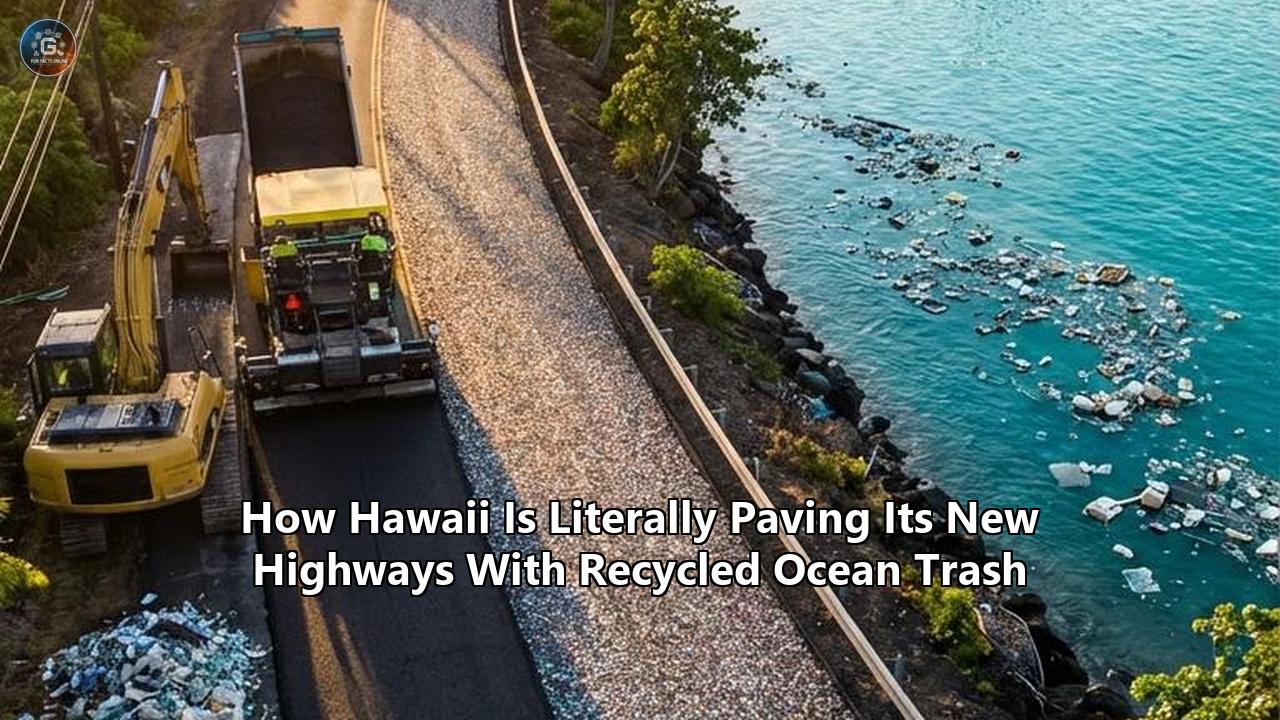
The Empirical Verdict on Asphalt and Marine Debris
At the American Chemical Society (ACS) Spring 2026 meeting in Atlanta, researchers from the Center for Marine Debris Research (CMDR) at Hawaiʻi Pacific University presented a set of findings that officially transitions a highly scrutinized infrastructure experiment into a viable public works strategy. After nearly two years of testing, data confirms that incorporating recycled fishing nets and local plastic waste into Hawaii’s asphalt roads does not increase the shedding of microplastics into the surrounding environment.
For environmental chemists, municipal planners, and marine biologists, this is the operational clearance they have been waiting for. The viability of recycled ocean plastic roads has officially moved from a theoretical concept to proven infrastructure. By replacing traditional petroleum-derived polymers with repurposed polyethylene extracted directly from the Pacific Ocean, Hawaii has engineered a functional end-of-life fate for the derelict fishing gear that routinely chokes its shorelines.
The news anchors an ongoing pilot project spearheaded by the Hawaii Department of Transportation (HDOT), which initially laid down an experimental stretch of modified asphalt in Ewa Beach, Oahu, in October 2022. For 11 months, CMDR researchers meticulously vacuumed road dust from the pavement, capturing particulate matter generated by daily traffic. Using advanced chemical instrumentation to quantify polymer shedding, the team, led by researcher Jeremy Axworthy and CMDR director Dr. Jennifer Lynch, found that the recycled polyethylene pavement performed identically to standard polymer-modified asphalt in terms of particulate release. Furthermore, the road dust analysis revealed a stark reality of modern transportation: vehicle tire wear produces exponentially more microplastic pollution than the pavement itself.
This development shifts the trajectory of Hawaii’s waste management and infrastructure planning. The state faces an acute geographic disadvantage, isolated from mainland recycling facilities and burdened by overflowing local landfills. By successfully upcycling marine debris into highly durable highway surfaces, HDOT and its academic partners have established a framework that simultaneously hardens local infrastructure against a punishing tropical climate and sequesters hazardous ocean waste.
Anatomy of the Ewa Beach Pilot Project
To understand the scale and mechanics of this development, it is necessary to examine the physical testing ground on the island of Oahu. The initial pilot site encompasses a heavily trafficked segment of Fort Weaver Road in Ewa Beach, stretching between Kilaha Street and Cormorant Avenue.
The road is divided into three seamless sections to provide a controlled comparative analysis. The outer segments of the road were paved using the experimental recycled plastic mixture, while the middle segment was paved with conventional polymer-modified asphalt to serve as a control. To the naked eye, and to the tires of passing vehicles, the sections are indistinguishable. The pavement looks, feels, and handles exactly like any standard highway in the state.
Beneath the surface, however, the material composition represents a highly engineered departure from traditional road construction. The pilot required 1,950 tons of modified asphalt. Integrated into this heavy aggregate mixture was the equivalent of 195,000 plastic bottles, alongside high-density polyethylene derived directly from abandoned commercial fishing nets. To date, more than a metric ton of fishing nets have been successfully integrated into Hawaiian roads through this specific initiative.
The physical laying of the asphalt was conducted by a local paving company working under HDOT contracts, utilizing standard heavy machinery. This operational detail is highly significant for the short-term consequences of the project: it proves that municipal road crews do not need specialized paving equipment to utilize the new material. The modified asphalt can be heated, transported, and laid using the existing fleet of infrastructure hardware.
The Threat Profile: Ghost Nets and the Archipelagic Waste Crisis
The push to engineer alternative asphalt is fundamentally a response to an environmental crisis unique to the Hawaiian archipelago. Due to its geographic position in the central North Pacific, the state acts as a massive comb that traps debris circulating within the North Pacific Subtropical Gyre—commonly known as the Great Pacific Garbage Patch.
The most destructive element of this debris is derelict fishing gear, frequently referred to as "ghost nets." These massive webs of synthetic rope and plastic mesh break loose or are intentionally discarded by commercial fishing fleets in international waters. Left to drift, they continue to "fish," indiscriminately entangling and drowning marine life, including endangered Hawaiian monk seals, sea turtles, and various cetacean species. When these nets eventually make landfall, they act like bulldozers across Hawaii’s fragile coral reefs, pulverizing ancient coral heads with every tidal surge before finally washing onto the beaches.
Foreign derelict fishing gear is the single largest contributor to Hawaii’s marine debris problem. The sheer volume of this material overwhelms local waste management infrastructure. Hawaii’s primary landfill on Oahu, Waimanalo Gulch, has strictly limited capacity, and the economic cost of shipping bulk waste 2,500 miles back to the U.S. mainland for processing or disposal is exorbitant.
For decades, the standard procedure was to remove these nets from the ocean and simply bury them in local landfills or incinerate them at the H-POWER waste-to-energy plant in Kapolei. Both options carry negative environmental consequences. Incineration produces greenhouse gas emissions and toxic byproducts, while landfilling consumes precious island real estate and leaves the polymers intact for centuries.
"By reusing plastic waste that is already in Hawaii, we can reduce the environmental and economic impacts of transporting waste plastics from the islands, incinerating it or dumping it in Hawaii's overflowing landfills," Axworthy noted during the ACS presentation.
The Economics of the Bounty Project
The integration of marine debris into highway infrastructure requires a steady, reliable supply chain of raw materials. To bridge the gap between ocean cleanup and pavement production, CMDR established the Bounty Project.
This initiative essentially creates a commodities market for ocean trash by paying a financial reward to licensed commercial fishers for the removal of marine debris. Commercial fishers are uniquely positioned to intercept ghost nets before they strike the reefs. They have the offshore capability, the heavy winches required to haul massive nets weighing several tons out of the water, and the navigational reach to spot debris far beyond the coastal zones.
The short-term economic impact on the local fishing industry is highly favorable. Fishers are compensated for an activity that simultaneously protects the marine ecosystems their livelihoods depend upon. According to Dr. Lynch, the Bounty Project has successfully removed 84 tons of large, derelict fishing gear from the Pacific Ocean to date. Overall, the broader Nets-to-Roads program, managed by marine biologist Mafalda de Freitas, has processed roughly 90 metric tons of plastic trash hauled from Hawaiian waters and beaches.
By assigning a financial value to derelict nets, the program ensures a continuous feedstock of polyethylene for HDOT's infrastructure projects. This shifts the economic burden of cleanup away from purely taxpayer-funded municipal efforts and incentivizes private maritime operators to actively engage in environmental remediation.
Chemical Engineering: Replacing Petroleum with Polyethylene
To comprehend the structural changes introduced by this initiative, one must analyze the chemistry of modern road construction. Standard asphalt is a mixture of aggregate (rocks, sand, and gravel) bound together by bitumen, a highly viscous petroleum byproduct.
Since 2020, HDOT has predominantly paved Hawaii's roads with Polymer-Modified Asphalt (PMA). Standard asphalt is highly susceptible to the state's harsh environmental conditions. The combination of intense ultraviolet radiation, high surface temperatures, and heavy tropical rainfall causes unmodified bitumen to become brittle, leading to rutting (surface depressions in the wheel path), thermal cracking, and water intrusion.
To combat this, highway engineers traditionally add styrene-butadiene-styrene (SBS) to the mix. SBS is a synthetic rubber copolymer derived from petroleum. When melted into the sticky asphalt binder at high temperatures, the SBS particles create an elastomeric network. This makes the pavement significantly more elastic, allowing it to stretch under the weight of heavy commercial trucks and contract during cooler night temperatures without fracturing.
The breakthrough achieved by CMDR and HDOT involves substituting a portion of this expensive, petroleum-based SBS with recycled high-density polyethylene (HDPE) harvested from ghost nets and local municipal recycling bins. The salvaged plastics are sorted, shredded, and melted down into precise polymer pellets. When tumbled with heated aggregates in a mixing drum, this recycled plastic binder fully coats the rocks and sand, mimicking the elastomeric properties of SBS.
Integrating recycled ocean plastic roads into tropical climates requires this exact polymer stability. If the plastic does not bind correctly at a molecular level, the pavement will delaminate, causing the road surface to strip away under the friction of vehicle tires. The Ewa Beach pilot demonstrated that the polyethylene blend matches the high-performance metrics of traditional PMA, resisting rutting and water damage while permanently locking the waste plastic within the solid asphalt matrix.
The Supply Chain Paradox: Exporting Waste to Import Pavement
While the environmental and structural data presented at the ACS Spring 2026 meeting are highly favorable, an analysis of the current operational logistics reveals a significant short-term bottleneck. The supply chain required to produce this modified asphalt is not yet fully localized.
Currently, the Nets-to-Roads program collects and sorts the marine debris on the islands, isolating the durable polyethylene materials suitable for paving. However, Hawaii lacks the specialized industrial facilities required to shred, wash, and process this heavily degraded maritime waste into standardized polymer pellets.
Consequently, the raw waste and nets are loaded onto cargo ships and exported across the Pacific to a processing facility on the U.S. mainland. There, the material is ground down and refined. The finished pellets are then shipped back across the Pacific to an Oahu-based pavement production facility, where they are finally mixed into the hot asphalt.
This dual-transit requirement introduces a carbon footprint that partially offsets the greenhouse gas reductions achieved by diverting the plastic from incinerators. It also exposes the program to the volatility of trans-Pacific shipping costs and logistical delays. For the project to scale from a successful pilot into a standard, statewide infrastructure policy, the long-term consequence must be the development of local processing infrastructure. Capital investment in island-based shredding and pelletizing facilities will be necessary to achieve a truly closed-loop circular economy.
Environmental Risk Assessment: The Microplastic Shedding Data
Critics of recycled ocean plastic roads often point to the severe risk of secondary pollution. The primary concern is that the mechanical friction of daily traffic, combined with ultraviolet degradation and heavy rain, will cause the pavement to shed microscopic plastic particles into the environment.
If microplastics leach from the roads, they will inevitably be carried by stormwater runoff directly into the coastal waters they were originally removed from. This exposes human populations and marine life to toxic plastic additives, which are known to cause hormone disruption, chronic inflammation, and severe reproductive problems.
The HDOT tasked Dr. Lynch’s team with executing a rigorous environmental risk assessment to address these exact concerns. Over the course of 11 months, CMDR researchers including Jeremy Axworthy collected granular dust samples directly from the surface of the Ewa Beach test sections. The laboratory utilized state-of-the-art chemical instrumentation designed specifically to quantify and characterize microplastics in environmental samples.
The data presented in Atlanta confirmed that the experimental pavement containing recycled polyethylene did not release a higher volume of polymers than the control pavement made with traditional SBS. The synthetic matrix effectively locks the recycled plastic inside the bitumen binder.
Furthermore, the study illuminated a broader environmental reality regarding roadway pollution. The chemical analysis of the road dust revealed that the vast majority of microplastics found on the surface were generated by tire wear. Modern vehicle tires are manufactured from a complex blend of natural and synthetic rubbers. As tires roll across the aggregate surface of the road, they constantly abrade, leaving behind millions of microscopic rubber particles. The pavement itself, whether made from recycled nets or traditional petroleum products, remains highly stable.
In addition to road dust analysis, the College of Engineering at the University of Hawaii Manoa and CMDR conducted extensive water quality sampling. Researchers simulated heavy rainfall events on the pilot road and collected the resulting stormwater runoff. The water was analyzed over several months to detect any synthetic chemicals or plastic additives that might leach from the pavement into the storm drain system. The preliminary results align with the road dust data, showing no elevated chemical signatures originating from the recycled plastic matrix.
Short-Term Operational Shifts for HDOT and Fishers
The validation of the microplastic data triggers immediate operational shifts for several stakeholders in Hawaii.
For the Hawaii Department of Transportation:HDOT Deputy Director for Highways Ed Sniffen has emphasized that utilizing this material has the potential to make roads stronger while radically reducing landfill dependency. With the Ewa Beach pilot successfully surviving the rigors of island weather and traffic, HDOT now possesses the empirical data required to integrate this modified mix into future requests for proposals (RFPs).
The state is currently evaluating high recycled asphalt (RAP) mixes utilizing up to 50% recycled materials. If the polyethylene-modified pavement continues to meet long-term structural benchmarks, HDOT could more than double the percentage of recycled materials currently used in state infrastructure projects. This will gradually shift municipal purchasing power away from imported, virgin petroleum products and toward locally sourced waste polymers.
For the Commercial Fishing Industry:The success of the asphalt pilot secures the immediate future of the Bounty Project. With a proven end-use market for the derelict gear, the funding mechanisms that compensate fishers for debris removal can be stabilized and expanded. Commercial crews will increasingly view ghost nets not merely as navigational hazards, but as harvestable commodities. This financial incentive structure will likely lead to an acceleration in the tonnage of debris removed from the Pacific, directly benefiting the fragile near-shore reef ecosystems.
For Local Municipalities:City and county waste management divisions face immediate relief regarding specific types of plastic disposal. The polyethylene from Honolulu’s residential recycling containers was successfully integrated into the pilot mix alongside the fishing nets. This proves that post-consumer residential waste, which is notoriously difficult to sell on the global commodities market, can be absorbed by local infrastructure projects. Every ton of plastic paved into a highway is a ton diverted from Waimanalo Gulch or the H-POWER incinerators.
Broadening the Scope: Global Implications for Island Nations
The engineering breakthroughs achieved in Hawaii extend far beyond the state's borders. The challenges of tropical climate infrastructure, isolated supply chains, and overwhelming marine debris are shared by island nations and coastal municipalities globally.
From the archipelagos of the Caribbean to the remote islands of the South Pacific, governments struggle with the high cost of imported bitumen and the ecological devastation caused by ocean plastics. The methodology developed by CMDR and HDOT offers a blueprint for infrastructural resilience.
By proving that ghost nets can be reliably converted into high-performance polymer-modified asphalt, Hawaii has demonstrated a highly replicable model. Future international aid or environmental grants targeted at ocean cleanup could logically be paired with infrastructure development funds. Instead of treating marine debris strictly as an expensive waste management crisis, coastal governments can redefine it as a raw material for necessary public works.
The analytical frameworks established by Dr. Lynch’s team also provide a standardized testing protocol. Other municipalities looking to adopt this technology will not have to guess regarding microplastic shedding or chemical leaching; they can replicate the CMDR road dust vacuuming and simulated stormwater runoff tests to ensure environmental compliance within their own jurisdictions.
Unresolved Variables and the Horizon Line
As Hawaii looks to expand its network of recycled ocean plastic roads, several key variables remain unresolved, dictating what engineers and environmental scientists will monitor over the next decade.
The primary unresolved question is long-term fatigue cracking. While the 11-month and two-year data sets validate the immediate durability and environmental safety of the pavement, highway infrastructure is evaluated on a 10-to-20-year lifespan. HDOT engineers will closely monitor the Ewa Beach test site to determine how the recycled polyethylene matrix reacts to a decade of thermal cycling, UV radiation, and heavy load repetitions. If the plastic binder becomes prematurely brittle after five years, the maintenance costs of repaving will outweigh the initial environmental benefits of the upcycling process.
Secondly, the chemical degradation of the specific plastics over extended time horizons requires ongoing scrutiny. The ghost nets recovered from the Pacific have already endured severe weathering, ultraviolet exposure, and saltwater immersion. How this pre-weathered plastic interacts with the heavily oxidized bitumen binder over decades is a relatively new area of material science. Researchers will need to continuously test the deep soil and groundwater near these road installations to ensure that toxic plasticizers or endocrine-disrupting chemicals do not slowly migrate out of the pavement as it ages.
The ultimate milestone for this initiative will be the localization of the processing infrastructure. To entirely remove the environmental and financial cost of shipping the waste to the mainland and back, Hawaii must develop domestic facilities capable of washing, shredding, and pelletizing marine debris on the islands. Securing the capital investment, zoning, and permitting for such an industrial facility will be the next major phase of the Nets-to-Roads program.
Until then, the data out of the ACS Spring 2026 meeting serves as a definitive operational green light. The roads of Oahu are successfully capturing the debris of the Great Pacific Garbage Patch, providing a structurally sound, environmentally secure mechanism for mitigating one of the ocean's most persistent threats. The pavement holds, the microplastics remain locked within the aggregate, and the commercial fleets have a financial mandate to pull destructive gear from the reefs. The framework is functioning precisely as engineered.
Reference:
- https://www.acs.org/pressroom/presspacs/2026/march/paving-hawaiian-roads-with-recycled-plastics-and-abandoned-fishing-nets.html
- https://www.plasticstoday.com/sustainability/hawaii-turns-plastic-waste-into-pavement
- https://www.stormwaterhawaii.com/tips/hawaii-department-of-transportation-pilots-project-with-recycled-asphalt-materials/
- https://hidot.hawaii.gov/administration/category/main/page/99/
- https://www.hpu.edu/about-us/the-ohana/article.php?nid=nc07052302
- https://www.anthropocenemagazine.org/2026/04/hawaii-pioneers-turning-plastic-waste-into-pavement/