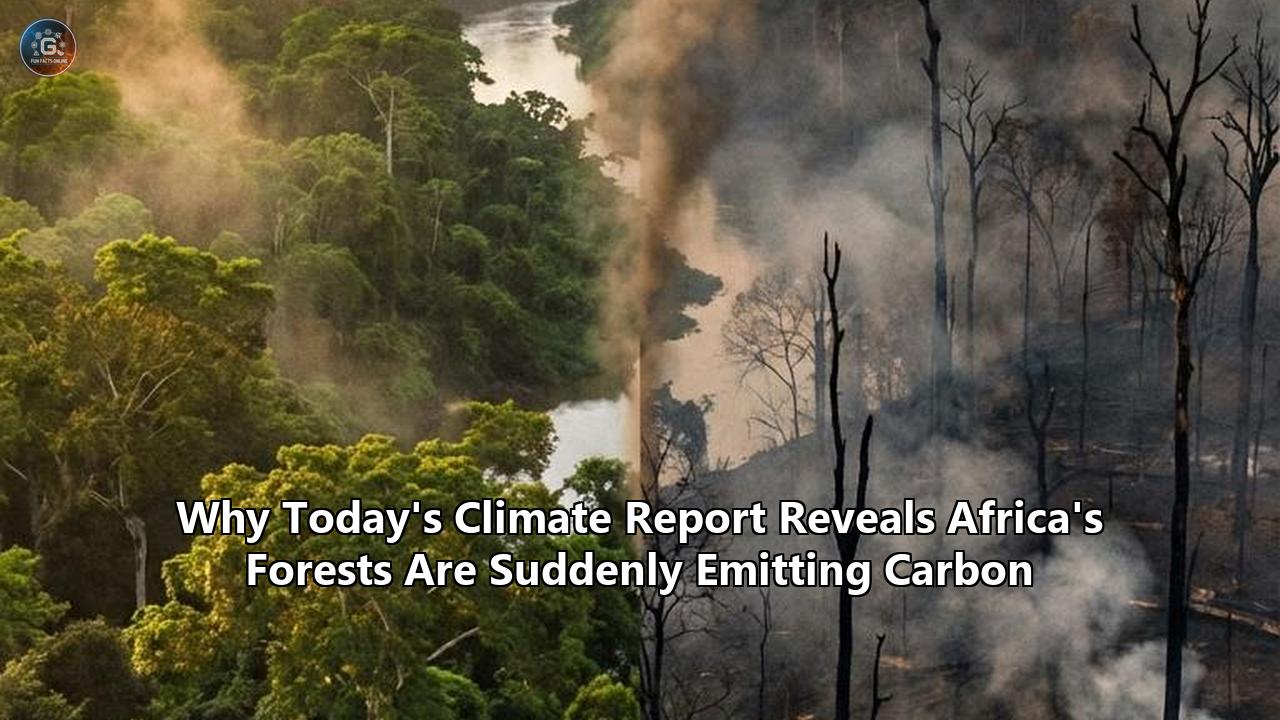
A stark reversal in the Earth’s climate mechanics was verified this week. Africa’s vast tropical forests, historically relied upon as a primary atmospheric filter, are no longer mitigating global warming. Instead, they are actively accelerating it.
According to an exhaustive international assessment published in Scientific Reports—led by researchers at the National Centre for Earth Observation (NCEO) at the Universities of Leicester, Sheffield, and Edinburgh—the continent’s forests crossed a critical ecological threshold shortly after 2010. Transitioning from a net carbon sink to a net carbon source, African forests are now releasing approximately 200 million tons of carbon dioxide into the atmosphere annually. The data reveals that between 2010 and 2017, the continent lost roughly 106 million tons of forest biomass every year. To contextualize the physical scale of this deficit, the annual loss is equivalent to the weight of 106 million automobiles.
The transition represents a severe structural failure in the global carbon cycle. Between 2007 and 2010, the same regions were successfully sequestering excess emissions, gaining roughly 439 million metric tons of biomass annually. The violent downward trajectory observed in the subsequent years means the world’s three largest rainforest regions—the Amazon, Southeast Asia, and now the Congo Basin and its surrounding woodlands—have all been compromised.
Professor Heiko Balzter, senior author of the study and Director of the Institute for Environmental Futures at the University of Leicester, articulated the severity of the findings during the recent COP30 Climate Summit in Belém, Brazil. “If Africa’s forests are no longer absorbing carbon, it means other regions and the world as a whole will need to cut greenhouse gas emissions even more deeply to stay within the 2°C goal of the Paris Agreement and avoid catastrophic climate change,” Balzter stated.
The ramifications stretch from immediate atmospheric physics to long-term macroeconomic planning. Global climate architecture, including the intricate calculations underpinning the 2050 net-zero targets, presumed that the terrestrial biosphere would continue absorbing roughly 2.4 billion tons of carbon annually. With the African continent reversing its role, the math stabilizing international climate accords is suddenly obsolete.
The Mechanisms of Reversal: Satellite Precision Meets Ground-Level DestructionFor decades, tracking African forests carbon emissions has historically been an exercise reliant on extrapolations from sparse field data. The sheer physical inaccessibility of the central Congo Basin, compounded by regional instability and minimal monitoring infrastructure, forced climate modelers to rely on broad estimates. The scientific consensus assumed that the vast, unbroken stretches of greenery in Central and West Africa were steadily accumulating carbon, buffering the industrial output of the Northern Hemisphere.
The current findings dismantle those assumptions using an unprecedented array of orbital sensors. To bypass the limitations of ground-based sampling, the research team utilized high-resolution Earth-observing technology, specifically NASA’s GEDI (Global Ecosystem Dynamics Investigation) laser altimeter mounted on the International Space Station, alongside Japan’s ALOS radar satellites.
By analyzing the backscatter of radar signals and the precise timing of laser pulses bouncing off the forest canopy and the forest floor, researchers mapped the three-dimensional structure of the continent's vegetation. Machine learning algorithms processed over a decade of this high-resolution imagery to calculate aboveground woody biomass—the physical carbon stored in the trunks, branches, and leaves of trees and shrubs.
This synthesis of radar, LiDAR, and machine learning provided the first continent-wide, high-resolution assessment of terrestrial carbon dynamics. The granular data split the continent into distinct biomes, revealing a highly unequal distribution of carbon storage and loss.
Savanna ecosystems and dry woodlands technically experienced minor biomass gains during the observation period. Elevated atmospheric CO2 levels trigger a "fertilization effect" in certain resilient plant species, allowing drought-resistant shrubs to aggressively expand across open grasslands. However, the carbon density of a savanna—averaging roughly 45 tons per hectare—is a fraction of the carbon stored in dense tropical environments.
The marginal gains in the savannas were completely eclipsed by the catastrophic collapse of the tropical moist broadleaf forests. In these dense, humid ecosystems, carbon storage regularly reaches 396 tons per hectare, peaking at 429 tons per hectare in the deepest, oldest sections of the Congo Basin. When these heavyweight carbon vaults are breached, the emissions outpace any localized growth in the surrounding arid zones. The satellites confirm that the structural degradation of these specific moist broadleaf zones is the primary engine driving the new emissions reality.
The Geography of the Hemorrhage: Where the Biomass is VanishingThe spatial distribution of the biomass loss provides a precise roadmap of ecological vulnerability. The deficits are not uniformly spread across the continent but are violently concentrated in three specific regions: the Democratic Republic of Congo (DRC), Madagascar, and the fragmented forest corridors of West Africa.
In West Africa, nations have already lost the vast majority of their historical primary forest cover. The degradation here is chronic, characterized by the slow, relentless expansion of smallholder agriculture, cocoa farming, and the aggressive extraction of fuelwood. What remains is highly fragmented, leaving the edges of the forest exposed to extreme heat, wind, and eventual desiccation.
Madagascar presents an entirely distinct crisis. Characterized by unparalleled endemism, the island’s forests are being rapidly dismantled by slash-and-burn agriculture—locally known as tavy—and illegal logging operations targeting precious hardwoods like rosewood. The biomass maps indicate steep, vertical drops in carbon storage along the island's eastern escarpment, a direct result of human encroachment into previously undisturbed steep-terrain ecosystems.
The most systemic threat, however, lies in the heart of the continent. The Congo Basin spans over 300 million hectares across 11 countries and holds roughly 59 billion metric tons of aboveground carbon—a staggering reserve equivalent to six years of total global fossil fuel emissions. While the Amazon has been systematically industrialized and mapped over the last four decades, the Congo Basin has often been termed "the rainforest the world forgot".
For years, the sheer lack of industrial-scale infrastructure protected the interior of the DRC. Deforestation rates here were significantly lower than in Brazil or Indonesia. But the satellite data confirms that this passive protection has expired. New roads, logging concessions, and artisanal mining operations have fractured the intact forest landscapes. Once a road pierces the primary forest, a predictable cascade follows: commercial loggers extract the most valuable timber, artisanal miners follow the roads to prospect for cobalt and coltan, and subsistence farmers eventually clear the remaining degraded forest to grow crops. The sheer volume of biomass in the Congo Basin means that even a minor percentage increase in deforestation yields a massive spike in atmospheric carbon.
The Underworld Awakening: Ancient Carbon Venting in the Congo BasinWhile aboveground biomass destruction accounts for the visible loss, a secondary, entirely distinct climate threat is currently materializing below the forest floor. A concurrent study published in February 2026 by a research team at ETH Zurich has exposed a massive vulnerability in the Cuvette Centrale peatlands of the Congo Basin.
Mapped comprehensively only within the last decade, these peatlands cover an area roughly the size of England and contain an estimated 30 billion metric tons of carbon in dense, waterlogged organic matter. For millennia, the swampy, anoxic conditions of the central basin halted the decomposition of fallen leaves and dead wood, locking the carbon into a thick subterranean layer. As long as the peat remains submerged, the carbon is secure.
However, the ETH Zurich researchers discovered that large blackwater lakes distributed throughout the peatlands are actively venting highly concentrated carbon. Initially, scientists assumed these emissions were simply the byproduct of surface microbes breaking down recently fallen, young plant material. But by utilizing advanced radiocarbon dating techniques on water samples collected deep within the interior swamps, researcher Travis Drake and his colleagues proved that the lakes are releasing "ancient carbon"—organic material that has been buried and isolated for thousands of years.
“Given the relatively pristine condition of the Congo peatlands, I suspect that these lakes have long outgassed peat carbon to one degree or another,” Drake stated, outlining a baseline natural process. But the discovery of the ancient carbon pathway introduces a terrifying variable into climate models. If the blackwater lakes have a mechanism to mobilize deep-peat carbon and vent it into the atmosphere, the stability of the entire 30-billion-ton reserve is in question.
The venting of ancient carbon represents a highly sensitive feedback loop. As the regional climate warms and the canopy above the peatlands is degraded by human activity, the microclimate dries out. Deforestation physically reduces the volume of moisture transpired into the air, decreasing local rainfall. This drought pressure inevitably lowers the water levels in the peatland lakes and swamps. As the water table drops, previously submerged ancient peat is exposed to oxygen. Oxygen triggers rapid microbial decomposition, instantly converting thousands of years of stored organic matter into atmospheric CO2.
The ETH Zurich study confirms that we are not just losing the trees that capture carbon today; the environmental shifts are unlocking the prehistoric carbon vaults buried safely underground since the last ice age. The dual assault—aboveground chainsaws and belowground oxidation—creates an emissions multiplier that current global carbon budgets completely fail to account for.
The Human Driver: Demographics, Agriculture, and ExtractionUnderstanding the shift in Africa's carbon dynamics requires a forensic examination of the pressures operating on the ground. The destruction is not the result of a single, monolithic industry, but rather a complex matrix of demographic expansion, poverty, and aggressive global resource extraction.
Human activity is the absolute primary catalyst. Unlike the Amazon, where massive, mechanized agribusiness operations aggressively clear-cut primary forest for cattle ranching and soy cultivation, the dynamics in the Congo Basin and West Africa are predominantly driven by decentralized, small-scale actors forced into unsustainable practices by economic necessity.
Farmers are progressively clearing more land strictly for food production. Shifting cultivation—where patches of forest are cut, burned, farmed until the soil nutrients are exhausted, and then abandoned for a new patch—is a deeply entrenched practice. Historically, when populations were smaller, the forest had decades to regenerate and reclaim the abandoned plots. But with demographic pressures surging, the fallow periods have been drastically shortened. The forest never has time to recover its biomass before it is cut again, leading to permanent structural degradation.
The demographic statistics guarantee that this pressure will escalate violently over the coming decades. The population of the Democratic Republic of Congo alone is projected to triple by the year 2050. Feeding this rapidly expanding population utilizing current, low-yield agricultural techniques will require the conversion of millions of additional hectares of primary forest into cropland.
Simultaneously, the global energy transition is paradoxically driving localized destruction. The international demand for minerals critical to battery manufacturing and renewable energy infrastructure—specifically copper, cobalt, and lithium—has triggered a massive expansion of mining operations across the African copper belt and the Congo Basin. These infrastructure projects slice through the intact forest, bringing roads, heavy machinery, and influxes of transient laborers who rely on the surrounding forest for bushmeat and fuelwood.
Biomass burning remains the dominant energy source for the majority of the population in these regions. The aggressive harvesting of wood for charcoal production systematically strips the larger, more carbon-dense trees from the landscape. The Scientific Reports authors highlight that Africa’s ecosystems already account for roughly 40 percent of the world’s carbon emissions from biomass burning. When combined with the 20 percent of global emissions originating from outright deforestation, the continent’s total output becomes a massive global liability.
The Immediate Casualties: Local Weather, Hydrology, and BiodiversityThe immediate impacts of this transition are already manifesting across the continent, hitting local economies and ecosystems long before the global temperature dials register the excess carbon. Forests are not merely passive carbon storage units; they are active, mechanical engines driving regional hydrology.
The dense canopy of the moist broadleaf forest acts as a massive water pump. Trees draw moisture from the deep soil and transpire it into the atmosphere, creating the cloud cover that generates regional rainfall. This "rainfall recycling" sustains the entire agricultural system of the continent's interior. As the forest is fragmented and the overall biomass drops, the hydrological pump loses power. The immediate consequence is localized drought, erratic rainfall patterns, and extended dry seasons.
For subsistence farmers relying on predictable rain patterns, this micro-climate disruption is devastating. The loss of forest cover increases local surface temperatures, severely impacting crop yields and accelerating soil erosion. Without the root systems of the large trees to anchor the soil, the torrential seasonal rains wash away the fertile top layer, further depressing agricultural output and forcing farmers to push even deeper into the remaining forest in search of arable land.
The biodiversity fallout is equally acute. The Congo Basin and Madagascar are two of the most critical genetic repositories on Earth. The large, canopy-emergent trees that store the most carbon are also the foundational keystone species for the broader ecosystem. When these specific trees are logged or burned, the structural integrity of the habitat collapses. Primates, endemic bird species, and thousands of undocumented insect and plant species face immediate habitat compression.
Furthermore, the surge in African forests carbon emissions alters the fundamental chemistry of the regional waterways. As the burned and degraded topsoil washes into the river systems, it carries massive loads of dissolved organic carbon and silt. This runoff alters the pH and nutrient balance of the rivers, impacting freshwater fish populations that serve as the primary source of protein for millions of river-basin residents. The transition from a carbon sink to a carbon source is not just an atmospheric abstract; it is an active degradation of the life-support systems sustaining human and animal populations across the tropics.
The Geopolitical Shockwave: Paris Agreement Calculations DisintegrateThe realization that African forests are bleeding carbon rather than absorbing it sends a massive shockwave through the highest levels of international climate diplomacy. The entire architecture of the Paris Agreement, which seeks to limit global temperature rise to 1.5°C or well below 2°C, is built on a very specific mathematical foundation known as the Global Carbon Budget.
This budget calculates exactly how much anthropogenic greenhouse gas can be emitted into the atmosphere before the temperature thresholds are breached. The mathematics heavily rely on the Earth's natural sinks—primarily the oceans and terrestrial forests—to offset a significant portion of human emissions. According to Professor Doganay Tolunay of Istanbul University's Forest Engineering Department, natural sinks historically absorbed about 5.6 billion tons of carbon each year, or roughly 20.5 billion tons of CO2 equivalent.
The UN’s Food and Agriculture Organization (FAO) built their models on the assumption that African forests held 132 billion tons of carbon in 1990. But current FAO and satellite data confirm that by 2025, those stocks had already plunged to 115 billion tons. The models were entirely wrong about the trajectory.
“We can claim with high confidence that the transition from a carbon sink to a source is real,” the study authors bluntly state.
This means the global carbon budget is significantly smaller than diplomats and policymakers have been operating under. If the continent is emitting 200 million tons of CO2 instead of absorbing hundreds of millions of tons, the gap in the ledger is immense. Every industrialized nation, every corporate net-zero pledge, and every carbon-offset market that relied on the passive absorption of the global south just lost a massive portion of its operating margin.
The revelation directly impacts the multi-billion dollar voluntary carbon market. Hundreds of massive corporations have purchased carbon credits based on REDD+ (Reducing Emissions from Deforestation and forest Degradation) projects in Central Africa. The underlying premise of these credits is that protecting a specific patch of forest offsets the emissions generated by an airline flight or a manufacturing plant in Europe or North America. But if the surrounding ecosystem is functionally collapsing and shifting toward a net-emitter state due to systemic degradation, the permanence and validity of those offsets are completely undermined.
The African negotiating bloc at the United Nations Framework Convention on Climate Change (UNFCCC) now holds a fundamentally altered hand. They can definitively prove that the global north can no longer rely on African geography to silently clean up industrial excess. The demand for direct, massive financial intervention just gained unprecedented scientific backing.
The Economic Pivot: The Tropical Forests Forever Facility and Climate FinanceMitigating African forests carbon emissions requires an immediate and total restructuring of how the global economy values a living tree versus a dead one. Currently, a standing mahogany tree in the DRC generates zero gross domestic product for the host nation until it is cut down, sold as timber, and the underlying land converted to crops. The global economic system incentivizes the exact behavior that is triggering the carbon hemorrhage.
Recognizing this critical market failure, an urgent policy response dominated the recent COP30 summit in Belém, Brazil. Spearheaded by the Brazilian delegation but highly relevant to the Congo Basin nations, the international community launched the Tropical Forests Forever Facility (TFFF).
The TFFF represents a massive departure from the fragmented, project-by-project funding of the past. The facility aims to mobilize over $100 billion to essentially put forested nations on a global payroll. Instead of relying on complex, highly scrutinized carbon offset markets, the TFFF will pay sovereign governments directly for every hectare of primary forest they successfully protect and leave entirely untouched.
“Climate finance for the Tropical Forests Forever Facility must be scaled up quickly to put an end to global deforestation for good,” warned Professor Balzter. The logic is brutally simple: the host nations require massive, consistent capital to enforce environmental protections, build sustainable alternative economies for the millions of people living on the forest edge, and reject lucrative logging and mining contracts offered by foreign multinationals.
The Grantham Research Institute on Climate Change and the Environment at the London School of Economics recently published a report highlighting the massive disparity between the ecological value of the Congo Basin and the actual revenue the regional governments collect. Destructive forestry practices yield only a fraction of what the natural capital is truly worth to the global climate. A genuine "fair deal" is required, where the international community compensates the Congo Basin countries for the opportunity cost of halting their extractive development.
Parallel to the TFFF, continental restoration initiatives are attempting to reverse the damage. The AFR100 program aims to restore 100 million hectares of deforested and degraded landscapes across Africa by 2030. But planting new saplings cannot immediately replace the complex, massive carbon vaults of an old-growth moist broadleaf forest. A newly planted tree takes decades to accumulate the biomass lost in a single afternoon of logging. Therefore, the absolute priority of climate finance must be locking down the primary forests that remain intact, preventing the carbon from ever leaving the biomass.
The Road to COP31: Unresolved Questions and the 2050 DeadlineThe reality of African forests carbon emissions means the international community faces a vastly accelerated timeline. As diplomats and environmental ministers prepare for the 31st UN climate change conference (COP31), scheduled to be hosted by Türkiye in the coming year, the data mandates a shift in global strategy.
Professor Tolunay emphasized that upcoming summits must integrate biodiversity protection directly with climate finance. Treating carbon emissions and habitat loss as separate policy silos is no longer viable when the destruction of the ecosystem is the exact mechanism releasing the carbon.
Several critical uncertainties will dominate the scientific and political agenda leading into 2050. First, the exact tipping point of the Cuvette Centrale peatlands remains dangerously unquantified. If rising temperatures and reduced rainfall continue to lower the blackwater lake levels, venting more of the ancient carbon discovered by the ETH Zurich team, the emissions from the Congo Basin could exponentially multiply. The global community currently has no engineering solution to stop peatland oxidation once the regional hydrology dries up.
Second, the demographic momentum of Central and West Africa requires immediate agricultural innovation. If the DRC’s population triples by 2050 as projected, and agricultural yields per hectare remain stagnant, no amount of international climate finance will physically stop starving populations from clearing the forest for food. The TFFF and similar funds must aggressively invest in agrotech, improved seed varieties, and soil management for the communities living on the periphery of the remaining dense biomes. The forest will only survive if the people living next to it have an alternative way to survive.
Finally, the accountability of the industrialized world faces a brutal reckoning. The collapse of the African carbon sink transfers the physical burden of mitigation squarely back to the primary emitters. Nations in North America, Europe, and Asia cannot rely on a vast, silent absorption mechanism in the global south to balance their continued fossil fuel use. The buffer has shattered.
The high-resolution maps generated by the Universities of Leicester, Sheffield, and Edinburgh offer no ambiguity. The bleeding of the continent's biomass is mapped, measured, and verified. The shift from a carbon sink to a carbon source fundamentally rewrites the rules of international climate survival. The next five years of global policy, financial mobilization, and enforcement will definitively determine whether the world's second-largest rainforest can be stabilized, or whether it will continue to dismantle the very climate it once helped protect.
Reference:
- https://le.ac.uk/news/2025/november/africa-forests-absorbing-emitting-carbon
- https://e360.yale.edu/digest/african-forests-carbon-source
- https://www.zmescience.com/ecology/african-forests-have-officially-flipped-instead-of-absorbing-carbon-theyre-now-releasing-it/
- https://africalive.net/article/africas-forests-emit-more-carbon-than-they-capture/
- https://www.theguardian.com/environment/2025/nov/28/africa-forests-transformed-carbon-sink-carbon-source-study
- https://www.downtoearth.org.in/forests/africas-forests-transitioned-from-carbon-sink-to-net-carbon-source
- https://www.researchgate.net/publication/398084210_Loss_of_tropical_moist_broadleaf_forest_has_turned_Africa's_forests_from_a_carbon_sink_into_a_source
- https://www.lse.ac.uk/granthaminstitute/publication/a-fair-deal-for-the-sustainable-development-of-the-congo-basin-countries-and-the-protection-of-the-rainforest/
- https://pmc.ncbi.nlm.nih.gov/articles/PMC12817162/
- https://ethz.ch/en/news-and-events/eth-news/news/2026/02/peatland-lakes-in-the-congo-basin-release-carbon-that-is-thousands-of-years-old.html
- https://news.mongabay.com/2026/03/ancient-carbon-venting-from-lakes-in-the-congo-basin-peatlands-study/