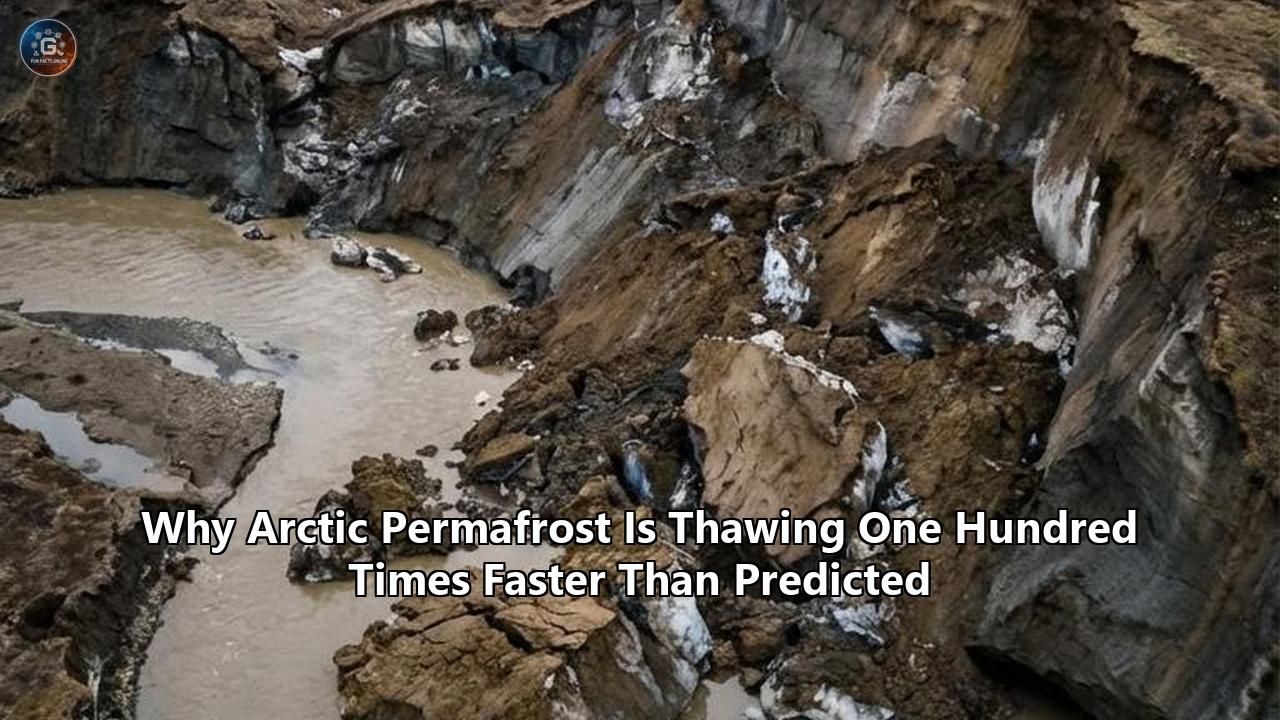
The collapse of the far north is no longer a slow-motion event. Recent data syntheses and field measurements from late 2025 and early 2026 reveal that abrupt landscape collapses are causing localized permafrost to thaw up to one hundred times faster than early steady-state climate models projected. Rather than melting mere millimeters a year from the top down, entire frozen hillsides are liquefying, forests are sinking into newly formed craters, and subterranean ice wedges are dissolving rapidly enough to drain entire lakes.
The Arctic is currently warming at four times the rate of the global average, pushing the region past critical thresholds. Earth System Models built in the 1990s and early 2000s primarily calculated the thaw of frozen soil as a gradual, linear process driven by ambient air temperatures. However, field researchers mapping the Canadian High Arctic, Alaska, and Siberia have documented localized thermokarst expansion—where ice-rich ground collapses into sinkholes and lakes—occurring at rates completely untethered from those initial algorithms. According to aquatic ecosystem ecologists like Katey Walter Anthony at the University of Alaska Fairbanks, the formation of thermokarst lakes can trigger local temperature changes that historically took 8,000 years to unfold, compressing that same thermal shift into a mere 80-year window.
This acceleration forces an immediate recalibration of global carbon budgets. Permafrost across the Northern Hemisphere holds an estimated 1,500 billion metric tons of carbon—roughly double the amount currently suspended in Earth’s atmosphere. As the models are rewritten to capture reality, the challenge is no longer just predicting the melt, but stabilizing the human and ecological systems caught in its immediate path.
The Physics of the Miscalculation
To understand why early projections failed, one must look at how the models were constructed. Standard models assumed that arctic permafrost thawing would occur through simple thermal conduction. In this scenario, warmer air slowly heats the topsoil, and the active layer—the surface soil that thaws in summer and freezes in winter—gradually deepens by a few centimeters each decade.
Nature, however, does not operate in a vacuum of simple top-down heat transfer. The models overlooked the violent physical dynamics of ice-rich terrain. Approximately 20 percent of the Arctic region contains permafrost heavily saturated with ice wedges and lenses. When this subterranean ice melts, the water occupies less volume than the ice did, causing the ground above it to slump. This creates a depression that collects rain and snowmelt. Because water is darker than snow, it absorbs more solar radiation, which in turn heats the water, melting the frozen ground beneath and around it even faster.
This process, known as thermokarst development, transforms the landscape into a fractured mosaic of lakes, bogs, and sinkholes. Once water pools on the surface, it acts as a thermal drill, driving heat deep into the earth. Researchers mapping the Canadian High Arctic recently recorded thermokarst expansion accelerating tenfold between the 1970s and recent years, completely bypassing the linear progression models.
Furthermore, subterranean water movement is generating hidden thermal threats. Hydrologists are increasingly tracking underground drainage channels that form as permafrost degrades. These channels allow relatively warm water to flow rapidly through the subsurface, transferring heat horizontally and melting the structural foundations of the soil from the inside out. When these subterranean networks breach the surface, they can drain entire surface lakes in a matter of days—an event that early models predicted would not happen for decades.
The Methane Reality and Winter Emissions
The speed of the physical thaw directly dictates the speed of the biological decay. When permafrost thaws, the organic matter trapped within it—leaves, roots, and animal remains frozen since the Pleistocene—becomes accessible to microbes. As these microbes digest the ancient carbon, they release greenhouse gases.
If the soil thaws in a dry, oxygen-rich environment, the microbes release carbon dioxide. However, abrupt thaw almost always creates wet, inundated, oxygen-starved environments. Under these anaerobic conditions, the microbes produce methane. While methane does not linger in the atmosphere as long as carbon dioxide, it traps up to 30 times more heat over a century-long timeframe.
A critical blind spot in historical modeling was the assumption that microbial activity halted when the surface snow returned. It was presumed that the long, dark Arctic winter effectively paused carbon emissions. Recent pooling of observations from over 100 Arctic field sites via the Permafrost Carbon Network has thoroughly dismantled this assumption. Researchers found that the permafrost zone is releasing billions of tons of carbon during the winter months alone. The soil remains just warm enough beneath the insulating layers of heavy snow for microbial communities to continue their digestion.
Lakes formed by abrupt thaw are particularly volatile. These bodies of water act as direct vents to the atmosphere. Deep beneath thermokarst lakes, the thaw front can plunge 10 to 15 meters into the earth, unlocking ancient, carbon-dense layers of soil. The methane generated at the bottom of these lakes bubbles to the surface year-round, sometimes with enough pressure to keep sections of the lake from completely freezing over in winter. The sheer volume of methane migrating from these localized "hotspots" means that even though abrupt thaw affects only a fraction of the total landmass, its emissions equal or exceed those of the vast areas experiencing gradual thaw.
Chemical Spills and "Arctic Alchemy"
Beyond carbon and methane, the accelerated thaw is fundamentally altering the regional chemistry. In the pristine watersheds of the Brooks Range in Alaska, researchers have documented a startling phenomenon where crystal-clear streams are rapidly turning the color of rust.
Ecologist Roman Dial and other researchers investigating this "Arctic Alchemy" determined that as the permafrost degrades, it exposes ancient bedrock and mineral deposits to water and oxygen for the first time in millennia. The water reacts with these newly exposed rocks, producing highly acidic runoff that mobilizes heavy metals like iron, zinc, and copper. This toxic, metallic sludge flows directly into the river systems, altering the pH of the water and suffocating aquatic life.
This chemical alteration represents a severe threat to subsistence fisheries that Indigenous communities have relied upon for generations. The acidification of these rivers is not a localized anomaly; it is an emerging systemic issue across the discontinuous permafrost zones of North America and Siberia, forcing environmental agencies to treat climate-driven heavy metal contamination with the same urgency as an industrial chemical spill.
Infrastructure in Freefall
The most immediate human toll of arctic permafrost thawing is measured in the failure of infrastructure. Entire communities, military installations, and industrial pipelines were built on the assumption that the frozen ground beneath them was effectively bedrock.
In the coastal village of Point Lay, Alaska, and dozens of similar communities across the circumpolar north, the ground is literally dropping out from underneath the residents. Community boreholes reveal that the underlying soil consists of up to 40 percent excess ice. As that ice turns to water and drains away, the ground subsides. Houses tilt violently, structural foundations crack, and utilidors—the above-ground insulated pipes that carry water and sewage—snap under the uneven strain.
The Mackenzie River Delta in the western Canadian Arctic highlights the sheer scale of the subsidence. Measurements across the depocenter reveal that land is sinking while the sea level is simultaneously rising, resulting in coastal flooding and the rapid loss of avian nesting habitats. Coastal erosion is accelerating because the sea ice that historically buffered the shorelines from winter storms now forms later in the year and melts earlier. Storm surges slam directly into the exposed, thawing bluffs, pulling massive chunks of land into the ocean. In some instances, coastlines are retreating by tens of meters in a single severe storm season.
Transportation networks are equally compromised. Across Alaska and Russia, the freeze-thaw cycles heave and buckle asphalt, creating hazardous "rollercoaster" roads. The iconic "drunken forests," where black spruce trees lean at chaotic angles because their root systems have lost the solid ground, now border highways that require constant, exorbitant maintenance to remain passable.
The Biological Vault Opens
As the structural integrity of the Arctic dissolves, scientists are confronting the unsealing of a frozen biological and industrial vault. Over the past century, industrial operations assumed the permafrost would serve as a permanent containment system. Oil and gas drilling waste, mining tailings, and industrial chemicals were routinely buried in unlined pits, trusting the deep freeze to keep them isolated from groundwater.
With the thaw plunging deeper every summer, these legacy pollutants are mobilizing. Contaminated water is leaching from these sites into adjacent wetlands and rivers, presenting a severe public health hazard to remote settlements that rely on untreated surface water.
Furthermore, the permafrost harbors ancient biological agents. The frozen ground has preserved bacteria, viruses, and fungal spores for thousands of years. While the narrative of "zombie viruses" often trends toward sensationalism, the clinical reality is tangible. Outbreaks of anthrax in Siberian reindeer herds have already been traced back to the thawing of carcasses infected decades ago. As temperatures rise, the exposure of long-buried organic material increases the statistical probability of introducing novel or eradicated pathogens into the modern biosphere, placing unprecedented strain on the limited health infrastructure of Arctic towns.
Redesigning the Earth System Models
Recognizing the failures of early projections, atmospheric scientists and geologists are deploying a massive technological upgrade to map the crisis. The solution begins with accurately diagnosing the landscape.
Until recently, identifying thermokarst features and localized abrupt thaw required boots on the ground—an impossible task across the 18 million square kilometers of the northern permafrost zone. Today, researchers are utilizing advanced satellite LiDAR, synthetic aperture radar (SAR), and AI-driven image recognition to map the topography of the Arctic down to the centimeter. These algorithms scan vast datasets to identify the subtle topographical depressions and surface water accumulations that signal the early stages of a subterranean collapse.
By quantifying exactly how much of the landscape is actively experiencing abrupt thaw, scientists are finally feeding accurate surface-flux data into the global climate models. The National Center for Atmospheric Research (NCAR) and the Intergovernmental Panel on Climate Change (IPCC) are working to integrate these non-linear feedback loops into their core projections. Understanding the actual timeline of the thaw allows for a more honest calculation of how much carbon humanity can still emit before blowing past the 1.5°C or 2.0°C warming thresholds. If abrupt thaw amplifies the carbon feedback by a factor of two, as recent estimates suggest, the global permissible emissions budget is significantly smaller than previously advertised.
Engineering and Adaptation Solutions
On the ground, engineering firms and local governments are pivoting from mitigation to immediate adaptation. The structural paradigm of the North is shifting from rigid permanence to modular flexibility.
To save high-value infrastructure like hospitals, power plants, and main transportation arteries, engineers are installing passive cooling systems known as thermosyphons. These are large, pressurized tubes partially filled with a refrigerant, embedded deep into the soil alongside building foundations. During the winter, the refrigerant absorbs heat from the ground, vaporizes, rises to the top of the tube, releases the heat into the frigid air, and condenses back to the bottom. This continual cycle mechanically drives the cold deep into the earth, artificially maintaining the permafrost beneath critical structures even as the surrounding air warms.
However, thermosyphons are prohibitively expensive for widespread residential use. For housing and community structures, the focus has shifted to adjustable foundations. Homes are being built on heavy-duty steel space frames resting on adjustable pilings or large wooden pads. When the ground inevitably shifts and the house begins to tilt, maintenance crews can use hydraulic jacks to lower or raise specific corners, keeping the structure level despite the collapsing earth below.
Water and sewage systems are also being redesigned. Traditional underground pipes are no longer viable in shifting soil. Communities are transitioning to highly insulated, flexible above-ground utilidors, or in the most remote areas, decentralized water treatment systems that sever the reliance on community-wide pipe networks entirely.
Ultimately, for some coastal and highly degraded communities, engineering cannot outpace the environment. Managed retreat—the coordinated relocation of entire towns to more stable bedrock further inland—is transitioning from a last-resort concept to an active policy. These relocations are complex, culturally devastating, and financially overwhelming, requiring unprecedented coordination between Indigenous leadership, state governments, and federal funding agencies to ensure that communities maintain their sovereignty and cultural cohesion when forced to abandon their ancestral lands.
Policy Recalibration and the Path Forward
The realization that arctic permafrost thawing is acting as a massive, autonomous carbon emitter is forcing a re-evaluation of international climate policy. Historically, permafrost was viewed as a passive victim of global warming. It is now classified as an active driver.
Climate negotiators and policymakers are being pushed to formally account for the "country of Permafrost" in international carbon treaties. If the emissions from abrupt thaw and thermokarst lakes were attributed to a sovereign nation, that nation would rank among the top emitters on the planet. Leaders in the scientific community are lobbying to have these naturally occurring but human-triggered emissions subtracted directly from the remaining global carbon budget.
This mathematical reality leaves policymakers with a narrower window for action. It demands a hyper-accelerated phase-out of industrial fossil fuels, because every fraction of a degree of atmospheric warming exponentially accelerates the underground ice melt. The feedback loop cannot be negotiated with or legislated away once it reaches a self-sustaining tipping point.
The immediate focus is on aggressive monitoring and deep emissions cuts to prevent the Arctic from transitioning entirely from a historic carbon sink into a runaway carbon source. What happens next depends heavily on how quickly global industries can decarbonize to limit peak atmospheric temperatures. In the short term, upcoming milestones include the deployment of next-generation satellite constellations specifically tuned to monitor methane plumes over remote lakes, and the widespread roll-out of community-driven climate resilience grants aimed at stabilizing the most vulnerable Northern settlements.
The models have been corrected, and the reality of the speed of the collapse is clear. The challenge now lies in how rapidly human engineering, policy, and global economics can move to meet a landscape that is shifting beneath our feet.
Reference:
- https://www.natureworldnews.com/articles/72793/20260402/why-arctic-ice-melting-so-much-faster-climate-models-ever-predicted.htm
- https://www.iowapublicradio.org/2025-12-21/arctic-alchemy-explores-the-wonder-of-the-alaskan-wilderness
- https://pmc.ncbi.nlm.nih.gov/articles/PMC6093858/
- https://www.colorado.edu/today/2020/02/03/arctic-permafrost-thaw-plays-greater-role-climate-change-previously-estimated
- https://www.counterpunch.org/2022/03/04/climate-breakdown-2/
- https://earth.org/arctic-permafrost-abrupt-thaw-a-risk/
- https://www.tandfonline.com/doi/full/10.1080/15230430.2022.2118639
- https://ouci.dntb.gov.ua/en/works/42nYoaj4/
- https://news.sustainability-directory.com/news/thawing-ground/feed/3/
- https://www.researchgate.net/publication/222886864_Pore_water_anomalies_of_submarine_gas-hydrate_zones_as_tool_to_assess_hydrate_abundance_and_distribution_in_the_subsurface_What_have_we_learned_in_the_past_decade
- https://earth.org/tipping-points-of-climate-change/
- https://www.earth.com/news/permafrost-is-no-longer-permanent-arctic-communities-in-danger/
- https://www.researchgate.net/publication/359115024_Subsidence_drives_habitat_loss_in_a_large_permafrost_delta_Mackenzie_River_outlet_to_the_Beaufort_Sea_western_Arctic_Canada
- https://www.resilience.org/stories/2023-03-20/faster-higher-hotter-what-we-learned-about-the-climate-system-in-2022-parts-2-and-3/