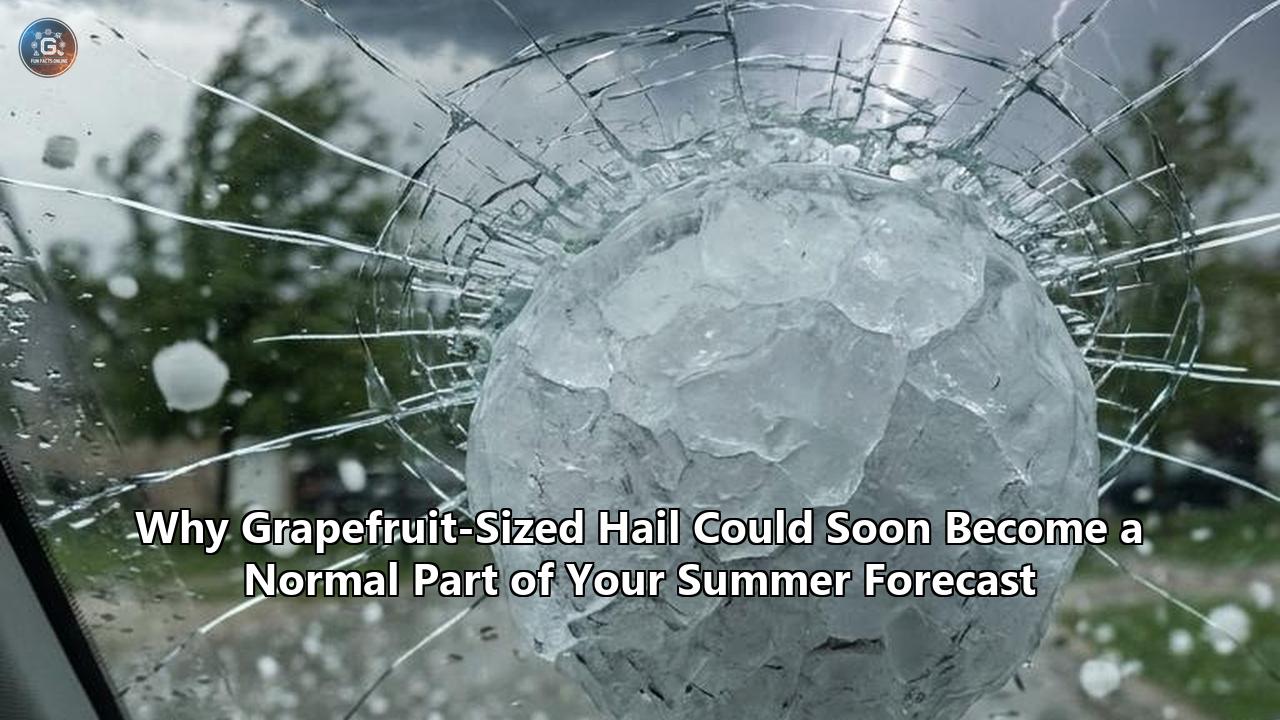
On a spring afternoon in late April 2026, the sky over Springfield, Missouri, bruised to a deep, unnatural shade of violet-black. Within minutes, a barrage of solid ice began hammering the city. While residents are no strangers to severe spring weather, what fell from the heavens was not the typical scattering of pea-sized stones. Chunks of ice the size of baseballs—and in several neighborhoods, larger than grapefruits—smashed through car windshields, pulverized residential roofing, and left craters in suburban lawns.
Just weeks earlier in March, a sweeping system across the upper Midwest dropped an aggregate hailstone in Illinois measuring a historic 16 inches in diameter. “It didn’t just break the record, but it shattered the record,” remarked Victor Gensini, a meteorologist at Northern Illinois University. “We’ve never seen anything like this since we’ve been recording hail, which started in the mid-1950s.”
These jaw-dropping events are no longer isolated anomalies. According to a landmark study published in the journal Nature, giant hailstones are slated to become a far more common, devastating fixture of our summer forecasts. The research, led by meteorologists Qinghong Zhang and Shiyi Zhang of Peking University alongside John Allen of Central Michigan University, delivers a stark warning: while a warming planet might intuitively seem like it would melt falling ice, the reality is a stark paradox.
As global temperatures rise, storms that produce smaller, relatively harmless hail are expected to decrease by 4% to 8%. However, storms capable of dropping giant, destructive stones—defined as larger than a marble up to grapefruit-sized—are projected to surge by 38% to 47% by the end of the century.
To understand why our skies are preparing to hurl blocks of ice through our roofs, we have to look at the complex atmospheric engine that creates hail in the first place, and how human-driven climate change is supercharging it.
The Physics of the Hail 'Sling': How Ice Grows in the Clouds
To understand the shifting nature of severe storms, it helps to first understand how hail forms. Hail is not frozen rain; that is sleet, which freezes as it falls through cold air near the ground. Hail, conversely, is born in the violent, towering updrafts of severe convective storms—most notably supercells.
Inside a developing thunderstorm, powerful winds rush upward from the hot ground. This upward-moving air column is known as an updraft. When an updraft carries liquid water droplets miles up into the freezing upper reaches of the atmosphere (often between 20,000 and 50,000 feet, where temperatures are well below freezing), these droplets instantly freeze upon contacting tiny airborne particles like dust or pollen.
Once this tiny ice embryo is formed, it begins a chaotic, high-altitude dance.
Supported by the relentless updraft, the ice crystal is suspended in a region of the cloud filled with "supercooled" water—liquid water that remains liquid despite being below freezing. As the ice crystal bounces around, it collides with these supercooled droplets, which instantly freeze onto its surface. This adds layer upon layer of ice, much like adding coats of wax to a candle.
The hailstone will remain suspended in this freezing factory as long as the upward force of the wind is stronger than the downward pull of gravity. If the updraft is weak, the hailstone falls quickly, remaining small. But if the updraft is exceptionally violent, it can suspend the ice chunk for tens of minutes, allowing it to grow to the size of a golf ball, a baseball, or a grapefruit. Eventually, the stone becomes too heavy for the updraft to support, or it gets thrown out of the main updraft core, and plummets to Earth at speeds exceeding 100 miles per hour.
Breaking Down the Atmospheric Causes of Large Hail
When meteorologists evaluate severe weather setups, they analyze several ingredients to determine if a storm will produce destructive ice. The physical causes of large hail rely on a delicate but high-energy atmospheric recipe.
       [ High-Energy Updraft ]
                  ▲
                  │  (Fueled by high CAPE & Warm Moisture)
                  │
     [ Ice Embryo Suspended ]  ◄─── (Kept aloft by tilted wind shear)
                  ▲
                  │  (Layers of supercooled water freeze on contact)
                  │
       [ Fall to the Earth ]
                  │
                  ▼  (Passing through the Deep Melting Layer)
                  │
        ┌─────────┴─────────┐
        ▼                   ▼
[ Small Hail ]      [ Giant Hail ]
(Melts completely   (Partially melts;
into raindrops)     hits ground intact)
The primary variables controlling the causes of large hail include:
1. Convective Available Potential Energy (CAPE)
CAPE is essentially the atmospheric fuel available for a storm. It measures the amount of instability in the air, calculated by the temperature difference between a rising parcel of warm air and the colder air surrounding it in the upper atmosphere. High CAPE values translate directly to explosive updraft speeds. When CAPE is exceptionally high, updraft winds can easily surpass 100 to 150 miles per hour, providing the brute force required to hold massive, heavy pieces of ice aloft.
2. High Surface Moisture and Ambient Heat
Moisture is the raw material. Warmer air holds more water vapor—approximately 7% more moisture for every 1 degree Celsius of warming. This moisture provides an abundant supply of supercooled water droplets inside the cloud. Additionally, as this moisture condenses into clouds, it releases latent heat, which acts like an extra injection of high-octane fuel to the storm, further accelerating the updraft.
3. Vertical Wind Shear
Among the structural causes of large hail, wind shear is the ultimate organizer. Vertical wind shear occurs when wind speed and direction change rapidly at different heights in the atmosphere.
In a low-shear environment, a storm's updraft rises straight up, gets choked by its own falling rain and hail, and quickly collapses. However, when strong wind shear is present, it tilts the updraft. This separation is crucial: the rain and hail fall to one side of the storm, while the clean, warm updraft continues to pump air upward unimpeded on the other.
Furthermore, high wind shear induces rotation within the storm, creating a supercell with a spinning mesocyclone. This rotation helps to prolong the "residence time" of the hailstone within the liquid-rich zone of the cloud, keeping it suspended in the sweet spot for maximum growth.
The 'Melt or Grow' Paradox: Why Small Hail is Shrinking but Giant Hail is Thriving
With global temperatures on the rise, a common question arises: If the planet is getting warmer, shouldn't falling ice simply melt into rain before it ever reaches the ground?
The answer is both yes and no, and it explains the fascinating divergence in future hail sizes. The Nature study notes that warming global temperatures trigger two competing forces within a thunderstorm.
On one hand, the lower atmosphere—the layer of air between the base of the storm cloud and the ground—is warmer and deeper than it used to be. As a hailstone falls out of the cloud, it must pass through this warm, sub-cloud layer.
For smaller hailstones (those under an inch in diameter), this deep melting layer is a death sentence. Because they have a high surface-area-to-volume ratio, they transfer heat quickly and melt completely before hitting the ground, turning into ordinary raindrops. This is why storms producing small hail are expected to shrink globally.
On the other hand, the exact same warming temperatures are pumping unprecedented amounts of CAPE and moisture into the atmosphere. When a severe storm triggers under these high-energy conditions, the updrafts are far more violent.
Inside these supercharged clouds, the hailstones are thrown higher and kept suspended longer, growing to massive, dense proportions.
When a baseball- or grapefruit-sized hailstone finally drops, its thermal mass is incredibly high. While it will experience some melting on its descent through the warm lower atmosphere, the core of the stone remains frozen solid. It easily survives the trip to the ground, hitting the earth as a slightly melted but still highly destructive block of ice.
"Large hailstones melt too, but they can still reach the ground as sizable chunks of ice," explains lead author Qinghong Zhang. "Smaller hailstones are affected more. They may melt completely and turn into raindrops."
This creates a future of weather extremes: fewer days with annoying, small hail, but a dramatic increase in rare, high-severity days where giant hail falls from the sky.
Where the Ice Will Fall: The High-Latitude Sweet Spots
The threat of giant hail is not distributed evenly across the globe. The Nature model, which researchers validated by running simulations on more than 14,000 real-world historical storms between 2014 and 2021, shows a distinct geographic shift.
┌─────────────────────────────────────────────────────────────┐
│             PROJECTED GLOBAL HAIL TRENDS BY 2100            │
├──────────────────────────────┬──────────────────────────────┤
│    High-Latitude Regions     │ Equatorial / Tropical Zones  │
│ (US Plains, Canada, Europe)  │                              │
├──────────────────────────────┼──────────────────────────────┤
│  ▲ Large Hail: +38% to +47%  │  ▼ Overall Hail Risk: Easing │
│  ▼ Small Hail: -4% to -8%    │  (Melting layer too thick)   │
└──────────────────────────────┴──────────────────────────────┘
The potential for giant hail is shifting away from the equator and moving toward higher latitudes. This is because climate change is warming the higher latitudes, such as the northern United States, Canada, Europe, and northern Asia, at a faster rate than the tropics.
- The United States and Canada: While the classic "Hail Alley" has historically centered over the central and southern U.S. Great Plains (Texas, Oklahoma, Kansas), the ideal recipe for giant hail is shifting northward. The northern Great Plains, parts of the Upper Midwest, and central Canada are seeing a substantial rise in high-energy atmospheric setups.
- Europe: Europe is emerging as a primary hotspot for rapid hail escalation. Severe hailstorms in countries like France, Germany, and Northern Europe are already 30% more likely to occur today than they were before the Industrial Revolution. According to insurance data, hailstorms in Europe have surged by a staggering 267% over a five-year period compared to 2019/2020 levels.
- Argentina: Located in South America's mid-latitudes, the region east of the Andes Mountains is already famous for some of the most violent supercells on Earth. Under future climate scenarios, Argentina's agricultural belt is expected to experience some of the sharpest increases in giant hail frequency.
Conversely, in tropical and equatorial regions, the hail hazard is projected to ease. In these areas, the lower atmosphere is already incredibly warm and humid. As global temperatures rise further, the melting layer in the tropics will become so deep that almost all hail, except for the most astronomically large outliers, will melt into rain before reaching the surface.
The Multi-Billion Dollar Threat to Our Infrastructure
For decades, hail has been the stealth assassin of the insurance industry. Unlike dramatic hurricanes or photogenic tornadoes, hailstorms rarely make national breaking news unless they cause direct casualties. Yet, hail is consistently the costliest thunderstorm hazard.
In the United States alone, hail damage historically costs between $10 billion and $15 billion annually. However, the mid-2020s have seen those numbers skyrocket, with insured losses topping $35 billion in 2024. Globally, the annual toll hovers near $80 billion.
"Hail does more damage than tornadoes and generally costs more than a couple of hurricanes a year now," warns Central Michigan University's John Allen.
The transition toward larger hail sizes carries severe economic consequences across multiple sectors.
The Solar Energy Bottleneck
The rapid global transition to renewable energy has inadvertently aligned with the rising threat of giant hail. Solar farms, which consist of thousands of acres of forward-facing glass panels, are often built in flat, open regions—the exact geographical areas most prone to severe hailstorms.
While modern solar panels are tested to withstand moderate impacts, they are not designed to survive large stones. A one-inch hailstone might bounce off a panel, but a three-inch (apple-sized) or four-inch (grapefruit-sized) stone falling at terminal velocity will easily shatter the tempered glass, destroying the photovoltaic cell beneath and causing cascading electrical failures.
In Europe, the 2022 and 2023 hail seasons produced record-breaking losses of more than €5 billion (about $5.8 billion) each, driven heavily by shattered solar installations and damaged rooftops.
To survive, the solar industry is scrambling to adapt. Operators are implementing "hail-stow" systems. When advanced radar detects an oncoming severe storm, remote operators can trigger the solar panels to tilt dramatically—often up to 70 degrees. This steep angle prevents direct, perpendicular impacts, allowing the hailstones to glance off the panels rather than shattering them. However, this strategy relies on early warning systems that are accurate down to the minute.
       NO WIND STOW                           HAIL-STOW MODE
     (High Damage Risk)                      (Reduced Damage Risk)

       [Hail Falling]                         [Hail Glancing]
          │   │                                   /   /
          ▼   ▼                                  ▼   ▼
     ┌─────────────┐                        _  / /
     │ Solar Panel │                       \ \/ /   ◄── Panel Tilted
     └─────────────┘                        \  /        at 70°
  (Perpendicular Impact)                     \/
The Real Estate and Auto Insurance Crisis
For homeowners, wind and hail damage already account for nearly half of all property insurance claims. A roof can survive multiple storms of small hail, but a single storm dropping baseball-sized ice can crack concrete tiles, puncture asphalt shingles, and compromise the structural integrity of the entire roof deck.
This has triggered a severe insurance crisis in states like Texas, Colorado, and Minnesota. Premium rates are skyrocketing, and some carriers are raising deductibles specifically for wind and hail, or pulling out of high-risk markets entirely.
Agricultural Devastation
For farmers, a sudden hailstorm can wipe out a year’s worth of work in under five minutes. While small hail can shred leaves, grapefruit-sized hail will completely flatten mature crops, snap fruit tree branches, and kill livestock in the fields.
Chasing the Beast: How ICECHIP is Revolutionizing Hail Science
Because hail is incredibly localized and transient, it remains one of the most difficult weather phenomena to study, model, and forecast. For nearly 40 years, hail research took a back seat to tornado and hurricane studies. That changed with the launch of the ICECHIP campaign.
Formally known as the In-situ Collaborative Experiment for the Collection of Hail in the Plains, ICECHIP was funded by the National Science Foundation (NSF) and brought together more than 70 researchers from 15 academic and scientific institutions.
During its high-intensity field operations, ICECHIP deployed a fleet of specially rigged vehicles, mobile radars (including the famous Doppler on Wheels), and high-tech drones.
The scientific teams chased the most violent storms across the central United States, getting close enough to intercept hail immediately after it hit the ground. To understand the physical causes of large hail, researchers used several innovative technologies:
- Hail-Sondes: Much like the fictional "Dorothy" device from the movie Twister, these are lightweight, impact-resistant sensors launched directly into storm updrafts. Swept up into the storm core, they recorded the exact three-dimensional trajectories, temperatures, and wind speeds that hailstones experience as they grow.
- UAV Storm Mapping: Uncrewed aerial systems (such as the RAAVEN drone) flew along the backside of severe storms, using downward-looking, high-resolution cameras to map the exact swath of hail left on the ground before it had time to melt.
- 3D Laser Scanning: Chasers gathered thousands of fresh, pristine hailstones and immediately scanned them with 3D lasers, capturing their complex, irregular shapes and aggregate structures. They then preserved them in liquid nitrogen for structural analysis in materials-science labs.
The massive dataset generated by ICECHIP is currently being used to upgrade dual-polarization weather radar networks, which will allow meteorologists to distinguish between heavy rain and massive, growing hail in real-time. This can improve lead times for severe storm warnings from minutes to hours.
Looking Ahead: Building a Resilient Future
The atmospheric shifts are clear: grapefruit-sized hail is transiting from a rare, once-in-a-decade anomaly to an expected summer hazard for many mid-to-high latitude regions. This shift is driven by the physical causes of large hail, which are amplified by a warmer, more humid environment.
"Climate change may be increasing the potential for larger, more damaging hail in some regions, but the future loss signal will also depend heavily on where people build, what they build, how resilient those structures are, and how land use changes," says Walker Ashley, an atmospheric scientist at Northern Illinois University.
To mitigate these losses, communities must shift their focus toward adaptation and structural resilience.
This includes updating municipal building codes to require impact-resistant roofing materials, such as class-4 rated shingles or metal roofs, which are designed to withstand high-velocity impacts. It also means incorporating hail risk into the engineering design standards of public infrastructure, municipal utility grids, and commercial solar arrays.
As we head into future summer storm seasons, a "normal" forecast may no longer just warn of lightning and heavy rain. Increasingly, we will have to look to the sky and prepare for the arrival of solid, fast-falling blocks of ice.
Key Takeaways
- The Shift: A landmark study in Nature projects that giant hail (larger than a marble/golf ball up to baseball and grapefruit sizes) will increase in frequency by 38% to 47% by 2100 due to climate warming.
- The Science: Warmer temperatures increase atmospheric instability (CAPE) and moisture (7% more water vapor per degree Celsius), fueling stronger storm updrafts that can keep massive ice stones suspended longer to grow larger.
- The Melting Paradox: While a warmer lower atmosphere melts smaller hailstones into rain before they hit the ground, the heaviest, most massive hailstones easily survive the descent.
- Impact Areas: The risk is shifting toward higher latitudes, with the northern U.S., Canada, Europe, and Argentina seeing the sharpest increases in giant hail potential.
- Infrastructure Vulnerability: Giant hail represents a multi-billion dollar threat to residential roofs, automobiles, and especially the expanding network of commercial solar farms.
Reference:
- https://www.sciencenews.org/article/large-hail-climate-change-more-common
- https://ground.news/article/study-says-climate-change-could-increase-large-hail-by-38-to-47-by-2100_8f3226
- https://www.smithsonianmag.com/smart-news/giant-destructive-hail-is-becoming-more-common-with-climate-change-study-says-180988849/
- https://www.latimes.com/environment/story/2026-06-01/warmer-world-creates-bigger-more-damaging-hailstones-study-says
- https://www.thecooldown.com/green-tech/climate-change-hail-damage-prediction/
- https://www.youtube.com/watch?v=0Ldi_twCyoo
- https://www.youtube.com/watch?v=3q-exkH9tmA
- http://qxxb.cmsjournal.net/en/article/latest_all
- https://www.newsweek.com/climate-change-hailstones-weather-north-america-629343
- https://www.businessmole.com/study-led-by-essl-aims-to-discover-causes-and-locations-of-increasing-hail-destruction/
- https://icechip.niu.edu/
- https://www.prnewswire.com/news-releases/ibhs-joins-nations-largest-hail-study-in-40-years-as-icechip-launches-with-media-field-day-302453815.html
- https://www.roofingcontractor.com/articles/100920-understanding-hail-project-icechip-is-finally-measuring-it
- https://www.colorado.edu/iriss/project-icechip
- https://news.ucar.edu/133022/largest-us-hail-study-40-years-kicks-boulder