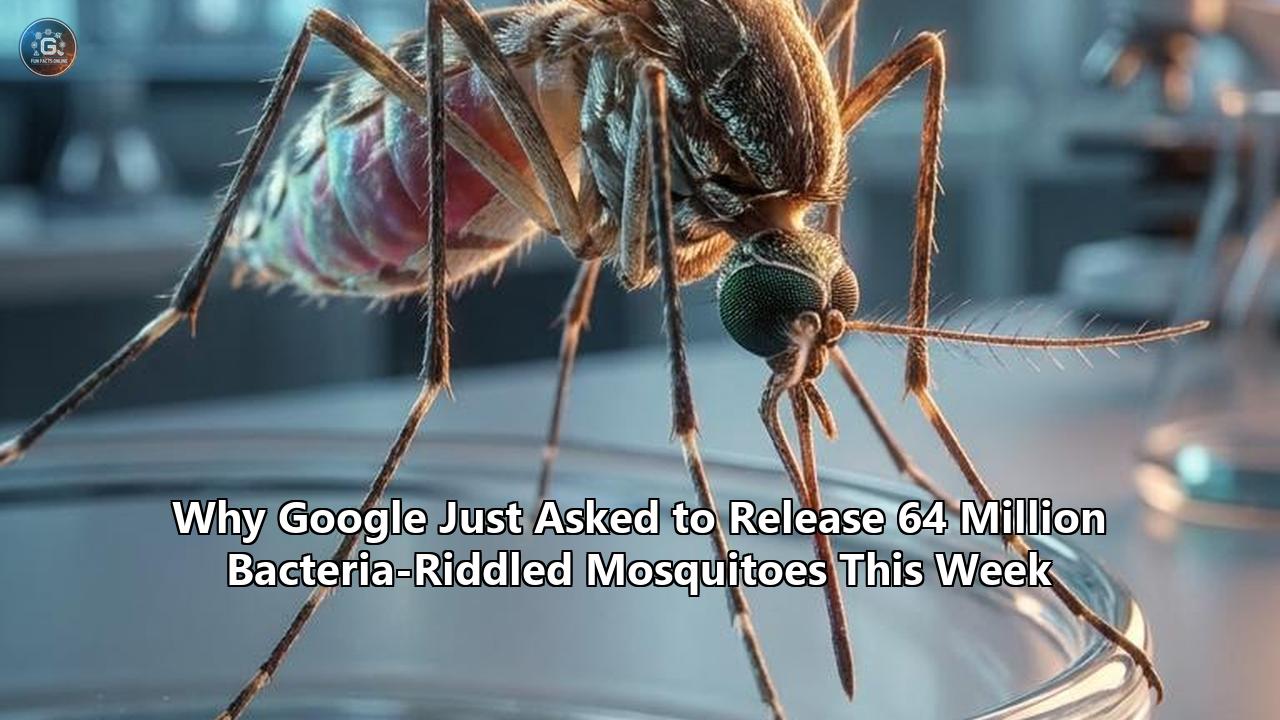
The notice appeared quietly in the Federal Register, buried beneath hundreds of routine regulatory updates. But to those tracking the intersections of Silicon Valley wealth and biological engineering, the document was a lightning rod. Google—the multi-trillion-dollar titan of web search, cloud computing, and artificial intelligence—had formally petitioned the U.S. Environmental Protection Agency (EPA) for an experimental permit. The request was staggering in its scale: the company wanted permission to release up to 64 million lab-grown, bacteria-infected mosquitoes directly into residential and natural areas across California and Florida over the next two years.
Almost immediately, the internet reacted with a mixture of confusion and visceral alarm. Within days, social media platforms were flooded with warnings. On X, Tennessee Republican Representative Tim Burchett expressed a widely shared sentiment: "Have we not learned our lesson with Kudzu, Sparrows, Black Birds (and) Asian Carp? Should I go on? Don’t mess with the balance of nature". Nicolas Hulscher, an epidemiologist, warned his followers that "Google is about to conduct one of the LARGEST open-air biological experiments in U.S. HISTORY... potentially causing irreversible ecosystem disruptions". Commentators questioned why a tech company whose primary business is indexing the web was suddenly breeding massive swarms of blood-sucking insects in highly automated factories.
Yet, behind the dramatic headlines and dystopian anxieties lies a highly sophisticated scientific mission. Under the umbrella of a project known as "Debug"—which originated within Alphabet’s life sciences sister company, Verily, before being directly acquired by Google in late 2024—the tech giant has spent a decade quietly building a biology division.
The 64 million insects Google plans to release are not genetically modified organisms (GMOs). They are not designed to bite humans, nor can they transmit diseases. Instead, they are all-male southern house mosquitoes (Culex quinquefasciatus) carrying a naturally occurring bacterium called Wolbachia pipientis.
To scientists, the project represents a crucial test of a decades-old biological suppression technique, supercharged by Silicon Valley's proprietary robotics and machine learning. To the public, it remains an unsettling experiment where the line between public health intervention and corporate overreach has blurred.
Tracing the evidence trail of Google’s Debug project reveals how a search engine company became the world’s most ambitious insect breeder, the complex cellular biology that makes these mosquitoes sterile, and why local public health departments believe this controversial technology may soon be their only defense against a rising tide of tropical disease.
The Birth of the Bug Factory: Inside the Automated Labs
To understand how Google became an insect manufacturer, one must look back to 2016, when Alphabet’s life sciences division, Verily, officially launched the Debug project. Initially, the project was seen as an eccentric side venture, a moonshot designed to showcase how the company’s analytical and data-processing capabilities could be applied to epidemiological crises. But by December 2024, when Google took direct corporate ownership of the Debug project from Verily, it had evolved from a theoretical research initiative into a highly industrialized, end-to-end biological manufacturing platform.
At the heart of Debug's operation is a fundamental ecological bottleneck. For decades, scientists have known that the Sterile Insect Technique (SIT)—releasing sterile males to mate with wild females and crash a local pest population—is highly effective. However, the scaling bottleneck of any modern mosquito release project lies in a single, high-stakes question: How do you breed tens of millions of mosquitoes, infect them with the correct bacterial strain, and guarantee that not a single biting female is released into the wild?
"It's hard to rear the number of mosquitoes you need to do this for it to be effective," explained Lila Seidman, a reporter for the Los Angeles Times who has closely investigated the project. "Actually in the millions".
Traditionally, separating male and female mosquitoes was a labor-intensive, manual process. Workers used physical sieves to sort pupae by size, as female pupae are typically slightly larger than males. This method was slow, expensive, and prone to human error—a dangerous flaw, given that releasing even a small percentage of fertile, infected females could inadvertently boost the local mosquito population or cause the target bacteria to establish itself in the wild, rendering future releases ineffective.
To solve this, Google did what Google does best: they built a robotic assembly line governed by artificial intelligence.
Inside Debug’s specialized facilities, the rearing process is fully automated. Robotic arms move trays of larvae through climate-controlled breeding rooms. When the insects reach the adult stage, they are funneled through high-speed sorting channels where proprietary computer vision systems analyze each individual insect in real time.
These AI models are trained to detect minute anatomical differences between the sexes, such as the shape of the abdomen and the presence of feathery antennae on males, which are used to sense the wingbeat frequencies of females.
"Google says it’s 'developing new technologies that combine sensors, algorithms and novel engineering to take advantage of unique aspects of mosquito biology to quickly and accurately sort males from females,'" Seidman noted.
Any insect flagged as female is automatically filtered out and euthanized. The remaining males—which do not possess mouthparts capable of piercing human skin and feed exclusively on plant nectar—are packed into transport containers.
This automation has allowed Debug to scale its production capacity to unprecedented heights. In collaborative programs like Project Wolbachia in Singapore, the technology has enabled the rearing and release of over 6 million mosquitoes per week.
The current EPA application to release 64 million mosquitoes over two years across California and Florida represents an attempt to deploy this industrial-scale biological machinery on U.S. soil at a volume never seen before.
[Larvae Breeding] ──> [Robotic Rearing] ──> [High-Speed AI Computer Vision Sorter]
                                                  │
                                                  ├──> [Females Detected] ──> [Euthanasia]
                                                  │
                                                  └──> [Males Confirmed]  ──> [Wolbachia Infection] ──> [EPA Release Sites]
The Cellular Saboteur: How Wolbachia Works
To understand why scientists are enthusiastic about releasing millions of bacteria-riddled insects into the wild, one must look closely at the microscopic organism driving this entire operation: Wolbachia pipientis.
Wolbachia is an obligate intracellular bacterium, meaning it cannot survive outside of a host cell. It is one of the most common parasitic microbes on Earth, naturally infecting roughly 50 to 60 percent of all insect and arthropod species, including butterflies, bees, beetles, and spiders. Crucially, Wolbachia is not a human pathogen. It cannot live inside human or mammalian cells, and it cannot be transmitted to humans through a mosquito bite or any other form of contact.For insects, however, Wolbachia is a master manipulator of reproduction. Because the bacterium is passed down maternally from a mother to her offspring through the cytoplasm of the egg, it has evolved complex evolutionary strategies to ensure that infected females have a reproductive advantage over uninfected ones.
The primary mechanism leveraged by Google’s Debug project is a cellular phenomenon known as cytoplasmic incompatibility (CI).
                        WILD FEMALE (Uninfected)
                              │
             ┌────────────────┴────────────────┐
             ▼                                 ▼
    UNINFECTED MALE                  WOLBACHIA-INFECTED MALE
  (Compatible Mating)                 (Incompatible Mating)
             │                                 │
             ▼                                 ▼
     [ Eggs Hatch ]                    [ Eggs Fail to Hatch ]
    Population persists                 Population collapses
Cytoplasmic incompatibility operates like a molecular lock-and-key system, which can be broken down into a multi-step biological process:
- Sperm Modification (The Lock): During spermatogenesis in a male infected with Wolbachia, the bacteria secrete specific proteins called Cytoplasmic Incompatibility Factors (specifically CidA and CidB). These proteins alter the paternal chromatin (the DNA packaging structure) inside the developing sperm cell.
- The "Toxin" Delivery: When the mature sperm is released, the Wolbachia bacteria themselves do not travel inside the sperm head; only the modified, "imprinted" paternal DNA is delivered to the egg.
- The Uninfected Egg (Failed Rescue): If this modified sperm fertilizes an egg from an uninfected female, the egg lacks the corresponding cellular "antidote".
- Mitotic Catastrophe: Upon fertilization, the paternal chromosomes fail to condense and segregate properly during the very first embryonic cell divisions. Chromatin bridging occurs, the paternal nucleus is torn apart, and the embryo undergoes regional mitotic failure, leading to early embryonic death. The eggs simply fail to develop or hatch.
- The Infected Egg (The Rescue Key): If the male mates with a female that is infected with the exact same strain of Wolbachia, the bacteria present in the egg cytoplasm produce a rescue protein (CifA). This protein binds to the paternal chromatin defects, correcting the synchronization of maternal and paternal pronuclear development. The chromosomes align, the egg hatches normally, and all offspring carry the maternal Wolbachia strain.
By releasing only infected males, Google's Debug project ensures that only "incompatible matings" occur in the wild. Because wild females of the target species do not naturally harbor this specific Wolbachia strain, every single mating event with a lab-released male results in a biological dead end. Over time, as these sterile matings multiply, the wild population of the pest species collapses.
"It’s a highly targeted, elegant biological weapon," says a molecular biologist specializing in vector control, speaking on the condition of anonymity to discuss pending regulatory approvals. "We aren't introducing chemical toxins into the air, and we aren't altering the genetic code of the mosquito itself. We are simply exploiting a reproductive mismatch that has been occurring in nature for millions of years."
Target Shift: The Menace of the Southern House Mosquito
While the science of Wolbachia-induced suppression is well-established, Google’s latest EPA application marks a significant and highly strategic pivot.
In its previous field trials, such as the multi-year study conducted in Fresno County, California, between 2017 and 2019, Debug targeted Aedes aegypti—the yellow fever mosquito. Aedes aegypti is an aggressive, day-biting invasive species responsible for spreading devastating tropical diseases like dengue, Zika, chikungunya, and yellow fever.
The proposed 64 million release, however, focuses primarily on a different adversary: Culex quinquefasciatus, commonly known as the southern house mosquito.
Unlike Aedes aegypti, which thrives in hyper-local, urban environments and breeds in containers as small as a bottle cap, Culex quinquefasciatus is a highly adaptive, night-biting species. It is the primary vector for several severe pathogens in the United States, including:
- West Nile Virus: The leading cause of mosquito-borne disease in the continental United States, which can lead to severe neurological illnesses such as encephalitis or meningitis.
- St. Louis Encephalitis: A viral disease that causes inflammation of the brain, particularly in older adults.
- Lymphatic Filariasis: A parasitic disease caused by microscopic worms that can lead to severe swelling in the limbs (elephantiasis), though primarily of concern in tropical territories.
Targeting Culex quinquefasciatus with Wolbachia is a much more complex ecological challenge. Unlike Aedes aegypti, which do not naturally carry Wolbachia in the wild, many wild populations of Culex mosquitoes already carry their own native strains of the bacterium (such as wPip).
To bypass this, Google’s scientists had to use a biological process called "transinfection". Researchers cleared lab-reared Culex mosquitoes of their native wPip bacterial infection using antibiotics, and then microinjected them with a different strain of Wolbachia—specifically, wAlbB, which is isolated from the Asian tiger mosquito (Aedes albopictus).
Because the wild Culex females carry the native wPip strain and the released males carry the foreign wAlbB strain, the mating is bidirectionally incompatible. Neither egg nor sperm has the correct matching "rescue key" for the other’s bacterial strain, resulting in complete sterility.
The operational precedent for this specific strain transition was established in April 2026, when the EPA registered Debug's wAlbB-infected Culex mosquitoes for use in Hawaii. On the Hawaiian islands, the invasive southern house mosquito has driven several native forest bird species to the brink of extinction by transmitting avian malaria, a pathogen to which the birds have no natural immunity.
The success of the Hawaii mosquito release project under an emergency EPA exemption provided the crucial regulatory proof-of-concept that Google needed. Now, the tech giant wants to scale this intervention from isolated conservation areas in Hawaii to heavily populated mainland communities in Florida and California.
┌────────────────────────────────────────────────────────┐
│     SOPHISTICATED BIOLOGICAL DIFFERENCES AT A GLANCE   │
├─────────────────────┬───────────────────┬──────────────┤
│ Vector Species      │ Target Diseases   │ Biting Habit │
├─────────────────────┼───────────────────┼──────────────┤
│ Aedes aegypti       │ Dengue, Zika,     │ Day-Biter    │
│                     │ Yellow Fever      │              │
├─────────────────────┼───────────────────┼──────────────┤
│ Culex               │ West Nile,        │ Night-Biter  │
│ quinquefasciatus    │ St. Louis Enceph. │              │
└─────────────────────┴───────────────────┴──────────────┘
The Ecological Pressure Cooker: Why Google is Stepping In
The timing of Google’s massive push is not coincidental. Public health departments in both California and Florida are facing an unprecedented, climate-driven ecological crisis, making alternative vector-control strategies increasingly urgent.
Historically, local dengue transmission was virtually non-existent in California. The dry climate and cooler night temperatures of the West Coast acted as a natural barrier to the propagation of tropical vectors. But those barriers are rapidly crumbling.
In 2023, California logged its first locally acquired dengue cases in modern history—meaning the patients were infected by mosquitoes in their own neighborhoods, rather than contracting the virus while traveling abroad. By 2024, that number had ballooned to 18 confirmed local cases, with 14 of them clustered in Los Angeles County.
A recent epidemiological study estimated that approximately 18.2 million Californians now live in regions where environmental conditions are suitable for local dengue transmission. Mild winters and hotter, more humid summers have allowed invasive mosquito species to establish permanent, year-round breeding populations.
Local Dengue Cases in California (2022-2024)
────────────────────────────────────────────
2022:  0 cases
2023:  1 case   █
2024: 18 cases  ██████████████████
"Climate change, rapid urbanization, and increased global travel have created a perfect storm for vector-borne diseases," said Dr. Eric Caragata, an associate professor and mosquito interaction expert at the University of Florida. "The geographical range of these insects is expanding faster than our traditional control methods can handle."
For decades, public health districts have relied on two primary weapons: larvicides to treat standing water and chemical adulticides (spraying pesticides from trucks or planes) to kill flying insects. However, these tools are losing their efficacy:
- Pesticide Resistance: Over-spraying has driven rapid evolutionary selection, leaving wild mosquito populations increasingly resistant to common chemical pyrethroids.
- Collateral Environmental Damage: Broad-spectrum chemical sprays are non-selective; they run the risk of killing critical non-target pollinators, including honeybees, butterflies, and aquatic invertebrates.
- Urban Barriers: In densely populated metropolis areas like Los Angeles or Miami, spraying chemicals over millions of homes faces significant regulatory, logistical, and public opposition.
As local health authorities in California and Florida look at the geography of these climate shifts, they realize a targeted mosquito release project may no longer be an optional luxury, but a necessity to prevent dengue, West Nile, and Zika from becoming endemic threats.
"The beauty of using Wolbachia is its absolute specificity," says Dr. Karthikeyan Chandrasegaran, an assistant professor at the University of California, Riverside, who studies mosquito ecology. "An incompatible male mosquito is only seeking out a female of its exact same species. It doesn't fly over to a bee, a butterfly, or a ladybug. It is a biological smart bomb that leaves the rest of the ecosystem completely untouched."
The Backlash: Playing God or Saving Lives?
Despite the scientific enthusiasm, Google’s application has ignited a fierce debate, exposing deep public distrust of corporate involvement in ecological management.
On one side of the ledger is the scientific consensus. Public health agencies point to highly successful international deployments of Wolbachia-infected mosquitoes. In Northern Australia, the release of Wolbachia-carrying mosquitoes virtually eliminated local transmission of dengue fever over a ten-year period. In Singapore, continuous releases have suppressed wild Aedes aegypti populations by over 90 percent and reduced clinical dengue incidence by up to 77 percent.
But to a skeptical public, the involvement of Google—a company that dominates digital advertising and search—adds a layer of corporate suspicion that is difficult to ignore.
"I want everyone to stop and ask what interest Google has in releasing mosquitoes," wrote one critic on X, whose post quickly went viral. "They're a tech company. Not an environmental group. Not a non-profit. Not a government. A tech company".
This skepticism is often amplified by a lack of public understanding regarding insect biology. Many community members hear that "64 million bacteria-riddled mosquitoes" are being released and naturally assume they will be subjected to an unbearable swarm of biting, disease-transmitting pests.
"Releasing millions of mosquitoes is not going to lead to a bunch of biting insects being in your orbit," clarified Lila Seidman in a broadcast interview, emphasizing that male mosquitoes do not bite or feed on blood. But keeping public fear at bay remains an uphill battle.
Furthermore, opponents of Google's mosquito release project invoke a long, cautionary history of humanity's attempts to outsmart nature. They point to ecological disasters like the introduction of the cane toad in Australia or the kudzu vine in the American South—well-intentioned biological interventions that spiraled out of control and caused permanent damage to native biodiversity.
"When you perturb an ecosystem on this scale, there are always unexpected secondary consequences," argues Dr. Janet Miller, an independent environmental policy analyst. "If you successfully crash the population of Culex quinquefasciatus, what ecological niche opens up? Does another, potentially more dangerous invasive species move in to fill the void? What happens to the native birds, bats, and amphibians that rely on these mosquitoes as a food source?"
Scientists, however, counter that Culex quinquefasciatus and Aedes aegypti are invasive species in the United States, not native components of the food web. Releasing sterile males does not eradicate all mosquitoes; it merely suppresses these specific, disease-carrying invaders to levels where they no longer pose a threat to human and animal life.
"We are not talking about wiping out native insects," Dr. Chandrasegaran noted. "We are talking about using a targeted, natural biological mechanism to control a non-native pest that we introduced in the first place. It's about restoring a balance, not destroying it".
The Regulatory Matrix: What Happens Next?
With the official EPA public comment period having closed on June 5, 2026, the proposal is now undergoing a rigorous federal review process. Under the Federal Insecticide, Fungicide, and Rodenticide Act (FIFRA), the EPA regulates mosquitoes carrying Wolbachia bacteria as a "biopesticide".
This regulatory classification can seem counterintuitive to laypeople—how is a living, breathing insect classified as a pesticide? But because the biological agent is being introduced specifically to prevent, destroy, or mitigate a pest population, it falls squarely under the EPA’s chemical and biological control jurisdiction.
The EPA is currently evaluating several key parameters:
- Human Health Impacts: Ensuring that the wAlbB strain of Wolbachia poses absolutely zero risk to humans, domestic pets, and livestock.
- Non-Target Species Safety: Confirming that the release will not negatively impact endangered species, particularly native insect pollinators or predators.
- Sex-Sorting Efficacy: Auditing Google's automated AI and robotic sorting systems to verify that the percentage of females accidentally released remains mathematically negligible.
- Environmental Persistence: Assessing whether the introduced Wolbachia strain could somehow mutate or horizontally transfer its genetic material to other organisms in the wild.
In past evaluations of similar applications, the EPA has consistently concluded that releasing Wolbachia-infected male mosquitoes is safe and does not "significantly affect the quality of the human environment". The agency’s previous registrations found that these releases do not cause unreasonable adverse effects.
┌────────────────────────────────────────────────────────┐
│             REGULATORY ROADMAP (2026-2027)             │
├───────────────────────┬────────────────────────────────┤
│ Target Date           │ Milestone Stage                │
├───────────────────────┼────────────────────────────────┤
│ June 5, 2026          │ EPA Public Comment Period Closes│
├───────────────────────┼────────────────────────────────┤
│ Late 2026             │ EPA Review & Permit Decision   │
├───────────────────────┼────────────────────────────────┤
│ Early 2027            │ Potential Initial Release      │
│                       │ (California & Florida)         │
└───────────────────────┴────────────────────────────────┘
Should the EPA grant the experimental permit, the mosquito release project will enter its most critical phase. Starting in 2027, fleets of specialized Debug vans could begin driving through selected neighborhoods in California and Florida, using automated release tubes to disperse millions of male mosquitoes.
These vans are equipped with specialized GPS-tracking systems, release algorithms, and environmental sensors. As the vehicle moves at a steady speed, the system calculates the local population density, current wind speed, and humidity, and then automatically releases the exact number of male mosquitoes needed to achieve optimal suppression in that specific block.
The New Frontier of Biological Defense
As the sun sets over the concrete channels of Los Angeles and the humid wetlands of Miami, the soft, high-pitched buzz of Culex quinquefasciatus remains an invisible, yet increasingly dangerous, threat. The diseases they carry are no longer distant tropical anomalies; they are knocking at the door of the American mainland.
Google's Debug project represents a profound shift in how humanity approaches public health crises. By converting an ancient, cellular parasite into a high-tech weapon, and scaling its production through robotics and artificial intelligence, a corporate giant has positioned itself at the vanguard of biological defense.
Yet, the project's true test will not be conducted inside the sterilized, robotic laboratories of Silicon Valley. It will be decided in the air above residential backyards, community parks, and conservation areas where millions of invisible biological interactions will occur every single day.
Whether Google’s massive, 64-million-bug release is viewed as an ecosystem-saving intervention or a corporate biological overreach, one thing is certain: the war against the world's deadliest animal has entered the digital age, and the battle lines are being drawn in our own backyards.
References
- Federal Register & EPA Filing Data: Details on Google's experimental permit applications to the U.S. Environmental Protection Agency (EPA) for the release of Wolbachia-infected mosquitoes.
- The Debug Project Technical Specifications: Information regarding the proprietary AI-driven rearing, computer-vision sex sorting, and automated release systems developed by Alphabet's life sciences sibling, Verily.
- Journal of Nature Biotechnology: Studies and results of Debug's field trials in California's Central Valley showing up to a 95 percent suppression of biting female mosquitoes.
- The National Environment Agency (NEA) of Singapore: Statistical data on Project Wolbachia, demonstrating a 90 percent population suppression and a 77 percent reduction in local dengue incidence.
- EPA Hawaii Emergency Exemption (April 2023): Documentation of the regulatory approval of Wolbachia-infected Culex quinquefasciatus males to protect endangered forest birds from avian malaria.
- California Department of Public Health: Epidemiological reports detailing the rise of locally acquired dengue cases in Los Angeles County and broader climate-related risks.
- National Institutes of Health (NIH): Scientific reviews explaining the molecular biology of Cytoplasmic Incompatibility (CI) and the roles of the CifA and CifB genes.
Reference:
- https://www.latimes.com/environment/story/2026-06-04/how-googles-32-million-mosquito-project-could-change-californias-battle-against-dengue
- https://www.latimes.com/0000019e-8fd8-d059-afde-cfda98b80000-123
- https://www.livescience.com/health/viruses-infections-disease/google-wants-to-release-64-million-bacteria-riddled-mosquitoes-across-california-and-florida-heres-why-scientists-are-enthusiastic
- https://reason.com/2026/06/04/google-aims-to-debug-california-and-florida-by-releasing-64-million-mosquitoes/
- https://www.snopes.com/news/2026/06/03/google-bacteria-mosquitoes/
- https://thenightly.com.au/society/health/google-mosquito-release-outrage-as-64-million-bacteria-infested-insects-set-for-release-by-alphabet-c-22375762
- https://www.kjzz.org/the-show/2026-06-10/google-wants-to-release-64m-sterile-mosquitoes-why-is-the-tech-giant-interested-in-pest-control
- https://timesofindia.indiatimes.com/etimes/trending/must-be-stopped-why-googles-plans-to-release-64-million-mosquitoes-in-america-has-citizens-worried/articleshow/131532497.cms
- https://www.click2houston.com/news/local/2026/06/04/google-wants-to-release-64-million-mosquitoes-heres-why-scientists-support-the-plan/
- https://en.wikipedia.org/wiki/Debug_Project
- https://blog.debug.com/
- https://www.insidehook.com/culture/google-verily-debug-mosquitoes
- https://tech.supercarblondie.com/google-release-millions-mosquitoes-verily-florida-california/
- https://www.mosquitomagnet.com/articles/fresno-mosquito-verily
- https://hsph.harvard.edu/news/a-tech-centric-approach-to-reducing-mosquito-borne-diseases/
- https://cnas.ucr.edu/media/2026/06/03/google-wants-release-64-million-bacteria-riddled-mosquitoes-across-california-and
- https://pmc.ncbi.nlm.nih.gov/articles/PMC7465683/
- https://www.snopes.com/news/2026/06/03/google-bacteria-mosquitoes/
- https://www.annualreviews.org/content/journals/10.1146/annurev-micro-041020-024616
- https://www.proquest.com/openview/cec3a51384b9da2d190138fcef709e1c/1?pq-origsite=gscholar&cbl=18750&diss=y
- https://pmc.ncbi.nlm.nih.gov/articles/PMC11014437/
- https://en.wikipedia.org/wiki/Cytoplasmic_incompatibility
- https://dlnr.hawaii.gov/hisc/files/2023/08/HISC-FY22_Summary-report-Statewide-EA.pdf
- https://pmc.ncbi.nlm.nih.gov/articles/PMC11326542/
- https://www.epa.gov/pesticides/epa-approves-emergency-exemption-wolbachia-mosquitoes-protect-endangered-birds-hawaii
- https://unblock.federalregister.gov
- https://www.youtube.com/watch?v=d060xJHB6iI