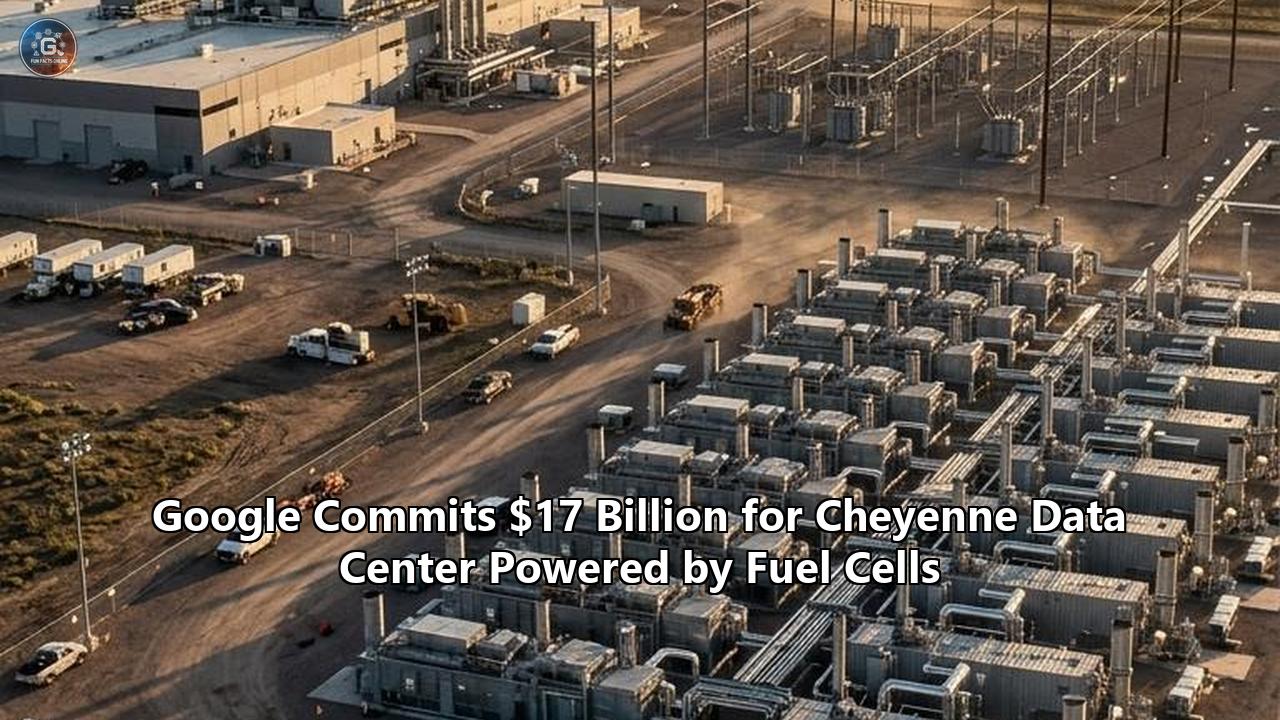
On November 5, 2026, Alphabet’s Google formally committed $17 billion to construct its first computing campus in Wyoming, anchoring the development to an unconventional energy architecture designed to bypass the strained American power grid. Located on a 716-acre parcel in the Switchgrass Industrial Park, eight miles south of Cheyenne in Laramie County, the facility will pair gigawatt-scale artificial intelligence computing with a 702-megawatt solid oxide fuel cell installation—the largest deployment of its kind ever contracted.
The project brings together an intricate consortium: utility giant American Electric Power (AEP), regional energy provider Black Hills Corp., pipeline and logistics operator Tallgrass Energy, fuel cell manufacturer Bloom Energy, and real estate developer Related Digital. To power the campus, AEP is investing approximately $4 billion to construct and operate the fuel cell plant under a 20-year take-or-pay power purchase agreement with Google, while Black Hills Energy executes a parallel $1.8 billion capital program to supply natural gas generation and manage a 2.1-gigawatt private microgrid. Carbon emissions produced by the electrochemical fuel cells will be gathered and piped to Tallgrass Energy’s Eastern Wyoming Sequestration Hub for permanent subterranean storage, while the server halls will forgo evaporative water cooling in favor of closed-loop air systems to protect local aquifers.
"Together, these efforts represent a novel approach to powering data centers efficiently, accelerating the commercialization of carbon capture and storage, and creating pathways to reduce the carbon emissions associated with natural gas generation," said Steve Walter, Google’s Vice President of Global Infrastructure and Energy, during the project's unveiling.
The announcement marks the culmination of a two-year escalation marked by stealth land acquisitions, clandestine corporate maneuvering, the sudden firing of an early development partner, billions in utility filings, and mounting political friction over data infrastructure across the American West. By choosing to build its own generation, transmission, and carbon capture infrastructure, Google is testing whether hyperscale operators can insulate themselves from both utility bottlenecks and the public backlash threatening tech-driven energy consumption.
Phase One: The Grid Bottleneck and Cheyenne’s Rise (November 2024 – Mid-2025)
The trajectory that culminated in Google’s $17 billion commitment began when the computing industry's appetite for continuous baseload power collided with the physical limits of the North American electric grid. By late 2024, transmission interconnection queues in primary data center hubs—most notably Northern Virginia’s PJM Interconnection and central Ohio—stretched between five and seven years. Hyperscalers planning multi-gigawatt infrastructure clusters for large language models found themselves holding hardware with nowhere to plug it in.
Cheyenne, Wyoming, emerged as an unexpected release valve. Perched at an elevation of 6,000 feet on the high plains, the city possessed key natural advantages: low average ambient temperatures that reduce cooling demands, an established convergence of transcontinental fiber routes along the Interstate 80 and Interstate 25 corridors, and vast reserves of natural gas. Microsoft had operated data centers in Laramie County since 2012, breaking ground on an extensive campus expansion in August 2025, while Meta had quietly assembled its own acreage nearby.
Wyoming offered an established regulatory framework tailored for rapid industrial energy consumption: Black Hills Energy’s Large Power Contract Service (LPCS) tariff. Approved by the Wyoming Public Service Commission, the tariff allowed the utility to negotiate custom power packages with high-load industrial customers, provided that those customers covered 100 percent of the generation and transmission costs directly driven by their operations, legally insulating residential ratepayers from capital expenses.
Early Siting Advantages: Cheyenne, Wyoming
├── Climate: 6,000-ft elevation, cool mean temperatures
├── Connectivity: Intersecting transcontinental fiber paths (I-80 / I-25)
├── Resource Base: Proximity to Denver-Julesburg basin natural gas
└── Regulatory Mechanism: Wyoming LPCS Tariff (ring-fences utility ratepayers)
At the same time, equipment vendors were formulating off-grid delivery models. In November 2024, American Electric Power signed an agreement with San Jose-based Bloom Energy to procure up to one gigawatt of solid oxide fuel cells. Unlike conventional gas turbines that burn fuel to drive mechanical generators, solid oxide fuel cells generate electricity through an electrochemical reaction, combining natural gas with ambient oxygen across a ceramic membrane.
The process yielded electrical efficiencies above 60 percent, emitted virtually no particulate matter, and produced an exhaust stream composed almost entirely of water vapor and concentrated carbon dioxide. Crucially, Bloom’s fuel cells were modular; factory-assembled units could be transported by flatbed and commissioned on-site within months, bypassing the three- to four-year delivery lead times plaguing gas combustion turbines.
Recognizing that hyperscalers needed energy immediately, pipeline operator Tallgrass Energy moved to capitalize on its existing assets in southeastern Wyoming. In mid-2025, Tallgrass began assembling parcels southwest of the intersection of Chalk Bluff Road and U.S. Highway 85, designating 1,375 acres as the Switchgrass Industrial Park. Tallgrass held a critical asset nearby: the Eastern Wyoming Sequestration Hub, an underground carbon capture project in the Denver-Julesburg Basin supported by a grant from the Wyoming Energy Authority, designed to inject millions of metric tons of carbon dioxide deep into stable geologic formations. The stage was set for a private, gas-backed energy campus.
Phase Two: 'Project Jade' and Crusoe’s Siting Push (July 2025 – January 2026)
On July 24, 2025, the initial version of the project surfaced publicly under the code name "Project Jade". The initiative was unveiled not as a Google development, but as a joint venture between Tallgrass Energy and Crusoe Energy Systems, a Denver-based developer that had gained prominence by building data centers powered by flared natural gas at oil wellheads.
Crusoe and Tallgrass announced an ambitious vision: a 1.8-gigawatt artificial intelligence data center campus capable of scaling to an unprecedented 10 gigawatts over a decade. Under the initial design, Crusoe would construct and manage the computing halls, while Tallgrass would construct an adjacent $7 billion generation complex dubbed the Cheyenne Power Hub. The generation facility was slated to deploy natural gas combined-cycle turbines over 659 acres, paired with carbon capture pipelines routed directly to Tallgrass’s Trailblazer sequestration network.
Local officials embraced the proposal. On October 7, 2025, the Laramie County Board of Commissioners held a public hearing to consider changing the zoning of the Switchgrass site from Agricultural/Rural to a Planned Unit Development. Tallgrass representatives Scott Prestidge and Adam Marsano appeared alongside Vincent Whisker of Crusoe Energy to assure commissioners that the project would be built "behind the meter"—operating on a self-contained electrical island that would place no strain on Cheyenne’s municipal grid.
Commissioners unanimously approved the rezoning. By January 2026, Laramie County granted full site-plan approvals for the initial 1.8-gigawatt buildout. Black Hills Energy formalized its involvement shortly thereafter, executing agreements with Crusoe under the LPCS tariff and accepting more than $200 million in customer-funded advances to begin engineering work on high-voltage substations and transmission interconnects. Heavy earthmoving equipment arrived at Switchgrass Industrial Park, clearing sagebrush and grading dirt across hundreds of acres.
Initial "Project Jade" Structure (2025–Early 2026)
┌─────────────────────────┐       ┌──────────────────────────┐
│      Crusoe Energy      │       │     Tallgrass Energy     │
│ (Data Center Developer) │◄─────►│   (Cheyenne Power Hub)   │
└─────────────────────────┘       └──────────────────────────┘
             │                                  │
             ▼                                  ▼
 1.8 GW Planned Computing             2.7 GW Gas-Fired Turbines
 (Modular AI Server Halls)            + Trailblazer CCS Network
Throughout this phase, neither Crusoe nor Tallgrass revealed the ultimate occupant of the compute capacity. Rumors circulated across the data center industry that Crusoe was building speculatively, or that it was fronting for an international cloud consortium. In reality, Crusoe was functioning as an intermediary developer for Alphabet, which had quietly engaged the startup to fast-track land assembly, water permits, and preliminary power interconnections while avoiding the premium pricing and public attention that accompanied direct hyperscaler acquisitions.
Phase Three: The Summer Rupture and Crusoe's Ouster (May – July 2026)
By the spring of 2026, the partnership began to fray. Inside Google’s global infrastructure division, engineering leaders grew increasingly alarmed by the operational and financial trajectory of Project Jade. Supply chain dislocations had caused the estimated capital cost of combined-cycle gas turbines to spike, and delivery dates for primary generation components drifted from late 2027 into 2029.
Concurrently, Crusoe’s internal cost models ballooned, creating friction over project milestones, procurement budgets, and contractual liabilities. Google required absolute certainty: it was engaged in an intense computing race with Microsoft, Amazon, and Meta, and could not afford multi-year delays on a multi-gigawatt site.
In May 2026, Google made the calculated decision to cut ties with Crusoe. The startup was instructed to cease operations immediately and demobilize its personnel from Laramie County.
The rupture stayed hidden from the public for nearly a month. On June 9, 2026, Bloomberg broke the news that Crusoe had exited Project Jade. In a terse public statement, Crusoe acknowledged: "At the request of our customer, Crusoe has paused its development activities".
Speculation surged that the multi-billion-dollar Cheyenne development had collapsed entirely. However, the infrastructure partners moved quickly to calm market fears. Tallgrass Energy confirmed that work on the Cheyenne Power Hub was continuing at full capacity. Three days later, on June 12, Linn Evans, President and CEO of Black Hills Corp., issued an emphatic public statement:
"We remain committed to supporting the project's data center customer and delivering the infrastructure necessary to meet their long-term energy needs. The 1.8-gigawatt project has not been paused and continues to represent a significant opportunity for the company. Our efforts remain fully directed toward successfully delivering the project".
In July 2026, regulatory filings revealed what had transpired behind the scenes. Crusoe was entirely gone. In its place, Google stepped directly into the light, operating through a wholly owned subsidiary named Jupiter Star Holdings LLC.
Google formally renamed the development "Project Tembo" and overhauled the project’s execution strategy. Rather than delegating development to a niche startup, Google partnered directly with Related Digital, the digital infrastructure arm of Related Companies, to oversee physical construction of four massive data halls, administrative offices, and logistics hubs on 716 acres. More fundamentally, Google took direct command of the energy procurement strategy, concluding that waiting for traditional utility turbine installations carried too much risk.
Development Pivot: Project Jade to Project Tembo (Summer 2026)
┌─────────────────────────────────┐     ┌──────────────────────────────────┐
│      Old Model: Project Jade    │     │      New Model: Project Tembo    │
├─────────────────────────────────┤     ├──────────────────────────────────┤
│ Intermediary: Crusoe Energy     │ ──► │ Direct Control: Google / Jupiter │
│ Generation: Combined-Cycle Gas  │ ──► │ Primary Power: AEP Fuel Cells    │
│ Real Estate: Speculative Lease  │ ──► │ Developer: Related Digital       │
│ Governance: Fragmented Third-Pty│ ──► │ Oversight: Multi-firm Consortium │
└─────────────────────────────────┘     └──────────────────────────────────┘
Phase Four: The $5.8 Billion Energy Architecture Locks In (September – October 2026)
With direct control established, Google spent late summer and early autumn assembling a completely restructured, two-pronged power architecture valued at nearly $5.8 billion in dedicated generation and microgrid assets. The strategy relied on parallel, coordinated contracts with Black Hills Corp. and American Electric Power.
The first piece clicked into place on September 30, 2026, when Black Hills Corp. signed definitive, long-term agreements with Google extending through 2048. Disclosed in an SEC Form 8-K on October 6, the package included a Large Power Contract Services Agreement and a Generation Facilities Agreement.
Under the contract, Black Hills agreed to invest $1.8 billion between 2027 and 2029 to construct 564 megawatts of company-owned natural gas generation through an unregulated subsidiary. Black Hills committed to providing up to 590 megawatts of grid-connected energy service, while simultaneously operating a private microgrid that would manage approximately 2.1 gigawatts of third-party contracted resources.
To insulate local electricity customers from capital risk, Google provided Black Hills with $399 million in upfront, refundable cash advances to purchase long-lead transmission transformers and switchgear. Black Hills projected the project would generate $2.4 billion in unlevered free cash flow through 2048 and deliver approximately $150 million in annual net income by 2030.
Eight days later, on October 14, 2026, American Electric Power announced an even larger commitment. Operating far outside its traditional 11-state utility footprint, Columbus, Ohio-based AEP revealed plans to invest approximately $4 billion to construct a 702-megawatt fuel cell generation facility near Cheyenne.
AEP structured the deal through Cheyenne Fuel Cell LLC, an entity 92 percent owned and controlled by AEP, with the remaining 8 percent held by infrastructure funds advised by Basalt Infrastructure Partners. AEP executed a 20-year, take-or-pay power purchase agreement with Google, meaning Google pays for the full generation capacity regardless of whether its servers consume the electricity.
Integrated Power and Microgrid Structure
┌────────────────────────────────────────────────────────┐
│             Cheyenne Data Center Campus                │
│             (Google / Related Digital)                 │
└────────────────────────────────────────────────────────┘
          ▲                                    ▲
          │ 702 MW Baseload                    │ Up to 590 MW Grid Service
          │ (Take-or-Pay PPA)                  │ + 2.1 GW Microgrid Mgmt
┌─────────────────────────┐          ┌───────────────────────────┐
│ Cheyenne Fuel Cell LLC  │          │     Black Hills Corp.     │
│   (AEP 92% / Basalt 8%) │          │   ($1.8B Gas Generation)  │
│  702 MW Bloom Energy    │          │  Private Microgrid Ops    │
└─────────────────────────┘          └───────────────────────────┘
          │ (Concentrated CO2)
          ▼
┌─────────────────────────┐
│ Tallgrass Sequestration │
│  (Eastern WY DJ Basin)  │
└─────────────────────────┘
The 702-megawatt installation will draw on Bloom Energy’s solid oxide fuel cells, representing the commercial deployment of the framework options AEP had acquired in late 2024 and early 2026. Construction was slated to begin before the end of 2026, with the first power modules entering commercial operation by late 2028.
The fuel cells run on natural gas supplied by regional pipelines, but because the electrochemical conversion avoids combustion, the exhaust stream does not mix with atmospheric nitrogen. This design yields an effluent of roughly 70 percent water vapor and 30 percent carbon dioxide, drastically lowering the parasitic energy load required to capture the carbon compared to scrubbing flue gas from standard open-air gas turbines.
Tallgrass Energy completed the loop. Tallgrass contracted to take the concentrated carbon dioxide stream from Cheyenne Fuel Cell LLC, compress it, and transport it via pipeline directly into the Eastern Wyoming Sequestration Hub. The arrangement expanded Google’s nationwide contracted carbon capture portfolio to nearly one gigawatt, building on its previous 400-megawatt Broadwing Energy agreement in Decatur, Illinois.
Concurrently, Google, Black Hills, and Tallgrass initiated a technical Front-End Engineering and Design (FEED) study to assess whether carbon capture systems could also be retrofitted onto Tallgrass’s planned combined-cycle gas turbines.
Phase Five: Civic Pushback and the Midterm Warning (Late October – November 2026)
Even as Google locked down multi-billion-dollar power contracts, the political environment surrounding data infrastructure shifted abruptly across the country. In late October 2026, the reality of what was happening at Switchgrass Industrial Park filtered down to Cheyenne’s residents.
Google and its utility partners hosted a community meeting at a hotel conference center in downtown Cheyenne, drawing more than 200 Laramie County residents. The mood was openly skeptical. Attendees peppered corporate executives with questions regarding local water draw, diesel backup emissions, the visual blight of high-voltage transmission towers cutting through grazing land, and fears that their household utility bills would inevitably rise to cross-subsidize utility network upgrades.
Electoral and Civic Headwinds (Fall 2026)
├── Local Meeting: 200+ Cheyenne residents challenge water and grid impacts
├── National Elections: 33 of 45 local ballot measures pass limiting data centers
├── Political Shift: Gubernatorial campaigns challenge unrestricted tech power demand
└── Corporate Pivot: Community Council established with local taxing districts
Tensions crested on November 3, 2026, during the U.S. midterm elections. Across the nation, public frustration over skyrocketing power demand and land consumption translated into direct democratic resistance. By early tallies, voters passed 33 of 45 local ballot measures aimed at curbing, zoning out, or taxing data centers. In Texas, which housed more than a quarter of all planned data center capacity in the country, the newly elected governor had actively campaigned on imposing an outright moratorium on new facilities.
The message was clear: tech companies could no longer rely on quiet backroom zoning deals and standard economic development platitudes. Local approval had become the single most unpredictable risk in technology infrastructure.
Understanding that local resistance could stall their permits before the Wyoming Industrial Siting Council, Google pivoted. The company structured its public commitment to address the core complaints driving electoral pushback: water depletion, grid destabilization, and economic extraction.
The Breaking Climax: Google’s $17 Billion Cheyenne Data Center Announcement
On the morning of Thursday, November 5, 2026, Google formally ended all speculation, issuing a comprehensive $17 billion public announcement for the Cheyenne data center campus. The public unveiling unified the piecemeal utility filings into an integrated development strategy, presenting the campus as a model for how hyperscalers could grow without disrupting local communities.
Google Cheyenne Data Center: Key Metrics
├── Total Capital Commitment: $17 Billion
├── Site Footprint: 716 acres in Switchgrass Industrial Park, Laramie County
├── Baseload Fuel Cell Plant: 702 MW Bloom Energy solid oxide cells ($4B, AEP-owned)
├── Microgrid Management: Black Hills Corp. (590 MW grid / 2.1 GW private microgrid)
├── Cooling Technology: 100% closed-loop air cooling (zero municipal water consumption)
├── Carbon Abatement: Direct piping to Tallgrass Eastern WY Sequestration Hub
├── Tax Impact: Several hundred million dollars to Laramie County & School District 1
└── Projected Timeline: Site prep underway; early operations 2027; full capacity 2031
To counter public anxiety over water consumption, Google announced that the Cheyenne data center will abandon wet cooling towers entirely, utilizing closed-loop, air-cooled chillers. While air cooling sacrifices a measure of electrical efficiency on hot summer days, it eliminates the millions of gallons of daily water evaporation typical of traditional hyperscale campuses, insulating Laramie County’s municipal water supply and the underlying Ogallala and Lance Formation aquifers from data center draw.
On the grid front, Google doubled down on its ratepayer guarantee, pledging that it will pay for 100 percent of the energy it consumes and fully fund every transformer, substation, and transmission line upgrade necessary to integrate the campus. By relying on AEP’s dedicated fuel cell plant and Black Hills’ private microgrid, the campus will operate largely self-sufficiently, reducing peak-demand draw on the Western Interconnection.
Google also outlined a broad fiscal package designed to win long-term municipal support. The company projected that the campus will deliver several hundred million dollars in direct property tax revenue to Laramie County and Laramie County School District 1 over the project’s operational life.
Simultaneously, Google, AEP, Black Hills Energy, Tallgrass, Bloom Energy, and Related Digital established a formal, multi-stakeholder Community Council. The council is tasked with meeting regularly with Cheyenne community leaders, directing corporate grants toward local K-12 STEM education, funding union trade apprenticeships for electrical and mechanical workers, and coordinating regional infrastructure planning.
Technical Architecture: Natural Gas Without a Flame
The linchpin of Google’s $17 billion commitment is its deployment of solid oxide fuel cell (SOFC) technology at a utility scale. In traditional gas-fired generation, methane is burned in a combustion turbine to produce high-pressure gas that turns a generator, losing significant energy as heat and diluting carbon dioxide with atmospheric nitrogen.
Solid oxide fuel cells function through an entirely different physical mechanism.
Inside an SOFC module, an electrolyte made of a solid ceramic material (typically yttria-stabilized zirconia) is sandwiched between two porous electrodes. Steam and natural gas enter the fuel side (anode), where internal reforming breaks the methane down into hydrogen and carbon monoxide.
On the air side (cathode), oxygen molecules from ambient air absorb electrons and transform into oxygen ions. These ions migrate through the solid ceramic electrolyte to the anode, where they react electrochemically with hydrogen and carbon monoxide.
$$\text{Cathode Reaction: } \text{O}_2 + 4e^- \rightarrow 2\text{O}^{2-}$$
$$\text{Anode Reactions: } 2\text{H}_2 + 2\text{O}^{2-} \rightarrow 2\text{H}_2\text{O} + 4e^-$$
$$\text{CO} + \text{O}^{2-} \rightarrow \text{CO}_2 + 2e^-$$
Solid Oxide Fuel Cell Electrochemical Operation
     Ambient Air (O2)
            │
            ▼
    ┌───────────────┐
    │    Cathode    │  O2 + 4e⁻ ──► 2O²⁻
    ├───────────────┤
    │  Electrolyte  │  (Ceramic membrane conducts O²⁻ ions)
    ├───────────────┤
    │     Anode     │  2H2 + 2O²⁻ ──► 2H2O + 4e⁻  (Releases electricity)
    └───────────────┘  CO + O²⁻   ──► CO2 + 2e⁻
            ▲
            │
 Natural Gas (CH4 / H2 / CO)
            │
            ▼
    Exhaust Stream: ~70% H2O vapor + ~30% Concentrated CO2
    (Easily condensed and captured without cryogenic flue-gas separation)
The reaction generates an electrical current through an external circuit, producing steady direct current (DC) power that can be inverted to alternating current (AC) or fed directly into emerging 800-volt DC data center power distribution architectures.
Because nitrogen is kept strictly separated from the fuel stream, the fuel cell produces negligible nitrogen oxides (NOx), sulfur oxides (SOx), or unburned hydrocarbons. Furthermore, separating carbon dioxide from the exhaust requires only cooling the stream to condense out the water, leaving a concentrated stream of gaseous carbon dioxide ready for pipeline transport without requiring energy-intensive amine scrubbers.
For Google, this closed-loop chemistry makes it possible to claim near-zero-emissions baseload power while relying on fossil fuel feedstocks. The carbon dioxide is compressed to a supercritical fluid state and injected into deep saline aquifers and depleted reservoirs managed by Tallgrass, satisfying corporate sustainability mandates without waiting for renewable energy projects or long-distance transmission lines.
The Strategic Shift: Building Private Utility Islands
Google’s decision to commit $17 billion to the Cheyenne data center reflects a structural evolution in how hyperscale compute campuses are conceived and built.
During the initial cloud expansion of the 2010s, technology firms acted as conventional utility customers, purchasing electricity from regulated regional monopolies and offsetting their environmental footprints by buying virtual power purchase agreements for distant wind and solar farms.
That model has ceased to function for artificial intelligence infrastructure. Hyperscalers are planning clusters that demand between one and five gigawatts—loads equivalent to the electrical consumption of mid-sized cities or small states. Public utility commissions face intense pushback from consumer advocates whenever regulated utilities propose adding massive capital costs into consumer rate bases.
Hyperscale Siting Paradigms
┌─────────────────────────────────┐     ┌──────────────────────────────────┐
│       The 2015–2022 Model       │     │         The Cheyenne Model       │
├─────────────────────────────────┤     ├──────────────────────────────────┤
│ Customer of public utility grid │ ──► │ Private, off-grid microgrid      │
│ Virtual clean power offsets     │ ──► │ Collocated generation + on-site  │
│                                 │     │ carbon capture                   │
│ Evaporative water cooling towers│ ──► │ Closed-loop air cooling          │
│ Reliance on shared transmission │ ──► │ Self-funded dedicated lines      │
│ Standard local tax abatements   │ ──► │ Direct funding for civic budgets │
└─────────────────────────────────┘     └──────────────────────────────────┘
The Cheyenne project demonstrates a new operational playbook: the private infrastructure island.
By partnering with an unregulated affiliate of AEP, Black Hills, and Tallgrass, Google is effectively constructing a private utility embedded within Laramie County. The consortium builds its own generating plants, operates its own microgrid, finances its own high-voltage interconnects, and establishes its own carbon disposal pipeline.
This separation isolates the Cheyenne data center from the volatile politics of residential utility bills while cutting years off the deployment timeline.
Timeline of Key Milestones
- November 2024: American Electric Power signs a framework agreement with Bloom Energy covering up to 1 gigawatt of solid oxide fuel cells to supply large-load industrial customers bypassing long grid delays.
- July 24, 2025: Tallgrass Energy and Crusoe Energy announce "Project Jade," revealing plans for a 1.8 GW data center campus expandable to 10 GW, paired with a $7 billion gas-fired Cheyenne Power Hub in Laramie County.
- October 7, 2025: Laramie County Board of Commissioners unanimously approves a zone change establishing the 1,375-acre Switchgrass Industrial Park.
- January 2026: Laramie County grants formal site approvals for Project Jade; site grading begins, while Black Hills Energy enters into early engineering agreements with Crusoe.
- May 2026: Google raises concerns over Crusoe’s budget and turbine delivery timelines, privately ordering Crusoe to halt site work.
- June 9, 2026: Bloomberg reveals Crusoe has abruptly exited Project Jade at customer request; Tallgrass and Black Hills confirm the data center customer remains committed.
- July 2026: Public land filings identify Google’s subsidiary, Jupiter Star Holdings LLC, as the developer; the project is renamed "Project Tembo" and brought under Related Digital.
- September 30, 2026: Black Hills Corp. signs definitive agreements running through 2048 with Google to invest $1.8 billion in 564 MW of gas generation and manage a 2.1 GW private microgrid.
- October 14, 2026: AEP announces a $4 billion investment through Cheyenne Fuel Cell LLC to build a 702 MW Bloom Energy fuel cell facility to supply Google under a 20-year PPA.
- Late October 2026: Over 200 residents confront project partners at a public forum in downtown Cheyenne over concerns regarding water, grid stability, and noise.
- November 3, 2026: Voters nationwide pass 33 of 45 local ballot measures restricting data center developments during the midterm elections.
- November 5, 2026: Google formally announces its $17 billion commitment to build the Cheyenne computing campus with air cooling, fuel cells, carbon capture, and a multi-firm Community Council.
Unresolved Questions and What to Watch Next
Despite the scale of the $17 billion commitment, significant technical, regulatory, and financial milestones must be cleared before Google’s servers power on in late 2027 and reach full capacity in 2031.
Upcoming Milestones and Vulnerabilities
├── Late 2026: Groundbreaking for Cheyenne Fuel Cell LLC installation
├── Early 2027: WPSC review of Black Hills South Cheyenne transmission CPCN
├── Late 2027: Initial commercial power delivery via Black Hills generation
├── Late 2028: Commercial operation of AEP's 702 MW fuel cell plant
├── 2028–2029: FEED study results for Tallgrass combined-cycle turbine CCS retrofit
└── 2030–2031: Peak load ramp to 2.7 GW and final data hall commissioning
The foremost technical test lies in the carbon capture and sequestration system. While Bloom Energy’s solid oxide fuel cells have demonstrated high electrical efficiency in distributed commercial settings, operating a 702-megawatt installation linked directly to continuous underground geologic sequestration at this scale is unprecedented.
The exact capture efficiency, pipeline compression energy penalties, and long-term storage integrity at the Eastern Wyoming Sequestration Hub remain unproven in sustained field operations. If the carbon capture infrastructure faces delays or operational bottlenecks, Google may be forced to run the fuel cell array with partial emissions or throttle server capacity to meet internal corporate sustainability rules.
A second critical factor is the outcome of the Front-End Engineering and Design (FEED) study assessing carbon capture retrofits on Tallgrass’s combined-cycle gas turbines. If scrubbing flue gas from standard turbines proves economically unviable, Google will face a strategic fork: scale down its long-term generation aspirations at Switchgrass, or purchase unabated gas power at the expense of its climate pledges.
Regulatory proceedings also carry residual risk. Although Google and Black Hills have structured their contracts under the LPCS tariff to shield retail consumers, the Wyoming Public Service Commission retains oversight over grid interconnection safety, Certificate of Public Convenience and Necessity (CPCN) filings for the South Cheyenne Transmission Expansion, and the Large Customer Transmission Cost Adjustment Mechanism.
Public watchdogs and industrial ratepayer coalitions are expected to scrutinize these filings to verify that physical transmission lines connecting the Cheyenne data center campus to the broader grid cannot allocate hidden reliability or balancing costs to the general public.
Finally, the success of the project’s civic framework will serve as a bellwether for tech infrastructure nationwide. As local communities across the American West organize against hyperscale growth, the newly established Community Council in Cheyenne will test whether long-term property tax disbursements, school district grants, and closed-loop air cooling can build durable public acceptance.
If Google successfully executes its $17 billion Wyoming blueprint, the partnership will establish a reproducible template for powering artificial intelligence away from the public grid. If it falters on cost, carbon storage, or community relations, it will underscore the growing friction between hyperscale ambition and the physical limits of American infrastructure.
Reference:
- https://qz.com/google-wyoming-data-center-17-billion-investment-110526
- https://www.datacenterdynamics.com/en/news/google-announces-17bn-data-center-campus-in-cheyenne-wyoming/
- https://carbonherald.com/google-announces-17b-wyoming-data-center-with-carbon-capture/
- https://www.datacenterfrontier.com/energy/article/55413102/aep-google-advance-4-billion-fuel-cell-project-to-power-cheyenne-data-centers
- https://www.publicpower.org/periodical/article/energy-company-signs-agreements-serve-planned-google-data-center-wyoming
- https://www.wyomingnews.com/news/local_news/crusoe-pulls-out-of-project-jade-data-center/article_b9a8bde9-21c0-4e8a-9051-9154b91bf0eb.html
- https://www.datacentermap.com/usa/wyoming/cheyenne/project-jade-building-3/
- https://www.forbes.com/sites/jonmarkman/2026/11/07/google-plans-a-17-billion-wyoming-data-center-run-on-fuel-cell-power/
- https://www.hollingsheadforcommissioner.com/post/crusoe-tallgrass-power-plant-and-data-center
- https://www.tecshx.com/news/aep-4-billion-702-mw-bloom-fuel-cell-plant-google-cheyenne-wyoming
- https://www.irecruit.co/insights/aep-google-4b-cheyenne-data-center-power-project
- https://www.credenceresearch.com/news/aep-bloom-fuel-cell-plant-wyoming-google
- https://capcity.news/community/county-community/county-government/2025/10/09/laramie-county-oks-zoning-to-allow-massive-switchgrass-industrial-park-for-data-center-power-plant/
- https://www.unite.ai/google-plans-its-first-wyoming-data-center-with-carbon-capture-power/
- https://communitydigitaltech.com/projects/project-jade-crusoe-tallgrass-cheyenne-campus
- https://www.compute-atlas.com/facilities/tallgrass-project-jade-cheyenne-wy
- https://capcity.news/latest-news/2026/06/12/project-jade-data-center-to-continue-development-without-partner-crusoe/
- https://www.datacenterdynamics.com/en/news/google-announces-17bn-data-center-campus-in-cheyenne-wyoming/
- https://www.stocktitan.net/sec-filings/BKH/8-k-black-hills-corp-sd-reports-material-event-7983a7110f0f.html
- https://scanx.trade/stock-market-news/companies/black-hills-signs-1-8b-gas-deal-serve-google-data-center/52864069
- https://qz.com/aep-google-wyoming-fuel-cell-plant-4-billion-101426
- https://blog.google/innovation-and-ai/infrastructure-and-cloud/global-network/wyoming-data-center/
- https://tedmag.com/google-plans-17b-wyoming-data-center/
- https://aiweekly.co/alerts/google-backs-17b-wyoming-data-center-with-702mw-fuel-cell-ccs