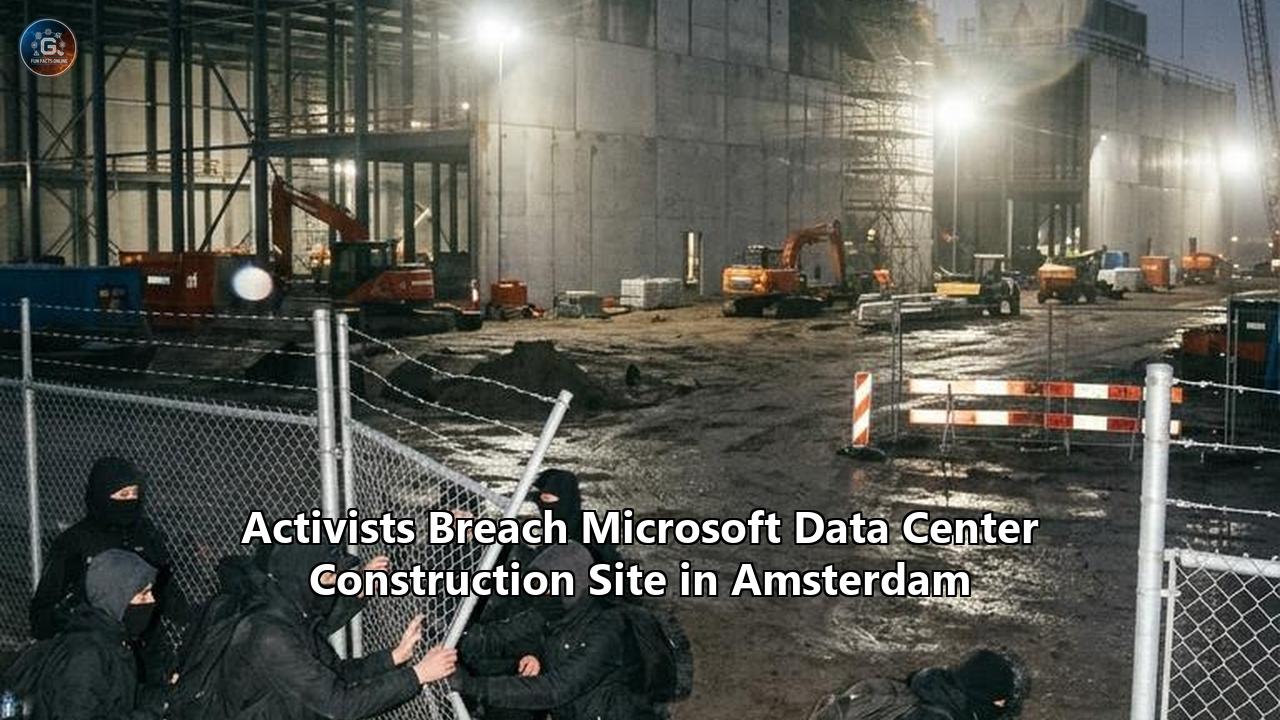
Riot police clashed with hundreds of demonstrators on the perimeter of Amsterdam’s western harbor district on November 6, 2026, as an escalating conflict over the physical footprint of artificial intelligence turned into a direct physical confrontation. Activists organized by the Dutch direct action collective Geef Tegengas—joined by factions from Extinction Rebellion and allied civic groups—cut through security fencing, breached construction lines, and occupied a multi-story data center site on Plimsollweg in the Westpoort industrial zone. Several demonstrators scaled high-reach tower cranes, unfurled banners condemning tech monopolies and military cloud contracts, and set off smoke flares. Police deployed tear gas and containment tactics, ultimately detaining between 150 and 200 people after municipal authorities declared an emergency prohibition on demonstrations in the immediate port sector.
The facility under siege is a €1 billion, 78-megawatt complex being constructed by UK-based developer Pure Data Centres, an enterprise backed by Brookfield’s Oaktree Capital Management. The entire facility is pre-leased to Microsoft.
The Amsterdam breach was not an isolated flare-up of local NIMBYism. It served as the tactical spearhead for a coordinated, two-day wave of civil disobedience organized by the pan-European "Stop Dirty Data Centres" coalition. Over the same 48 hours, synchronized direct actions, sit-ins, and demonstrations mobilized across 85 designated infrastructure sites spanning 16 countries, including targeted facilities outside Dublin, Copenhagen, Frankfurt, and Warsaw.
This incident marked an unmistakable inflection point in digital infrastructure politics: cloud computing has lost its political invisibility. For two decades, data centers operated on the cultural periphery as silent, utilitarian utility hubs—gray concrete monoliths neatly tucked away behind logistics park fencing. The Amsterdam Microsoft data center protest proves that these facilities are now viewed by environmental coalitions, urban planners, and anti-war activists as physical flashpoints where energy equity, municipal sovereignty, geopolitical accountability, and the unchecked resource consumption of generative AI collide.
Using the Amsterdam breach as an empirical case study reveals the core tensions defining hyperscale infrastructure expansion, showing how regulatory workarounds, electrical grid limits, and corporate mission scope are reshaping public resistance worldwide.
Dissecting the Asset: The Anatomy of Amsterdam's 78-Megawatt Dispute
To understand why this specific construction site attracted intense direct action, one must dissect the engineering specifications and political history of the Westpoort development.
The project on Plimsollweg deviates sharply from standard hyperscale architectural typology. Rather than spreading sprawling single-story server halls across dozens of rural hectares, the facility is designed as three stacked vertical towers, each rising 85 meters (279 feet) into the skyline of Amsterdam’s port. Each tower is engineered to draw 26 megawatts of critical computing load, establishing a cumulative site capacity of 78 megawatts supported by a newly commissioned on-site power substation.
+-------------------------------------------------------------------------+
|                  WESTPOORT DATA CENTER CAMPUS (78 MW)                  |
|                                                                         |
|   +-------------------+  +-------------------+  +-------------------+   |
|   |  Tower 1 (26 MW)  |  |  Tower 2 (26 MW)  |  |  Tower 3 (26 MW)  |   |
|   |  85 Meters Tall   |  |  85 Meters Tall   |  |  85 Meters Tall   |   |
|   |  Pre-leased to    |  |  Pre-leased to    |  |  Pre-leased to    |   |
|   |  Microsoft        |  |  Microsoft        |  |  Microsoft        |   |
|   +-------------------+  +-------------------+  +-------------------+   |
|                                                                         |
|        Shared Infrastructure: Substation | Liquid/Evaporative Cooling   |
+-------------------------------------------------------------------------+
The scale of this energy demand triggered immediate backlash. In municipal terms, a continuous 78-megawatt electrical load consumes roughly the same annual power volume as every private residential household within the city of Amsterdam combined. For an urban region already grappling with strict decarbonization mandates and volatile household utility bills, this volume of baseload draw became politically radioactive.
The site’s regulatory trajectory stoked deep community skepticism. In 2019, the municipality of Amsterdam imposed a landmark temporary ban on new data center developments, driven by fears that runaway digital expansion was exhausting the municipal power grid and crowding out residential construction. By 2022, the Dutch central government took that policy nationwide, introducing a national ban on hyperscale developments—defined as facilities exceeding 10 hectares of land surface area or requiring more than 70 megawatts of connected electrical capacity.
Yet the Plimsollweg project advanced through a matrix of grandfathering provisions and spatial technicalities. Initial zoning paperwork had been submitted in 2016, pre-dating both municipal and national freezes. Furthermore, by engineering the data halls vertically into three distinct 85-meter vertical towers rather than a single sprawling horizontal warehouse, developers successfully designed around the horizontal surface-area thresholds established in national land-use statutes. In January 2026, the provincial government of North Holland granted formal construction approvals, brushing aside objections from local councilors who argued that breaking down a single 78-megawatt complex into three adjacent 26-megawatt towers was a naked circumvention of the national policy's intent.
This administrative friction ignited direct hostility. Before the November mass breach, the facility had already become a primary target. In July 2026, Extinction Rebellion launched an act of physical sabotage against the same construction site, throwing projectiles filled with an acidic mixture of hydrogen peroxide, acetic acid, salt, and acrylic paint directly over the perimeter to chemically etch and degrade the curing concrete foundations and corrode structural rebar. The failure of that effort to halt development led directly to the tactical escalation seen on November 6, when activists replaced covert chemical sabotage with mass physical occupation.
The Intersectional Coalition: Why Climate, War, and AI Grievances Converged
The November breach broke the mold of traditional environmental picketing. The crowd that gathered on Plimsollweg was an ideological merger of disparate activist groups acting against a common target.
Historically, opposition to digital real estate fell into narrow silos. Conservationists protested habitat fragmentation; rural communities fought agricultural water consumption; and energy advocates argued against fossil-fueled electrical generation. At the Amsterdam Microsoft data center protest, those discrete arguments merged with anti-militarism, digital rights advocacy, and cultural backlash against algorithmic automation.
                +---------------------------------------+
                |    THE HYPERSCALE RESISTANCE MATRIX   |
                +---------------------------------------+
                                    |
       +----------------------------+----------------------------+
       |                            |                            |
       v                            v                            v
[ CLIMATE & GRID ]          [ CIVIC EQUITY ]         [ GEOPOLITICS & TECH ]
- Netcongestie crises       - Housing vs. compute    - Military cloud contracts
- Massive baseload drain    - Water allocation       - Mass surveillance tools
- Fossil backup generation  - Public revenue parity  - Algorithmic automation
Activist communications during and after the incident highlighted this systemic fusion. Nathan Timmer, a spokesperson for Geef Tegengas, framed the facility not as passive neutral cloud hardware, but as an engine for geopolitical and ecological exploitation:
"We don't want it to be built. Nobody needs it. The only thing this will be used for is AI slop, AI warfare, data surveillance and committing genocides. We don't want that."
Pro-Palestinian advocacy networks were prominent among the front-line occupiers, specifically targeting Microsoft’s corporate cloud infrastructure contracts with the Israeli Ministry of Defense and the Israel Defense Forces (IDF), alongside software deployments for United States Immigration and Customs Enforcement (ICE).
Roos Molenaar, another organizer with Geef Tegengas, reinforced this political synthesis:
"The struggle against big tech is inseparable from the fight against oppression and fascism. We won't accept Amsterdam being used for the creation of AI slop and the facilitation of genocide. This datacentre is gulping up our drinking water to make the rich even richer."
By framing data infrastructure as a material link between planetary carbon footprints, algorithmic warfare, and local resource depletion, the protest coalition built an unusually resilient message. The compute cluster was no longer defended as an abstract tool of technical progress; it was attacked as physical machinery driving real-world harm.
This ideological convergence strips tech firms of their standard public relations defenses. When corporate communications attempt to counter environmental complaints by highlighting net-zero offset programs, they run straight into simultaneous critiques regarding municipal housing shortages or defense contracting. The Amsterdam case demonstrates that once an asset is caught in an intersectional dispute, solving any single technical critique rarely diffuses the opposition.
Principle 1: Grid Congestion Sets the Hard Physical Boundary for Compute
The first systemic lesson from the Amsterdam case is that national transmission networks have hit their absolute physical limits, transforming high-voltage interconnects into battlegrounds over social equity.
For years, energy experts warned that the European digital transition was operating on a collision course with basic electrical reality. In the Netherlands, this crisis has a specific technical name: netcongestie (grid congestion). Decades of underinvestment in high-voltage substations, combined with the rapid integration of intermittent offshore wind and distributed solar, have pushed the Dutch national transmission operator (TenneT) and regional distribution system operators (such as Liander) to operational limits. Across major metropolitan hubs, the grid has no spare transmission capacity left.
This technical bottleneck creates direct, zero-sum competition between civic infrastructure and hyperscale compute clusters:
- Housing Halts: Amsterdam faces a severe structural housing shortage. City planning departments have warned that grid capacity allocations handed to heavy industrial developments, such as the Westpoort site, are directly stalling grid connections for an estimated 30,000 newly planned residential homes and public schools.
- Industrial Queues: Hundreds of domestic small- and medium-sized enterprises (SMEs) wanting to electrify their operations, abandon natural gas, or install EV fleet charging hubs sit on multi-year waiting lists for a commercial grid hookup.
- Baseload Demands: A hyperscale AI training cluster cannot run on intermittent power. It demands continuous baseload reliability, pulling constant energy every second of every day. When regional renewable assets drop offline during overcast, windless conditions (Dunkelflaute), these sites are backed up by utility gas generation or massive fields of on-site diesel backup engines.
When an international tech titan uses administrative mechanisms to secure a dedicated 78-megawatt pipeline while ordinary citizens face utility inflation and residential developments remain unplugged, electrical capacity changes from an engineering metric into an incendiary social division.
The Amsterdam incident proved that public patience for this resource imbalance has broken. Compute is no longer recognized as an untouchable public good. Instead, it is scrutinized as an extractive private resource that directly prevents the electrification of the surrounding human community.
Principle 2: Regulatory Arbitrage Inevitably Breeds Radical Resistance
The second core dynamic illustrated by the Westpoort project is that using legal loopholes to override local planning policy makes an asset a magnet for extra-legal direct action.
The regulatory history of Microsoft’s Amsterdam development reads like a playbook in regulatory arbitrage:
+-------------------------------------------------------------------------+
|                  REGULATORY CHRONOLOGY & POLICY TENSION                |
+-------------------------------------------------------------------------+
| 2016: Initial zoning application filed for Westpoort industrial plot.   |
|                                                                         |
| 2019: Amsterdam issues municipal freeze on new data center developments.|
|                                                                         |
| 2022: Dutch National Hyperscale Ban passed (>70 MW or >10 hectares).    |
|                                                                         |
| Late 2022-2025: Developers adapt design into three vertical 26 MW towers|
|                 (total 78 MW) to stay within municipal footprint caps.  |
|                                                                         |
| Jan 2026: North Holland provincial authorities grant final approval.   |
|                                                                         |
| July 2026: Extinction Rebellion targets foundation concrete with acid.  |
|                                                                         |
| Nov 2026: Mass direct-action breach and occupation of construction site.|
+-------------------------------------------------------------------------+
When local governments pass clear land-use moratoriums, they signal an explicit democratic mandate: their constituents believe the social, economic, and environmental costs of data clusters outweigh the local benefits. When hyperscale developers circumvent those policies by leaning on pre-moratorium grandfather clauses or segmenting large horizontal footprints into stacked multi-tenant architectural shells, they secure a narrow legal victory while destroying their social license to operate.
In the Amsterdam case, local residents felt twice disenfranchised. First, their municipal government’s 2019 moratorium was bypassed because the developer’s initial application predated the rule. Second, the 2022 national hyperscale ban—specifically drafted by the Dutch parliament to prevent massive facilities from consuming national infrastructure—was technically avoided by splitting the facility into three distinct, vertical structures.
This dynamic creates a dangerous governance vacuum. When civic communities discover that formal policy instruments fail to stop developments that violate the spirit of regional protections, direct confrontation becomes seen as the only tool with real leverage.
The violence and vandalism seen on Plimsollweg were the direct result of that administrative failure. Law and engineering may have operated strictly within the letter of grandfathered codes, but the lack of public consent left the site exposed to physical disruption. Corporate legal teams frequently focus entirely on obtaining defensible permits while ignoring community buy-in, failing to realize that a valid permit offers little protection when hundreds of demonstrators storm the security gates.
Principle 3: The End of Cloud Immateriality and the Politics of Concrete
For more than two decades, Silicon Valley worked hard to brand internet infrastructure as clean, light, and weightless. Metaphors like "the cloud," "cyberspace," and "serverless computing" successfully convinced the public that software was entirely decoupled from heavy industry and physical resources.
The Amsterdam confrontation has shattered that illusion for good.
Building three 85-meter vertical towers produces a massive industrial silhouette. These towers do not look like light, forward-looking software suites; they loom over Amsterdam's harbor like heavy industrial processing plants. Activists could see, touch, and disrupt the raw physical ingredients required to train and run generative AI models:
- Poured Concrete: Massive foundation blocks designed to support rows of heavy compute racks, demanding immense volumes of emissions-intensive cement that climate groups targeted with acid.
- Industrial Cooling: Evaporative cooling arrays and complex chiller circuits that swallow millions of liters of municipal water during high-load summer periods, raising severe environmental alarms in low-lying water basins.
- Grid Hardware: High-voltage switchgear, copper-heavy busbars, and transformers that consume raw electrical energy on a municipal scale.
- Embodied Carbon: Gigawatt-hours of embedded energy locked away in specialized ASIC processors, copper cabling, and physical plant machinery.
                     THE CRUMBLING ABSTRACTION

 [ THE ILLUSION ]                               [ THE REALITY ]
 "The Cloud"                                   Three 85m Concrete Towers
 Seamless & Clean                             78 MW Continuous Baseload
 Invisible Bits                                Millions of Liters of Water
 Ambient Software                              Heavy Industrial Asset
This sudden visibility has completely shifted public sentiment. When computing power was seen as a neutral digital bridge enabling personal connection and enterprise efficiency, communities accepted nearby data centers. But as the industry reorganizes itself around generative AI—workloads that ordinary citizens frequently associate with automated spam, unverified synthetic output, surveillance systems, and tech job cuts—the balance collapses.
The public increasingly asks a simple question: why should a local community risk its electrical stability, forfeit 30,000 family homes, and give up municipal water capacity simply to power industrial server racks for distant corporate bottom lines? By turning server complexes into visible physical infrastructure, activists have forced computing to account for its material ecological costs.
Principle 4: Corporate Dual-Use Contracts Create Universal Target Surfaces
Tech conglomerates have long presented their enterprise platforms as neutral backbones for global industry. However, the coordinated Microsoft data center protest exposed how enterprise cloud computing has become entangled with international defense programs and geopolitical conflicts.
Modern hyperscale business models rely on multi-tenant, centralized architecture. The exact same data campus hosts compute workloads across an enormous range of clients:
- Local consumer services and mobile apps.
- Regional enterprise software platforms.
- Advanced large language models (LLMs) and automated image/video generators.
- State defense cloud systems, intelligence operations, and border enforcement infrastructure.
This blended architecture carries enormous political risks. Activists on Plimsollweg carried placards and hoisted banners calling out Microsoft’s cloud services for the Israeli military, along with data hosting agreements for US federal immigration authorities.
Because modern cloud compute is centralized, physical data facilities serve as an open, vulnerable target for every single ethical grievance linked to any client on the company's books. A climate activist outraged by global carbon emissions, an anti-war protester tracking overseas drone strikes, and a digital-rights advocate warning against algorithmic surveillance all identify the exact same physical site as the core machine enabling those activities.
When tech giants actively seek out lucrative defense contracts and national intelligence deals to monetize their cloud systems, they pull their commercial real estate right into global political conflicts. Hyperscale companies can no longer isolate local real estate developments from their high-profile corporate defense ties. In the eyes of direct-action coalitions, the data center fence is not just a building site boundary—it is an accessible front line in a sprawling international resistance movement.
Institutional Fallout: Capital Reallocation, Gridlock, and the $68 Billion Delay
The financial shockwaves of the Amsterdam disruption spread far beyond the municipal boundaries of North Holland.
The direct action inside Westpoort landed as global financial markets were already pricing in heightened political vulnerability for the tech sector. In the second quarter of 2026 alone, local community opposition, permitting freezes, and environmental litigation successfully stalled or blocked an estimated $68 billion worth of data center projects across Europe and North America.
+--------------------------------------------------------------------------+
|          CAPITAL IMPACTS: GLOBAL RESISTANCE SQUEEZE (Q2-Q4 2026)         |
+--------------------------------------------------------------------------+
|  Metric                                  | Volume / Shift                 |
|------------------------------------------|--------------------------------|
|  Projects Stalled by Grassroots Pushback | $68 Billion (Q2 2026 alone)    |
|  PwC Europe Capex Projection (to 2050)   | $5.6 Trillion (18% of global)  |
|  US Capex Forecast (to 2050)             | $15.1 Trillion                 |
|  Targeted Pipeline Assets (Pan-Europe)   | 85 Dedicated Sites / 16 States |
|  National Hyperscale Moratoriums Active  | 4 EU States (Full or De Facto) |
+--------------------------------------------------------------------------+
Data center capital expenditure represents an unprecedented concentration of industrial wealth. Analysis from PwC’s Global Data Centre Outlook projects that cumulative data center capital expenditure across Europe will top $5.6 trillion between 2026 and 2050, capturing roughly 18% of all global infrastructure spending (with the United States commanding an astonishing $15.1 trillion over the same timeline).
However, deploying trillions in private capital requires long-term policy stability, uninterrupted construction schedules, and reliable grid interconnection agreements. The events in Amsterdam proved to institutional lenders and real estate investment trusts that data center developments face mounting sovereign and operational risks:
- Spiraling Site Security Costs: Hyperscale operators and their wholesale colocation partners can no longer rely on simple chain-link fences and private security guards. Site developers now face soaring costs for perimeter hardening, specialized riot-control measures, constant police support, and anti-sabotage engineering to protect active assets.
- Rising Insurance Premiums: Following structural chemical attacks on foundations and mass site occupations, commercial insurers are hiking project risk premiums, introducing strict direct-action exclusions, or demanding comprehensive site security overhauls before backing these facilities.
- Operational Uncertainty: In response to the coordinated European protests, municipal and regional leaders are pulling back on fast-tracked approvals. Italy’s Lombardy region has moved to tighten regional site restrictions, Portuguese regulators have launched broader environmental reviews, and in Finland, a major Google facility ran into criminal probes over land-clearing permits.
The modern Microsoft data center protest proves that public resistance is no longer a localized nuisance handled by public affairs teams. It has grown into a structural bottleneck capable of derailing capital schedules, driving construction cost overruns, and triggering regulatory interventions across major Western economies.
Strategic Adaptations: How Hyperscalers Are Scrambling to Respond
Faced with rising public pushback, mounting grid congestion, and organized direct action, cloud hyperscalers are racing to overhaul their engineering roadmaps and infrastructure strategy.
                        HYPERSCALE STRATEGIC PIVOTS
                                     |
       +-----------------------------+-----------------------------+
       |                             |                             |
       v                             v                             v
[ OFF-GRID NUCLEAR ]         [ DEEP INDUSTRIAL ]           [ REGIONAL RETREAT ]
  Behind-the-meter PPA         District heat recovery        Exiting saturated FLAP-D
  On-site SMR deployment       Circular graywater cooling    Migrating to Nordic hydro
  Bypassing municipal grid     Co-locating in heavy zones    Abandoning urban centers
1. The Behind-the-Meter Pivot: Escaping the Public Grid
To stop competing with residential housing and local manufacturing for transmission lines, tech companies are exploring ways to step off the public grid entirely. Hyperscalers are pursuing dedicated "behind-the-meter" power purchase agreements (PPAs), co-locating data centers directly next to dedicated nuclear power plants or offshore wind lines.
By sourcing baseload power directly from power generation stations without routing it through municipal high-voltage lines, operators hope to eliminate public criticism over residential grid congestion and blackouts. However, this strategy faces growing regulatory skepticism from watchdogs who point out that cordoning off large zero-carbon power plants for corporate AI clusters deprives public grids of the clean baseload power required to phase out fossil fuels.
2. District Heating and Circular Resource Commitments
In urban industrial areas where facilities are already under construction, operators are redesigning their cooling loops to capture and reuse waste heat. Under pressure from the EU Energy Efficiency Directive (EED), newly engineered urban facilities are installing heat exchangers to route their warm server-exhaust water into municipal district heating systems.
Under ideal operational conditions, a 78-megawatt complex can supply baseline winter space heating to tens of thousands of nearby residential apartments, turning an energy drain into a municipal heating asset. Yet retrofitting existing heating networks is expensive, and most European cities lack the pipe infrastructure to absorb this low-grade heat, leaving the bulk of data center thermal exhaust vented directly into the air.
3. Geographical Dispersion Away from FLAP-D Markets
Historically, data center developments clustered inside the "FLAP-D" markets—Frankfurt, London, Amsterdam, Paris, and Dublin—due to their proximity to financial exchanges, subsea fiber landings, and dense populations.
The Amsterdam breach shows that FLAP-D markets have hit their absolute social and infrastructural limits. In response, developers are shifting non-latency-sensitive workloads (such as foundational AI model training) far away from urban hubs. Projects are migrating north to Scandinavia and remote areas of Spain and North America, where abundant hydropower, lower ambient temperatures, and vast expanses of low-density land lower the risk of direct community conflict.
Yet this geographic escape is temporary. As sovereign AI initiatives expand and local communities across Southern and Eastern Europe organize their own resistance, local opposition is spreading just as fast as the infrastructure footprint.
The Horizon: What Amsterdam Portends for Global Infrastructure Siting
The events of November 6, 2026, in the port of Amsterdam will be studied by infrastructure investors, policy makers, and climate strategists as a defining milestone. The occupation proved that the race to scale artificial intelligence has entered a new and volatile era: the physical infrastructure of computing is now a contested political border.
Several forward-looking developments will determine whether this friction stabilizes or intensifies into broader civil unrest:
- The Expansion of Coordinated European Action: The pan-European "Stop Dirty Data Centres" coalition has proven it can mobilize direct action across multiple national borders simultaneously. As regional activist hubs share tactical playbooks, environmental intelligence, and legal strategies, hyperscale developers will face coordinated, cross-border opposition rather than scattered, isolated local hearings.
- Tighter Legislative Limits Across the European Union: The administrative maneuver used at Westpoort—splitting large, horizontal campus layouts into stacked vertical towers to bypass national moratorium thresholds—will almost certainly trigger corrective legislation. European lawmakers are already pushing for integrated policy frameworks that assess data campuses strictly by their total connected electrical load and regional water consumption, entirely closing spatial and architectural loopholes.
- Public Utility Interventions: With high-voltage lines stretched thin across both North America and Europe, central grid operators will face intense pressure to prioritize public social goods—residential housing, school construction, public transit electrification, and domestic industry—ahead of speculative AI infrastructure. If forced to choose between municipal electrical reliability and hyperscale corporate expansions, regional politicians will increasingly side with their voting constituents.
- Direct Corporate Accountability for Dual-Use Infrastructure: Hyperscale operators will no longer be able to run enterprise defense platforms, high-stakes surveillance programs, and consumer cloud applications across the same corporate network without facing blowback. Activist coalitions will continue targeting physical cloud buildings to pressure tech executives over controversial corporate contracts and geopolitical entanglements.
The three 85-meter concrete towers rising over Amsterdam’s Westpoort stand as monuments to this shifting reality. The era of building invisible, frictionless digital infrastructure is officially over. Every single megawatt of capacity, every cubic meter of cooling water, and every metric ton of foundation concrete must now be justified to the local community living outside the security fence. The Amsterdam breach proved that whenever those vital resources are captured without genuine public consent, the modern resistance movement will not wait for the courts—they will breach the perimeter and take the fight directly to the construction cranes.
Reference:
- https://www.theguardian.com/world/2026/nov/06/activists-break-into-building-site-of-microsoft-datacentre-in-amsterdam
- https://timesofindia.indiatimes.com/world/europe/climate-activists-storm-microsoft-data-centre-site-in-amsterdam-several-arrested/articleshow/135604781.cms
- https://nltimes.nl/2026/11/06/protesters-break-onto-site-planned-microsoft-data-center-adam-police-intervene
- https://www.dutchnews.nl/2026/11/activists-occupy-site-of-microsoft-data-centre-in-amsterdam/
- https://live.euronext.com/en/financial-news/activists-breach-microsoft-data-centre-construction-site-protests-spread-europe
- https://www.datacenterdynamics.com/en/news/more-than-100-protesters-break-into-microsoft-data-center-construction-site-in-amsterdam/
- https://qz.com/protesters-microsoft-amsterdam-data-center-site-110626
- https://www.tomshardware.com/tech-industry/data-centers/protesters-storm-microsoft-ai-data-center-construction-site-amsterdam-reportedly-first-of-85-targeted-actions-across-europe
- https://emergent.sh/news/protesters-break-into-microsoft-data-center
- https://www.idcnova.com/news/Climate-Activists-Attack-Microsoft-Datacenter-Project-in-Amsterdam-with-Acidic-Balloons
- https://cybernews.com/tech/dutch-activists-microsoft-data-center/
- https://mynorthwest.com/national/protester-microsoft-amsterdam/4295905