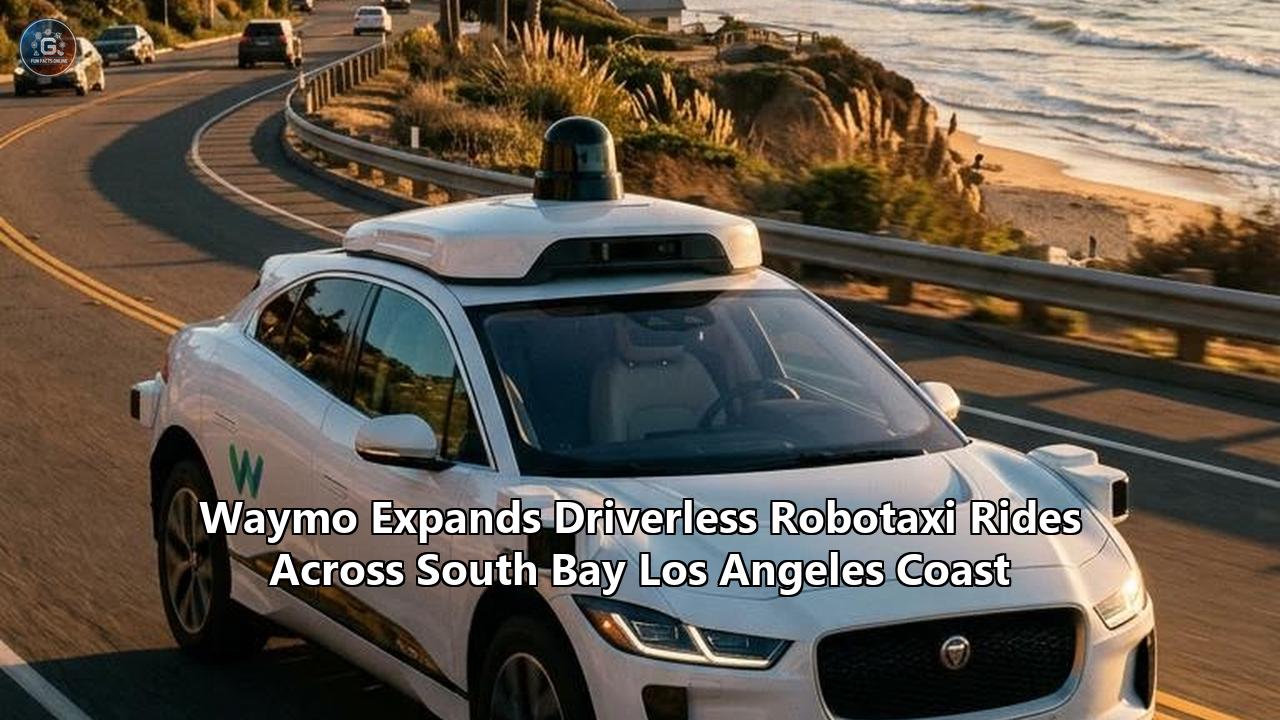
TORRANCE, Calif. — On a sun-drenched Tuesday morning along Pacific Coast Highway, a white, sensor-crowned Jaguar I-PACE slipped quietly into the curbside lane near Torrance Boulevard, navigated past a line of delivery vans, and brought itself to a halt next to the curb without a human driver inside. Inside the cabin, a dashboard touchscreen illuminated with the rider's name, confirming a pickup that marked a historic redraw of Southern California’s transit map.
Alphabet Inc.’s autonomous driving subsidiary, Waymo, has officially opened commercial, fully driverless ride-hailing across the coastal South Bay region of Los Angeles County. The rollout represents the single largest geographic expansion of the company’s Southern California footprint since it launched commercial service in the region, adding approximately 88 square miles of territory and increasing the operational domain of the Waymo robotaxi Los Angeles fleet by more than 70 percent to an aggregate operating zone of roughly 213 square miles.
The newly unlocked corridor extends Waymo One service south from its prior coastal terminus around Santa Monica, Venice, and Playa del Rey, pushing directly through El Segundo, Manhattan Beach, Hermosa Beach, and Redondo Beach before fanning inland across Torrance and reaching southeast toward Lomita. Concurrently, the company incorporated high-profile cultural destinations on the opposite side of the basin, including Universal Studios Hollywood and The Beverly Hills Hotel.
Yet the rapid expansion down the coastline has laid bare a striking paradox in the urban grid: a geographic exclusion zone around Los Angeles International Airport (LAX). While autonomous vehicles now patrol the arterial boulevards flanking LAX to both the north and the south, they remain prohibited from entering the airport's central terminal horseshoe, forcing tech-savvy travelers into multimodal workarounds while city authorities, labor unions, and airport commissioners debate the future of public curb space.
The South Bay deployment comes as Waymo scales aggressively across the United States, managing a commercial fleet of more than 4,000 autonomous vehicles completing over 500,000 paid passenger trips per week across 15 metropolitan markets. However, as the autonomous vehicles move into the South Bay's narrow residential avenues, high-speed coastal arterials, and complex multi-jurisdictional street networks, the expansion is igniting tensions among municipal leaders over local self-governance, emergency response protocols, labor displacement, and spatial equity across Los Angeles County.
Redrawing the Basin: Coastal Expansion and Network Topography
For two years following its initial public pilots in Los Angeles, Waymo confined its commercial service primarily to an east-west transit belt running from the Pacific Ocean in Santa Monica through West Los Angeles, Beverly Hills, and West Hollywood, terminating in downtown Los Angeles, Echo Park, and Silver Lake. Pushing into the South Bay represents a calculated operational leap. The area features a distinct demographic and physical environment compared to the dense urban grid of Downtown or the walkable, grid-dominated avenues of Santa Monica.
       [ Santa Monica / Venice ] (Established Zone)
                  |
                  v
         [ Playa del Rey ]
                  |
       =======================  <--- LAX Exclusion Zone / "Donut Hole"
                  |
                  v
           [ El Segundo ]
                  |
         [ Manhattan Beach ]
                  |
          [ Hermosa Beach ]    ===> [ Expanded Footprint: +88 Sq Miles ]
                  |                 [ Total Service Area: ~213 Sq Miles ]
         [ Redondo Beach ]
                  |
            [ Torrance ]
                  |
            [ Lomita ]
The new territory captures some of Southern California’s most affluent residential markets alongside heavy industrial and aerospace employment hubs. In El Segundo, Waymo vehicles now navigate the corporate campuses of aerospace contractors, satellite manufacturers, and media studios that line Rosecrans Avenue and Sepulveda Boulevard. Further south, the service area absorbs the steep hillsides, tight alleyways, and intense pedestrian concentrations of the beach cities, where pedestrian walkways intersect with delivery trucks and cycling traffic near The Strand.
In Torrance, the second-largest city in Los Angeles County by land area, the deployment covers a sprawling suburban fabric characterized by wide multi-lane boulevards, major industrial facilities, and regional commercial destinations such as the Del Amo Fashion Center—one of the largest shopping malls in North America.
"Torrance residents now have direct access to autonomous transportation, but our city staff and emergency personnel have spent months monitoring test runs to evaluate how these vehicles handle our local street network," said Corbin Carson, Torrance communications manager. Waymo vehicles operated across Torrance streets with licensed human safety drivers behind the wheel for months prior to the driverless commercial launch, mapping roadway geometries, light timing, and curb regulations.
The expansion into the South Bay was synchronized with a multi-state network expansion that injected nearly 250 square miles of commercial autonomous territory across five major markets, including the San Francisco Bay Area (with extensions into San Jose connecting to the Berryessa BART station), San Diego (reaching north into La Jolla), Nashville, and Orlando.
Industry trackers who monitor autonomous vehicle geofences note that the Los Angeles expansion signals growing confidence in the operational software’s ability to handle high-speed coastal driving conditions, marine atmospheric interference, and diverse municipal infrastructure variations. With the flick of a server-side switch, riders in Manhattan Beach can hail a fully driverless vehicle to travel to Westwood or downtown Los Angeles without a single human intervention.
The LAX "Donut Hole" and the Infrastructure Stalemate
Despite the contiguous southward expansion, anyone looking at Waymo’s updated service map will spot an empty enclave carved directly out of the coastal territory: Los Angeles International Airport.
The exclusion of LAX creates an operational doughnut hole. Waymo vehicles operate freely in Playa del Rey immediately north of the runways and cruise down Imperial Highway through El Segundo immediately south of the airfield perimeter. They can transport passengers to hotels lining Century Boulevard, but they cannot cross into the airport’s Central Terminal Area (CTA) to drop off or pick up travelers curbside.
+-------------------------------------------------------------------------+
|                  THE AIRPORT DISCONNECT AT A GLANCE                     |
+-------------------------------------------------------------------------+
|  Operational Status:     Excluded from autonomous pickups and drops     |
|  Governing Agency:       Los Angeles World Airports (LAWA)              |
|  Regulatory Basis:       CPUC General Order rules requiring express     |
|                          airport authority approval                     |
|  Primary Hurdle:         Terminal roadway congestion and delayed        |
|                          Automated People Mover (APM) project           |
|  Current Workaround:     Waymo drop-off at LAX/Metro Transit Center     |
|                          at 96th & Aviation, transfer to free shuttle   |
+-------------------------------------------------------------------------+
The restriction stems from a convergence of state regulatory frameworks and local airport governance. Under California Public Utilities Commission (CPUC) regulations, an autonomous vehicle fleet holding a commercial Charter-Party Carrier permit is explicitly prohibited from conducting commercial operations on airport grounds without the express, written authorization of the specific municipal airport governing authority.
For LAX, that authority is Los Angeles World Airports (LAWA), a proprietary department of the City of Los Angeles governed by the Board of Airport Commissioners. In formal communications with municipal officials, LAWA leadership has maintained a strict ban on autonomous vehicle access.
In an official letter to the Los Angeles City Council, LAWA Chief Executive Officer John Ackerman clarified the agency’s position: "To date, LAWA has not granted access to any AV companies to conduct pickups, drop-offs, or to operate on LAX property, and there is currently no timeline for permitting such activities". LAWA indicated that while exploratory discussions with Waymo have taken place, the airport cannot accommodate autonomous test runs or fleet operations within the congested terminal horseshoe, which already struggles to manage private vehicles, scheduled buses, and human-driven ride-hail services like Uber and Lyft.
The structural gridlock within the airport horseshoe prompted LAWA years ago to ban conventional ride-hail pickups from terminal curbs, banishing them to the remote "LAX-it" staging lot near Terminal 1, where arriving travelers must take dedicated shuttle buses to meet their cars.
LAWA officials have signaled that any integration of autonomous fleets is indefinitely tied to the completion of the airport’s long-troubled Automated People Mover (APM), an elevated 2.25-mile electric train system designed to ferry passengers between six central stations, parking facilities, and the regional rail network. Originally scheduled to enter service in 2023 ahead of major international sporting events, the $3.4 billion infrastructure project has suffered repeated construction and software validation delays, pushing its projected opening back to early 2027.
Airport planners envision that once the People Mover opens, all ride-hail services—autonomous and human-driven alike—will be prohibited from terminal curbs and directed to consolidated ground transportation centers situated along the perimeter, away from airport roadways.
Frustrated by the prolonged delay, Waymo launched an unusual direct-to-consumer advocacy campaign titled "Bring Waymo to LAX". The company emailed its active Los Angeles user base and published web portals urging riders to write letters directly to LAWA commissioners and city council members, emphasizing the safety and reliability benefits of autonomous transit.
In the interim, local commuters and frequent flyers have engineered a grassroots bypass. Riders hail a Waymo robotaxi Los Angeles to the newly opened LAX/Metro Transit Center station at 96th Street and Aviation Boulevard. Located outside the airport's restricted zone, the multi-modal facility serves as a drop-off hub where passengers disembark, grab their luggage, and board free municipal shuttle buses that run directly to the airline terminals.
This hybrid routine demonstrates how riders will string together autonomous mobility networks and public transit to route around regulatory bottlenecks.
Fleet Engineering: The Transition to the "Ojai" Platform
Waymo’s South Bay expansion coincides with a structural transition in the company's vehicle architecture. For years, the backbone of Waymo’s commercial deployment in Los Angeles has been the all-electric Jaguar I-PACE, outfitted with the company’s fifth-generation autonomous driving system. While the I-PACE established Waymo's ability to operate safely without a steering wheel monitor, its luxury crossover platform was never conceived from the ground up for commercial ride-hailing.
To scale its economics, Waymo has begun deploying its next-generation platform across Los Angeles: a purpose-built electric passenger vehicle engineered by Zeekr, the electric mobility brand owned by Geely, which Waymo has designated the "Ojai".
===========================================================================
               ARCHITECTURAL COMPARISON: HARDWARE GENERATIONS
===========================================================================
Metric / Component         5th-Generation Driver       6th-Generation Driver
                          (Jaguar I-PACE)             (Zeekr "Ojai")
---------------------------------------------------------------------------
Primary Chassis            Modified Luxury EV CUV      Custom Purpose-Built Van
Sensor Count (Cameras)     29 Cameras                  13 Cameras
Sensor Count (LiDAR)       5 High-Resolution Units     4–5 Solid-State/Mechanical
Sensor Count (Radar)       6 Imaging Radar Arrays      6 High-Definition Radars
Interior Ergonomics        Standard 5-Seat Auto Cabin  Flat Floor, Sliding Doors
Accessible Entry           Standard Door Swing         Low Step-In, Ramp Ready
Compute System             Multi-Board Trunk Rack      In-House Custom 5nm ASIC
Operational BOM Cost       Base Luxury Vehicle Cost    Significantly Reduced BOM
===========================================================================
The Ojai represents a deliberate philosophical break from the retrofitted passenger cars of autonomous vehicle testing history. Built on Zeekr's Sustainable Experience Architecture (SEA-M), the vehicle features a minivan-like silhouette with a flat interior floor, low ingress step heights, and automatic dual sliding doors designed to eliminate the risk of "dooring" passing cyclists along beach corridors like Ocean Avenue and Hermosa Avenue.
The interior eliminates the traditional driver’s cockpit layout, reclaiming space to offer three passenger display screens, generous legroom, accessible Braille notation across interaction points, and dedicated rear cargo space capable of swallowing the oversized suitcases that challenged the Jaguar I-PACE fleet.
Underneath its exterior skin, the Ojai introduces the sixth-generation Waymo Driver system. The new platform reduces hardware component costs while increasing compute performance and environmental resilience. The fifth-generation hardware on the Jaguar I-PACE relied on an array of 29 cameras alongside five spinning and solid-state lidar units. The sixth-generation architecture slashes the camera count to 13 while using higher-resolution image sensors that offer greater dynamic range and integrated heating elements to clear salt spray, ocean moisture, and coastal morning marine fog.
The compute platform has also evolved. Waymo moved away from off-the-shelf industrial GPUs and server-grade motherboards toward specialized, custom-designed 5nm compute silicon. This custom hardware cuts electrical power consumption, allowing the vehicle to devote more battery capacity to revenue-generating passenger miles rather than running onboard machine perception models.
However, the vehicle's manufacturing pipeline highlights the complex geopolitical tensions confronting the autonomous mobility industry. The un-outfitted electric gliders are manufactured in Ningbo, China, by Zeekr, imported through the Port of Los Angeles, and then transported across the desert to an advanced integration facility in Mesa, Arizona, operated in partnership with automotive supplier Magna International. There, American technicians integrate Waymo’s proprietary lidar domes, radar modules, safety compute nodes, and sensor-cleaning systems.
Navigating tariffs on Chinese-manufactured electric vehicles has led Waymo to diversify its vehicle portfolio. The company signed a multi-year commercial partnership with Hyundai Motor Group to integrate the sixth-generation Waymo Driver into Hyundai’s Ioniq 5 electric SUVs, which will be assembled at Hyundai’s Metaplant America facility in Bryan County, Georgia. This dual-sourcing strategy ensures that the company can scale operations across Los Angeles and other American cities regardless of shifting international trade barriers.
Municipal Sovereignty Versus Sacramento Preemption
While riders in Manhattan Beach and Torrance have welcomed the arrival of the driverless fleet, the expansion has renewed frustration among local elected officials who find themselves structurally sidelined by California’s regulatory architecture.
Under the California Vehicle Code and decisions rendered by the California Public Utilities Commission, regulation of commercial autonomous vehicles is reserved entirely for the state. The California Department of Motor Vehicles (DMV) holds exclusive jurisdiction over the testing and operational safety permits of autonomous driving systems, while the CPUC regulates commercial passenger transport, fare collection, and geographical authority.
Cities and regional councils of governments possess zero legal power to license, limit, tax, or cap the number of robotaxis traversing their streets.
This dynamic was on display during meetings of the South Bay Cities Council of Governments (SBCCOG), a joint powers authority encompassing 16 municipal jurisdictions across the South Bay region. When Waymo representatives presented their deployment plans to regional municipal leaders at the council’s Torrance headquarters, council members and local city managers pressed the company on operational transparency, street management, and how local public safety departments would be supported.
"Our police chiefs and city managers are held accountable by residents whenever an incident happens on a local street, whether it's an emergency response delay or a vehicle obstructing a lane," explained one South Bay municipal transit analyst. "Yet our city councils have no authority to set fleet limits, designate mandatory pickup spots, or mandate data sharing. We are essentially forced to accommodate private autonomous fleets on infrastructure funded and maintained by local taxpayers."
The issue of regulatory preemption extends directly into street-level police work. Under traditional traffic statutes, when a vehicle commits an infraction—such as double-parking in a bike lane, blocking a crosswalk, or executing an illegal turnaround—a law enforcement officer issues a citation to the driver’s license of the human behind the wheel. When a driverless vehicle commits an infraction, police officers have historically faced legal ambiguities regarding how to hold the registered company accountable.
Recent statutory clarifications enacted by the California Legislature have established mechanisms allowing police officers to issue civil traffic citations directly to the corporate autonomous vehicle permit holder, but local law enforcement agencies must develop customized protocols to interface with autonomous vehicles during field stops.
===========================================================================
             THE REGULATORY MATRIX: STATE CONTROL VS. LOCAL IMPACT
===========================================================================
Jurisdiction Level     Governing Body               Scope of Authority
---------------------------------------------------------------------------
Federal                NHTSA                        Federal Motor Vehicle Safety
                                                    Standards (FMVSS); SGO Crash
                                                    Reporting Mandates
---------------------------------------------------------------------------
State                  California DMV               Vehicle safety permits;
                                                    autonomous operation testing
                                                    and deployment licensing
---------------------------------------------------------------------------
State                  California CPUC              Commercial fare collection;
                                                    passenger service zones;
                                                    annual accessibility plans
---------------------------------------------------------------------------
Local / Municipal      Cities (Torrance, MB, etc.)  Curbside paint, red-curb
                       LA County Board of Sup.      enforcement, local signal
                       (Preempted from AV control)  maintenance. NO direct AV caps.
===========================================================================
Waymo points out that it maintains an active First Responder Safety Program, conducting hands-on training sessions with the Torrance Police Department, Manhattan Beach Fire Department, and regional public safety agencies. The company equips its vehicles with internal and external microphones that detect sirens, programming the vehicle's driving algorithms to pull over and yield to approaching emergency vehicles. If an officer needs to halt or reroute an autonomous vehicle at the scene of an accident, fire, or construction detour, Waymo provides a dedicated, 24/7 law enforcement priority hotline that connects directly to remote fleet incident response agents capable of directing the vehicle to stop, pull to the shoulder, or unlock its doors.
Despite these bridge-building efforts, municipal pushback remains organized. Coalitions of local leaders, joined by transportation officials from the San Francisco Municipal Transportation Agency (SFMTA) and the Los Angeles Department of Transportation (LADOT), have repeatedly petitioned the CPUC to adopt local concurrence rules.
Such measures would require autonomous vehicle operators to obtain formal operational agreements from local city councils before deploying commercial fleets on neighborhood streets. The CPUC has firmly rejected these petitions, arguing that granting California’s 482 incorporated cities veto power over autonomous vehicles would create an unworkable patchwork of conflicting municipal regulations that would stifle interstate commerce and technological innovation.
Safety Data, Road Reality, and Coastal Driving Dynamics
Waymo’s aggressive expansion into the South Bay has reignited the public debate surrounding autonomous vehicle safety records. In regulatory filings with the National Highway Traffic Safety Administration (NHTSA) under the agency’s Standing General Order (SGO), autonomous vehicle operators must report every collision involving their fleets on public roads.
As Waymo’s commercial fleet has scaled across Los Angeles County, raw crash numbers have climbed in tandem. A review of federal crash data reveals that total reported incidents involving Waymo vehicles in Los Angeles County tripled over the past year.
However, transportation safety researchers urge caution when interpreting these aggregate figures without context. The surge in raw collision events corresponds with an exponential increase in vehicle miles traveled (VMT), as hundreds of Waymo vehicles carry passengers across the Los Angeles basin every hour of the day.
When normalized per million miles driven, Waymo’s collision rate has declined consistently each year since 2023.
                   COLLISION SEVERITY BREAKDOWN: L.A. COUNTY
          ==========================================================
          [ 80% No Apparent Injury ]  Low-speed contact / bumps
          [ 15% Possible Injury    ]  Minor complaints / precautionary
          [ <1% Suspected Serious  ]  Severe vehicle structural damage
          ==========================================================
A granular analysis of the NHTSA crash records filed across Southern California illustrates that the vast majority of collisions are low-speed fender benders. Approximately 80 percent of all incidents reported by Waymo in Los Angeles County resulted in no apparent injuries, 15 percent involved complaints of possible or minor injuries, and less than 1 percent involved suspected serious injuries.
Crucially, an overwhelming majority of these incidents involved a human-driven vehicle rear-ending a stationary or slow-moving Waymo car at a traffic light, stop sign, or mid-block pedestrian yield point. Because autonomous systems strictly observe California Vehicle Code requirements—stopping fully at yellow lights when safe, yielding generously to pedestrians in marked and unmarked crosswalks, and maintaining conservative following distances—they are frequently struck from behind by distracted human drivers accustomed to aggressive urban driving habits.
Operating along the South Bay coastline presents unique environmental edge cases that test the limits of autonomous perception stacks:
- Coastal Atmospheric Interference: The marine layer, colloquially known as "May Gray" and "June Gloom," rolls inland off the Pacific Ocean, blanketing coastal arteries like Manhattan Beach Boulevard and Vista Del Mar in dense, salt-laden fog. Thick fog can scatter near-infrared light pulses emitted by lidar sensors, creating noisy returns that the vehicle's perception filters must classify and dismiss to prevent phantom braking.
- Complex Multi-Modal Interactions: Coastal communities feature unusually high concentrations of non-traditional road users. The Strand and adjacent coastal avenues are crowded with electric bicycles traveling at upwards of 28 mph, skateboards, rollerbladers, and pedestrians carrying surfboards that alter their visual profiles. Waymo’s machine learning models must correctly predict the intent of these dynamic road users under challenging lighting conditions.
- Corrosive Salt Air and Sensor Degradation: Persistent exposure to marine salt spray coats external sensor windows, requiring specialized mechanical cleaning systems. The sixth-generation Ojai vehicle integrates high-pressure fluid jets and heated wiper seals on its primary sensors to prevent salt crust from degrading visual cameras and lidar windows.
- High-Speed Arterials with Irregular Geometries: Corridors like Pacific Coast Highway (State Route 1) through Torrance and Redondo Beach feature high-speed multi-lane traffic punctuated by unprotected left turns, offset intersections, and heavy commercial truck traffic moving to and from nearby port facilities.
Waymo’s peer-reviewed safety studies, based on more than 200 million fully autonomous miles driven nationally, indicate that the Waymo robotaxi Los Angeles fleet demonstrates an 85 to 94 percent reduction in injury-causing crashes compared to baseline human-driven benchmarks over identical road types.
Yet incidents still occur. In May, Waymo issued a voluntary software recall across its commercial fleet after two vehicles in Phoenix and Los Angeles struck roadway hazards—including an incident involving unmapped standing floodwater. The company rolled out an over-the-air software update to its perception model to better detect and avoid street flooding, illustrating the continuous validation required to operate in varied urban conditions.
Labor, Equity, and the Civic Divide
The arrival of autonomous fleets across affluent coastal enclaves has triggered blowback from organized labor and transit equity advocates. Outside the San Francisco headquarters of the CPUC, hundreds of app-based gig drivers, public transit operators, and union members affiliated with the International Brotherhood of Teamsters and the Service Employees International Union (SEIU) staged rallies denouncing the state’s rapid greenlighting of autonomous expansions.
Chanting "Our Streets, Our Safety, Our Say," the protesters argued that the uncontrolled expansion of corporate autonomous fleets threatens the livelihoods of tens of thousands of gig workers across California. Full-time Uber and Lyft drivers who rely on high-demand Friday and Saturday evening airport and beach runs—frequently the most lucrative fares in the Southern California market—worry they will be systematically priced out of the industry by autonomous fleets backed by Big Tech capital.
+--------------------------------------------------------------------------+
|                  THE GEOGRAPHIC EQUITY DIVIDE IN LOS ANGELES             |
+--------------------------------------------------------------------------+
|  Active / Included Communities         Excluded / Waiting Communities    |
|  -----------------------------         ------------------------------    |
|  * Santa Monica & Venice               * Boyle Heights                   |
|  * West Hollywood & Beverly Hills      * East Los Angeles                |
|  * Manhattan Beach & Hermosa Beach     * Southeast Cities (Huntington    |
|  * El Segundo & Torrance                 Park, South Gate, Lynwood)      |
|  * Brentwood & Pacific Palisades       * San Fernando Valley Communities |
+--------------------------------------------------------------------------+
Simultaneously, the South Bay expansion has sparked an intense dialogue regarding transportation equity and redlining. While Waymo has aggressively expanded service into wealthy coastal and Westside enclaves—where median household incomes regularly exceed $150,000—working-class, transit-dependent, predominantly Latino communities across East Los Angeles, Boyle Heights, and the Southeast Cities remain excluded from the commercial service area.
"When you chart where autonomous mobility is deploying across Los Angeles County, it follows an unmistakable pattern of affluence," said a Los Angeles transportation equity researcher. "The affluent communities of Manhattan Beach, Santa Monica, and Beverly Hills receive access to safe, quiet, driverless transportation. Meanwhile, communities in the Eastside and South Los Angeles—where transit dependencies are highest and pedestrian fatalities from human traffic violence are most acute—are left waiting on the other side of the digital divide".
In public filings and community workshops, Waymo executives have countered accusations of spatial redlining by noting that their geographic rollouts are guided strictly by operational safety considerations, depot logistics, fleet scale, and wireless network coverage rather than neighborhood demographics. The company has initiated early mapping and vehicle training operations in industrial and commercial sectors of Commerce, Montebello, and Huntington Park, signaling that future expansions will gradually integrate the broader San Gabriel Valley and Southeast Los Angeles into the network.
Waymo has also partnered with the Los Angeles County Metropolitan Transportation Authority (Metro) on its Mobility Wallet pilot program, subsidizing autonomous rides for low-income residents to connect with rail transit hubs. However, until those pilot programs translate into comprehensive, basin-wide service availability, the spatial divide between the Westside-coastal corridor and the Eastside remains a point of friction.
Fleet Logistics, Energy Infrastructure, and Depot Politics
Behind the passenger experience of the Waymo robotaxi Los Angeles app sits a sprawling, complex industrial infrastructure dedicated to fleet maintenance, routing, and battery charging. Operating hundreds of fully electric autonomous vehicles 24 hours a day across a 213-square-mile metropolitan region requires significant electrical power and physical real estate.
To support its expanding South Bay fleet, Waymo relies on a distributed network of secure fleet depots strategically positioned throughout Southern California. These facilities, often situated in light-industrial zones around Hawthorne, Inglewood, and the edges of Torrance, serve as command centers where vehicles report for automated interior sanitation, mechanical sensor calibration, and battery charging.
+-------------------------------------------------------------------------+
|                  AUTONOMOUS FLEET DEPOT WORKFLOW                        |
+-------------------------------------------------------------------------+
|                                                                         |
|  [ In-Service Fleet ]                                                   |
|           |                                                             |
|           v                                                             |
|  [ Low State of Charge / Shift End ]                                    |
|           |                                                             |
|           v                                                             |
|  [ Automated Fleet Depot Check-in ]                                     |
|           |                                                             |
|           +---> [ Dedicated DC Fast Charging Array ]                   |
|           |                                                             |
|           +---> [ Sensor Calibration & High-Pressure Glass Wash ]       |
|           |                                                             |
|           +---> [ Interior Detail & UV-C Disinfection Cycle ]           |
|           |                                                             |
|           v                                                             |
|  [ Vehicle Safety Validation & Redispatch to Commercial Grid ]          |
|                                                                         |
+-------------------------------------------------------------------------+
The electrical demand generated by these commercial fleets has introduced new challenges for municipal energy infrastructure. A single commercial depot servicing 150 electric robotaxis equipped with 150 kW to 350 kW DC fast chargers requires multi-megawatt electrical service drops from Southern California Edison (SCE) or the Los Angeles Department of Water and Power (LADWP).
In some coastal cities, upgrades to local substation transformers can take 12 to 24 months, forcing autonomous fleet operators to stage charging operations or temporarily rely on private charging infrastructure partners.
In neighboring San Diego, where Waymo launched commercial operations over the summer and similarly expanded north to La Jolla, public friction flared over fleet charging habits. Local electric vehicle owners reported that off-duty Waymo vehicles were occupying stalls at public DC fast-charging plazas, sparking anger from private commuters who found themselves waiting in line behind driverless commercial cars.
The company moved swiftly to address the public relations challenge by shifting the vast majority of its charging operations to proprietary, closed-door commercial charging facilities, while negotiating off-peak charging schedules with regional utilities to prevent grid strain during periods of peak summer energy demand.
Managing vehicle movements, known in the ride-hail industry as deadhead routing, represents another major engineering problem. When demand slumps in Torrance during mid-day hours, Waymo’s centralized fleet dispatch algorithms must decide whether to park vehicles in staging zones, keep them circulating in low-speed holding loops, or direct them north toward the Westside.
Excessive street circulation without passengers can exacerbate local traffic congestion, a concern raised by the South Bay Cities Council of Governments as local leaders examine how autonomous fleets affect vehicle miles traveled across coastal communities.
Market Landscape: Alphabet’s Scaling Moat
Waymo’s aggressive South Bay push arrives at a pivotal moment in the competitive autonomous mobility sector. Alphabet has transformed Waymo from a long-horizon research endeavor into a commercial enterprise operating at real scale. In its most recent outside funding round, Waymo secured billions in capital, valuing the autonomous mobility subsidiary at upwards of $120 billion and cementing its lead over competitors.
===========================================================================
             COMMERCIAL AUTONOMOUS RIDE-HAIL MARKET POSITIONING
===========================================================================
Developer          Current Public Scale      Primary Hardware Strategy
---------------------------------------------------------------------------
Waymo (Alphabet)   >500k Paid Rides/Wk       Multi-Modal Sensor Suite:
                   Across 15 US Metros       LiDAR + Radar + Vision (6th Gen)
---------------------------------------------------------------------------
Zoox (Amazon)      Early Commercial Launch   Custom Bi-Directional Pods;
                   (Las Vegas, Testing SF)   LiDAR + Vision Heavy Architecture
---------------------------------------------------------------------------
Tesla              Unsupervised Testing in   Vision-Only (FSD Supervised Base);
                   Texas & Florida; Cybercab End-to-End Deep Neural Networks
---------------------------------------------------------------------------
Cruise (GM)        Restructuring Operations  Custom Origin Paused; Relaunching
                   Post-2023 Moratorium      Chevy Bolt Platforms with Drivers
===========================================================================
Waymo’s operational position in Los Angeles contrasts sharply with that of its direct competitors:
- Amazon's Zoox: Zoox has been methodically testing its purpose-built, bidirectional autonomous "carriage" on the streets of Las Vegas, San Francisco, and San Diego. While Zoox secured regulatory exemptions from the CPUC to operate vehicles without traditional steering wheels and foot pedals, its commercial operations remain tightly geofenced pilots compared to Waymo’s expansive urban footprint.
- Tesla: Tesla continues to pursue an alternative engineering philosophy centered entirely on computer vision and end-to-end neural networks, shunning lidar, radar, and HD mapping assets. While Tesla unveiled its purpose-built Cybercab prototype and operates limited unsupervised employee pilots in Austin, Texas, it does not hold a commercial driverless deployment permit from the California DMV or CPUC to collect fares from the public in Los Angeles. The company's consumer-facing Full Self-Driving (FSD) software remains classified by California regulators as an SAE Level 2 advanced driver-assistance system that legally requires continuous driver supervision.
- General Motors’ Cruise: Following an October 2023 incident in San Francisco where a vehicle struck and dragged a pedestrian who had been thrown into its path by a human driver, Cruise grounded its national fleet and underwent an executive, cultural, and technical overhaul. Cruise has since resumed supervised testing with human safety operators behind the wheel in select sunbelt markets, but it has yet to regain the regulatory permits required to offer paid, driverless commercial rides in California.
Waymo's primary challenge is no longer technological validation; it is operational economics. Transitioning from the capital-intensive Jaguar I-PACE to the more cost-effective Ojai platform, expanding the geographical geofence to drive utilization rates, and pushing toward a corporate target of one million paid weekly rides nationally are all key to demonstrating unit economics profitability.
By capturing the South Bay's lucrative coastal transit market, Waymo is locking in commuter loyalty across the Los Angeles basin ahead of its rivals, building an operational moat paved in high-resolution lidar point clouds and real-world commercial miles.
Toward 2028: Autonomous Transit and the Road Ahead
Waymo’s expansion through Torrance, El Segundo, and the Beach Cities is part of a larger plan to restructure transportation across Southern California ahead of a historic deadline: the 2028 Summer Olympic and Paralympic Games.
Los Angeles will host the Games under a pledged "car-free" transit vision, an ambitious undertaking for an urban basin defined by car dependency and chronic freeway congestion. Regional transportation authorities are racing to complete dozens of major transit expansions under Metro’s "Twenty-Eight by '28" initiative, including the D Line Subway Extension to Westwood and the automated LAX People Mover.
However, transit planners acknowledge that heavy rail and bus rapid transit networks cannot solve the last-mile challenge across a region as sprawling as Los Angeles County. Regional planning groups like the South Bay Cities Council of Governments have openly debated how commercial autonomous fleets can function as high-frequency feeders connecting low-density residential neighborhoods to major rail corridors.
The strategic roadmap for autonomous mobility in Southern California over the next 24 months centers on four critical milestones:
- The Freeway Frontier: While Waymo briefly paused autonomous freeway testing earlier this year to refine its construction and debris detection models, the company is preparing to re-deploy fully driverless operations onto California freeways. Gaining regulatory clearance to route autonomous vehicles onto the Interstate 405 (San Diego Freeway), the Interstate 105 (Century Freeway), and State Route 91 will cut cross-basin transit times between the South Bay and downtown Los Angeles by more than half, turning the service into a competitive alternative to interurban driving.
- The LAX Resolution: As construction wraps up on the Automated People Mover, pressure will mount on the Los Angeles Board of Airport Commissioners to establish a formal regulatory framework for autonomous fleet access. Whether autonomous vehicles are granted direct terminal curbside permits or restricted to the planned Consolidated Rent-A-Car (ConRAC) and Intermodal Transportation Facilities (ITF-West), resolving the airport impasse is essential to unlocking the region's full economic potential.
- Geographic Infill and the Eastside Expansion: Responding to civic pressure from social justice groups and municipal transit advocates, Waymo is expected to extend its commercial geofence eastward, linking the current downtown core through Boyle Heights, East Los Angeles, and the industrial Southeast Cities. Completing this eastern corridor will address equity critiques and connect diverse employment centers across the central basin.
- Integration of the Hyundai Ioniq 5 Fleet: As the purpose-built Ojai minivans continue to roll off assembly lines, the arrival of American-assembled Hyundai Ioniq 5 robotaxis from Georgia will accelerate fleet scaling, providing the vehicle volume necessary to absorb massive spikes in regional demand during global events like the 2026 FIFA World Cup and the 2028 Olympics.
The driverless cars gliding past the surf breaks of Manhattan Beach and the industrial refineries of El Segundo are no longer an experimental curiosity. They represent the emerging operational reality of 21st-century urban infrastructure. As Waymo stitches together the fragmented municipal landscape of Los Angeles County street by street, it is forcing the region to confront fundamental questions about who governs public roadways, how civic spaces are shared, and what an automated future means for the workers and communities that keep Southern California moving.
Reference:
- https://eletric-vehicles.com/waymo/waymo-pushes-into-las-south-bay-as-robotaxi-map-widens-across-15-us-cities/
- https://patch.com/california/redondobeach/waymo-expands-torrance-after-quietly-testing-city-streets
- https://www.thembnews.com/2026/10/31/589512/waymo-expands-to-manhattan-beach-and-south-bay-areas
- https://soz6.com/news/waymo-expands-to-torrance-manhattan-beach-and-other-corners-of-l-a-county
- https://www.forbes.com/sites/bradtempleton/2025/08/26/waymos-get-exclusive-access-to-sf-market-st---how-about-lax-airport/
- https://www.thedriverlessdigest.com/p/exclusive-waymo-wants-into-lax-whats
- https://www.kqed.org/news/12107317/california-lawmakers-and-drivers-pressure-regulators-to-reign-in-autonomous-vehicles
- https://kfiam640.iheart.com/featured/la-local-news/content/2026-10-28-waymo-expands-driverless-ride-service-into-south-bay/
- https://explainx.ai/blog/waymo-14-us-cities-robotaxi-expansion-september-2026
- https://www.parriva.com/waymo-los-angeles-expansion-boyle-heights-east-la/
- https://cdn.southbaycities.org/wp-content/uploads/2025/10/13171314/2_Board-Attendance-and-Minutes-10.23.2025.pdf
- https://dockduty.com/blog/tesla-robotaxi-los-angeles.html
- https://electrek.co/2026/10/27/waymo-expansion-250-square-miles-five-cities/
- https://www.reddit.com/r/SouthBayLA/comments/1xgxlza/waymo_to_expand_into_more_of_the_south_bay/
- https://eletric-vehicles.com/waymo/waymo-asks-riders-to-lobby-los-angeles-officials-for-lax-access/
- https://cybercabcollective.com/news/waymo-lax-rider-campaign-access-still-pending
- https://roadsigns.com/blogs/resources/how-many-waymo-cars-are-there
- https://www.latimes.com/business/story/2026-11-03/waymo-expands-to-torrance-manhattan-beach-other-corners-of-la-county
- https://www.latimes.com/business/story/2026-05-28/waymo-launches-services-with-cheaper-robotaxis-in-los-angeles
- https://eletric-vehicles.com/waymo/waymo-expands-paid-robotaxi-rides-to-denver-san-diego-and-tampa/
- https://newmarketpitch.com/blogs/news/autonomous-vehicle-waymo-ahead
- https://www.seiu1021.org/article/workers-and-community-advocates-protest-california-public-utilities-commissions-latest
- https://cal.streetsblog.org/2020/12/03/op-ed-pros-and-cons-of-the-california-public-utility-commission-decision-to-deploy-automated-vehicles
- https://en.wikipedia.org/wiki/Waymo