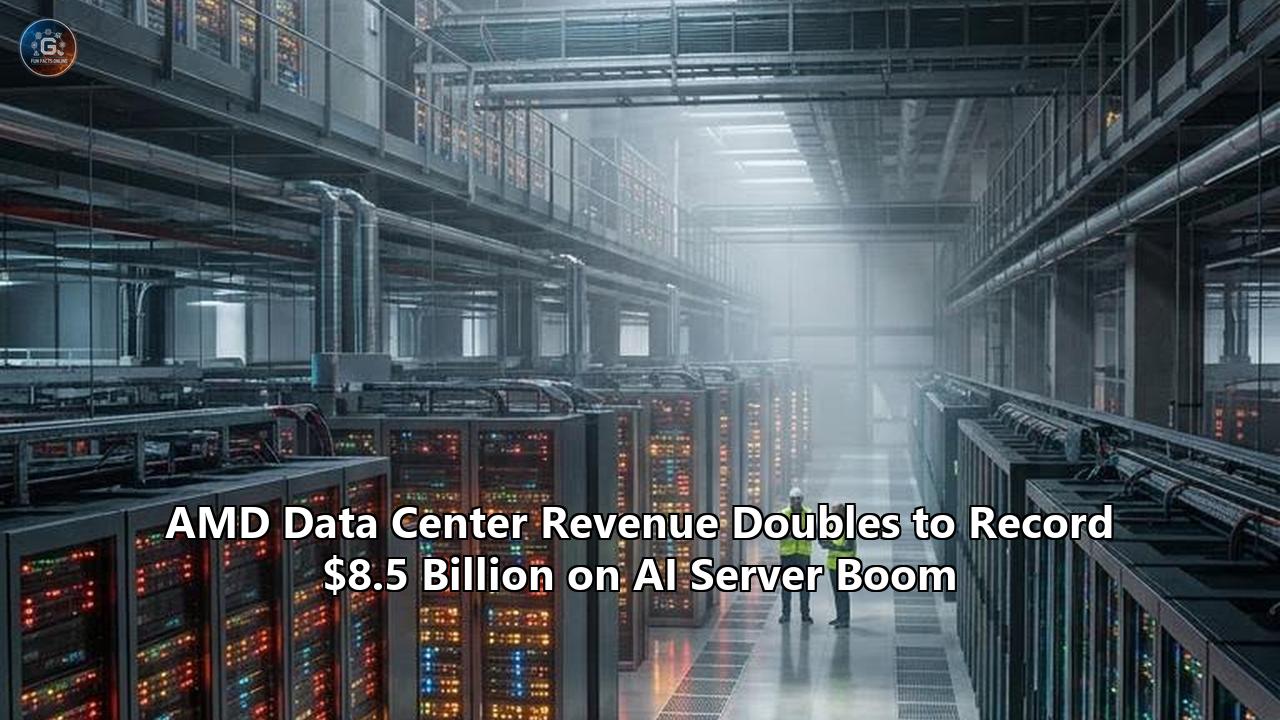
Advanced Micro Devices reported its fiscal third-quarter financial results on November 3, 2026, delivering a structural milestone that resets the competitive landscape of the semiconductor industry. Driven by an aggressive expansion in artificial intelligence infrastructure, AMD data center revenue jumped 97% year-over-year to reach a record $8.5 billion. The segment now accounts for 64% of AMD’s total quarterly revenue, which climbed 45% to $13.4 billion, surpassing Wall Street expectations and demonstrating that the company has moved past its historic reliance on personal computers and gaming consoles.
The quarterly print provided immediate validation of AMD’s multi-year pivot toward high-performance computing clusters. Adjusted earnings per share reached $2.09, up 74% from $1.20 a year earlier, beating analyst projections of $1.95. Net income calculated under generally accepted accounting principles (GAAP) rose 95% to $2.4 billion, despite a $1.1 billion accounting charge linked to the fair-value adjustment of warrants granted to strategic customers, including OpenAI.
Looking ahead, management signaled that the acceleration is not a momentary spike. Chief Executive Officer Dr. Lisa Su projected fourth-quarter revenue of approximately $17 billion—representing an implied 66% year-over-year jump—as the company prepares to ramp production of its Helios rack-scale systems and next-generation "Venice" server processors.
================================================================================
AMD Q3 2026 FINANCIAL SNAPSHOT
================================================================================
Metric                           Q3 2026          Q3 2025        YoY Change
--------------------------------------------------------------------------------
Total Revenue                    $13.38 Billion   $9.25 Billion   +45%
Data Center Segment Revenue      $8.55 Billion    $4.34 Billion   +97%
Client (PC Processors) Revenue   $2.90 Billion    $2.71 Billion   +7%
Gaming Segment Revenue           $773 Million     $1.29 Billion   -40%
Embedded Segment Revenue         $1.10 Billion    $853 Million    +29%
Non-GAAP Gross Margin            56%              54%             +200 bps
Non-GAAP Operating Income        $3.92 Billion    $2.24 Billion   +75%
Non-GAAP Diluted EPS             $2.09            $1.20           +74%
Q4 2026 Revenue Guidance (Mid)   $17.00 Billion   $10.24 Billion  +66%
================================================================================
"We delivered a record quarter with revenue exceeding the high end of our guidance as Data Center segment sales nearly doubled year-over-year," Dr. Su told investors. "Demand for our Instinct and EPYC products continued to strengthen, and we expect growth to accelerate further in the fourth quarter as we scale Helios and Venice production. We now expect server revenue to double year-over-year in 2027 and data center AI revenue to grow even faster than we projected 90 days ago."
The financial surge arrives during an uneasy period for capital markets. While top-line growth at AMD and market leader Nvidia continues to break records, hyperscalers face acute scrutiny over capital expenditure efficiency, power grid constraints, memory supply deficits, and the operational viability of running massive clusters. AMD’s surge to an $8.5 billion quarterly data center run rate is more than an earnings triumph; it exposes a structural crisis across global cloud infrastructure and illustrates how the industry is scrambling to resolve it.
The Infrastructure Trap: The Crushing Cost of Silicon Monopolies
The primary challenge highlighted by AMD’s results is the capital crisis created by single-vendor lock-in. Over the past three years, the buildout of generative artificial intelligence platforms has functioned under an extreme economic imbalance. Nvidia captured more than 90% of the market for specialized accelerators, granting it unprecedented pricing leverage. Hyperscale operators—chiefly Microsoft, Meta Platforms, Alphabet, Amazon Web Services, and Oracle—allocated unprecedented capital budgets to procure accelerators priced upward of $30,000 to $40,000 per unit, coupled with costly proprietary networking components.
+-----------------------------------------------------------------------------+
|                  THE MONOPOLISTIC INFRASTRUCTURE TRAP                       |
+-----------------------------------------------------------------------------+
|                                                                             |
|   +--------------------+       +--------------------+       +-------------+ |
|   | 85-90% Accelerator |       | Proprietary Fabric |       | CUDA Engine | |
|   | Market Share       | ----> | Lock-In (NVLink /  | ----> | Software    | |
|   | (Single Vendor)    |       | InfiniBand)        |       | Moat        | |
|   +--------------------+       +--------------------+       +-------------+ |
|              |                            |                        |        |
|              v                            v                        v        |
|   +-----------------------------------------------------------------------+ |
|   |                       ECONOMIC & OPERATIONAL SQUEEZE                  | |
|   |  - Gross margins transfer directly from Cloud to Silicon Vendor       | |
|   |  - Cluster topologies locked to proprietary physical form-factors     | |
|   |  - Severe allocation bottlenecks delay production model rollouts      | |
|   +-----------------------------------------------------------------------+ |
|                                                                             |
+-----------------------------------------------------------------------------+
This dynamic transferred operational margins out of the cloud ecosystem and into the merchant silicon supply chain. Cloud operators saw their infrastructure depreciation climb faster than their software monetization rates. When infrastructure operators depend on an exclusive silicon provider, several operational hazards emerge:
- Gross Margin Compression: Hyperscalers selling cloud compute instances find their own unit economics capped by hardware acquisition costs.
- Capacity Allocation Rationing: Cloud providers have spent quarters waiting on prioritized allocations, leaving critical enterprise engineering projects stalled in software queues.
- Architectural Rigidity: Proprietary inter-chip networking protocols prevent data center engineers from mixing, matching, or tailoring memory subsystems to specific software workloads.
- Systemic Single-Point Vulnerability: Supply chain shocks, packaging yields, or design revisions at a single semiconductor firm create knock-on deployment delays across the global software economy.
Hyperscalers recognized that their capital spending trajectory was becoming untenable. Industry leaders understood that without a credible second source capable of delivering competitive floating-point performance, thermal efficiency, and production-scale volume, the financial profile of enterprise AI would collapse under its own weight.
AMD's rapid rise answers this industry demand for alternatives. Hyperscalers have poured resources into qualifying AMD’s Instinct accelerators and EPYC server microprocessors. They are not adopting AMD hardware merely for small price discounts, but to preserve their long-term operating models. The sharp rise in AMD data center revenue proves that Tier-1 cloud operators are deploying production workloads onto alternative silicon architectures at scale.
The Pivot to Agentic AI and the CPU Bottleneck
A second structural challenge revealed by AMD's earnings is a fundamental shift in model architectures. For two years, the industry’s primary technical challenge was pre-training large language models (LLMs). Pre-training requires massive clusters of GPUs running synchronous matrix multiplications across thousands of nodes for months at a time, with central processing units (CPUs) largely relegated to peripheral housekeeping tasks.
During 2026, compute demand shifted rapidly toward inference and autonomous agentic workflows. Unlike static chat prompts that generate quick text completions, agentic systems—such as Meta’s Muse, autonomous software engineering agents, and multi-step enterprise workflows—execute persistent reasoning loops. These systems query external databases, compile and run sandboxed code, coordinate sub-agents, and manage active session memory for hours at a stretch.
+-----------------------------------------------------------------------------+
|                    WORKLOAD COMPUTATIONAL PROFILE SHIFT                     |
+-----------------------------------------------------------------------------+
|                                                                             |
|   CLASSIC LLM TRAINING (2023-2024)       AGENTIC REASONING (2025-2026+)     |
|   --------------------------------       ------------------------------     |
|   [GPU Cluster: 95% Compute Budget]      [Host CPU: Dynamic State Orchestr] |
|   - Synchronous matrix multiplication    - Virtual machine provisioning     |
|   - Static parameter backpropagation     - Sandboxed code execution         |
|   - Minimal CPU interaction              - Persistent session state caches  |
|                                                          |                  |
|   [Host CPU: 5% Compute Budget]                          v                  |
|   - Basic node monitoring                [GPU Cluster: Intermittent Bursts] |
|   - Data loader batch feeding            - Vector embeddings & generation   |
|                                          - Long-context inference steps     |
|                                                                             |
+-----------------------------------------------------------------------------+
This architectural shift triggered an unexpected crisis: the CPU host node bottleneck. Autonomous agents require substantial general-purpose compute to provision virtual machines, manage application state, coordinate networking calls, and maintain complex memory caches. Data center configurations that paired low-cost, low-core-count CPUs with dense banks of accelerators struggled to handle thousands of concurrent agentic threads.
During the earnings call, Dr. Su pointed to this technical shift as a primary catalyst for the company’s enterprise and cloud server momentum.
"Turin is now the most widely deployed EPYC generation in the public cloud, with more than 540 instance types available globally from the largest providers," Su noted. "Cloud providers also added significant EPYC capacity in the quarter for personal and enterprise agents, which are quickly becoming the next killer app for CPUs in the cloud. OpenAI, for instance, selected EPYC Turin processors as host CPUs for its first custom accelerator platforms."
The rise of agentic computing transformed what had been an accelerator-only expansion into a balanced platform upgrade. Data center operators running modern inference clusters require dozens of high-throughput x86 cores per accelerator to prevent host-level thread contention. This dynamic enabled AMD to post record margins on its 5th Gen EPYC processors while simultaneously ramping accelerator shipments.
Memory Deficits, Thermal Walls, and Enterprise Strain
While AMD's headline numbers reflect strong demand, they also highlight the severe physical constraints facing advanced computing clusters. Building out multi-gigawatt data center footprints has exposed three critical hardware and operational hurdles:
The High-Bandwidth Memory (HBM) Squeeze
Modern generative models, with context windows reaching millions of tokens and parameter counts in the trillions, require massive memory capacity and bandwidth. Accelerators are bound by their memory subsystems; if an accelerator cannot ingest weights quickly enough, its arithmetic logic units sit idle.
The semiconductor sector faces an acute shortfall of High-Bandwidth Memory (HBM3E and next-generation HBM4). Fabrication facilities operated by SK Hynix, Samsung Electronics, and Micron Technology have sold out their production capacities quarters in advance. Packaging these memory stacks via advanced silicon interposers (such as TSMC’s Chip-on-Wafer-on-Substrate, or CoWoS) remains a critical supply chain bottleneck. Any delay in memory fabrication halts cluster deliveries, regardless of how many compute dies AMD or Nvidia produce.
The Power and Thermal Wall
Historical data center footprints were designed around rack densities of 10 kilowatts (kW) to 15 kW. Modern AI server racks house clusters that demand between 80 kW and 140 kW per cabinet. Air cooling cannot dissipate thermal energy at this density. Infrastructure operators must convert facilities to direct-to-chip liquid cooling or rear-door heat exchangers, a retrofit requiring hundreds of millions of dollars per facility.
In major cloud corridors such as Northern Virginia, Frankfurt, and Dublin, municipal utility grids cannot supply additional substations fast enough. Compute efficiency per watt is no longer just a metric for lowering operating costs—it is the governing factor determining whether an operator can turn on hardware within its contracted utility envelope.
+-----------------------------------------------------------------------------+
|                   THE DATA CENTER RACK DENSITY ESCALATION                   |
+-----------------------------------------------------------------------------+
|                                                                             |
|   Traditional Enterprise Server Rack (2020)                                 |
|   [||||||||||||||||||||] ~10 kW - 15 kW (Forced Air Cooling)                |
|                                                                             |
|   Dense Accelerated Training Rack (2024)                                    |
|   [||||||||||||||||||||||||||||||||||||||||||||] ~40 kW (High-Flow Air/Liq) |
|                                                                             |
|   Helios / NVL72 Rack-Scale System (2026)                                   |
|   [||||||||||||||||||||||||||||||||||||||||||||||||||||||||||||||||||||||]  |
|   ~120 kW - 140 kW (Mandatory Direct Liquid Cooling / Facility Heat Exch)   |
|                                                                             |
+-----------------------------------------------------------------------------+
Divergence in Silicon Demand
AMD’s quarterly report card underscores a growing split across the technology sector. While the data center unit surged 97%, consumer client processors grew only 7% to $2.9 billion, and gaming revenue plunged 40% year-over-year to $773 million.
Hyperscale infrastructure spending is absorbing a disproportionate share of global semiconductor manufacturing and advanced packaging capacity. Consumer categories are bearing the cost through elevated component prices, prolonged console product cycles, and sluggish personal computer refresh rates. Enterprise IT departments are delaying on-premise hardware refreshes to divert their capital budgets into cloud AI service credits.
Balance Sheet Realities: Capital Intensity, Warrants, and Supply Risk
AMD’s earnings report highlights the financial and balance sheet strain required to build complex artificial intelligence systems. Delivering rack-scale compute platforms is capital-intensive, carrying operational exposure that standard component-level semiconductor companies historically avoided.
A granular examination of AMD’s balance sheet reveals how much working capital is needed to support this growth. Free cash flow for the third quarter fell to $554 million, down sharply from roughly $1.5 billion in the prior-year period. The drop was driven by an inventory build of roughly $3 billion in the quarter.
AMD procured advanced silicon wafers, high-bandwidth memory stacks, liquid-cooled chassis, and optical networking components to prepare for fourth-quarter deliveries of its Helios rack-scale systems and Venice processors. To finance this production pipeline, AMD increased its short-term and long-term borrowing, more than doubling its debt obligations since the second quarter.
+-----------------------------------------------------------------------------+
|                     AMD WORKING CAPITAL EXPOSURE (Q3 2026)                  |
+-----------------------------------------------------------------------------+
|                                                                             |
|   +--------------------------+          +-------------------------------+   |
|   | Free Cash Flow: $554M    |          | Inventory Build: +$3.0B       |   |
|   | (Down from ~$1.5B YoY)   |          | (Components for Helios/Venice)|   |
|   +--------------------------+          +-------------------------------+   |
|                 \                                     /                     |
|                  \                                   /                      |
|                   v                                 v                       |
|   +---------------------------------------------------------------------+   |
|   |                        EXECUTION TIMELINE RISK                      |   |
|   |  - Capital deployed quarters ahead of cash receipts                 |   |
|   |  - Debt doubled since Q2 2026 to fund packaging and memory queues   |   |
|   |  - Risk profile: Any cloud deployment delay strands finished goods  |   |
|   +---------------------------------------------------------------------+   |
|                                                                             |
+-----------------------------------------------------------------------------+
This posture introduces clear execution risks:
- Assembly Inventory Exposure: If a hyperscaler pauses data center construction due to electrical permitting delays or cooling fluid shortages, AMD must hold expensive inventory that depreciates rapidly as new silicon revisions loom.
- Customer Warrant Liabilities: Under GAAP, AMD incurred a $1.1 billion pre-tax charge linked to the fluctuating fair value of stock warrants issued to foundational customers such as OpenAI. When AMD’s share price appreciates, the calculated liability of these performance-vesting warrants expands, depressing reported net earnings.
- Supply Allocation Lock-In: To guarantee access to TSMC’s advanced packaging lines and memory suppliers' HBM queues, AMD must sign multi-billion-dollar non-cancelable wafer and component commitments.
Chief Financial Officer Jean Hu addressed this cash-flow mismatch directly, emphasizing that the upfront capital outlays match customer order books.
"Third quarter revenue grew 45% year-over-year to a record $13.4 billion, while non-GAAP earnings per share grew 74%, demonstrating the significant operating leverage in our business model as our Data Center business drives scale," Hu stated. "Our fourth-quarter outlook reflects accelerating revenue and earnings growth, driven by strong demand across our Data Center portfolio."
The operational trade-off is clear: to challenge an entrenched incumbent, AMD must operate with higher balance-sheet leverage, shoulder system-integration risks, and absorb inventory exposure.
Silicon Engineering Solutions: MI450, Turin, and the Venice Roadmap
To address market consolidation, AMD built an architectural response spanning multiple semiconductor nodes. The engine powering AMD data center revenue past the $8.5 billion mark is a coordinated pair of compute platforms: the AMD Instinct MI450 accelerator series and the 5th and 6th Generation EPYC processor families.
================================================================================
AMD DATA CENTER SILICON SPECIFICATIONS (2026 DEPLOYMENTS)
================================================================================
Feature                     Instinct MI450 Accelerator     EPYC 9005 (Turin) CPU
--------------------------------------------------------------------------------
Architecture                CDNA 4 Core Engine             Zen 5 / Zen 5c Microarch
Process Node                Advanced Multi-Dielet (TSMC)   3nm / 4nm TSMC FinFET
Max Memory Capacity         Up to 432 GB HBM4              Up to 6TB DDR5-6400
Peak Memory Bandwidth       Up to 9.8 TB/s                 Up to 12 Memory Channels
Precision Support           FP4, FP8, FP16, BF16, TF32     AVX-512, VNNI, BFLOAT16
Maximum Configuration       72-GPU Rack-Scale Fabric       Up to 192 Cores / 384 Thr
Primary Workload            Trillion-Param Inference/Train Agentic Orchestration
================================================================================
The Instinct MI450 Series
The Instinct MI450 series marks a significant shift in accelerator hardware design. Built on the CDNA 4 microarchitecture, the MI450 moves past the single-node board designs of the earlier MI300 generation to focus directly on clustered rack-scale performance.
- HBM4 Memory Integration: The MI450 integrates up to 432 gigabytes (GB) of ultra-fast HBM4 memory per GPU, delivering nearly 10 terabytes per second (TB/s) of memory bandwidth. This massive on-package memory footprint allows cloud operators to load multi-hundred-billion parameter models across fewer physical chips, reducing cross-node network latency and lowering energy consumption per inference query.
- Micro-Scaling Data Formats: The silicon includes dedicated mathematical engines that natively support FP8 and emerging FP4 precision formats. By reducing numerical precision from 16 bits to 4 bits without degrading task accuracy, the MI450 quadruples effective token throughput while reducing memory bus energy draw.
- Decoupled Compute and Memory Dies: Using advanced 3D packaging techniques, AMD separates high-performance matrix calculation tiles from input/output memory controller dies. This layout improves manufacturing yields and lets AMD tailor chip configurations for hyperscale customers without redesigning the primary silicon core.
EPYC Turin and Venice Microprocessors
Simultaneously, AMD expanded its lead in general-purpose x86 server infrastructure. The 5th Generation EPYC processor (codenamed "Turin"), based on the Zen 5 architecture, offers up to 192 processing cores and 384 execution threads per socket.
Turin provides enterprise clusters with the multi-threaded performance required to drive modern agentic workflows. Its memory controller supports 12 DDR5 channels, giving host nodes the throughput needed to coordinate operating system threads, host vector databases, and execute agent sandboxes without starving paired accelerators.
Looking to the fourth quarter and early 2027, AMD has begun sampling its 6th Generation EPYC processor family, codenamed "Venice". Built on TSMC's 2nm-class process technology and introducing the Zen 6 microarchitecture, Venice introduces wider instruction decoders, on-package optical interconnects, and enhanced cache hierarchies. These improvements are designed specifically to eliminate data-transfer delays between host operating systems and clustered AI hardware fabrics.
The System-Level Redesign: ZT Systems and Helios Rack Architecture
An important shift in AMD's strategy is its transition from selling standalone socket processors to delivering fully integrated, rack-scale computing platforms. For years, Nvidia held a critical operational advantage: it did not just sell chips; it sold complete HGX boards, DGX appliances, and NVL72 rack-scale systems with pre-routed liquid cooling, power distribution busbars, and pre-configured network topologies. Hyperscale operators could wheel an entire cabinet onto the data center floor, hook up facilities power and water, and bring thousands of computing cores online in days.
AMD addressed this competitive gap through an aggressive operational move: the $4.9 billion acquisition of ZT Systems.
+-----------------------------------------------------------------------------+
|                  ZT SYSTEMS INTEGRATION & THE HELIOS ENGINE                 |
+-----------------------------------------------------------------------------+
|                                                                             |
|   +--------------------+       +--------------------+       +-------------+ |
|   | AMD Silicon R&D    |       | ZT Systems Unit    |       | White-Box   | |
|   | (Instinct MI450 &  | ----> | (Power, Liquid     | ----> | Cloud ODMs  | |
|   | EPYC Venice CPUs)  |       | Cooling, Busbars)  |       | (Volume Mfg)| |
|   +--------------------+       +--------------------+       +-------------+ |
|                                          |                                  |
|                                          v                                  |
|   +-----------------------------------------------------------------------+ |
|   |                   HELIOS RACK-SCALE ARCHITECTURE                      | |
|   |  - 72 MI450 Accelerators coupled with Venice Host CPUs                | |
|   |  - Direct Liquid-to-Chip manifold handling >100 kW thermal envelopes  | |
|   |  - Open UALink inter-chassis fabric without proprietary lock-in       | |
|   +-----------------------------------------------------------------------+ |
|                                                                             |
+-----------------------------------------------------------------------------+
ZT Systems had operated as one of the world's premier cloud-manufacturing design firms, engineering custom server architectures for top hyperscale operators. By bringing ZT Systems’ elite system design, thermal simulation, power distribution, and validation teams in-house—while committing to divest the capital-heavy manufacturing operations to avoid competing with server original equipment manufacturers (OEMs)—AMD transformed its go-to-market speed.
The first major result of this acquisition is the Helios rack-scale computing architecture.
Helios integrates up to 72 Instinct MI450 GPUs alongside next-generation EPYC host processors in a unified liquid-cooled cabinet. Designed to compete directly with Nvidia’s dense rack systems, Helios incorporates several key design elements:
- Integrated Direct Liquid Cooling: Liquid manifolds deliver coolant directly across the cold plates of every GPU and CPU die, capturing over 90% of heat dissipation at the component level and reducing facility fan energy use.
- Blind-Mate Blind-Node Serviceability: Compute nodes slide directly into modular rear busbars carrying high-voltage direct current (48V/380V DC), eliminating internal power conversion steps and boosting power distribution efficiency.
- Customer-Validated Deployments: Tier-1 hyperscale operators have begun validating and deploying early Helios units. Oracle Cloud Infrastructure (OCI) committed to deploying more than 50,000 Instinct MI450 processors within these rack configurations starting in 2026, creating one of the largest public cloud supercomputing clusters built outside of a proprietary Nvidia stack. Meta, Microsoft, Anthropic, and OpenAI are also running models and production workloads on early Helios infrastructure.
By delivering validated, rack-scale platforms, AMD removed integration friction for cloud providers, accelerating time-to-production and directly driving the doubling of its data center top line.
Dismantling the Software Moat: ROCm and Open Standards
Silicon specifications alone cannot break a computing monopoly. Nvidia’s most durable defensive asset has never been its silicon dies; it has been CUDA (Compute Unified Device Architecture). Launched in 2006, CUDA became the default application programming interface and development environment taught in universities, embedded in academic research, and integrated into commercial enterprise codebases. For over a decade, porting deep learning models to alternative silicon required engineering teams to rewrite low-level kernel code, a costly and bug-prone process that kept customers locked into the incumbent's hardware.
================================================================================
COMPUTATIONAL STACK EVOLUTION: CLOSED VS. OPEN-SOURCE
================================================================================
Layer               Proprietary Incumbent Model       AMD Open Ecosystem Model
--------------------------------------------------------------------------------
Frameworks          PyTorch / JAX / TensorFlow        PyTorch / JAX / TensorFlow
High-Level Compiler OpenAI Triton / XLA               OpenAI Triton / ROCm XLA
Runtimes            CUDA Runtime / Driver             ROCm 6.x / 7.x Driver Stack
Low-Level Kernels   cuBLAS / cuDNN / NCCL             rocBLAS / MIOpen / RCCL
Interconnect Tech   Proprietary NVLink / NVSwitch     Ultra Accelerator Link (UALink)
Network Fabric      InfiniBand (Proprietary)          Ultra Ethernet Consortium (UEC)
================================================================================
AMD's software initiative, centered on its ROCm (Radeon Open Compute) open-source software stack, approached this challenge with a different strategy. Rather than attempting to force developers into a closed AMD-specific language, the company partnered directly with the open-source software community and hyperscale engineering teams to commoditize the translation layer.
Framework-Level Integration
Modern machine learning development rarely involves writing raw, low-level GPU code. Most artificial intelligence practitioners build models using high-level frameworks like PyTorch, JAX, or domain-specific compilers such as OpenAI Triton.
AMD deployed hundreds of software engineers to contribute upstream to the primary PyTorch and Triton repositories. As a result, when a development team pulls a standard container for modern PyTorch or vLLM (an open-source model inference serving engine), the software recognizes Instinct accelerators out of the box. Model weights and operational graph layers compile directly down to CDNA machine code through open runtimes, without requiring application-level manual code rewrites.
The Rise of OpenAI Triton
The rapid adoption of OpenAI Triton transformed GPU compiler dynamics. Triton allows developers to write custom deep learning primitives in Python and compile them directly into high-efficiency machine code for diverse hardware targets.
By working closely with the Triton compiler development group, AMD ensured that CDNA microarchitectures were fully supported backend targets. This integration weakened the traditional CUDA software lock-in; as model builders author their proprietary algorithms in Triton, their software becomes hardware-portable by default, able to execute across both Nvidia and AMD clusters without manual code modifications.
Open Interconnect Consortiums: UALink and UEC
Beyond local machine software, proprietary networking standards long prevented heterogeneous data center expansion. Proprietary fabrics like NVLink and InfiniBand locked cloud providers into single-vendor network switches, network interface cards (NICs), and cabling harnesses.
To counter this lock-in, AMD co-founded and expanded two critical industry consortiums alongside partners like Google, Meta, Microsoft, Intel, Broadcom, and Cisco:
- Ultra Accelerator Link (UALink): A high-speed, low-latency open interconnect standard that lets accelerators, memory expansion buffers, and CPUs share a coherent memory space across an entire rack without proprietary switches.
- Ultra Ethernet Consortium (UEC): An open networking effort modernizing standard Ethernet to support the high-bandwidth, lossless, tail-latency-sensitive packet delivery needed for massive AI clusters, directly challenging proprietary InfiniBand fabrics.
Hyperscalers have backed these open consortiums because they lower total operating costs. By supporting standardized physical connections and open software frameworks, cloud operators can build data center facilities where compute accelerators can be swapped without re-architecting physical networks or rewriting application software.
Market Rebalancing: Hyperscaler Capital Allocation Strategies
The rapid expansion of AMD data center revenue highlights a broader realignment in how the technology sector allocates capital. Cloud providers are moving away from treating artificial intelligence hardware as an experimental, unbudgeted research expense and are managing it as a strategic, multi-vendor supply chain.
+-----------------------------------------------------------------------------+
|               HYPERSCALER DUAL-VENDOR CAPITAL ALLOCATION MODEL              |
+-----------------------------------------------------------------------------+
|                                                                             |
|                      TOTAL INFRASTRUCTURE BUDGET                            |
|                                  |                                          |
|                 +----------------+----------------+                         |
|                 |                                 |                         |
|                 v                                 v                         |
|   [PRIMARY INCUMBENT ALLOCATION]     [STRATEGIC EXPANSION ALLOCATION]       |
|   - 65% to 75% Capex Share           - 25% to 35% Capex Share               |
|   - Legacy model pre-training        - Enterprise inference services        |
|   - Fixed software installations     - Agentic state orchestration          |
|   - Premium multi-tenant cloud       - Custom model fine-tuning             |
|                                      - Open-source internal workloads       |
|                                                                             |
+-----------------------------------------------------------------------------+
Cloud computing operators are increasingly standardizing on a dual-vendor procurement model:
- Tier-1 Training Reserves: The incumbent market leader retains a significant share of capital spending, primarily directed toward flagship, frontier-scale model training runs where legacy software optimizations and specialized engineering teams remain deeply entrenched.
- Scale-Out Inference and Fine-Tuning Deployments: AMD’s Instinct accelerators are capturing growing allocations for high-throughput inference operations, enterprise retrieval-augmented generation (RAG) pipelines, and open-source model serving (such as Meta’s Llama family). Because open-source models can run directly on open hardware platforms, cloud operators can deliver these services at lower costs, preserving operating margins.
- Host-Node CPU Dominance: AMD’s EPYC server line continues to win major host-node deployments. Hyperscalers expanding their accelerator fleets are standardizing on dense EPYC processors to serve as the master control plane for their compute clusters. This dynamic ensures that even when a cloud operator buys accelerators from another provider, it often sources the companion host CPUs directly from AMD.
This procurement structure establishes a natural price ceiling across the component supply chain. For the first time since the current computing boom began, procurement officers at major cloud providers have credible pricing leverage. If a vendor demands steep premiums or imposes restrictive purchasing conditions, cloud operators can shift incremental capacity allocations toward AMD’s Helios platforms. This dynamic introduces competitive discipline into hardware procurement, lowering total cost of ownership across the broader technology industry.
Operational Guide: Navigating Heterogeneous Cluster Deployments
For Chief Technology Officers, infrastructure architects, and engineering managers tasked with building modern compute clusters, the expansion of high-performance AMD hardware requires a clear operational roadmap. Transitioning from homogeneous infrastructure to a multi-vendor, heterogeneous environment demands deliberate architectural planning.
================================================================================
ENTERPRISE HARDWARE ALLOCATION DECISION MATRIX
================================================================================
Workload Profile               Optimal Hardware Selection  Technical Rationale
--------------------------------------------------------------------------------
Frontier Pre-Training          Proprietary Incumbent       Deep legacy codebase
(>10 Trillion Tokens)          Dense Accelerator Clusters  optimizations; specialized
                                                           cross-node libraries.

Production Inference & RAG     AMD Instinct MI450          Massive on-chip HBM4 memory
(Large-Context Serving)        Rack-Scale Fabrics (Helios) capacity reduces cluster
                                                           sharding and node latency.

Agentic Compute Workflows      Dual-Socket AMD EPYC        High core density (192 cores)
(Persistent Execution Loops)   Turin/Venice Host Nodes     prevents CPU thread stalling
                                                           during background execution.

Regulated / Sovereignty Cloud  Open-Standard Hardware      Mitigates single-vendor
(On-Prem / Multi-Cloud)        via UALink / UEC Fabrics    licensing risks; supports
                                                           open-source software stacks.
================================================================================
Actionable Implementation Steps for Engineering Organizations
Step 1: Framework and Compiler Decoupling
- Audit Legacy Repositories: Identify all internal codebases that use proprietary, closed-source hardware calls or vendor-locked parallel libraries.
- Target Modern Intermediate Compilers: Standardize new model development on PyTorch 2.x and OpenAI Triton. Avoid writing raw hardware kernels; rely on Triton to compile operations across various silicon targets.
- Containerize Runtime Stacks: Package deployment environments into containerized layers that dynamically bind to target device drivers (ROCm or CUDA) at runtime, keeping application code hardware-agnostic.
Step 2: Optimizing the Host CPU-to-Accelerator Balance
- Size for Concurrency: When designing inference infrastructure for multi-step agentic systems, do not under-provision the host CPU. Pair dense accelerators with high-core-count x86 host nodes (such as AMD EPYC Turin) to ensure sufficient capacity for session management, sandboxed execution, and data pre-processing.
- Maximize Memory Channels: Configure servers with all 12 DDR5 memory channels populated to prevent memory bandwidth starvation during concurrent agent thread execution.
Step 3: Modernizing Network Fabrics
- Adopt Open Ethernet Fabrics: Avoid designing greenfield data center facilities around single-vendor, proprietary networking fabrics. Invest in modern, RoCEv2 (RDMA over Converged Ethernet) network infrastructure and monitor standards developed by the Ultra Ethernet Consortium.
- Plan for Standardized Rack Designs: Design future server clusters around open, modular rack specifications that accept standard UALink accelerator trays, preventing physical cabinet redesigns during subsequent hardware refresh cycles.
Step 4: Facility Thermal and Power Retrofitting
- Assess Facility Cooling Capabilities: Evaluate whether existing data center footprints can support rack power densities exceeding 80 kW.
- Transition to Direct Liquid-to-Chip Cooling: Install facility-side cooling distribution units (CDUs) and secondary fluid loops capable of connecting directly to modular liquid-cooled server architectures, such as AMD’s Helios platform. This step ensures facilities can support future silicon generations that will exceed the thermal dissipation limits of forced-air cooling.
The Strategic Horizon: Toward the 2027 Computing Inflection
AMD's third-quarter earnings report, punctuated by data center sales doubling to $8.5 billion, marks a clear structural milestone for the global semiconductor industry. By building multi-dielet silicon architectures, integrating ZT Systems’ rack-scale engineering capabilities, and upstreaming support for open software frameworks, AMD has established itself as an indispensable alternative in high-performance computing.
================================================================================
INDUSTRY MILESTONES TO MONITOR (2026 - 2028)
================================================================================
Timeline       Milestone Target                Key Industry Significance
--------------------------------------------------------------------------------
Q4 2026        Helios Volume Production Ramp   First broad hyperscaler scale-out
                                               of AMD liquid-cooled systems.

H1 2027        TSMC 2nm "Venice" Production    Introduction of Zen 6 EPYC cores
                                               and on-package optical fabrics.

Mid-2027       HBM4 Supply Chain Rebalancing   New fabrication lines ease global
                                               memory bandwidth allocation limits.

FY 2027        Projected >80% Revenue Share    Data center operations become AMD's
               from Data Center Segment        primary structural business driver.

2028           Projected $500B TAM Horizon     AI accelerator market matches the
                                               entire semiconductor sector of 2023.
================================================================================
During her discussions with financial analysts, Dr. Su pointed to this long-term growth trajectory, projecting that total company revenue will expand by more than 80% through 2027, with the data center business eventually generating over 80% of AMD's aggregate sales.
"Looking into 2027 and beyond, we see an industry that is still in the early stages of a massive infrastructure buildout," Su remarked. "In the data center alone, the addressable market for accelerators is expanding rapidly toward $500 billion. Truly addressing this opportunity requires consistent operational scale, deep partnerships with cloud and enterprise customers, and an open ecosystem where software and hardware evolve together."
Critical questions remain as the industry moves into this next phase:
- Can memory manufacturers scale advanced packaging and HBM4 yields fast enough to meet projected shipment volumes?
- Will municipal power utilities expand municipal electrical infrastructure quickly enough to support planned data center campuses?
- Can enterprise software providers monetize agentic automation fast enough to sustain high capital expenditure budgets across the cloud ecosystem?
One conclusion is already evident: the era of a single vendor dominating the advanced computing market has drawn to a close. The rapid rise in AMD data center revenue demonstrates that the global computing infrastructure is diversifying out of economic and operational necessity.
As cloud operators deploy dense Instinct accelerator racks and multi-threaded EPYC processors into production, they are building a more resilient, multi-vendor compute ecosystem. The ongoing artificial intelligence expansion will not be governed by a single hardware architecture; it will be driven by open compilers, modular rack platforms, and competitive market forces that lower costs and broaden access to high-performance computing across the enterprise economy.
Reference:
- https://ir.amd.com/news-events/press-releases/detail/1303/amd-reports-third-quarter-2026-financial-results
- https://stocktwits.com/news-articles/markets/equity/amd-expectations-for-80-percent-revenue-jump-in-2027/cNGXj5vR9dK
- https://www.stocktitan.net/articles/amd-q3-2026-earnings-data-center
- https://startupfortune.com/amds-data-center-revenue-nearly-doubles-as-ai-chip-demand-accelerates/
- https://qz.com/amd-q3-earnings-data-center-revenue-doubled-110326
- https://www.channelnewsasia.com/business/amd-forecast-eases-ai-spending-fears-data-center-sales-surge-6517996
- https://ir.amd.com/financial-information/sec-filings/content/0001193125-25-067185/0001193125-25-067185.pdf
- https://www.crn.com/news/data-center/2026/amd-data-center-revenue-soars-97-percent-on-ai-epyc-demand
- https://www.reddit.com/r/stocks/comments/1xn5v2j/amd_stock_jumps_7_on_earnings_as_data_center/
- https://www.fool.com/investing/2026/11/03/amd-forecasts-66-q4-growth-on-ai-chip-demand-rapid-earnings-reaction/
- https://www.gurufocus.com/news/9167064/amd-projects-data-center-revenue-to-double-by-2027-amid-strong-ai-demand-amd
- https://ir.amd.com/news-events/press-releases/detail/1236/amd-reports-fourth-quarter-and-full-year-2024-financial-results