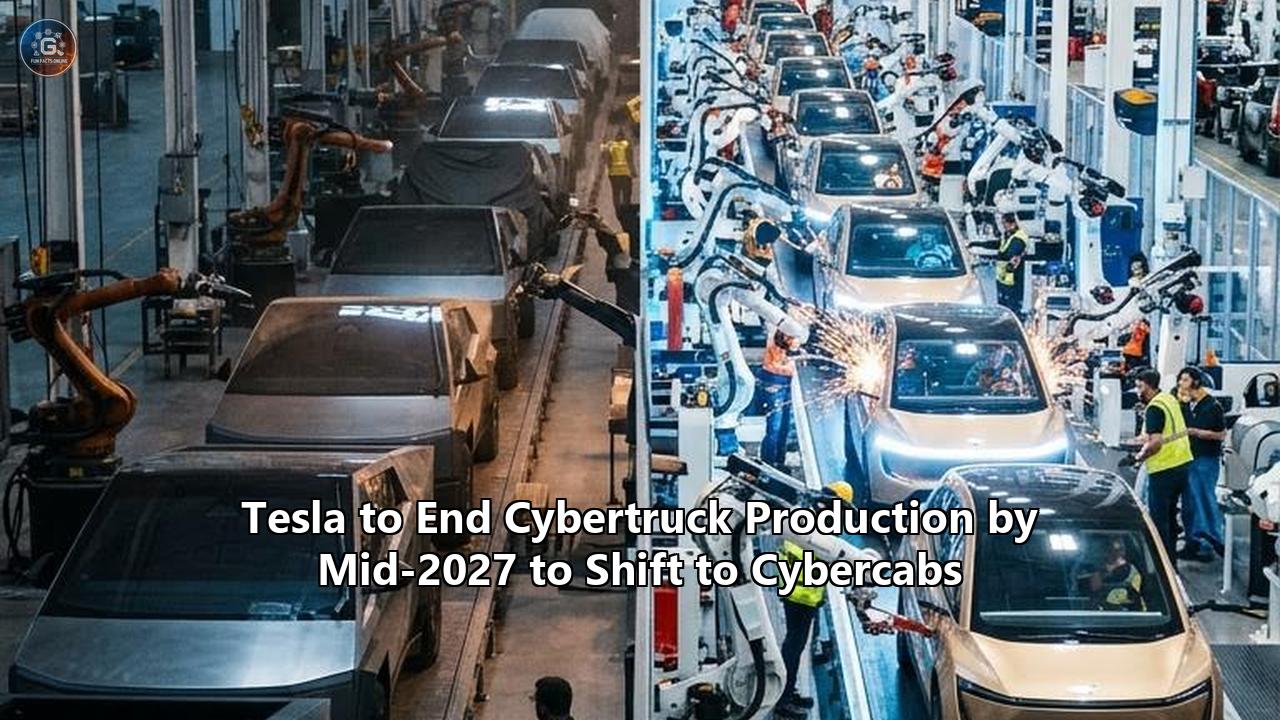
A quiet shift inside Gigafactory Texas reached its culmination on a Friday morning in November 2026, when Tesla chief executive Elon Musk published a succinct sentence on X: "Tesla will be winding down production of the Cybertruck at Gigafactory Texas around the middle of next year to make room for increased Cybercab production."
With that single dispatch, the curtain began to fall on the most polarizing automotive design in modern industrial history.
For months, assembly personnel in Austin had watched the signs multiply. Tooling fixtures sat idle between shortened shifts. Staging lots near the Colorado River filled with unallocated stainless-steel pickups. Capital spending was redirected toward autonomous mobility lines. Less than three years after the first hand-finished units rolled out to hand-picked celebrity buyers, Tesla confirmed what manufacturing analysts had suspected: the electric pickup truck that promised to redefine American utility will permanently clear the factory floor by mid-2027.
The announcement was accompanied by immediate operational moves. Minutes before Musk posted, Tesla quietly altered its online configurator, pausing new orders for its entry-level $82,490 Dual-Motor all-wheel-drive trim while raising the Premium AWD and tri-motor "Cyberbeast" prices to $92,490 and $102,490. The message to prospective buyers was clear: whatever remains of the production run will be sold at a premium to balance the vehicle’s high unit manufacturing costs.
Wall Street responded with relief. Tesla shares rose 4.7% following the announcement, reflecting an investor sentiment that had grown increasingly weary of the truck’s balance-sheet drag.
"The writing was on the wall," said Dan Ives, managing director at Yorkville Ives & Co. "Between the astronomical tooling expenses, severe margin compression, and niche demand that cratered past the early-adopter wave, continuing down this path was indefensible. The market does not want a four-ton titanium-blade polygon; it wants cheap, software-driven autonomous miles."
Behind the financial pivot lies a deeper story of engineering hubris, supply chain compromises, and an aggressive technological gamble. An examination of factory work schedules, confidential supplier communications, federal regulatory audits, and secondary market valuations reveals how Tesla’s grand pickup experiment collided with industrial realities, forcing the company to liquidate its pickup ambitions in order to salvage its autonomous future.
The 250,000-Unit Mirage
When Musk stepped onto an Austin stage in November 2023 to hand over the first ten commercial Cybertrucks, the projections were ambitious. Musk told shareholders that Tesla targeted a steady-state annual output of 250,000 units by 2025. Internal line capacities at Gigafactory Texas were engineered to handle upwards of 125,000 units across dual-shift schedules. Musk cited an internal reservation backlog exceeding one million refundable $100 deposits as proof that the pickup truck market was ready for an aesthetic shock.
The reality unfolded differently. According to registration data, NHTSA fleet filings, and automotive delivery estimates, Tesla never came close to running the Texas lines at half their rated speed.
In 2024, its first full calendar year on the market, Tesla delivered 38,965 Cybertrucks across the United States. That figure briefly made it the best-selling electric pickup in the country, surpassing Ford’s F-150 Lightning and Rivian’s R1T, but it represented a mere 15% of Tesla’s stated factory capacity. The following year brought a collapse in demand. In 2025, U.S. Cybertruck deliveries plunged 48% to 20,237 units.
By the third quarter of 2026, the velocity had slowed further. Kelley Blue Book estimates showed Tesla delivering just 4,323 Cybertrucks domestically during the quarter—a 19.7% decline from the same period in 2025. Through the first nine months of 2026, total domestic deliveries reached just 11,586 vehicles.
CYBERTRUCK U.S. DELIVERIES (ANNUAL TRAJECTORY)
2024: ████████████████████ 38,965 units
2025: ██████████ 20,237 units (-48.1%)
2026: █████ 11,586 units (Q1-Q3 annualized pace: ~15,400)
------------------------------------------------------
Target Capacity: 250,000 units/year
Cumulative Fleet to Date: ~70,800 units
Tesla’s financial reports offered clues about the program's struggles. Tesla reports delivery numbers by lumping lower-volume vehicles into an "Other Models" category. In April 2026, the company permanently ended Fremont assembly of its legacy flagship Model S sedan and Model X SUV, intending to focus its Northern California facility on high-volume Model 3 and Model Y architectures.
That left the "Other Models" line populated by three vehicles: the low-volume Tesla Semi, lingering legacy inventory, and the Cybertruck. In the third quarter of 2026, total deliveries across that entire category shrank to 8,295 units globally. Tesla’s electric pickup had not become a mass-market alternative to the Detroit Big Three; it was selling at the volume of a luxury specialty roadster.
"From a volume perspective, keeping those dedicated lines operational became impossible to justify," said Andy Palmer, former chief executive of Aston Martin and former chief operating officer of Nissan. Palmer, who oversaw the global launch of the Nissan Leaf, noted the structural economics of modern auto manufacturing: "A vehicle with bespoke sheet metal, dedicated stamping, unique high-voltage architectures, and distinct suspension links requires high asset utilization to amortize fixed capital expenditures. At 20,000 units a year, the line bleeds cash every hour it runs. Every rational auto executive would pull the plug".
Metallurgy and Miscalculation: The Stamping Hall Audit
The financial failure was tied directly to early manufacturing decisions. In 2019, Musk had made the deliberate decision to abandon conventional automotive body design. Instead of stamping exterior panels out of automotive-grade sheet aluminum or low-carbon steel, Tesla used an ultra-hard, 30X cold-rolled stainless steel.
Because the steel was too hard for conventional mechanical stamping presses to shape into compound curves without tearing the alloy or shattering the die faces, Tesla's engineers were forced to adopt an origami-like scoring and bending process. That single decision rippled through every square foot of the Austin facility.
"The fundamental error was treating a structural material choice as a marketing gimmick," said an ex-Tesla manufacturing engineer who worked on the body-in-white team at Giga Texas until late 2025 and spoke on the condition of anonymity. "Stainless steel does not have uniform grain structure when cold-rolled at that thickness. One coil would have an elastic limit varying 5% to 8% from the next. The air-bending brakes would punch an angle, and because the springback was unpredictable, one door panel would sit flush and the next would protrude six millimeters past the A-pillar."
The production floor inside the southern wing of Gigafactory Texas became a troubleshooting bottleneck:
- Hydraulic and Laser Scoring Bottlenecks: To bend the 1.8-millimeter-thick stainless steel, panels required partial laser etching or deep mechanical scoring along the bend lines. The cycle time for the laser tables was three times longer than traditional progressive stamping lines, creating constant bottlenecks that starved the assembly line downfield.
- Die Wear and Machine Stress: Even heavy tooling supplied by specialized Italian manufacturers degraded faster than anticipated. Tooling downtime exceeded internal targets by over 300% during the initial ramp, leading to scrap rates that neared 20% in mid-2024.
- The Giga Press Integration: Tesla deployed two massive 9,000-ton Giga Press high-pressure die-casting machines, designed by the IDRA Group, to cast the single-piece front and rear aluminum underbody assemblies. While the castings were structural triumphs, bonding the cast aluminum underbodies to the rigid stainless steel exterior created thermal expansion discrepancies. Aluminum expands nearly twice as fast as steel under ambient temperature fluctuations, forcing engineers to use structural adhesives and rubberized fasteners that added manufacturing complexity.
Musk had foreshadowed this vulnerability during an October 2023 earnings call when he stated bluntly: "We dug our own grave with Cybertruck. It is one of those special products that comes along only once in a long while. And special products that come along once in a long while are just incredibly difficult to bring to market, to reach volume, to be cash-flow positive."
By late 2025, internal audits showed that the cost of goods sold per vehicle remained significantly higher than planned. While a Model Y could clear the final assembly line in under 10 hours, a single Cybertruck tied up assembly floor stations for nearly three times that duration. Tesla had succeeded in engineering a technical showcase, but it had built a platform that resisted rapid, cost-effective scaling.
The 11-Recall Spiral and Global Dead-Ends
As factory engineers fought assembly variances, field performance issues added further strain. Over a 32-month operational window, the National Highway Traffic Safety Administration (NHTSA) published 11 separate safety recalls covering the vehicle.
Some issues were remedied via over-the-air software patches, but several involved physical assembly breakdowns that damaged the model's reliability reputation:
- Accelerator Pedal Pad Detachment (April 2024): Unapproved assembly lubricants used on the pedal assembly allowed the slip-on pad to dislodge and trap the accelerator pedal in the interior bulkhead under full throttle.
- Windshield Wiper Motor Failure (June 2024): The vehicle's 48-volt front windshield wiper motor—the largest single-blade motor in passenger vehicle production—succumbed to electrical gate failure caused by current overloads during heavy rainstorms.
- A-Pillar and Bed Sail Applique Separation (June 2024): Cosmetic and aerodynamic exterior composite trim panels, secured by structural double-sided adhesive tape, repeatedly sheared off at highway speeds due to wind turbulence.
- Instrument Cluster and Rearview Camera Boot Delays (September 2024): Electronic processing delays prevented the central infotainment display from projecting the backup camera feed within the federally mandated two-second window upon shifting into reverse.
- Drive Inverter Component Failure (October 2025): MOSFET semiconductor gate arrays within the rear drive unit suffered dielectric breakdown under high-load regenerative braking cycles, prompting a complete physical recall of 63,619 trucks—a filing that inadvertently revealed the total operational size of the U.S. fleet.
The vehicle faced even more formidable barriers beyond the United States. In Europe, vehicle safety standards established by the United Nations Economic Commission for Europe (UNECE)—specifically Regulation No. 127 regarding pedestrian head and leg protection—made the truck illegal to sell without a complete front-end redesign. The truck’s rigid stainless steel nose and front fender creases offered no pedestrian impact crumple zones, while its sharp 90-degree edges violated external projection rules (ECE Regulation No. 26).
Efforts to adapt the truck for China encountered similar regulatory pushback. Ministry of Industry and Information Technology (MIIT) vehicle certification standards required exterior safety adaptations that would have forced Tesla to stamp conventional rounded body panels over the exoskeleton, eliminating the truck's signature aesthetic.
Confined almost entirely to the North American market, the vehicle’s addressable audience hit a demographic ceiling. While the Ford F-Series sells roughly 700,000 units annually across suburban, agricultural, and commercial enterprise sectors, the Cybertruck's high curb weight, limited bed length, and controversial design alienated traditional fleet managers, construction contractors, and municipal buyers.
The Secondary Market Collapse
Nowhere was the declining demand clearer than on the secondary vehicle market.
During the first half of 2024, early-delivery Foundation Series models commanded secondary auction prices of $150,000 to $210,000. Early adopters and corporate influencers paid substantial markups, prompting Tesla to temporarily enforce a purchase agreement clause threatening buyers with a $50,000 penalty if they resold their vehicle within the first 12 months.
By the beginning of 2026, that artificial scarcity had evaporated. Manheim auction data and vehicle listing aggregates showed secondary prices entering a sharp correction.
CYBERTRUCK AVERAGE SECONDARY SALE VALUE
March 2024:    $178,500 (150%+ of original MSRP)
November 2024: $104,200 (Parity with Foundation MSRP)
June 2025:     $79,800  (First discounts below standard MSRP)
January 2026:  $67,400  (Accelerating drop across high-mileage units)
October 2026:  $56,900  (44% depreciation off standard entry price)
The steep depreciation created a cascade of trade-in rejections across major dealership networks. Independent used-car retailers began blacklisting the pickup from inventory floors, citing high financing rates, volatile wholesale valuations, and severe insurance premiums.
Underwriters, including State Farm and GEICO, categorized the vehicle in high-risk insurance tiers due to high collision repair bills. Repairing cosmetic side damage on a Cybertruck often required cutting and re-welding entire quarter-panel assemblies rather than performing traditional body filler and paint operations.
The vehicle also faced an unusual headwind: cultural and political polarization. As Musk took on an increasingly visible political profile throughout 2024 and 2025, the vehicle transformed from a high-tech status symbol into an overt political statement.
Automotive market consultancies documented widespread buyer fatigue among early-adopting suburban coastal consumers—previously Tesla's primary demographic base—who increasingly migrated toward less politically charged electric alternatives such as the Porsche Taycan, Cadillac Lyriq, or Rivian R1T.
Austin Retooled: Clearing the Bay for the Cybercab
The decision to end production was ultimately driven by competition for physical floor space inside Gigafactory Texas.
Tesla’s Austin facility is one of the largest single industrial structures in the world, enclosing over 10 million square feet of factory floor space. Yet despite its size, the facility has hit capacity constraints. The plant houses manufacturing cells for the Model Y, runs the pilot battery lines for the 4680 dry-electrode cell, hosts the central casting operations, and supports the initial fabrication runs for the Tesla Semi.
To fulfill Musk’s commitment to deploy dedicated autonomous vehicles at commercial scale, Tesla needed an extensive manufacturing bay. It chose to take that space directly from the Cybertruck.
GIGAFACTORY TEXAS FLOOR SPACE REALLOCATION (ESTIMATED METRICS)

[========================================================================]
[  Model Y Assembly & Paint   ][    Battery Cells & Casting    ][ Cybercab ]
[  (~42% Floor Space)         ][    (~33% Floor Space)         ][  (25%)   ]
[========================================================================]
                                                                     ▲
                                 [ Formerly Cybertruck Lines ] ──────┘
                                 (Transition Window: Q4 2026 - Q2 2027)
The Cybercab, introduced in late 2024 as a low-slung, two-seat autonomous vehicle devoid of a steering wheel, pedals, or rear window, demands a different assembly footprint.
Unlike the Cybertruck, the Cybercab is engineered for Tesla’s "unboxed" manufacturing methodology. In this modular assembly system, distinct sub-assemblies—the structural seats and floorboards, the drive modules, and the exterior body components—are painted and assembled simultaneously at independent sub-stations before joining in a single, final docking maneuver.
Winding down Tesla Cybertruck production frees up an estimated 2.2 million square feet of climate-controlled manufacturing space at Gigafactory Texas. The heavy gantry cranes, high-amperage 800-volt high-voltage pack staging areas, and custom hydraulic press lines currently assigned to the pickup will be stripped, decommissioned, or modified to support high-speed robotic Cybercab cells.
Cybercab pilot builds began in Austin in April 2026, and in September 2026, Tesla initiated limited geofenced commercial rides within select corridors of Austin. Tesla plans to ramp up Cybercab manufacturing to hundreds of thousands of units per year—a target that requires dedicating the full capacity of the Texas plant to the robotaxi platform.
Yet the pivot is not without major obstacles. While clearing the floor eliminates one manufacturing problem, the Cybercab faces a steep regulatory battle.
In September 2026, NHTSA opened a special regulatory audit into Tesla’s driverless certification process. Under Title 49 of the United States Code (Section 30115), automakers self-certify that their products meet Federal Motor Vehicle Safety Standards (FMVSS). But because the Cybercab lacks manual controls—no steering column, no mechanical braking linkages, and no interior rearview mirrors—it falls outside the scope of current FMVSS rules.
Tesla must either secure an exemption from NHTSA under 49 CFR Part 555 (which caps production at 2,500 exempt vehicles per manufacturer per year) or prove that its camera-only Full Self-Driving (FSD) architecture achieves an equivalent level of safety without human intervention. Reallocating the Cybertruck's factory space gives Tesla the hardware capacity to build the Cybercab, but whether those vehicles will be legally permitted to operate across public roadways without a driver remains uncertain.
The Technology Testbed: An Autopsy of Ambition
While the Cybertruck's commercial run is coming to an end, the truck left behind an influential engineering legacy. The effort spent designing the pickup was not a total write-off for Tesla's broader engineering pipeline.
Cybertruck lead engineer Wes Morrill acknowledged the decision on X shortly after Musk's confirmation: "Cybertruck was an incredible technology development platform and lives on through Cybercab. Thanks to everyone who contributed to making the future looking like the future".
Morrill’s appraisal highlights a central reality: the truck functioned as an expensive rolling laboratory for technologies that have since migrated to the rest of Tesla's fleet.
The 48-Volt Architecture
For over a century, automotive low-voltage electronics relied on a 12-volt direct-current standard. As modern vehicles added auxiliary computing nodes, high-torque steering actuators, and sensor arrays, 12-volt wiring harnesses grew excessively heavy and thick.
With the Cybertruck, Tesla became the first major automaker to adopt a complete 48-volt low-voltage electrical distribution system. Quadrupling the voltage reduced the necessary electrical current by 75%, allowing Tesla to replace thick copper wire bundles with thin, lightweight ribbon conduits.
Tesla even sent a 48-volt system engineering schematic to the CEOs of competing automakers, a move publicly confirmed by Ford CEO Jim Farley. That exact 48-volt harness and controller network has been adapted for use in the Cybercab and the refreshed Model Y architectures.
ELECTRICAL WIRING WEIGHT REDUCTION (48V VS. 12V HARNESS)
Conventional 12V Harness: █████████████████████████ 110 lbs (Approx. Average)
Cybertruck 48V Harness:   █████████ 38 lbs (-65% Mass Reduction)
Steer-by-Wire
The Cybertruck was the first mass-market vehicle to replace the physical steering shaft with a software-driven, steer-by-wire system. Mechanical steering linkages were replaced with twin redundant electric motors mounted directly to the steering rack, paired with variable steering ratio algorithms. At slow parking speeds, a 180-degree turn of the wheel fully locked the wheels; at high highway speeds, the rack automatically dialed back sensitivity to preserve vehicle stability.
This steer-by-wire actuator system served as the proving ground for the Cybercab, which relies entirely on dual-redundant electromechanical steering actuators controlled directly by its central Full Self-Driving computer.
800-Volt Powertrain and Structural Cells
The truck marked Tesla’s first implementation of an 800-volt high-voltage architecture, cutting direct-current fast-charging times at V4 Superchargers and minimizing thermal throttling under heavy acceleration. Furthermore, the structural integration of the second-generation 4680 dry-coated cylindrical battery cells—where the pack housing functions as the floor of the passenger cabin—provided structural rigidity data that shaped the unboxed frame of the Cybercab.
The engineering lessons were real, but they came at an extraordinary financial cost. Industry teardown specialists from Munro & Associates estimated that Tesla invested over $4.5 billion in custom capital expenditures, tooling development, assembly line robotics, and engineering hours to launch and sustain the model. Over a lifetime production run that is projected to conclude around 85,000 to 90,000 units by mid-2027, the capital expenditure amortization per vehicle stands among the highest in modern automotive manufacturing history.
What Happens to Owners and Outstanding Orders?
The mid-2027 end of Tesla Cybertruck production creates complex operational questions for current owners and remaining reservation holders.
Morrill took to social media following Musk’s announcement to reassure existing customers that the company will maintain dedicated spare parts lines and ongoing warranty support. Automotive consumer protection regulations, including the Magnuson-Moss Warranty Act, mandate that manufacturers maintain parts availability for vehicles under warranty coverage—which for the Cybertruck extends to eight years or 150,000 miles for the battery and drive units.
Yet, several practical issues remain unresolved:
- Collision Repair Delays: Owners already face weeks-long repair backlogs due to a shortage of certified body shops equipped to work on cold-rolled stainless steel. As the production line winds down, suppliers of structural exterior stampings will transition away from active stamping runs to low-volume service batch operations, which often results in extended lead times for replacement panels.
- The Residual Value Trap: For current owners who financed their purchases during the 2024 peak, the early phaseout is expected to accelerate depreciation. With the vehicle formally transitioning to an orphaned model status by mid-2027, loan-to-value ratios will continue to compress, leaving secondary market owners with negative equity.
- The Reservation Queue: Tesla has never disclosed the exact number of active reservation deposits remaining on its books, but estimates suggest hundreds of thousands of reservation holders declined to convert their $100 deposits into binding purchase orders once base pricing rose from the original $39,900 promise to more than $80,000. Musk’s announcement did not specify a deadline for refund processing, but the suspension of the entry-level Dual-Motor configuration effectively signals that lower-priced trims will never be built.
CYBERTRUCK: THE GAP BETWEEN PROMISE AND EXECUTION
Metric              2019 Unveiling Target      Actual Production Reality
-------------------------------------------------------------------------
Base Starting Price: $39,900                    $82,490 (Suspended Nov 2026)
Max Driving Range:   500+ miles                 325 miles (Tri-Motor)
Towing Capacity:     14,000 lbs                 11,000 lbs
Annual Target:       250,000 units              Peak 38,965 units (2024)
Lifespan:            Core Vehicle Portfolio     Phased out after ~3.5 years
Tesla’s vehicle portfolio has transformed dramatically over the past year. By sunsetting the Model S and Model X in Fremont and winding down the pickup in Texas, the company has narrowed its consumer passenger lineup to just two primary retail vehicles: the Model 3 and Model Y. The remaining manufacturing footprint is being reserved for commercial assets: the heavy-duty Tesla Semi, the stationary energy Megapack systems, and the Cybercab fleet.
The Strategic Bet: Robotaxis Over Steel
The wind-down of the electric pickup marks a fundamental turning point in Tesla's corporate identity. For fifteen years, the company operated as an aggressive, iconoclastic automobile manufacturer, setting out to prove that electric vehicles could outperform, out-accelerate, and out-sell internal-combustion counterparts across consumer segments: sports cars, sedans, luxury SUVs, and commercial pickups.
With the mid-2027 sunset of the pickup line, Tesla has formally stepped away from the full-line manufacturing model pursued by traditional automakers like Toyota, General Motors, and Ford. The company will not build an electric heavy-duty work truck, nor will it contest the sprawling consumer truck market that generates tens of billions in annual profits for Detroit.
Instead, Tesla has staked its capital, manufacturing floor space, and market valuation on a radically different proposition: that private automobile ownership will soon be eclipsed by centralized, camera-vision-guided autonomous robotaxi fleets.
The risks of this transition are substantial:
- The Regulatory Bottleneck: If NHTSA rejects Tesla’s driverless self-certification, or if state-level departments of motor vehicles demand expensive sensor redundancies like LiDAR or radar, Tesla will be left with high-volume assembly lines producing vehicles that cannot legally operate on public roads.
- The Vision-Only Software Question: Full Self-Driving continues to rely exclusively on optical camera inputs and neural networks. While edge-case performance has improved, independent safety researchers maintain that level-4 and level-5 autonomous driving cannot achieve commercial safety parity with humans without multi-modal sensor fusion in extreme weather conditions such as dense fog, blinding snow, or heavy rain.
- The Revenue Void: The pickup program, despite its compressed margins, generated upwards of $4 billion in gross vehicle revenues over its operational lifespan. Phasing it out leaves Tesla entirely dependent on the Model 3 and Model Y to sustain automotive revenues while the Cybercab scales toward commercial viability.
In the southern wing of Gigafactory Texas, the transition has already begun. Technicians and industrial tooling contractors have started mapping out the floor reallocations. Over the next 18 months, the heavy hydraulic bending brakes and the specialized stainless-steel assembly jigs will complete their remaining shifts.
By mid-2027, the sparks will fade from the cold-rolled steel lines. In their place, robotic unboxed assembly modules will turn out thousands of compact, driverless pods designed for a world where people no longer drive themselves—a gamble that will either cement Musk’s reputation as an autonomous mobility pioneer, or expose the limits of what software can achieve in a world built on steel.
Reference:
- https://paultan.org/2026/11/06/tesla-cybertruck-production-wind-down-mid-2027-cybercab/
- https://www.automotivemanufacturingsolutions.com/news/tesla-sidelines-cybertruck-as-cybercab-takes-centre-stage/2763746
- https://www.cbsnews.com/news/tesla-ending-cybertruck-production-next-year/
- https://evwire.com/p/tesla-cybertruck-production-ends-mid-2027
- https://timesofindia.indiatimes.com/technology/tech-news/elon-musk-says-tesla-will-wind-down-cybertruck-production-at-its-texas-factory-by-mid-2027-making-room-for-the-driverless-cybercab-after-years-of-recalls-price-changes-and-weaker-than-expected-demand/articleshow/135610919.cms
- https://www.teslarati.com/tesla-is-ending-cybertruck-production/
- https://www.notebookcheck.net/Tesla-to-wind-down-Cybertruck-production-in-2027-to-make-room-for-Cybercab.1443927.0.html