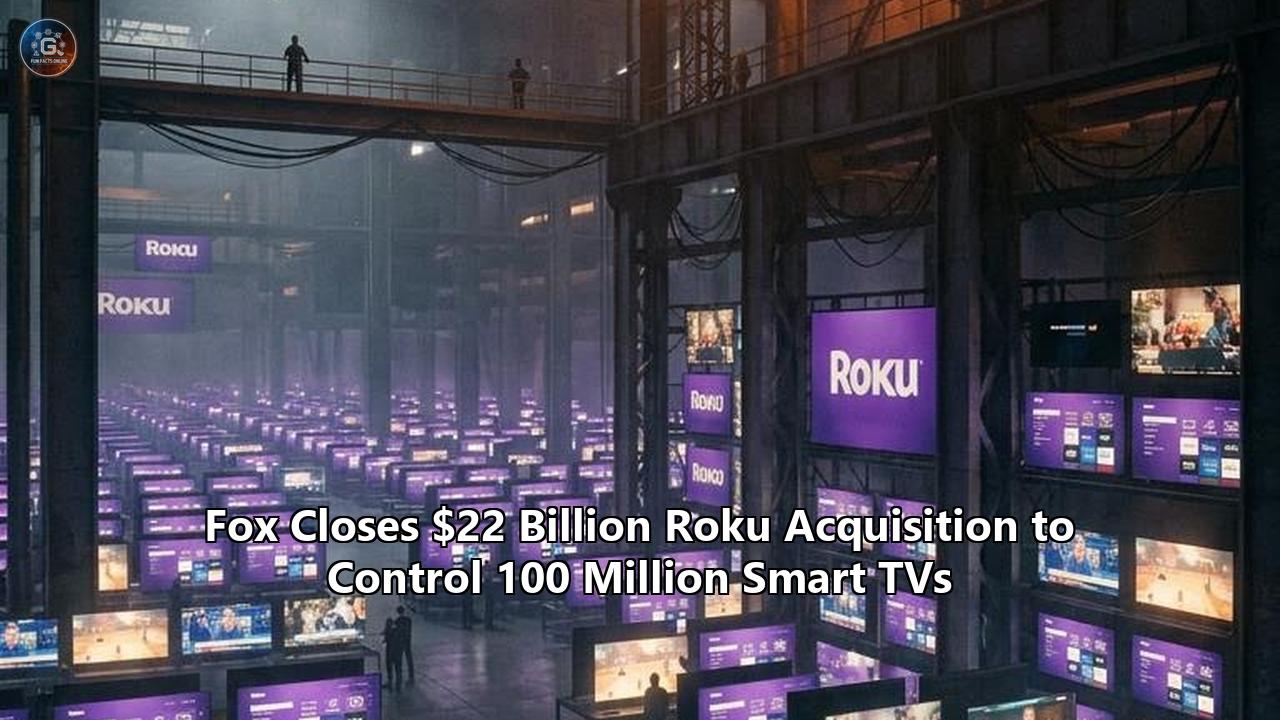
Fox Corporation has officially finalized its $22 billion acquisition of Roku, abruptly concluding one of the largest media-technology consolidations of the decade months ahead of schedule. The transaction, completed on November 6, 2026, transfers the world’s leading independent connected-television operating system—commanding an active footprint of more than 100 million smart TV households—directly into the Murdoch media empire.
Trading in Roku common stock ($ROKU) was permanently halted on the Nasdaq exchange as the closing documents were executed. Under the finalized terms of the cash-and-stock merger, Roku shareholders receive $95.30 in cash alongside 0.9799 shares of Fox Class A common stock for each share owned. The ownership structure leaves legacy Fox shareholders controlling approximately 74% of the combined entity, while former Roku investors hold the remaining 26%.
The completion blindsided Wall Street observers who had prepared for an extended antitrust review extending well into the first half of 2027. Instead, a swift regulatory resolution with the U.S. Department of Justice cleared the final hurdle, enabling Fox to integrate Roku’s hardware, software, and advertising apparatus into a newly christened corporate division: Fox Digital Platforms.
“The closing of this acquisition advances the long-term strategy of Fox,” said Lachlan Murdoch, executive chair and chief executive officer of Fox Corporation, in a statement announcing the close. “Beginning today, our top priority for the combined company is to continue to relentlessly serve audiences and partners, while reinforcing the openness and choice that is the essence of the Roku platform. Our shared entrepreneurial passion and clear conviction toward building the future together with our new Roku colleagues gives us great confidence in the opportunities ahead of us”.
Roku founder Anthony Wood, who transitions into a seat on the Fox Corporation board of directors and becomes co-chair of Fox Digital Platforms, framed the sale as an evolutionary necessity in an ecosystem increasingly dominated by trillion-dollar technology conglomerates.
“We started Roku more than two decades ago to give people a better way to watch TV, and that mission doesn’t change today,” Wood stated. “What does change is our reach and resources”.
The closing ends Roku’s nine-year run as an independent, publicly traded entity and creates the third-largest television business in the United States by total share of viewing, trailing only YouTube and Walt Disney. By bringing together the broadcast power of the Fox network, Fox Sports, and Fox News with the hardware scale of Roku OS, the free-streaming dominance of Tubi, and The Roku Channel, the transaction establishes a distribution pipeline that bypasses traditional cable and satellite intermediaries.
2019–2023: The Divergent Roads to Convergence
To understand how a legacy broadcast network engineered a takeover of Silicon Valley’s premier television operating system, the timeline traces back to the radical restructuring of both companies between 2019 and 2023.
In March 2019, Rupert Murdoch and his son Lachlan executed the historic $71.3 billion sale of 21st Century Fox’s film and television entertainment assets to The Walt Disney Company. The divestiture offloaded the 20th Century Fox film studio, FX Networks, National Geographic, and Fox’s stake in Hulu. Wall Street largely viewed the remaining entity—reconstituted as Fox Corporation—as an unbundled, defensive holdout. It was built around three traditional linear cash cows:
- The Fox broadcast network
- Fox News Media
- Fox Sports (including multi-billion-dollar packages for the NFL, MLB, and college football)
While competitors like Disney, Warner Bros. Discovery, and Paramount spent tens of billions of dollars chasing subscription video-on-demand (SVOD) subscribers—burning cash to launch Disney+, Max, and Paramount+—Fox pursued a deliberate counter-strategy. In March 2020, Fox spent an unassuming $440 million to purchase Tubi, an ad-supported streaming television (FAST) platform. At the time, media analysts questioned whether an unscripted, ad-supported catalog could survive alongside premium subscription giants.
Meanwhile, 3,000 miles away in San Jose, Roku was charting its own path. Originating inside Netflix in 2007 as “Project Griffin”—an internal hardware player designed to beam Netflix’s fledgling digital library to living room sets—Roku was spun out by founder Anthony Wood in 2008 when Netflix CEO Reed Hastings feared dedicated hardware would antagonize third-party consumer electronics partners.
Over the subsequent decade, Roku outmaneuvered consumer hardware giants like Sony, Samsung, and Apple by offering a low-cost, neutral platform. Wood realized early that manufacturing streaming pucks and HDMI sticks was an unprofitable race to the bottom. Instead, Roku developed its proprietary operating system, Roku OS, and began licensing it to budget television manufacturers such as TCL, Hisense, and Sharp. By 2021, Roku OS powered more than one in three smart TVs sold in the United States.
Yet Roku’s business model harbored a structural vulnerability. While the company categorized its financial results into "Devices" and "Platform," the Devices segment routinely operated at negative gross margins. Roku treated hardware as a subsidized customer-acquisition vehicle to drive its Platform division. Platform revenue derived from three primary streams:
- Selling home-screen display advertisements and branded remote-control buttons
- Taking a 30% cut of subscription fees generated through its platform
- Extracting roughly 30% of the digital video ad inventory run by third-party streaming apps on Roku devices
When the connected-TV (CTV) advertising market hit macro headwinds throughout 2022 and 2023, Roku’s valuation plummeted from pandemic highs of more than $60 billion down to single-digit billions. Although Roku continued adding active accounts, it faced a dual squeeze: escalating hardware production costs and aggressive platform encroachment from Amazon’s Fire TV, Google TV, Apple TV, and proprietary smart TV software developed by Samsung (Tizen) and LG (webOS).
Roku possessed the distribution pipeline but lacked deep pools of proprietary, appointment-viewing content. Fox possessed premier live programming and a booming digital service in Tubi, but remained dependent on third-party distribution pipes that were slowly suffocating linear television.
2024–2025: The Cord-Cutting Cliff and the FAST Explosion
The escalation toward the merger gained momentum as structural shifts in television consumption accelerated across 2024 and 2025.
Traditional multichannel video programming distributors (MVPDs)—the cable and satellite providers that had supplied Fox with steady carriage and retransmission fees for three decades—saw cord-cutting rates exceed 8% annually. Pay-TV household penetration in the United States dropped beneath the critical 50% threshold. For Fox, the arithmetic of linear television was deteriorating. Retransmission consent revenue, long regarded as a guaranteed hedge against cyclical advertising slowdowns, reached an inflection point as subscriber churn began to outpace per-subscriber carriage fee hikes.
Concurrently, the SVOD business model hit a wall. Consumers, battered by cumulative price increases across Netflix, Disney+, and Warner Bros. Discovery, began canceling paid subscriptions at record rates. In response, audiences migrated en masse to free ad-supported streaming television.
Fox’s early wager on Tubi paid off ahead of expectations. In 2025, Tubi officially posted its first full year of operating profitability, capturing nearly 2% of total U.S. television viewing time according to Nielsen’s "The Gauge" metrics. Tubi outpaced premium paid services like Max and Peacock in regular viewership, proving to Lachlan Murdoch that ad-supported digital models offered far greater margin stability than capital-intensive subscription services.
Yet Tubi’s growth was bounded by platform gatekeepers. For every dollar of advertising Tubi generated on a smart TV, platform operators demanded a revenue cut, direct data access, or preferred ad inventory splits.
Roku, meanwhile, achieved operational stabilization but faced an increasingly hostile competitive perimeter. In early 2025, Roku passed 90 million active households and continued to expand The Roku Channel—its owned-and-operated FAST destination. Yet Roku found itself competing directly for ad dollars against the very media companies whose applications it hosted.
Tech giants were weaponizing their corporate balance sheets. Amazon began baking Fire TV software directly into mass-market displays, while Google made aggressive distribution agreements with global television manufacturers to install Google TV. Roku could no longer rely solely on neutral software licensing to retain market leadership; it required guaranteed, marquee programming—specifically live news and high-profile sports telecasts—to keep its 100-million-household base anchored to Roku OS.
Chronology of the Deal: From Whisper to Closing Bell
| Date | Milestone | Significance |
|---|---|---|
| April 2026 | Roku Surpasses 100 Million Households | Roku’s Platform revenue surges 28% year-over-year in Q1, highlighting massive consumer scale despite hardware margin pressure. |
| June 14–15, 2026 | Merger Agreement Signed & Publicly Announced | Fox agrees to acquire Roku for $160 per share in cash and stock, an enterprise value of approximately $22 billion; Morgan Stanley commits $12B bridge loan. |
| July 2026 | Initial HSR Filings & Competitor Protests | Rivals in streaming and news distribution warn regulators of potential self-preferencing and gatekeeping risks on the Roku home screen. |
| September 8, 2026 | DOJ Issues Formal Second Request | U.S. antitrust regulators extend the waiting period, demanding internal documents, data on CTV ad auctions, and home-screen algorithms. |
| October 14, 2026 | Shareholders Overwhelmingly Approve Deal | Fox and Roku stockholders vote in favor of the merger; Anthony Wood’s majority voting power formally binds Roku to the acquisition. |
| November 2, 2026 | Foreign Regulatory Clearances Finalized | Fox discloses all required international competition approvals have cleared, leaving the DOJ as the final hurdle. |
| November 3–5, 2026 | DOJ Approves Consent Decree Framework | Regulators drop plans for an injunction following Fox's legally binding three-year open-platform commitments; arbitrage spread narrows sharply. |
| November 6, 2026 | Transaction Officially Closes | Fox completes the $22 billion acquisition; $ROKU halts Nasdaq trading; Fox Digital Platforms division is formally constituted. |
January – May 2026: Secret Overtures in Sun Valley and Silicon Valley
The early discussions that laid the groundwork for the Fox Roku acquisition began in high secrecy in early 2026. Lachlan Murdoch tasked Fox’s chief strategy officers, alongside investment bankers at Allen & Company and Morgan Stanley, with identifying transformational digital assets that could insulate Fox from the terminal decline of linear television without saddling the balance sheet with unmanageable subscription-content costs.
Roku stood alone as an acquisition target. It possessed the largest dedicated TV operating system in North America, maintained an installed base traversing 100 million active households, and had built an advanced programmatic advertising infrastructure via the Roku Ad Platform. Furthermore, Roku’s enterprise value had stabilized within a digestible range for Fox’s balance sheet.
Anthony Wood had spent decades guarding Roku’s corporate independence, routinely turning down acquisition inquiries from legacy media firms and Silicon Valley peers. However, by spring 2026, Wood faced a changing competitive landscape. Streaming service consolidation meant fewer platform clients were spending marketing dollars on customer acquisition, and major players like Amazon were bundling CTV ad inventory with retail retail media data.
Direct negotiations commenced in March 2026. Lachlan Murdoch and Anthony Wood held a series of private meetings in San Jose and Los Angeles. Murdoch presented a pitch: Fox would not absorb Roku into a traditional studio hierarchy or compromise the operating system’s open architecture. Instead, Fox proposed creating an autonomous division, Fox Digital Platforms, co-chaired by Wood and Tubi Media Group CEO Paul Cheesbrough.
Financially, Fox offered a substantial premium backed by cash reserves and a massive committed debt facility, while offering Wood an influential governance seat on Fox’s board of directors. For Wood, who controlled a commanding percentage of Roku’s Class B super-voting shares, the proposal offered an exit valuation that protected his operational control over the operating system while pairing Roku’s hardware network with Fox’s live sports and news machinery.
June 15, 2026: The $22 Billion Agreement Revealed
On the morning of Monday, June 15, 2026, Fox Corporation and Roku, Inc. issued a joint press release announcing they had entered into a definitive merger agreement. Fox agreed to acquire Roku in a cash-and-stock transaction valued at $160.00 per share, representing an enterprise value of approximately $22 billion.
Under the headline terms unveiled that morning:
- Roku stockholders were slated to receive $96.00 in cash and 0.9693 shares of Fox Class A common stock for each share owned.
- The equity consideration was pegged to Fox Class A stock's 10-day volume-weighted average price of $66.03 as of June 10, 2026.
- Fox secured $12.0 billion in fully committed bridge financing through Morgan Stanley Senior Funding, Inc. to bankroll the cash component.
- Pro forma net leverage at closing was projected at approximately 2.8x trailing EBITDA, including credit for targeted cost savings.
- Fox identified $400 million in annualized run-rate cost synergies within two years of closing.
The combined company’s pro forma metrics rattled the media and tech establishments. Together, Fox and Roku controlled:
- Over 100 million connected-TV households globally
- The second- and third-largest free ad-supported streaming services in the United States (Tubi and The Roku Channel), which together represented nearly 5% of total American TV viewing
- A continuous pipeline of live broadcast events spanning the NFL, Major League Baseball, NASCAR, FIFA World Cup, and Fox News Channel
Lachlan Murdoch hailed the transaction as a defining event in Fox's history, noting that the merger positioned Fox across every critical component of the video ecosystem: live production, broadcast distribution, streaming content, and physical device interfaces.
The market’s initial reaction reflected both astonishment and caution. Fox shares dipped 4% on concerns over the $12 billion debt load, while Roku shares surged 18% toward $145—remaining somewhat below the $160 headline price due to anticipated antitrust scrutiny.
July – September 2026: The Antitrust Crucible and Political Friction
The regulatory escalation began almost immediately. Unlike horizontal media mergers—such as Disney’s purchase of Fox's entertainment assets or Skydance’s acquisition of Paramount—the Fox Roku acquisition presented a massive vertical consolidation. It fused a major owner of content with the underlying digital gatekeeper controlling the discovery, placement, and delivery of that content.
In late July, rival media companies, independent streaming networks, and digital advertising trade groups began private lobbying efforts in Washington. The core antitrust objections focused on three leverage points:
- Self-Preferencing on the Home Screen: Roku’s home-screen interface is prime digital real estate. Competitors alleged that Fox would systematically privilege Fox Sports, Fox News, Fox One, and Tubi over competing services like Netflix, Peacock, Max, and independent FAST apps.
- Ad-Tech Foreclosure and Data Asymmetry: Roku’s Automatic Content Recognition (ACR) technology tracks viewing behavior on the glass across millions of smart TVs, regardless of input or application. Rivals argued Fox could use ACR data to undercut competing networks in CTV programmatic advertising markets while hoarding valuable consumer behavioral insights.
- Retaliatory Carriage Negotiations: Broadcasters worried Fox would tie carriage of the Fox network or Fox News to preferential distribution terms for Roku devices, or conversely, demand exorbitant ad-inventory splits from rival networks to remain accessible on the Roku Channel Store.
On September 8, 2026, the Department of Justice formally escalated its review by issuing a "Second Request" under the Hart-Scott-Rodino (HSR) Antitrust Improvements Act. The Second Request extended the statutory waiting period and required Fox and Roku to turn over millions of pages of internal emails, strategic decks, and algorithmic code governing Roku's search and recommendation engines.
The review took an unpredictable political turn later that month. Chris Ruddy, CEO and majority owner of the conservative cable news network Newsmax, mounted a public campaign urging the Trump administration’s Justice Department to block the deal. Ruddy, who had engaged in long-running distribution disputes with Fox, publicly argued that handing the Murdoch family control of the nation’s dominant television operating system threatened viewpoint diversity and risked marginalizing independent conservative networks.
Associate Attorney General Stanley Woodward oversaw the DOJ’s review, maintaining that the antitrust division remained strictly focused on whether the combination harmed consumer pricing, video discovery, and programmatic advertising competition.
During late September, arbitrage spreads widened. Roku common stock drifted downward to the $130 range as traders hedged against the possibility of a DOJ lawsuit to block the merger, with Fox facing a potential $1.2 billion reverse termination fee if the transaction collapsed under regulatory pressure.
October – Early November 2026: The Regulatory Breakthrough
The logjam broke with unexpected velocity across October and early November.
On October 14, 2026, shareholders of both companies officially convened. At Fox headquarters in New York and Roku’s campus in San Jose, the merger received overwhelming backing. Wood’s voting control ensured Roku’s approval crossed the finish line without activist investor dissent.
Concurrently, Roku delivered a third-quarter earnings report that illustrated the financial health of the platform Fox was inheriting. Roku posted revenue of $1.502 billion for the September quarter—beating consensus estimates by $90 million—while generating $164 million in operating income and $727 million in digital advertising revenue. The platform segment continued expanding at a 23% pace, demonstrating that the consumer shift toward connected TV advertising remained structurally sound.
Roku Financial Escalation Leading into Acquisition Close:
----------------------------------------------------------------------
Quarter        Revenue        Operating Income       Platform Ad Growth
Q3 2025        $1,211M             $9M                    +14%
Q4 2025        $1,395M            $66M                    +16%
Q1 2026        $1,249M            $52M                    +19%
Q2 2026        $1,355M           $146M                    +21%
Q3 2026        $1,502M           $164M                    +23%
----------------------------------------------------------------------
*Source: SEC Filings & MLQ Financial Database
Behind the scenes at the Department of Justice, Fox’s legal team, directed by veteran regulatory counsel, recognized that the government was prioritizing behavioral market protections over blocking vertical integrations.
Rather than engaging in a protracted courtroom trial, Fox offered a comprehensive package of legally binding behavioral commitments that addressed the core of the DOJ's antitrust concerns:
- Carriage Protections: Fox guaranteed that for a minimum of three years following closing, Roku will maintain distribution agreements for third-party streaming applications on terms non-discriminatory relative to market standards.
- Algorithmic Neutrality: Fox agreed not to manipulate Roku OS search results, voice command routing, or top-level recommendations to disadvantage competitor applications or favor Fox-owned assets.
- Consumer Interface Autonomy: Fox stipulated that Roku users will retain full autonomy to customize, organize, and prioritize application tiles on their home screens without forced default placement of Fox apps.
- Ad-Exchange Non-Exclusivity: Roku pledged to preserve open programmatic bidding protocols, preventing Fox from restricting ad buyers or inventory to Fox's proprietary ad tech stacks.
On November 2, 2026, Fox announced during its quarterly earnings call that it had obtained every required foreign regulatory clearance from European and Asian competition bodies. The next morning, November 3, trade publications reported that the DOJ had concluded its staff review and was preparing to clear the transaction under an enforceable consent agreement. The deal spread collapsed from $1.31 to $0.64 in hours as institutional capital recognized the merger was imminent.
On Friday morning, November 6, the Justice Department formally confirmed it had concluded its antitrust investigation, allowing the statutory waiting periods to lapse without filing an injunction. The path was cleared.
November 6, 2026: Closing the $22 Billion Buyout
By Friday afternoon, November 6, Fox Corporation filed formal notice with the SEC executing the merger agreement.
The finalized financial execution underwent slight mathematical adjustments from the original June figures to reflect exchange ratio formulas tied to Fox’s Class A share performance. Roku shareholders officially received $95.30 in cash and 0.9799 shares of Fox Class A common stock for each share of Roku Class A and Class B stock held.
Fox funded the multibillion-dollar cash consideration by tapping the investment-grade debt markets, locking in term loans and long-term notes that replaced its initial Morgan Stanley bridge financing while preserving Fox's investment-grade corporate credit rating.
Simultaneously, Fox announced the corporate architecture of its new operating umbrella: Fox Digital Platforms.
                          FOX CORPORATION
             (Lachlan Murdoch, Exec. Chair & CEO)
                                 │
     ┌───────────────────────────┴───────────────────────────┐
     ▼                                                       ▼
FOX LINEAR & SPORTS                              FOX DIGITAL PLATFORMS
• Fox Broadcast Network                          • Roku Operating System (100M+ TVs)
• Fox Sports / FS1 / FS2                         • The Roku Channel (FAST)
• Fox News Media                                 • Tubi (FAST)
• Fox Local Stations                             • FOX One (Subscription Streamer)
                                                 • Red Seat Ventures (Creator Network)

Co-Chairs: Anthony Wood & Paul Cheesbrough
Division CEO: Paul Cheesbrough
The division merges the operational scale of Roku with Fox’s digital portfolio. Anthony Wood was appointed co-chair of Fox Digital Platforms while taking a seat on the Fox Corporation board of directors. Paul Cheesbrough, the longtime technology executive who architected Tubi's technical operations and rapid expansion, steps in as co-chair and chief executive officer of Fox Digital Platforms, overseeing day-to-day integration and digital advertising execution.
The business includes:
- The Roku Platform: Operating system development, OEM TV licensing, streaming devices, and smart-home products.
- Tubi: Fox’s free, ad-supported streaming television service.
- The Roku Channel: Roku’s native FAST and AVOD content hub.
- FOX One: Fox’s centralized, authenticated direct-to-consumer digital subscription and live-streaming app.
- Red Seat Ventures: Fox’s creator-economy digital investment wing, supporting independent media properties including those founded by Megyn Kelly, Bari Weiss, and Tucker Carlson.
In an internal memo sent to combined staff on Friday afternoon, Paul Cheesbrough underscored the operational scope of the new business:
“Together we have premium live sports and news, a growing streaming portfolio, and a leading connected TV platform. More importantly, we have talented teams who know how to build, innovate, and deliver for viewers, partners, and advertisers. We have the content people want to watch and the screen they watch it on”.
The Strategic Architecture: Owning the Operating Glass
The closing of the Fox Roku acquisition addresses a longstanding structural puzzle in modern media: how does an independent entertainment and broadcast company survive when distribution platforms are owned by Big Tech?
By taking ownership of Roku, Fox transforms its operational profile from a pure-play content programmer into a dual-engine media and technology conglomerate.
1. The Consolidation of the FAST Marketplace
Before the merger, Tubi and The Roku Channel were bitter rivals, fighting for third-party licensed film catalogs, linear FAST channel distribution, and unscripted originals. Combined under Fox Digital Platforms, Fox controls the two dominant independent ad-supported streaming services in the United States, trailing only Google’s YouTube in total ad-supported viewing minutes.
This concentration gives Fox leverage during content-acquisition negotiations with major Hollywood studios. Warner Bros. Discovery, Lionsgate, Sony Pictures, and Paramount license vast libraries of catalog films and syndicated television series to Tubi and The Roku Channel. By negotiating as a unified buying bloc across both platforms, Fox can extract licensing terms and exclusivity windows while amortizing licensing fees across a combined audience representing tens of millions of daily active users.
2. Deterministic Data and the CTV Advertising Moat
The battle for digital advertising dollars is waged over targeting precision. Roku’s underlying operating system runs Automatic Content Recognition technology. ACR software fingerprints pixels directly on the glass, identifying precisely what content, commercials, or video games are being displayed on the screen in real-time, regardless of whether the video originates from an antenna, an HDMI cable box, an Xbox, or a streaming app.
For Fox, this deterministic first-party dataset is commercially transformative. When selling advertising inventory across the Fox broadcast network, Fox News, or FS1, Fox has historically relied on panel-based estimates from firms like Nielsen.
By integrating Roku’s direct, device-level telemetry across 100 million households, Fox can offer advertisers cross-screen attribution data:
- Fox can identify an audience member who watched a commercial during an NFL broadcast on the Fox network.
- Fox can retarget that exact household with a related interactive commercial on Tubi or The Roku Channel later that evening.
- Fox can close the measurement loop by confirming if the viewer subsequently engaged with an advertiser's interactive prompt directly via their Roku remote control.
3. Securing Distribution for Live Sports and News
Legacy media networks routinely face blackouts during contentious carriage disputes with pay-TV providers like Charter, Comcast, and DirecTV. While Fox News and Fox Sports remain must-have programming, their leverage over cable operators was slowly eroding as basic cable subscriber counts declined.
Owning Roku guarantees Fox perpetual, unfettered distribution inside 100 million households without paying intermediary platform fees or signing revenue-share splits with outside hardware gatekeepers. While Fox must maintain the open-platform conditions mandated by the DOJ consent decree, owning the underlying operating system ensures that Fox's direct-to-consumer digital applications will permanently reside natively within the world’s largest television app store.
Market Repercussions: The Threat to Competitors
The consummation of the buyout resets the competitive landscape across Hollywood, Silicon Valley, and Madison Avenue.
U.S. Television Ecosystem by Estimated Viewing Share (Pro Forma, Q4 2026):
----------------------------------------------------------------------
1. YouTube (Alphabet)                     ~10.5%
2. The Walt Disney Company                ~9.8%
3. FOX Corporation (Fox + Tubi + Roku)    ~8.4%
4. Netflix                                ~7.9%
5. Paramount Skydance                     ~6.7%
6. Warner Bros. Discovery                 ~6.2%
7. NBCUniversal (Comcast)                 ~5.9%
----------------------------------------------------------------------
*Source: Industry estimates synthesizing Nielsen Gauge metrics, company disclosures, and SEC pro forma filings.
For independent smart TV manufacturers like Vizio (acquired by Walmart) and mid-sized operating system developers like Xperi (TiVo OS), the creation of a Fox-backed Roku presents an intimidating market force. Fox’s balance sheet enables Roku to subsidize hardware and OS integration deals with international television brands at aggressive price points, threatening to squeeze smaller software contenders out of consumer retail channels.
For tech giants Amazon, Apple, and Google, Fox’s purchase of Roku creates an unconventional competitor. Amazon and Google have historically treated streaming platforms (Fire TV and Google TV) as loss leaders to funnel consumers into broader cloud, retail, and mobile ecosystems.
Fox, by contrast, relies on Roku as its primary distribution pipeline and media monetization engine. Fox is motivated to maximize ad-fill rates, CTV programmatic pricing, and direct consumer engagement across every TV set running Roku OS.
For advertising agencies and Madison Avenue holding companies, the consolidation simplifies CTV ad purchasing. Rather than buying ad inventory across fragmented app-level exchanges, media buyers can enter enterprise upfront agreements directly with Fox to buy across linear broadcast, cable news, live sports, premium FAST (Tubi and The Roku Channel), and the native Roku operating system interface through a unified programmatic ad server.
What to Watch Next: The 2027 Road Ahead
As Fox initiates the corporate, technical, and operational integration of Roku, media executives, equity analysts, and antitrust monitors are tracking several critical milestones slated for 2027:
- The 2027 Upfront Market: In May 2027, Fox will host its first consolidated Upfront presentation alongside Roku in New York. The advertising market will closely watch how Fox bundles Roku’s native home-screen inventory and ACR attribution data with its linear sports packages (including the NFL and college football) and Tubi's ad inventory.
- Execution on Cost Synergies: Fox committed to Wall Street that it will achieve $400 million in annual run-rate cost reductions within 24 months. Investors will look for headcount consolidations, the alignment of redundant cloud infrastructure, and the merger of Tubi’s and Roku’s ad-tech stacks under Paul Cheesbrough’s leadership.
- DOJ Consent Decree Compliance Audits: The Justice Department’s three-year behavioral decree requires external compliance audits. Regulatory eyes will monitor whether third-party news networks (like CNN, MS NOW, or Newsmax) or competing FAST services (such as Pluto TV and Freevee) lodge formal complaints regarding discovery placement or search algorithms on the Roku platform.
- Hardware Expansion vs. Software Pure-Play: Fox must decide whether to continue manufacturing Roku-branded smart TVs and streaming sticks or pivot Roku strictly toward an asset-light software licensing model for third-party television manufacturers. Retaining hardware production preserves consumer brand visibility on store shelves, but carries manufacturing margin volatility that media-focused investors historically avoid.
- Retaliatory Media Consolidation: With Fox vaulting to the third spot in national viewing time, pressure intensifies on legacy rivals. Industry analysts expect the transaction to trigger defensive M&A discussions among legacy content owners—most notably Warner Bros. Discovery, Paramount Skydance, and Comcast’s NBCUniversal—who must decide whether they need dedicated hardware operating systems of their own to insulate their businesses from big-tech and Murdoch-controlled screens.
The completion of the $22 billion buyout closes a strategic loop begun when Fox sold off its Hollywood studios seven years ago. By stepping into the hardware and software operating architecture that controls 100 million living room displays, Fox has secured its place on the digital television dial for the connected era.
Reference:
- https://www.latimes.com/entertainment-arts/business/story/2026-11-06/fox-closes-roku-acquisition
- https://qz.com/fox-completes-roku-acquisition-22-billion-110626
- https://gizmodo.com/the-murdochs-expand-media-empire-as-foxs-roku-acquisition-closes-2000836339
- https://founderinsidermag.com/business/fox-completes-22-billion-roku-acquisition
- https://www.foxbusiness.com/markets/fox-completes-acquisition-streaming-giant-roku
- https://www.businessinsider.com/fox-buys-roku-free-streaming-tv-tubi-advertising-2026-11
- https://www.prnewswire.com/news-releases/fox-corporation-to-acquire-roku-inc-302800240.html
- https://hoodline.com/2026/11/fox-finally-seals-22-billion-roku-buyout-betting-big-on-streaming-ads/
- https://www.marketscreener.com/news/fox-corporation-completed-the-acquisition-of-roku-inc-from-anthony-wood-and-others-ce785fd2da81f227
- https://investor.foxcorporation.com/news/corp-press-releases/2026/fox-corporation-to-acquire-roku-inc/
- https://qz.com/doj-second-request-fox-roku-merger-review-090926
- https://www.tikr.com/blog/trumps-doj-nears-clearing-foxs-22-billion-roku-deal
- https://seekingalpha.com/news/4663752-roku-fox-spread-narrows-amid-report-doj-is-near-approving-deal
- https://www.pymnts.com/cpi-posts/foxs-22-billion-roku-takeover-nears-us-antitrust-approval/
- https://www.sportsmediawatch.com/2026/11/fox-corp-completes-roku-acquisition/
- https://finance.biggo.com/news/42fd11f3-9d1c-4dea-ac2d-0c61486ee41d
- https://mlq.ai/news/fox-closes-its-22-billion-roku-acquisition-months-ahead-of-schedule/